Grrrr

I wish to make a complaint. And a confession.

I freely admit that I have not been assiduous in my composing. Part of it is being busy riding infuriating theme park rides, part of it is laziness, but—and here’s the complaint—a very large part of it is my keyboard.

It’s an M-Audio eKeys-49, a little 49-key keyboard controller. That is, it cannot produce sound on its own; it merely sends data to some other device when you play it. In my case, it sends data to the music notation software Finale.1

The problem is that it has stopped sending data to Finale. Or to SimpleSynth, the nifty little piece of software that I can use if I’m just noodling around and need sound out of the thing. Or to the computer’s MIDI Audio Setup app, which allows me to hook up this kind of thing or to check why it’s not hooked up.

It started getting flaky last year when I was working on A Christmas Carol, so much so that after I was done with that I really really avoided getting back on track with composing. It was too frustrating: I could input about five or six notes before the keyboard just lost its connection.

Today, as I started to work on a new song for Mike Funt because he really thinks I’m going to get that finished soon when in fact I started today, the keyboard completely lost it. I could play one chord, and not only would it drop off the map it also produced a “hung note,” requiring me to get to the menu to “turn off all notes.”

Blergh, as we say in the business.

Sometimes, especially with updates to the operating system and/or to Finale, it’s an issue of the driver needing to be updated. (That’s a tiny snippet of software that the system uses to make the equipment in question go.)

A brief moment on the googles was enough to show that M-Audio no longer supports the eKeys-49. Not only that, but a simple USB-connected keyboard usually doesn’t even need a driver.

tl;dr: my keyboard is officially an ex-keyboard.

What to do? I thought I would stop by Musicology to see if those guys had any recommendations for a keyboard controller that was affordable, but they don’t open till noon. I emailed them.

In the meantime, I went to the FacePlace and asked the hive mind, and within ten minutes I had some guidance. I found and have ordered the Korg microKEY2, 49-key version.2

Free shipping, it will be here Thursday, and then I can get back to whining about how hard it is to write Mike’s song.3

——————

1 Finale has its own issues. Grrr.

2 Just so you know, there are buttons on a 49-key keyboard that allow you to play the lower or upper octaves.

3 I mean, what do I know from Dixieland/gospel?

In which I grouse

You may have wondered, if you are of an inquiring mind, whether there is anything on the planet as vapid, obnoxious, irritating, and offensive as a Michael Bay movie.

I am now able to assure you there is: a theme park ride based on a Michael Bay movie.

To wit: the Transformers 3D ride at Universal Studios Resort in Orlando. Sweet Cthulhu, what an indictment of humanity!

It did not help that during the supposed 30-minute wait the ride experienced “technical difficulties,” and so we were stuck in one room for an eternity listening to the same loud sound effects and storyline video without air conditioning or indeed circulating air. Or that this took place in mid-afternoon when I had about had it with all the intense joy generated by theme parks in general.

But my lovely first wife is for some unknown reason a fan of Michael Bay’s oeuvre, if I’m allowed to use the term in connection with a man whose entire output seems deliberately designed to kill off humanity’s fascination with plot once and for all. What Jorge of Burgos accomplished in The Name of the Rose[1] with Aristotle’s missing treatise on comedy, Bay seems determined to do with the remainder of western civilization’s theory of drama.

And so I found myself dutifully accompanying my spouse into this disaster, knowing there was a possibility that I might not find it very enjoyable.

I did not find it enjoyable.

It may be that in the dim, dark future—and here I am thinking specifically of Idiocracy—Michael Bay will be hailed as a genius of filmic structure and this blog post will be included in one of those tidy anthologies of critical snipings that entertain us so today, e.g., the critic who called Beethoven’s Symphony No. 2 “a gross enormity, an immense wounded snake, unwilling to die, but writhing in its last agonies, and in the Finale bleeding to death.”

Permit me to doubt it.

Full disclosure: I have never watched an entire Michael Bay movie, yet somehow I do not feel disqualified in assessing his skills as a storyteller. If you’ve seen one Transformers preview, you’ve seen the whole series.

So what exactly do I think about Transformers 3D: The Ride? It was loud, splattered over enormous screens, and visually incoherent.[2] Perhaps aficionados of the genre could distinguish friend from foe, but I suspect that is beside the point. The visual field was simply filled with roiling bits and pieces, none of which ever stopped moving long enough to establish the who/what/when/where (and I understand that some consider this a feature not a bug.) Focus was always diffuse/split, and Bay seems to understand “pacing” to mean “sempre fortissimo e presto.” The whole thing was a brutal assault on both sense and sensibilities.

Lest you think that I did not enjoy this ride because I am an old fart, remember that I had waited even longer to ride Minion Mayhem earlier in the day, and it was essentially the same ride in terms of throughline and effects: swoops, jerks, reversals, zooms, bumps. But it was delightful: I laughed and giggled the entire ride. In Transformers 3D, I simply closed my eyes halfway through the ride to escape the boredom of the violence.

Likewise, even earlier in the day Harry Potter & the Escape from Gringott’s was a superb example of the exact same technology in service to a carefully crafted sequence of encounters.

So, yes, I am capable of enjoying a simulator/dark ride. Just not this one.

Here, for those who doubt me: https://youtu.be/4SQtBh_LCNs

And get off my lawn.

—————

[1] RIP, Humberto Eco

[2] In other words, a Michael Bay movie.

ULTIMATE SHAKESPEARE DEATH SMACKDOWN

Oh, look, a not-rant!

Enjoy it while you can.

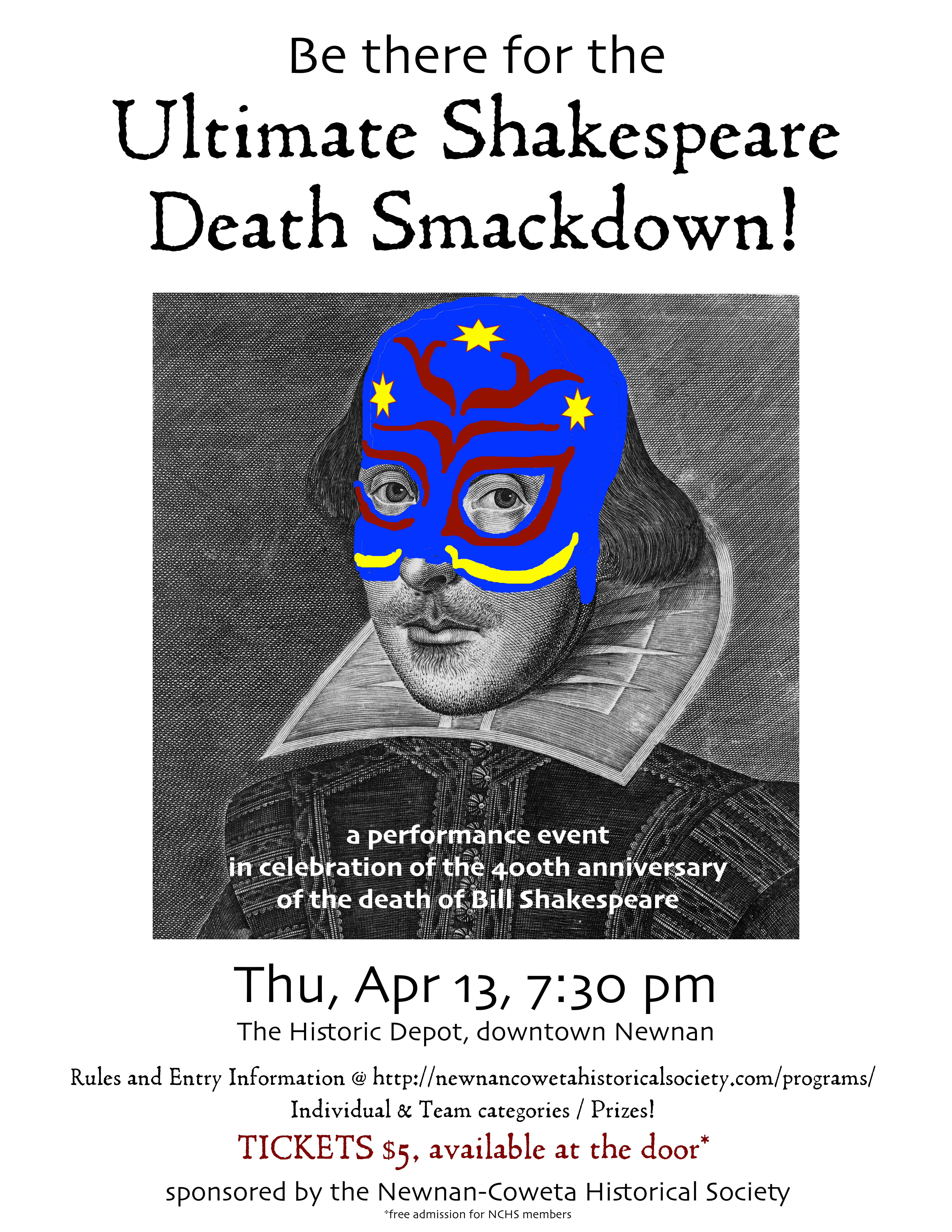
So, last month sometime, a bunch of Lichtenbergians were whooping it up in my living room, and I posited that we really ought to do something for the 400th anniversary of Bill Shakespeare’s death, since we missed the 450th anniversary of his birth two years ago, and now we have this to look forward to:

You find the rules/info at https://goo.gl/sVh9Uj, and the application form at http://goo.gl/forms/8N66OCs2WD.

Now to wrangle the Lichtenbergians into actually getting something prepared.

Interestingly, as I post this as a challenge to various people on the FacePlace, I find myself hesitating to enter into the spirit of the thing and talk smack.  (For example, the original title of this post was ULTIMATE SHAKESPEARE DEATH SMACKDOWN. [bitches], and I chickened out.)  So if nothing else, it will be an interesting acting exercise for me.

Mark your calendars.

A find

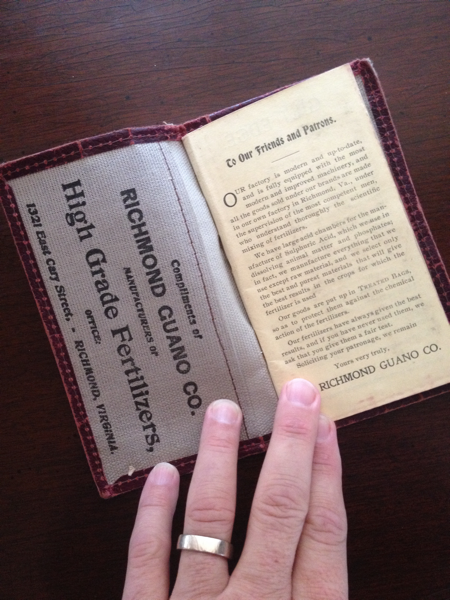
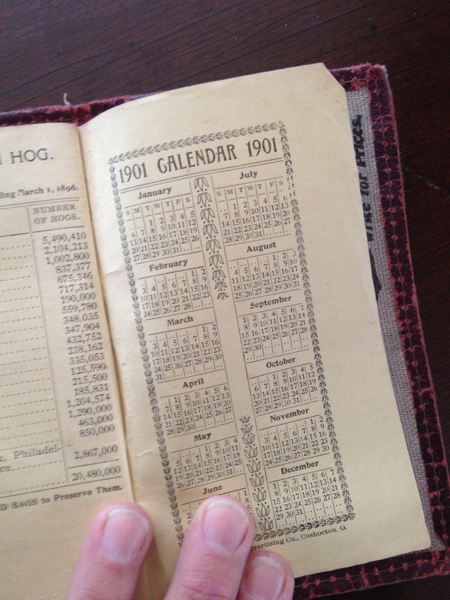
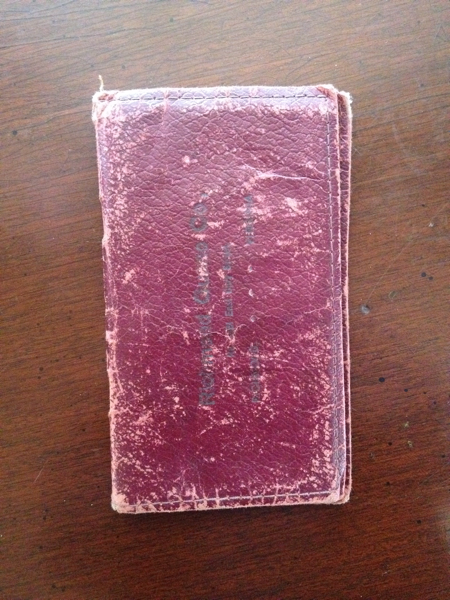
Recently we traveled to Virginia to visit with the in-laws and to continue to help tidy up the old homestead in preparation for an eventual move, maybe perhaps.  One task this trip was clearing out the antique secretary in the living room (not to be confused with the antique plantation desk in the den), which meant looking through the collection of antique books contained therein.  I got an old edition of A Christmas Carol, and this:

What is it, you ask?  It is an actual field notebook, you guys!

For those of you just joining us, I am a huge fan of the Field Notes Brand notebooks, even going so far as to subscribe to their Colors quarterly special editions.  They are just the coolest ever; the recent Winter edition has a pure white cover that turns blue in the sunlight.  (I’ve written about them here and here and here.)

The company tells you on their website that they are paying homage to the old field notebooks given to farmers by one supplier or another as advertising, so when I opened my new find, I knew exactly what I had.

It has a leather cover, and I presume the front was stamped in gold which has faded.  The interior is fabric, cotton or linen, and you can see the stitching near the spine: that’s a pocket, both front and back covers.

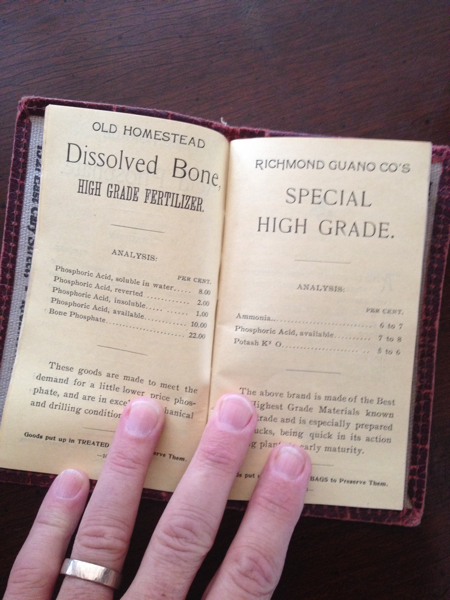
The front pages are ads for Richmond Guano Co’s wares (fertilizers), followed by all kinds of helpful and inspirational platitudes.

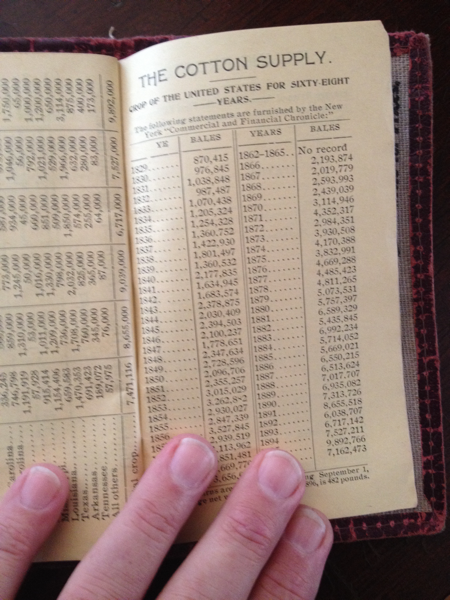
The back pages are useful tables of yields and prices.  And the center…

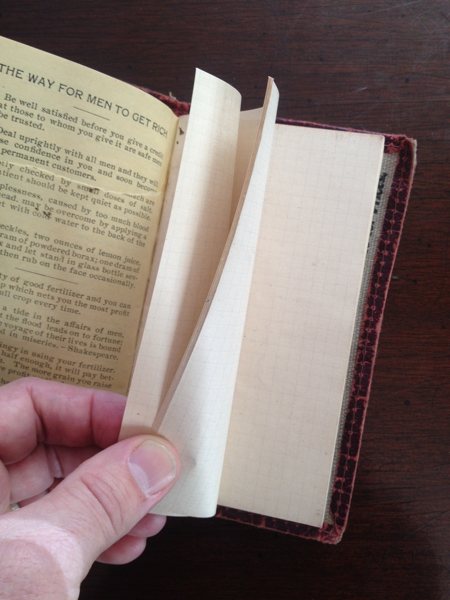
…is the grid paper I’ve come to know and love as one of the papers used by Field Notes!  So cool, you guys!

It is unused, except for the top of that page on the left in the above photo and part of the last page of grid paper being torn out.  And finally…

It’s 115 years old.  Awesome.

Lichtenbergianism: an update

When last we checked in on my progress, I hadn’t actually posted about my progress in writing Lichtenbergianism: procrastination as a creative strategy.

So here’s your first real progress report.

If we posit a length of about 30,000 words—not a very long book—then I’m more than halfway there, having scribbled about 19,000 words.

The structure of the book is as follows:

  1. Introduction to Lichtenbergianism
  2. Framework
  3. Precept 1: Task Avoidance
  4. Precept 2: Abortive Attempts
  5. Precept 3: Successive Approximation
  6. Precept 4: Waste Books
  7. Precept 5: Ritual
  8. Precept 6: Steal from the Best
  9. Precept 7: Gestalt
  10. Precept 8: Audience
  11. Precept 9: Abandonment
  12. The 10th Precept
  13. Conclusion
  14. Appendices
    1. The Lyles Scale of Compositional Agony
    2. The Arts Speech
    3. The Invocation
    4. SUN TRUE FIRE

Also, I have begun and have almost finished an actual book proposal to start submitting to publishers, although first I’m going to run it by a friend who’s an editor with one of them fancy New York publishing houses to prevent self-embarrassmentation.

Having said that, though, I have to say that when I started looking at what I’ve written so far in terms of submitting sample chapters, a lot of it is still misshapen and raw.  Like the chapter on STEAL FROM THE BEST, what is that even about, Kenneth?  I’m thinking that I’ve passed that first gush of creativity and am now starting to hack my way into the real part of writing, i.e., psychic pain.  Physical pain.  Will the Lyles Scale of Compositional Agony apply to writing?  Stay tuned.

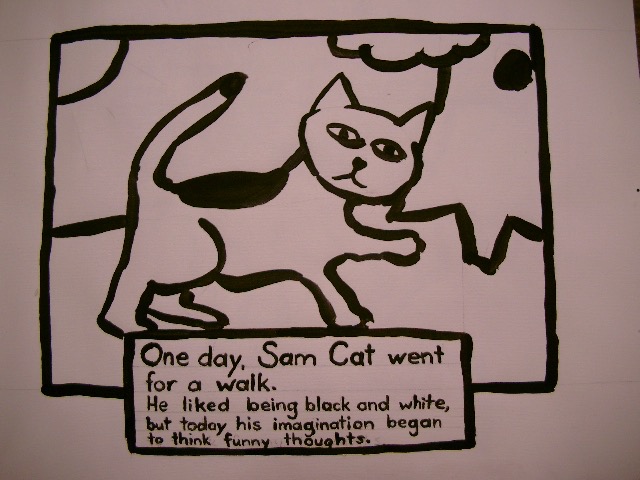
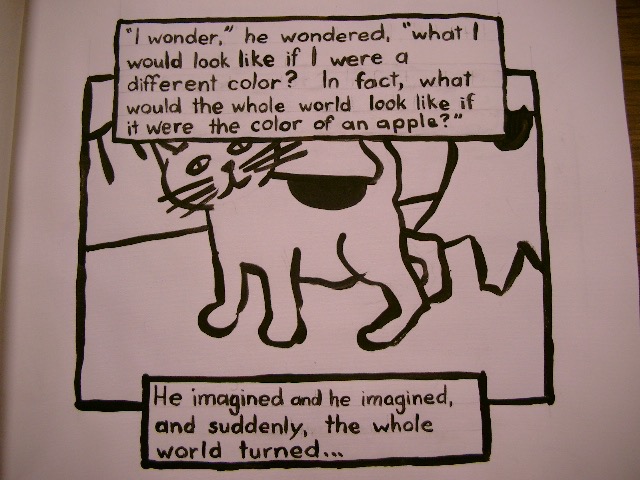
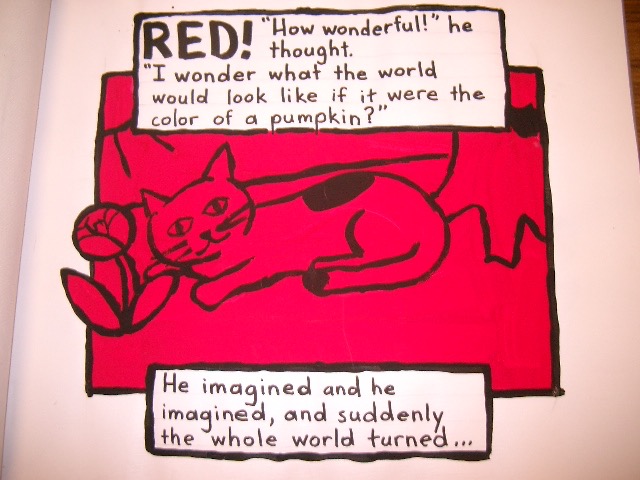
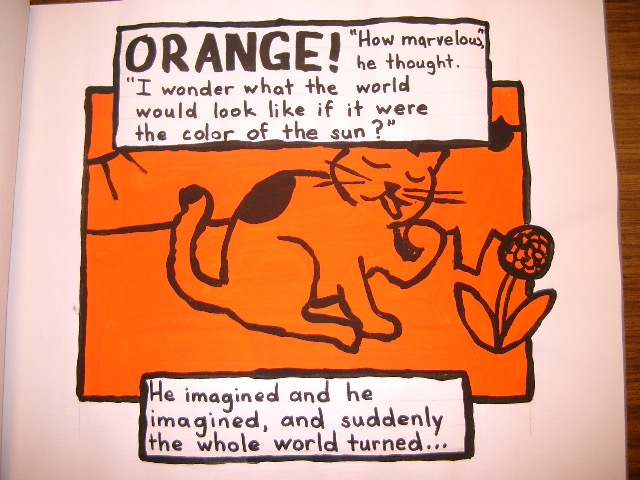
Sam Cat’s Colors

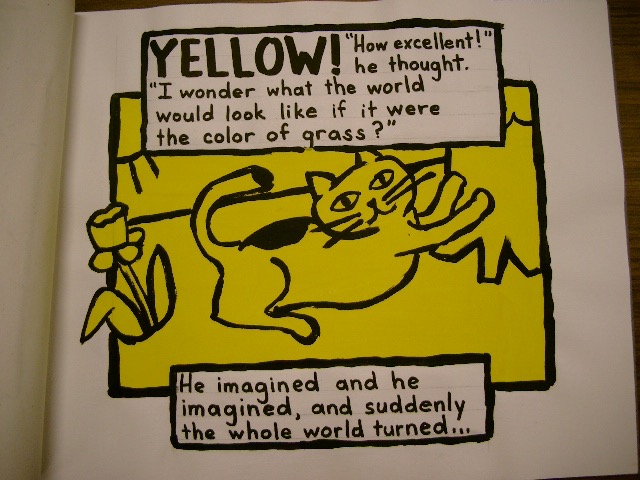
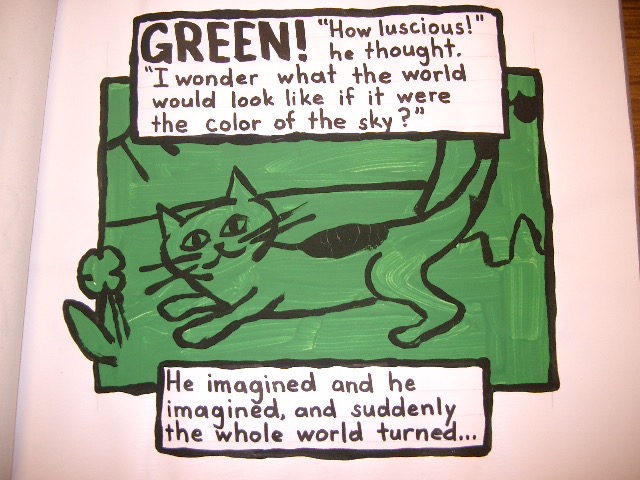
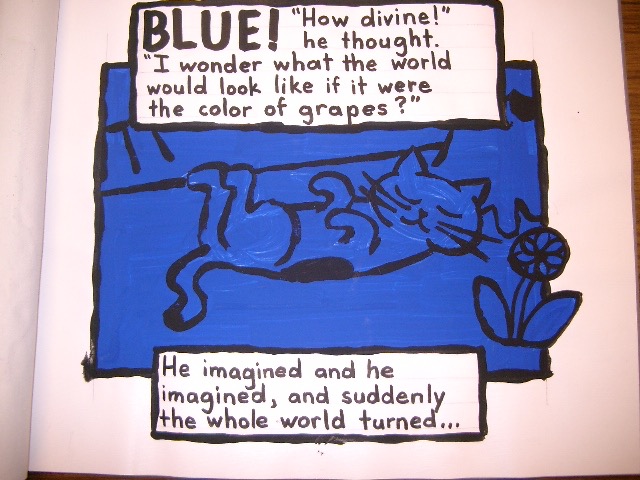
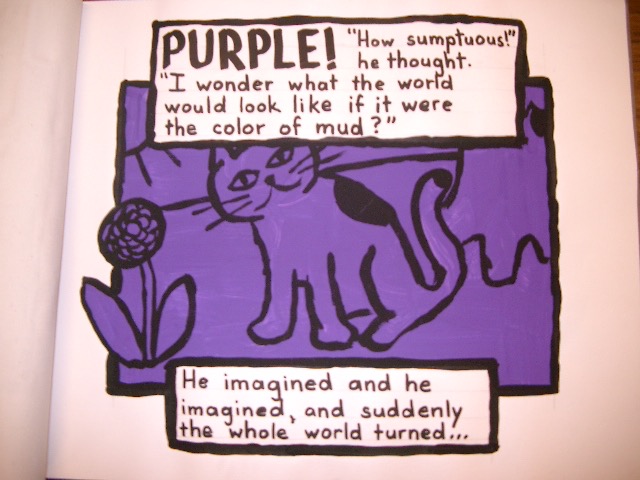
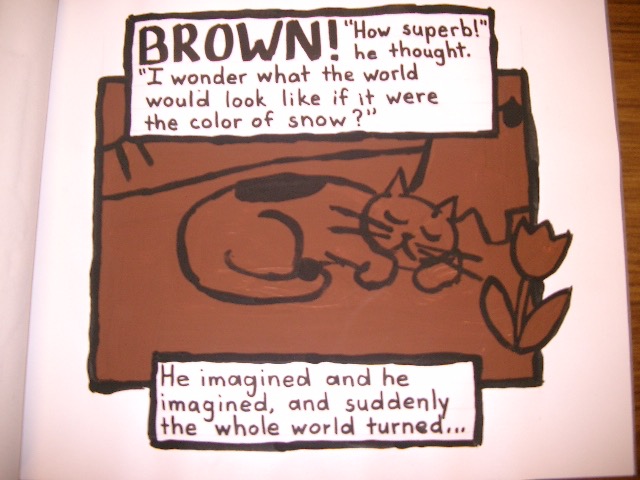
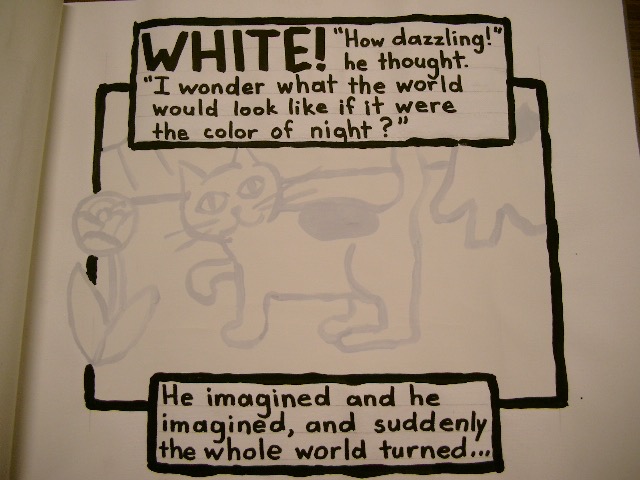
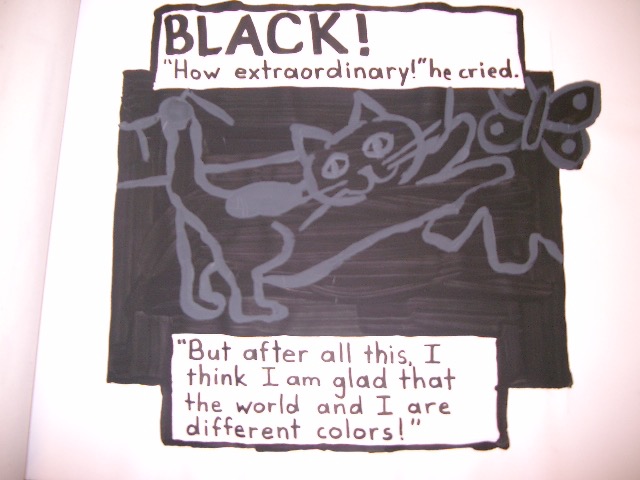
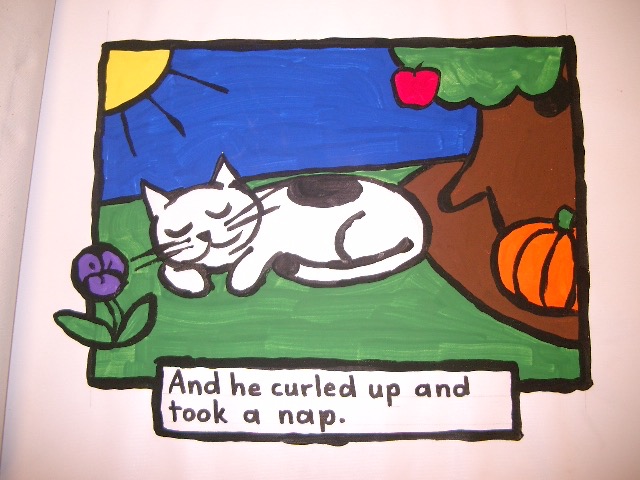
Once upon a time, I had a kindergarten teacher ask me to do a lesson on colors.  So I wrote a book.  As one does.

Today I found all the photos while looking for images of our Successive Approximation of the sunflowers for William Blake’s Inn (to illustrate the process in Lichtenbergianism) and thought it would be fun to show them off.

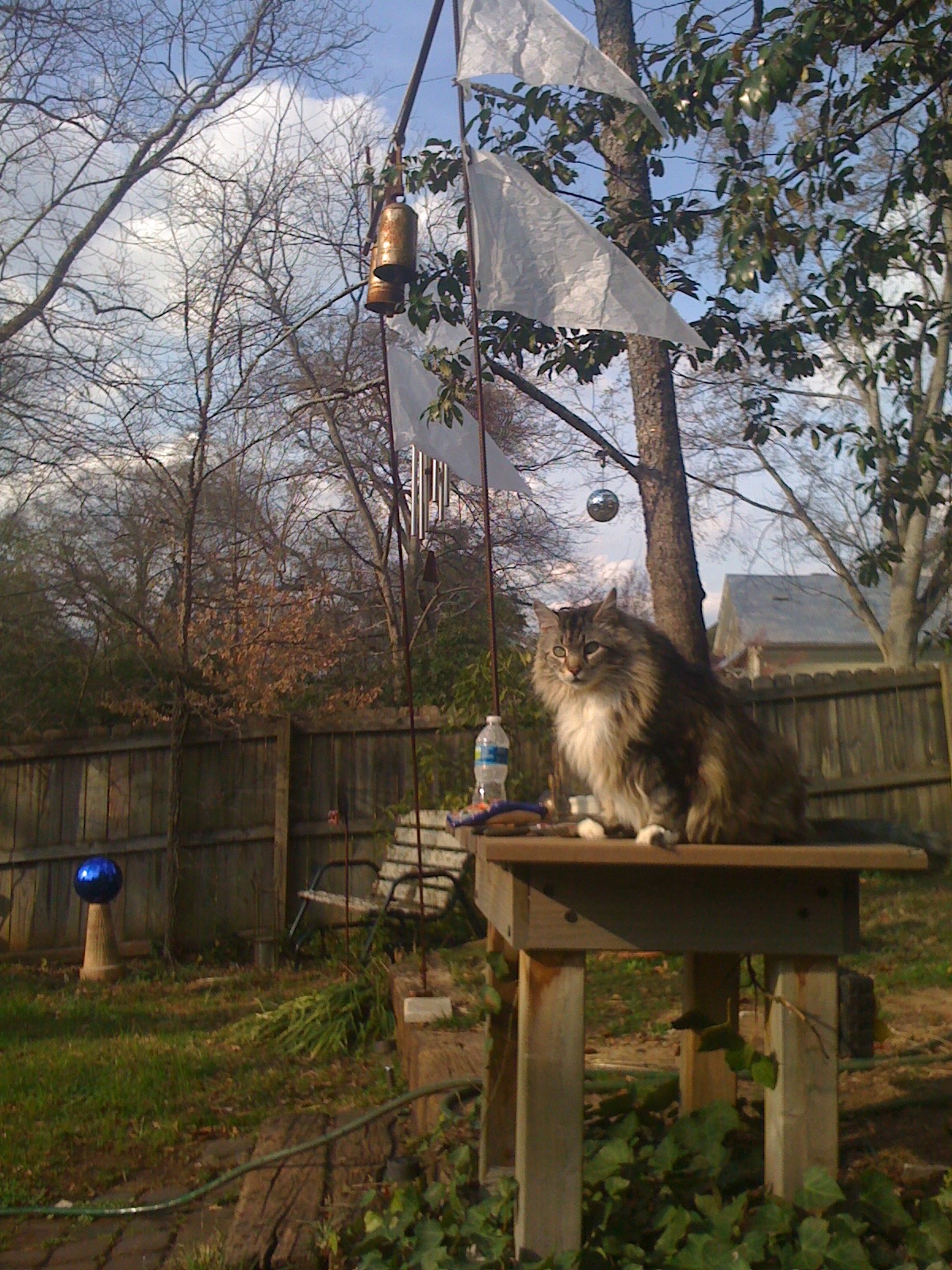
The original used a pad of canvas panels and tempera paint for the brilliance of the colors; my inspiration was my Maine Coon Sam.  I forget how I bound the pages; it may have just been clips on the edge.

—click to embiggen and see Sam in his full glory—

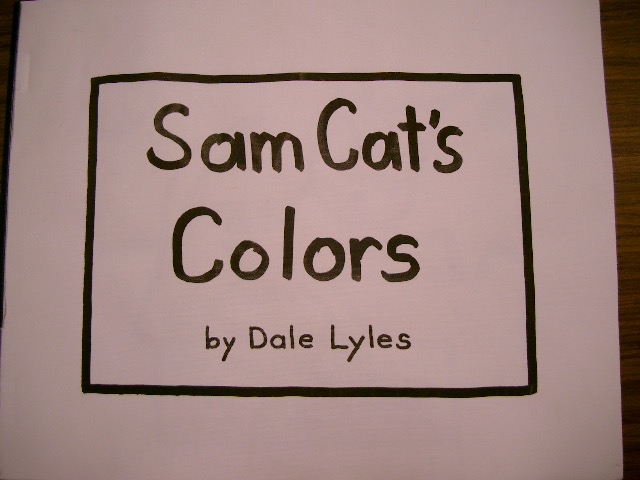
Here’s the book:

The presentation was simple: I’d read a page and at the ellipses would pause to let the kindergarteners guess which color was next.  The book also promoted the idea of imagination—and the attendant alternate realities—as a very good thing.  Finally, there’s the subtle vocabulary lesson of superlatives used by Sam Cat. All in all, a successful lesson I think.

An anniversary

Today is the anniversary of the premiere of Dmitri Shostakovich’s Symphony No. 15, Op. 141, in 1962.

Eight years later, I returned from Governor’s Honors hungry for more: more art, more theatre, more music, more literature.  In Newnan at the time, the most immediate source of a lot of what I wanted was to be found at the Carnegie Library downtown. I’m sure the librarians there were thrilled to see a young patron digging into the more refined corners of the collection with such hunger and avidity; I know as a librarian I would have been.
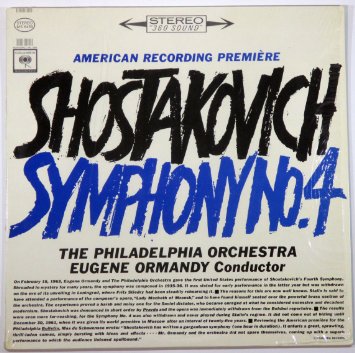
The Carnegie had a small, weirdly eclectic record collection of classical music—about which I’ve written before—and one of the records I discovered was Shostakovich’s Symphony No. 4, a work which puzzles many critics but which I found to be a complete planet of musical ideas.  Since I was simultaneously reading The Lord of the Rings for the first time, the symphony became cinematically linked to the landscapes of Middle-Earth in my mind.[1]

You know how it is when you’re young: like a freshly hatched duckling you imprint on your first experiences, so that Eugene Ormandy’s interpretation of that work remains for me the standard against which all others must be matched.  I moved on to the composer’s 5th Symphony, his most famous, and then I started collecting the man’s works on my own.  He remains one of my favorites.

So you can imagine my excitement when it was reported in my senior year in high school—how?  How did I learn things like this back before the internet?—that he had written a fifteenth symphony, that it had been premiered in Moscow, conducted by the composer’s son Maksim, and that it had been recorded!  I began a waiting game until it was released here in the U.S.
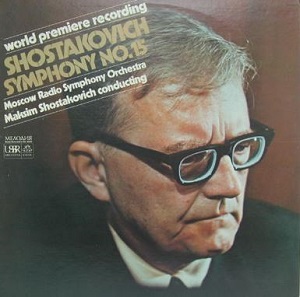
By the time the recording came out, I was at the University of Georgia in my freshman year.  There was a record store on North Lumpkin St., and I checked it religiously until one day, there it was. I wrote my check—I’m telling you, I’m old—and scurried back to the dorm.

Back in the day, O my younglings, music came in these sizable cardboard sleeves with enough room on the back for a great deal of information.  The basis of my knowledge of music history comes largely from those liner notes, as we ancient ones called them.  The liner notes of Shostakovich’s Fifteenth seemed to indicate that the piece was a great puzzle to listeners and to critics.  What was the deal with the William Tell quote in the first movement?  The liner notes couldn’t pin that one down, almost suggesting that it was tacky (as did other critics at the time).  And then the quote from “Siegfried’s Funeral March” from Götterdämmerung in the final movement—was he resigned to his “fate”?

This inability to pin down the “meaning” of Shostakovich’s intent was in turn puzzling to me.  It’s like the reputation of the Fifth, with its final movement of triumphant joy.  At least, “triumphant joy” was the phrase used to describe that last movement, but from my very first encounter with the piece I found that hard t0 believe.  That was not joyful music; it was angry, furious, destructive music.  Why did anyone believe it was “joyful”?

In 1979, after Shostakovich’s death in 1975, Testimony was published.  It purported to be a book-length interview with Solomon Volkov and was immediately assailed by the Soviet authorities as bogus; the jury is still out as to its authenticity and there are strong arguments on either side.  Nevertheless, in it the composer says:

I discovered to my astonishment that the man who considers himself its greatest interpreter [the conductor Yevgeny Mravinsky] does not understand my music.  He says that I wanted to write exultant finales for my Fifth and Seventh Symphonies but I couldn’t manage it.  It never occurred to this man that I never thought about any exultant finales, for what exultation could there be?  I think that it is clear to everyone what happens in the Fifth.  The rejoicing is forced, created under threat, as in Boris Godunov.  It’s as if someone were beating you with a stick and saying, “Your business is rejoicing, your business is rejoicing,” and you rise, shaky, and go marching off, muttering, “Our business is rejoicing, our business is rejoicing.”

What kind of apotheosis is that?  You have to be a complete oaf not to hear that.[2]

Precisely.

Shostakovich’s relationship with the authorities—Stalin in particular—was always precarious.  His Fourth Symphony, my favorite, was pulled from rehearsal shortly before its premiere in 1936 after Stalin was offended by the composer’s opera Lady Macbeth of Mzensk . An editorial entitled “Muddle Instead of Music” appeared in the papers, condemning such modernist garbage.  The opera company closed the production and Shostakovich pulled his new symphony, which did not have its premiere until 1962.  His Fifth Symphony is subtitled “A Soviet Artist’s Reply to Just Criticism.” He kept his bags packed by the front door in case the secret police showed up to disappear him into the gulag; it had happened to others.

So with my first listening to Shostakovich’s new symphony, I heard him saying things that were pretty clear.  The William Tell quote?  The famous rhythm, of two sixteenths and an eighth, is also Shostakovich’s signature rhythm.  He relies on it constantly.  The triteness of the quote?  Shostakovich’s assessment of his own output: “This is what I have produced because of the regime under which I have struggled. Screw you guys.”  (The opening theme of the first movement is the same rhythm and indeed the same intervals as the Rossini.)

The other movements are shot through with references to his past compositions, culminating with that Wagner “fate” motif in the last movement.  There the massive passacaglia harks back to his Seventh Symphony (almost an inverted version of it, in fact), and the whole thing ends as the structure evaporates into fragmentary quotes of the symphony’s main themes, the percussion toys ratcheting out a clockwork reminder of his Fourth, his grandest failed experiment, the path not taken because he was forced from it.

Dmitri Shostakovich was a deeply unhappy, depressed, and grim man—and who can blame him?  He survived when others didn’t, and he kept his artistic integrity even while knuckling under to the despotic regimes of the USSR.  As his life came to a close—he had cancer as well as heart problems—he limned his misery in his final large work.

I raise my glass to him.

—————

[1] It is a tribute to Howard Shore’s genius that his score for the movies surpassed that linkage in my mind. As if Howard Shore’s genius needs a tribute from me.

[2] Shostakovich, D. D., & Volkov, S. (1979). Testimony: The memoirs of Dmitri Shostakovich. New York: Harper & Row.
3 Old Men: The 1000 Commands

One of my 2016 Lichtenbergian Proposed Efforts is to continue my work with 3 Old Men, my Burner theme camp.

For over a year now we have joked about expanding the camp to include a 50-foot square, roped off, with a deer stand at one end where one of us would sit with a megaphone and yell commands at any hippies who stepped into the square.  Well, deer stands are a) expensive; and b) heavy, so we’ve never gotten around to doing it.  (Needless to say, we already have the rope from the old version of the labyrinth.)

But I think getting this idea off the ground is going to be my major 3 Old Men focus for a while.  First of all, we can give up the deer stand idea—just a tall bar chair would do, especially if we put it on a small platform.  So that’s a major hurdle we don’t have to clear.

The second major item on the agenda is what exactly would happen if hippies wandered into the enclosure?  I have a vague idea of contact improv/InterPlay/Twyla Tharp movements, but once I’m sitting in that chair,  what happens?

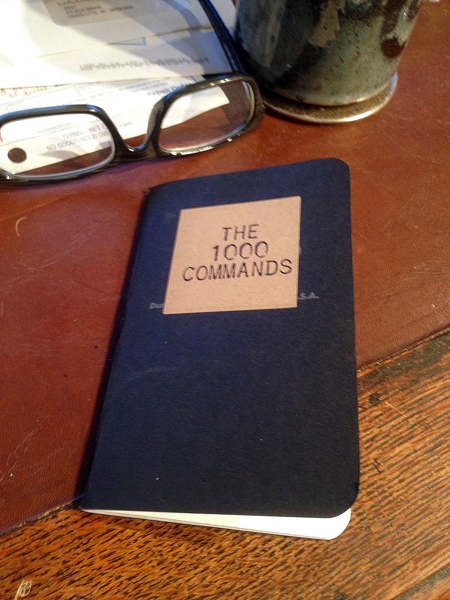
To that end, here’s my newest Waste Book:

When I’m trying to avoid other projects, I can pick this up and start imagining what would be interesting, amusing, or beautiful in the arena.  I also intend to engage the rest of the troupe in the project, probably through a Google Doc.

Also too, I have to come up with a name for it.

Lichtenbergianism: the Nine Precepts

Since I just realized that I have never actually blogged about the Nine Precepts of Lichtenbergianism, I shall do that now. (I have mentioned them once, but gave no explanation of them.)

As I explain in the upcoming Lichtenbergianism: procrastination as a creative strategy, these Precepts spring from a seminar some fellow Lichtenbergians and I gave at GHP in 2013.  In preparing to sit in what turned out to be a crowded room and to discuss how putting off doing any work had actually made us more successful creators, I boiled down our experience to nine keywords.  In the seminar, we simply threw each term up on the screen and then all shared how they affected us as artists/teachers/programmers/veterinarians.

Here are the Nine Precepts:

  1. Task Avoidance: Obviously. Cras melior est.
  2. Abortive Attempts: Give yourself permission to create crap.  Lots of crap.
  3. Successive Approximation: Give yourself permission to change what you’ve done.
  4. Waste Books: Create a system to record your ideas willy-nilly.  Sort them out later.
  5. Ritual: Find ways to make your work flow.
  6. Steal from the Best: Pay attention to the past, learn from it, then run with it.
  7. Gestalt: Look at your work and see what’s there and what’s not there, what needs to be there and what needs to be not there.
  8. Audience: Have someone in mind.
  9. Abandonment: Give up.

There’s a lot more complexity to these ideas, of course.  I discuss that in the book.  Reserve your copy today.  Or tomorrow.