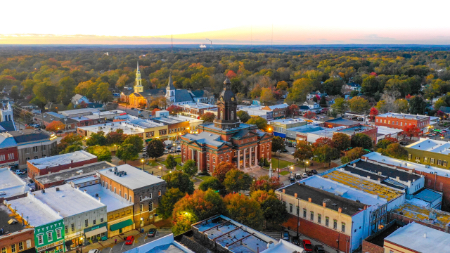
I live in my hometown of Newnan, GA, in Coweta County. (Yes, that Coweta County.) In fact, I live two blocks from the historic Court Square in a beautiful historic neighborhood filled with lovely homes and lovely neighbors. It’s a great place to live, with vibrant social and cultural communities. Like most cities in the past, it was laid out in a grid that rapidly dissolved at the edges. Hold that thought.
The explosive growth of Newnan and Coweta County has become a topic of concern, mostly because of the increased traffic. It can get gnarly out there multiple times a day, so I thought I would provide some hippie-woo perspective on the problem and at least one solution, even it’s not an easy one.
First of all, City of Newnan, if that is your real name even, I think y’all should have a retreat and read through A Pattern Language together. You might even consider someone who is familiar with the concepts in that tome to help you figure out What It All Means and how it might help you in keeping our fair city a fabulous place to live.
tl;dr: A Pattern Language is structured through 253 “patterns” that the authors derived from their examination of land, cities, streets, homes, public spaces, all the way down to individual rooms, that seemed to work for the people who live there, all around the world. As it says in the Wikipedia article linked above, “Patterns describe a problem and then offer a solution. In doing so the authors intend to give ordinary people, not only professionals, a way to work with their neighbors to improve a town or neighborhood, design a house for themselves, or work with colleagues to design an office, workshop, or public building such as a school.” (The “walkable city” movement springs from the concepts in this book.)
What does this have to do with traffic congestion in Newnan, GA? A lot.
A couple of decades ago I suggested to the city manager at the time — based on my experiences with Pattern Language — that we should build a main road between and parallel to two existing main roads, Bullsboro Drive/Hwy 34 and Lower Fayetteville Rd, as well as connecting roads. In other words, lay out another grid.
Eventually, the light went on in someone’s brain, and we now have the Macintosh Parkway extending from downtown out to City of Hope, our regional cancer treatment center.
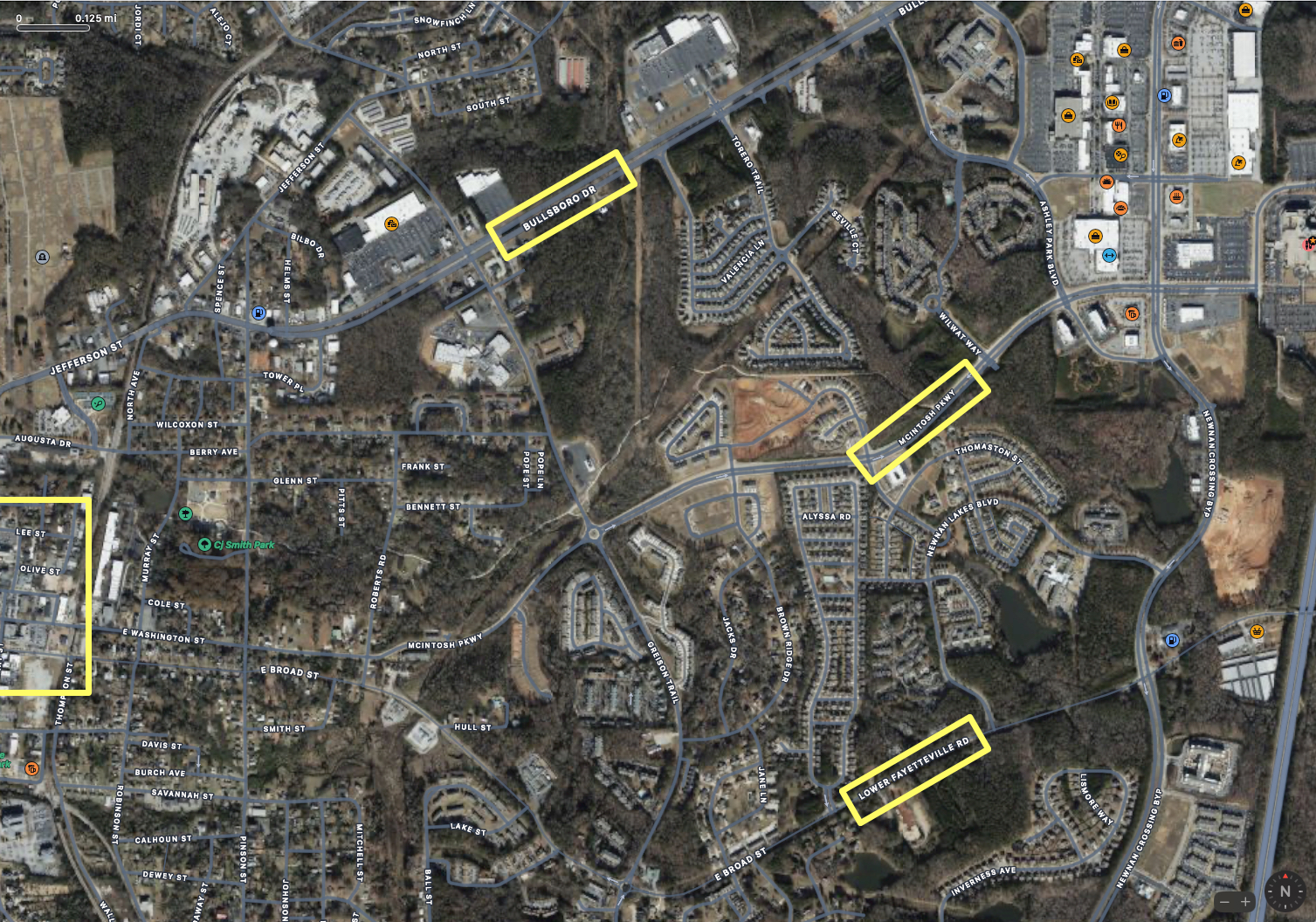
You know what we don’t have? Any new cross roads connecting the parkway directly to the other two main arteries. (There is sort of one there in the lower left, but it’s all twisty roads, not a straight grid. In fact, I drive both Macintosh Parkway and Lower Fayetteville Road multiple times a week, and I was completely unaware of that cross road until now.
You know what we do have? Multiple (and an increasing number of) subdivisions with at most two exits onto the main artery.
And here’s what brought this blog post into being: This morning I needed to run a couple of items to the dry cleaner, which is a four-minute drive from my house.
Usually.
Today, I decided that rather than drive to the end of my street and have to deal with turning right onto a main artery and then facing an immediate left turn — I was in a mood — I would simply drive over to one of the two main downtown streets , crossing over Jackson Street over to Jefferson Street and just zip up past the Dairy Queen, etc., a route didn’t require me to deal with oncoming traffic.
However, when I made the first right turn to head over to Jefferson, there was a cop car, blue lights going, blocking Jackson St. Hm, I thought, no problem. I made a right turn, then a left, but there was another cop car blocking Jackson St.
Of course: Today was the Juneteenth parade, and they were blocking cross traffic from the parade route.
Again, not a problem. I simply went back to my neighborhood and went through the grid and circled back to the cleaners. And to get home, I circled back in an even bigger loop, mostly because I had nothing pressing waiting on me at home and I wanted to see what my childhood neighborhood looked like these days. (Nearly 50 years after I moved out of my parents’ house, the trees are gorgeously bigger.)
Now imagine having a parade on Lower Fayetteville Road. How many subdivisions would have to stay put at home until the parade was over and Lower Fayetteville was clear before they could run an errand/go to the doctor/etc.? Some have twisty-turny paths they could take, but some don’t even connect through to the next subdivision for an escape route.
And now you understand why traffic can get so bad on those three main arteries: There are no capillaries connecting them. All those cars must pour on to those three main arteries — and onto the main arteries that do cross those three — whereas unless my street is shut down — I’m looking at you, PorchFest, Halloween, etc — I can get almost anywhere in town multiple ways.
Is this pattern an easy solution to our traffic issues? No, but the usual practice of adding lanes to existing arteries is not a long-term solution. There’s a reason our bodies need capillaries, and our cities have that same need for the exact same reason.
You can read/download a copy of A Pattern Language here.