Dream One… done

So, Dream One is done.

Not really, of course, but for the moment let’s pretend that I have actually finished composing the first scene of the new opera, Seven Dreams of Falling.

It took me a moment to realize I was through.  Honestly, it was like finishing a New York Times crossword puzzle that has resisted solution: you push and pull and step back and plunge in, and then finally you realize what the last few letters must be and you write them in, and then you’re done.  No great “aha!” moment, no feeling of reaching a summit or crossing a finish line.  You’re just done, almost unexpectedly.

Still, I’ll take what sense of accomplishment I can scrape up.   Whatever its weaknesses, it’s done, and I think there are some very strong moments in it.  Baritones will curse my name if they have to sing Theseus, whose opening aria takes them right to the top of their range and a little beyond, but everyone else should have a lot to please them.

What’s next?  Scott is working on the text for Dreams Two, Three, and Four, and in the meantime I could begin orchestrating Dream One.  I have a bit of a concern that I’ve not been thinking in orchestral terms, and that may be an issue when it comes time to get rid of the piano.  However, the same was true of William Blake’s Inn, and it turned out just fine.  The main thing will be deciding what orchestral forces we’ll need.

Side note: I just checked the instrumentation of Finale’s “full orchestra” template, and it seems a bit odd to me.  No English horn, but an E-flat clarinet.  Trumpet in C (2)?? I can understand not having saxophones, perhaps.  No bass trombone.  Percussion is timpani and “percussion.”  None of this is a problem, of course.  I just have to decide what I’m going to use and then create a new template from that.

For comparison, here is the orchestration for Anna Nicole:

  • 3 flutes, including one player doubling on piccolo and alto flute
  • 3 oboes, with two doubling on English horn (that’s a lot of oboe shrillness right there)
  • 2 clarinets, doubling on bass
  • 2 soprano saxes
  • 2 bassoons, one contra
  • 4 horns, 3 trumpets, 3 trombones, 1 tuba
  • timpani
  • percussion:vib/marimba/t.bells/wdbl(sm)/tamb/metal bar/wooden cube/guiro/tpl.bl/tgl/claves/h.bells/brake dr(lg)/SD/quica/bongo/TD/BD(lg)/susp.cym(lg)/2gongs/tam-t(lg) (I’m not unpacking that for you.  TL;DR: lots of stuff to bang on)
  • harp
  • piano/celeste
  • strings(8.8.6.6.4)
  • Jazz ensemble: elec.gtr(=banjo,mand)-elec.bass(=mand)-drums.

That lineup is close to what I’ll end up with, other than not needing that many oboes or bangable items, or the jazz ensemble.

When I start orchestrating, you should expect changes in the piece, some of them quite significant.  What happened with William Blake’s Inn is that when I started breaking up the piano accompaniment, I would hear opportunities for embellishments and counter-melodies that are not possible with ten fingers on a keyboard, and suddenly the piece would sound quite different.  You can cover a multitude of joints with the spackling of strings.

So, onward!
Dream One, “Hark the sound of screaming fans!”

We’re just going to let this sit here for a while and annoy us.

Dream One, 4a. “Hark, the sound of screaming fans” | score [pdf] | mp3

In other news, I watched the Royal Opera production of Anna Nicole, music by Mark-Anthony Turnage, libretto by Richard Thomas.  You can find videos here, and the entire production via Amazon Instant Video.  Oddly, the show  has not been recorded.

It was quite entertaining—the music was likable and fun if not exactly hummable, and the production values were beyond excellent.  Costumes were incredible, and hats off to director Richard Jones.  And Eva-Marie Westbroek must be seen to be believed as the ill-fated Playboy bunny—she is simply amazing from beginning to end.  The rest of the cast was right behind her, too—do you know how mind-blowing it is to see a perfect replica of Texas trailer trash on an opera stage?  Great, great fun all round.

Dream One, “Hark, the sound…” — moving on

I did the sensible thing this morning: since I can’t make up my mind about Theseus’s little gigue bit, I just skipped ahead to where I was surer of what I wanted, mainly because I’d already written it.

After a little repartée between Theseus and Daedalus, Daedalus starts riffing on his machines again, so I knew we’d pick up the “machine music.”  Oddly, Daedalus continues his lilting 3/4 time over it.

Finally Ariadne enters, we get a few cheap laughs at her expense, and when the boys try to exclude her by picking up the gigue theme again, she busts a nut, leading into her “My mother spoiled and pampered.”

From there to the end of the Dream, we’re good.

No samples today because it’s all just pretend notes right now.  I’ll have to work on them some more before they become real.

Spoiler alert: the fact that T & D return to the gigue theme means that I probably am going to settle for that.

Nancy Willard

Tomorrow is Nancy Willard’s birthday.  (It’s also my son’s birthday, and that of my first girlfriend.  Anybody else?)

One of the greatest regrets of my life is that I have been unable so far to get William Blake’s Inn produced.  Nancy is such a phenomenal writer and artist, but more than that she is such an unbelievably warm and supportive human being that she deserves to have this work staged and performed all over the country.

When I asked her for permission to set her Newbery Award-winning book to music in 2003, she did not hesitate.  As a creative master, she was unafraid of what I might do to her “child”; indeed, she eagerly anticipated the completion of each song and has remained the work’s biggest fan.

In a perfect world, we would be able to workshop William Blake and then give it a full staging—soloists, chorus, adults, children, puppets, projections, orchestra—and present it along with an exhibit of her related artwork.  (She actually built the Inn out of cardboard.  It’s with all her papers at UMich/Ann Arbor.)  And then we would take it on the road to share with the rest of the planet.

I may be exploring new territory with Seven Dreams of Falling, and my magnum opus of SUN TRUE FIRE may be my future towering work of genius, but William Blake’s Inn will always be my favorite child.

To our children we shall say
how we walked the Milky Way.

(If you haven’t before now, go listen to the Epilog.  It is probably the best thing I will ever write.)

Dream One, “Hark”—really abortive attempt

Now that my doctor has transitioned from suggesting I might benefit from moderate exercise to insisting that I walk two miles every day (within 30 minutes, YOU GUYS!), I have the opportunity to listen obsessively to my work on Seven Dreams of Falling.

Thus it was that as I slogged around the park this morning I found myself really enjoying “Hark, the sound of screaming fans” as an entirely fun piece of bravado.

Which is why I set myself the goal of ditching it and writing something else.  I cannot shake the feeling that an audience of any sophistication would sneer at this snarky little tune.

side note: I’m having issues about melody.  On the one hand, I despise modern opera’s avoidance of a good tune.  There’s a reason why we keep scheduling the Top 40 years and years after their premieres and more modern pieces... not so much.  (For the record, I would love to hear and learn from each and every piece mentioned in that article.)

On the other hand, maybe it’s because of my lack of talent, but I don’t think bits like “Hark” are very strong.  It seems lazy to plop something in there just because it’s hummable.

Oh, who knows?  My inadequacy, my fear of not being thought one of the “cool kids,” or is it all just fine?  Discuss in comments.

So I wrote another version of “Hark, the sound of screaming fans.”  Not the whole thing, just the first two lines.  I’m not happy with it either.  It’s definitely got Theseus’s smarminess down, but if anything it’s even weaker musically than yesterday’s version.

Maybe I’ll keep pushing, writing ever more strenuously for voice and ear until I have something at which the cognoscenti will nod knowingly.  Or maybe I’ll just leave the gigue where it is.

Dream One, “Hark, the sound of screaming fans,” 2nd version | score [pdf] | mp3

Dream One, “Hark…”

I found a solution for the cheesiness of Theseus’s opening aria, and that is MOAR CHEEZEENESS YOU GUYS!

Seriously: I abandoned the lame attempt at polytonality in his first phrase and settled it into straight harmony, and then extended the first verse.  So now we have a full-on huckster approach, a kind of in-your-face/dare-you-to-diss-this-throwback attitude.

I’ve moved on to Daedalus’s objections, which will be in a kind of waltz mode over Theseus’s 9/8 gigue.

Dream One, “Hark, the sound of screaming fans” (06/24/14) | score [pdf] | mp3

Dream One: “Hark the sound of screaming fans”

I posted on Facebook how frustrating it is to compose something that is perfectly cromulent but which you know is not the solution to the problem, and after losing a whole week to grappling with Theseus’s first appearance, I was ready to slap down anything.

So I have.  It’s silly, silly stuff with a couple of good bits, but really, can you hear this being performed on a modern opera stage?  The faux-Baroque bit is too much to begin with, and now this lame bel canto?  I think it gets Theseus’s hucksterism right, but it’s just so unsophisticated.

But here it is.  Scoff in the comments.  I’ll be over in the corner working on a replacement.

Dream One, “Hark the sound of screaming fans” | score [pdf] | mp3

Dream One, “Hark, the sound of screaming fans!”

I’ve settled down to work on the remaining bit of Dream One, i.e., the section that follows Icarus’s “I am alone.”  In it, Theseus reveals himself as more of a showman than a hero; Daedalus is practically a monomaniacal technocrat; and Ariadne… well, Ariadne has issues.

Mostly today I’ve tried to parse the text and decide what it is that the music needs to be telling us.  I did some work on getting from the “machine music” scene change into Theseus’s opening lines, but now I’m doodling on the main theme of his number.  I think on the whole we need to hear some kind of lounge lizard or advertising jingle in his aria, but that’s going to take time, because after Daedalus interrupts whim with some priggish rebuttal, I want that theme to return for the bit of stichomythia between Theseus and Daedalus.

That in turn will be followed by the machine music (lightly), and then Ariadne, eternal feminist spoilsport, pipes up.  From there it’s just a short jump to “My mother, bored and pampered.”

Short version: I piddling around trying to invent an advertising jingle for the Event.

And I won’t have it done by the end of the week.

Patio progress

No musical updates today—I slept poorly and my brain just wasn’t in the mood to create whole universes this morning.

Fortunately[1] I could still be useful by helping with The Patio, Part II: The Harlequinading.

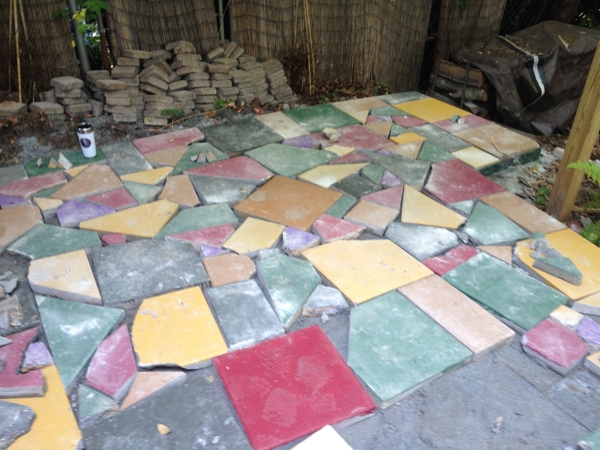
This is what we had at the end of yesterday:

To the untrained eye, this might appear to be harlequinadesque, but we (Cow-Tip, Squirrel, John, and I) were informed that it was in fact patchwork.  We didn’t want patchwork; we wanted harlequinade.  European farmland, not Kansan.

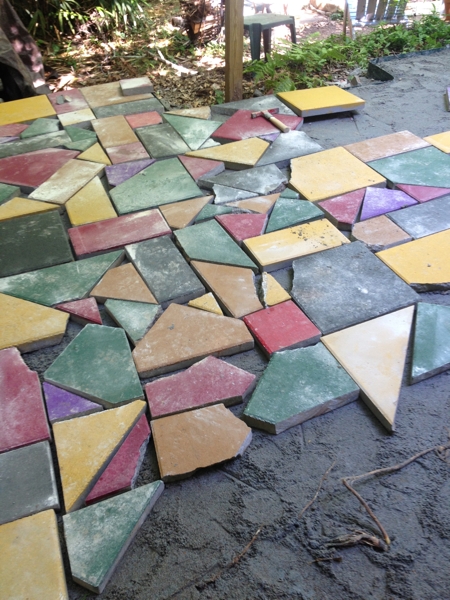
So this morning, I rearranged the above patch into:

I was gratified to learn that this was in fact what we wanted.

As of lunchtime today:

We have run out of pavers, so those have to be purchased and painted before we can keep working.

Maybe I’ll get back to Theseus and his boosterism tomorrow.

And happy 36th anniversary to my lovely first wife!

—————

[1] for differing values of “fortunate”

Dream One, two new pieces

Don’t everybody get over-excited, but today we have two new sections of Dream One.

Lest you think that I was super industrious over the weekend, remember that I had worked on both of these all last week and only had the ending of each to hammer out.  Still, it is impressive, isn’t it?

The first is our old friend, Ariadne’s “My mother, bored and pampered.”  I had to work out her last phrase, “We map this fate forever,” in which I wanted Theseus to join her in a gentle lament.  I think it works.

Astute listeners will hear that I radically revamped the accompaniment to Ariadne’s climactic “I loved you—I love you!”  It’s very effective in a maudlin kind of way, and I’m wondering if it’s too Broadway.  Or am I forging new paths for La Scala?

The second new piece is the closing of our first Dream, “What of us?”  It starts with Daedalus reminding Ariadne that he too was trapped there, along with Icarus.  The music references “Fly and fall,” and then segues into the “machine music” motif as our trio retreat to their personal concerns.  (I am reminded of Sweeney Todd, where Sweeney and Mrs. Lovett often sing at cross-purposes, he of emotions and she of commerce.)  From there we reprise the opening chorus, “Let us joyfully gaze.”

On the whole, I’m quite pleased.  Next up: the beginning of this last segment of Dream One, transitioning from Icarus in the sky down to the control room.  It’s not a short piece of text, so this may take all week.  However, when I finish this, DREAM ONE WILL BE FINISHED, YOU GUYS!

Dream One, “My mother, bored and pampered” | score (pdf) | mp3

Dream One, “What of us?” | score (pdf) | mp3

Do not let me forget that I have to work out the “falling” motif.