I got nothing. Leave me alone.

No, I didn’t get anything done yesterday.  I spent the entire morning on the phone with tech support trying to figure out why every component of the network was functioning properly and yet I couldn’t get onto the internet.

The more cynical among you—and you know who you are—will suggest that not having internet might allow for more productivity, but screw you.  It is actually crucial to my process that I delete emails from ASCD and Al Franken every 20 minutes.

We still don’t know why nothing worked and yet everything worked.  Very Zen.  Eventually we restarted everything enough times and in the right order that presto! I was able to wish people a happy birthday on Facebook.

In other news, I’ve decided to skip the end to Ariadne’s “My mother” bit and whack out the end of the scene, since it’s just recitative and a reprise. And I’m not likely to get much done there today, either, because yesterday my iPad fell flat onto the floor in the black box at the theatre, and shattered the screen.  A trip to the shop is required.  ::sigh::

Dream One, “My mother”

So here’s the next little section of “My mother, bored and pampered.”  I abandoned my interpolated text—although I reserve the right to come back and stick it in.

I’m posting this today even though I’m not sure I like any of it.  Some adventurous harmonies, but my compositional strategy of “listen to it over and over until it makes sense” may have failed me this time.  Will a conductor and cast take the time to understand it?  Does it in fact make sense musico-dramatically?

Oh well, unlike The Bridges of Madison County, this is not going to lose anyone millions of dollars, so I shall post it and then circle back to it later.

Dream One, “My mother,” 06/10/14 | score (pdf) | mp3  (The new stuff starts at about 1:10.)

Next, a little coda in which Ariadne and Theseus have a bittersweet duet, closing out that bit.  Then a bit of recitative from Daedalus, and then our “tinker-toy” theme kicks in to take us out to a reprise of “Let us joyfully gaze.”  Sounds simple enough.

Dream One, “My mother, bored and pampered”: some progress

When last we left Ariadne, she was explaining how

  • her mother had sex with a bull
  • the resulting Minotaur, her half-brother, was put into the labyrinth
  • all of which is Daedalus’s fault

Today we get a little more: Theseus mentions his part in slaying the Minotaur, and Ariadne throws it in his face that he couldn’t have done it without her telling him the secret of getting in and back out again.

From here, I think we’re going to get a little interpolated text, just a little something for Ariadne and Theseus to sing before she launches into her I LOVE YOU DAMMIT bit.

I would like to state for the record that the piddling amount that is new in today’s selection represents days of my writing stuff that went absolutely nowhere, and you will notice that Ariadne’s last bit is still in the boogie-woogie style we started with.  Next section, pretty music.  I swear.

Dream One, “My mother, bored and pampered” | score (pdf) | mp3

Treading water

Here in the fourth scene of “Dream One” of Seven Dreams of Falling, we have Ariadne leading the way in a rather expository passage, i.e., the background of the Minotaur myth.  As she and Theseus trade pointed viewpoints about their roles in the story, it seems to me that we might want some kind of operatic give-and-take, if not an outright duet.  And it might still be an outright duet.

I can’t tell at this point, given that I’m treading water with the passage.  I have put a few tentative notes up on the screen, but nothing is appealing to me or making sense yet.  (For those who don’t know, I work in files that are labeled ‘Abortive Attempts,’ i.e., “4. Hark, abortive attempts,” where I simply abandon stuff that doesn’t work, insert new measures, and keep going.  Often I will find later that some of the abandoned material fits right in with the stuff that works.)

So nothing to report today, music composition-speakingwise.

Well, this was unexpected… and ADORABLE!

So I’ve been roped into teach a weeklong workshop down at Newnan Theatre Company—thanks, Robbie Kirkland—for middle schoolers.  The ostensible topic is “character development,” and the theme is “Villains.”  Bwahaha, and all that.

Actually, not bwahaha at all.  It’s “character development,” and I’m not spending a week teaching kids how to twirl their mustaches.  Just the opposite in fact.  We’re going to develop two villains each, one Disney-esque/cartoony, the other “real life,” e.g., the mean girl at school, the snotty boy down the street, etc.

Mainly we’re going to learn that none of these people think they’re evil.  They just want certain things and they have their own ways to go about getting them.

Anyway, we spend Monday through Thursday working on material, and then on Friday is the obligatory show for the parents.  It will be interesting to see what we come up with.  (Panel discussion about public misperceptions? The Dating Game?  The mind boggles.)

I got home from our meeting at the theatre, and for some reason the idea of an opening number just seized me.

Presenting, “Not Really Bad: a song for villains,” words and music by Dale Lyles | score (pdf) | mp3

It is totally adorable, you guys.  (And yes, 3 hours start to finish—how kind of you to ask.)

One of those days

Yesterday I was sleep deprived from my torn rotator cuff bugging me all night, and I was so zombified that I didn’t really get any composing done.  I took a stab at it, but the results are more than likely not going to survive.  I’m piddling away at the text today, and my main struggle is deciding where Ariadne is heading in this section.

First instinct is to sustain her caustic bitch act.  Second instinct is to let her reveal how much she really loved Theseus and expected to live happily ever after with him.  I’d also like to show Theseus’s ambivalence about this history.

In other words, time for some pretty music.

More work is required.

Dream One, “Hark, the sound of screaming fans” – a fragment

I’m taking my time with this scene, so don’t expect a lot of results right away.  Of the fourteen pages of the libretto for “Dream One,” six and a half of them are the control room scene.  So it’s long and it’s complicated, and it’s going to take a while to nail down.  (I’ve already tackled part of it, in Ariadne’s bit about her mother.)

Today I just began throwing notes around to see if I could develop anything that might be useful later on, and actually I think I have something.

I’m thinking of it as my “machine” fragment.  There are two segments of the scene where the characters offer competing views of what their machines are for, one of which leads into a reprise of “Let us joyfully gaze” with the chorus.  Besides those two segments, I could use the motif to transition from Icarus’s aria into the control room, i.e., scene change music.

At any rate, I succeeded in whacking out nearly 30 seconds of music, which is not bad for a shortened work session this morning.  It’s something to play with.

“Machine fragment” | mp3

It occurs to me that I have yet to let loose with a waltz of any sort.  Hm.

An artifact

My lovely first wife returned from Virginia recently with another box of old stuff from ancestral sources, and one of the items was an ancient music notebook.
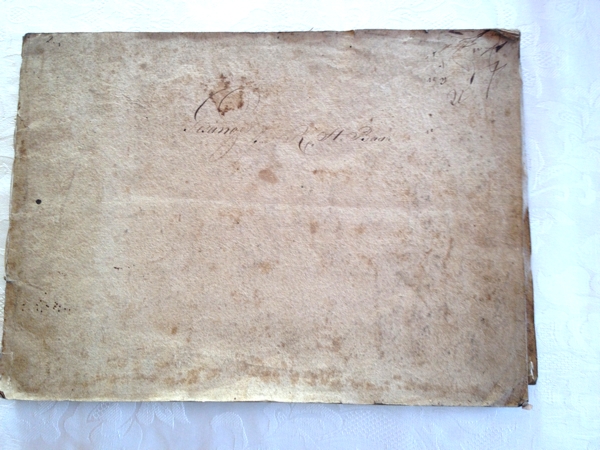
It’s 12″ wide x 9″ tall, and everything in it is completely handwritten.  It seems to be two notebooks bound together.

Here’s what is written on the cover:
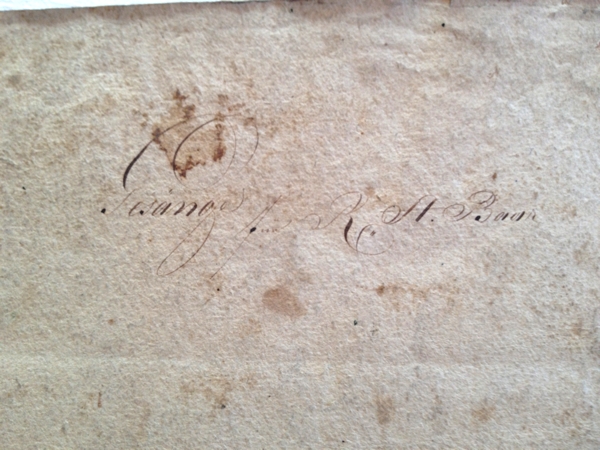
“Gesänge für R. A. Bxxx.”  “Songs for R. A. someone…”

There is no date anywhere in, and it’s all in German.  There are two pages which seem to be lyrics, written in the same beautiful hand, and one of those is in French.  The lyrics page in German is almost completely illegible.

There are two songs and around twenty piano pieces, all dances like galops, waltzes, ländler, and polkas.  There is a set of five contradanses near the end.

There are many blank pages.
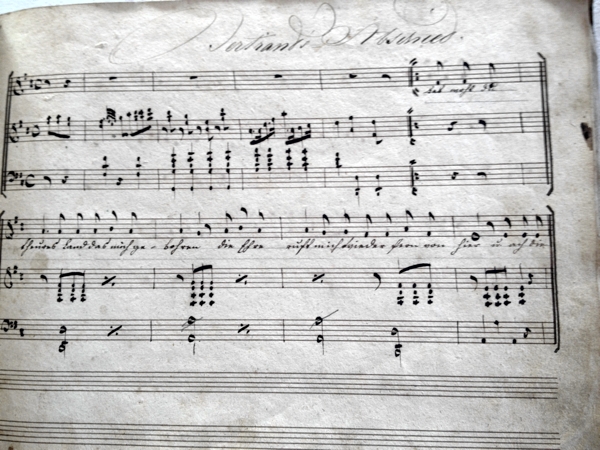
Titles, if present, are written in either the florid script you see above or some neatly penned fraktur script.

I have not yet played through the book yet, but a cursory glance reveals no overtly famous pieces.  None of the pieces are attributed to a composer.  There are more than a few corrections in pencil and in ink.

So is this a copybook that someone was making for a friend or loved one, or is it like Bach’s Notebook for Anna Magdalena, original compositions?
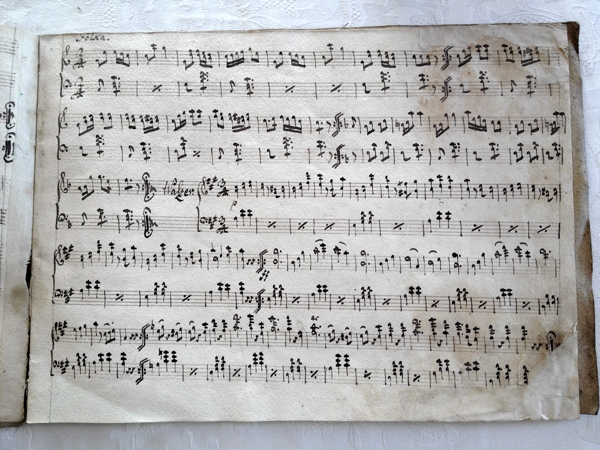
I’ll report back if I find anything interesting.

update:

One of the pieces was titled “Schwarzenbacher-Galopp,” and I was able to track that down to The Universal Handbook of Musical Literature, published in 1907.  It’s listed under the works of one Wenzel Schwarz, born in 1830, and that’s all I can find about the man.  [To give you the full nerdgasm, I actually found the piece in this version of the Handbook; otherwise, I might have missed Wenzel’s entry.  Both are scanned; neither are edited.]

So it seems that at least some of the works are copied, although one of the pieces I played through had some blatant harmonic missteps, given the simplistic nature of dance music of the time.  Could have been a copying error.

And here’s another one: “C. M. von Webers lezter [sic] Gedanke,” found here.  It’s the exact piece in the notebook.  So this is a copybook.

One more: “Lied aus Czaar und Zimmermann,” by one Albert Lortzing.

All in all, I’m dating this thing to the late 19th century, when individuals would still be interested in these dances.  This easily could have been someone’s g0-to book for impromptu dances at home or with friends.

So that was fun.  I suppose I should get back to analyzing the libretto for the last scene in “Dream One.”  Or something.

Dream One, “I am alone”

Well, that wasn’t so hard, was it?

I’m posting this, although I am under no illusion that it’s finished.  There are passages that I know are going to get changed; I just feel it.

However, for the time being, Icarus’s first dream aria, “I am alone,” is complete.

After the confident glories of the first two numbers, Icarus cannot stay out of tonal ambiguity.  He is happy to be where he is, and he believes that.  However, his accompaniment is not so sure; it confronts him with doubts and forces him to contemplate that perhaps this gig is not all it’s cracked up to be.

I look forward to the projection designer’s solutions to Icarus’s flight.

Note: I changed the vocal line to a French horn in order to check a couple of notes, and I left it that way.  It’s actually clearer and keeps me hearing an operatic tenor rather than that fuzzy little synth voice thing.

Dream One, 3. “I am alone” | score (pdf) | mp3