Body paint

Those of you who have been reading along can skip this post.  This is for those who, like me, were looking for a cheap white body paint they could make at home for whatever reason.  I’ve tagged the post so that perhaps it will show up in searches.

Brief history: I and my compadres in the 3 Old Men ritual troupe needed a cheap white body paint.  There is no such thing as cheap commercial body paint, and so I had hoped that the intertubes would provide me with a recipe to make it myself.

Alas, all internet recipes I found were completely ineffective.  They were based on cold cream, which would have been problematic in Nevada’s Black Rock Desert anyway, but worse, they weren’t actually white.  I regard the accompanying photos of happy, whitefaced children as fraudulent.

Luckily, here in Georgia we mine kaolin, a white clay used for various industrial purposes such as making paper white and shiny and for Kaopectate.

Knowing that some people eat it for whatever reason—you can go do that research yourself if you like—I figured it would be available somewhere around here.  I asked the Facebook and got more than a couple of kaolin resources, the best of which is a nearby grocery store, where it sits in the produce section:
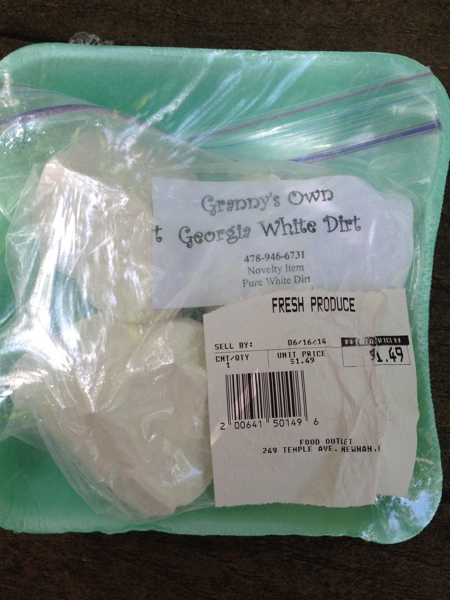
You thought I was kidding, didn’t you?  Yes, the price is $1.49 for about a pound of kaolin.

So here are the instructions to make an incredibly cheap white body paint based on my experimentation.

Dump your kaolin into a bowl and add 1-1/2 to 2 cups of water to it.
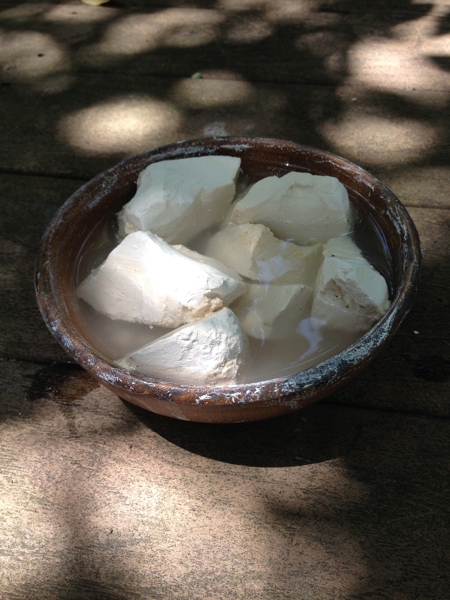
Just let it sit for about half an hour, stirring occasionally.  You will want to use a little larger bowl than I have here, and my advice is do this outside.  It can get very messy very quickly, and as you will discover, a little bit of this stuff can go a very long way.

Add water if necessary:
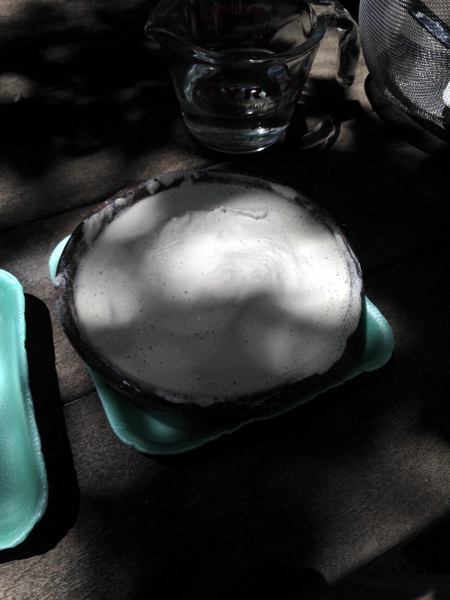
It should be the consistency of sour cream.

Buy yourself a bowl large enough to hold your final mixture; a strainer that will hook over the bowl; and a spatula, one that is completely flat on its face (unlike mine).  It is possible to use your household utensils, but if you’re going to be making a lot you will want dedicated equipment so that you don’t have to completely clean the kaolin off of every nook and cranny.
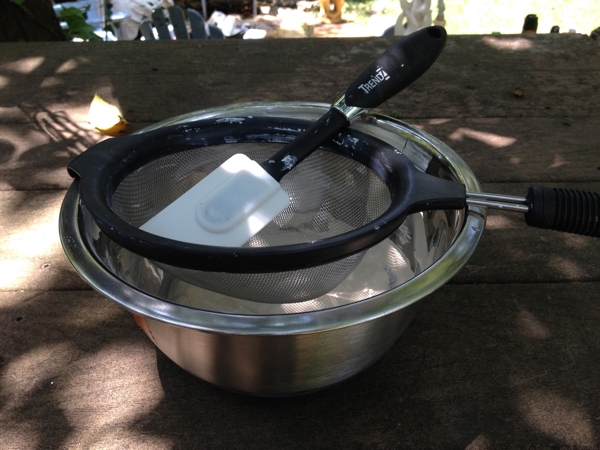
Scoop the goop into the strainer, and force it through with the spatula.  The finer mesh your strainer had, the finer your body paint will be.
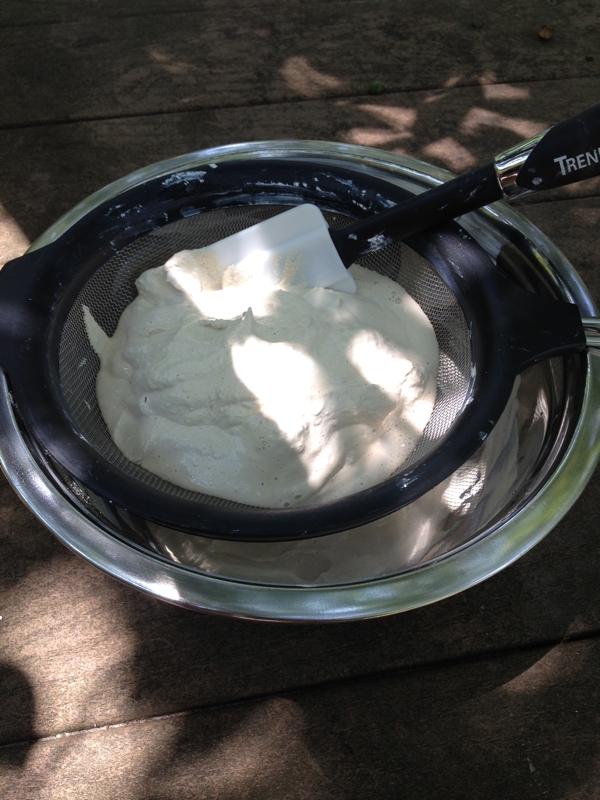
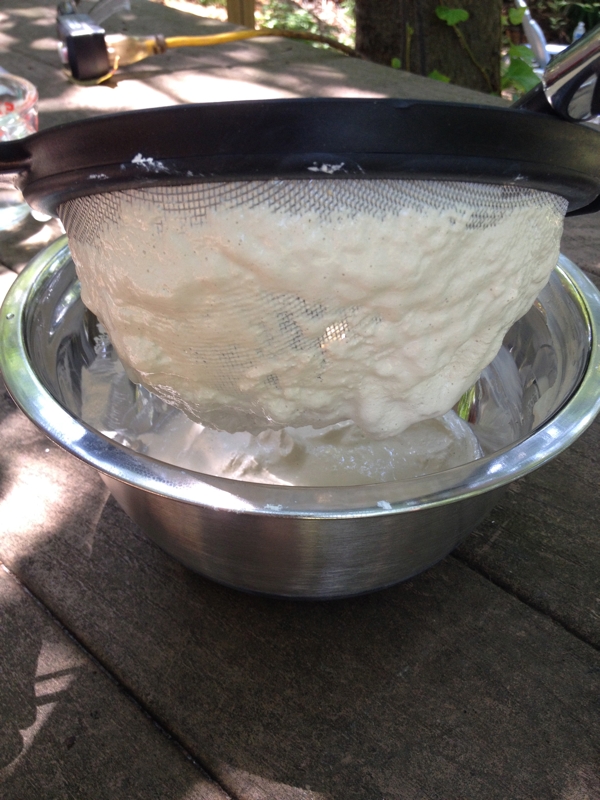
As you moosh it through, you may need to add water for any clumpy bits.  Also, of course, it doesn’t fall straight into the bowl.  A lot of it will cling to the other side of the strainer, so be prepared to scrape the bottom:
Finally, you will have a bowl of white, yummy kaolin.  Stir, add water, etc.
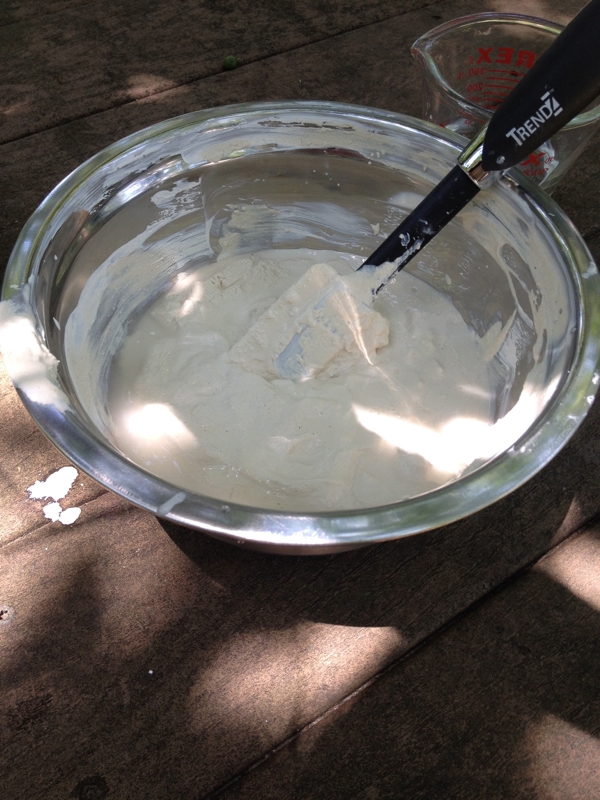
I was smart to buy a stainless steel bowl with a rubberized bottom, but I wish it had come with a lid.  You will want to keep it covered to keep it wet, although if it dries, it’s not difficult to reconstitute it.

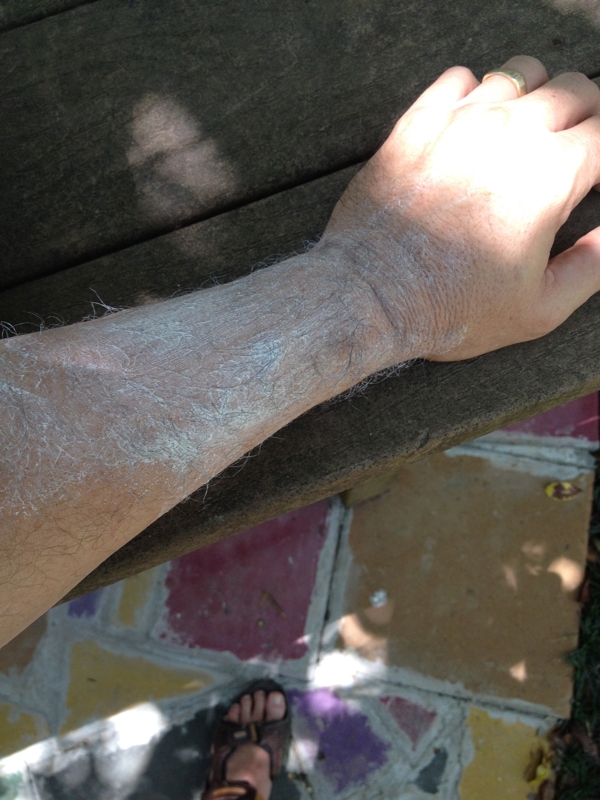
How well does it cover?  Here’s about a teaspoon smeared on my arm, still wet:
And here it is dry:
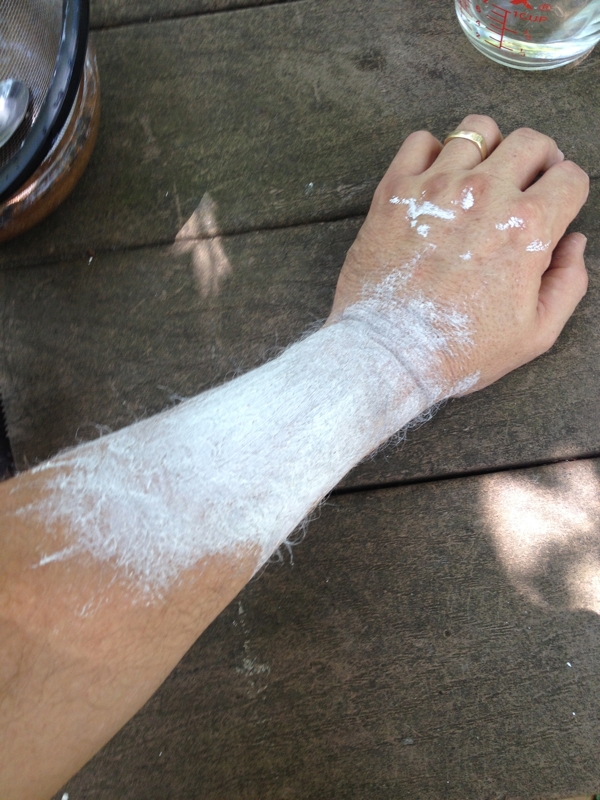
Used in a fairly liquid state, it dries smooth and does not come off.  If you don’t use as much water, it may cake and crack—that’s a definite look as well.

It’s comfortable on the skin, and best of all it just rinses right off.  Pretty much perfect: cheap kaolin, water, comfortable, and removable.

Unanswered questions: how much does it take?  I started with a pound of the stuff, and I covered my entire body with maybe a fifth of it.  However, that was the first formulation, which was thicker and cakier, so it ought to go even further if you use a runnier consistency on fewer body parts.

Also, I don’t know whether this could be tinted or not.  I’m sure you could use food coloring, but you would risk dyeing your skin.  Perhaps sidewalk chalk or tempera paint?  I may or may not play with that; we just needed white.

Could you add cold cream to it?  I don’t see why not, but why go greasy when it’s perfectly comfortable the way it is?

Finally, there are online sources for kaolin, but it’s not cheap like that.  My advice would be to start checking around convenience stores and groceries that cater to the African-American community; it is mostly older black ladies who eat “white dirt.”

Bottom line: you can spend $12.95 for 4 oz. of body paint, or you can spend $3.00 for a pint.  You’re welcome, internet.

Also too…

I may or may not have finished orchestrating “I am alone.”  It has some gorgeous crashing sounds in it, but I worry that they’re too much.  Pretty music, powerful music, but does it support the tenor or simply overwhelm him?

I can’t tell yet, so let me listen to it another day before posting it.

Onward, to “Hark, the sound of screaming fans,” to which my response this morning on my walk was revulsion—still—at Theseus’s jaunty little tune.

Random thoughts

This little poster has been showing up on Facebook:

::sigh::

Here’s my issue with this: it exemplifies the execrable egocentrism of many religious folk in our society.  As my favorite liberal evangelical blogger Slacktivist would say, it’s a moral trap to want to believe that your virtue is enhanced and sustained by the unvirtue of others.

These believers look at this poster and identify with Noah and his family—”Yes, Lord, you are mighty we just bless your name for all your mercies to me etc etc etc”—without ever thinking that God also brought all the other people in this painting “to it.”  What other people, you ask?  The people under that water.  Those people.  The doomed, the drowned.

Ah, but those were bad people, wicked people, says the believer of this poster.  And that’s the moral trap.  Whatever the values of the cautionary tale of the Bible, our believers transfer that to their relationship to actual people here and now.  Those people are bad, not like me.  God will bring me through “it,” because I am Godly.  Those others?  They deserve to be under the black, cold sea.

So this morning, as I was doing my doctor-mandated walk and listening to Dream One… again… I lost interest in the music qua music and began thinking about staging, specifically the opening scene.

When I got home, here are the stage directions I typed into the libretto:

Icarus is in the sky again. The Event is on. Observers (CHORUS) attend the moment in amazement and delight.

[In the rear, projected sky.  Two vomitoria flank the central playing area.
Large overhead screens flicker to life: corporate sponsor logos, Icarus 2014 splashscreens, on-location reporters, tweets, selfies, etc.
Beneath, we hear control room sounds, commercials, reporters, etc.]

CHORUS I
[emerging from the SR vomitorium]
[Among them are a handful of Old Believers, who still worship in the old ways.  Their dress may be a bit more ceremonial, and they would not be carrying electronic devices, which the rest of the CHORUS most certainly are.]

I think that would be one kick-ass opening.  The idea of Old Believers would not be central to the plot, but I think it would reinforce the idea that the Event is actually an ancient ritual, one that became laden with meaning for some and that has now achieved the status of religion, while for the majority of us it’s just another entertainment.  Think Christmas.  Or Independence Day.  (I also am amused by the idea of not explaining these people or even referring to them; they’re just there.)

I suppose I should get back to orchestrating “I am alone”…

Dream One, 1. “Joyfully gaze” orchestrated

Here’s the opening number.  It’s been done for about a week now, but I haven’t felt like putting it up for review yet.  Made a minor tweak this morning.  Again, I fear I am over-orchestrating.

Dream One, 1. “Let us joyfully gaze” | piano score [pdf] | orchestral mp3

That’s all you’re getting today, because I am now setting out to work in the labyrinth all day.

Reality TV show #1

Occasionally, my lovely first wife and I will come up with silly—yet viable—ideas for television shows.  Here’s one of our favorites: Mama’s Stuff.

The premise is very simple: each episode focuses on a family who is stuck trying to decide what to do with Mama’s stuff.  See?  Great idea—you’ve already tumbled to the possibilities, haven’t you?

Perhaps Mama is deceased.  Perhaps she’s alive and downsizing—moving into a smaller house, or into a facility, or in with one of the children.

Perhaps nobody wants Mama’s stuff, or worse, everyone wants it.

Our hosts are comprised of an appraiser, an estate sale planner, and a counselor.  You can see the need for the talents of all three, I’m sure.

Is there a Daddy in the picture?  Did some of the stuff come from the Other Side of the Family?  Are there relatives who want certain pieces retained in the bloodline, so to speak?  Did Mama make off with some favored trinket in a previous generation’s episode and now Cousin Sally sees an opportunity to get it back?

Are some siblings simply unaware of the value of some of the stuff?  Are some of the siblings… not nice people?  Would the stuff clearly be better off in the home of one of the siblings (as opposed to the double-wides of the others)?  Are any of the siblings hyper-emotional about Mama’s stuff?

Some episodes could be about the interfamily drama.  Others could be about the sadness of a life’s end without any really meaningful artifacts left behind (and by “meaningful” I’m not saying “valuable”).  Some episodes might focus on Mama herself; others, on the heirs.

With the richness of personality types (…) available to us in most American families, I think it would be easy to craft a narrative for each episode that would keep viewers coming back. And of course, we’d be providing a service for the nation by holding up these families as models of how to go about dealing with Mama’s stuff.

TLC, you have my email.  Let’s do lunch.

Orchestration… ugh.

And so our long national nightmare begins.

Having successfully copied the piano score parts from 1. “Let us joyfully gaze” into an orchestral score, I set about assigning instruments.  You might think that this particular piece might be a lark, given that it’s just faux-Baroque excess, and to a certain extent you would be correct.

But it doesn’t sound right: too loud, too repetitive.  I will have to let it sit for a day and annoy me.

Mercy, what’s it going to be like when I have to do something subtle?

Orchestration and landscaping

I spent the morning attempting to discover a way to make Finale do a very simple thing: using the ScoreMerger option in the program, take the soloists/chorus/piano staves and append them to an orchestral template.  In other words, take the music I’ve already written and copy it over to a file with all those extra instruments in it.

It would not.  It would append, but then it also copied over the page setup, so that I’d have two pages of 11×17 orchestral score followed by x number of 8-1/2×11 pages of piano score, along with all the title page stuff of the piano score.

I could go in and tell it to forget all page formatting, but then the 11 staves of the piano score would end up in weird places: the sopranos above the soloists, or the piano staves distributed amongst the vocals.

And under no circumstances was it bringing over dynamics or tempos.

Blergh.

I posted on the Finale online forum, but so far no one’s answered, except one person who has had the same issues.  Their solution was the same as mine: re-order the orchestral score so that the piano part is below the vocals (normally it’s above them), then copy and paste the piano staves into the orchestral score.  Not difficult but hardly elegant.

That took all morning, so no actual orchestration got done.  But the template is set up now, and I should be accomplishing something tomorrow.


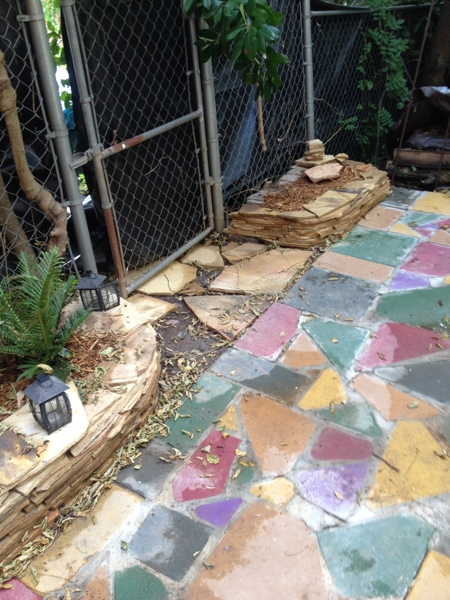
And I finally got that little wall on the back end of the patio done:

When autumn ferns come back on the market, I’ll plant one there.

Soon, but not tomorrow, I will revisit the stone store and drag home some medium-thickness flagstone for the gate entrance, and for the area around the firepit.

Dream One… done

So, Dream One is done.

Not really, of course, but for the moment let’s pretend that I have actually finished composing the first scene of the new opera, Seven Dreams of Falling.

It took me a moment to realize I was through.  Honestly, it was like finishing a New York Times crossword puzzle that has resisted solution: you push and pull and step back and plunge in, and then finally you realize what the last few letters must be and you write them in, and then you’re done.  No great “aha!” moment, no feeling of reaching a summit or crossing a finish line.  You’re just done, almost unexpectedly.

Still, I’ll take what sense of accomplishment I can scrape up.   Whatever its weaknesses, it’s done, and I think there are some very strong moments in it.  Baritones will curse my name if they have to sing Theseus, whose opening aria takes them right to the top of their range and a little beyond, but everyone else should have a lot to please them.

What’s next?  Scott is working on the text for Dreams Two, Three, and Four, and in the meantime I could begin orchestrating Dream One.  I have a bit of a concern that I’ve not been thinking in orchestral terms, and that may be an issue when it comes time to get rid of the piano.  However, the same was true of William Blake’s Inn, and it turned out just fine.  The main thing will be deciding what orchestral forces we’ll need.

Side note: I just checked the instrumentation of Finale’s “full orchestra” template, and it seems a bit odd to me.  No English horn, but an E-flat clarinet.  Trumpet in C (2)?? I can understand not having saxophones, perhaps.  No bass trombone.  Percussion is timpani and “percussion.”  None of this is a problem, of course.  I just have to decide what I’m going to use and then create a new template from that.

For comparison, here is the orchestration for Anna Nicole:

  • 3 flutes, including one player doubling on piccolo and alto flute
  • 3 oboes, with two doubling on English horn (that’s a lot of oboe shrillness right there)
  • 2 clarinets, doubling on bass
  • 2 soprano saxes
  • 2 bassoons, one contra
  • 4 horns, 3 trumpets, 3 trombones, 1 tuba
  • timpani
  • percussion:vib/marimba/t.bells/wdbl(sm)/tamb/metal bar/wooden cube/guiro/tpl.bl/tgl/claves/h.bells/brake dr(lg)/SD/quica/bongo/TD/BD(lg)/susp.cym(lg)/2gongs/tam-t(lg) (I’m not unpacking that for you.  TL;DR: lots of stuff to bang on)
  • harp
  • piano/celeste
  • strings(8.8.6.6.4)
  • Jazz ensemble: elec.gtr(=banjo,mand)-elec.bass(=mand)-drums.

That lineup is close to what I’ll end up with, other than not needing that many oboes or bangable items, or the jazz ensemble.

When I start orchestrating, you should expect changes in the piece, some of them quite significant.  What happened with William Blake’s Inn is that when I started breaking up the piano accompaniment, I would hear opportunities for embellishments and counter-melodies that are not possible with ten fingers on a keyboard, and suddenly the piece would sound quite different.  You can cover a multitude of joints with the spackling of strings.

So, onward!