A consideration

When looking to acquire an Assistive Feline™, one thing to check is its Adorability Factor.

For example, this model is extremely attached to her Mouse-on-a-Stick:

In fact, this is her fourth Mouse-on-a-Stick.  She will eventually stretch out the elastic and get it caught on something in the house and break it.  Any owner of an Assistive Feline™ should be prepared to provide a replacement Mouse-on-a-Stick immediately.1

Until that happens, though, the Assistive Feline™ will trot around the house with the Mouse-on-a-Stick in her mouth, dragging the plastic stick behind her.  You can hear her coming down the hall or down the stairs, tick tick tick.

She is most apt to do this when there are visitors: one will be chatting in the living room, perhaps over cocktails, and she will appear with her Mouse-on-a-Stick, walking in like a lioness on the Serengeti with a zebra in her mouth.  This is Extremely Adorable.

You should make sure that the Assistive Feline™ you are considering has an equivalent Adorability Factor.

This has been a public service announcement from the AAFC.2

—————

1 When the local Family Dollar did not have said implement we freaked a little, but after looking in another Family Dollar store, we found the necessary replacement.  We bought two.

2 American Assistive Feline™ Council

Fantastic Beasts? Eh.

[Here be Spoiler Alerts.]

We went to see Fantastic Beasts and Where to Find Them, because Harry Potter.  It’s a dazzling movie, to be sure, and the performances are all spot-on, with the four main characters especially charming and adorable.

But…

We left feeling very unsatisfied.  The plotting is haphazard and whatever suspense there might be in figuring out what’s going on is dissipated by the most telegraphing since the Titanic went down.  It relied a lot on fan service, i.e., our prior knowledge of the Potterverse,  to keep us on board, and the middle third especially just dragged.

We were appalled at the loose threads in the plot.  What exactly did the newspaper publisher/senator story have to do with anything?  Was it simply for the Citizen Kane shot being destroyed by the Obscurus?  Not enough.  I got the feeling there was a lot left on the cutting room floor, because the paltry conflict within that plotline was never integrated at all with the main plot.  J. Jonah Jameson, Jon Voight was not.

The conflict that seemed to be driving the American wizards (remaining hidden from Non-Maj society, etc.) was never fleshed out, and the “villainous” Mary Lou who rants on the steps of the bank about the danger of witches among us never seemed more than your usual NYC crackpot.  The idea that she posed a credible threat to the magical community was dumb—her headquarters was a rundown hellhole, while MACUSA occupied a luxurious Art Deco skyscraper.

And what was the deal with Scamander’s relationship with the Lestrange girl back at Hogwarts?  We may never know.  We certainly don’t know what it had to do with the current movie, other than to allow Scamander to display some empathy with poor Credence Barebone, whose relationship with Tina Goldstein is likewise never fully explained.  (There is an explanation, kind of, but like everything else in the movie it’s compressed and rushed.)

The final reveal, that Graves is actually Grindlewald, raises more questions than it solves: Graves is head of the Aurors at MACUSA—how long has Grindlewald been disguised in order to ascend to that position??  I don’t think it’s justifiable that eventually the good Potterian will think, “Ah, it must have been Polyjuice Potion,” even though we never see any evidence of that.

(I just went to the Wikipedia article on the film in order to remember the term “Obscurus,” and was shocked to find in the synopsis details that were not at all clear in the movie.  There are also details which apparently the author of the Wikipedia article got from the film which I think are wrong. Sloppy, and I’m talking about the filmmakers.)

The fantastic beasts were fantastic, but again, they felt glued onto the plot.  They were mostly deployed for slapstick interludes, and we never got to be familiar with any of them except for the Niffler and the Bowtruckle (who smacked of Baby Groot, alas).

After we got home, we kept gnawing on the sources of our discontent, as one does, when it finally dawned on us: the problem was not so much with the movie itself as it was that it shouldn’t have been the first Newt Scamander movie.  This was the second Fantastic Beasts film.  The first film introduced us to Newt Scamander as he scours the earth for these creatures, along with flashbacks to his problems at Hogwarts leading to his expulsion, culminating in the rescue of the… whatever the big bird thing was in the second movie… a Thunderbird, maybe?… in Egypt.  This propels us into the second film, as Scamander comes to America to release the Thunderbird into its native habitat in Arizona (mentioned briefly in the film), and gives more breathing space for actual plot.

Somebody really should be paying me big bucks to do this thinking for them.  Jo?

The GLRP, 11/11/16

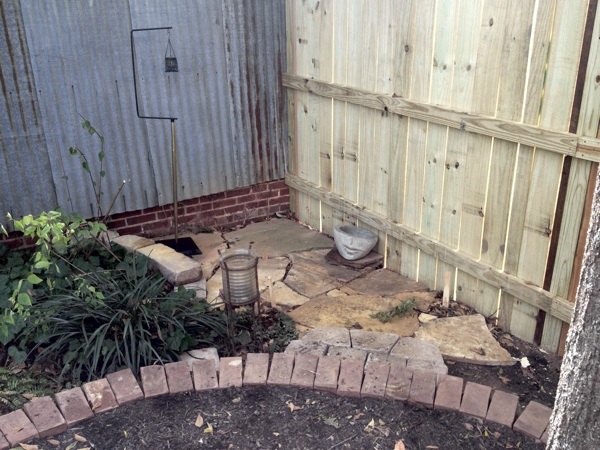
This was a pleasant surprise.  I had decided, you may recall, to claw out a place from the very back corner in the southwest.  It was previously just a jungle of ivy and whatever volunteer plants sprang up.  I had planted a variety of ferns there over the years, but the ivy choked out everything not at the edge of the planting.

So when the fence builders ripped out all the ivy, I decided not to let it grow back.1  My plan was to pave over it with the same flagstone I used in the fire pit area and to create a little nook of some kind.

And…

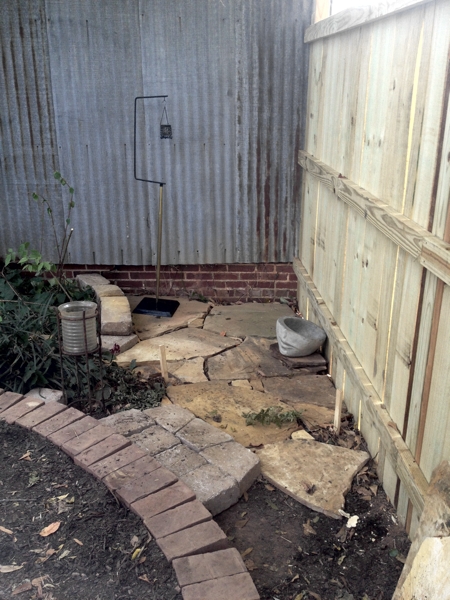
All in all, a pretty spectacular little spot.

The stand is a bird cage stand.  We think we will find some kind of hanging lantern that can go on it.  (Since taking that photo, I’ve moved it to the other side of the block wall in order to clear more space in the nook.)

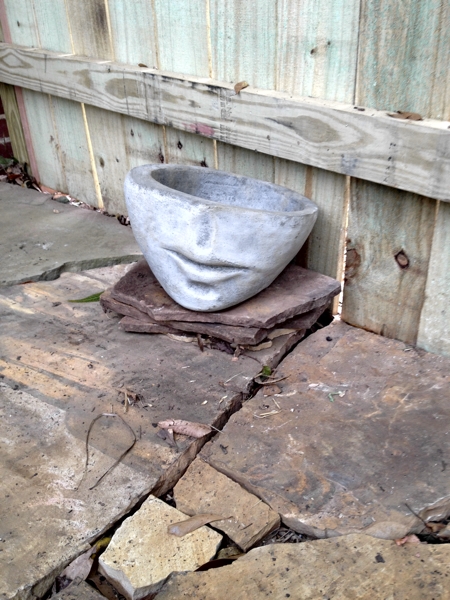
And look at that planter I found when I went to buy the flagstone at Mulch & More!

I think I’m not planting anything in it.  It’s just delightful/provocative enough by itself.

—————

1 Yes, I know it will grow back.  I am prepared to do battle.

The GLRP, 11/9/16

More terracing, this time at the westpoint:

A slight revamping of the westpoint bowl just to make it balance better:

There remains the northwest corner:

I’m still thinking about the area, but I think I will terrace this area as well, with stone steps curving down the left of the area.

The GLRP, 11/08/16

This was fun.

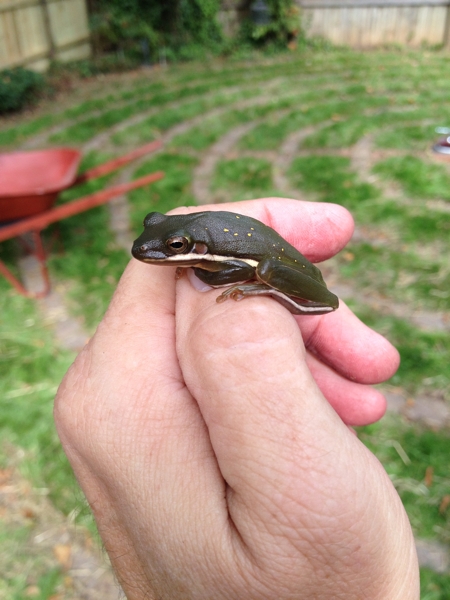
First of all, at Home Depot when I went to load the 12 bags of top soil into my car, I discovered this guy:

Thinking that there were too many ways for him to come to grief in his current setting, I scooped him up and brought him home.  There was a moment of panic when I carefully unloaded the car and he wasn’t there—what if he had decided to burrow under the seats and die?—but I found him and as you can see he’s fairly content to be my friend.  He finally leapt to my shoulder and from there to the hostia by the southpoint.  I haven’t seen him since, but he should be fine.

You will recall from yesterday that I had begun the mini-terrace at the southwest corner.

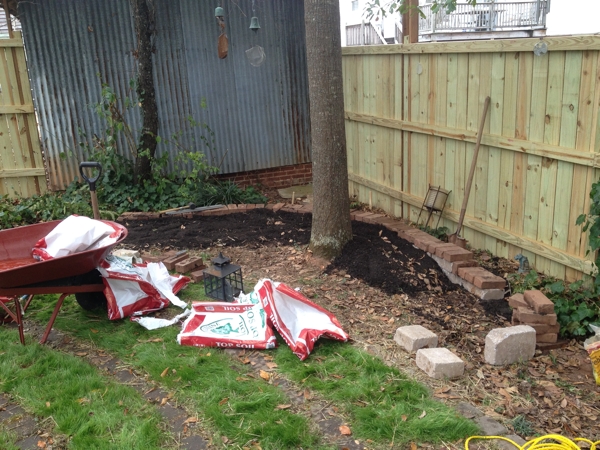
I decided to lower the far range of blocks so that the border bricks were all on one level.  I could have done that by dismantling the whole thing and digging a deeper foundation, but I found it easier just to replace the concrete blocks with others half their height.

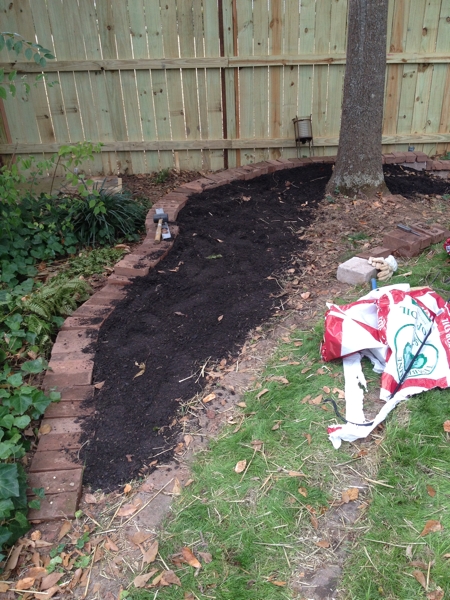
After I got the whole thing walled in and filled in, I stepped back and took a good look at it.

Those who know the Lichtenbergianism process know that it’s time for GESTALT and SUCCESSIVE APPROXIMATION.  My thinking was that the sinuous outline of the terrace was lame.  It did not resonate.  Its woo factor was pitifully low.

So I fixed it.

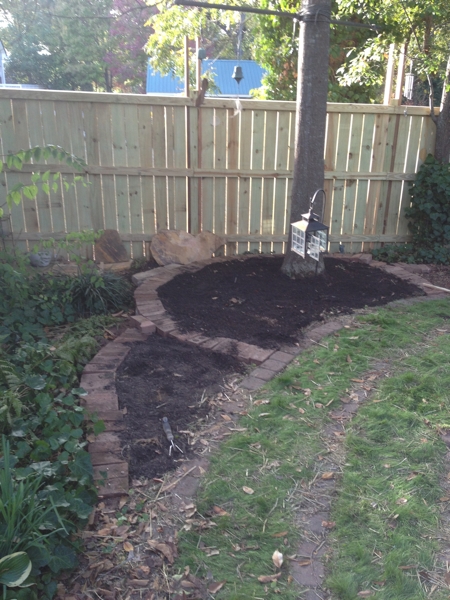
Still some adjusting to be done—brick-cutting, etc.—but on the whole I think it’s much better.

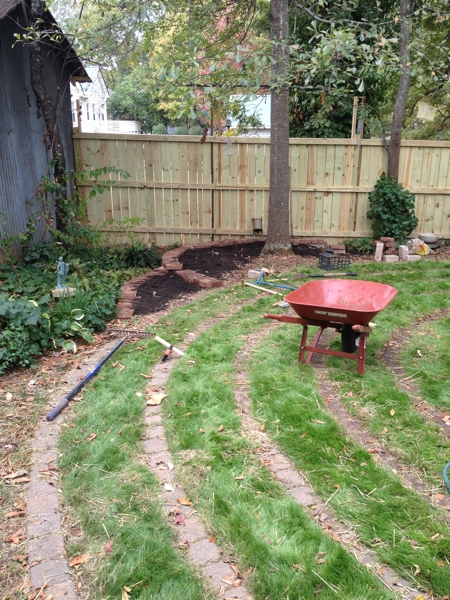
Long shot:

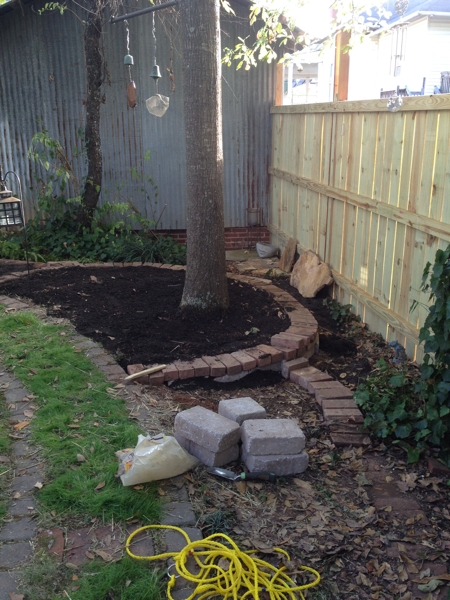
I am halfway considering paving that circle around the tree with flagstones like the fire pit and the back corner, but that won’t be until the spring.

I also have concerns that the brick edging is precarious: a slight misstep will knock them off.  If I weren’t so averse to permanence I’d cut them to fit and then cement them in place.  Oh well, if that becomes necessary at some point in the future, we can do that.

Next up: the back corner.

The GLRP, 11/07/16

Back at work on the Great Labyrinth Reclamation Project, this time on the southwest corner.

You may recall that the new fence, in cutting a straight line from one corner to the other, cut off some of my “landscaping” at the far end of the labyrinth, and so I am having to revamp that corner.  It’s always been problematic in that the bricks that I used to create a border were continually being covered over by soil washing down the little slope there.

So my plan is to build a small wall and fill that in with dirt.

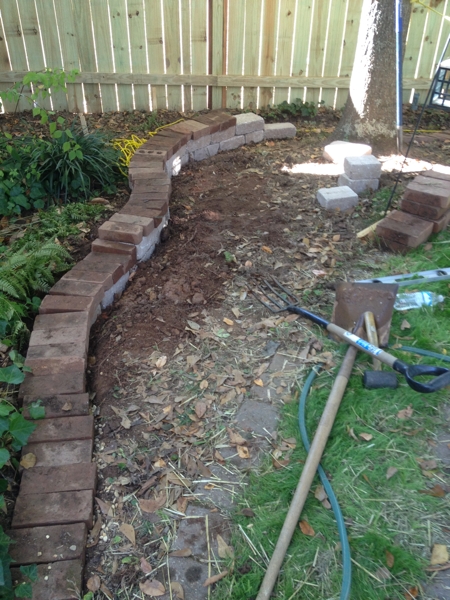
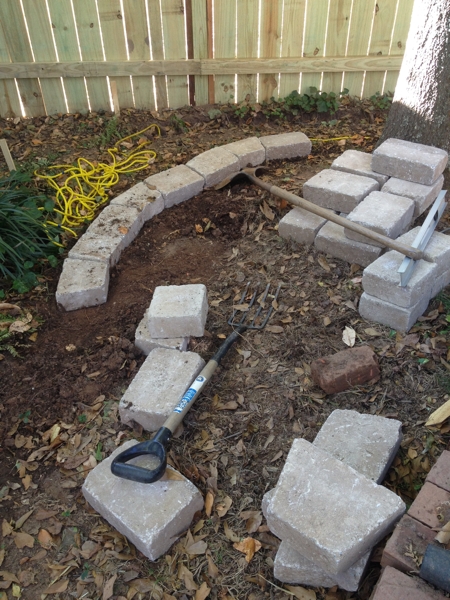
Here’s the bottom layer of wall:

And more:

I didn’t buy quite enough blocks, so back to Home Depot today.  I will also buy the fill dirt to put in there and then seed it.

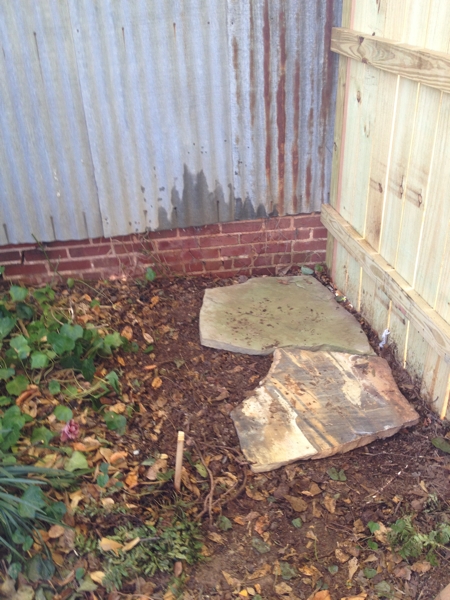
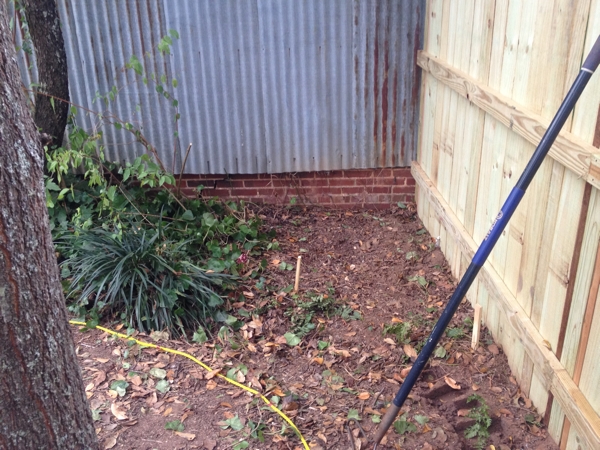
Meanwhile that back corner will become a nook of some kind:

I already had two large pieces of fieldstone, so I went ahead and put them down.  I’ll get to this area later this week.

Onward!

The GLRP, 11/01/16

I bought a timer for the sprinkler last week—none of the timers I had bought previously worked, of course—and so the labyrinth was watered while I was on Lichtenbergian Retreat last weekend.  When I got home on Sunday, I went to check on things and was astonished to find:

The grass seed has already sprouted!

Now to keep it alive for another four weeks…

The GLRP, 10/26/16

Step 4: Improve the walkway

Years and years and years ago, before there was a labyrinth, before there was anything in the back yard but weeds, I created a walkway.  It has remained a constant no matter what else has happened in the area.

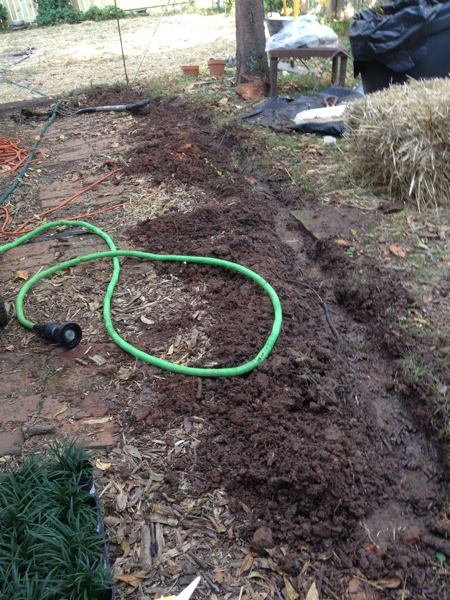
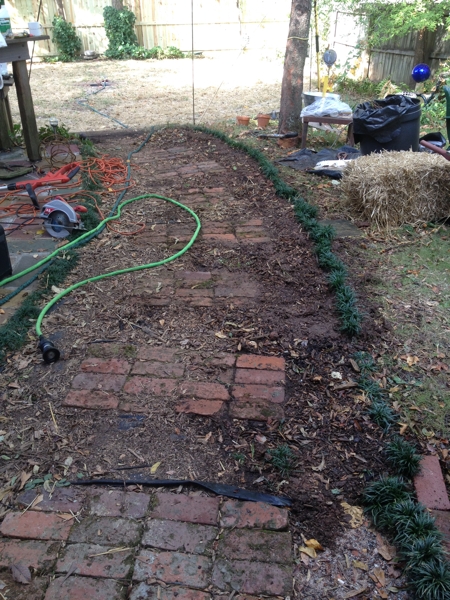
After we put in the patio two years ago, I re-landscaped it with mulch and all that jazz, but that has never been quite satisfactory.  The mulch drifts, and it looks messy.  So now I’m taking steps to contain the mulch:

The majority of the work was creating a trench for the dwarf mondo grass.  The ground is so dry and hard that I used a trencher to cut through the soil, then again to create a parallel cut.  I watered it to soften it, waited, then went back over it with two different shovels, watering and scraping the whole time.  It was tedious.

I also wondered at the ethics of a construction grading firm who—twenty years previously—blithely bulldozed all the construction detritus into what was surely going to be a landscaped back yard.1

I also also wonder at The Home Depot, where I bought out their entire stock of dwarf mondo grass (six flats), and the nice lady watering the plants asked if I would be needing more.  I cheerfully replied, “Maybe, but you certainly will.”

Getting the mondo into the ground was easy: plop the plant into the trench, cover.

“People” will tell you that mondo grass is easy, that you plant some and it will “spread” and “fill in.”  These “people” are lying.  It never does.  There was a small patch near the downspout by the patio for twenty years, and it never grew nor spread.  Never.

So if I want to further fill in the path with mondo, I will have to buy it and plant it.  That should keep me busy until my mid-70s at least.

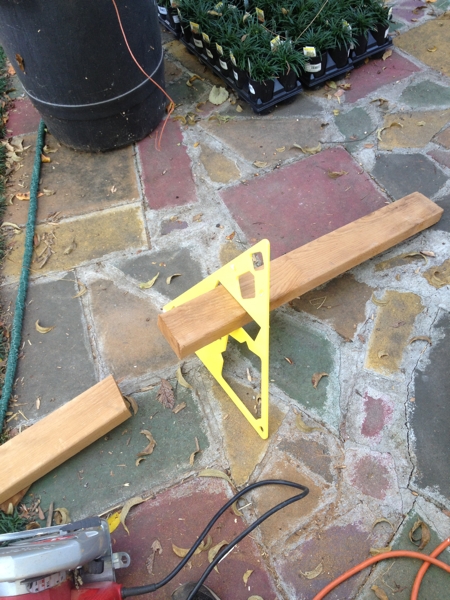
In other news, you may have seen the video on the FaceTubes about the cool little metal triangle that all manly men should have to cut lumber and/or pipe.  It slices, it dices, it’s better than a Veg-O-Matic.  I bought one last month and yesterday I got to use it for the first time.

One of the great pleasures of being alive is when something like this is everything that is claimed for it.2   Where was this device during all those years of set building at the theatre??

I used it to cut a board to insert into the fence along the patio, because of course the lighting fixture we’ve been holding for a couple of years, waiting on a new fence, is too big to fit between the rails but too small to attach to the rails.

One more thing: a huge task on my GLRP checklist was to dig up the underground speakers and figure out why they had stopped working.  I figured I would at least have to buy new speakers; I hoped I wouldn’t have to dig up the cables as well.

I plugged in my little marine amp (not all-weather, just weather “resistant”) and plugged in the iPad and the speakers, just to be ready to test.  Lo! the far speaker, down where until last week there were ferns (::sigh::) began playing.

Great, I thought, only one speaker to dig up.  I began to pull up the bricks that I had laid around the speaker to slow down the ivy.  As soon as I touched the second brick—THE SECOND BRICK, KENNETH—the speaker came on.  This is after months of not producing sound of any kind.

I chalked it up to living a virtuous life and replaced the brick.

…to be continued…

—————

1 I don’t have to wonder at all.  I remember the day: I had arrived home from school to find the bulldozer guy grading the entire back yard into a slope down to the retaining wall despite the contract to create two levels.  I stopped him, told him he was doing it wrong, he said he knew nothing about it and started back up.  I stopped him again and told him rather acerbically that either he could call his boss and find out the specifics, or he could finish the job and then I would call his boss and he would have to re-do the entire yard.  He rather sensibly chose the former.

2 Another thing that performs equally well is the Sonos sound system.  It’s awesome when you can have every speaker in the house playing a different station and can control all of them from your phone or iPad or computer. But I digress.

The GLRP, 10/25/16

Step 3: Reclaim the southwest corner

Yesterday I began reconstructing the southwest corner.

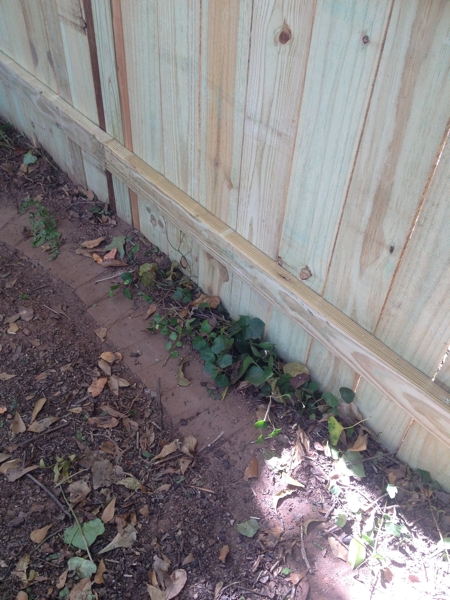
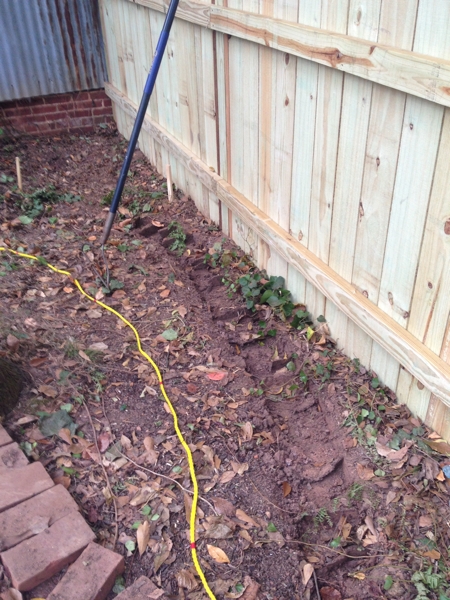
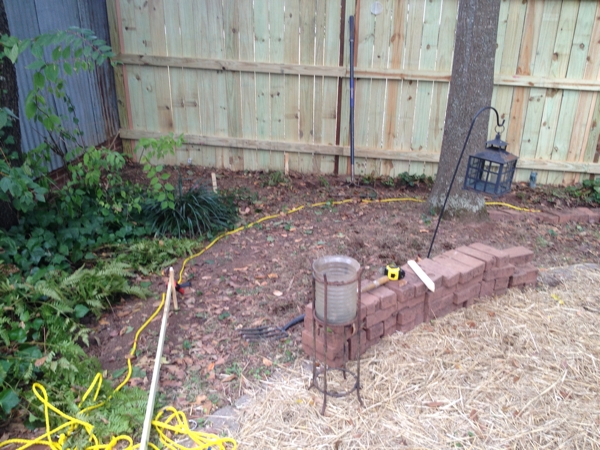
The problem is that the new fence was designed to cut straight from one neighbor’s fence on the right to the other neighbor’s shed on the left—and the original chain link fence hugged the retaining wall before jogging over to the shed.  Hence, I lost two–three feet of landscaping, as seen here:

There is actually one of my ferns on the other side of the fence now (which, it just dawned on me, I can go dig up and move…) I’m also missing several cherry laurel saplings which framed the westpoint bowl rather nicely.  Oh well.

The area’s been problematic anyway: the slope of the ground there means that the bricks are always being covered with dirt washing down the hill. It’s impossible to grow grass there, and the battle with the ivy and the thorns is never-ending.  So revamping it is a net plus, actually.

First, take up all the bricks:

Here’s what I’m thinking: define an extension of the mostly level labyrinth area, build a mini-retaining wall, fill in the space with dirt, re-establish the brick edging.

Install some stone steps leading down to that back corner and resurface it with paving stones, perhaps as a little sitting nook?

I’ll let this sit for a couple of days to see how it grows on me.

The Great Labyrinth Reclamation Project

The Great Labyrinth Reclamation Project [GLRP hereinafter] has begun.

Given that it’s been too hot to do any outdoor maintenance, and given that we’ve had no rain, it should come as no surprise that the labyrinth is a minor disaster: the grass is dead, while the ivy/bamboo/privet/wisteria have run riot.

Normally, that would not entail a lot of worry.  Just get out there and kind of work it out as one moseys through life, ne-ç’est pas?  However, in a moment of weakness earlier this year I agreed to allow the labyrinth to be a part of the Presbyterian Preschool Tour of Homes on December 3.  So now I am under a deadline, which at least will get the job done.

Step 1: Install a new fence.
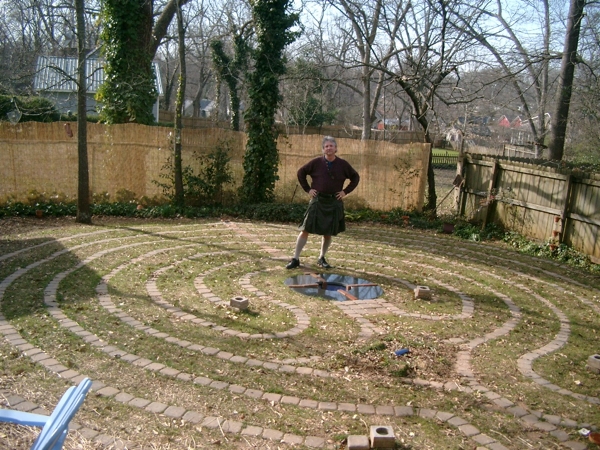
Here we have a happy labyrinth owner installing a new bamboo fence over the original chain link fence six years ago. This was for privacy, of course, and it was quite lovely, although as you can see it did not completely block anyone from seeing into the yard.  I was not worried, since I knew the ivy would grow up over the bamboo and provide cover.

Which it did, and that worked—until the bamboo began to rot and break down.
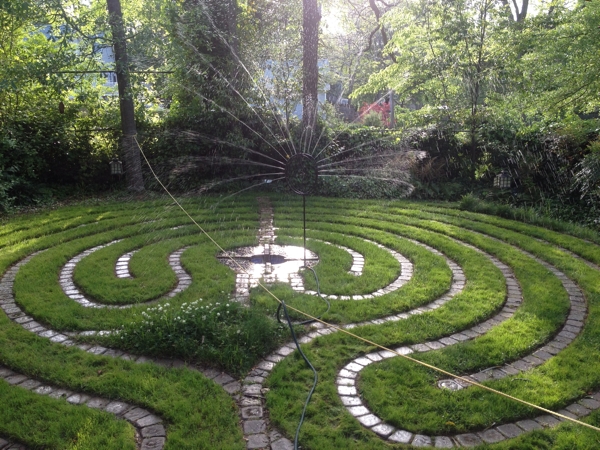
Here we see, if through a lovely sprinkler earlier this year, the wild and woolly state of the fence.  (That lush green grass died almost immediately.)  It was really ratty looking, and that included some rats who would trot about on top of the chain link.

And so I’ve been looking for someone to replace the chain link with a real fence.  I tried dealing with a builder recommended by a neighbor, but that person led me on (since April!) and I finally turned to Angie’s List, where I found First Fence of Georgia.  I highly recommend them, although parts of this process may give you pause about hiring them.  Ignore the roadbumps: this is a good company.

I really wanted an 8-foot fence, given the proximity of my neighbors, but city ordinances only allow 6-foot fences.  I could have applied for a variance, but by the time I hired First Fence it was too late.  So I asked First Fence to install a 6-foot fence with 8-foot posts; I could, if I wished, install art stretched between them, art that might even look like curtains.  Or summat.

The crew arrived at 8:00 a.m. and got straight to work.  Every now and then I’d wander out and smile brightly at them.  Chain link—gone.  Ivy—ripped out.  Post holes—dug.  Posts—installed, two feet deep in concrete.  Cross pieces—nailed in.

And so it was that shortly after lunch I went to the back yard to marvel at their progress and found—to my horror—that they had installed 6-foot posts.

I suppose I could have been a raging asshole and demanded that they tear everything down and start over, but a) that’s not who I want to be; and b) the expense, while probably bearable by First Fence, might have fallen on the two young Hispanic men who had made the error.  Let’s face it, unless someone had specifically told them, “Remember this dude wants 8-foot posts, so that’s different than what you do every other day of the year,” it was easy to miss the one reference (in 6-point type) to the posts being 2′ taller than the fence.

On the other hand, I had asked for—and was paying for—8-foot posts.  So I stopped the work and told them about the problem.

The lead worker was calm, but crushed.  He double-checked the blueprint and there it was in plain 6-point sight.  I told him I wasn’t mad, exactly, but I was upset.  I’d call the office to see what they recommended.

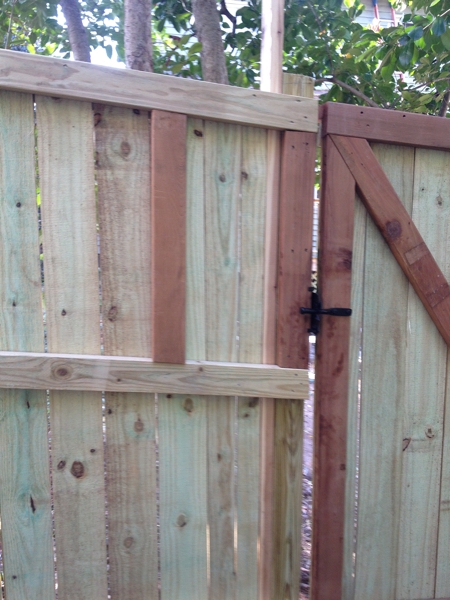
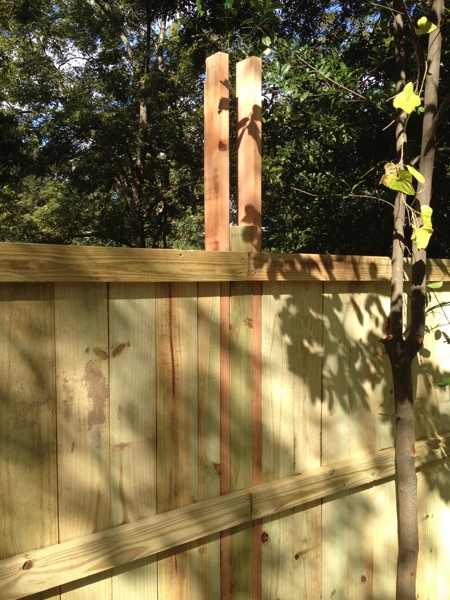
By the time I had spoken to the office (and been told the person to whom I needed to talk would have to call me back), the lead worker had a solution: what if we ran 2x4s up either side of the posts?  I liked it, specifying that they use cedar instead of pine just for extra safeguard against warping.  And so we did.
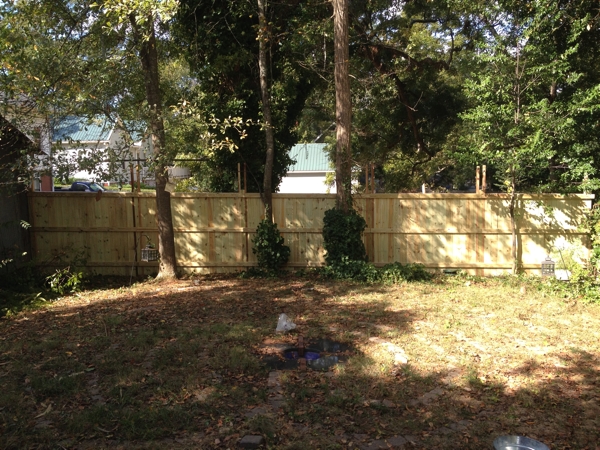
Quite frankly, even though it means that I will have to create the art, i.e., EXTRA WORK, KENNETH, I think it’s actually more attractive.  I think First Fence should offer it as a design, and I think they ought to pay the young man who thought of it royalties.
More to come.  Way more to come.