Religious Freedom: yur doin it wrong

Today’s lesson, class, is on propaganda.

First, let’s establish a couple of premises:

  1. Our Constitution, via the First Amendment, prohibits our government from “establishing” a religion.  This means that no part of the government can privilege or express a preference for any religious tradition.  None.  Not any. [P1]
  2. It also means that, despite what the Rightwing Christianists believe, that the United States is, in fact, a secular nation, at least as far as the government and its agencies are concerned. [P2]
  3. Rightwing Christianists, on the other hand, have it in their heads that they are the default position.  This is known as “Christian privilege,” and it is impossible for the R/Cs to see their way out of it.  (See here and here.) [P3]
  4. Finally, because R/Cs cannot see any reason to acknowledge the validity of any other position of faith, they regard any attempt to act as if Christianism might not be the default as an attack on their faith and hence, America. [P4]

Now let’s look at this webpage that came across my Facebook feed.  No, I’m not linking to it—if the website tracks back to my blog, we’ll be inundated with the crazies who believe this stuff.  (And no, they wouldn’t read this and realize that they’ve been duped by their leaders.)  If you want to see it live, google the headline.

(Annotations mine.)

(Snark alert: there will be no snark.  I will not even mention the comma splice in the headline.)

Right off the bat (1), our anonymous writer begs the question.  For those who need a refresher course, “begging the question” does not mean “surely a question that occurs to everyone,” but “you forgot to ask the most important question first,” e.g., “Did you ever beat your wife?,” not “When did you stop beating your wife?”  The important question here is, “Does Obama have an agenda to keep the Bible out of the hands of our Military [sic]?”

The answer would seem to be no.  You will notice that there is no link to any source that would show us what Obama’s evil agenda is, a link maybe like this one, which is probably the cause of the R/Cs’ distress.  You will notice the date: December 18, 2008, and the ACLU actually questioned the military’s policy in August 2007.   This is, of course, more than a year before Obama was even elected, much less inaugurated.

(Naturally, this can be explained with the Time Traveling Obama Theorem; political ramifications here.  Okay, a little snark.)

Moving on to (2): here we see the innate belligerence of the R/Cs as well as their confirmed persecution bias [P4].  “Take him down”?  What is he, Emperor Palpatine?  And after you read the transcript below of this “one speech you have to see,” you’ll wonder exactly what they imagine is going to happen once the nation sees this brave—yet anonymous—rear admiral give his defiant speech.

The problem is [P3], wherein the R/Cs are convinced that they are the correct and only framework for this nation (or any nation—that’s why the rest of the planet worships us and can only aspire to our political system).  Once “everyone” sees this speech, they’re pretty sure that the revulsion will be so general and so profound that… oh, who knows?  Obama will be “taken down.”  Riots in the streets?  Impeachment proceedings?  Sternly worded letters?  But it will definitely “bring him down.”

I am always amazed at how like elementary schoolboys this crowd is.  Their discourse rarely rises above “You just wait—you’ll see,” or vague expressions of some Gordian solution that will vindicate their outrage.  I’m reminded of King Lear’s impotent splutter,

I’ll have such revenges on you both
That all the world shall — I will do such things —
What they are yet, I know not; but they shall be
The terrors of the earth!

Yes, this one speech will take Obama down.

(You may noticed a huge cognitive split in the R/C brain: they are the default, the majority, the Real America BUT they are the horrifically persecuted minority.  No, I don’t know how that works.)

(3) OK, /snark on: “Governmnt”?  [sic] That’s like “Gubmint,” right? /snark off.

Here’s a rubric that I used with coworkers who tended to think like this author and who forwarded emails with similar stuff: “Is it too outrageous to believe?  Then it probably is: do your research before believing it.”  Hence, (4): is it really plausible that our armed services, which are struggling with suicide as a serious issue, have directed their leaders to send distressed troops to a chaplain and do nothing else??

No, it is not plausible.  Sixty seconds on the Google will give you:

And that’s just the Navy.

Again, propaganda-speaking-wise, you will notice that our anonymous author gives you no link to back up this assertion.  You will also notice that I’ve given you several that refute it.  In general, a lack of links to reputable sources is one sign that someone is pulling this stuff out of his ass.

Another sign of “too outrageous to be true” is that if you do google the topic, the only hits you get are either the original article or links back to the original article.  In other words, the original is someone’s fantasy of a Bible-hating Obama (in this case), and then all the other like-minded anonymous writers pick up the outrage and run with it.  If you don’t find links to actual news sources, then it’s not true, and no, it’s not because there’s a conspiracy to suppress it.

I especially like (5): “Rear Admiral.”  Nice impressive title—R/Cs are nothing if not worshippers of authority—and of course if the brass are standing up to Bible-Hating Obama [hey, I just noticed I can abbreviate that to BHO—get it??], then surely this is an important thing.  The fact that he is not named in the article nor in the video should be a red flag.  I’m sure this guy is an actual officer in the Navy, but why don’t we know who he is?  That’s sloppiness on the videographers/directors’ parts.

With (6), we’re back to the tingly feelings we all get from [P4], wherein we get to be brave martyrs shaking our brave fists at the evil BHO.

Of course, BHO has been a convenient focal point for the R/Cs, but more disturbing to me is how successfully the R/C and their political allies have framed “Government” as a faceless bastion of intentional evil.  I just don’t understand the impulse, but it fits into their persecution narrative, and it gives them pleasure in the very center of their brains.

Ah, (7): the Family Research Council.  A more wretched hive of scum and villainy… This organization, home of professional liar Tony Perkins, is categorized as a hate group by the Southern Poverty Law Center, who makes it their business to track groups like this.  They are the epitome of Jesus’ definition of a Pharisee.  They host these get-togethers that they imagine are both bastions of supreme faith [P3] and last stands against the BHO [P4], and this speaker is one of a very full slate at one of these events—again, unidentified by our (unidentified) author.

And then we wrap it all up at (8) with a straw man argument.  Exactly who are these people that “wish that the Bible didn’t exist”?  Do they have a Facebook page?  Obviously they all got into government work as part of their nefarious mission to take over this Great Land of Ours™ (for differing values of “Ours,” of course), but who are they?  To paraphrase Voltaire, “If militant atheists didn’t exist, it would be necessary for the Family Research Council to invent them.”

So what is this (unidentified) rear admiral saying?  Again, if you want to hear this man yourself, google the headline.  Here’s a transcript so you don’t have to:

Right now as we speak leaders like myself are feeling the constraints of rule and regulations and guidance issued down by lawyers1… that puts us in a tighter and tighter box regarding our CONSTITUTIONAL RIGHT2 to express our religious faith.  As one general3 so aptly put it, “They expect us to check our religion in at the door.”4  Don’t bring that here. Leave that business to the chaplains. I’m here to tell you there’s not enough chaplains to go around. And who can tell that young man who is downtrodden and on his last legs, who has no hope, to go make an appointment to see the chaplain? Go get in line and wait—when the opportunity right now exists.5 Yet if I do something such as I did several weeks ago when I was looking in the face of a young man, twenty-something years old, who eighteen months before had put a gun to his head and pulled the trigger and survived… When I looked at that young man and heard his story, the rules say ‘send him to the chaplain’— my heart said, “Give this man a Bible.”6

First of all, why is he wearing a uniform to a private function?  Still, I think it’s important to recognize that clearly the man still has his job—BHO has not had him court-martialed for his audacity in giving out Bibles to the needy, i.e., proselytizing to those in his command.  (That’s another great schism in R/C thinking: on the one hand, BHO is the AntiChrist himself, all-powerful and completely evil; on the other hand, he’s not very good at it.)

He’s not a very dynamic speaker, but boy is he sincere.  You can tell because he speaks in a strained, guttural basso.  It pains him as a manly man (notice the shaved head) to have to speak about these atrocities, but he’s containing his fury.  For now.

What are our propaganda issues in this speech?

1 “by lawyers”: the disdain for civil procedure is evident.  This is part and parcel of the conservative worship of the military.  They will tell you that it’s not worship, it’s just respect.  But any respect that is demanded—as ours is for our military—is worship.  (The parallel to the R/Cs’ belief that God commands our praise is telling.)  Remember [P1] and [P2]: our founders distrusted the military and intended very seriously that it should be subservient to the civilian government.  The Commander in Chief is the civilian President; the military itself has no role and no voice in the government.  But our rear admiral sneers at our civilian “rules and regulations and guidance.”

2 “CONSTITUTIONAL RIGHT to express our religious faith”: Helpful hint, guys.  Refer to [P1].  The First Amendment is there to protect your religion from the government; it is not, as [P3] would have it, there to promote your religion, or to privilege it over those “other” religions.  Or more pertinently, to privilege it over no religion at all.  Your “right” to pester others with your faith is not protected by the Constitution.  Quite the reverse: we are protected by the First Amendment from having to listen to you.

3 “As one general said”: Names, Travis, I need names.  Propaganda alert: any time you hear phrases like “one general,” e.g., “some say,” or even “many say,” circle the wagons.  This is a straw man, just one the speaker/writer made up to be on their team.

4 “They expect us to check our religion at the door.”: Yes, that is a true statement.  We do expect agents of our government to keep their religions to themselves, especially if they are in positions of authority, and it would seem to me that a rear admiral is a position of some authority.  Given what I know of the military ethos, we spend an awful lot of tax money to make sure that those who choose to be in that system obey their superiors in almost every regard.  To use your position to proselytize to those in your command is, in fact, against military code: see here, here, and here.  But rear admiral whatever-his-name-is sees that as “persecution.”  Of course he does; it’s the essence of [P4].

5 “Get in line and wait”: I’m not sure to what he’s alluding here—possibly the VA’s notorious wait times for many forms of health care, especially mental health care.  That is a critical issue, of course, although I expect our rear admiral votes for the assholes that send our troops off to fight very expensive wars but who won’t fund the aftermath.  “As ye sow…” as I’m sure someone once said.

6 “Give this man a Bible”: I have to believe that even in that audience that day, more than one person sat there in disbelief when he said this.  R/Cs are almost cripplingly blinkered in their worldview, but surely there were those who thought, “Are you insane??  Giving a suicidal sailor a Bible instead of calling in the mental health professionals?” What next, a couple of verses of “such a worm as I” hymns? That ought to do the trick.

So if the picture he paints of being persecuted as part of a general anti-Christian bias of the BHO is not the case, then what the frack actually happened?  Since there is no real data on the webpage—and I’ve thoroughly searched the interwebs for this bozo—we will have to guess.

My guess is that probably he has been told to follow procedure, i.e., refer the sailor to mental health professionals and not to take it upon himself to bring the young man to Christ.  I’m guessing he may have been reprimanded for doing so repeatedly.   This can only mean that the Governmnt [sic] is out to destroy brave people of Faith [sic] like himself, because [P4].  Of course.

This man is not an unfairly persecuted hero.  He’s a dick.  He’s a whinging, self-important dick, one who bullies desperate troops under his command and then petulantly (and publicly) complains when he is told to lay off, because of [P1] and [P2], not to mention the Uniform Code of Military Justice.  But such is the power of [P3] and [P4] in the minds of R/Cs that they cannot conceive that most of us recoil from him with disgust.

At first, I started this post with the phrase “rightwing religious propaganda,” but I changed it to just plain “propaganda” in order to be a little fair.  However, here’s a little thought experiment.  It is well-known that from 2001-2009, many of us suffered from Bush Derangement Syndrome.  It got to the point, so much did I despise that man, that I couldn’t bear even to hear his voice.  It made me want to hurl things.

During all that time, though, I never encountered a liberal version of this webpage: ill-conceived, based in irrational fear and hatred, and completely undocumented.  And I read a lot of anti-Bush commentary.  You may make of that what you will.

Here endeth the lesson.
Herodotus

So last night, I was reading a little Herodotus in bed—as one does—…

No, really, Herodotus is a hoot.  We’re still reading him 2,500 years later because he’s such a gossip.  He reminds me of T. R. Pearson and of Lawrence Sterne in that he is absolutely unable to resist a detour into whatever name/event/detail comes up in his narrative.  (Yes, I know that all three writers are doing it deliberately.)

The edition I’m reading is The Landmark Herodotus, edited by Robert Strassler and translated by Andrea Purvis.  It’s a beautiful book qua book, with copious footnotes, sidenotes, maps, illustrations, and a stream of info across the top of each page alerting you to where we are geographically and narratively.  There’s a timeline/outline up front, and a flock of appendices (22!) about various topics in Herodotous’s world.

Of course, none of this helps me to keep it all in my head.  If there were ever an example of not having the context necessary for understanding, this charming 700-page story of Middle Eastern politics and mores would be it.  But I plug away, enjoying the author’s wit and style and keeping up enough to keep going.

Why do I bring this up?  It has occurred to me that perhaps Herodotus—and this edition in particular—is the key to the structure of my putative A Perfect Life, the oversize blank book I bought six years ago (!) with the idea that I would fill it with a discursive memoir of what it’s been like to live my life, i.e., that of a more-upper-than-not middle class, educated white male in an undisturbed small town in the late-20th/early-21st century United States.  I should expect to wander from topic to topic, following the flow of thought that comes from realizing that the reader needs background on something I’ve just mentioned.  (Remember that this whole project sprang from my childhood curiosity about the details of private life in the past.)

Which is not to say that I think I should whip out the pen and ink and just start scribbling.  It’s probably vital that I give some thought to some kind of structure, e.g., what is it I want to be discursive about?  Do I want to get polemical?  Should I write as if I thought the book itself might be discovered in the rubble after the apocalypse, or am I writing for actual publication?  Do I want to explain what the “United States” “used to be,” or “electricity,” or do I presume the future reader still knows these things?

I think I need a Retreat to think about this seriously.

How to do it

Here’s how you do it.

  1. Go to http://votesmart.org/.  Ignore all the stuff at the top. Go to the bottom, the dark blue area, and find the white search box. Input your ZIP+4 and submit.
    1. (You may also want to register your own account here.)
  2. If you don’t know your ZIP+4 ZIP code, go here to find it.
  3. Here you will find all your elected officials, up and down the food chain.  Start at the Congress level.
  4. It’s no good looking for your Congresscritter’s email.  None of them have that any more.  Instead, they have ‘webmail,’ which allows them to restrict your input. F*ers.  Anyway, snag that webmail address.
    1. Do not look at the legislation your knuckledragging, Teahadist, dickweasel has voted for.  It will only ruin your sunny disposition.
  5. Open your Contacts list.  Create a new group.  Call it Elected Officials or Dickheads or something that you can remember.
  6. Create a new contact for the Congresscritter.  Paste in the webmail address under ‘home page’ or whatever your contact software has.  Don’t put it under email—it’s not an email address and will just make your mail program vomit.
  7. Do this for all your elected officials.
    1. State level officials may have actual email addresses.  Those you add as email, of course.
  8. Go to http://www.opencongress.org and register.
    1. It’s just as well to put VoteSmart and OpenCongress in as contacts in your Elected Officials group, along with your username and password.  Keep it all in one place.
  9. Now, whenever you read about proposed legislation that you think you’d like to influence one way or the other, open up your contacts and fire away.  It doesn’t do to be vituperative, but I have long since stopped trying to be anything but blunt in dealing with these people.

And that’s how you do it.

Do it.

Drawing the Circle: a ritual meditation on ‘community’

Every summer, I would go to the eastern entrance to the campus, and I would begin to draw the circle.

Walking to the front arch, I would stand there with the great lawn at my back, facing where the sun would rise, and consider the element of air: the mind | intellect | breath | inspiration | creative breakthroughs | beginnings.  I would invoke all these attributes for the children who were heading my way.

I would walk to the north side of the campus and consider the element of earth: concreteness | stability | the body.  The fact that I was facing the student health center added another invocation: Please don’t let us have any broken bones this summer.  (It rarely worked.)

Around to the west side, facing down the broad avenue that would soon bring families who were entrusting their children to us, with my back to the fountain, I considered the element of water: love | hope | fear | dreams | change | ebb | flow | gateway.

On the south side, with the Fine Arts building behind me, I would consider the element of fire: energy  | passion | determination | transformation | peak experiences.

Finally, I made my return to the front entrance and finished my meditation.  The circle was now drawn.

This was the Magic Square.  And into it we invited 700 of Georgia’s brightest, most talented, funniest high school students.  For six weeks they lived out all the attributes of the elements—and more—and created a community, one that ebbed and flowed and transformed them into something more, something that would remain with them for the rest of their lives.

And then we sent them home.  We exiled them.  We broke the circle and dissolved the Magic Square and broke their hearts.

One summer, on the last day, after most students had gone, a viola player who had formed an attachment to me found me as I walked across campus.  With tears streaming down her face, she asked, “Will we ever have this again?”

“Yes,” I told her, but I didn’t want to lie to her.  “Yes, it’s possible, but it’s very hard—and you have to make it happen.”

—————

created at an InterPlay “performance jam,” Dec 8, 2014


3 Old Men: mapping the field of ritual, redux, part 6

: Ritual action :

[original post here]

What kinds of actions are performed as part of the rite, for example, sitting, bowing, dancing, lighting fires (!), touching, avoiding, gazing, walking?  In what order to they occur?  … What are the central gestures?  … What actions are not ascribed meaning?  What actions are regarded as especially meaningful and therefore symbolic?  What actions are regarded as efficacious rather than symbolic?  What meanings, causes, or goals do participants attribute to their actions? … Which actions are repeated?  What gestures mark transitions?  What are the recurrent postures?  What qualities of action persist—quickness, slowness, verticality, hesitance, mobility, linearity, exuberance, restraint?  Are parts of the rite framed theatrically? … What parts of the body are emphasized by participants’ kinesthetic style?  … How do the social and environmental contexts influence the actions?  What actions are done with objects? …  What actions are optional, required?

So much questions…

One thing I found fascinating was the way we arrived at Alchemy with having gone through the ritual only once, and yet it was cemented, fully formed—and it was still allowed to grow in a very organic way.

For example, no one determined that after donning body paint each Old Man would wait to enter the labyrinth until the Man before him had reached and left the center, yet that became our standard action.

There was no prescribed method of painting oneself; everyone did as they felt best (especially as it got colder!). Personally, I think we looked best as a group when we covered our entire torsos.

Our solutions to initiating a walk to the next station evolved, and I remember the first time we did that, Joe just naturally walked from the west to the east, not stopping at the north entrance where the paint was. It seemed right, and so that’s what that part of the ritual became. It also worked when Wolf showed up with a fully worked out protocol for those who wanted to be relieved by another Old Man—thank goodness, since I was the first one to succumb, to dehydration I think.

The opening of the ritual I think was nearly perfect. I think our decision to strip and paint ourselves was the right one. Not only did it play off the infamous “drop-trou” atmosphere of Burns, it underlined the ritual transformation of campers into Old Men: we shed our daily garb; exposed our bodies and marked them with the other-worldly white of the body paint; took the journey into the labyrinth, stopping in the center for whatever private moment we each made there and then emerging to our station; donned our skirts and took up our staffs; and there we stood, newly born as officiants.

(And then of course, the reverse process: stripping off the skirt, retracing our steps into the labyrinth, and emerging to reassume our daily personae.)

As for the “qualities” of these actions, it seemed to me that we all invested our time as Old Men with seriousness and grace. For our participants, there was room for laughter, for talking, for serious meditation and blessing, for shenanigans; throughout, the Old Men were protective and alert.

The question I had of making the installation of the labyrinth a ritual—still unresolved. That might be a good excuse to get together next spring out at Craig’s and explore. For one thing, Old Men Who Aren’t Dale should be able to construct the labyrinth without me. More work is required there.

Craig has talked about developing a “walkabout” ritual, really the original concept for 3 Old Men: us in our skirts and staffs walking through the Burn. I think it would be very easy to institute: effect the transformation, then line up and head down the road to the Promenade and up to the Effigy. What would we do once we go there? More work is required.

We also need to develop a more betterer “acolyte” role, one that Christine created on the spot. Perhaps the idea of a carnival barker is not particularly apt, but we need to work on ways to invite the rubes passersby into the experience. More work is required.

Anything else? It’s tough analyzing an ineffable experience.

Ambition

You may recall that one of my Lichtenbergian goals this year was to institute a system of “waste books,” i.e., notebooks that would serve as repositories of random stuff that could later be transferred to wherever they needed to go, e.g., blogpost, letter, other notebook.

You may also recall that I subscribed to the Field Notes “Colors” notebooks, which has been really cool since every quarter I get a new set of notebooks, each a new geek-o-rific design. It’s actually a creative impetus each time, since one tends to think, “Ah, a set of notebooks with a cherry (wood!) veneer cover! I shall use those to journal my Burner experiences!” And so forth.

I’ve had a great year with my Field Notes: planning 3 Old Men for Burning Man/Alchemy; morning pages; waste books; keeping my re-orchestration of Christmas Carol on track; text and notes for John Tibbetts’ song; prepping for SUN TRUE FIRE, which was sidetracked by Seven Dreams of Falling, which has its own notebook. I planned my son’s wedding ceremony in the Arts notebook, and started a labyrinth design project in the Sciences notebook. It’s been fun.

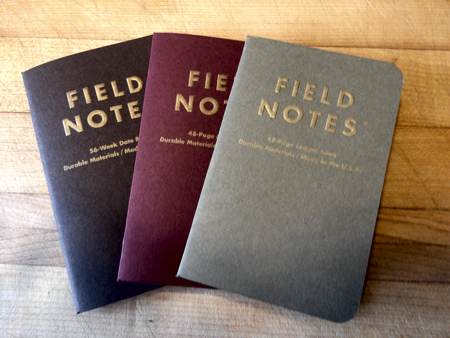
However, I am distressed at the most recent offering, their 25th release. Each release has a name—Shelterwood, Arts & Sciences, Unexposed—and they’ve named this one Ambition. It’s stunning, beautiful, and absolutely daunting.

Love the colors. Love the gilded edges you guys! Love the gold staples.

But then you open them.

AMBITION. You see what they’re about. From left to right, we have a 56-week date book, a ledger book, and a memo book.

This is serious stuff. Planning. Budgeting. Making something happen. Something big. Something important. Something consequential. They didn’t gild those edges for your paltry, quotidian concerns.

What am I supposed to do with these?? They mock me. They’re going into the archival wooden box where I will not have to look at them. I will be able to sleep at night. All will be well.

Trees by Microsoft (a public service announcement)

This year, for the first time ever in the history of ever, we switched to artificial trees.  That’s right, trees, plural, as in more than one Christmas tree.  We take our Decoratoring™ pretty darn seriously around here, Skippy.

The short reason is that our new daughter-in-law is highly allergic to conifers, which must have made growing up in the Pacific Northwest a pain.  For the record, my lovely first wife is of the opinion that I too must have some similar allergy, since I tend to become all sniffly during the holiday season.

So we bought a couple of trees, which I did not assemble because — ironically — I was not feeling well, and so my noble son did it for me.

Therefore, when I went to Decoratorate™ the tree in the living room, it took me a while to realize that apparently these trees were designed by Microsoft, because who else would neglect to include a way to mount and plug in a tree topper???

I called the 24/7 toll-free number, where a nonplussed underling gave me a “ticket number” and tossed the puzzler up the chain.

Liz called back the next day and confirmed that, indeed, there was no built-in way to put your family’s traditional tree topper on these artificial trees.  One must run another extension cord to the top, she said, and then confirmed that, no, that didn’t solve the problem since there was no stem on which to perch the tree topper.

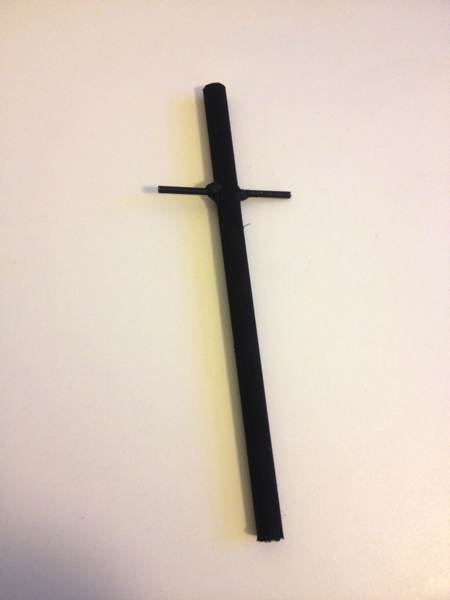
Viz:

Fortunately for civilization as we know it, the top is open-ended, and so I set about resolving the issue.  (I had already accomplished all of this by the time Liz called back, so it was depressing but gratifying to know that a) I had assessed the situation correctly; and b) there was no official solution, other than to encourage me cheerfully to blog about my solution.)

Tree toppers for artificial trees designed by Microsoft

  1. Find a piece of doweling that fits into your tree top.  Mine was 1/2-inch wood.
  2. Measure how much of the dowel needs to stick up into your tree topper and mark it.
  3. Measure down another 6″ and cut your dowel.
  4. Cut a 3″ piece of smaller doweling.  Mine was 1/8-inch aluminum.  I suppose you could use wood, but why risk it snapping?
  5. Drill a hole to accommodate your small dowel through your larger dowel, at the mark you made for the topper.
  6. Insert the smaller dowel and hot glue that sucker.
  7. Paint it whatever color works.  Mine is flat black.1
  8. Stick it in the top of the tree.
  9. Surmount it with your topper.

Viz:

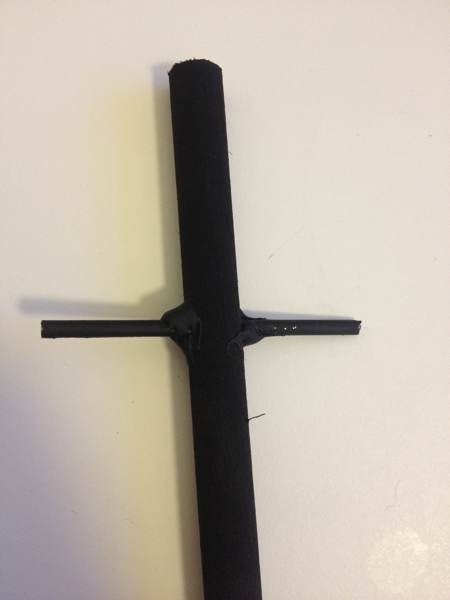
Closeup:

In situ:

Et finis:

Pro tip: Check the lights on the topper before you install it.

I could probably market this thing, right?  Maybe with an extension cord built in?

—————

1 Flat black is the color I painted the ORANGE SOCCER CONES THAT THE COUNTY PLACED IN THE HISTORIC COURTROOM FOR MY SON’S WEDDING SO WE DIDN’T TRIP OVER DATA PORTS IN THE FLOOR.

3 Old Men: mapping the field of ritual, redux, part 5

: Ritual sound & language :

[original post here]

What is the role of silence in the rite? … Do the people consider it important to talk about the rite, avoid talk about it, or to talk during it?  Are there parts of the rite for which they find it difficult or impossible to articulate verbalizable meanings? … How important is language to the performance of the rite?  What styles of language appear in it — incantation, poetry, narrative, rhetoric, creeds, invective, dialogue?  In what tones of voice do people speak?  … To what extent is the language formulaic or repetitious? … How much of the language is spontaneous, how much is planned?

The ritual itself, the transformation of Old Men, was done in silence, and I think it was good that way. I don’t know what others were doing, but I was soaking in the energy and trying to return it to my fellow Old Men and to the space. I think also that the visual of the Old Men performing their ritual in silence—as if we’d been doing this for years instead of for the second time in our lives—was quite compelling and beautiful.

(Think about that last bit, guys: we’d literally done the ritual only once before, at the runthrough out at Craig’s in September. We had no official way of making assignments or changes—and yet we did. More than one burner was astonished to find that we were Alchemy virgins, and a lot of their impression came from watching the solidity of the ritual. It looked ancient.)

Of course language was important to the agons—we had to engage the participant with the blessings/struggle. As far as I know, we didn’t actually codify the language there, although I don’t think anyone strayed very far from, “May I bless you?” / ”Will you bless me?” / “I offer you a struggle.” It doesn’t get much simpler than that.

And then language became critical for the experience: either our improvised blessing or theirs, and the choice of the struggle. Silence played its role as well: I never explained the struggle to the participant, just pushed into the space and did what felt right. Question for discussion: did anyone else develop specific language/actions for their versions of each agon?

As for talking about the rite, many people did and thought it was important to do so. I agree. I like to hear what people brought to the experience and what they got out of it. I think Craig’s instincts are correct that we should eventually provide a “decompression” space, perhaps with food and/or music.

Music was always welcome. Will’s Bach suites were amazing, and of course after sundown we always had Incendia for company. I do wonder how, if we added drumming, bells, or flute laying as a regular thing, that would work with Incendia going full blast.

3 Old Men: mapping the field of ritual, redux, part 4

 : Ritual identity :

[original post here]

What ritual roles and offices are operative—teacher, master, elder, priest, shaman, diviner, healer, musician?  How does the rite transform ordinary appearances and role definitions?  Which roles extend beyond the ritual arena, and which are confined to it? … Who initiates, plans, and sustains the rite?  Who is excluded by the rite?  Who is the audience, and how does it participate?  … What feelings do people have while they are performing the rite?  After the rite?  At what moments are mystical or other kinds of religious experience heightened?  Is one expected to have such feelings or experiences? … Does the rite include meditation, possession, psychotropics, or other consciousness-altering elements?  … What room is there for eccentricity, deviance, innovation, and personal experiment? … Are masks, costumes, or face paint used as ways of precipitating a transformation of identity?

Again, I think there are two rituals going on in our camp: the ritual we perform to become Old Men, and then the ritual experienced by those who walk the labyrinth. I’ll try to keep them straight as I move through this section.

I don’t know how others felt, but I for sure felt as if I were elder, priest, and occasionally a shaman while I was in our ritual. The transformation from Alchemy camper into Old Man never failed to ring true for me. I felt not necessarily exposed, but opening to the onlookers: “This is my body,” if you will. “I mark it, I draw attention to it, I show you the way in, and now I become an Old Man who can assist you. Follow.”

While officiating, I felt very calm—outside time—while at the same time alert to the participants and their choices. I found myself reviewing the original list of traits: solemnity, compassion, serenity, wisdom, openness, and groundedness, and trying to embody and project those to onlookers and participants.

Someone commented that they noticed that I smiled much of the time. Truthfully, it was a conscious decision on my part to return all the positive energy that I was absorbing to the environment. Alchemy and 3 Old Men made me very happy, and I wanted to give that back.

It is interesting that in the original post I was still dithering about the body paint and the nudity. I was fairly sure that it was what we needed, but at that point the troupe was all my theory and no real practice. Needless to say, it was amazing to perform and to watch. I’ll have more thoughts about this element in a couple of days when I talk about ritual action.

I am very curious as to what people’s feelings were when they walked the labyrinth. That’s one thing I want us to do better in the future: collect responses, either through interviews or with some kind of book people could write in.

Was there room for “eccentricity, deviance, innovation, and personal experiment”? You betcha. I think that’s one of the strengths of 3 Old Men, that we opened the labyrinth for others to build their own experiences. It never bothered me to see people romping through it, or stepping over the ropes to be ‘clever’ in ‘finding the way out.’ Everyone brought what they needed and took what they needed.

As I said in the original post:

I expect to see people walking the labyrinth in silence and prayer; singing and dancing; giggling and inattentive; naked; stoned and lost; smirking and cynical; hurriedly.  I expect drummers and other musicians to join us.  I expect people to be puzzled or put off by the offer of an agon; I expect some to accept it gratefully, with tears, with joy.  I expect to be quizzed—”What is this about?  How do I do it?”  I expect to be ignored.  I expect to have others expect me to be something more than I have offered.

And I expect to be transformed by all of it, to learn more about my identity as an Old Man.

And so it was.

A Rant

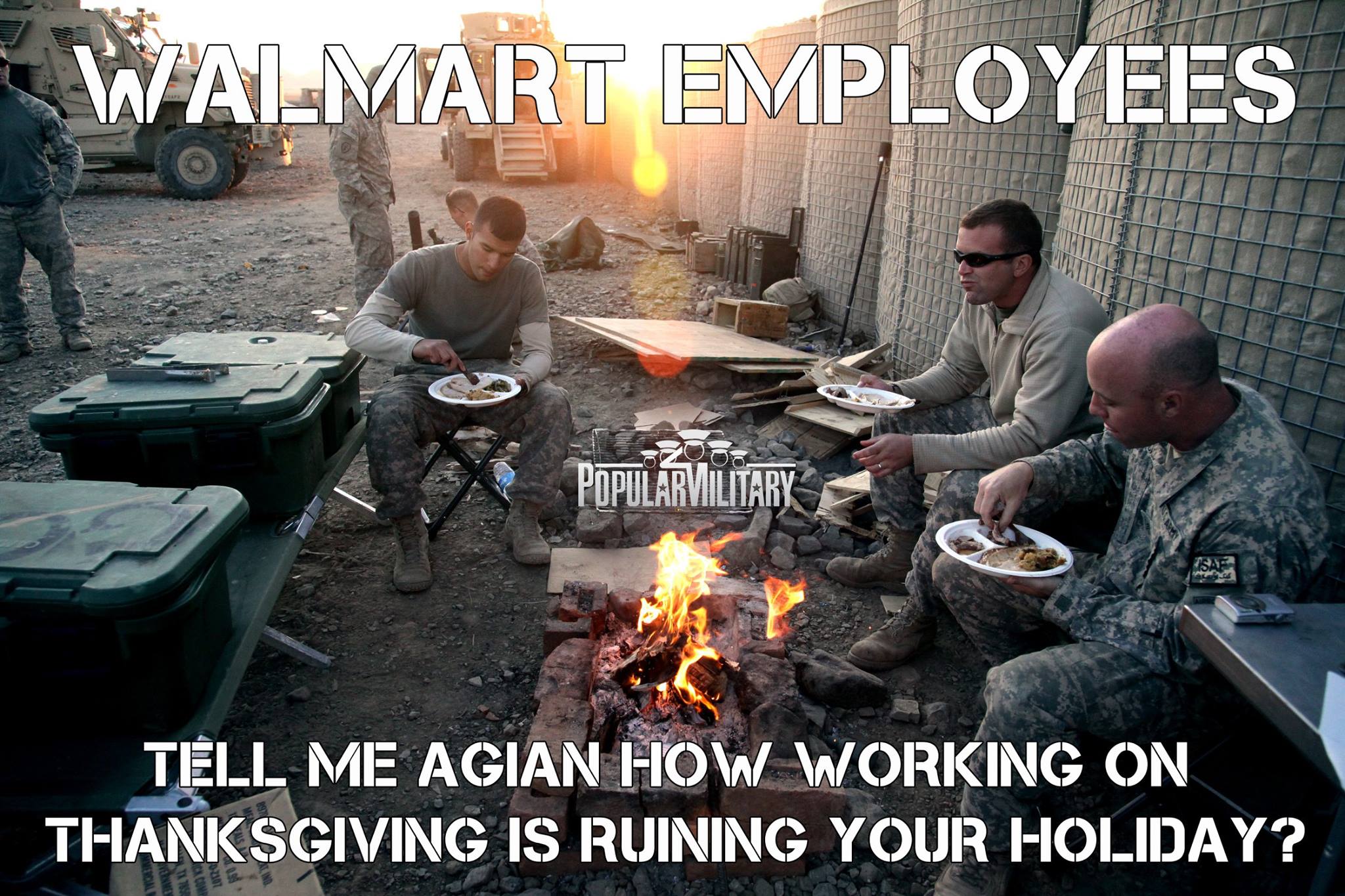
See, if I were working on the symphony like I was supposed to be, I wouldn’t run into triggers like this one:

Okay, people, let’s see if I can calmly deconstruct this:

  1. We will leave aside the inevitable misspelling, but really, nutjobs, can you never get it right?  Sometimes I wonder if you’re not all really Poes.  (I do wonder, often, whether the websites who generate this kind of bullshit are actually fronts for our corporate overlords to sow disinformation to keep the peasants riled up?)
  2. Walmart employees were not protesting having to work on Thanksgiving.  Walmart protesters were protesting their lack of a living wage.  The Walmart business model consists of paying unskilled people less-than-poverty-level wages by shorting them on wages, hours, and benefits.  The documentation of the cost to taxpayers—in terms of food assistance and Medicaid assistance—is all over the internet: Walmart workers don’t make enough to live on.
  3. Neither do many of our troops. (See also.)
  4. And above all and always, the worship of the military, surest sign of fascism.  Oh, yes you do: discounting a very real problem by comparing it to Our Boys, the Valiant, our Holy Warriors, whose daily job must be Valued Above All Others—and if anyone doesn’t Value spending trillions on wars that got us nothing but a ruined economy and an unstable region, they are Vermin Not Worthy to Lick the Boots etc etc he said and drank rapidly a glass of water.   But Walmart workers?  Who work for a huge and hugely profitable corporation in America?  They can go suck it because they are not Worthy.

I will now refrain from commenting on America’s sick addiction to consumerism.