My Reading Rat

Look at this little guy? Isn’t he cute?

I am not given, as a rule, to enthusing over such things in an overt, little-girl-squealy kind of manner, but last Thursday night we were in Decatur and visited one of our favorite stores there, Mingei World Arts, and there was a whole display of these bizarre, wonderful little creatures, about 50, all different and all of them reading.

I couldn’t contain myself.

I oohed and aahed so much over each and every one that I attracted the attention of the owners of the store who guessed correctly that I must have something to do with reading in my real life. I told them who I was, and they told me about the figures.

The school in La Union, Oaxaca, Mexico, has a library, but the children cannot take books home from there. And so Libros Para Pueblos (in Spanish, and the English button doesn’t seem to work) was formed to establish circulating libraries for the children. They can open a library and sustain it for a year for $1,000.

So the good ladies of Mengei cut a deal with the village of La Union, to donate 20% of the sales of these figuras, carved there in La Union, to Libros. I think I’m remembering correctly that they very quickly raised multiple thousands for the children.

Anyway, all of the animals are reading books. There were dogs and zebras and elephants and lions and mermaids and nearly everything you could think of. My favorite was a large cat, about fifteen inches long, with a rat dangling from its mouth, and the rat was reading a book. Of course, a figura that size is very expensive, about $200. None of them were cheap.

But I find Oaxaca wood carvings (follow the link and make sure you look at the galleries) irresistible. There’s something endlessly intriguing about them. The store had a lot more from other villages, larger, even more fantastical (and more expensive), but I had to have one of the La Union readers.

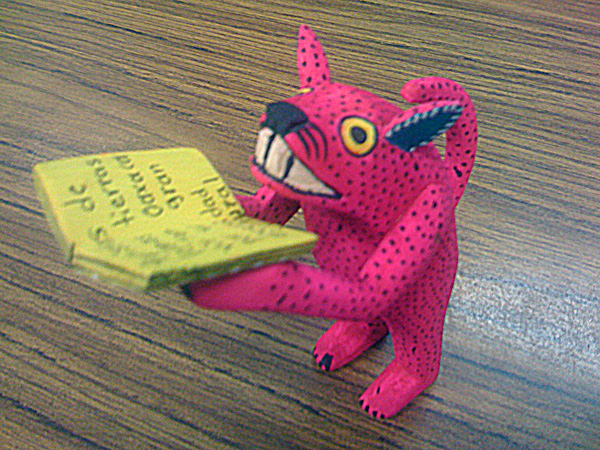
It took me a long time, but I finally settled on this little guy. His carver was Calixto Santiago, who appears to be somebody in the carving community. Color being what it is on computers, you’ll have to imagine his brilliant cerise coat, his vivid yellow eyes and book (which is purest lapis lazuli underneath), and his emerald green ears. He is no more than five inches tall.

There is some question as to his species. Others have suggested that he’s a jaguar because of his spots; I’m thinking he’s a rat because of his incisors, but he could be some other rodent. Anyway, I find him absolutely charming. I will be collecting more.

Arrrgh!

I have been reading Treasure Island, of all things, via dailylit.com, and I have to say it is a ripping tale. If you have not read it, believe all the good things you’ve ever heard about it and go subscribe to it. I subscribed to the “double dose” mailing, because I knew that one small chunk every morning would not be enough.

Labyrinth, 11/29/09

I meant to write about this on Sunday, but I didn’t get around to it.

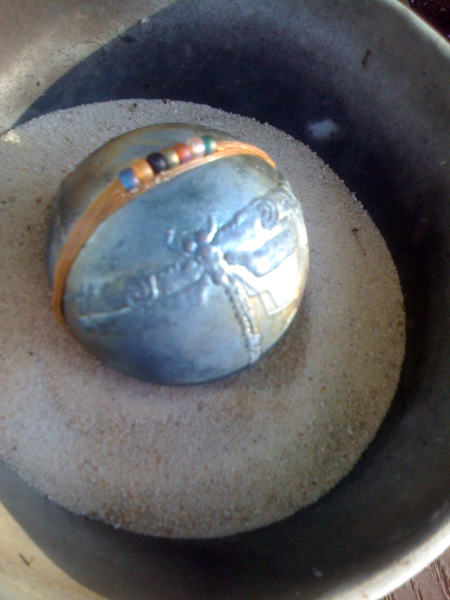
While in Key West, I bought a couple of things for the labyrinth. Here’s the first:

It’s a little fuzzy, since I took the photo with my iPhone, but essentially it’s a raku ceramic rattle. It’s stamped with dragonflies on its two halves, and then what seems to be waxed raffia holds some not-quite-what-I-would-have-picked-but-unoffensive beads, while at the same time blocking the hole on the bottom.

I figured it would be something to do a little meditative noise with while I sit out there.

I was worried about how to store it, and then the bowl I already had came to mind, along with sand to cushion it. Very nice presentation, I think, and a highly practical solution.

Mortgages and morality

I thought this was a rather interesting story. (Short version: law professor advises mortgagees whose properties are “underwater” simply to walk away from their homes and stop paying for them.)

The most interesting part was where he chastises the “social control” of homeowners by the power structure, who has hit the public hard about the “morality” of stiffing the banks. Predictably, the banks have thrown up their hands in dismay that anyone would be so wicked:

[Brian Faith of Fannie Mae] said, “there’s a moral dimension to this as homeowners who simply abandon their homes contribute to the destabilization of their neighborhood and community.”

If there is in fact a moral dimension to homeowners acting in their own self-interest, wouldn’t you agree with me that it’s absolutely horrific that the poor bankers are completely powerless to prevent it happening? Powerless, I tell you! All they can do is to sit by helplessly and get nothing of their investment back, rather than, I don’t know, a moderately reduced amount just by agreeing to negotiate with the terrorists homeowners.

And so the banks are forced to “contribute to the [immoral] destabilization of their neighborhood and community.” Personally, of course, I blame ACORN.

Oh my, part 2

Sometimes I believe the Flying Spaghetti Monster has too much time on his appendages.

From the What?? Dept., the Church of Latter Day Saints has thrown its support behind a Salt Lake City measure that would bar landlords and employers from discriminating against gay people. Yes, the same folks that paid huge bucks to pass Proposition 8 in California are not as heinous in the day-to-day press of real life, apparently. And now they’re backing a statewide bill to the same effect.

But that’s not what has caught my eye. One Chris Buttars, state senator, explained his support of this bill but continued opposition to marriage equality by saying that while he doesn’t “mind” gays, he doesn’t want them “stuffing it down [his] throat all the time. Certainly not in my kid’s face.

Sen. Buttars (I swear I have not made this up) has also stated in the past, however, that gay men and women are “the greatest threat to America going down.”

Praise be to the FSM!

Palin, oh my Palin

Oh my. Sarah Palin is proof that the Flying Spaghetti Monster loves us and wants us to drop our jaws in stunned disbelief.

Here she is being interviewed by Bill O’Reilly, who seems to be skeptical but, because of the clause in his contract that requires him to share an amygdala and at least part of his cerebellum with the rest of the FOX crowd, is doing his best to let the woman shine out. He asks her, finally, “Do you believe you are smart enough, and incisive enough, intellectual enough, to handle the most powerful job in the world?”

And I believe I can say without contradiction that she, bless her little moose-shooting heart, gives the definitive answer to that question:

I believe that I am because I have common sense, and I have, I believe, the values that are reflective of so many American values. And I believe that what Americans are seeking is not the elitism, the, um, the, ah — kind of spineless — a spinelessness that perhaps is made up for that with elite Ivy League education and — fact resume that’s based on anything but hard work and private-sector, free-enterprise principles. Americans could be seeking something like that in positive change in their leadership. I’m not saying that that has to be me.

Praise be to the FSM!

I had already purchased my Cheney/Palin 2012 bumper sticker:

Click to go buy your own!

I do have one modification to make to it before I put it on my van, though:

Labyrinth, 11/21/09

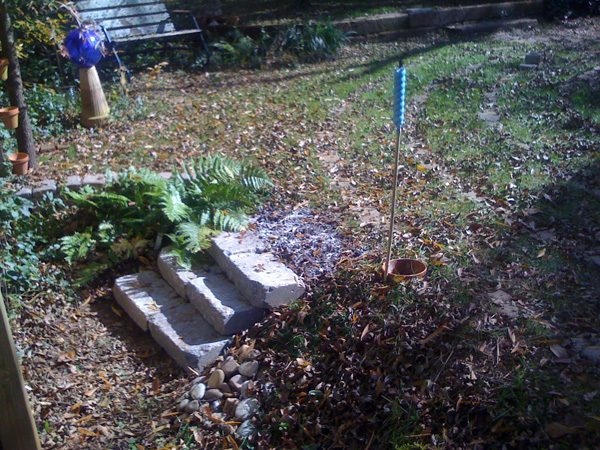
I had to build up the north edge of the labyrinth in order to have a level surface. Consequently there is a small embankment there. I have planted peacock ferns on the shallow end, but didn’t have enough to do the whole bank.

The problem was that at the deep end, where the autumn ferns are, the embankment was difficult or impossible to mow. The mower just chewed off the grass and dirt. Also, I found myself needing to step up that embankment every time I went around to light candles.

Since the element of North is earth/dirt/stone, I decided to install a little stone stair, solving all my problems with one solution.

Yes, there is a little cairn of stones next to the staircase, left over from the drainage pipe under the omphalos bowl. I need to embiggen it.

Anyway, there’s the latest addition to the space. I think I will tackle the western stone circle sculpture next.

Art

I had an interesting experience last night, in which I encountered a work of art that affected me viscerally, aesthetically, and intellectually. It was especially powerful because I had not gone in expecting to be so affected.

The opera Orfeo ed Euridice by Gluck is one of those that everyone talks about being so wonderful, but I had never seen nor heard it. I made a feeble attempt yesterday at becoming familiar with it, but downloading it and giving it quick listen on the way up to the Cobb Energy Center (Atlanta Opera’s current home) wasn’t enough.

If anything, that prepared me to be disappointed. I found the piece to be ponderous, just so much early classical dithering. “Pretty.” I knew that these early works (like the works of Handel, Haydn, and Monteverdi) have found favor in the past forty years, but I also knew that it takes a pretty slick director to make them work, usually by layering “meaning” on top of the music. I was sanguine about my prospects for the evening. In fact, I stopped and bought a mini-Moleskine to slip into my jacket so that I could write down my ideas during intermission(s).

The notebook remains unsullied. I was captivated from beginning to end.

The music was beautiful. What was muddy and ponderous in the recording I downloaded was clear and limpid in performance. Part of that is the difference between live and recorded, part was the interpretation. While it rarely moved me or thrilled me the way that Boheme or Elisir d’Amore or Figaro do, it was simple and gorgeous.

(I’ll say right now that Gluck’s much-vaunted “reform” of opera is not just hype. Rather than a succession of florid vocal showpieces, the show was taut and moved right along, clocking in at 85 minutes without intermission.)

The production was designed by John Conklin, originally for the Glimmerglass Opera Festival. You can see photos here (pdf, but worth it). That was the first pleasant surprise: a hyper-competent intelligence guiding the look and feel of the thing. It didn’t overreach into vague postmodern metaphor, it simply provided a good-looking and coherent mise en scène for the action of the opera.

The performers were topnotch. Countertenor David Daniels knocked Orfeo out of the park. Yes, it took a little while to get used to an alto voice coming out of the throat of a man, but it didn’t take long. Katherine Whyte was a beautiful Euridice, and both she and Deanne Meek as Amore were very effective actors. (You may remember my complaint about the soprano in Elisir last time.)

But it was the direction of the piece that bowled me over. Lillian Groag did a phenomenal job of structuring stage pictures to fill the music. The overture was a harvest festival, with all the usual peasant business, ending with a joyous round dance that ended abruptly as the dancers realized with a shock that Euridice had fallen in their midst. That set up the opening number, which is a chorus of mourning. Orfeo’s punctuating cries of “Euridice!” began offstage, a nice touch: rather than a repetitive “woe is me” effect (as the original score suggests), we were led into action as he learns of her death and then comes onstage to confront it.

It was the ending, though, that sent me soaring out into the evening. This version of the story has a happy ending. Yes, I know. After Orfeo cannot resist Euridice’s pitiful pleadings, he turns and embraces her, and she dies a second time. It was actually quite affecting. So he lies down to die himself, but Amore shows up and rewards his corragio by bringing Euridice back to life again.

Happy ending, triumph of love, etc., etc. The chorus streams onto the stage to celebrate. The happy couple are seated, and before them two dancers, dressed in gleaming robes of white and gold, re-enact their story to the final chorus: they’re in love, she dies, he journeys, she awakens, they journey, he turns, she dies again.

And then…

The dancer Euridice does not arise again. The dancer Orfeo turns in puzzlement to Amore, but she has turned and is walking upstage. She’s leaving. The real Orfeo leaps to his feet, distressed. The chorus reaches out in dismay to Amore, and on the last note of the opera, she turns to look over her shoulder, her face an enigma. Blackout.

Whoa.

I barely had time to see it coming. What had been a lovely rendering of an 18th-century classic was suddenly wrenched into the 21st century. The original myth, with its themes of love and loss, was suddenly, awfully, terribly restored to its rightful focus, subverting the artificial happy ending of Gluck’s audiences and throwing our humanity into the bright light of mortality. Absolutely wonderful.

Painting, 11/12/09

The madness continues.

Click for full-sized image

Again, much change, and I don’t know why or whether it’s for the better. I look at the painting, I think, well, it needs more balance here, or it needs more movement here, or how about this color over here, or geez it’s all crap why don’t I just cover it with white?

The next to go will be the vertical line on the left.

I keep thinking about the little blobs swarming the yellow glow and being rebuffed, but I’m not sure that’s right either.