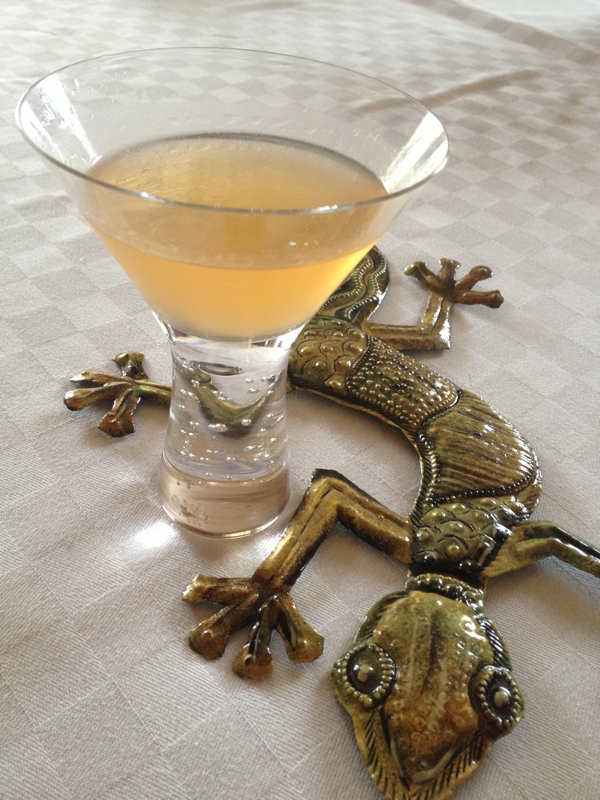
In my continuing exploration of Forgotten Cocktails, I came across the Barnum (Was Right) Cocktail. I’m not sure whether one is supposed to call it a Barnum or give it the full Was Right treatment.
I was completely taken with the drink; it’s now my favorite, both in its original form and in my tweak of it.
Barnum Cocktail
2 oz. gin
1 oz. apricot brandy
1/2 oz. lemon juice
2 dashes Angostura bitters
Shake with ice, strain into a cocktail glass, garnish with lemon twist.
Very very nice.
Since the Lovely First Wife doesn’t care for gin (although she liked this drink), I tried it with vodka and Peychaud’s bitters for a slightly rounder taste. It’s OK with this variation, but if you use Karlsson’s Gold vodka, then you really have something. The earthy tones of the Karlsson’s completely fill out the flavor.
I began unpacking my old office stuff, and doing so raises an issue: what to do with all that stuff.
I had four large plastic tubs filled with stuff from my office: books, folders, decorative items, a veritable medicine cabinet, a small flock of tools, rulers, pens, inks, markers, sticky notes, labels, teas, a coffee maker, memorabilia, and an “idea card stadium” with hundreds of idea cards.
All of this flotsam was largely in duplication of stuff I already have at home. Those of you with an office know how it is; you need a second stick of deoderant at work for those days when your brain can’t even manage the unconscious ritual of your morning toilette. (Oh, right, like that hasn’t happened to you…)
So what is one to do with an actual duplicate desk? How does one merge two worlds when one of them no longer exists, especially when there’s barely enough room for the one that’s already there?
Truth be told, that’s why it’s taken me a month to even look at those tubs. It wasn’t going to make me all maudlin about my cubicle in the Twin Towers overlooking the Capitol—I just couldn’t manage thinking about where I was going to put everything.
I’ve kind of done it. At least the tubs are empty; not everything has found a home yet, nor will it for a while longer. But the tubs are empty. Now I’m looking around my study and thinking I need to completely overhaul it so that I will have a place for all my stuff.
Why I could go to work for 36 years and not be bothered by the fact that I didn’t have a place for all my stuff is quite irrelevant. Now that I’m at home all day every day and rapidly approaching that new period where I will actually start being productive/creative again, it is critical that I reorganize/redesign/restructure the study so that I have a Place. For. All. My. Stuff.
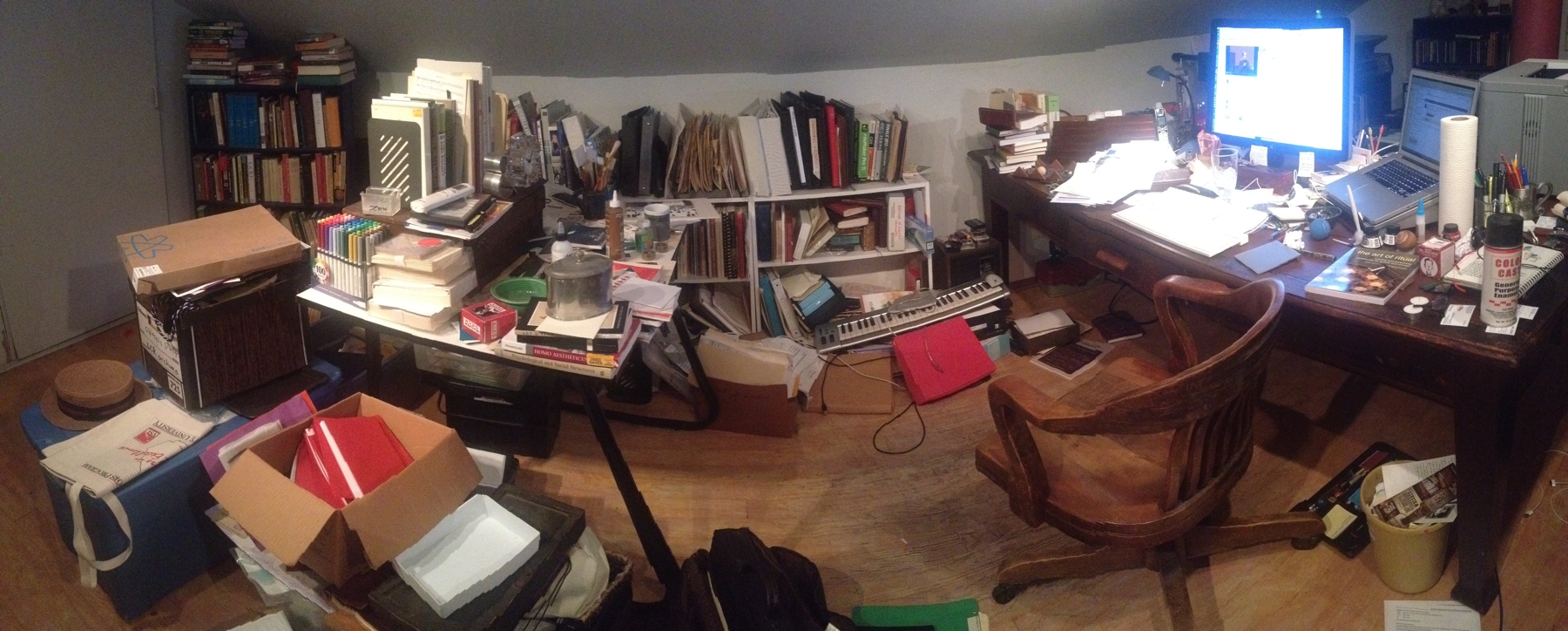
I mean, look at this:
click to embiggen
Let’s just look at the stuff here and pinpoint why it’s even in my study.
On the left, a big blue tub of material I used to carry to GHP as assistant director. It didn’t make the trip in 2012 or 2013. Atop that is a box of my old choral music, and on top of that is memorabilia from my office.
Ignore the books in the back.
At the bottom of the photo, underneath where you can’t see it, a tub of material from Lacuna Group’s work on William Blake’s Inn. Atop that, a painting (unfinished) from the Field series; a box of art paper and envelopes; to the right of that, a desk tray, and an old wooden box with office supplies, and under that, the large blank book in which I will write A Perfect Life (some day). To the right of that, my leather satchel, formerly used for travel to the office, now my Lacuna kit.
On the table, markers, glue, paint for various thinks, like Artist Trading Cards and more paintings; books on the creative process; more cards/envelopes. A large wooden box with drawers of music score paper and other implements. On top of that, two DVDs on mixing colors; books on orchestration and composition, rhyming dictionaries, drawing books, and three study scores: Brahms’ 4th, Shostakovich’s 15th, and Strauss’s Death & Transfiguration.
Under the table where you can’t see them, my drawing box/kit, a Lacuna Group tub for our “bear/giraffe” piece, and the original pages of my Mozart’s Marriage of Figaro. Plus two blank Moleskine notebooks that I have just now reclaimed to begin doing morning pages.
On the shelves behind the table, books, but also folders of materials for setting to music; copies of William Blake’s Inn and A Christmas Carol; stationery; blank books, some of which have ongoing narratives in them (Figaro, William Blake, the Symphony, etc.); a box of videocassettes of the 2002 production of Figaro.
In front of the shelf, a folder of paperwork for my mother’s estate; full scores for William Blake and the Symphony, plus a pile of scores of three decades of abortive attempts; the keyboard; letters from Craig, and trailing out there on the right, more stationery and a book on counterpoint.
On the desk itself, on the left, a stack of books on ritual and liturgies, topped by The Book of the Labyrinth. Behind those, the source books for the 24 Hour Project, plus folders of texts. The little triangle thingies are a fold-out box that originally held Singer sewing machine attachments and which I am configuring as a little assemblage/icon piece. Behind that, the aforementioned idea card stadium, noticeably empty.
A stack of papers that haven’t found a home yet, including my separation paperwork from the DOE; another blank book, half buried; two computer keyboards (duplicates, remember?); desk detritus; the copper of my Lichtenbergian Chalice, silently affirming my inactivity; a small wooden pencil box containing ink pen nibs for lettering in The Book of the Labyrinth; the computer monitor, with two sticky notes of 24 Hour Challenge texts; a lifetime supply of sticky notes; the laptop; inks for Book of the Labyrinth; another book on ritual; a blinking red reindeer nose; pens; paper towels; a reference book on knots.
You can ignore the trashcan.
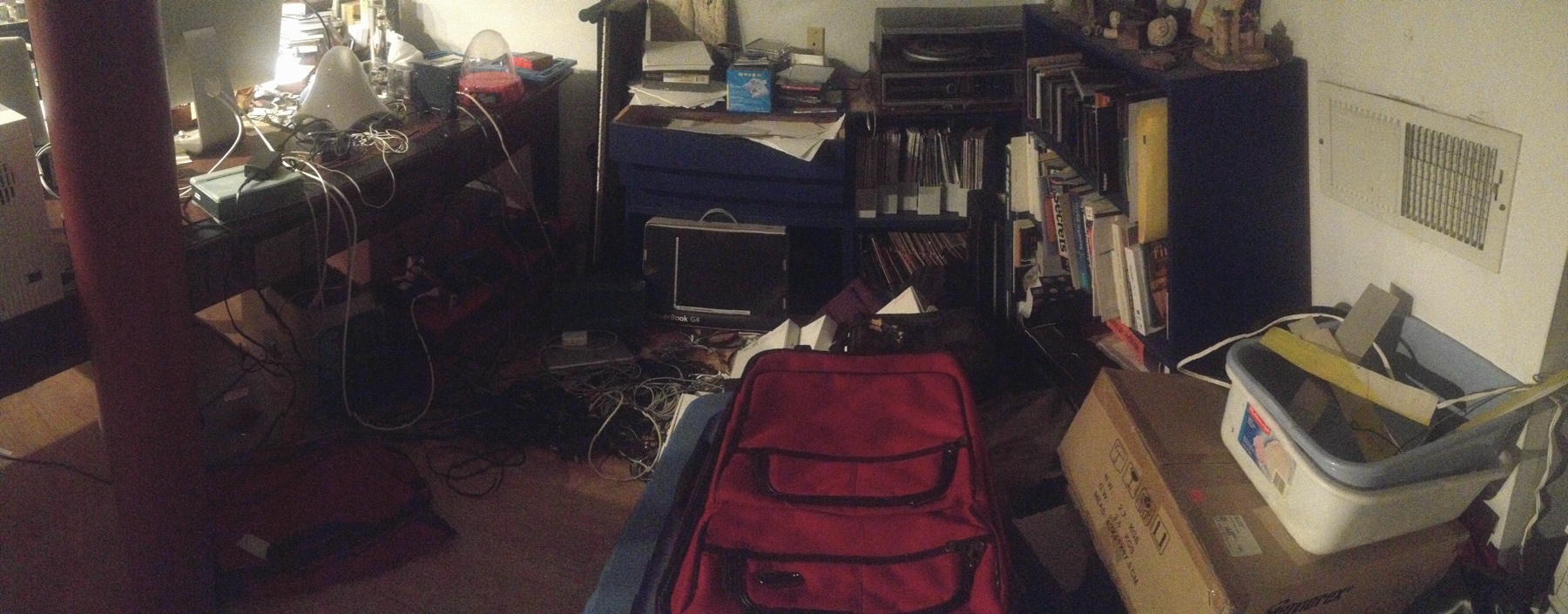
Continuing on the other side of the desk…
click to embiggen
The backside of the technology, including a little shelf unit for the multiplugs and chargers; my old G4 and Grayson’s old iMac; a mess of mostly audio cables which used to live comfortably in a purple computer bag; another keyboard and stand; printing paper supplies; every box of every Apple product I’ve bought in the last ten years; paper for the printer and drawers that haven’t been opened in fifteen years; old issues of Mac magazines; my Lovely First Wife’s old quadraphonic stereo (and 8-track player!); shelves of old software and books that are largely useless; my old SE-30 and two old synthesizers; a Memorex turntable that could potentially digitize any album we want to if we’d take it out of the box and set it up.
I will spare you the photos of the other bookshelves, the CD shelves, and (behind me in the two photos above) my college drafting board; various art supplies like chipboard, canvas boards, sketch pads, a paper cutter (one of two now), rulers, Lacuna Group stuff. Plus a tall cabinet of art supplies and printing supplies, and a filing cabinet.
I should be a busy, productive artist, but it will take me until 2014 to reconfigure all this stuff. Don’t expect new works from me until then. At least that will be my excuse.
I came across this video yesterday, and it had a curious effect on me: I cried.
The video was produced at Coláiste Lurgan, which is one of several summer schools in Ireland established to teach high school students Gaelic. (Astute readers can see where I’m heading with this.) The song itself is by Avicii, a Swedish DJ/remixer/producer, and apparently Lurgan developed a habit a couple of summers ago of doing Gaelic covers of popular songs.
This one has gone viral, and it’s not hard to see why. It’s infectious even if you don’t know the background, and the professionalism of the production is impressive. Frankly, I found it more appealing than the original.
You might reasonably suppose that it brought tears to my eyes because of my recent dismissal from GHP, but that is not entirely the case. It would have brought tears to my eyes anyway, just as each summer’s group of GHPers make me weepy the entire last week.
Here’s why: the video is an exceptionally pure example of the white-hot intensity of that kind of experience. These young people have bonded over that life-changing experience; they are a tribe in the best sense of the word. They are extremely talented—remember, this video was produced at a summer camp—and you can see the joy and commitment they bring to the project.
And I at least cannot escape the sad underlying truth that this kind of thing is so very, very impermanent. Part of the sadness stems from their youth: everything is intense, so beautiful (and let’s admit it: the lead singer is gorgeous), and it will not last. We old folk know that, and kids who live through a GHP learn it too, painfully.
Full admission: there is a small number of songs that make me cry for exactly the same reasons. Each summer, the RAs have dances for the kids on Saturday nights, and each summer they select a “last song.” It’s usually a power anthem with a rousing, heart-rending chorus, and it closes out the dance. It also becomes a symbol for the entire experience, and whenever it plays, 700 kids (and me) get misty-eyed. My lovely first wife and I were dancing at a wedding reception last fall when the DJ played one of those songs, and I just had to keep dancing with Pavlovian tears streaming down my face.
Perhaps my loss of GHP made it even more painful to grok this video than it might have been otherwise, but I don’t think so. I’ve been mourning its loss for years, right along with each generation of kids. Go raibh maith agat, daoine óga!
Recently we had landscape people come in and reconfigure the upper part of the back yard, i.e., “Ginny’s part.” The plan is to make it an entertainment area, and it’s coming along nicely.
However, one part of the renovation was inadequate:
The edge of the flowerbed was just messy. The black mulch spilled onto the driveway, and worse, onto the new zoysia lawn. You can barely see at the far end where I began edging it with brick, which contained the mulch—but I ran out of brick. (All the brick in our landscaping came from the old coal furnace chimney that was toppled when we added on the back of the house.)
So I decided to build a wall:
Here’s the beginning of it, swerving out of the existing brickwork at the head of the flowerbed. This is about 200 pounds of flagstone, my first day’s purchase. It gave me about five feet of wall and was enough to figure out what I was doing and how much I might need to complete the entire 25 feet or so.
The first aesthetic issue I encountered (other than blending the start of the wall with the brickwork) was that if I just followed the paved driveway straight to the lawn area, it would be an incredible boring straight wall. So I curved it:
That meant having to lay in larger pieces for the first row; I thought about leaving that setback area for planting, but decided against it. The soil at that level is mostly clay.
That photo is after I bought 400 pounds more of flagstone. By this morning, I had used all of it:
Notice what I’ve done there at the juncture of the driveway and the lawn:
Since there has to be a “stepdown” in the level of the wall there anyway, I’ve added a little pillar that will be taller than either and which will serve as a platform for candles, etc.
All in all, an easy project and a fun one. I’ll get the remaining flagstone tomorrow or Tuesday and have the whole thing finished by the middle of the week.
The labyrinth itself?
It doesn’t look quite this good at the moment. A lot of the new grass which sprouted bounteously during the rains of a couple of weeks ago simply collapsed weakly without the rain. Very frustrating.
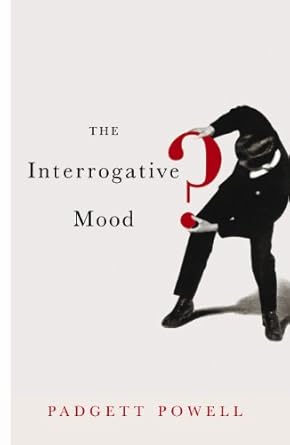
I am tackling once again after a long hiatus The Interrogative Mood, by Padgett Powell, a marvelous little novel (?) that consists of nothing but questions. To wit:
“If you had enough money to live on, could you see yourself retiring to a small village in France and never being heard of or from again, and not speaking French when there, mostly because you can’t, but also because you have nothing to say and you’d have no one to say it to if you had something to say, and mostly just sleeping in your quaint medieval stone cottage? Could you make do with a little exercise once in a while and a piece of Beaufort of very high quality? And maybe a look-in on the pigs? What if the cartoonist R. Crumb were your neighbor?”
And that’s where I had to stop reading.
I am in Beaufort, SC, and the Writer’s Almanac email this morning heralded R. Crumb’s birthday, noting that he had retired to a chateau in France.
This kind of thing happens to me all the time, and it’s unnerving. Usually it’s with the crossword puzzle: this morning I read that Slawomir Mrozek, the Czech playwright had died, and I mentioned it to my lovely first wife, who was doing the crossword puzzle. I reminded her of the the production of The Cuttlefish for which we had had to work on costumes at UGA—I was mistaken: Cuttlefish was by Witkiewicz—and she immediately said, “The clue I’m looking at is ‘cuttlefish kin.'”
In yesterday’s post, I began rambling about the joys and challenges of exploring vintage cocktails, those drinks that have vanished from the beau monde for one reason or the other, and we had gotten to the part where I’m enumerating the problems that arise with this hobby.
The first one was availability of materials, and it’s often a problem in Jigger, Beaker, & Glass, since it’s a reprint of a book from the 30s. Everybody used to have pastis just sitting around, I suppose, but today you really have to look for it.
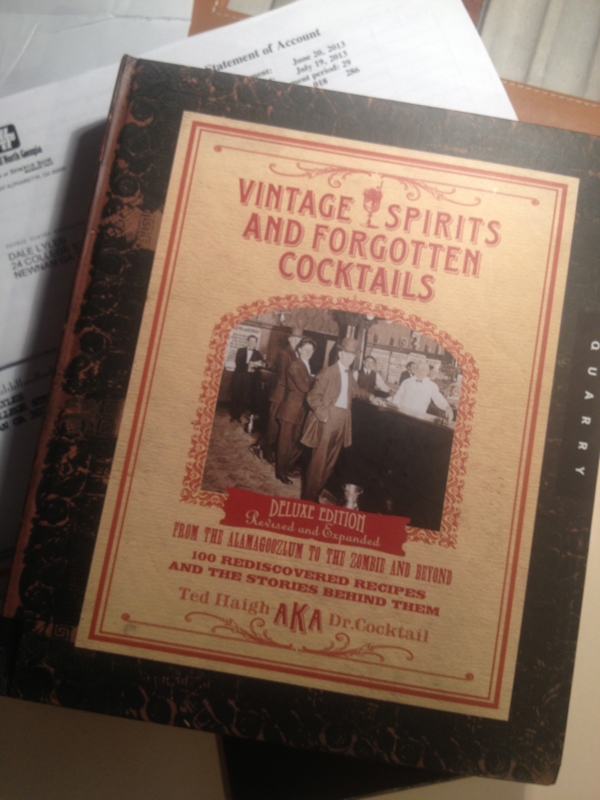
It’s not as much of a problem with this book:
Vintage Spirits and Forgotten Cocktails, by Ted Haigh (no really), is a spiral-bound notebook of 100 recipes, accompanied by their histories and photographs of period bottles, etc. Mr. Haigh (no really) made availability of materials part of the criteria for inclusion, and where the liquid in question no longer exists he lists acceptable substitutes. There are still rarities—it took me forever to find Parfait Amour, for example, and that was before I got this book—but on the whole it’s a great book in that regard.
In fact, Mr. Haigh relates how he was involved with the revival of bitters as a staple of the 21st century bar. I remember recipes calling for something as simple as orange bitters, and for the longest time there was no such thing on the market. Finally my friend Jim discovered that the Fee Bros. were making bitters again (and Mr. Haigh talks about that), and he sent me a starter kit of orange bitters, orange blossom water, mint bitters, and regular Fee Bros. bitters. Now of course there are all kinds of bitters on the market. I’ve added lemon and grapefruit bitters, plus Peychaud’s from New Orleans. Celery is next on my list.
I have taken to writing notes on the drinks in the margins, both in Forgotten Cocktails and J/B/G, so that I remember from one exploration to the next what I thought of any particular drink, including any notes to changes I might make the next time I make it. I feel like the Half-Blood Prince.
And that leads to our second problem: vintage cocktails often taste funny. Charles Baker lays down very strict rules about the number of ingredients in J/B/G, so that helps avoid the car crashes of some of today’s libations, but tastes change. Most of those neo-glamorous Mad Men cocktails, for example, are sweeter than you might be used to.
A great many of the Forgotten Cocktails involve fortified/aperitif wines like vermouth or Lillet Blanc or Dubonnet Rouge, and to my palate they tend to overwhelm most cocktails. (I am one of those who will shake gin in a shaker, pour it into the martini glass, then spray a light mist of vermouth on top and call it a martini.) In the front of the book I have written that many of these cocktails have “a sticky/sweet foretaste, a bitter aftertaste, and a vermouth-like overtone.” I then abbreviate that as SBVO for use throughout the book, and I tend to avoid recipes with more than a hint of vermouth.
Having said that, Forgotten Cocktails is more successful than J/B/G in its selection. (I don’t think J/B/G was curated so much as poured out.) Some of Baker’s concoctions are just plain funky tasting; most of Haigh’s are at least valid even I don’t like them.
The problem of taste means that once you’ve mixed one of these and you find that the thing is an assault on your sensibilities—what then? Be resolute, my friend, and dump it. Straight into the sink. Don’t be a man about it and finish the nasty thing, or worse, finish it because it would be a “waste.” Dump it.
Because we have to consider the third problem: Exploring these recipes can make for a very short night. You are after all pouring a lot of alcohol down your throat, and it would be smart to stop before consuming three. Don’t waste one of your slots on a vile drink. Toss it and pick a new one.
The sensible option, of course, is to make a tiny version using the proportions of the recipe. Teaspoons instead of ounces, so that you’re swallowing a tablespoon instead of half a cup.
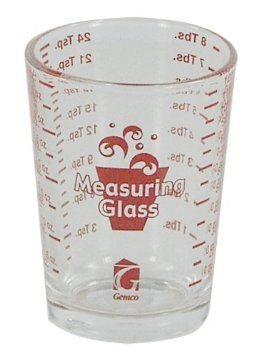
For this you need the following device:
It has a four-ounce capacity, and it’s marked for tablespoons, teaspoons, ounces, and milliliters. It’s an excellent way to make a tiny Algonquin Cocktail so you can confirm that it has too much vermouth in it ever to pass your lips again, without having to waste a whole jigger of rye.
So what fabu cocktails have I discovered that have become part of my stable of offerings?
The Miyako Hotel Special is one of my earliest discoveries (in J/B/G): gin, Grand Marnier, pineapple juice. Yummy.
The Gin-Blind: gin, cognac, curaçao, orange bitters
From Forgotten Cocktails so far:
The Pegu Club Cocktail… and friend
The Bebbo: gin, lemon juice, honey, orange juice
The Brandy Crusta: lemon juice, cognac, orange curaçao, bitters
The Corpse Reviver #2: gin, Cointreau, Lillet Blanc, lemon juice, drops of absinthe
The Honeymoon: Calvados, Benedictine, orange curaçao, lemon juice
The Jack Rose: applejack, lime juice, grenadine
The Jupiter: gin, dry vermouth, Parfait Amour, orange juice
The Mamie Taylor: scotch, lime juice, ginger beer
The Monkey Gland: gin, orange juice, grenadine, absinthe (This one is phenomenal!)
The Moscow Mule: lime juice, vodka, ginger beer
The Pegu Club: gin, Cointreau, lime juice, bitters (This one is also phenomenal!)
The Seelbach: bourbon, Cointreau, Angostura and Peychaud’s bitters, champagne
The Twentieth Century (as in the train): gin, Lillet Blanc, creme de cacao, lemon juice
The Vesper (yes, the James Bond martini): gin, vodka, Lillet Blanc
The Widow’s Kiss: Calvados, Chartreuse, Benedictine, bitters
Those are the ones I’ve tried and would repeat. There are quite a few I haven’t tried yet for lack of the proper ingredients. (Swedish Punsch, anyone?)
I like my hobby—it’s always a blast to discover a cocktail from another age. It keeps the palate from getting bored with the quotidian gin & tonic, but beware: once you start down this path you will have one more problem facing you, and that is that these are in fact forgotten cocktails. You have to type your favorites into your notes and be prepared to whip out your iPhone at any point to show a bartender what you want. However, most are extremely obliging if they have the ingredients, and the really good ones already have a copy of Forgotten Cocktails behind the bar.
If you are at all of a drinking disposition—and who among us is not?—you have spent time in bookstores/cookery* stores looking at books of cocktail recipes. (Other than the two main books I am about to discuss here, buy the Ultimate Bar Book and be done with it. Or pony up for the iPhone app Mixologist. Trust me.)
Once your grown-up palate is accustomed to the basics, you start looking abroad, and the first thing you check upon being seated at any new restaurant is the cocktail list. Do they have anything interesting, i.e., not a sweet argle-bargle for the ladies who lunch? Leon’s in Decatur always has the most interesting, but not a lot of it is transferable. What is one to make of their “bullet & trigger”: bulleit rye, zucca amaro, cocchi rosa, cherry, acid phosphate. Wait, what? Hold that thought, it will resurface in a moment.
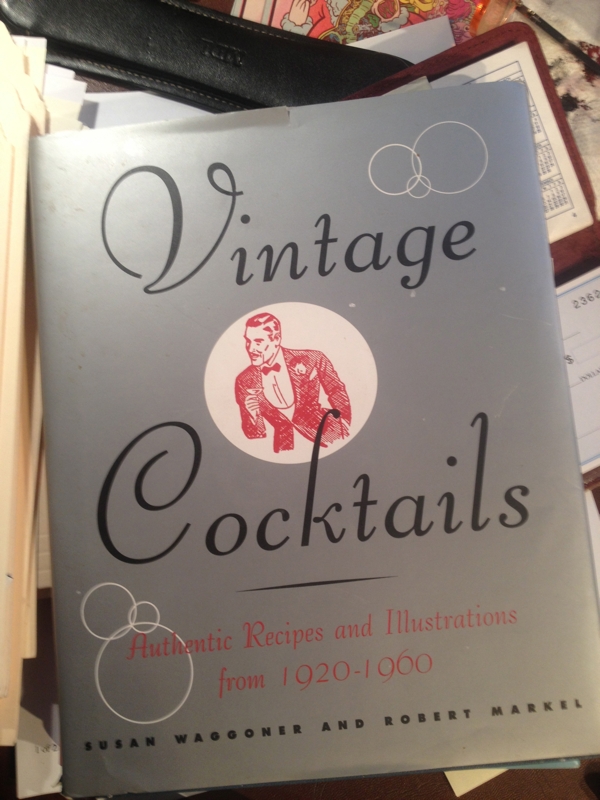
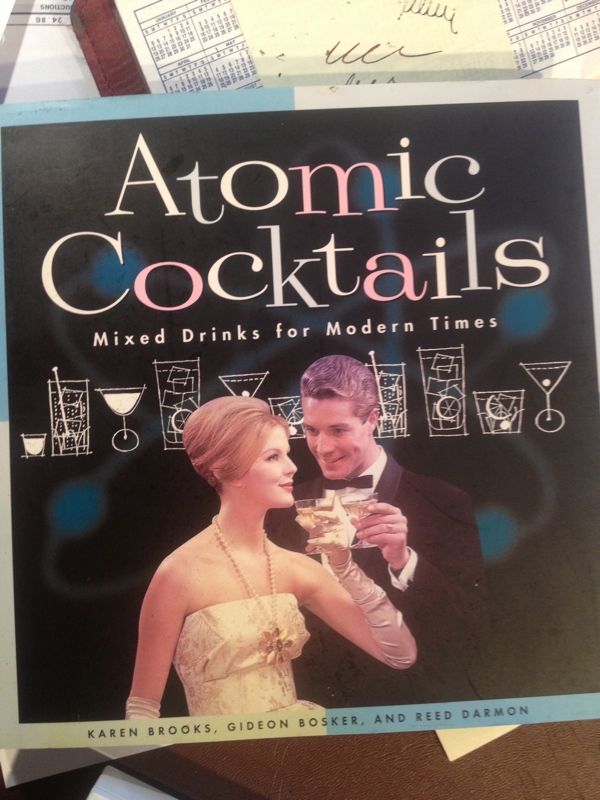
So as I browse through bookstores/cookery stores, one of my fascinations has been cocktails from the past. What concoctions did our forebears enjoy, how were they made, and why can’t I just step up to the bar and order a “Miyako Hotel Special” without whipping out my iPhone? I present a couple of those here:
These two are just chock full of COCKTAILS EVERYBODY ALREADY KNOWS ABOUT. I mean really, a Manhattan? Or a French 75? Honey, please. These books are just hipster posers for novices.
No, I’m talking about the seriously long-gone concoctions that no one any longer orders. Just imagine Leon’s’s “bullet & trigger” fifty years from now.
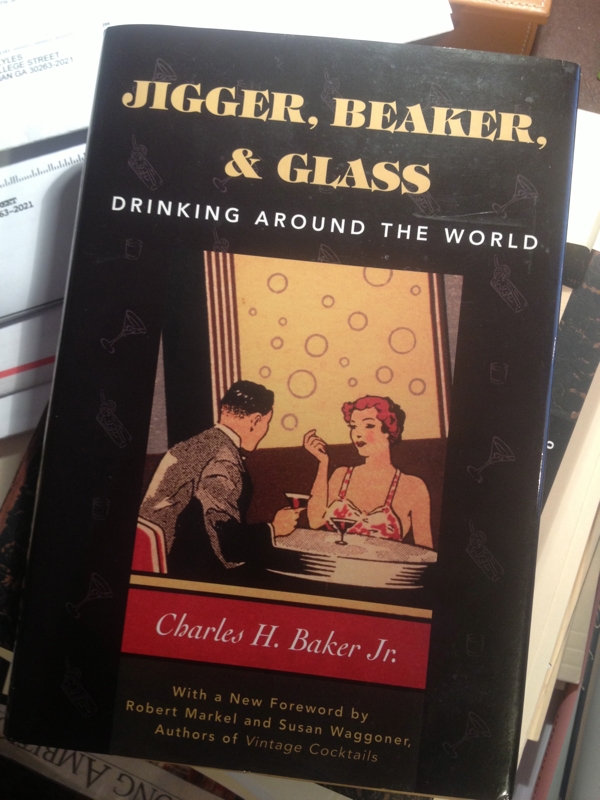
Fortunately, I have two books that will sate anyone’s appetite for these things. The first is Jigger, Beaker, & Glass: drinking around the world, by Charles H. Baker, Jr. (It’s a re-issue of Baker’s original Gentleman’s Companion, and I just noticed features a new foreword by the authors of Vintage Cocktails. Oops.)
Baker was a bon vivant who swanned around with Hemingway and the gang back in the 20s and 30s, and he collected cocktails.
From the original preface, in which he pooh-poohs Prohibition:
We also doubt if any lemonade social ever afforded a thrill like the moonlit night in Ceylon when we went to a Hollander friend’s beach bungalow out beyond Galle Face, where we swam in the blood-warm Indian Ocean and drank enough of his Flying Fish cocktails to do, and lay on the cool sand and listened to Tauber sing Dein Ist Mein Ganzes Herz on the gramophone. Then when we swam again we slipped out of our suits to make the water feel better, and finally, when it was very late indeed, we dressed and said goodnight and vowed eternal friendship to our host; then for precisely no reason at all dismissed our waiting carriage with a flourish of gross overpayment and walked all the way back in our evening clothes through a new quiet rain to the jetties and the motor launch, just in time to prevent one of our best American cruising friends from consummating bribery of the Quartermaster on the good ship RESOLUTE into letting him hoist a purchased baby elephant—whom he said was Edith, and over whom he politely held a Burmese parasol of scarlet oiled silk—from a hired barge onto the forward cargo hatch in a sling!
Well, hello sailor!
Here he is talking about an actual cocktail:
THE RANGOON STAR RUBY, a Wonderful & Stimulating Cocktail from Lower-Burmah
In 1926 we disembarked in Burmah from a round-the-world ship, and spent several days there before hopping off to Calcutta in a little “Bibby” boat carrying a mess of Mohammedan pilgrims headed for Mecca as deck passengers, and who did all their own cooking right down there in plain sight. In Rangoon we joined up with several folk in the Strand bar of evenings to chin about the romantic Mandalay country far up the Irrawaddy River, and to talk over gems with Hamid and his brother from Colombo and Bombay, and to acquire a really fine zircon for someone else and a set of star sapphire dress studs for ourself. One American headed out on leave from certain ruby mining operations up-country told us he had invented himself a drink that everyone up at headquarters liked so well he was going to shout it to the world so that no man might be denied its virtues. He popped behind the bar before we could say “knife” and whipped up the following mixture which, due to its color, he had christened the Star Ruby.
Take 1 jigger of good cognac, 1/2 pony of cherry brandy, 1/2 pony of French vermouth, 2 dashes each of orange bitters and lemon phosphate, then for added flavour 1 tsp of kirsch, or 1/2 tsp of maraschino. Shake with finely cracked ice, pour into a wine glass leaving a little ice floating, and let fall 6 drops of grenadine in the center of this chilly expanse for the ruby color touch.
Who can resist that kind of style? However, the experienced drinkers among us will already recognize a couple of problems.
Our first problem with vintage cocktails: many of the ingredients are no longer freely available. Lemon phosphate, anyone? (Well, actually…) It’s like trying to make a bullet & trigger at home. (And don’t get me started on Cynar, which shows up with depressing regularity in modern cocktails, or at least did last year, and which is unavailable in any liquor store I’ve checked.)
And even the ones that are freely available—who has all that stuff lying about? It leads to madness, trying to collect all those liqueurs and mixers and bitters and phosphates, and I should know: my bar now occupies the 1920s French pastry display case in my living room, two shelves in the front hall closet, and a separate bar for single malt scotches in the playroom downstairs. But, hey, I can make you almost anything but a bullet & trigger.
It’s lunchtime, and I will postpone my further ramblings (and the second book) till tomorrow.
_____
* Cookery was the actual, honest-to-God subject heading from the Sears List of Subject Headings the last time I looked. I think. The PTB might have changed it to Cooking before I left the media center, but I don’t think so.