Too much music

There is too much music. Not mine, of course. Of that stuff, there’s not nearly enough. (The other day, a student asked me how much music I’ve written. According to iTunes, less than two hours worth. Feh.)

No, there’s too much music out there. I say this because as part of my fragmentary composition exercises, I went to iTunes to listen to the opening of Vaughan Williams’ 2nd Symphony, “London.” I don’t own it, and considered buying it, but then I got sidetracked by his 7th, “Sinfonia Antarctica,” a stark work. I bought it, along with his 8th. Then I got distracted by the fact that a movement from Philip Glass’s 4th Symphony, “Heroes,” was the top ringtone.

I knew I owned that, but it was not in my iTunes collection, and then I couldn’t find it on the shelf. So I bought it.

At this point, I think my iTunes collection is officially bigger than my old iPod. And I’m OK with that. The new iPod Classic will store 120GB of music, but the fact is I don’t have that kind of space on my hard drive. I could put it on my external drive, but then my music wouldn’t travel with me on my laptop.

But that’s not what I mean by “too much music.” There’s just too much to listen to and to learn and to know. Right now on my desk are two stacks of CDs, waiting for me to listen to them again and get to know them:

  • Michael Harrison, Revelation, a microtonal thing, I think.
  • Brian Eno, Discreet Music
  • Philip Glass, Symphony No. 8
  • Philip Glass, Symphony No. 3
  • Einojuhani Rautavaara, Angel of Dusk (concerto for double bass)/Symphony No. 2/A Finnish Myth/Fiddlers, one of my favorites of the Baltic group
  • Peter Sculthorpe, Sun Music, Australian composer
  • Michael Danna, Skys, new age, I think
  • Erik Satie, Homage to Satie, his greatest hits
  • Music for Quiet Listening, a “Mercury Living Presence” reissue, featuring music commissioned back in the late 50s/early 60s by one Edward B. Benjamin, the Edward B. Benjamin Award for Restful Music, who apparently like me didn’t truck with the newfangled crap being taught in conservatories at the time
  • another, untitled “Mercury Living Presence” reissue, featuring works by Colin McPhee, Roger Sessions, and Virgil Thomson
  • John Adams, Gnarly Buttons/John’s Book of Alleged Dances
  • Robert Baksa, Flute Sonata/Woodwind Quintet No.1/Quartet for Piano and Winds
  • Sergei Prokofiev, Piano Concerto No. 1 & 3/Bela Bartok, Piano Concerto No. 3

All of these I have listened to once, maybe twice. None have been imported into iTunes. And I just bought three new works to listen to. And I think there’s a small stack of CDs in my van that I’m supposed to be listening to.

The point is that I want to learn this music, especially the stuff that doesn’t appeal to me right away. I want to know it like I know the Beethoven symphonies, to anticipate what comes next. Sometimes that’s nearly impossible with the more atonal “modern” stuff, and sometimes I give up. But mostly I can learn almost anything. So why is there this huge stack on my desk? And why are there even more stacked over by my CD shelving?

It’s lunchtime.

Composing, 12//07/08

I’m trying to get my brain back into “composer” mode, and to do that I’m putting myself back on a schedule, Sunday mornings and Tuesday evenings.

Further, as I listen to music in iTunes or elsewhere, I pay attention to structure, orchestration, etc., and make a note. I’m assigning these notes as “fragment exercises” for the duration. In other words, I’m not actually composing right now, I’m just using other people’s stuff as a model. In other other words, I’m copying. Think of it as a Renzuli phase II lesson. I certainly am.

My goal is simply to slap something up, to pour out the garbage and learn from hearing the stuff.

So, today’s fragment number 1 was “string arpeggios, agitato.” I think I was listening to the soundtrack for Pride & Prejudice.

(UPDATE: Each mp3 contains measures and measures of empty space at the end. Feel free to stop it and move on when the music stops. However, #3 does have one measure of silence after the first phrase. And I don’t know why #2 sounds so choppy.)

Here’s the mp3.

You will of course be alert to my dilemma this morning: this is actually pretty good. Do I keep working on it, only to bog down later, or just toss it aside and keep going? I worked a while on it, but decided to stop and move on. After all, the good work always waits.

Fragment number 2: “meandering chromatic piano line, high string accompaniment.” Again, I think this was the Pride & Prejudice soundtrack: mp3

Fragment number 3: “open fifths in strings, whole notes; countermelody in cellos/basses.” From the opening of Vaughan Williams’ Symphony #2, “London”: mp3

Fragments 2 and 3 are not as successful, but I think I got some interesting bits, like one measure or so in each. That’s all I’m after.

And so my morning ended.

Not that anybody asked…

…but here’s how to organize car riders at your larger-then-average elementary school.

Actually, people have asked how we clear 200+ children out of there in 15 minutes, but they’re not likely to be reading this. Still, I set it down for posterity, because it is a marvel.

THE PROBLEM

You have an assortment of parents who for whatever reason prefer not to have their child delivered straight to their home by bus. (I cannot mock, my own son was picked up religiously by his mother or her designee all the way through 8th grade.) At Newnan Crossing, nearly a quarter of our students are car riders.

So, how do you get the right kid in the right car quickly, safely, and securely?

The first few days of school, when every kindergartener and preschooler is picked up and many of the older kids as well, the problem is especially acute, and we have often joked that we could just turn the 300 kids loose in the great river of cars waiting outside the lunchroom and let them find their own ride home. It’s tempting.

However, we’ve developed a system that is the envy of all who see it.

THE BASICS

First, you have to have a database. In the database, you need an entry layout with the kid’s first name, last name, homeroom, and grade. You will also want a checkbox for “new,” which I’ll explain anon.

You will also have another layout with this info writ large, preferably with a non-reproducible school kind of logo screened in behind it. This is your “car rider sign.”

The day before school starts, you get a data dump from the student database and import it into your database. (Perhaps your school/student database will allow you to set up the car rider sign layout in it, lucky you.) Print out two car rider signs for each student.

Prior to printing these out, you have printed the backs of them. In big letters, it says:

Have this sign in your window for us to call your child out to put in the car.
Keep it in your window until your child is loaded.
We cannot load your child without this sign.
Thanks!

In a small box at the bottom, it says:

Parents may copy this sign if they need to.
Please keep this sign even if your child is not regularly a car rider, you will need it if you ever need to pick your student after school.

You print two of them for a) two parents, or b) regular pickup person and a spare.

When you get new students, or parents lose their signs, or the first name of the kid in the computer is not what they’re called and the little darling just sits in the cafeteria while his real name is being yelled out, you will want to print new signs. That’s what the “new” checkbox is for. When you create a new one or find an old one, you check the “new” box, then search and print the “new” ones. This keeps you from thinking you’re printing the one new one you’ve made and actually sending all 873 to the printer. Again.

Some database advice: create a script to find and print the new ones, and another one to clear the “new” box. Also, when you’re printing out the 800+ signs for the first day of school, print the back once and print the screened in logo once, then run those through a copier for your 1600+ templates. Waiting for a printer to print 1600+ pages with screened in graphics is not fun. Also, remember to uncheck the “collate” box in your print dialog, otherwise you’ll find yourself sorting 1600+ car rider signs. Also also, remember to sort by grade and homeroom before you print.

THE STRUCTURE

There are four components to the actual loading of kids.

First, there’s the holding area. For us, this is the lunchroom. It used to be the front of the school, but then we got big overnight and went from 30 car riders to over 100. We actually had to switch the bus and car rider areas.

So all the car riders are delivered to the lunchroom by the teachers or their surrogates. In the holding area you will have enough staff to a) keep them quietish, and b) call their names. Advice for the holding area: everything stays in the bookbag, and coats stay on. One or two of the staffers have walkie-talkies.

Outside, you have two areas: the calling area and the loading area.

We use three lanes of traffic. You may choose to use fewer. Do not use more. We tried that one year. “It was decided” we could move more kids through faster, but because the traffic director couldn’t readily see when all the cars were loaded, it was not a good thing.

The cars immediately in front of the portico, and you need a portico, are the loading area. You will need one staff person for every car you load. We load nine cars at a time, i.e., three cars in three lines.

The cars next in line are the calling area. You will need one caller for each line. Each has a walkie-talkie.

The final component is the traffic director, the brave and alert person who stands in front of the lines of traffic and bids them stop and go. That would be me.

THE PROCESS

Every car must have its car rider sign displayed in the dashboard. No sign, no kid. If you don’t have your sign, you have to go park and come into the office and sign your kid out, photo ID and all. Even if you’re the PTO president who spends most of every day volunteering, no sign, no kid. This is our security measure.

Every day, before I even get to the lunchroom, the loaders have already scoped out the first nine cars and lined up the kids. When I get there, the callers swing into action and begin calling the next nine cars in the calling area.

The loaders take out the first bunch of kids. The second bunch of kids begin to trickle out to the portico, where they are told by the first line loaders to stay up against the wall, i.e., no mucking about.

The loaders load the kids, I pull out the lines one by one, the next nine pull up. Repeat.

THEORY & PRACTICE

The theory is that while we’re loading nine cars, the callers will be reading the car rider signs and calling the next nine kids, who will be coming out and getting ready. Then the loaders just have to escort them out and pop them in the car. Some days, this happens.

But kids don’t listen, kids go to sleep, kids forget and get on the bus or go to after school. There are glitches every day. So here are some observations from the guy whose job it is not to run over kids.

First of all, I’m not paying attention to the kids. Memorizing 200+ cars/parents and which kid goes with which car, and then recalling that info flawlessly in seconds every afternoon, is not a recommendation I would make.

I watch the loaders. Each loader is assigned a specific spot, and I watch to make sure each one has walked out there with a kid before I start pulling lines out. Obviously, no one can pull out until the loaders have finished crossing through.

I pull out the lines one by one. Otherwise, we’d have three lanes of traffic trying to merge into one to exit the campus, and that would inevitably slow us down.

As you’re stepping back to pull out line two, then line three, keep an eye on line 1, which will probably already be loaded by the time line 3 begins to move. Keep an especial eye on that first car, especially if it’s a new person or a grandparent or someone who doesn’t know the drill, i.e., they are to sit there and wait for your direction. Because that’s the person who, having their kid, just pulls away, causing the next person to think they’re leaving, and then all kinds of disasters can ensue as loaders are trying to make their way back out to lines 2 and 3.

Watch for the parents who have not developed a system for twisting around and getting their kid strapped into the car seat within a reasonable amount of time. (Grandparents who are picking up for the day are especially bad at this.) You have to decide whether to make everyone wait, or to pull out the other lines and load them and just stop that parent where they are until the next loading is done.

If the kid is not there to be loaded, that’s a problem. Hundreds of people are being held up while we search for the kid. The first few days, of course, everyone has to be patient, but after a month or so, I’m not inclined to wait for the kid. I pull everyone out and direct the parent to pull over to the end of the sidewalk while we retrieve the kid who was not paying attention to his name being called. If a little intergenerational friction results, I’m OK with that.

When loaders are out, others take up the slack, and it’s important for me to know who’s loading which car, because again, I don’t watch the kids, I watch the loaders.

It’s an excellent system: quick, clean, with enough slack built into it to help it survive glitches but rigorous enough that everyone knows what to expect. We rarely have problems with parents. Even people new to the school catch on very quickly, especially after I step in front of their car to keep them from just pulling out. (I don’t know why, but new people always end up first in line.) Every afternoon, my heart swells with pride at our cheerful, efficient team as we get rid of the kids in record time.
Labyrinth, change of plans

I went to Amazon Stone over on the bypass today to see if they could trim my pavers to make the central circle. Yes, they could. But I also asked about getting a piece of granite cut for the center, and it turns out that it’s within in my price range, i.e., another month’s payment on the credit card.

So next Saturday morning I will go pick up the black granite quarter-circles to install around the compass-point bricks in the center. I think this is better in many ways. The stones which I would have had trimmed would never have been very stable to walk on, so we’d always be dealing with people slipping right at the center of the path. That cannot be good juju.

Also, the granite will be gorgeous. I’ll have to rethink the color of the bowl I plan on making next summer in the ceramics studio. I was going to make it black, but now I don’t know.

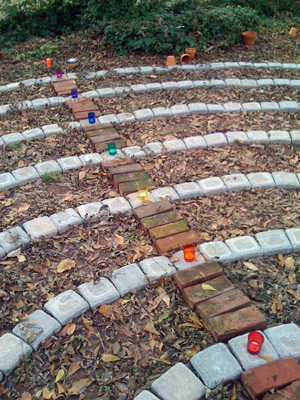
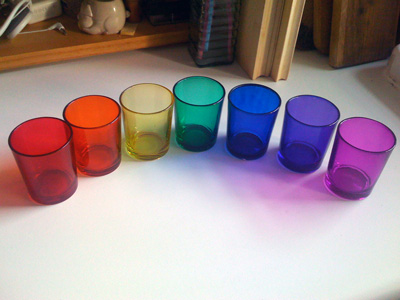
In other news, I got some new votive candle holders today:

Someone will have to explain to me how to use the rainbow/chakra configuration as part of the labyrinth. I just like the connection: 7 circuits of the labyrinth, 7 colors of the rainbow.

UPDATE:

Here’s what it looks like. Iffy picture of course, but it’s quite striking in real life:

SECOND UPDATE:

Here they are in the daytime:

Labyrinth, 12/3/08

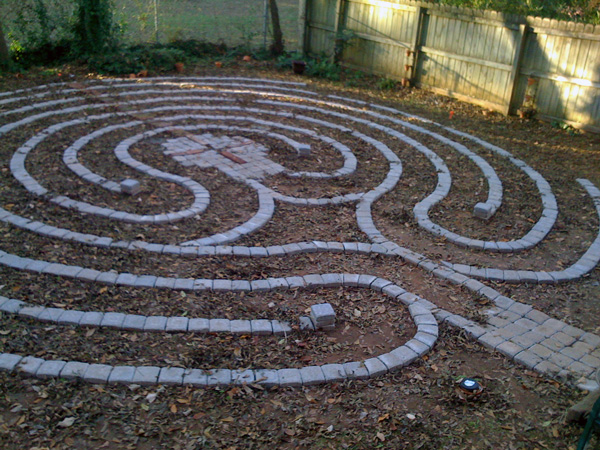
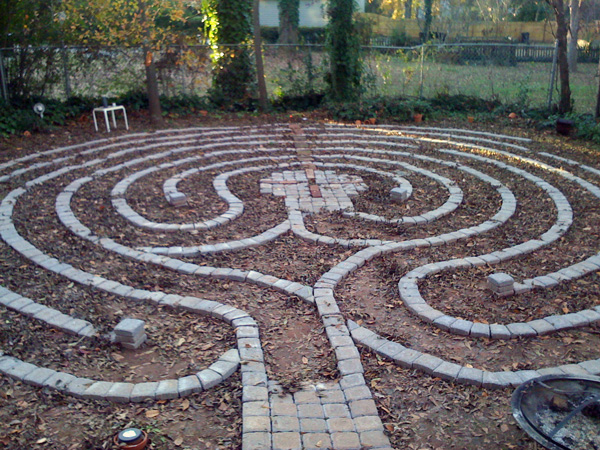
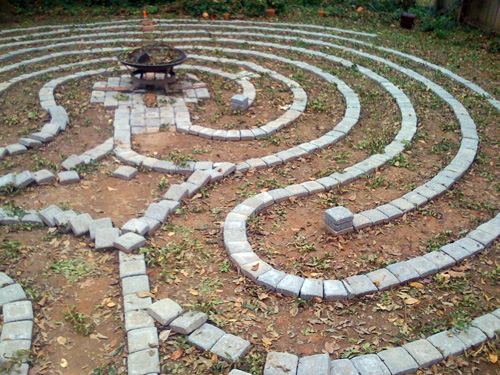
I finished the curved areas of the labyrinth’s pathway this afternoon. Next up, getting the center stones cut so that the center area is round, with a round hole; getting soil to a) build up the northern edge so I can complete the outer circuit, and b) fill in the pathway; spreading seed over the new soil; spreading straw over the new seed; and creating all kinds of interesting lighting fixtures to hold candles everywhere.

I have ordered red and green votive holders, so for Christmas I can outline the whole thing with seasonal lights. It’ll be real purty. I also ordered a set of colored votive holders the colors of the chakras, just for the mysticism of it all.

Here are the rest of the photos. It’s a proud moment.

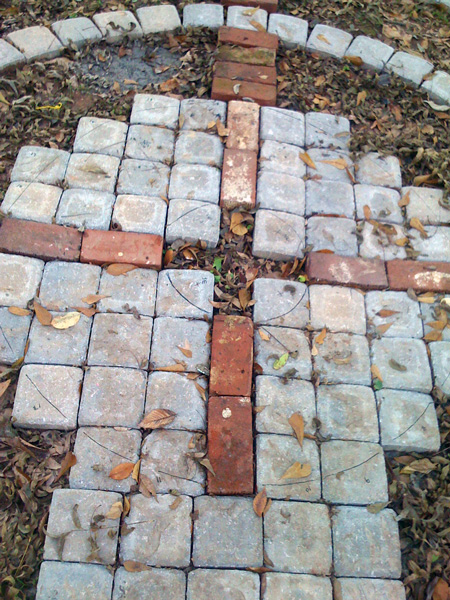
Here are the central stones, all marked and ready for someone to cut them. Where are the stone fairies when you need them?

And a closeup:

So…

The question arises, what have I been up to? I clearly have not been blogging.

Mostly that’s because I don’t have a lot to say. Actually, I might have a lot to say, but none of it is very coherent these days. Much tumbling through the brain, large galactical dust clouds, but no planets forming.

However, I can report on my latest acquisition(s).

First and foremost, I have bought a painting by Dianne Mize, my painting instructor from GHP in 1970. She and I have agreed never to mention how many years ago that was, and I’ll thank you to do the same.

Here’s the painting:

click to see Dianne’s original blog post

Dianne had sent me an invitation to the exhibit opening at the Tekakwitha Gallery in Helen, GA, but since it was November 1, the Saturday evening performance of Coriolanus at NCTC, I couldn’t go. When she sent an email saying the show had been held over until Christmas, I made plans to get there.

Ginny readily agreed to my idea of returning from Virginia via Helen so we could stop to see Dianne’s work. I had already decided that I would just pick one and charge it, so when Ginny offered to make me a Christmas present of whatever one I wanted, I accepted.

I also considered this painting:

click to see Dianne’s original blog post

It was a tough choice, obviously. I may have to have the cows later. I chose the landscape because of its subject matter. I love places like this. It reminds me of a couple of places from my life, and each of them was from a time of great happiness.

One is Snake Creek over on Parks Avenue. When I was a child, we would play there constantly, plashing in the water and running through the “woods” in that narrow strip that runs along the curve of the street. It was and is a beautiful green space.

Another is a park on the outskirts of Athens by the river. I didn’t get to go there a lot, but I remember one time, the spring of my junior year, when Kevin Reid, Cathy McQuaig, and I went for an afternoon picnic there. Kevin had become my closest friend after showing up that semester, he had dropped out of Griffin High School and just come on to UGA, and all three of us were close from working both in the costume shop and in Period Dance.

Kevin and I were a lot alike: young, precocious, serious, ferociously curious, intense readers. I know I was in love with him, and he with me, in the way young men are that verges on the physical. (Jobie, remember that piece I read out loud this summer? It was Kevin that gave my reading that passion.)

He’s dead now, of AIDS, back in the late 80s I think. I didn’t know this until last year when Ginny and I went to LA and had a reunion of a bunch of UGA theatre folk from that time. I had put together a video of all the Period Dance photos, and when we came to one of Kevin, that’s when someone told me of his death. It still hurts me, as I type this even, how I lost touch with him, and then lost him entirely.

As we sat by the river that afternoon in 1975, we knew we were enjoying a halcyon moment, and we even verbalized it. I think we knew that we would lose each other to Time, and we hugged our happiness to us even as the sun set.

That’s why I bought the landscape.

I like Dianne’s impressionistic style, her loose brushwork, and her sure sense of palette. I especially like her methods of working, and they are methods, which frustrates me when I am unable to develop similar methods for my own work in music.

However, I’m not going to whine. Let’s talk about what I am working on rather methodically, and that’s the labyrinth. I haven’t done anything since earlier in the week, of course, and now it’s raining, but I am beginning to see the endgame here.

I shall finish the curves on the pathway this week, working Tuesday and Thursday on that task. Tuesday afternoon, I order the topsoil, and with any luck will have that to play with this weekend. On Thursday, I will seek out stonecutters here in town, one of those granite countertop concerns over on the bypass, to see if they can cut the stones around the center in a more precise circular pattern. I also developed a fantasy today of checking out a four-foot piece of granite for the centerpiece. That wouldn’t be expensive at all, I’m sure.

With any kind of luck, I may have the labyrinth finished, if not this weekend, then the next. I will also be working then on coordinating the mise-en-scene of the entire backyard into something whole: columns, lighting, sculpture maybe? I don’t know. As Marc says, it seems I’m determined to become the Howard Finster of College Street.

Labyrinth, 11/24/08

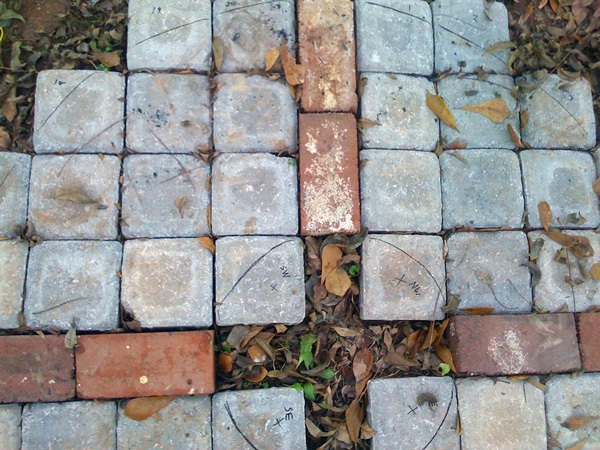
Today I worked on splitting the paving stones using an arcane process explained to me by a video on Lowe’s website.  It took only an hour and a half to do the three arcs you can see here. 

The good news is that it won’t take me very long to finish the curves.  I even found a reliable source for soil today.

The bad news is that I’m annoyed I didn’t try this earlier; I could have been done. Still, it’s easy to do and doesn’t look bad at all.

I have all these leftover stones, about 340.  Here’s what I’m thinking: buy a drill press, drill holes in them, drive rebar into the ground at the cardinal points of the compass around the labyrinth, and then stack the stones in a kind of rusticated column.  Could be pretty spooky in the firelight.

However, my calculations have just shown, and I’m double-checking them as we speak, that if I use all the stones, my columns will be fourteen feet tall.  I’m thinking maybe no on the height.  But eight feet tall could be cool.  And top them with ceramic sculptures or something.

A lovely bit of snark

I just had to share this, and I will share it on my Facebook page just to broaden its distribution:

from one of my favorite Evil Liberal Blogs™, Eschaton:

I’m so old I can remember when spending $8 billion to give more health care to kids would spook the bond markets so badly that it just couldn’t be done.

Stuff like this reminds me of why I hate Republican governance.

It’s official

I am hereby canceling the Quiet Strength meditation series. Trying to jumpstart my writing was a good idea, but merciful heavens what a truckload of treacle that book is!

Just scanning ahead to find a topic to write about this morning, again, trying to get something out of my head and onto the page, was enough to cause permanent pursing of the lips and raising of the brows.

  • People-pleasing
  • Crisis and pain in relationships: relationships are like crabs; they have to shed their shells to grow; and then they’re vulnerable… ::shivers down the spine::
  • Men as brothers: actually quotes Whitman and encourages us, as we are “trained to pursue women,” to “actively pursue friendships with men.” Come onto the raft, Huck, honey. (Yes, I know, but icky!)
  • Wordless language: I talk to the trees.
  • The True Work: SHA, anyone? How about a podcast sitcom?
  • Wounds into gifts: bang that drum, honey.
  • Zaniness: “one of the most endearing qualities of men is our zaniness”
  • Search for the sword
  • Removing my armor
  • Side-by-side intimacy
  • Body wisdom and sexuality
  • Howling

And we’ll leave it at that.

Gay marriage

Open letter to religious opponents of gay marriage:

First of all, when you say that “God ordained that marriage is between one man and one woman,” do us all a favor and say, “I believe God ordained that marriage is between one man and one woman.”

This keeps the debate over the topic a little clearer, because then others who might still be thinking about which way to think about it have the opportunity to reflect that you might also believe that the earth is 6,000 years old, or that God hates shrimp.

And I know you’re not given to thinking about ambiguities, but you really need to mull over this idea: with California’s Proposition 8, you restricted the right to marry to heterosexuals. The problem is that when a right is given only to part of the population, it is no longer a right, it is a privilege. And you remember what your parents told you about privileges. That’s right, you have to earn them. And they can be taken away by the Authority Figure who grants them. “It’s not a right, it’s a privilege,” remember? So by converting the right to marry into a privilege reserved for only a portion of the population, you have just stripped all of us of our right to marry.

Hope this doesn’t make your brain hurt too much, but remember: no pain, no gain.