Labyrinth, 2/1/09

Beautiful day outside, and actual free time. So I worked in the back yard all day, finally getting the labyrinth seeded with grass seed.

Since it’s been over a month since I finished getting all the topsoil in, I had to go back and till the entire thing with my handy little garden weasel style tiller. Sounds hard, but it wasn’t, since the dirt was two inches of loose dirt to begin with. It only took about an hour to churn up the whole thing.

Here it is partly finished. I thought this was a pretty shot:

Here’s a close-up. In the afternoon light, the chunks of dirt formed lovely patterns:

Then I had to go back and break up all the chunks with a garden rake. That also took about an hour:

Finally, I mixed my two bags of deep shade grass seed with the bag of winter rye, and proceeded to sow my seed. Finally I covered it all with straw. You will notice that although my supplier sold me too much dirt (I’m still figuring out what to do with about three wheelbarrows full), they didn’t sell me enough straw. Or maybe I don’t know how to distribute it. No matter, I will buy more tomorrow.

I also did a general cleanup of the back yard, cutting up limbs and stacking wood; moving patio furniture around; and cleaning up where the old Mercedes -Benz used to sit. (We sold it last week.) The dirt there smells awfully of gasoline.

Quick rant

All right, people, screw bipartisanship. Working with your ideological opposites is not a Good. It’s just a nice idea. And since I cannot say it better than Jamison Foser over at Media Matters, I will simply quote him:

Sure, people want the politicians to stop bickering and get things done. But, more specifically, most people want the politicians to stop bickering and do things they want done. A single mother working two minimum-wage jobs to feed her kids might want politicians to come together in a spirit of bipartisanship — but she doesn’t want them to pass bipartisan legislation lowering the minimum wage; she wants a bipartisan bill raising the minimum wage. If she can’t have that, I suspect she’d take a party-line minimum-wage increase, even if it means a decrease in the bonhomie at Washington cocktail parties she’ll never attend.

That is all.

Doodling, 1/29/09

Many things to do tonight, starting with this post.

In support of our explorations over at Lacuna Group, Wednesday nights if you’d like to join us, and you really really should, I dragged out the 341 poem, which, if you recall, was the first thing that emerged during the 365 project.

It’s actually not bad stuff, and so I made a decision last night to work seriously on it for a while. I may not keep everyone updated as I did back in the day, but if something good happens you’ll be the first to know. You can read all the posts about the poem as it stands now here.

The first thing I have to do, of course, because I want this to be a thing I can work on diligently, is to give it its own Moleskine notebook. I’ve pulled out a small one from my music drawers and am in the process, as I work on other things during the evening, of painting a cover on it.

This is not exactly the waste book approach, but this is not exactly a waste book process. I can focus my “poem energies” in this one place. Or so goes my theory.

In other news, I have listened to John Adams’ Gnarly Buttons and John’s Book of Alleged Dances in the van for a couple of days now and can report on its status. (This is from the stack of CDs on my desk that I’m trying to whittle down.)

Gnarly Buttons is a little mini-concerto for clarinet and is very appealing in many ways. It has some back story to it, but I didn’t read that until I had already made my decision about the piece.

It’s rhythmically complex, almost excessively so, and scored for an extremely oddball assortment: English horn, bassoon, 2 violins, viola, cello, double bass, banjo/mandolin/guitar, and two sampler/pianos who play all kinds of weird sounds, including at one point a moo. (That’s right, a moo.) However, the orchestration is deft and never uninteresting.

There is even actual emotion in several places. On the whole, I think Gnarly Buttons is a keeper.

I’m still unsure of John’s Book of Alleged Dances, a set of 11 short bits for string quartet and prepared tape. It’s not uninteresting, but after I’ve listened to it I’ve already forgotten it. I’m thinking I will not be adding it to iTunes like Gnarly Buttons.

Next up: Tenebrae, by Don Carlo Gesualdo, actual Renaissance prince of Venosa. Gesualdo felt no compunction to follow anyone’s rules, societal or compositional, and his music is usually described as “lurid.” It is good to be the king.

Teaching and testing

I’ve spent the past few days working with 1st graders, trying to show them atlases and dictionaries, and then at the very end of the session, sneak the internet in.

Why? Because on one standardized test or another, there is a question which asks them which would be the best place to find a picture of some animal. Would you look in an atlas, in a dictionary, or on the internet?

Whoever wrote the test item knows that dictionaries don’t have pictures. Except, of course, when you’re six years old, and the whole frickin’ dictionary is pictures.

Up and down the grade levels, our standardized tests ask similarly narrow-minded questions about reference sources that indicate that the people who wrote the test items do not know how the information society works, at least since 2000.

This has been a message for those who think that they’re getting reliable data from those standardized tests.

More good times in teaching

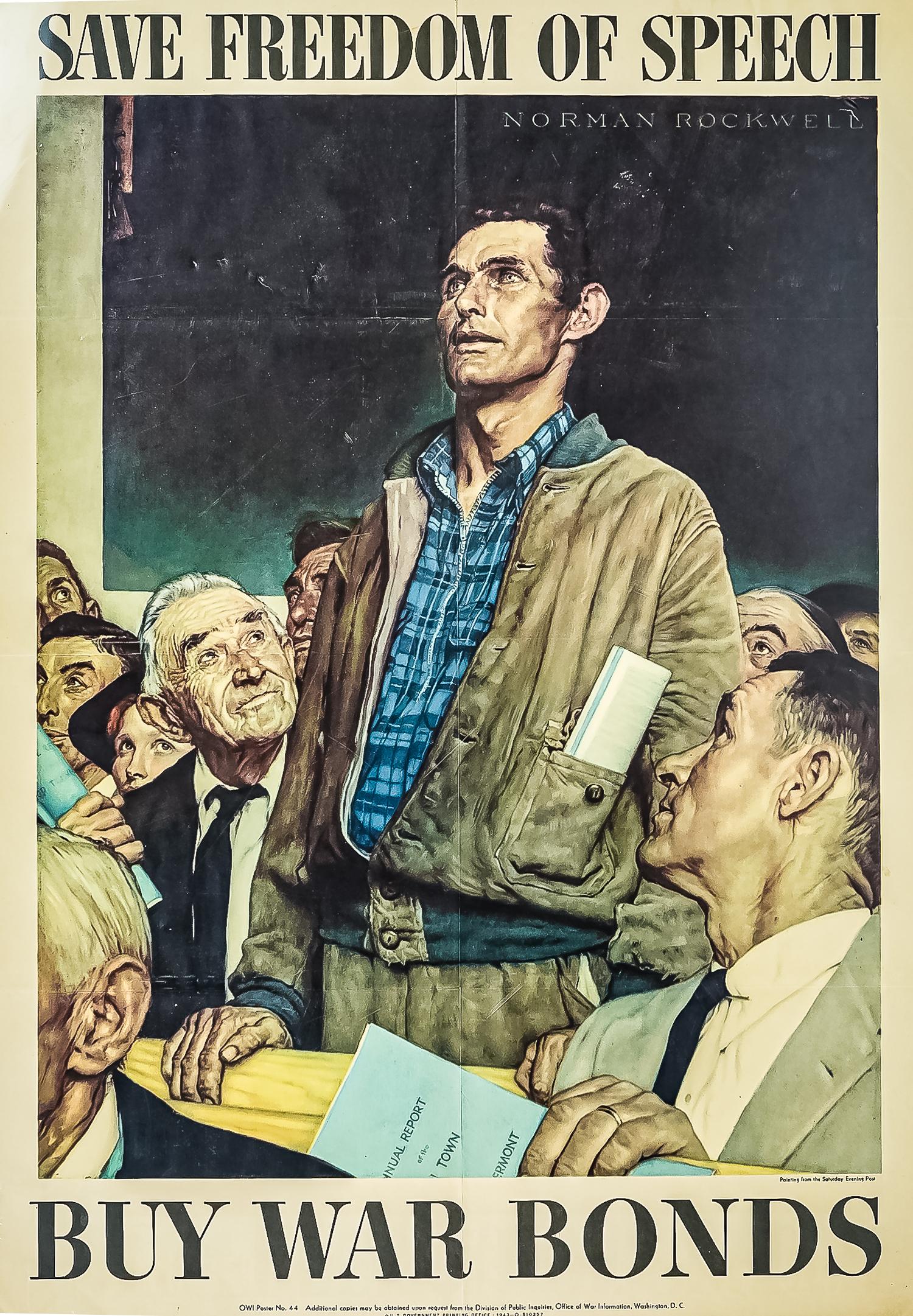
Last fall I applied for and got a National Endowment for the Humanities package called Picturing America: twenty or so gorgeous prints of notable American works of art that illustrate one or more American characteristics. These are double-sided, heavily laminated, and are accompanied by a really good teacher’s guide.

I’ve been posting them on my bulletin board, with the heading I Have a Question… I post a question, and the first student who researches the correct answer gets a free book.

This week, it’s been Norman Rockwell’s “The Freedom of Speech”:

The first question is “What’s going on in this photo?” And a kid we’ll call Jimmy figured out that it was a debate. (Technically, it’s a town hall meeting, but let’s give the little Southern kid a break here.)

Then I asked, “Where does the freedom of speech come from?” And Bobby quickly found the 1st Amendment.

Finally, this afternoon I posted, “What exactly does freedom of speech mean?”

Jimmy was back in the media center, this time with his friend Huck. Huck and Jim had a pretty good idea what it meant, but they weren’t putting their finger on the crux of the issue. They found a Constitutional dictionary. They found a book called Constitution translated for kids. They even found the vertical file folder on the Constitution.

Every time, they reported what they found, but it was never the exact answer I was hoping they’d find. Finally, I asked if they had read the actual Amendment itself. They quickly pounced on a copy, and within 60 seconds Jimmy was at my desk, announcing that the freedom of speech meant that the government could not control what was acceptable speech and what was not.

Bingo.

And to make it even more wonderful, he selected as his book a Star Wars novel that Huck had been shooting for and gave it to Huck. I love my job.

A revelation!

Get me the President on the phone. I’ve just had an insight that’s bloody brilliant in re: negotiating with our new BFF, the Republicans, over the stimulus package.

I am reminded of Green Acres, that masterpiece of American absurdism, whenever Oliver Douglas went to haggle with Mr. Haney. Oliver would behave in a rational manner, starting with a low bid, and then when Mr. Haney countered with something higher, attempting to meet Mr. Haney somewhere in the middle.

Except it never worked like that. Every time Oliver would raise his offer, Mr. Haney would respond by raising his. Rather than the paradigm of honorable compromise that Oliver was following, Mr. Haney saw that he didn’t have to give anything away because his opponent was willing to give up what he had started with.

This is in fact what is happening now with the Republicans and the stimulus package. President Obama stated his goals with the stimulus package, and the Republicans immediately made a counteroffer: more tax cuts. The President offers to cut taxes, the Republican counter with “no contraceptives!” And so it goes.

Instead, the Current President should enter that room with the Republicans this afternoon and deal with them like Lisa Douglas: they say to ditch the contraceptives, he returns with raised taxes. They respond with OK, you can keep the contraceptives. He responds with draconian regulation of Wall Street. They say, OK, Clinton-level income tax rates, but that’s our final offer.

You see how that works? When you’re dealing with Mr. Haney, you have to be Lisa Douglas.

Hm. Haney. Cheney. Mere coincidence? I think not.

Random thoughts

Today (Jan. 27) is the birthday of both Mozart and Lewis Carroll. I’m setting my iTunes now to celebrate. (Yes, I could celebrate Alice on iTunes, had I actually uploaded David del Tredici’s In Memory of a Summer’s Day, one of his several pieces based on the Alice books. It opens with sweeping strings and a wind machine, a thrilling effect.)

Have you ever noticed that a person who drives 35 mph in a 45 mph zone will maintain that speed when he hits the 25 mph school zone? From this we are allowed to conclude that such a person is senile or drunk or both.

The rightwing noise machine is in full roar:

  • making up Congressional Budget Office reports
  • making up Al Qaeda operatives released from Guantanamo (61 is the magic number, pulled from its ass by the Pentagon, and let us not forget the actual releasees are prisoners freed by the Previous Administration because it had completely botched their interrogation/imprisonment)
  • stating flatly that terrorists are going to be let go in the middle of our fair country (we need to invest in companies that make rubber bedsheets and Depends, apparently)
  • stating flatly that an extension of Medicaid benefits in these troubled times for the victims of the PA’s policies is nothing more than pork spending by Pelosi on contraceptives (because if you’ve lost your job, you should not be having sex!)
  • stating flatly that the stimulus package won’t benefit anyone for years and years and years (despite an actual CBO report that says the opposite)
  • and in trivial matters, comparing the cost of Bush’s last inauguration minus the cost of security to that of Obama’s plus the cost of security

There’s more, there always is, but it’s too wearisome. I am curious to see whether the public will fall for the terror!+egregious spending!!+people-not-like-you-and-me having sex!!!! smokescreens this time. I work with some who do so only too gladly, and the number of media people who parrot these lies without correction is very disturbing. Still, I have hope.

The dumbing down of our schools… not

I just spent 30 minutes teaching 2nd graders what a database was, how one works, how they use at least two nearly every day (the online library catalog and the Accelerated Reader™ quiz software), how I built and use one to keep track of AR™ Point Club tags, and we even built one based on a test question they had had.

Yes, that’s right, we’re testing 8-year-olds on what a database is and when to use one.

For the record, they were fascinated by my lecture/demo and a couple even asked how they might build one to keep track of stuff in their lives. I didn’t even have to prompt them on how we might sort the little cards I had them fill out: they were right on it with “last name,” “homeroom,” “birthday,” or even “homeroom THEN last name.”

This has been a message for those who are convinced that schools have gotten worse since they wrestled with Think & Do workbooks when they were in 2nd grade.

Creating

I worked for an hour and a half this morning with some music, and despite my best efforts to piddle with fragments, no pressure, I ended up solving a couple of problems with the first movement of the Symphony. Nothing to share yet, so you’ll just have to take my word for it. Short version: the main motif has been reimagined as an opening fanfare/intro, and what used to be the B theme is now the A theme, since it opened with the same notes.

And as I am typing this, it occurs to me that a further part of a solution to the thematic material is to re-declare the key of the thing. I’ve been thinking of it as in G major, but it might suit my purposes better to have it in C major, if my purposes are defined as maintaining the actual notes of the main motif (hereafter known as the Motif) as the opening of the theme.

There are a couple of reasons I don’t want to do this. One is the fourth movement, which is in G. Yes, I know, it’s a disaster and I might as well go rewrite it in C. (It actually opens in C minor, so the transition to C major would actually be easier.)

Another reason is that everyone’s first symphony is in C major. And almost no one writes in G major. Actually, almost no one writes in anything major these days, because it just sounds so damned cheerful and we all know the music can’t be serious if it’s cheerful. At any rate, I’m unreasonably stubborn about this. But something tells me I’m going to take the easy way out.

Yesterday, we went to the High Museum to see the First Emperor exhibit. Go, if you have the opportunity. It’s truly magnificent. There’s something awe-inspiring about the whole thing: the artistry that the culture brought to everything it touched, the craftsmanship, and above all, the incredible hubris of the project. The emperor in question, having united the Warring States under Qin, began immediately to construct this enormous tomb from which he could continue his glorious and blessed reign after death. It’s like 27 square miles of buried stuff: larger-than-life-size soldiers, yes, but also musicians, animals, acrobats, carts, banquets, temples, palaces–it’s literally an entire city for the emperor’s eternal use. (The half-size cart, which surprised me, because everything else was larger than life, was actually positioned next to a ramp, so the emperor could actually be driven up and out to travel around his domain.)

Equally impressive, though, were the two exhibits in the lower level, one of the sculptures of Ulysses Davis, and the other of works on paper from the folk art collection.

Ulysses Davis was an barber in Savannah, black, who carved amazing sculptures. Especially interesting to me was the way that he developed from very literal carvings and bas-reliefs to highly symbolic and imaginative pieces. He made a creative journey that trained artists can only pray for. He did it through the work, of course, although he did apparently study books on African art on his own. Follow the work, follow the work.

The drawings from the folk art collection is all “outsider” stuff, and like most of the genre is hallucinogenic in the extreme. I’ve never read of any of these artists ingesting entheogenic substances, yet there they are, acid trips and mushroom journeys, all on paper.

Many were schizophrenic and that’s usually credited with their bizarre visions, but having read Huxley’s The Doors of Perception, my question is whether they are actually perceiving the world visually in ways that the rest of us have to take drugs to see.

The complexity of their visions is astounding. Can any trained artist achieve this? Part of the awful beauty of the work is the un-academic clumsiness, which the artists apparently recognized at some level because there is always a compensation in the balance of the composition to make up for the lack of draftsmanship, perspective, etc.

The very existence of the works is one proof of the evolutionary nature of artistic creativity. Two drawings struck me in this regard. I don’t remember anything about the artist other than his being male. They were two large pieces of drawing paper, and the drawings were pencil. There were straight lines drawn in regular graphite, with tiny little Klee-like, or perhaps Tanguy-like, blodgets extending from either side of the lines. These blodgets were all red or blue. Very nervous, frantic pieces, and their titles were like “Demon House,” very ominous.

It occured to me as I examined the drawings that he must have used one of those double-ended pencils that have red lead on one end and blue on the other. Remember those? Do they even make them any more? I remember thinking how neat they were when I used to see them in Woolworth’s over in the old Eastgate shopping center (where the Justice Center is now), and I know I owned at least one in my childhood.

Without knowing anything about the artist, I am imagining that he created these drawings with the only materials available to him. He had no choice about any of it: the paper, the medium, even whether or not to draw, or indeed what to draw. He had to do what he had to do. (Lacunans, refer to my piece from last week.)

The power of all the works in this exhibit was overwhelming to me, for some reason. As I start/continue my sketching/painting, I would love to produce something like these: simple, complex, untrained, chthonic in its source. The irony is that with my music, my lack of training is a real stumbling block, yet with my art, what little training I have will derail my ambitions.

Back to work, kind of

With a clear evening for the first time in a long time, I did a little tidying up (tidying up being a time-honored Lichtenbergian tactic); changed one thing in the GHP video and exported, DVD’d, and burned three copies; had supper; and finally, finally, made myself sit down, turn off the web and email, and put some notes on paper.

I was not very successful. I returned to the opening theme of the symphony and played with that for a while. I played with some chord structures for a while. I played with a few countermotives for a while. I looked at my Fragmentary Exercises and plopped down one measure that might pass as a half-assed attempt.

I wasn’t wearing a hole in that psychic wall, I was just wearing out. So I stopped. But at least I got something on paper, whether it’s worth anything or not.

In other news, I took one of those CDs sitting in a stack on the left-hand side of my table and have been listening to it for a couple of days in the car. This one is the untitled Mercury Living Presence re-release of Howard Hanson and the Eastman-Rochester Orchestra playing some mid-century American greats.

Meh.

Sorry, none of it does anything for me. It’s all very daring for its time: Colin McPhee’s faux-gamelan Tabuh-Tabuhan: Toccata for Orchestra; Roger Sessions’ The Black Maskers, with its crashing seconds and clusters; Virgil Thomson’s Symphony on a Hymn Tune, which has passages of great lyrical beauty, which he insisted on undermining with bizarrely acerbic passages of snark.

But none of it sticks in my head, even after two days of listening. It just registers as so much fashionable claptrap from the 1930s. Into the giveaway pile it goes.

Next: John Adams’ Gnarly Buttons and John’s book of alleged dances. I remember them as being too determinedly “modern,” as if Adams was trying desperately to show the musical establishment that he could resist the siren call of tonality. We’ll see.

As savvy as the Obama team has been about the 21st century, I find it incredible that they didn’t have the John Williams piece performed at the inauguration all ready to roll out on iTunes by 12:01 pm, January 20. I know I said I wasn’t buying anything at least until June, and I haven’t, but I would break my vow in a heartbeat if it were available on iTunes.