The spring rains have arrived.
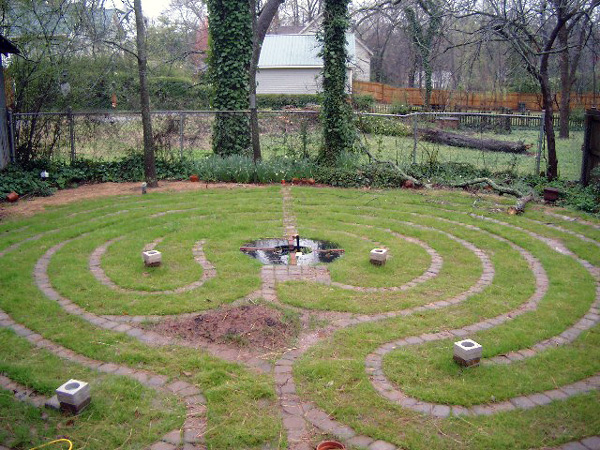
Soon I will have to mow.
I’m sitting here rereading some posts and comments thereunto (yes, I do that), and I had a sudden insight.
This springs from a comment on my Charter Systems post about how perhaps the push for the charter systems movement is coming from the corporations that run some charter schools, and that the whole thing is to push for the vast profits these corporations stand to make if we all go charter.
I had snarkily replied that if it were possible to make vast profits from a school, wouldn’t we be doing that? And I’ve been thinking: are we so wasteful of the taxpayer’s dime that we can’t see how to make money doing what we’re doing?
And I’ve decided, no, we’re not. There was a headline this week about how our school system is under budget, thank goodness, and won’t have to tap into the reserves. Well, yes we are, and do you know how? Spending was frozen in August. The amount sent by the state to this county for my media center, and which is entailed upon it, has been frozen.
Our checkbook balance looks good, but it’s the “good” we all see at the first of the month: lots of cash on hand, but every single bit of it is already marked for bills. My point is that the only way we can beef up the assets column is to choke the actual education process.
No, my dears, education is a rathole. You just have to keep shoveling money into it, and is that any way to run a business?
No, it’s not. Here’s my insight: education is not a business, and you cannot run it like one, or at least run it like one and expect business-like results. Education is a farm.
You plant, you water, you fertilize, you tend, you weed, and with any luck at all, you harvest. But some harvests are big ones, and some are not. You have no way of knowing, although of course you do have to use the right fertilizer and the right techniques. But one thing is for sure: you still have to pour money into the process. You have to buy the fertilizer and the tractors and the combines and the irrigation, and you have to maintain them. Because if you don’t, then you will get no harvest at all.
And I think it’s a better metaphor, at least to bring us back around to the profit motive, if we regard our farm as the source of our own food, not as crops to sell for profit. I’m not going to explicate that one; think through it yourself.
As for funding these nourishment-providing farms of ours, the History Channel had an absolutely intriguing show the other night about agricultural technology. We saw cotton farmers in California using satellite technology to identify which areas of their fields were ready to be sprayed with a saline solution, and with how much, as they flew over them with spraying helicopters. We saw rice farmers using satellites and computers to tell them which areas of which fields needed fertilizer or pesticides.
These were compared, of course, to developing nations where it’s all done by hand.
Now, which farms were feeding the world? And notice how much money has to be spent to give the farmers the tools to be able to that. It all depends on how badly you want crops, doesn’t it?
I am behind in my listening, or at least in my posting about the listening.
For about a week, I made my way through Skys, by Michael Danna, and Brian Eno’s Discreet Music.
The first one is somber space music, based, the composer says, on the lowering skies of Canada. Well, who wouldn’t jump at that? I can resist the temptation. The ten pieces on the CD are all basically the same, an ostinato kind of figure over which there is some countermelody, without any kind of harmonic exploration, or indeed thematic for the most part. Very uninspiring. Onto the giveaway pile.
The Eno is a bit more complex. The first piece, the title piece, is a lovely bit of Eno’s ambient stuff, pretty much indistinguishable from most of his other stuff, but pleasant.
The other three tracks are entitled Three Variations on the Canon in D major by Johann Pachelbel, and it’s a bit more involved. In each, parts of the Canon are subjected to “systems,” e.g., the tempo of each players part is decreased at a rate governed by the player’s pitch. The first is, at first listening, most successful. Probably the other two would bear fruit upon further exposure.
I then moved on to two symphonies by Philip Glass, No. 8 and No. 2. The Eighth was part of my desk pile; the Second was on my CD shelf.
The Eighth was my favorite of the two. Its command of the soundspace was more masterful. I know it’s hard to think of someone like Philip Glass becoming more assured over time, especially since the Second was written when he was already a master, but to my ears there’s a definite difference in the success rate of the form.
The Second was choppy, a little more self-conscious about what it was trying to do (be a symphony), and it just did not pull together. The Eighth, on the other hand, was a return to purely instrumental after the choral/vocal settings of the 5th-7th. It announces itself with a strong opening, and the energy is carried throughout the movement.
The second movement is a passacaglia, and it sounds organized in ways that Skys never did. The third movement is the most interesting. It’s very short, only seven minutes long, and it’s very slow, with no Glassian fireworks at all. The English horn intones a despairing kind of theme in a bleak landscape. It repeats, then twice more with a countermelody, then the whole thing closes out in an evaporation of sound.
My next two listening adventures are Prokofiev’s Piano Concertos Nos. 1 & 3, and Bartók’s Piano Concerto No. 3 on one CD, and Rautavaara’s “Angel of Dusk,” Concerto for Double Bass; Symphony No. 2; Suomalainen myytti (A Finnish Myth); and Pelimannit (Fiddlers), on the other CD.
I am intrigued by this latest movement on the part of school systems across the state of Georgia to move to “charter status.” Our own beloved Coweta County is exploring such a move.
Essentially, an entire system switches its schools over to charter school status, which means that it is freed from many state rules and regulations. Who wouldn’t want to do that? No more pesky rules about testing, hooray!
The question arises, why would the state want to do that? It turns out there is a trade-off for gaining charter system status: you have to produce better results than you would have under the state’s restrictions, “results” being defined as “student achivement,” where “student achievement” is defined as “better test scores,” where “better” is defined as “higher.”
Still, imagine the freedom! You get to teach your kids however you like, as long as you’re sure that your mavericky instructional ways are going to produce Lake Wobegon test scores.
Just this morning I heard a school system superintendent (not ours) on the radio, enthusing how charter system status would give them “more flexibility on things like class size and teacher pay.”
Well, alrighty then, let’s do that thing where you lower class sizes and hire more teachers at higher pay so that you can… what?
Really?
Oh. Never mind then.
I suppose that it is entirely possible that you could load up a class with 35 students (although today’s classrooms have been built for much smaller numbers) and cut the teacher’s pay, and at the end of the five-year charter period have freaking incredible test scores. It’s possible George W. Bush and Alberto Gonzales will be charged with war crimes, too. I am after all an optimist.
However, I am still curious: if “easing” the regulations on class size and teacher pay (among others) so that local systems have more “flexibility” actually would produce significant student achievement, then why do we have those gosh-darn regulations in the first place? Wouldn’t it make sense to liberate the entire state from the onus of these burdensome regulations so that Georgia could immediately “lead the nation in improving student achievement”?
I remain, as always, curious.
Let’s check the Times-Herald‘s Sound Off and see what we find, shall we? Oh look, conservative wingnuts!
What exactly has President Obama done that he said he was going to do? Nothing. Then again, we Republicans new [sic] that before the election.
Hm. Direct military leaders to end war in Iraq? Check. Expand SCHIP eligibility? Check. Increase funding for the NEA? Check. Lift stem cell research restrictions? Check. Close Guantanamo? Check. Overturn Ledbetter vs. Goodyear? Check. Etc. etc. Not bad for six weeks, actually.
Why do you say the people need government right now? The problem is that we have had too much government for the past eight years. Government jobs need to be cut and government spending stopped.
Yet this person would have called me a communist if I had suggested cutting government spending in Iraq over the last six years.
I own a successful business, pay taxes, pay my mortgage and pay all my other bills. I try to save as much money as possible. I bought a new automobile to help the auto companies. Don’t try to tell me I am to blame for the sorry state of affairs.
No one’s blaming you for the sorry state of affairs. Unless, of course, you’re the inventor of complex derivatives.
I, too, hope Obama fails in strangling our republic with socialism.
“Socialism” is not we call what Obama is doing. Nor would actual socialism strangle a republic. You can check with Sweden on that one.
What a furor there was over Richard Nixon’s enemies list. Now we have President Obama and his enemies list headed by Rush Limbaugh. I’d better not hold my breath waiting for the furor over Obama’s list.
Probably you shouldn’t, because it doesn’t exist. Nixon’s list was an actual on-paper list, and those enemies were spied on by the FBI, careers checked at any possible opportunity. Obama of course has no such list. No one’s even suggested that Limbaugh is an “enemy,” except of course for the Republican spokesman himself. But then that’s just good for business.
To Lynn Westmoreland: Thank you for voting no and being a good steward of our money.
Vid. sup., re: Iraq War. Also, I hope Mr. Westmoreland has publicly refused any of the stimulus money for our district. On principle, of course.
One’s jaw just has to drop when these things show up in our public discourse. They’re so disconnected from the reality-based community that there’s no way to approach them. All you can do is wave at them as their little parade passes by.
The chimes have just struck noon, and the carillon has played its selection of Lenten hymntunes. I am back in the labyrinth, soaking up the sunshine.
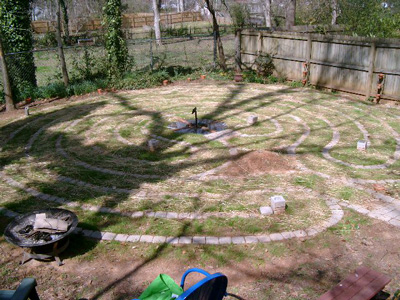 My intent is simply to relax. There’s nothing pressing on my agenda, no deadlines, no concerts, no Literacy Task Forces. So I’ll read, and do crossword puzzles, and probably nap.
I could work on the yard, but I think I will put all of that off till another sunny day.
What’s still left to do? Oh, plenty. Now I have lots of areas that need grass or moss or something covering the ground. The mound in the center needs a ground cover, since the bluestar stuff I planted earlier died, despite being featured prominently in the new Southern Living as having been used in a lovely Buckhead garden by one William Tingle Smith, of whom I could tell you some charming tales from our Period Dance days.
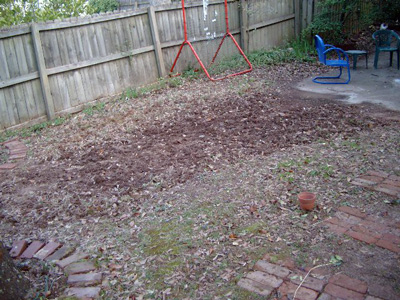 There’s the putative dance floor, which as you can see I have tilled but not yet leveled or shaped. This requires a lot of thinking and looking and probably drinking.
There’s multiple plantings of various ferns, but I really want to wait until it’s warmer before attempting all of that.
I have cut and sanded, but not stained, new armrests for the old glider. Also, I need to find nuts and bolts to attach them, which was not an automatically easy thing to accomplish when I went to Home Depot last time to accomplish it.
There is still the drilling of pavers for the little plinths out in the labyrinth. I got one finished, and then cold and rain sidelined that operation.
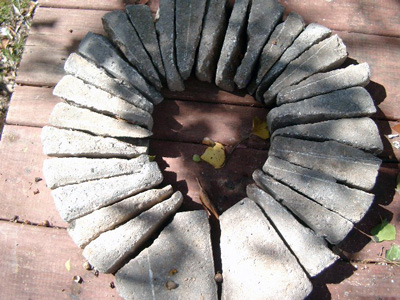 There’s this little deal. These are the leftover bits of pavers after I lopped them for the curves in the labyrinth. My plan is to drill a small hole through them and thread a rod of some kind that will hold them up, then install it as a sculpture somewhere in the complex. It’s an idea stolen directly from Andy Goldsworthy. He, of course, would not be drilling holes or threading rods, but then again he’s an international artist of some integrity. I’m just decorating my garden.
More as it occurs to me.

Later in the afternoon:
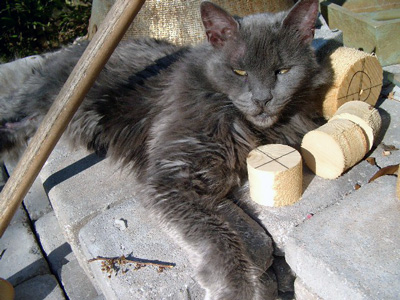 Cat with Platonic solids.
It is Friday, March 6, and I am enjoying the first warm afternoon of the year, sitting out by the labyrinth and sipping cosmopolitans, my own recipe.
There is a gray cat sitting in the center of the labyrinth, looking very blasé about sitting on the black granite, when she knows very well she is holding down the universe. I think too she is using it as a vantage point in case I rise from my seat, so that she can immediately run before me to the food bowl.
My plan was to make potato soup for supper tonight, but I may decide not to. The cosmopolitans will be a big help in my reconsideration. Just sitting in the sun, listening to my Pandora new age station over my outdoor speaker, and not thinking about tasks, even simple, non-essencetial tasks like making supper, is a dream. Watching the labyrinth. Watching the grass in the labyrinth.
The cat has moved from the center of the labyrinth to the entrance and thence to the steps. She of course used the Straight Path which is forbidden to us humans.
I feel I should explain my previous post. It reduced Marc even to a simple ?, even though I think (I’m on my second cosmo) that we discussed it at Lacuna on Wednesday.
I’m feeling a profound disturbance in the Force, and I think it’s me. Here’s what I think is happening: the tide has turned, and now it’s incoming. Still not clear? After major projects, I think most creative people (I’m generalizing, of course; I mean me) feel a bit bereft. Their creative tide has gone out, and there at the turning of the tide, there is a feeling of stasis.
Wise creators know not to resist this turning, but to sit and enjoy other things while their creative impulses settle and find something new. My tide was abruptly sucked out to sea when I found that there was no longer any need for me to be writing a symphony for the GHP orchestra.
But now, after a prolonged turning period, I am beginning to feel that onrush of ideas and impulses that signal a new period of creativity. This is always exciting, but it’s also a time of extreme anxiety.
There’s the time issue, foremost: when am I supposed to start on… whatever it is I’m meant to be working on? What schedule should I set for myself? (I’m one who works best on a schedule.)
You will have noticed that I haven’t said what it is I expect to work on. That’s because I’m not really sure. I’ve started painting again, of course, and I can always work on that. But there are these short stories that seem to have claimed part of my brain, and I am intrigued enough not to dismiss them out of hand.
There’s all the Lacuna material that is lined up like a flotilla of airplanes on the runway. I could hammer out “We’re Frauds” and “We’re Bears,” plus “The Boy Who Was Afraid of Nothing,” at the very least. I could generate scripts for any of the ideas on our gigantic performance graph.
There’s the music. There’s always the music. I could finish the two-piano arrangement of “William Blake Leads a Walk on the Milky Way,” thus improving its chances of performance several-fold. I could continue my self-imposed exercises. I could look at Day in the Moonlight again, and I need to. I could go back to the trio for piano, trombone, and saxophone. And I could always go back to the symphony.
You see my problem: the tide has turned, it;s surging up the shore, and I don’t know exactly how to respond yet. There is a disturbance in the Force, and it’s me.
In the meantime, however, I think I will have another cosmopolitan.
One way to deal with the Dakota:
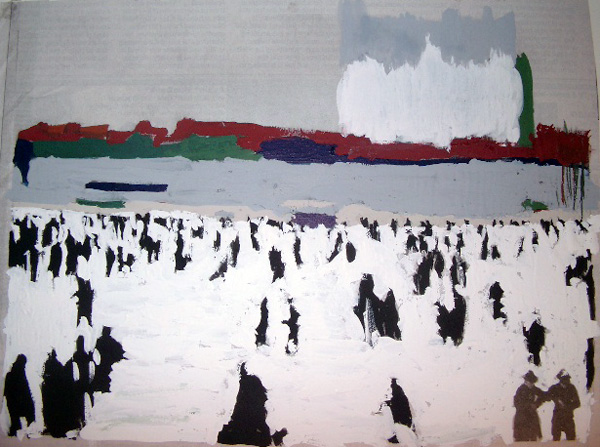
Just cover it up. The ochre stripe came to me last night as I tossed and turned. The “sky” area may go Prussian blue tomorrow.
In other news tonight, I almost had a solution for the center omphalos of the labyrinth. We had stopped at a home furnishings place in Buckhead, and there was a glass bowl thing with a hole in the bottom that would have been perfect: about an inch thick, and gold. Alas, it’s too small. I shall have to take it back. But I’m really thinking that the central bowl should be gold. That presents its own problems, of course.
So it snowed yesterday, and of course the whole school system shut down. [I will have to make up this day, because as a day laborer I am paid to be onsite for 180 days, whether or not there are children to be taught or work to be done. But let that pass.]
I’ve gotten a lot done today, most of it involving driving back and forth to Michael’s no fewer than three times. Don’t ask. But the original plan for the labyrinth is now framed, as is the photo of the roller coaster where we spent our wedding night.
I piddled around with a short story that crawled into my head a couple of weeks ago. I’m not sharing anything about them till they’re finished, if ever. Short stories have not been my métier heretofore. It doesn’t have a title. We can call it “Swimming,” if you like.
And finally, finally, just a few moments ago, I began a painting that started bugging me on Saturday.
Here’s the deal: the New York Times offers for sale prints of photos from their archives. Here’s the one that jumped out at me:

It’s of skaters in Central Park, 1884. That’s the Dakota apartment house in the background, reigning in solitary splendor on Central Park West.
I don’t know why this idea popped into my head, but it suggested itself to me that I should clip this thing out of the newspaper, attach it to a board, and then paint over it, exploring its composition as an abstraction. What do you think?
Here’s my first pass:
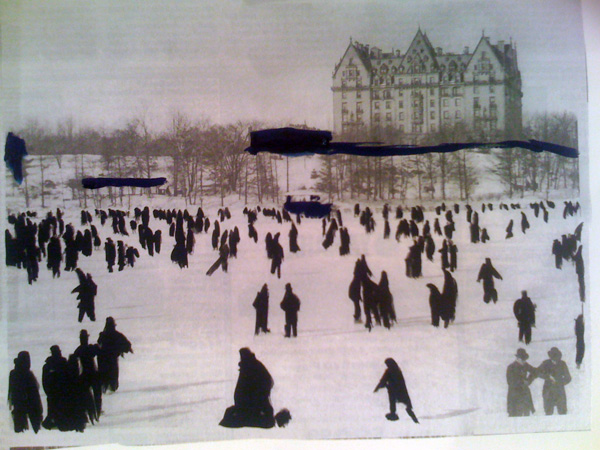
Here are my thoughts so far: a large whitish field on the bottom half, blackish hieroglyphics scarring the surface. A hot gray stripe above that, cooler gray swath above that. Above that, I don’t know yet. Blocks of Prussian blue. Vertical scrapings across the cool gray swath. I don’t know about the Dakota yet. Browns will begin to figure into the composition at some point.
I’ve begun by simply blacking out the figures, then blocking out some items in Prussian blue. I’m of half a mind to leave the two men in the lower right corner.
Back to the painting.

Pass #2:
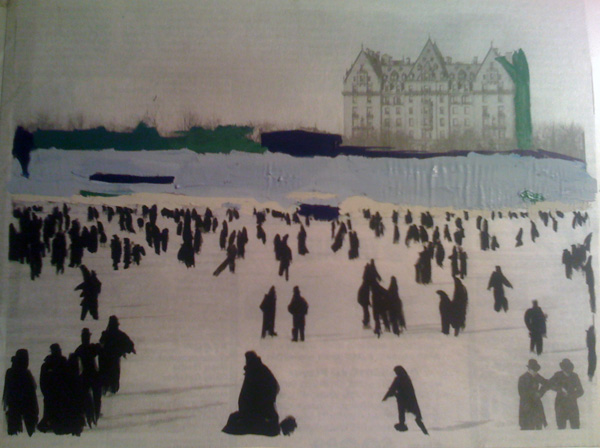
Now I’m curious about when the black marks down front are going to stop looking like humans.
Pass #3:
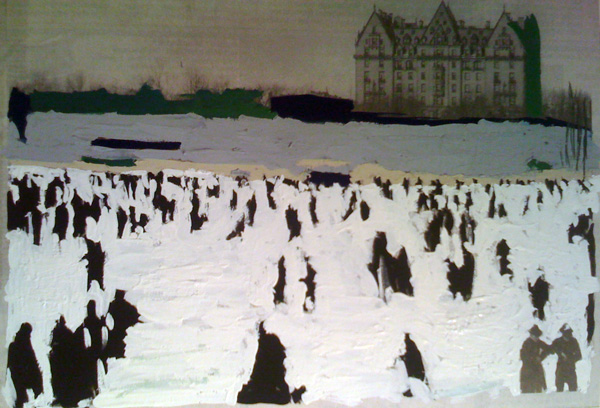
What am I to do with the Dakota?