Some reading

I’m behind on my blogging. We’ll see how much I get caught up this week while I’m on spring break.

For some reason I finished up a couple of books all at one time, and with my heavy-duty list of Things to Do over break, I haven’t started anything new yet. All three of my recent reads are worth looking into.

The first is a book of plays by Sarah Ruhl: The Clean House and Other Plays. The other plays are Eurydice, Late: a cowboy play, and Melancholy Play. Of the four, I think Clean House and Eurydice are the best. Both are witty, yet unbearably sad in many ways.

In The Clean House, Lane and her husband Charles are divorced. Both are doctors. She hires a Brazilian cleaning lady to keep her house clean. However, Matilde doesn’t like cleaning, so she readily agrees to let Lane’s sister Virginia scour the place while she continues to work on the best joke in the world. Charles brings his new wife Ana, a beautiful Argentine, to meet everyone. She’s charming and delightful. But her cancer recurs, and the second half of the play is a marvel of surreal warmth. I would love to direct this play. People would laugh, and they would sob. They would have no choice.

Eurydice was also quite lovely in a much grander, mythical way. It would nice to work on, but an elevator that rains?

Next on my reading list was More Information Than You Require, by John Hodgman. Hodgman is the funniest writer in America today. This is the sequel to The Areas of My Expertise, and is in exactly the same hysterical vein, in which he tells us everything we need to know. Everything. A brief example:

  • [Teddy] Roosevelt began every day by wrestling his entire cabinet and throwing them out the window. He accidentally killed Secretary of War Elihu Root this way.
  • When offered the “Presidential Option” to cover up any murder in the White House, he GUFFAWED MIGHTILY and insisted he could easily bring Root back to life VIA STRENUOUS EXERCISE AND BLACK MAGIC.
  • HE WAS RIGHT!
  • When rejected by the mainstream Republican Party, Roosevelt created the “BULL MOOSE” Party. Initially, only moose were allowed to join, as Roosevelt admired their solid, stubborn nature, their hatred of trusts, and their ability to LEGALLY HAVE SEX WITH FEMALE MOOSE.
  • LATER, PARTY MEMBERSHIP WOULD BE OPEN TO ANYONE WHO COULD GROW ANTLERS.
  • Only JANE ADDAMS could manage it!

And so on. A highly recommended read.

Finally, The Vertigo Years: Europe, 1900-1914, by Philipp Blom. Breezily written, it explores the social, psychological, and political parallels of the beginning of last century with the beginning of this one. It covers the same territory as Thunder at Twilight, but deals less with the political fissures of the Austrio-Hungarian empire that lead to WWI than it does the mise en scene of Europe as the old order crumbled. It explored some corners of that period of which I had been unaware. Also highly recommended.

So, let me do my taxes, produce a painting for the Patrons of the Centre auction, plant the ferns in the back yard, take out a loan to pay for the Child’s senior year, finish the two-piano arrangement of “Blake Leads a Walk on the Milky Way,” and create an instructional blog for newbie instructors at GHP, and then I’ll let you know what I’m reading next.

Talent

Here’s a great article about Allonzo Trier and all that he represents. You can go read it if you like.

What the article does not tell you is that Allonzo has a little brother, Geraldo. Geraldo displayed an early interest in the family’s piano, plunking out tunes when he was three-and-a-half. By the time he was four, he could mimic anything he heard on the radio.

One day when he was five, he heard a Philip Glass piano piece on the radio (he keeps his radio tuned to the local NPR station), went to the piano, and played it from memory.

He had to do a book report on a prominent African-American in second grade, and he astonished his teacher by writing a small musical about how Frederick Douglass escaped from slavery. He wanted to do the famous man’s whole life, but he didn’t have time, he said. His teacher, Ms. Barbara King, thought it was cute.

In short, Geraldo shows every sign of being another Mozart or Bernstein just like his big brother does of being the next Lebron James.

But he can rot in hell.

Quick rant

from Kung Fu Monkey:

There are two novels that can change a bookish fourteen-year old’s life: The Lord of the Rings and Atlas Shrugged. One is a childish fantasy that often engenders a lifelong obsession with its unbelievable heroes, leading to an emotionally stunted, socially crippled adulthood, unable to deal with the real world. The other, of course, involves orcs.

Har. (This is in reference to the recent spate of rightwing chickengalts, of course.)

Labyrinth, 3/21/09

The weather was glorious and I was out in it most of the day. I built a fire very early this morning and kept warm as I wrote the previous post. Then before lunch I headed out and bought some accoutrements for the yard: ferns of various dispositions to begin placing around the periphery, and some Irish moss, which I don’t think is a moss at all but still is a pretty ground cover. That’s going onto the little mound in the middle of the labyrinth. I will keep it watered and let you know how it survives.

Then I did a lot of small things, none of which need concern us here but one:

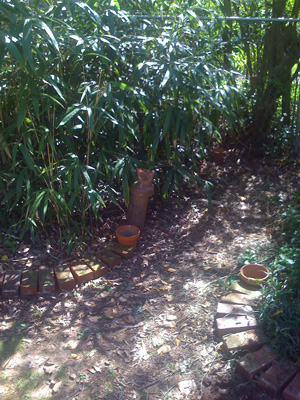
I went over to my brick pile and began extending the brick edging from the lower part of the yard.

What you see here is where the bricks define the entrance to the “men’s room.” It’s an intriguing gateway; this photo doesn’t do it justice. It just leads into a quiet area next to the bamboo, and all it is, is a corner of chainlink fence.

But the impact of the brick edging is very nice indeed. The two clay pots hold candles, to help light the unsteady their way. (There are other clay pots hung from the fence within the grotto itself.) You will also notice the terracotta pipe, the lingam, guarding the entrance.

I will have to set the bricks into the ground at some point. Spring break is coming up.

VSU

I traveled down to Valdosta for our annual administrative meeting, and this post is more for those with an interest in GHP business than for the general readership.

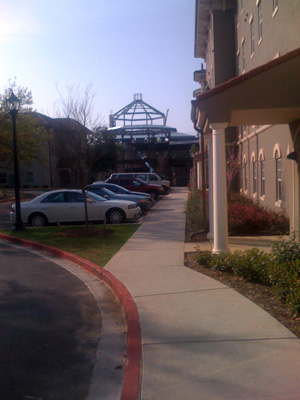
Look at all the pretty construction! I’ll chat about these in the order in which I took them.

This is looking along the new ginormous Hopper Hall, down what used to be Hopper Circle towards what used to be the University Union. That is the new Union rising upon the ashes of the old one.

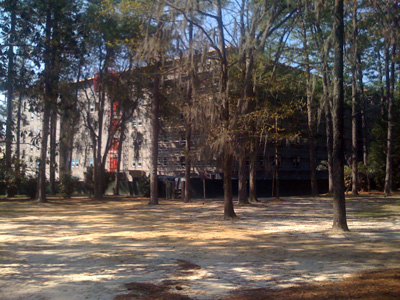
This is the new Georgia Hall, rising from the ashes of the old one. You can see Langdale to the left. Georgia has gone from three floors to five, extended itself over onto the old infirmary, and sprouted a wing out into what used to be Langdale Circle.

Here’s another shot of Georgia, from Georgia Avenue.

This is the new Student Health Center, across Georgia Avenue from Georgia Hall. Apparently it’s stunning. It’s certainly larger. It can do its own x-rays now, which will save many a daytrip to the ER. (In an added note, Parking is now way over in a new office in the Sustella Parking Deck.) The old infirmary was called the Farber Health Center; I don’t know why the new one didn’t carry the name over. Perhaps the Farbers didn’t donate enough to retain the honor?

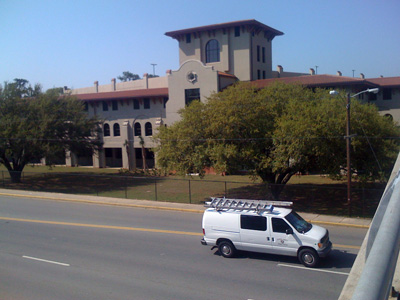
Here’s another shot of the Union, taken at the end of the pedestrian mall in front of the library. Yes, it will have a big ol’ atrium.

Trudging over the pedestrian bridge, here’s a shot of the new Oak Street Parking Deck. Very nice, and even nicer are the Auxiliary offices on the Education Building end of the thing. They are spacious and beautifully appointed. The team is very proud of their new large multipurpose room, which is a Starfleet Command meeting room, along with an enormous catering kitchen attached. Very very nice. The additional parking is handy as well. The University Police occupy new digs on the other side, but I didn’t see them.

Looking back towards campus, here’s the Union again. It’s huge. It sits where the old Union, pool, and Old Gym used to be.

Finally, here’s a shot at the end of Baytree. You can see the old smokestack doing its phallic thing on the right. Last year, you would have been looking at the back end of the Old Gym. The new Union will have meeting rooms, a food court, offices, and way up there at the top of this wing (the other wing runs along Hopper Used-To-Be-Circle) my ballroom.

In addition to this new construction, Nevins will be undergoing renovation by the time we get there, as will Ashley Hall. (IT has moved into University Police’s old quarters in Pine Hall.) Traffic up and down the campus will essentially be between construction sites.

All of this will be over and done with by next summer, and then we will be safe from construction/renovation for some time to come. It’s part of the strategic plan, and the construction part of all of that has played itself out. No new Fine Arts Building in our future, I’m afraid.

On the way home, I avoided I-75 and took US 41 up to Tifton. There’s this building in Sparks, right north of Adel, that has astounded me for years, and I finally took a picture of it:

This is driving north, just as you get to it.

And here’s rounding the curve, right in front of it.

What the hell is it? It’s enormous, and it’s been abandoned for as many years as I’ve been driving through there. It’s obviously a patchwork kind of place, and it gives off vibes of both commercial and residential. If this were in Houston or Peach County, I’d say it was a former peach farm kind of thing, where migrant workers bunked in the background and peaches were sold to tourists up front. And that would make sense before I-75 came through: US 41 was the old 75. But I’m not aware of Cook County being a big peach area.

I’m going to have to stop and ask this June.

An insight

I’m sitting here rereading some posts and comments thereunto (yes, I do that), and I had a sudden insight.

This springs from a comment on my Charter Systems post about how perhaps the push for the charter systems movement is coming from the corporations that run some charter schools, and that the whole thing is to push for the vast profits these corporations stand to make if we all go charter.

I had snarkily replied that if it were possible to make vast profits from a school, wouldn’t we be doing that? And I’ve been thinking: are we so wasteful of the taxpayer’s dime that we can’t see how to make money doing what we’re doing?

And I’ve decided, no, we’re not. There was a headline this week about how our school system is under budget, thank goodness, and won’t have to tap into the reserves. Well, yes we are, and do you know how? Spending was frozen in August. The amount sent by the state to this county for my media center, and which is entailed upon it, has been frozen.

Our checkbook balance looks good, but it’s the “good” we all see at the first of the month: lots of cash on hand, but every single bit of it is already marked for bills. My point is that the only way we can beef up the assets column is to choke the actual education process.

No, my dears, education is a rathole. You just have to keep shoveling money into it, and is that any way to run a business?

No, it’s not. Here’s my insight: education is not a business, and you cannot run it like one, or at least run it like one and expect business-like results. Education is a farm.

You plant, you water, you fertilize, you tend, you weed, and with any luck at all, you harvest. But some harvests are big ones, and some are not. You have no way of knowing, although of course you do have to use the right fertilizer and the right techniques. But one thing is for sure: you still have to pour money into the process. You have to buy the fertilizer and the tractors and the combines and the irrigation, and you have to maintain them. Because if you don’t, then you will get no harvest at all.

And I think it’s a better metaphor, at least to bring us back around to the profit motive, if we regard our farm as the source of our own food, not as crops to sell for profit. I’m not going to explicate that one; think through it yourself.

As for funding these nourishment-providing farms of ours, the History Channel had an absolutely intriguing show the other night about agricultural technology. We saw cotton farmers in California using satellite technology to identify which areas of their fields were ready to be sprayed with a saline solution, and with how much, as they flew over them with spraying helicopters. We saw rice farmers using satellites and computers to tell them which areas of which fields needed fertilizer or pesticides.

These were compared, of course, to developing nations where it’s all done by hand.

Now, which farms were feeding the world? And notice how much money has to be spent to give the farmers the tools to be able to that. It all depends on how badly you want crops, doesn’t it?

Ongoing listening, 3/12/09

I am behind in my listening, or at least in my posting about the listening.

For about a week, I made my way through Skys, by Michael Danna, and Brian Eno’s Discreet Music.

The first one is somber space music, based, the composer says, on the lowering skies of Canada. Well, who wouldn’t jump at that? I can resist the temptation. The ten pieces on the CD are all basically the same, an ostinato kind of figure over which there is some countermelody, without any kind of harmonic exploration, or indeed thematic for the most part. Very uninspiring. Onto the giveaway pile.

The Eno is a bit more complex. The first piece, the title piece, is a lovely bit of Eno’s ambient stuff, pretty much indistinguishable from most of his other stuff, but pleasant.

The other three tracks are entitled Three Variations on the Canon in D major by Johann Pachelbel, and it’s a bit more involved. In each, parts of the Canon are subjected to “systems,” e.g., the tempo of each players part is decreased at a rate governed by the player’s pitch. The first is, at first listening, most successful. Probably the other two would bear fruit upon further exposure.

I then moved on to two symphonies by Philip Glass, No. 8 and No. 2. The Eighth was part of my desk pile; the Second was on my CD shelf.

The Eighth was my favorite of the two. Its command of the soundspace was more masterful. I know it’s hard to think of someone like Philip Glass becoming more assured over time, especially since the Second was written when he was already a master, but to my ears there’s a definite difference in the success rate of the form.

The Second was choppy, a little more self-conscious about what it was trying to do (be a symphony), and it just did not pull together. The Eighth, on the other hand, was a return to purely instrumental after the choral/vocal settings of the 5th-7th. It announces itself with a strong opening, and the energy is carried throughout the movement.

The second movement is a passacaglia, and it sounds organized in ways that Skys never did. The third movement is the most interesting. It’s very short, only seven minutes long, and it’s very slow, with no Glassian fireworks at all. The English horn intones a despairing kind of theme in a bleak landscape. It repeats, then twice more with a countermelody, then the whole thing closes out in an evaporation of sound.

My next two listening adventures are Prokofiev’s Piano Concertos Nos. 1 & 3, and Bartók’s Piano Concerto No. 3 on one CD, and Rautavaara’s “Angel of Dusk,” Concerto for Double Bass; Symphony No. 2; Suomalainen myytti (A Finnish Myth); and Pelimannit (Fiddlers), on the other CD.

Charter Systems

I am intrigued by this latest movement on the part of school systems across the state of Georgia to move to “charter status.” Our own beloved Coweta County is exploring such a move.

Essentially, an entire system switches its schools over to charter school status, which means that it is freed from many state rules and regulations. Who wouldn’t want to do that? No more pesky rules about testing, hooray!

The question arises, why would the state want to do that? It turns out there is a trade-off for gaining charter system status: you have to produce better results than you would have under the state’s restrictions, “results” being defined as “student achivement,” where “student achievement” is defined as “better test scores,” where “better” is defined as “higher.”

Still, imagine the freedom! You get to teach your kids however you like, as long as you’re sure that your mavericky instructional ways are going to produce Lake Wobegon test scores.

Just this morning I heard a school system superintendent (not ours) on the radio, enthusing how charter system status would give them “more flexibility on things like class size and teacher pay.”

Well, alrighty then, let’s do that thing where you lower class sizes and hire more teachers at higher pay so that you can… what?

Really?

Oh. Never mind then.

I suppose that it is entirely possible that you could load up a class with 35 students (although today’s classrooms have been built for much smaller numbers) and cut the teacher’s pay, and at the end of the five-year charter period have freaking incredible test scores. It’s possible George W. Bush and Alberto Gonzales will be charged with war crimes, too. I am after all an optimist.

However, I am still curious: if “easing” the regulations on class size and teacher pay (among others) so that local systems have more “flexibility” actually would produce significant student achievement, then why do we have those gosh-darn regulations in the first place? Wouldn’t it make sense to liberate the entire state from the onus of these burdensome regulations so that Georgia could immediately “lead the nation in improving student achievement”?

I remain, as always, curious.

Reality checks

Let’s check the Times-Herald‘s Sound Off and see what we find, shall we? Oh look, conservative wingnuts!

What exactly has President Obama done that he said he was going to do? Nothing. Then again, we Republicans new [sic] that before the election.

Hm. Direct military leaders to end war in Iraq? Check. Expand SCHIP eligibility? Check. Increase funding for the NEA? Check. Lift stem cell research restrictions? Check. Close Guantanamo? Check. Overturn Ledbetter vs. Goodyear? Check. Etc. etc. Not bad for six weeks, actually.

Why do you say the people need government right now? The problem is that we have had too much government for the past eight years. Government jobs need to be cut and government spending stopped.

Yet this person would have called me a communist if I had suggested cutting government spending in Iraq over the last six years.

I own a successful business, pay taxes, pay my mortgage and pay all my other bills. I try to save as much money as possible. I bought a new automobile to help the auto companies. Don’t try to tell me I am to blame for the sorry state of affairs.

No one’s blaming you for the sorry state of affairs. Unless, of course, you’re the inventor of complex derivatives.

I, too, hope Obama fails in strangling our republic with socialism.

“Socialism” is not we call what Obama is doing. Nor would actual socialism strangle a republic. You can check with Sweden on that one.

What a furor there was over Richard Nixon’s enemies list. Now we have President Obama and his enemies list headed by Rush Limbaugh. I’d better not hold my breath waiting for the furor over Obama’s list.

Probably you shouldn’t, because it doesn’t exist. Nixon’s list was an actual on-paper list, and those enemies were spied on by the FBI, careers checked at any possible opportunity. Obama of course has no such list. No one’s even suggested that Limbaugh is an “enemy,” except of course for the Republican spokesman himself. But then that’s just good for business.

To Lynn Westmoreland: Thank you for voting no and being a good steward of our money.

Vid. sup., re: Iraq War. Also, I hope Mr. Westmoreland has publicly refused any of the stimulus money for our district. On principle, of course.

One’s jaw just has to drop when these things show up in our public discourse. They’re so disconnected from the reality-based community that there’s no way to approach them. All you can do is wave at them as their little parade passes by.