Behold!

I was out walking the labyrinth one night last week, concentrating on the classical element Earth, hoping for some insight into making the percussion piece more true, and what I ended up with was a flash of clarity about the northpoint.  After all these years, I knew what it should look like.

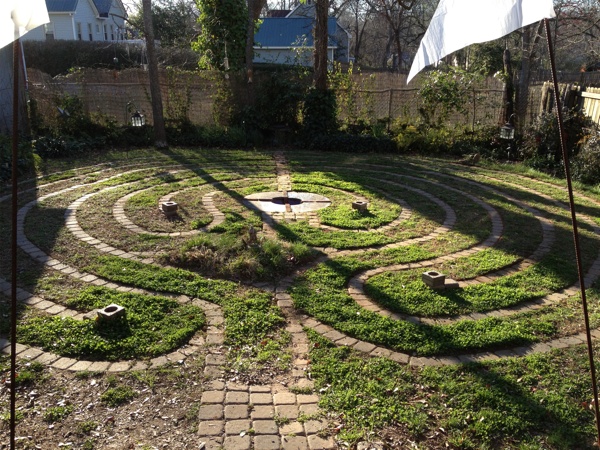
Here’s a shot of what it kind of looked like:
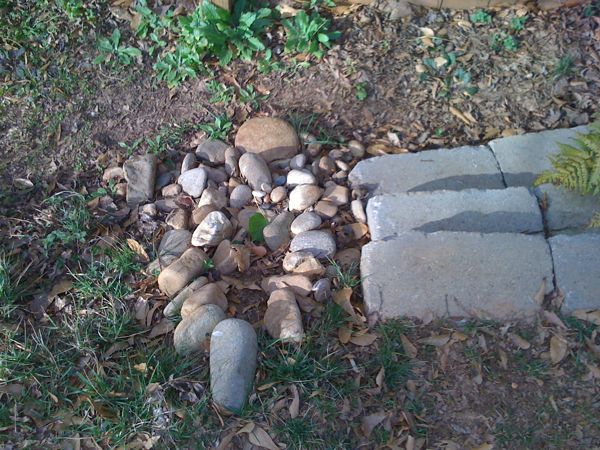
Except for the addition of a large square stone at the top, by the path, that was it.  Not very interesting and not very inspiring.

So this morning I dropped the cat off at the vet and headed over to Mulch and More, where I picked up the following:
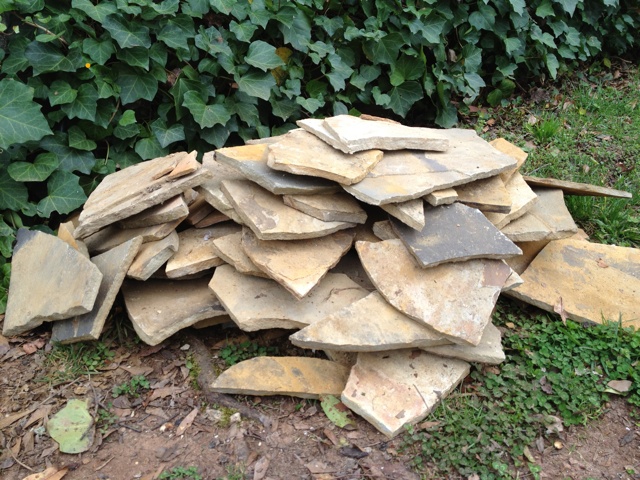
I overbought, but that’s OK.  I have another project in mind for which I can use them.  It’s fieldstone, by the way.  (Also by the way, I took today off because I had to meet with the lawyer to probate my mother’s will.)

This took a lot less time than I thought it would, so much so that I barely have any documentation of the process.  To wit, I stripped away the existing stones:

I dug a hole, leveled it, and laid out the base:
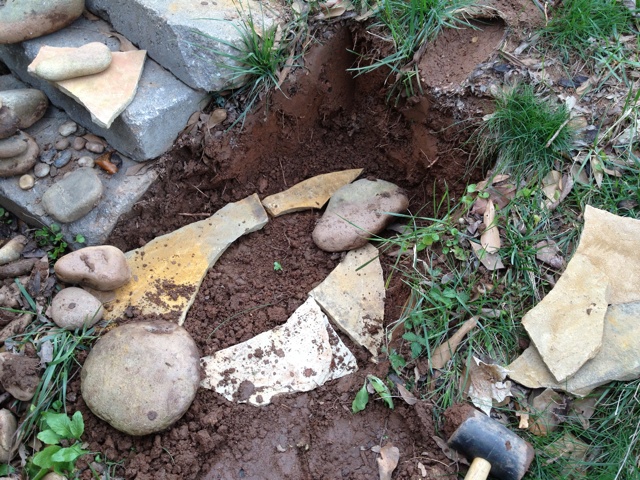
I built the little towery thing (and yes, you have another image in your mind, or will…):
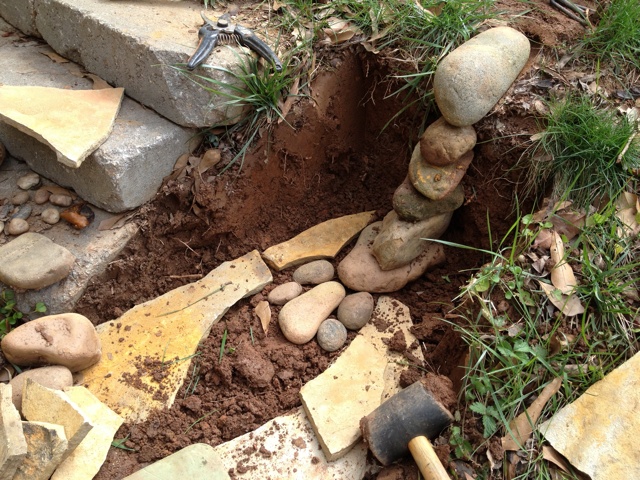
Notice the stones lying in the bottom.  More about that later.  After that, it went so quickly that I didn’t get any more photos until it was done:
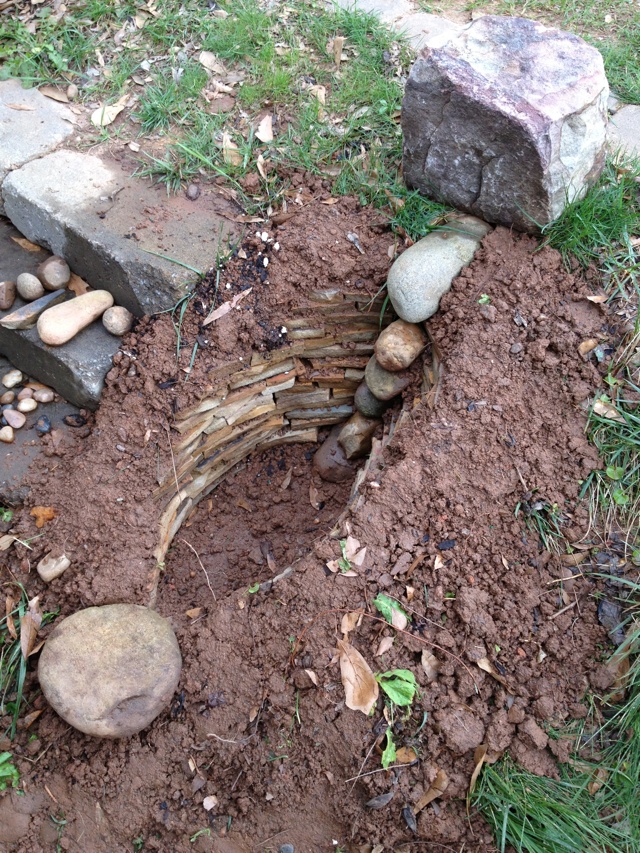
And from a more head-on angle:
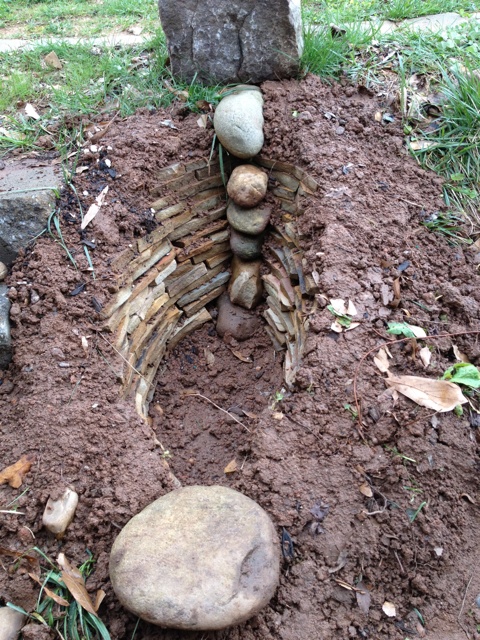
It’s pretty interesting, I think.  It makes a very good impression from the path looking down, but it didn’t photograph well.  I will be anxious to see how the bank of dirt holds out against the rain this weekend.  And I’m ready for the peacock fern to cover it immediately.

So what do you think?  Should I leave the bottom of the structure just plain dirt?  It would make it easier to maintain in many ways—just scrape the leaves out or spray it with Round-Up.  The other option is to fill it with the stones I stripped from the old structure.  I may play with that to see how it works.

UPDATE: After a lovely evening out by the fire last night, I can report that it functions quite beautifully with a plain dirt floor.  It is now raining heavily; I do wonder what it will look like by Sunday morning.
Earth Dance, part 2

This is going to surprise you, but I am not whining about my composition and how it’s going.

No, really.

I’ve observed something very interesting about my work on Earth Dance this time around.  I’m not struggling with it, which is not to say I’m just breezing along like some Mozart or Puccini, just pouring the music out onto the page (or in my case, the screen).  It’s still a very hard slog, but I’m not struggling.

Instead, I just excrete some work out there and play with it for a while, and then without any hesitation whatsoever skip a few measures, put in a double barline to remind myself of the new place, and start over with new excretions.  No pain, no gain, and no sweat.

I’m also sanguine about where the whole thing is going.  If I don’t like the sound of it, if it’s not chthonic enough, I’m OK with that.  Just start a new excretion.

If I like what I hear, also no problem.  I’m not at all concerned about taking it in a wrong direction, or even in any direction.

All I’m doing is excreting.  Sooner or later, I will hear what I want to hear.

I have come to understand my working habits and my approach to success.  Why should I worry about what I’m pretty sure is going to be a purely entertaining piece?

No, I’m not ready to share any of it yet.

A liberal rant

Here, go read this.  I’ll wait.

For those of you too lazy to do so, here’s the money quote:

“People who don’t have money don’t understand the stress,” said Alan Dlugash, a partner at accounting firm Marks Paneth & Shron LLP in New York who specializes in financial planning for the wealthy. “Could you imagine what it’s like to say I got three kids in private school, I have to think about pulling them out? How do you do that?”

My.  One’s heart aches for him, ne-c’est pas?

I am reminded of my first couple of years in the classroom, in the building that is now the Central Education Center here in Newnan, GA.  At the time, it was Central High School and served as the 9th-10th grade campus for Newnan High School.

Before 1970 or so, it was the high school of the black school system here in Newnan.  Yes, we had three school systems: Newnan, Coweta County, and the black school system.  I don’t even remember its official name.  But in 1971, we took the bold step not only of consolidating the city and county schools, but also integrating at the same time.  Could have been madness—it was boring, thank goodness (if sixteen years late).

Anyway, five years later and I’m back in my hometown teaching, and lo! parents were beginning to get a tad upset because their children were attending a school that was completely under-equipped, especially in the science labs.  How could the school system permit such a thing?

And I thought at the time, You assholes—it was fine for the Negroes to attend that school and not have any Erlenmayer flasks.  Perhaps if you had taken care of those students and their education, you wouldn’t be having this problem now.

It’s the Commons, people: take care of everyone and what we all  hold in common, and we will all benefit. Take care of your enclosure, and eventually you will suffer as well.  That’s something that even Ayn Rand and her slaves to selfishness might understand.

So, Mr. Dlugash, if that is your real name, if you had been more ferociously supportive of the public schools, making sure they were delivering excellent education to every single child no matter what the income level of their parents, you might not have such a terrible terrible dilemma on your hands now.  So can I imagine what it’s like for you?  Yeah.  Can I comprehend it? Nope.  Sorry.

An interesting Leap Day

Today, I have outlived my father.

In 1988, Grayson was born on Sunday, June 26.  That Friday, July 1, my father and mother were going out to the car to bring Ginny and Grayson home from the hospital—I was back in Valdosta—when he dropped dead of a heart attack, 292 days after his 58th birthday.

Thanks to the miracle of iPhone apps, a quick calculation for 292 days after my 58th birthday gives us February 28, 2012.  Yesterday.  Today, Leap Day, I have lived longer than my father.

This factoid is merely that; it has no real meaning for me, no superstitious portent or deep emotional wound or anything halfway approaching metaphysicality.  But when one gets to be a certain age, the hermetic elasticity of time exerts a fascination. Parents are not supposed to outlive their children, although my father’s mother certainly did (vid. sub.), so it’s entirely natural at some point in most people’s lives to look at their parents as figments of the past.

I often wondered whether I would “make it,” so to speak, given the genetics of the men in my family.  My father and grandfather both developed diabetes and both died before they were 59.  However, my father’s mother lived to be 99, dying of natural causes, and my mother just died at the age of 79 of cancer, so the genetic slot machine is just as likely to grant me another 20-40 years as not.

As I approached my 58th birthday last year, the fact that I was now ticking down to that metaphysical deadline was in and out of my thoughts quite a bit, but since then I haven’t really given it any thought.  I’ve been busy.  But last month I realized that I must be coming up on it, so that’s when I whipped out my iPhone and had Siri crunch the numbers for me.  (Ironically, today when I asked her to do it again so I could confirm all the math for this post, she balked.)

As I said, it has no meaning for me, just a curiosity.  It’s like the time about 15 years ago that my lovely first wife and I were visiting her parents for her father’s birthday, I think, and upon doing some math in my head I realized that we were at that point older than my in-laws were when we got married. Freaky, as the kids would say.  Or would have said 40 years ago.

I thought about having a vigil out by the fire in the Labyrinth tonight and meditate on it all, but the weather has turned yucky.  Perhaps tomorrow night, if things have dried out a bit.  Maybe I can come up with some meaning.

L’chaim!

The Labyrinth in February

I was very happy that today was clear and bright, and surprisingly warm.  I had work to do in the labyrinth.

I often feel like a bad steward at this time of year. The labyrinth is relatively grassless and muddy, and just looks abandoned. That’s kind of silly to think so, because it is February after all.  All the grass is dead everywhere.  But still.  My sacred space should always look cared for.

So today I was able to get out and rake it clean of all the tiny little twigs that the squirrels in their terrible ADHD have rained down on us, then mow it—although there wasn’t a lot to mow—then use the trimmer to edge the paving stones.

Behold:

You will see that there is green there and wonder why I’m complaining.  This is the clover that I am allowing to take over.  Since the last time I posted about the labyrinth, it has grown quite a lot.  That’s where the edging becomes necessary, because it will completely cover the paving stones if left to its own devices.  You can see, though, that the clover provides a nice ground cover.

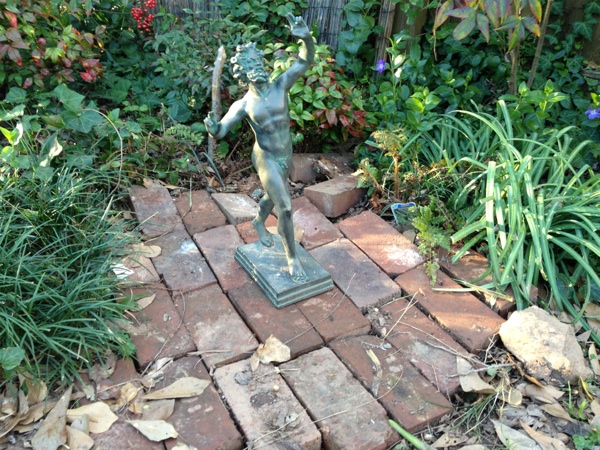
A couple of weekends ago, I got out and revamped the southwest corner.  A couple of years ago I planted a variety of nandinas, and those are coming along quite nicely.  This is where I positioned the Dancing Faun, but it was all kind of hugger-mugger.  So I got in, pulled up all the ivy, laid out some brick, and moved a couple of bristle ferns that were not doing as well as they might in a nearby location.  Now our Dionysian proxy has a stage:

Once the ferns grow up (and I’ll probably add a third one), he’ll be nice and lush.  I need to find little spike/stands for votive candles so that sojourners get a good look at him from the labyrinth.  Placing them around his feet is not very effective.

My labyrinth is still a refuge for me, although I haven’t been able to be out there a lot.  During the winter it’s a little hard, because you have to commit to building a fire and sticking it out with the cold as long as the fire is going.  Now that we’re beginning our approach to the Vernal Equinox, it will get a little easier.  Plus, I have a goal of burning all the Christmas greenery before the Equinox.

Earth Dance: the beginning

As promised, here is the framework for all the complaining you will enjoy between now and June.

Last summer, on the last night of GHP I think, Dr. Ryan Smith—our percussion teacher—asked all the composers on the music staff to write a piece for percussion ensemble to be played in 2012.  He was generous enough to include me in that request; I was actually surprised and gratified.  To my protestations that I don’t know how to write for percussion, he merely pooh-poohed me.  (Perhaps he was thinking of my “Dance for Double Bass Duo and Marimba”?)

I didn’t bother thinking about it until after the new year—I had other things to deal with, after all.  Still, if I’m going to do this I need to start now, so while driving up and down I-85 I began thinking about what I might do.  I’m a lot more comfortable with the tuned percussion—I really don’t  know how to write for all the really interesting things you can bang on—so I began planning on marimbas.

And because I’m radical like that, I thought I might include some low strings, some cellos, double basses.

So at the moment, the ensemble is for two marimbas, a vibraphone, a djembe, and bongos, plus two cellos and two double basses.

The working title is “Earth Dance.”  I’m pretending it’s the third movement in a suite called Elemental Dances: Fire/Water/Earth/Air.  We’ll see  how that goes, of course.

Last night’s work was just trying to create crap, and I largely succeeded.  There was one theme that was attractive, but I’m going for ponderous/savage/dark, so it may not work.

More as it fails to develop.

Return of the whinging composer

Tonight I forced myself to sit down in front of  the computer and begin banging on the keyboard in some kind of attempt to begin composing the percussion piece for this summer, so you know what that means: months of my whinging about how it’s going—or more usually, not going.

But first, it has been suggested that I post the world premiere performances of Six Preludes (no fugues).  You are spared the whinging for a moment.

I will not post all six; Maila Springfield hinted that she might not be happiest with all of them.  But I think her performances of the first four are quite lovely, so I’ll post those.

I’ll let those sink in for a day or two.  As for the percussion piece, there’s really not anything to whinge about at the moment.  Perhaps I’ll set up the framework for all my complaining tomorrow.

2012 Lichtenbergian goals

Yes, I have not blogged since November.  Sue me.

This past Friday night, I was hosting the meeting of interviewers for music and visual arts for Saturday’s statewide GHP interviews.  Two of my favorite people in the world, David and Maila Springfield, walked in, and the first thing Maila does, after hugging me with delight, is hand me a CD.

This was pretty momentous.  The CD contained her performance of her world premiere performance of Six Preludes (no fugues), which of course were written for her.  I got through the meeting somehow, then got into my car and popped the CD in.

The first thing you notice is that it’s a live performance and nothing at all like the computer version we’ve all come to know and love.  And the second thing you notice, after repeated listenings, is that even with the inevitable mistakes of a live performance, this music is pretty damn fine.

If you’re all very good, I may upload my favorites of Maila’s interpretations alongside the computerized versions just so you can hear how astounding a gifted human musician is.

But today, I need to talk about my Lichtenbergian goals for 2012.

We had our Annual Meeting back on December 16, and my life was just too crazy to think about writing about it.  (I actually had completely forgotten about it until this weekend.)  Every now and then I’ll think, “I should blog about that,” but I don’t.  Most of what goes on in my life these days is work related, or extremely personal, and of course I have never blogged about those kinds of things.

So: Lichtenbergian goals.

I think that of my 2011 goals I achieved one: finish the cello sonata.  That was kind of cheating, since I had started it in 2010 and it was due in the spring of 2011 anyway.  The only saving grace, Lichtenbergianism-speaking-wise, is that I didn’t finish it until the fall.

I knew my record would be pretty shoddy.  After all, since April my life has been swamped by GHP, and I was lucky to finish the cello sonata at all.  So I was sanguine about having to face my fellow Lichtenbergians and admit to cras melior est for everything I had claimed to be interested in finishing.  And I knew that my life in 2012 was not going to be any calmer.  For a while it looked as if I might be ramping up a production of William Blake’s Inn for international consumption, but that fell through, and whatever else I had on my mind, GHP would continue to be a Red Queen experience for at least another six months.

So I had decided that I was going to lowball my goals for 2012 just out of self defense.  And “lowball” is being generous.

My 2012 Lichtenbergian goals:

  • Finish a set of piano pieces called Five Easier Pieces as both a companion and an apology for Six Preludes
  • Do something about the westpoint in the labyrinth (I believe those are the actual words reported to me by Jeff Bishop when in fact I could not remember what my second goal was.)

That’s it.

In my defense, I completely forgot about the percussion piece that I was asked to write for this summer (along with the other composers on the GHP staff), so if we like, we can count that as a third goal.  But otherwise, that’s it.

Going to be an easy year, yes sir.


Ultimate Lichtenbergian procrastination

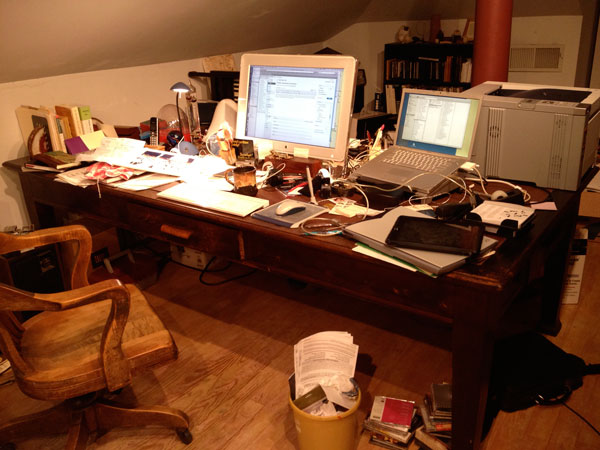
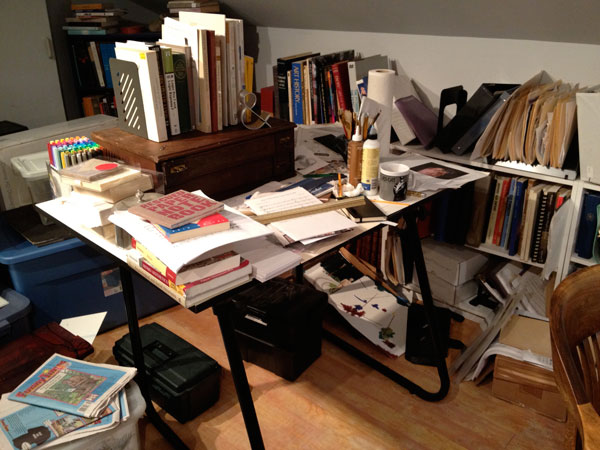
I cleaned up my study on Friday, really shoveled the place out.  I mostly got my desk cleaned off, but I barely touched my drafting table.  For those who have never seen my sanctum, I have a massive oak library table, 4×8, with a fake leather top, for my desk, and behind me, my old drafting table serves as my painting table.

Viz.:

The library table/desk
The drafting table

So this morning, while waiting for all the Baptists to clear the street so I could go mulch the labyrinth without disturbing their consciences—because I’m considerate like that—I thought I might at least reorganize the drafting table.

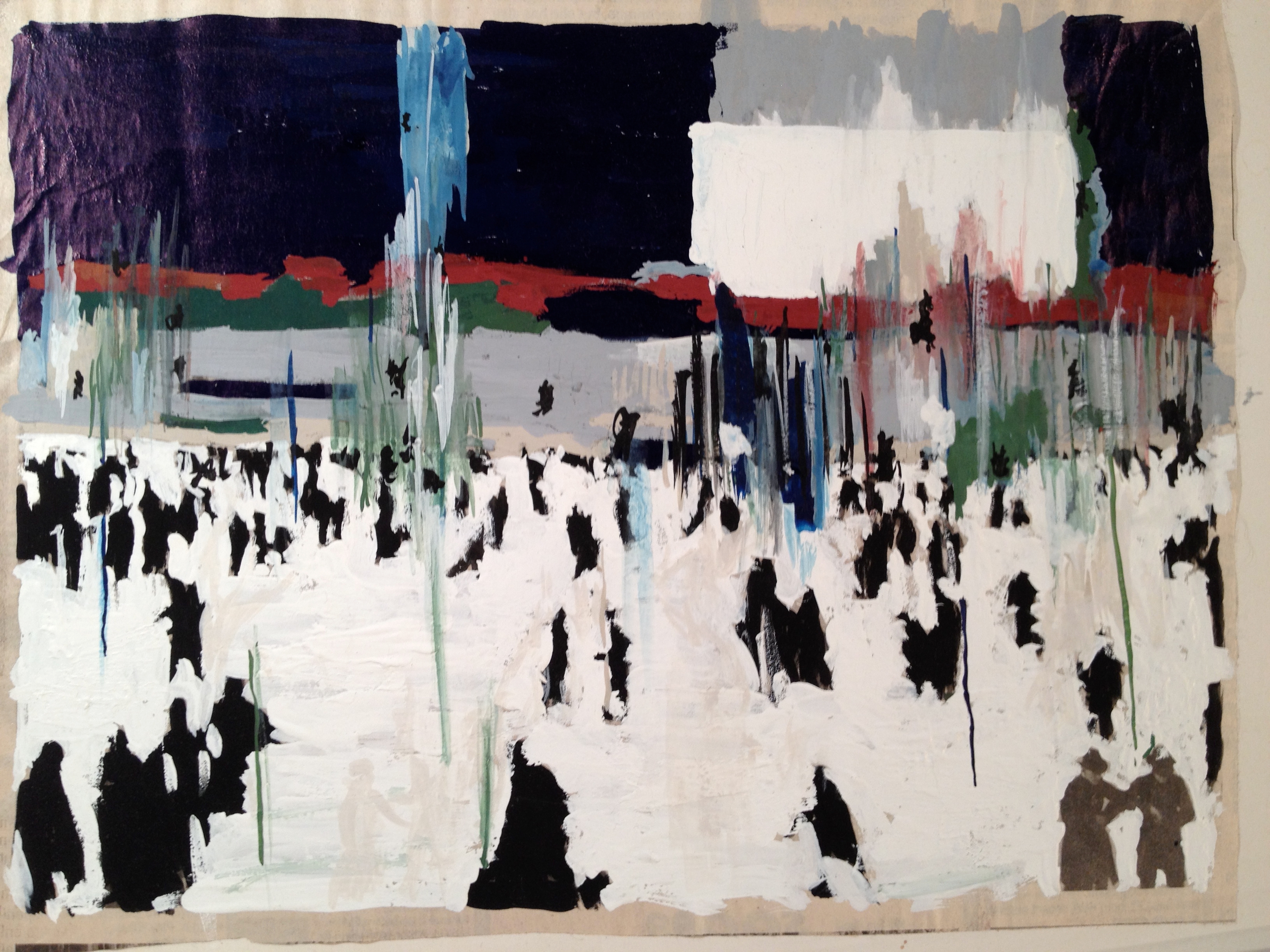
But the first thing that happened was that I picked up a painting that I have not touched in at least 18 months.  Here it is:

Click to see it embiggened.

Wow.  I like this.  I like this a lot.  It is of course one of my old Field series, one of the first, in fact.  It’s a photograph from the New York Times, of skaters in Central Park in the late 19th century with the fabulous Dakota apartment house rising in splendid isolation to the west.  My modus operandi was to paint directly over the photo and turn it into an abstraction.

It actually works, I think.  Don’t do it, Dale.  Do not clear off that drafting table.  Do not get out your gouaches and brushes and start all that up again at this point.  Don’t do it.  It has a kind of sinister energy that appeals to me. don’t do it It makes me feel as if I might have been accomplishing something all that time do not do it.

Ah well, time to mulch the labyrinth.


The labyrinth in autumn

I haven’t written about the labyrinth in a while.  It’s still there, and I still get out there for meditation and work, but not as much as I’d like.

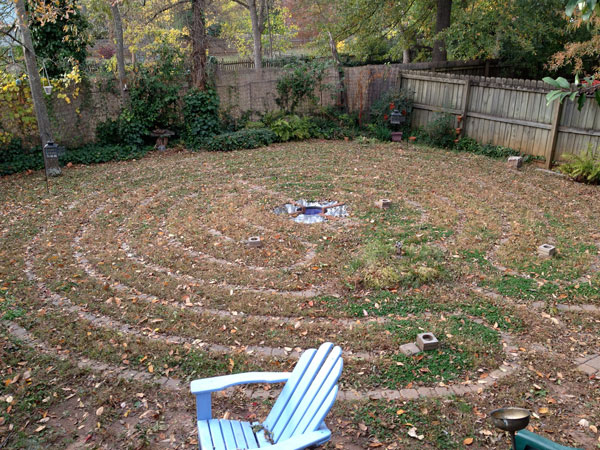
Here’s a shot from today:

The grass is going dormant, although the clover is still green.  Before tomorrow night I’ll need to get out and run the mower over it all to mulch the leaves.  Some Lichtenbergians are coming over to discuss The Ego and the Dynamic Ground, a book about transpersonal psychology.  I’ve been reading it back and forth on the train to the office, and it is utterly fascinating.  Another post, or series of posts.  All I will say at this point is that it reflects exactly my experience in the labyrinth.

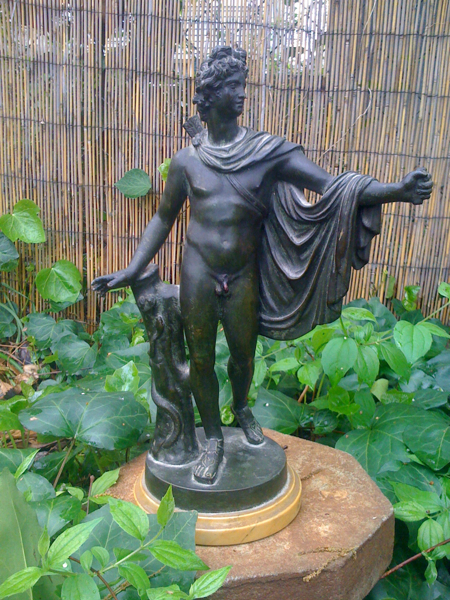
There are a couple of additions to the place.  You may recall the Apollo Belvedere:

Apollo, of course, was the Greek/Roman god of the sun, but also of medicine, music, and rationality, among other things.  He stood for the creative aspect, the putting together of things, the holding together.

Opposed to all of that was Dionysus, the god of wine, libido, and dissolution.  Dionysus (and his analogs of Pan and Shiva) stood for the destructive process, the taking apart, the letting go.

It does not take a Nietsche to realize that a wise person accommodates both these forces in his life and brings them into balance and alignment.  Easy to say, not so easy to do, of course.  But I’m working on it.

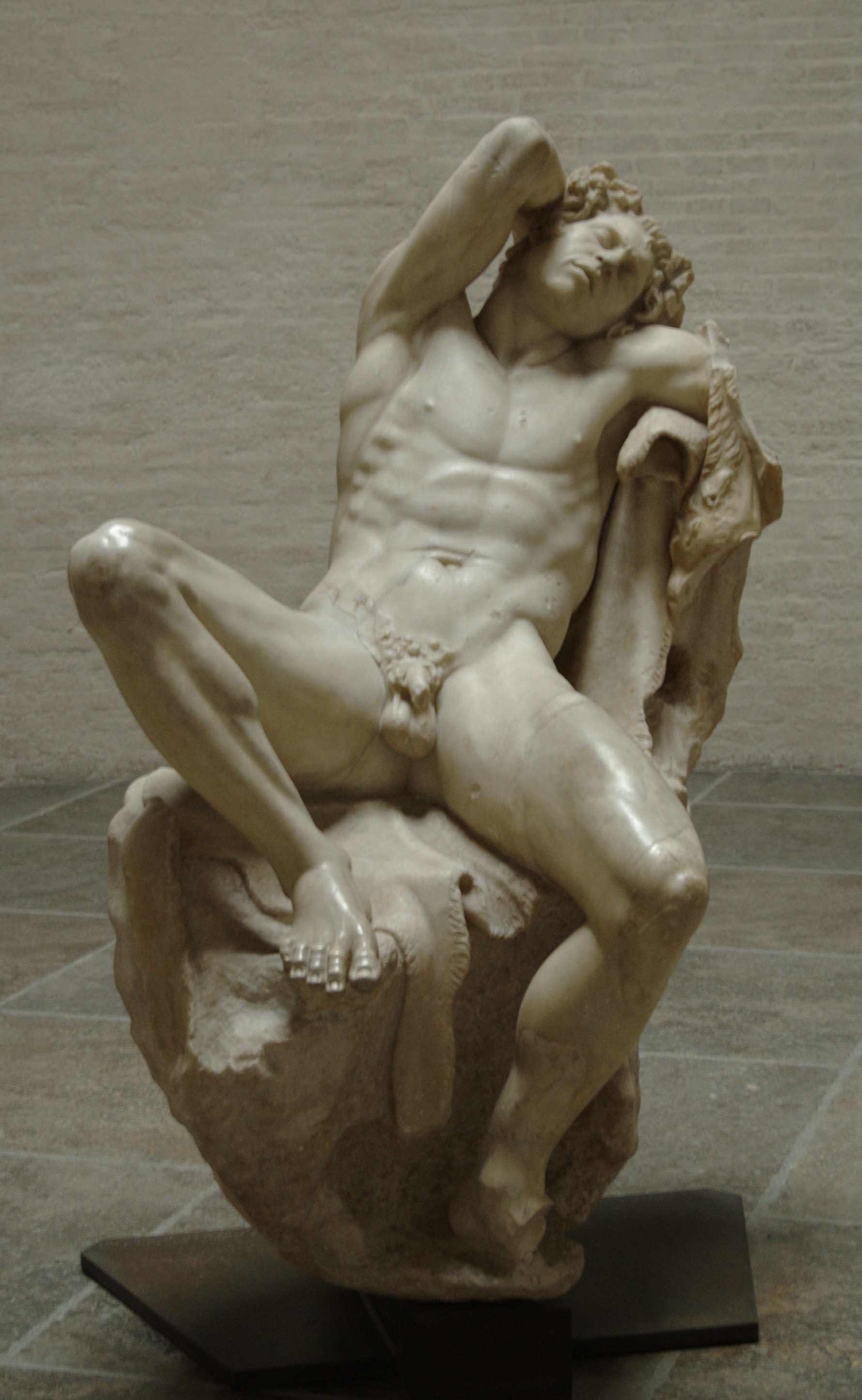
Anyway, I’ve been looking for a statue for the labyrinth, but the one I really wanted (the Barberini Faun) was only available in nearly lifesized copies costing $10,000.  That much dissolution I did not need.

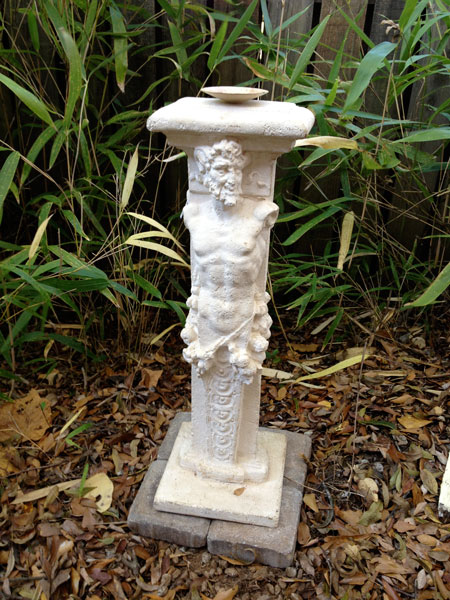
As an interim, I found this at Decor Encore downtown:

A charming little satyr plinth candle holder.  It’s actually double-sided, and I have it up in the bamboo in the driveway to light your path downwards.  No, that was not a metaphor.

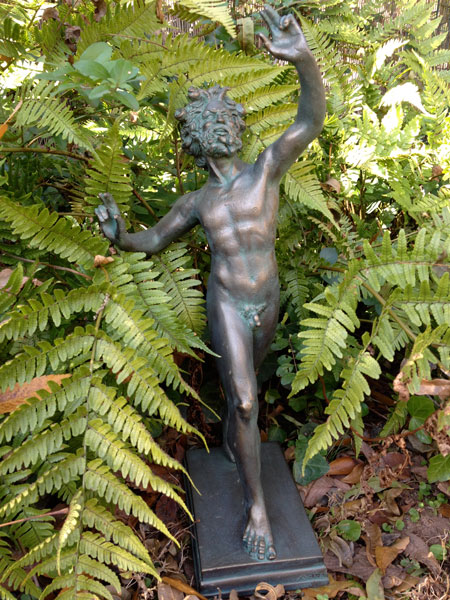
My big find, however, is the Dancing Faun:

Isn’t he beautiful?  As much as the totally oblivious dissolution of the Barberini appealed to me, this faun (the original is from Pompeii) is in a state to which I aspire: ecstatic abandon.  The photo does not do it justice; no photo can.  The piece is meant to be seen from all angles, and it changes depending on where you stand.  (Yes, he has a tail, right above his taut runner’s buttocks.)  This angle gives a better idea of the extreme contrapposto, the Hellenistic Mannerism—if I may slam two periods together—that motivates this work.

Next to him, Apollo looks kind of soft around the edges, doesn’t he?  Balance, dear reader, balance.