A Christmas memory

We were Decoratoring™ the domicile last month, and as I unpacked the ornaments for the front tree—yes, we have multiple trees—this little ornament surfaced:
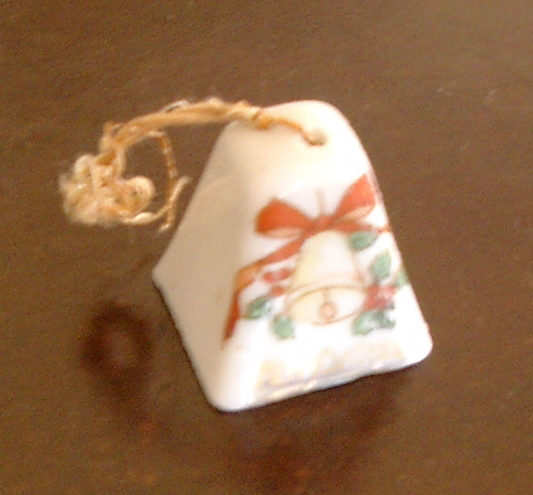
Here’s the story. I was in first grade, in Miss Betty Jim Owings’ room, and it was the day before Christmas holidays. She asked us all to put our heads down on our desks and to keep them down until she told us to look. I could hear her moving about the room, and I must have felt something being placed on my desk, although I do not remember that specifically.

What I do remember is the sound, the tinkling that moved about the room with Miss Owings. I think she said something about fairies. When we finally looked up, each of us had one of those red mesh stockings filled with various goodies, and attached to the top of each one was a little china bell.

That was in December of 1960, fifty years ago. Fifty years ago. Dwight Eisenhower was still President. Cuba had only just changed hands. Shostakovich had not yet written his Twelfth Symphony. In 1960, “fifty years ago” would have been before Shostakovich had written his First Symphony, before the premiere of Le Sacre du Printemps even, before World War I, before the Titanic sank. Shostakovich would have in fact been four years old, younger than I was fifty years later.

Do you know how hard it is to make myself believe that?

I took the little china bell home, and I put it away in a little cedar box that had been my mother’s but which she had given to me. Lots of flotsam in that box, and I can still see some of it in my mind: a cheap little horseshoe magnet, a piece of galena, some chalk, a stub of sealing wax. In this ark the china bell made its journey through the years, until finally I was married and beginning to decorate Christmas trees on my own. At some point I remembered the bell and brought it out, hanging it on the tree near the top.

Now it’s stored away during the year, and I remember Betty Jim Owings every Christmas when I take it out.

Betty Jim Owings was my first teacher, kindergarten being a rarity in those days, at least for those who grew up on dirt roads on the east side of Macon, GA. We had moved to Newnan that summer, and I entered Elm Street School in September. Miss Betty Jim was the first person outside my family to have a profound impact on me.

In those days, we learned to read via the execrable Dick & Jane series, and we did so by going up for Reading Circle. Six or eight children would come up and sit in the reading circle with Miss Owings, and we’d read round robin. (The point of the D&J series was “sight word” instruction, and no, I don’t know what everyone else was doing. Worksheets I assume.)

The first time I went to the reading circle I did not listen carefully to our instructions, so when she said, “Read the first three pages to yourself,” I didn’t realize she meant to read silently, and so I just lit out, flipping the pages as I read out loud. To myself, to be sure, but out loud. “Oh. Oh oh. See. See Spot…”

“Read silently, Dale,” Miss Owings admonished, but when Reading Circle was over, she pulled me aside. “You already know how to read,” she observed, and proceeded to test my reading level on the spot. I read at the fifth grade level, and so she provided fourth and fifth grade readers for me to read. I never returned to Reading Circle and its little wooden chairs.

So Miss Betty Jim jumpstarted my brilliant career, never holding me back to the level of the average first grader. Once, however, that was a problem. Does anyone remember the flannel board? This was a simple piece of cardboard, about poster size, covered with dark green flannel, accompanied by a box filled with dozens of cutouts of letters, shapes, and animals. Miss Owings would use it for various purposes, but mostly for math. She would put up the numeral ‘4,’ for example, and invite someone up to put the right number of pigs or cats on the board. Or she’d put up a simple math sentence,  ‘2 + 3 =,’ and some lucky child would get to define that in pigs.

That was marvelous: the six-year-old in me lusted after that box with its scores of items, all neatly categorized in their little compartments. But I never got called on. I’d raise my hand, but Miss Owings would always call on someone else. Finally I expressed my sadness to my mother, who to her credit called Betty Jim and told her. And Miss Owings, to her credit, apologized to me. She didn’t call on me because I already knew all of it, she said; I told her that I still wanted to “do flannel board” like everyone else. And so she began to call on me as well as the others. And I got a flannel board for Christmas. (I still use that story as a cautionary tale for parents of gifted kids: never forget that while they read like someone four or five years older, they’re still a kid and want to do kid things.)

Twenty-eight years later, my son Grayson was born, and Miss Betty Jim (as she was now known to me) came to our house bearing a gift: a small wooden chair. It was one of the original Reading Circle chairs, she said, and when the school system bought new, cheap, plastic chairs, she simply took all the wooden ones home with her. She stripped the paint from them and held on to them, doling them out as presents for special people and special occasions. I was one of those special people, she said, and this was a special occasion.

Betty Jim Owings died nine years ago tomorrow, January 13, 2002, having remained one of my biggest supporters for the rest of her life, attending every play at NCTC and cheering my every achievement. She was a great lady. Thank you, Miss Owings.
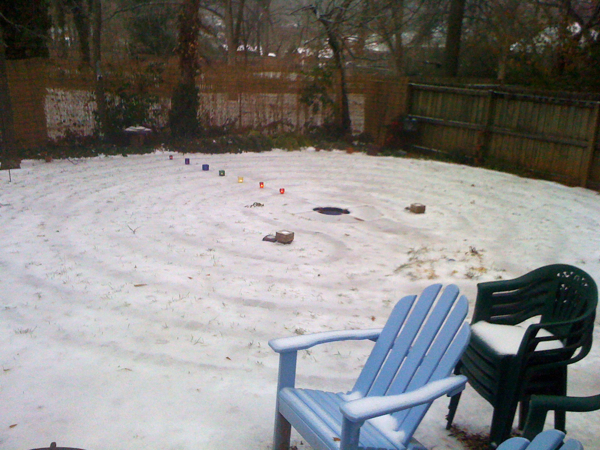
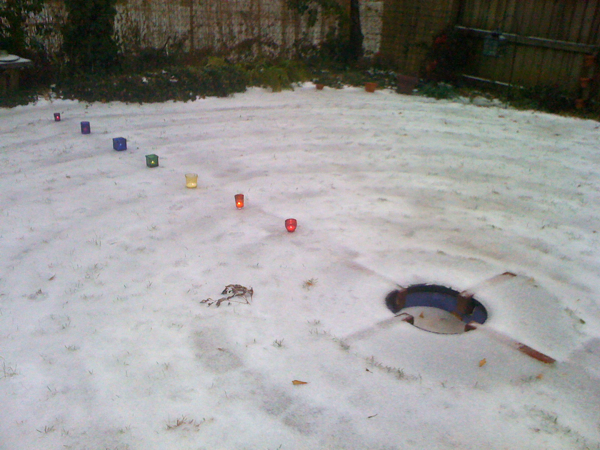
Labyrinth, 1/10/11

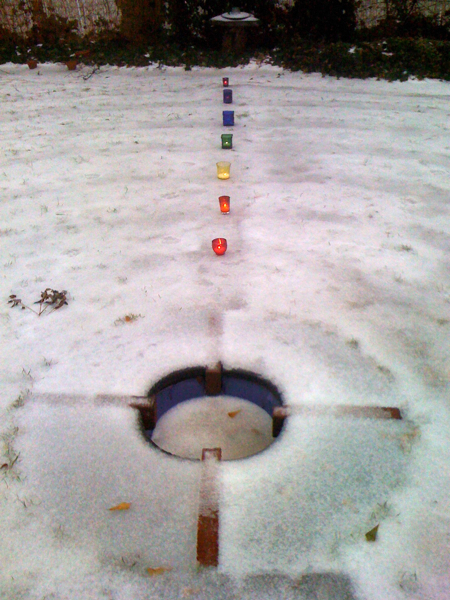
We haven’t had a photo of the labyrinth in a while, so here are some from today, after the storm last night:

A nice long shot. My original idea was to go out and walk it, since it was mostly a uniform sheet of white, then take a photo of the path my footprints left. But my feet left no prints, none discernible to the camera at any rate. Then it occurred to me to take the chakra candles out and light them.

Actually, I lighted the candles first, then distributed them.

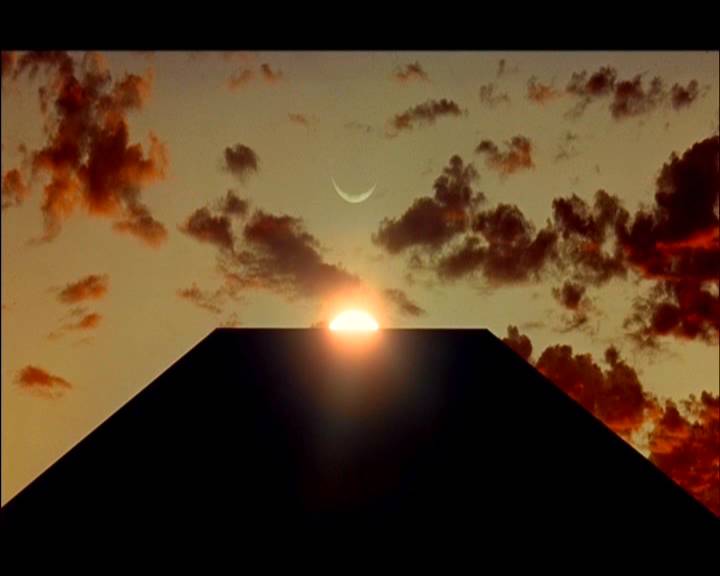
I always think of this angle as the “Kubrick/2001” shot, because of several shots from that movie like this:

Or like this:

What, you thought I meant this?

Okay, so maybe when I’m seriously meditating, I think of that kind of thing.

But isn’t the labyrinth pretty in the snow? If only I had a hot tub from which to meditate on it.

An hypothesis

I have an hypothesis.

You are probably aware of the fungus Ophiocordyceps unilateralis which turns ants into “zombies.” If not, check it out here.

I have become convinced that something similar is happening all around us. Somehow, a parasite has adapted itself to the human race, specifically the males. I’m not sure how it happens, but somehow this parasite finds a way into the body, probably in the adolescent period—I’m not prepared to speculate how, but suspect it’s sexual—and embeds itself, biding its time.

Then, as the victim reaches an advanced age, 60 or greater, the parasite climbs to the brain, where it compels him to go out and buy a little red truck.

Then, having purchased this vehicle, the victim takes it out on the road and drives slowly. Everywhere. In front of me.

Now, I have no idea what evolutionary advantage this gives the parasite, but I am certain that this is the only explanation for an otherwise inexplicable phenomenon.

Discuss.

A thank you

We sent Christmas cards this year for the first time in a couple of years. (When I say “we,” I mean “my lovely first wife,” of course.) Elizabeth Schuett’s came back as undeliverable. I went to the internet to track down her new address, and that’s when I found out that she died in 2007, a fact we would have learned had we kept up with sending cards.

Elizabeth was one of the people in my life who created me. I met her when I was in high school, after returning from GHP in 1970. My love for theatre had been reignited that summer, and so I joined the Newnan Playmakers upon my return. (Actually, I rejoined: I had been involved from sixth through eighth grades.)

Elizabeth was new-ish to town and was at the center of a small, hardcore group of creatives who had coalesced at that time and place. She was a self-described “tough old broad,” a drinker, a smoker, profane and funny. She was also one of the greatest ladies I’ve ever known, educated and kind and creative.

Over the next two years, Elizabeth took me under her wing and began to show me the possibilities in life. She owned a knit shop downtown, and it was the salon for what passed as intelligentsia in Newnan. We all hung out there in the back room, drinking coffee, make jokes, making plans, and talking, talking, talking.

It was Elizabeth who first made me aware of what “cosmopolitan” meant: she had lived other places, done other things, had other lives. She taught me that the horizon was not a wall but a goal. She showed me what it meant to go to a great restaurant, to attend the symphony, to explore ideas and their expression.

She showed me that not everyone would always think I was weird—or that my ideas and dreams were foolish—or that I would inevitably fail to find love or happiness if I didn’t learn to act like everyone else. She accepted me—and others—for not only who we were but who we needed to be.

I went off to UGA and returned to find that the gang had split off from the Playmakers to form the Newnan Repertory Company. They were frustrated with the old group’s hopelessly unimaginative approach to theatre, and it was their spirit that flowed on down to the Newnan Community Theatre Company. I picked the group up from them; if you ever benefited from NCTC, you have benefited from Elizabeth Schuett.

Eventually, she found the restrictions of Newnan too maddening, so she closed the shop and for reasons I never found very clear moved to her ex-husband Robert’s hometown, Gibsonburg, OH, where she taught high school and college, and wrote a syndicated column for years.

During those years we kept in touch sporadically. I would offer her a job in CommArts at GHP; citing the hellish heat, she would decline. We’d send her Christmas cards. She’d email. But we never communicated on a regular basis, so it is comforting to me that while the news of her death saddens me, I am happy that sometime in 2006 I wrote her a letter that told her everything that I have told you here. I thanked her over and over for making that pitiful, skinny Baptist kid into me.

Thank you again, Elizabeth Schuett.

The Parable of the Great City

Once a man returned from the dead and began to tell his friends what had befallen him.

“I rose from my body,” he said, “and I was grateful to be free finally of the suffering of life. I could see you all standing over my body, stricken with what seemed to be grief, but I felt nothing but gratitude.

“I did not move. I did not go towards a light. There did not seem to be a light. On the contrary, as I hovered in the room, everything seemed to fade away. I cannot say how long it took, whether it were a long time or short, but eventually the room was gone and I found myself in a vast darkness that was nonetheless bathed in light.

“I felt no fear. There were with me countless others, suspended in the great void. There may have been a sound of singing, or music of some kind. I cannot tell now. I do not remember silence.

“All were moving towards what appeared to be a boundary of some kind. As we moved, I began to see what transpired as the souls reached that line.

“Some began to rise, slowly at first, but then more and more rapidly, to a great city that shone above us, from which a great light streamed and into which those souls entered. Others upon reaching the boundary gave a tremor and before our eyes seemed to unwind like great sheets of fabric twisted after washing in the river, their bodies changing in an instant into great swaths of gossamer, which then dissipated into the void and vanished with a whisper.

“Still I did not fear, but slowly approached the line and awaited my fate: the beautiful city, or nothingness?”

The man’s friends broke in excitedly. “Clearly we see your fate! You were elected to the city, to the beautiful city, for if you had suffered dissolution you would not now be here.”

The man replied, “It is as you say. I am in the beautiful city, I and all the other elect, where we live for ever.”

His friends rejoiced. “Praise be to those who made us and taught us to worship correctly! We see now the right path to eternal bliss. If we follow the teachings of our prophets and the writings of our scribes, we too shall join you in heaven after we die!”

But the man cried out, “No, my brothers, do not rejoice for me, for I am in hell.”

Labyrinth, 11/7/10

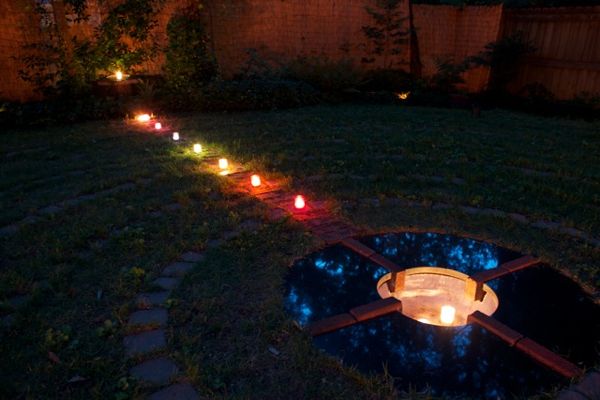
Those who have visited the labyrinth know well my chakra candles that I usually arrange along the western path:

Last summer I was cleaning up after an evening of quiet and meditation and I kicked the indigo/purple one. It broke. Not to worry, I knew I had a place to order one from.

Except it turned out I had to order a dozen. Again, not a problem. I’m sure I’ll find a place for the other eleven at one point or another.

However, a month or so ago I broke the red one. I decided against ordering a dozen red ones, I am trying to economize these days after all, and went rummaging around the house for a replacement. I found one of course—have you seen us decorate for Christmas?—but it was a largish round thing, not the same as the others.

This started me thinking. I decided to begin to replace all the votive holders with a random assortment of holders.

I rummaged some more and found a large square green one, actually a deeper, better green than the one I had been using.

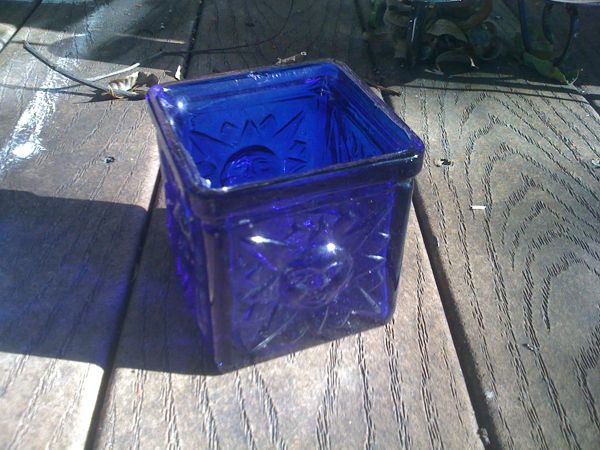
It had seemed to me for some time that my blue votive was quite weak, looking more white than blue, so that became my next quest. This weekend, we were antiquing in Greensboro, GA, and on my way out of the largest, junkiest store, I found this:

Beautiful. And at Target back into town, I found an orange one that is more traditionally shaped, but has decoration on it.

Now I’m looking for a brilliant yellow and a decisive violet/red-purple. Keep me in mind as you travel.

Labyrinth, 10/10/11

Poor labyrinth , the grass just will not live back there, at least not the shade-blend of fescue (the nice pretty straight-bladed grass) that I’d planted. Apparently it just cannot deal with heat, and heaven knows we had enough of that.

Other grass has sprung up. I fear it’s crab grass, but actually, it’s growing so I’m leaving it alone. And in the meantime, I’m watering it.

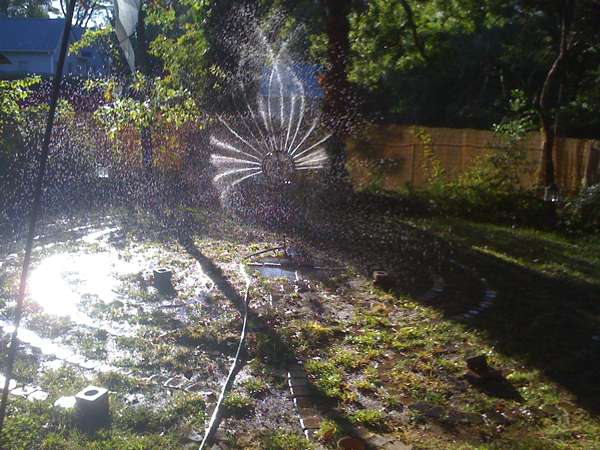
I’ve got the sprinkler on a timer, and it’s set to go off around 5:00 for about an hour. These days, that means it’s catching the rays of the declining sun, to wit:

Very pretty, I thought, even if the grass is not so sumptuous as it might be.

Regrets of the dying

Today on Facebook, this link was flying around. I went to read it, thinking it might be thought-provoking, and it was, even if not in the way most people might respond to it.

First of all, let me state that Ms. Ware is quite right in her observations. I have no issue with her list nor her explications. However, I wanted more from her list when I went there. I have worked my whole life not to be one of the mass of men living lives of quiet desperation, and I think I have completely and successfully escaped Ms. Ware’s list. Whatever else happens, I will not look back on my life with those regrets.

So if I expected more, what was it I hoped to find? What will I feel compelled to tell my hospice worker?

I think my biggest regret at the moment is my laziness in getting my work done. Notice that’s not the same as Keat’s “fears that I may cease to be/ Before my pen has glean’d my teeming brain.” I’m quite at rest with the idea that I may never get around to everything I might have done. The Symphony may never be written, the Epic Lichtenbergian Portrait may never be completed, and I certainly am not on track to get grass to flourish in the labyrinth. (At the advice of a Home Depot gardening employee, I have fertilized the bare dirt.)

My regret is that I will not have finished things I might have finished because I just didn’t take the time to get them done. Why am I writing this instead of working on Piano Prelude (no fugue) No. 5? As every good Lichtenbergian could tell you, I am writing this so that I don’t have to confront the Piano Prelude. Or the cello sonata. Or the Ayshire Fiddle Orchestra piece. Or the color charts for my painting. Or any of the exercises in Keys to Drawing.

(To assuage my future guilt, I just now went and added two notes to the prelude. I can goof off another 48 hours now.)

Any regrets I might have had, i.e., based on who I was even five years ago, are invalid. Those who have known me for a while might think I would have regrets about my organizational successes and failures: NCTC, GHP, Newnan Crossing, Lacuna/William Blake. But no. Those things come and go in any person’s life, and it’s just simple wisdom not to base your idea of a well-lived life on achievements—or not—in those arenas.

I will say that if I come to the end of my life and I’ve never seen/heard William Blake’s Inn performed, I will be disappointed, but that’s not a regret since I have no real control of whether that happens or not.

What else? I’m not a deep thinker, so I may have to settle for this one regret. I think it is a worthwhile one. Let’s see if I can be worthy of it.

Labyrinth, 8/15/10

I worked yesterday and today in the labyrinth. I was extremely productive.

The neighbors finally had the pecan tree taken down. Not taken away, mind you. It’s still in large chunks right on the other side of the fence, plus the 20-foot stump along with this substantial hawser which has been abandoned by the tree people. What happened? Disaster in the business? Non-payment? (but why leave the rope?) My father-in-law has given me his chain saw, and once it’s out of the shop (where it’s getting a look-over), I may just start to work on a huge amount of firewood.

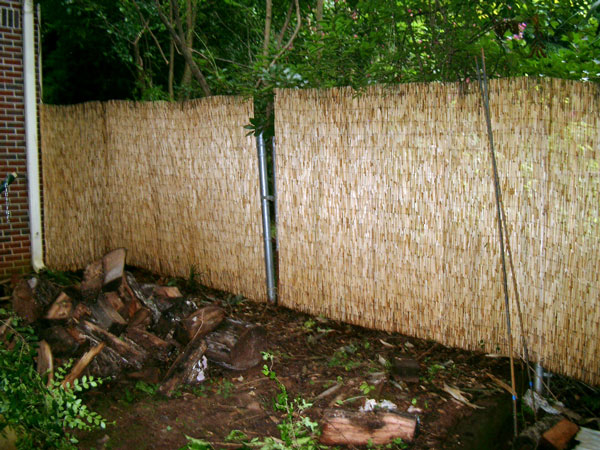
Which brings me to my major project of yesterday/today. With the pecan tree down, I finally felt comfortable putting up the rest of the bamboo fencing. Needless to say, the one remaining roll I had on hand was not enough to complete the job. That’s fine. I can order one more roll some time later. It’s not as anyone is actually living in the house there, and any peeping toms about would have a job negotiating the huge tree bits littering the yard in the dark.

The fencing I did put up looks nice:

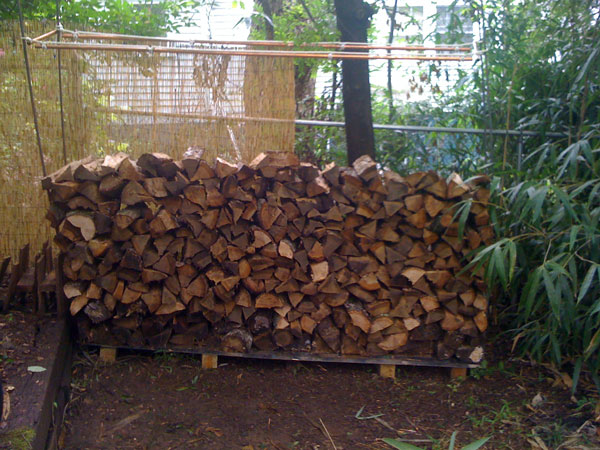
The gap is a gate, and you’ll notice the old woodpile in a pile in front of that. I had a whole new truckload delivered this past week, and so I had to move it all. I’ve decided to move the whole thing down to the fire pit level.

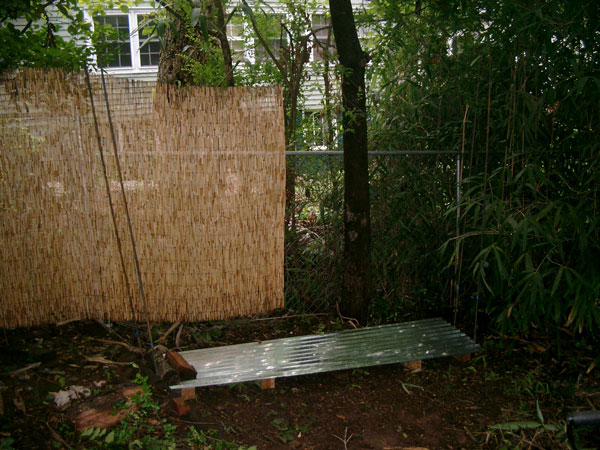
Now you might think that moving a woodpile is simple enough: pick up the wood, walk it over to the new place, and put it down. Sadly, no. First I had to design a woodpile. I chose to go semi-industrial, with corrugated metal base and rebar sides:

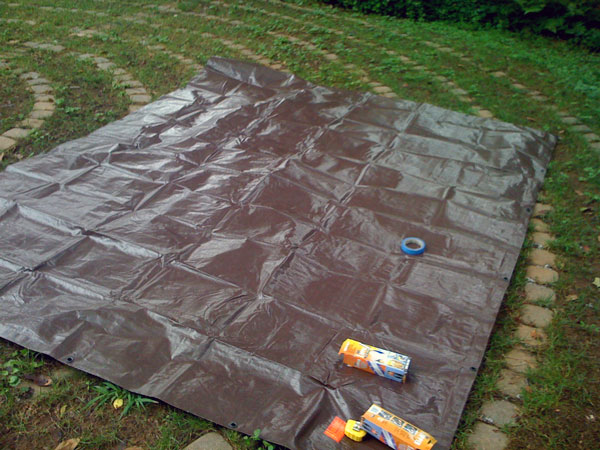
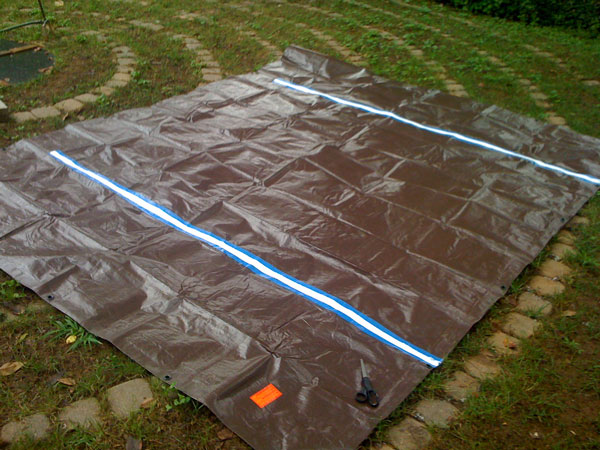
Then I had to add some ropes and copper pipes to secure the top ends. Finally I could tote all the wood over. I also decided I wanted a tarp to keep the wood dry. As fate would have it, I found a perfectly sized one, and it even had grommets every 24 inches around it. Perfect:

And if I had thought of these things, they would not have existed. But they do:

Zippers! Isn’t that the coolest? They tape down, then you unzip them and cut them. I especially like how they have zipper pulls on both sides. In case you’re trapped inside the woodpile.

Zippers installed!

And here’s my magnificent woodpile, sans tarp:

I think it’s gorgeous. The rebar works even better than I thought in holding the wood in place, and I’m excited about the corrugated metal holding the wood off the ground. I’m hoping it will help keep the ant/termite thing down.

And finally, the mise en scène:

It looks perfect, but alas, the grommets are too small to go over the rebar. I shall have to go get some grommets at Michael’s and install them myself. Later.

Summer Countdown: Day 10

I spent a lot of the day doing errands and stowing materials all over the house.

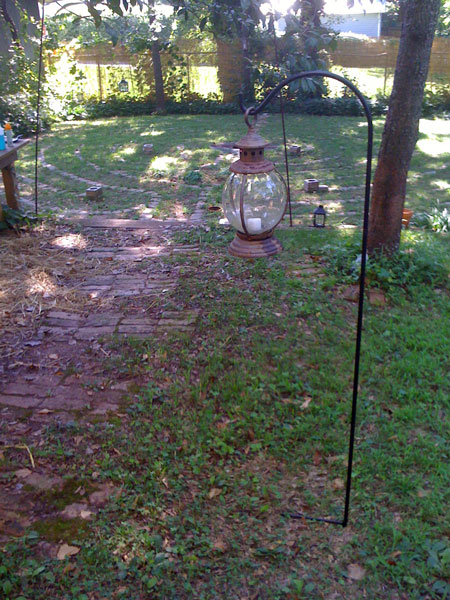
The only halfway creative thing I did was work on labyrinth a bit. My dear friend Anne’s family has been clearing out her house, giving away things to those of us who loved her before they donate the rest to charity. I was offered the lanterns out by her “party patio,” a beautiful concrete circle that was the former base of a municipal water tower.

I’ve been looking for ways to light the labyrinth that don’t blind the person walking, so I gratefully accepted the offer. We’ll see if the work. If they don’t, I can still use them on the margins.

Here’s one, that I set up on the walkway to the lower lot:

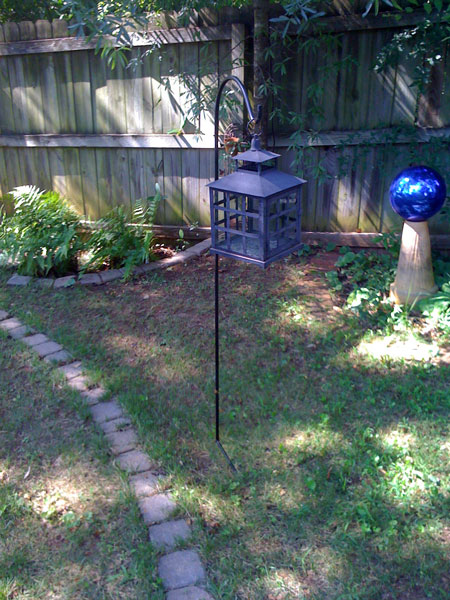
The other three are identical, and I put them at the northeast, northwest, and southwest corners of the labyrinth. The southeast corner, of course, is lit by the fire.

I doubt I will get anything done tomorrow (today); I am having an upper endoscopy to determine exactly what might be the cause of my ongoing intestinal distress. Since that involves general anesthesia, I’m pretty sure I’ll be useless the rest of the day.