Well, hello there!

Mercy, it’s been a month and a half since I’ve been able to even visit my blog.

You may wonder why, with all the foolishness available from the Presidential campaign, I have not been ranting nonstop during this time.  Two reasons: 1) I realized it would not be a healthy choice; and b) I’ve been busy.  For real busy.

Since I last spoke up here, I have:

  • helped clean out and shut down my in-laws’ house in Virginia, including a massive tag sale and dragging what wasn’t sold back here
    • local tag sale still to come
  • guided theme camps for Alchemy through the registration process for placement
  • designed the layout for the burn (on new property and thus tabula rasa)
  • driven up to the property five or six times to double-check my measurements and campability of the terrain
  • placed all those theme camps as close as I could to their requirements (all of which were “flat, by the road, near the treeline, centrally located, but away from the sound camps”)
    • this included 109 pieces of graph paper moving around for two weeks on an enlarged-by-hand map
  • created the Google map of the theme camps, art installations, roads/paths, stages, neighborhoods, villages, and infrastructure
  • generated the files for theme camp signs
  • led the Placement Team on build weekend, mapping out the theme camps and roads with stakes and tape
    • many changes in the map as we discovered space/time warpage on the property
  • coordinated my own theme camp, 3 Old Men, which had grown from about six campers to sixteen
  • packed and loaded an 8×10 trailer full of tubs, tents, tables, and general stuff for 3 Old Men
  • played Placement Overlord as the theme camps began arriving, making adjustments/giving permissions on the fly
  • enjoyed the burn
  • brought it all home, unpacked it, cleaned it (red dust everywhere), repacked it, stowed it
  • during all of this, auditioned A Christmas Carol and began rehearsing it
    • including creating/writing a frame story for the show to accommodate all the little girls (and scarcely any adults) who auditioned
  • coached my Boys & Girls Club Youth of the Year nominee in essay writing, speech giving, and interview skills
  • contracted for two huge oak trees to be taken down
    • which King Tree Service did in spectacular fashion, with a 30-ton crane reaching over the house to do so
  • contracted for a new fence for the back yard (First Fence of Georgia—they just started this morning, and so far I have nothing but praise for the entire company)
  • closed out my late mother’s estate

So yeah, I’ve been busy, too busy to write on this blog WHAT DO YOU PEOPLE WANT FROM ME??

We now return you to your regularly scheduled service.

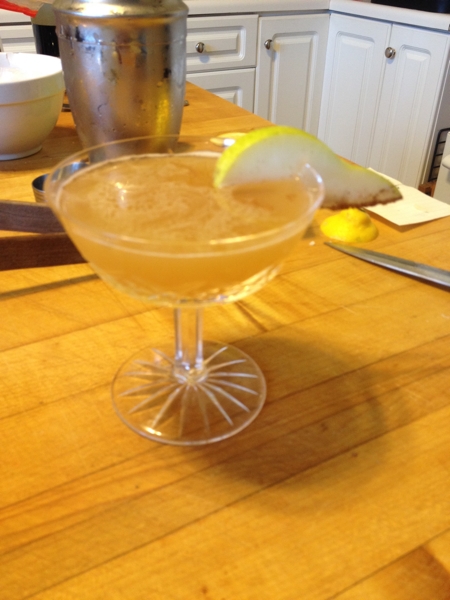
New Cocktail: the Pear-ly Legal

I bought pear juice for a Vanilla Pear Margarita, and that was fine but not exciting.  So now I’m stuck with all this pear juice.  I grabbed the first thing to hand, and …

the Pear-ly Legal*

  • 1.5 oz pear juice
  • .75 oz apricot liqueur
  • .5 oz cognac

Shake with ice.  Garnish with a thin slice of pear, edged with cinnamon sugar.

This is quite tasty.

—————

  • Thanks to Craig for the name!

A yummy recipe

Last night I intended to make a shrimp/pasta dish using some basil, kind of a pesto-like Alfredo sauce kind of thing.  But then…

After I had prepped the shrimp, the resulting sauce was too good to mess up with additional flavors.  Here you go:

Super Simple Shrimp

Recipe By: Dale Lyles
Serving Size: 2

Ingredients:

  • 10-12 shrimp
  • 2 tablespoons olive oil
  • 2 tablespoons butter
  • 1 clove garlic, pressed
  • 1/3 cup white wine
  • 1-2 tablespoon lemon juice
  • sea salt
  • white pepper

Directions:

  1. Season the shrimp with the salt and white pepper.
  2. In a skillet, melt the butter with the olive oil over medium heat.  Add the garlic and stir briefly.
  3. Add the shrimp and cook over medium-medium high heat for about 3 minutes on each side.  Remove to a plate.
  4. Add the wine and lemon juice, increase the heat, and gently boil until reduced by half.
  5. Put the shrimp back in, toss to cover, and serve.

Yum.

A cocktail, of sorts

Okay.  Can we talk?

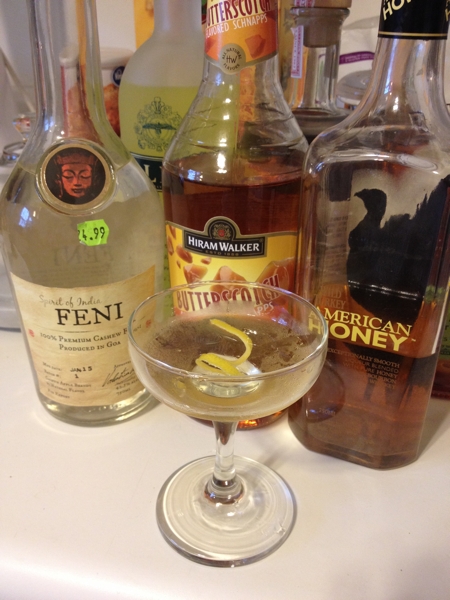
A couple of months ago I was in a liquor store frequented by my Eldest Son1 and came across a bottle of Feni.

Feni, as the label on the bottle has it, is “an exotic spirit 3x distilled from cashew apples and native to Goa, India.  Feni has a rich mysterious taste with fruity flavors of pineapple, citrus, and cashew apple.  Since the 1700s Feni has been popular in Indian cuulture. Feni is to Goa, India, just as Scotch is to Scotland and tequila is to Mexico.”

Well, I mean to say, wot?

Misreading the bottle entirely, I was intrigued by the idea of a “cashew liquor” and thought how much fun it would be to get in on it before all those trendy bartenders featured in liquor.com emails.

Oh my.  The rich, mysterious taste of cashew apples, i.e., the fleshy part of the tree-spawn from which dangles the oh-so-tasty nut, is apparently an acquired cultural taste.  It’s pretty nasty, and I say this as a man who bravely assayed Hog Master liqueur.2

But I persevere.  This evening I decided it was time to face my fears and create something drinkable from this stuff.  The official website was of no help at all—it was rife with recipes involving sweet-and-sour mix and/or Sour Apple schnapps and/or Sprite.  I am not making this up.

So I breathed in the nose of the stuff, took a tiny3 swig, and came up with this:

A Feni cocktail

  • .75 oz Feni
  • .75 oz Butterscotch schnapps
  • .75 oz honey whiskey

Stir with ice, strain, garnish with lemon.

That’s the best that I could do.  It’s drinkable, but if I were you I’d make it with 1/2 oz portions instead.

Equal portions of limoncello and Feni are passable, if you like limoncello.

—————

1 He is my only son, and hence my eldest.

2 Which I gave to my Eldest Son, who then pranked all of his friends with it.

3 tiny

Easy, fun, and SWANKY

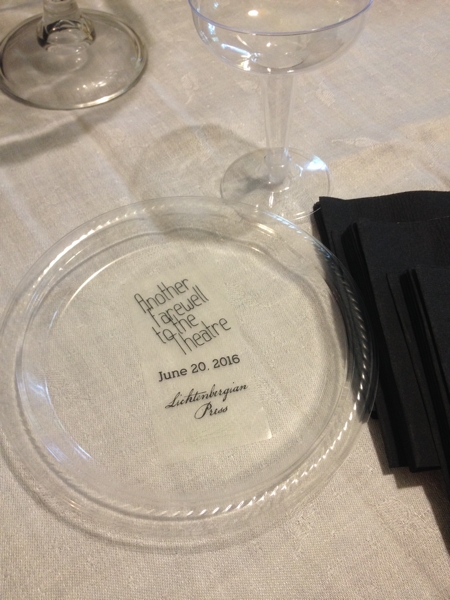
Now someday it may happen that a victim must found you will find yourself hosting a little soirée for a friend’s book launch, and you will think to yourself how nice it would be to have those little plastic plates with the event  printed on them.  But you don’t have them, because a) they’re expensive; b) you only need a couple dozen, not 500; and c) you waited too late to even try to get them.

So you make your own:

Here’s how.

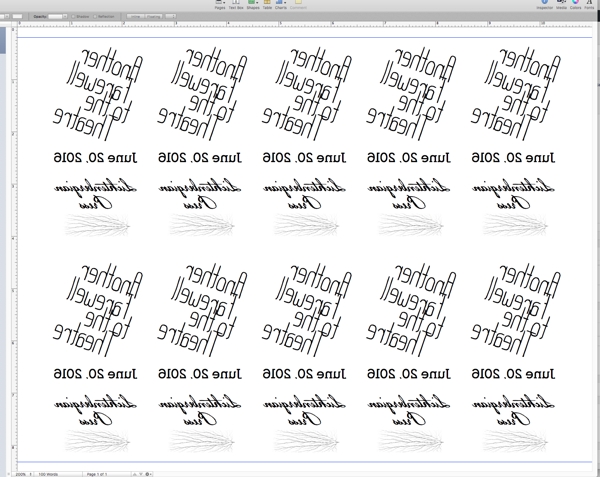
Open your favorite program to make posters/brochures/labels/bookmarks.  I use Apple’s Pages because it has everything I need.

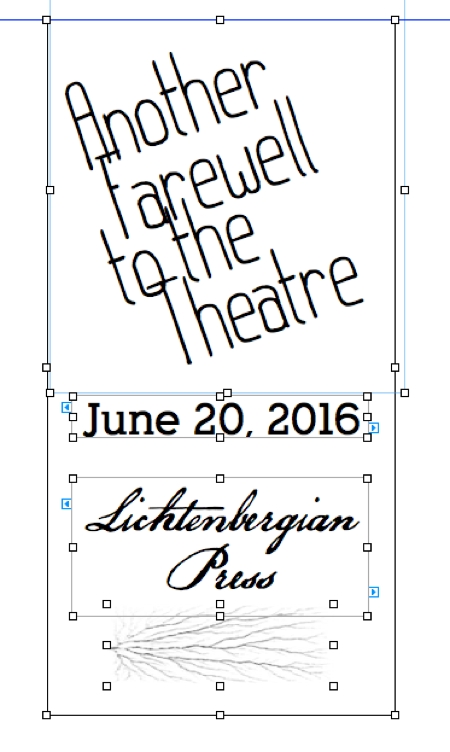
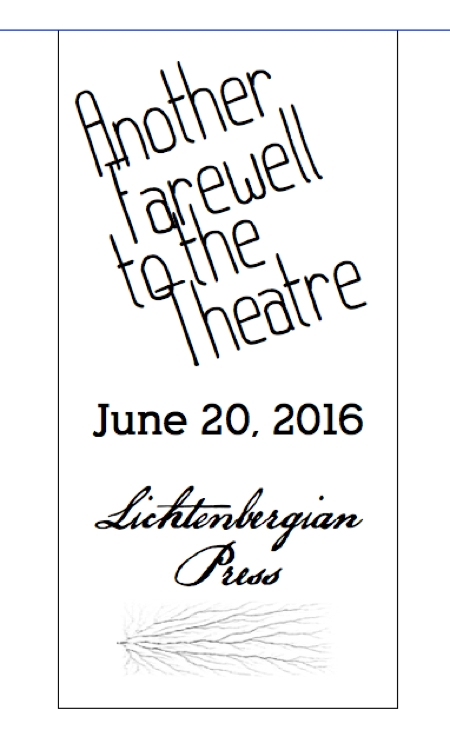
Create a rectangle the size of your label (clear mailing labels are what we’re looking at here.)  I got 2″x4″ labels.  To make it easier to select the rectangles later, make sure that the rectangle is filled with white.  (If you leave it just blank, then you have to click exactly on the border to select the rectangle, and that’s going to be very tedious indeed.)

Now fill it with your text blocks and images and whatever.

One reason I like Pages is that when you’re in “canvas” mode, little blue lines pop up to show you when objects are aligned/centered/etc.

Pro tip: once you get your one label made to your satisfaction, select everything and GROUP THEM so that nothing slides out of place.

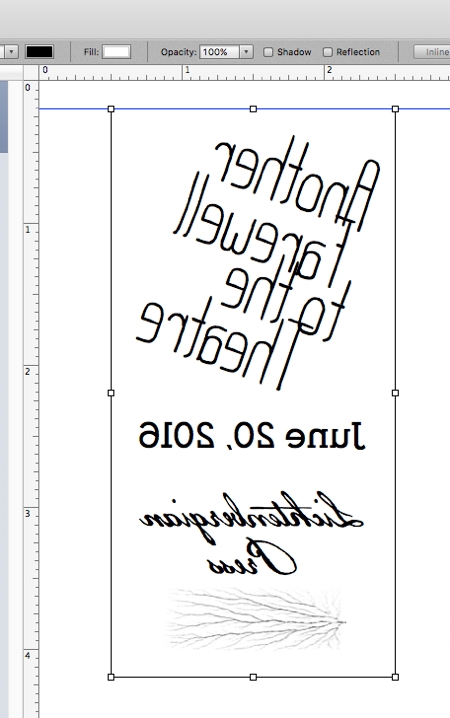
Here’s the critical step: flip that sucker horizontally:

Think about it: you’re going to be peeling these off and putting them on the bottom of the clear plastic plate.  You’re going to be seeing the label from the other side.

Now:

  • Duplicate your label across.
  • Align the labels.
  • Group them.
  • Duplicate that row and position the new row.
  • Measure your label sheet and position everything to land on the labels.  My labels were edge-to-edge, but if there are spaces between yours you will have to ungroup the row of labels to position each one.
  • Print on a piece of paper, then hold it up to the light behind a label sheet to see if you got the positioning right.
  • Adjust if necessary.

Once you get all the labels where they need to be, here’s the tedious part:

  • UNGROUP everything down to the level where you can select each rectangle and turn off the border line.  In Pages, it’s called the stroke of the object.  Your mileage may vary.  You’re doing this because you don’t need or want the lines, just the contents of the rectangle.
  • I wouldn’t delete the rectangles themselves, because one day you’re going to want to do this again and will need those borders.  If you’re clever, you can LOCK the position of each rectangle so that they won’t slide around by accident and all you have to do is duplicate the contents.
  • Print the labels.
  • Apply them to the bottom of your plates.

Have your soirée.

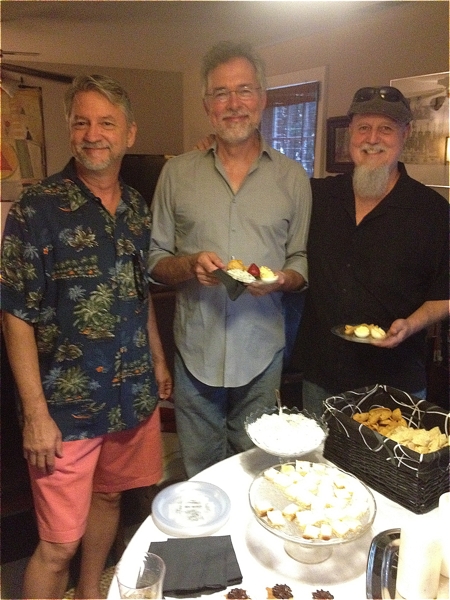
your host, the author, some rando

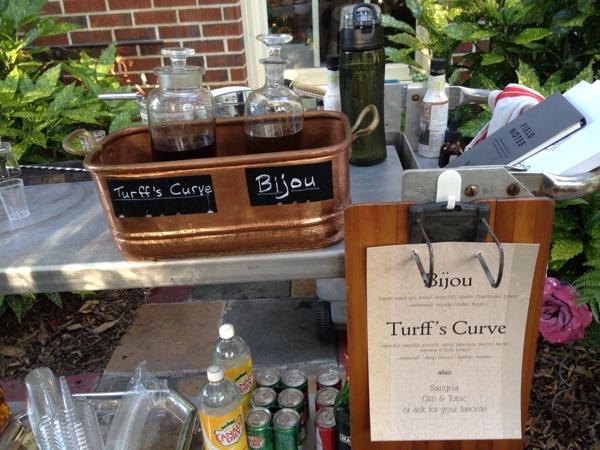
And don’t forget to make your bar as hipster as you can:

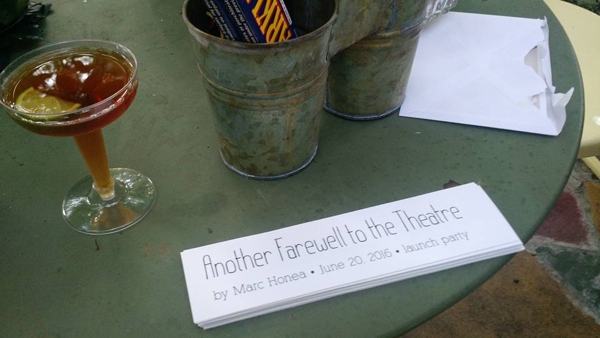
And bookmarks.  Don’t forget the bookmarks:

Swanky!

(The book, by the way, is Another Farewell to the Theatre, by Marc Honea, pictured above.  It is published by The Lichtenbergian Press and was designed by me.)

Cocktail update: Turff’s Curve

In the Lichtenbergian tradition, there’s a thing called Successive Approximation.  Some day you will be able to read all about it.  After your Abortive Attempt, you step back and do the Gestalt thing and figure out what’s missing.  Then you fix it.

So it is with the Turff’s Curve.  It was tasty, but it lacked depth.  So I futzed with it.

Turff’s Curve (improved)

  • 1.5 oz Calvados
  • .75 oz Swedish Punsch
  • .5 oz Velvet Falernum
  • .25 oz Averna Amaro
  • 3-5 drops 18.21 Havana & Hide bitters
  • lime slice

Much nicer.

The 18.21 Havana & Hide bitters were a discovery recently at the inestimable Decatur Package Store.  For such a small place, its selection for the cocktail craftsman is phenomenal.  Havana & Hide gives a dark flavor/aroma of cigars and leather—a nice complement to the sweetness of the main liquors in the drink.

New Cocktail: Turff’s Curve

This new drink came about, as so often is the case, by making one antique cocktail and then wondering what else one might be able to use one of the rather specific ingredients for.

In this case, I started with The Widow’s Kiss (from Vintage Spirits & Forgotten Cocktails): 1.5 oz Calvados, .75 oz yellow Chartreuse, .75 oz Benedictine, Angostura bitters.  Quite, quite tasty.

That meant I had the bottle of Calvados out on the counter, and then my eye fell on the newish bottle of Velvet Falernum, a sugarcane-based cinnamony kind of liqueur.  Apple and cinnamon, right?  So 1.5 oz of Calvados and .75 oz of Falernum, and it was very good.

However, you usually want three ingredients, and I thought that the drink, tasty as it was, needed a little depth.  But what?

I went to check out the cabinet and I found Swedish Punsch, one of my favorites.  As it happens, it’s also sugarcane-based, but with a deeper, nuttier flavor.  And lo!

Turff’s Curve

  • 1.5 oz Calvados
  • .75 oz Velvet Falernum
  • .75 oz Swedish Punsch
  • 1 lime wheel for garnish

Stir, strain, garnish.

Why is it called “Turff’s Curve”?  Kevin McInturff has a FaceTubes group called Turffin, and mostly it’s people posting photos of the beer they’re drinking.  I’m an outlier with my penchant for craft cocktails, and when I posted the aforementioned Widow’s Kiss, Turff jokingly complained that I never posted drinks that didn’t require a trip to the liquor store for some new substance.  I felt that this recipe was the apotheosis of throwing him a curve, since it was probable that he didn’t own any of the ingredients.

He of course claims it’s because I described the drink as “Sweetish, with bitter and nutty undertones.”  That, too.

Easy.

I’ve been reading The Fire Starter Sessions, by Danielle LaPorte, as one of the potential competitors for Lichtenbergianism: procrastination as a creative strategy.  It’s not really a competitor, but it is a very good “get off your butt and do what you love” kind of guide, so I’ve been reading it and journalling answers to the worksheet questions at the end of each chapter.

The worksheet for this last chapter, “The metrics of ease,” though, has me flummoxed.  Here are the questions:

  • What exactly needs to get done in your life and livelihood?
  • What’s your competency level for each activity?
  • Which of those activities actually makes you feel strengthened?
  • Which of those activities doesn’t really light your fire?
  • What can you do to develop these strengths and interests?
  • What three actions will you take this week to condition and nourish your true strengths?
  • What three actions will you take this week to decrease your time spent on activities that drag you down and don’t feed your true strengths?

Well.

I’m kind of reading this book to get a grip on how much I really want to be some kind of workshop leader/TED Talk sort of thing, and so this chapter stopped me cold.

What exactly needs to get done in my life and livelihood?  Empty the dishwasher, walk the dog, clean the litter box, cook some meals.  Honestly, that’s about it.  The rest of it—blogging, composing, writing, volunteering, Camping with the Hippies™—is completely optional.  If I stopped tomorrow,1 it would not make a sound in the forest.2

So then the rest of the questions become moot, don’t they?  Do they?  Should I forget that I literally have no obligations other than to wear pants and not smell in public and pretend that she’s asking about what I wish I were doing? (Or do I?)

Understand that I am not indulging in self-pity.  I am honestly at a loss as to how I should answer that first question in terms of planning my third career.

More work is required.

—————

1 I am not stopping tomorrow.

2 For those who are just joining us, I am retired, in the sense of “Governor Nathan Deal moved the Governor’s Honors Program from the Department of Education where it had been for literally 50 years to his own Office of Student Achievement and didn’t care to move the director of the program with it.”

“Gestures of approach”: a personal response to a scholarly article

In the most recent edition of Caierdroia: the journal of mazes & labyrinths [v.45, 2016], I was struck by the following quote:

As Ullyatt notes in “Gestures of approach”: aspects of liminality and labyrinths, “A threshold constitutes a boundary line or marginal area… from which a movement inward or outward may be inferred, even if not necessarily pursued….”1

Given my interest in all things liminal, I tracked down Tony Ullyatt’s article, published in Literator [32(2) Aug 2011: 103-134] and gave it a read.  Here are some thoughts.

Summary: Ullyatt discusses some definitions of liminality, discriminates between two- and three-dimensional aspects of labyrinths, summarizes various descriptors of the labyrinth walking process, and finishes up with a “brief consideration of the liminal significance of the Knossos Labyrinth’s location on the isle of Crete.”

For those just joining us, a limen is a boundary; the term—as liminal and liminality—has been appropriated by ritual scholars (Turner, Van Gennep, et al.) to describe the boundaries between “real” life and the mental/social/spiritual states entered into by practitioners of various rituals: shamans, priests, labyrinth walkers, artists,etc.  I have used it in  Lichtenbergianism: procrastination as a creative strategy to link ritual, the Hero’s Journey, and the creative process.

Essentially, the liminal state is where we are when we strike out from the normal (State A1) and find ourselves in unfamiliar territory (State B).  With any luck, we will return to State A2, changed/triumphant/renewed.  If we’re talking about labyrinths, that boils down to entering/center/leaving.  That’s my theory, and I’m sticking to it.

What I found curious about Ullyatt’s article was that he (she?) takes the OED definition of liminality and springs from the concept of “threshold” to discuss the opening of the labyrinth as an entrance to a house, i.e., entering a labyrinth is in some way similar to returning to one’s own hearth.  It seems to me that this is missing an essential element of any labyrinth: crossing the threshold of a labyrinth is not returning in any way but rather a leaving, a striking out from State A1 to arrive at State B.

Yes, “threshold” implies a house/home, but Ullyatt has not considered that, like Bilbo Baggins, we may find ourselves over that threshold following a road that goes “ever on.”  Or that we may someday need to break through a wall and make a new door where there was not one before so that we can create new paths for ourselves.  We may go into a labyrinth, but I think it is the same as going into the woods: in no way are we seeking the familiar when we do so.

As we Lichtenbergians say, while sitting around the fire pit beside my labyrinth,

Take the pathway
to explore
uncover
confront.
Return to the fire
to confirm
affirm
retreat.2

Ullyatt goes on to talk about the labyrinth as sacred space, quoting Eliade:

The sacred is always dangerous to anyone who comes into contact with it unprepared, without having gone through ‘the gestures of approach’ that every religious act demands.

This concept has always interested me since I have found, both with my labyrinth and especially with the 3 Old Men labyrinth, that there is a tension between the expectation of “dangerous approach” and the reality of these two labyrinths.  Indeed, at the burns we have found that many people express trepidation in entering the labyrinth, especially when the Old Men are officiating.  (We are fairly awe inspiring.)

My take is that the burners who pull back from entering/experiencing the labyrinth are responding to the labyrinth’s powerful pull as a sacred space and to their own fear that they don’t know the “gestures of approach” that will allow them to enter it safely.  I also believe that they recognize somehow that to enter the labyrinth is to strike out to the unknown, to leave State A—and who knows what State B could even be? If you’re a hippie who’s just trekking down to see the Effigy or to boogie at Incendia, that may not be on your agenda.

As Ullyat asks in a series of pertinent questions:

Apart from the certainty of the path itself, what expectations might we have about what could happen to us, psychologically at least, on the journey to the centre? Where are we heading? And in which direction? Are we moving “inwards” and, if so, what does that mean geographically, physically, psychologically, or spiritually? When we arrive at the centre, where are we then? Have we arrived at some sort of inner sanctum, the core of our being, the central purpose of our journey, after which our lives will be changed in some manner forever? What were we expecting to find at the centre? Have those expectations been met, and, if so, in what ways and to what extent? What are we meant to discover there? […] At the centre, are we only halfway through our travels? Uncertainty seems unavoidable unless we are made ready for the experience.

… Further, we might ask: Is the obliteration of the self, even temporarily, one consequence of arriving at the centre?

I wouldn’t go in either.

Of course, the Old Men are not there to guard the space, although that may be difficult for the average hippie to discern by torchlight.  We simply hold the space for anyone to encounter on their own terms.  We knew going into our first burn that we would host drunken revelers, smart-ass kids, and idiots.  All are welcome to enter, race through, step over the walls, laugh riotously, and in general miss the point.   That’s perfectly fine.  We’re not there to enforce orthodoxy.  Or heterodoxy, for that matter.

I will note here that the labyrinth of the 3 Old Men presents an interesting variation and challenge on the usual definition of labyrinth and the process of walking one.  First of all, there’s not one path, there are four—and each of those four paths split and rejoin twice before reaching the center.  We often see burners enter the labyrinth under the assumption that they are encountering a maze—that is, they are there to solve a puzzle and must be on guard not to be tricked—only to find, if they’ve chosen the “wrong turn” that they are merely in a simple loop and cannot be tricked except by their own expectations.  However, it is undeniable that there is an element of choice present in this labyrinth that is simply not there in the traditional unicursal design, from which entrance to use through the splits in each path to which exit to take.

Further, when the Old Men are officiating, the shape of the experience changes.  Without them, participants can walk to the center and back—the usual A/B/A journey (albeit with the above-mentioned choices to make).  When we’re standing at the entrances, though, there’s another, significant focal point.  After journeying “there and back again,” the walker is offered an additional, final opportunity to find meaning in the experience: depending on which Old Man he encounters, he will be offered a blessing, a request for a blessing, or a struggle (however he defines it).  I would be interested to know whether most participants regard that final encounter as in fact “final,” the end of their experience; or, as I see it, a second “beginning,” a hippie equivalent to Ite, missa est.3  I imagine that mileage varies.4

At any rate, in the second half of the article Ullyatt goes on to lose the thread of his topic with a meandering discussion of three-dimensionality, i.e., the space around labyrinths, and something something Minotaur.  He does note that a labyrinth is a “sheltered space,” that “the space around the labyrinth (rather than just the area the labyrinth itself occupies) may offer some sense of spiritual refuge and safety.”  I have certainly found this to be the case, both in my own back yard and with 3 Old Men.  Even with the camp next door blaring karaoke “Total Eclipse of the Heart” or Incendia’s DJ whomp-whomping away across the road, burners have told us repeatedly how calming they have found our installation—and now that we’ve been to enough burns, they look for us to provide that refuge.

Liminality.  It’s a thing.

—————

1 Louët, A.P., & J.K.H. Geoffrion. “Labyrinth doorways: crossing the threshold.” Caierdroia, 45: 11-31.  This was a discussion of representations of literal doorways at the entrances to floor labyrinths and need not concern us here.

2 Lyles, et al. The Book of the Labyrinth. The Path.

3 Said at the end of the Catholic Mass.

4 Deserving of some thought and analysis, but not here: what choices are being made by those who leave by the “front” entrance to the labyrinth, i.e., the octagonal mat with our bowl of white kaolin body paint, and where there is no officiant?
New(ish) cocktail: Honey Please

I was looking through my cocktail notebook last night and decided to test one of my originals that I think I only made the one time.  It didn’t sound as if it would actually be viable; best to make sure, and if not, strike it out of the notebook.  ABORTIVE ATTEMPTS and all that.

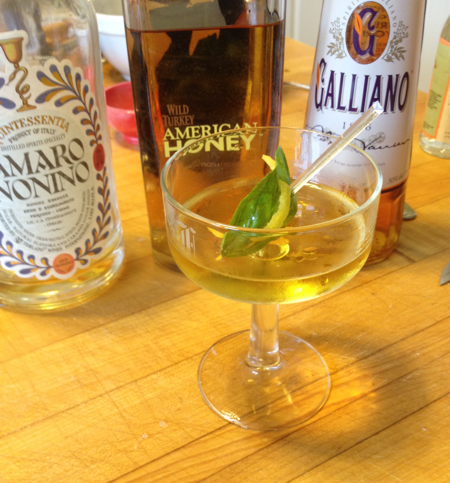
As it turns out, it wasn’t an ABORTIVE ATTEMPT, but it was a SUCCESSIVE APPROXIMATION.  The original was simply American Honey and Galliano, but in a burst of inspiration I added Amaro Nonino to it, and now, pending further testing, it works.

Honey Please

  • 1 oz American Honey
  • 1 oz Galliano
  • 1 oz Amaro Nonino
  • 3 dashes orange flower water (optional)
  • basil leaf/lemon peel garnish

Yes, the garnish is a bit twee, but a little showing off never hurt anyone: make two slits in the basil leaf and thread the lemon through it.  If you have a classy triangular pick, stick that through there too.

I’m out of Amaro Nonino, so further testing is moot at this point.  More work is required.