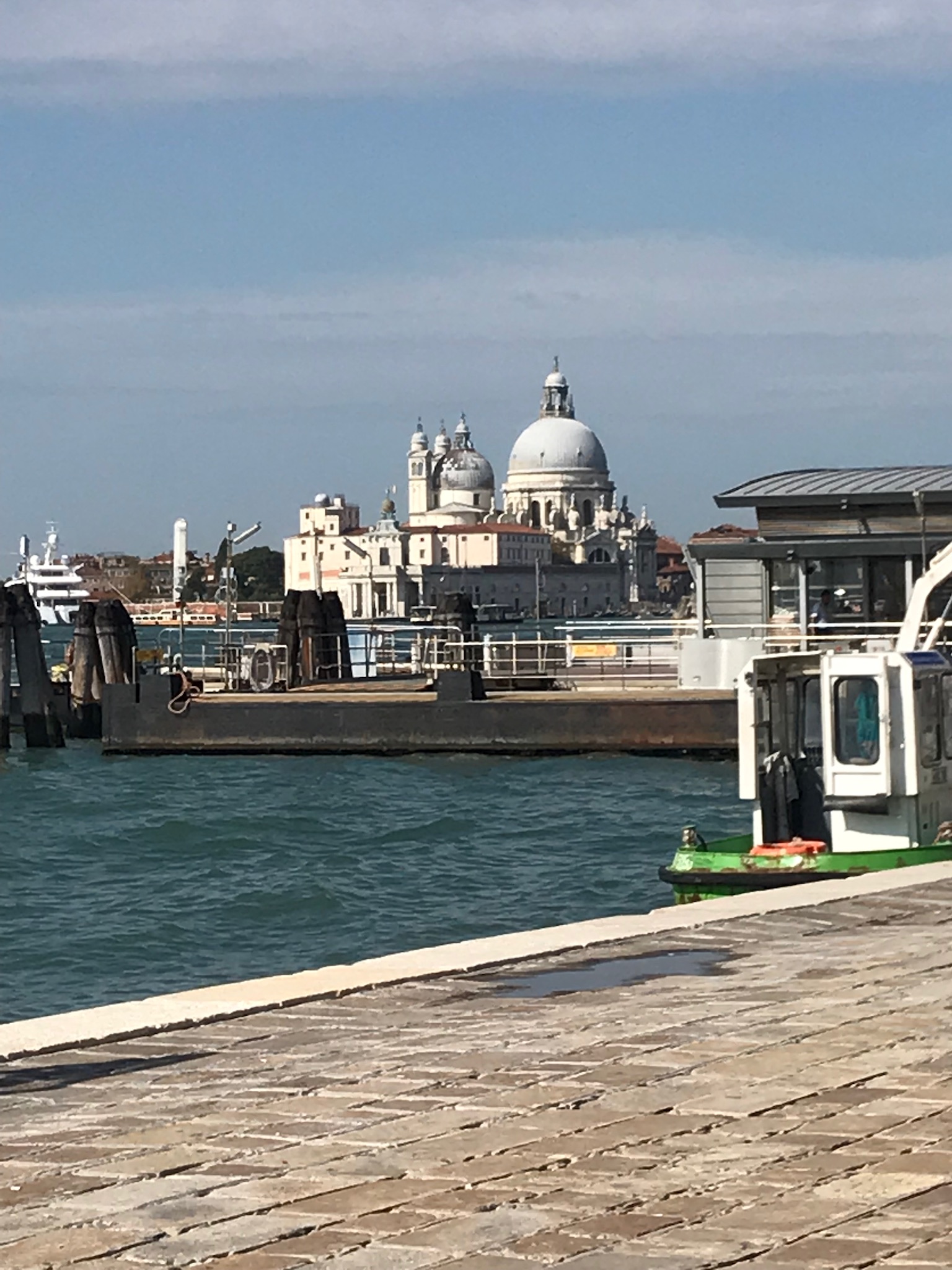
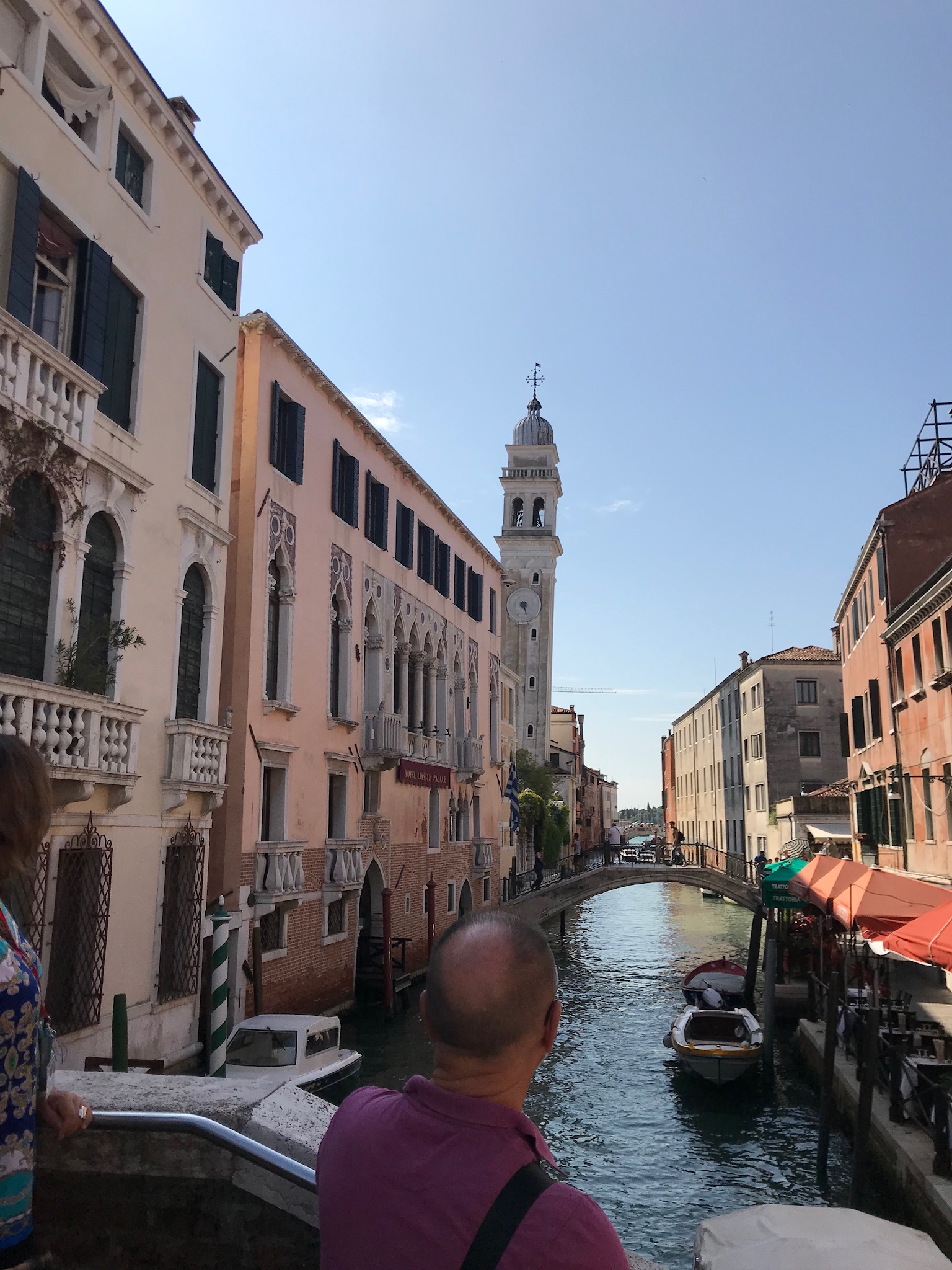
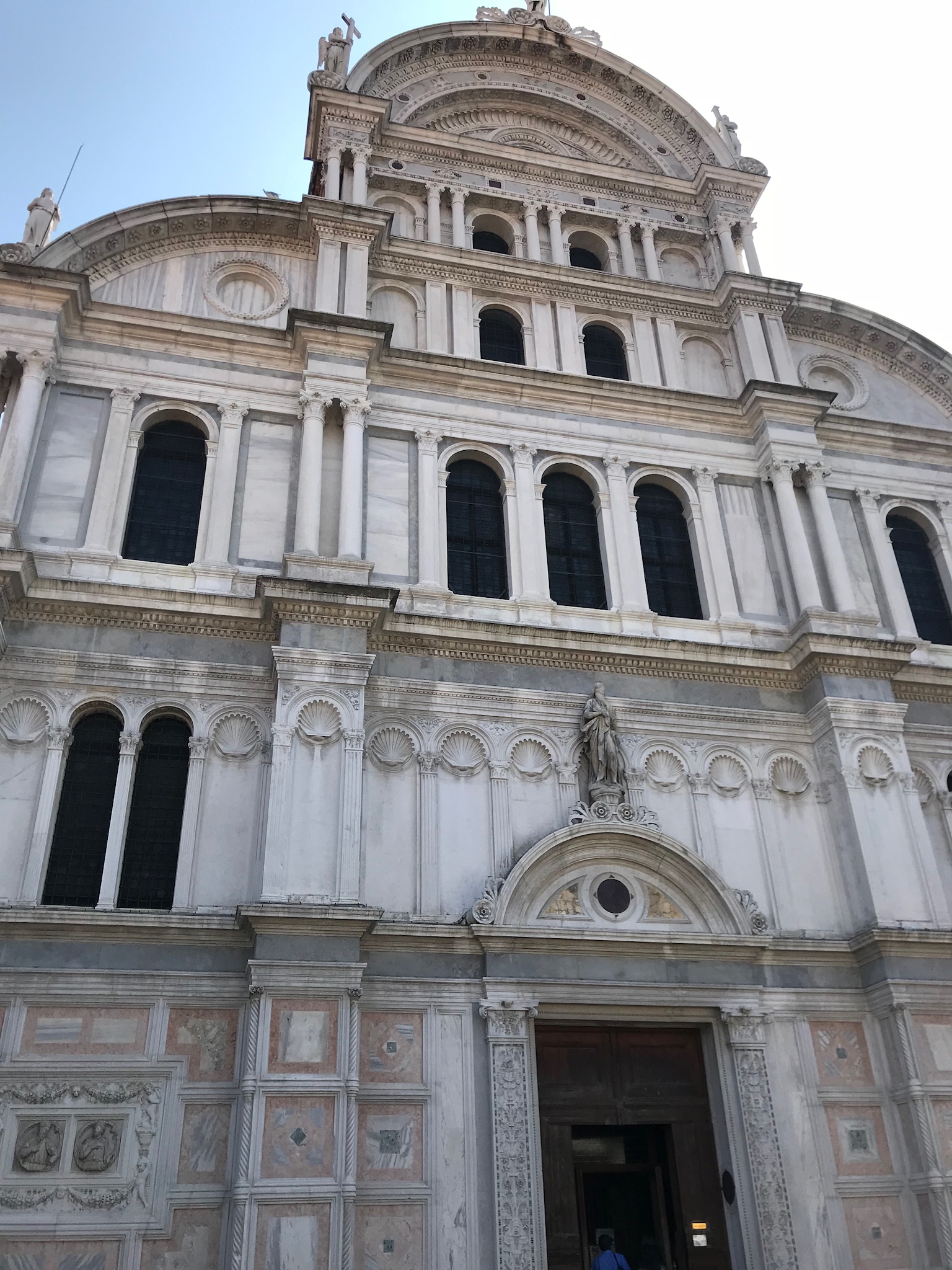
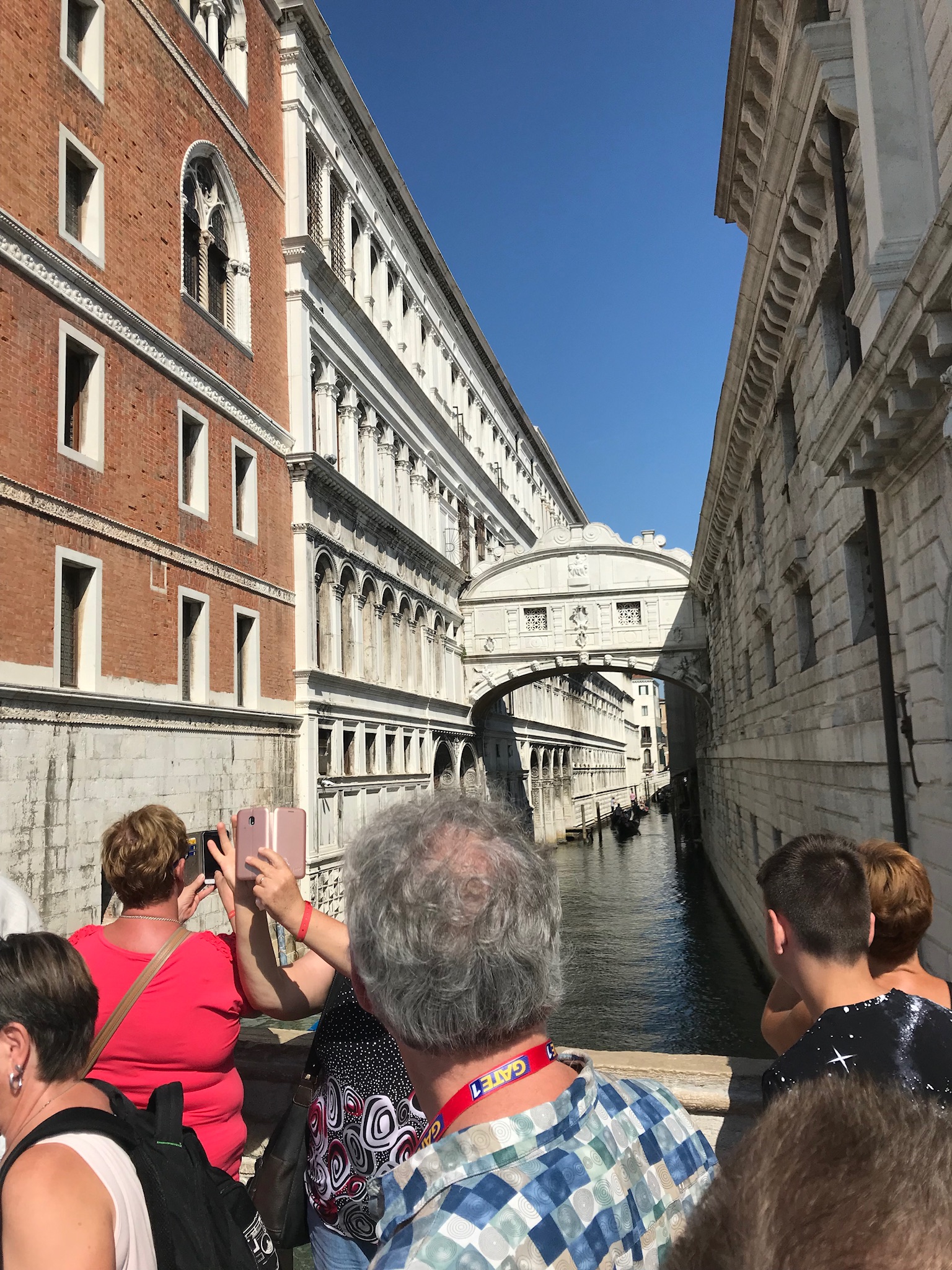
Italy — Day 3

Tuesday: We’re on our way to Florence. For lunch we stopped at a small winery near Collodi.
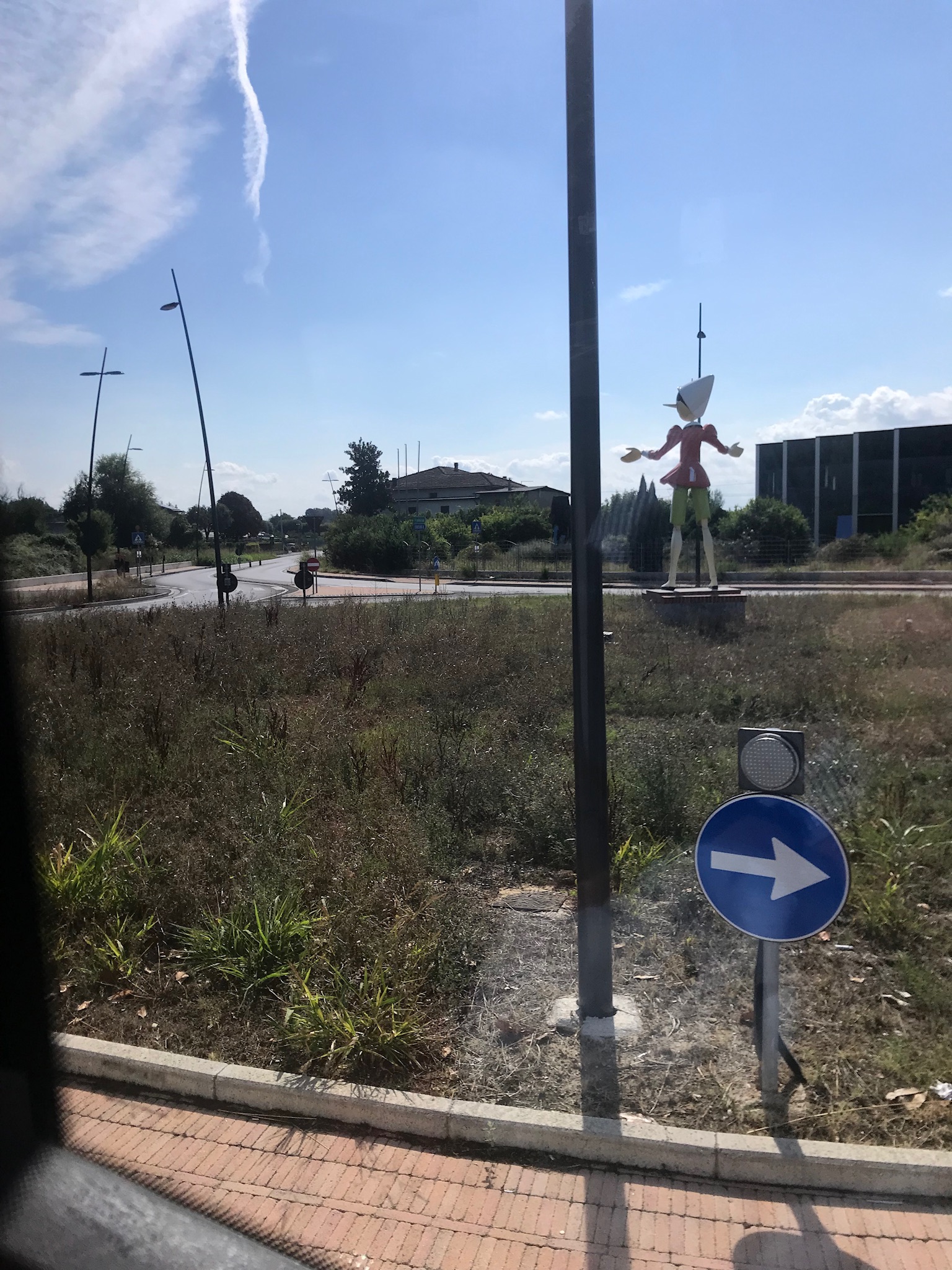
Why yes, that is Pinocchio, created by Carlo Collodi right here.
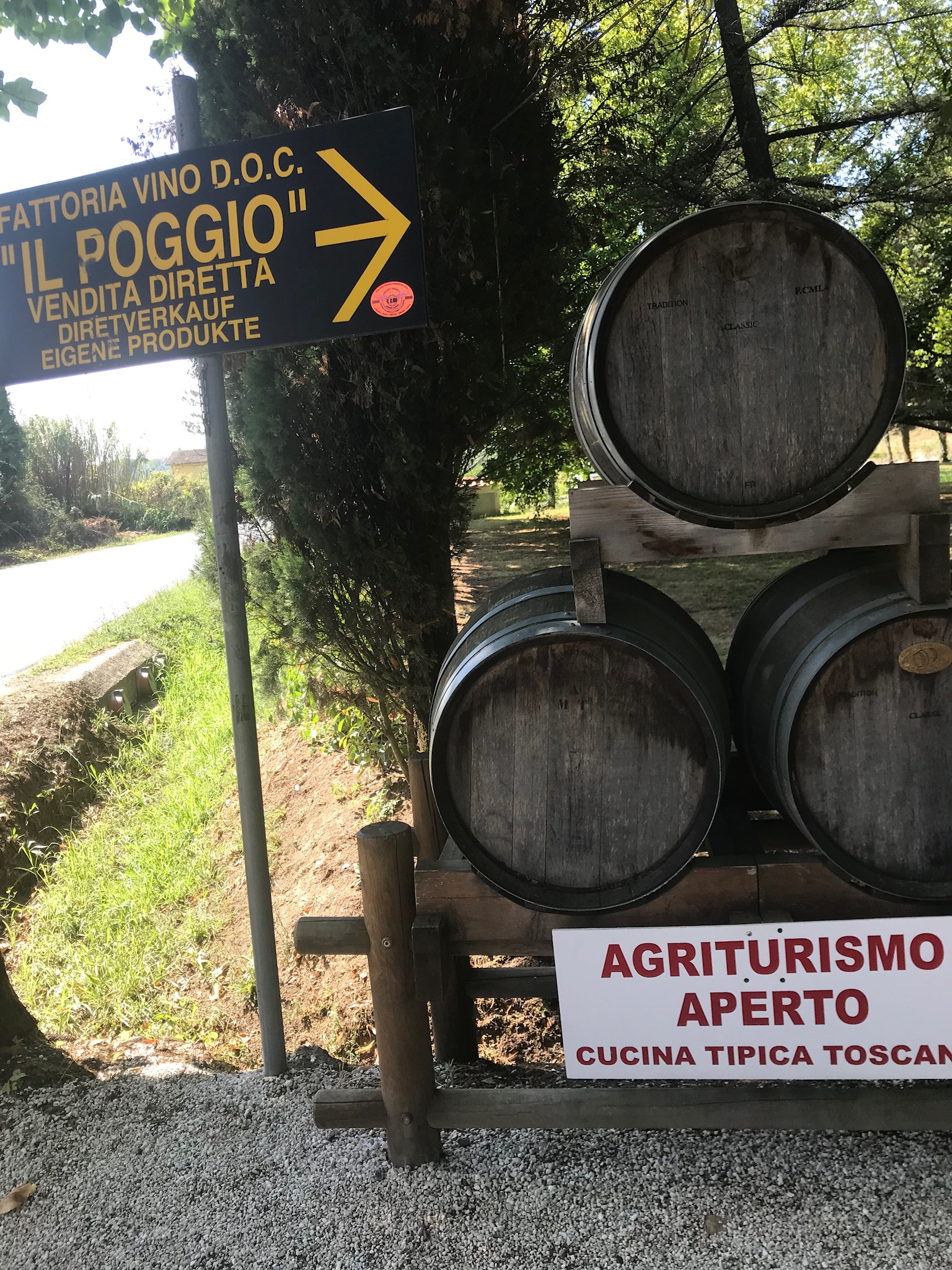
Il Poggio is a small winery, catering to the likes of us.
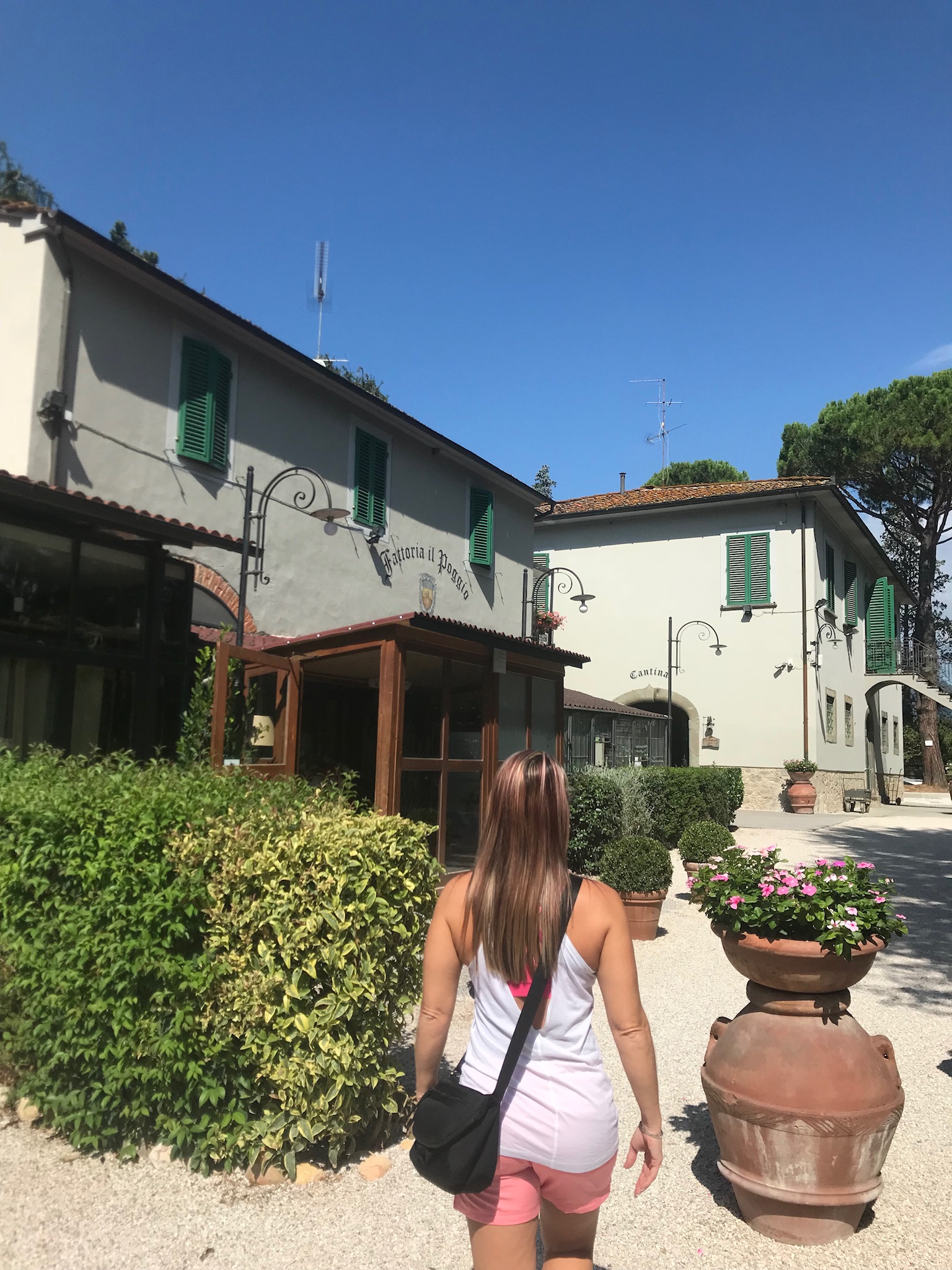
We were greeted by Pamela and two floppy Pyrenees dogs, one of whom was shameless in his/her readiness to be loved. (We were told that they were cuddly, but also had a bad habit of going to the next farm over and eating the chickens.)
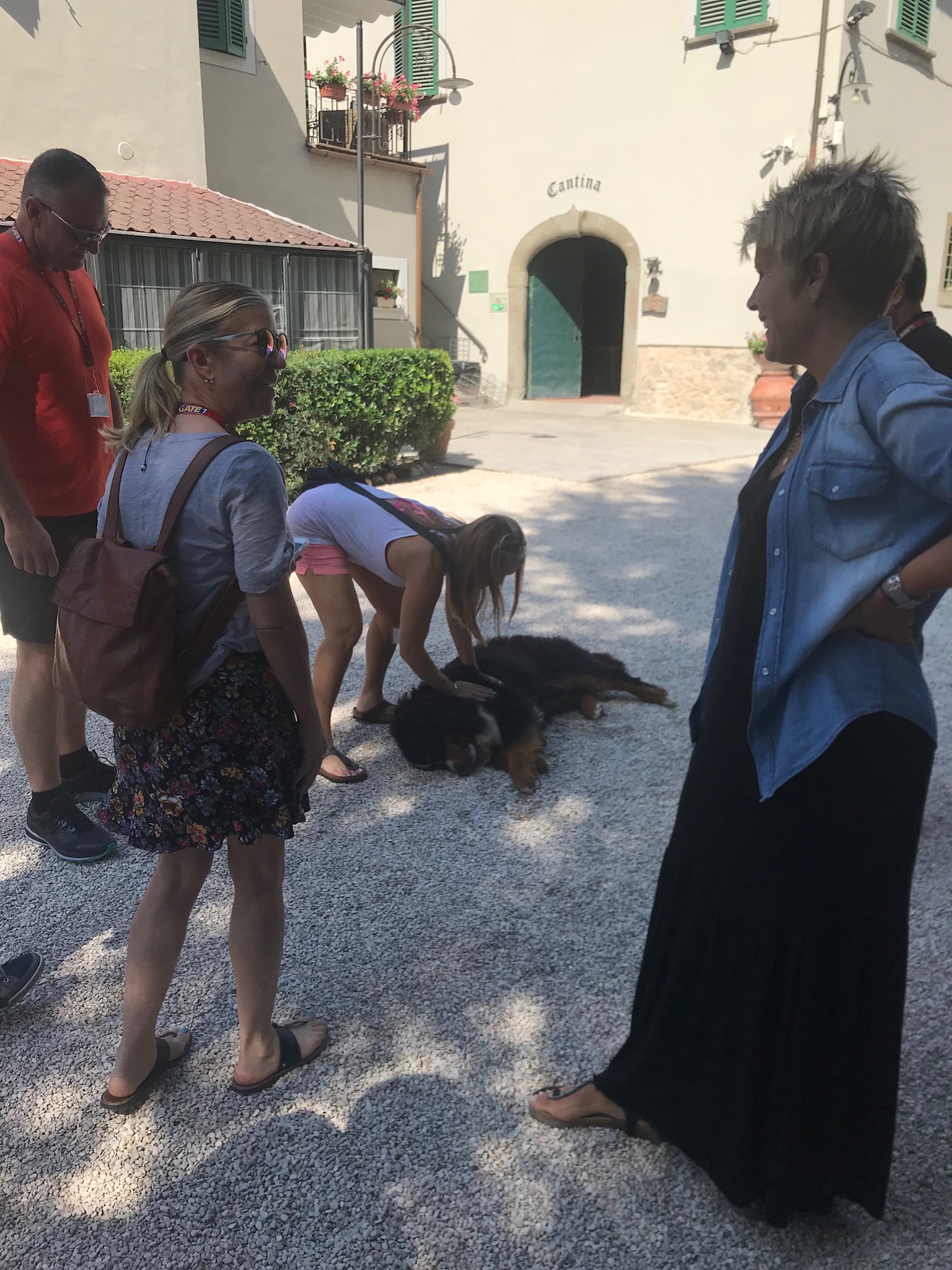
Pamela was one of those women who seem effortlessly chic and lovely.  She was also cheerful and friendly.
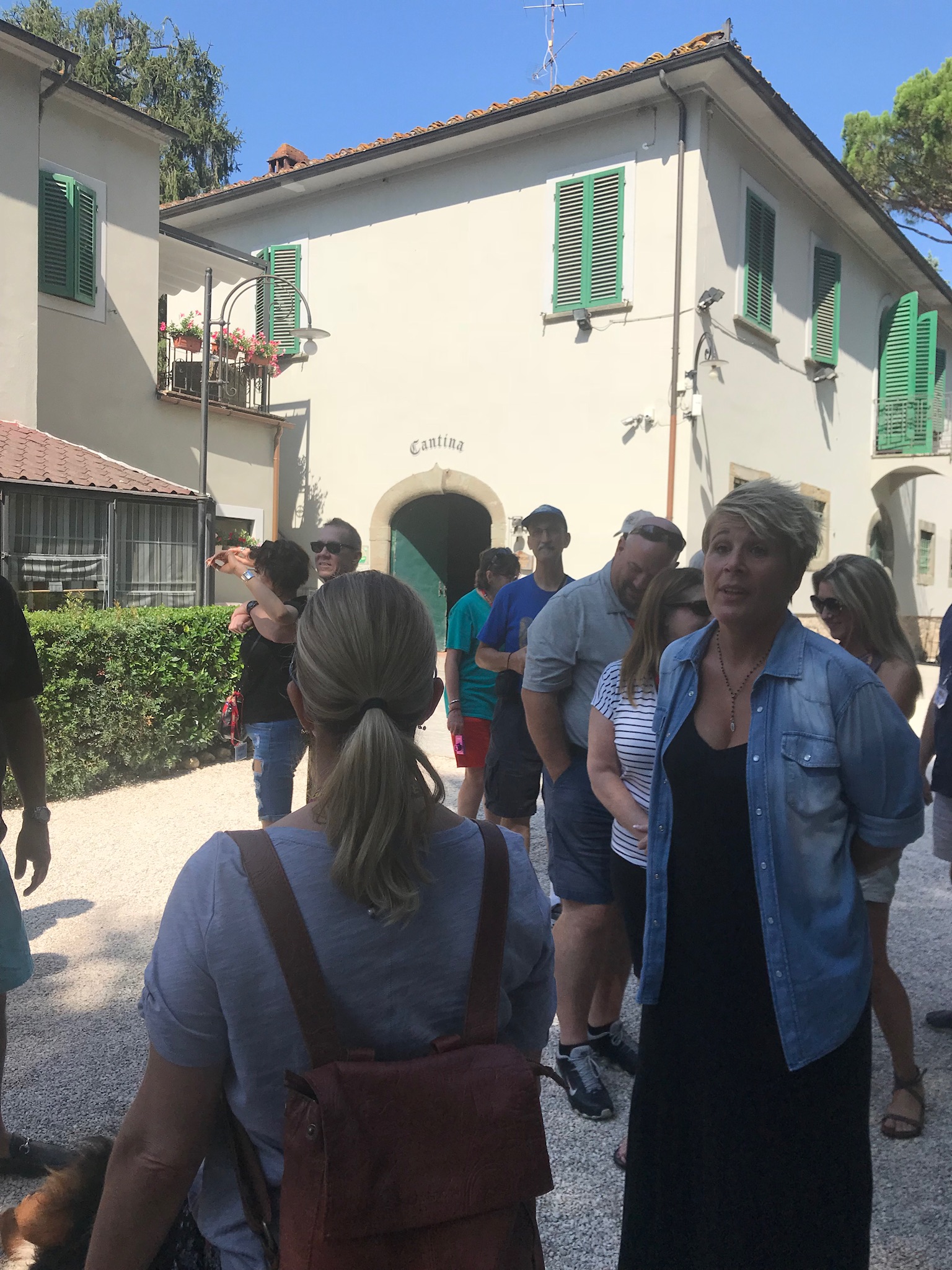
Pamela led us up the slope to talk about olives, grapes, and the wine and olive oil they make.
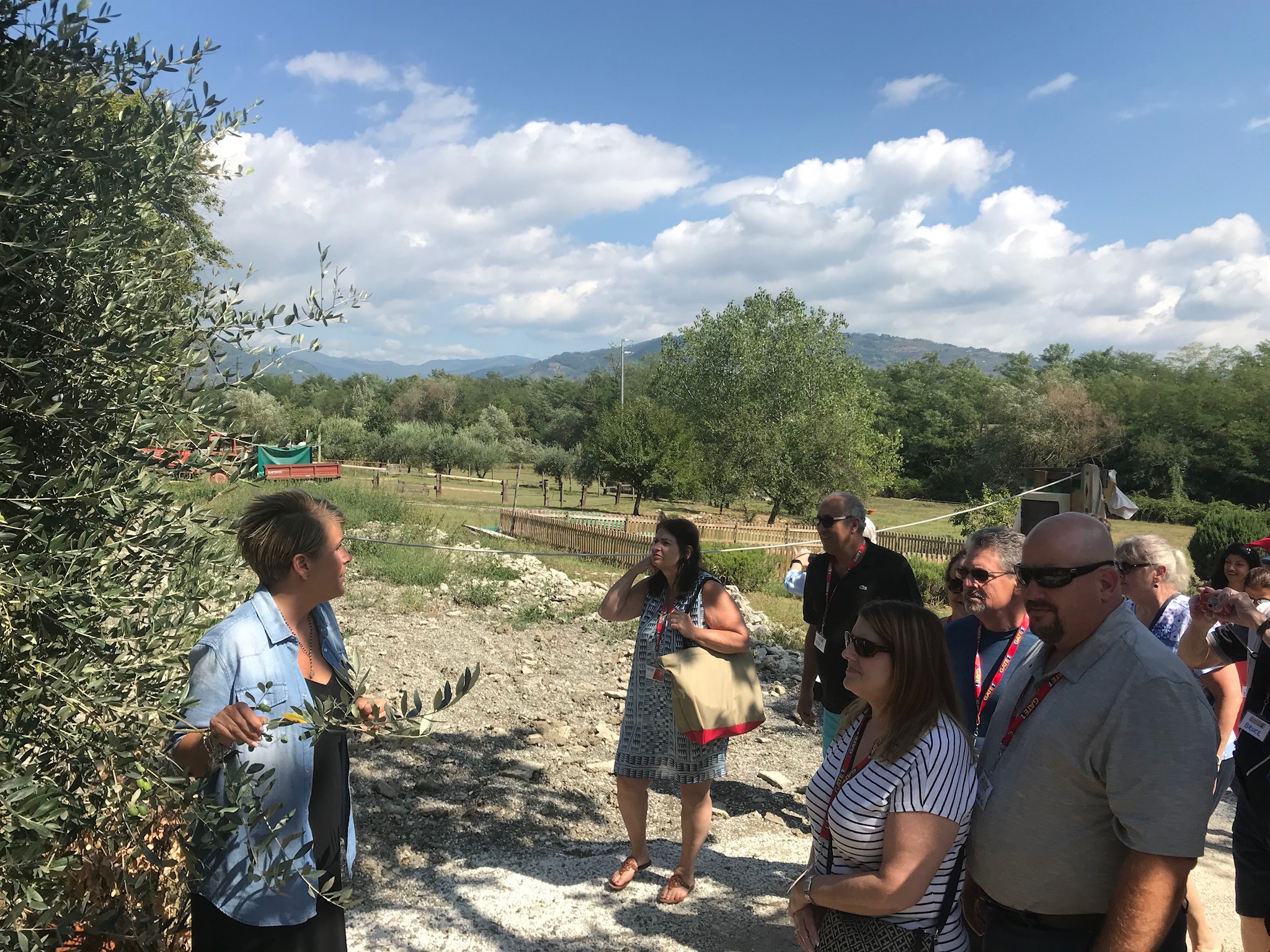
Behind me were some oak trees that had this curious growth on them:
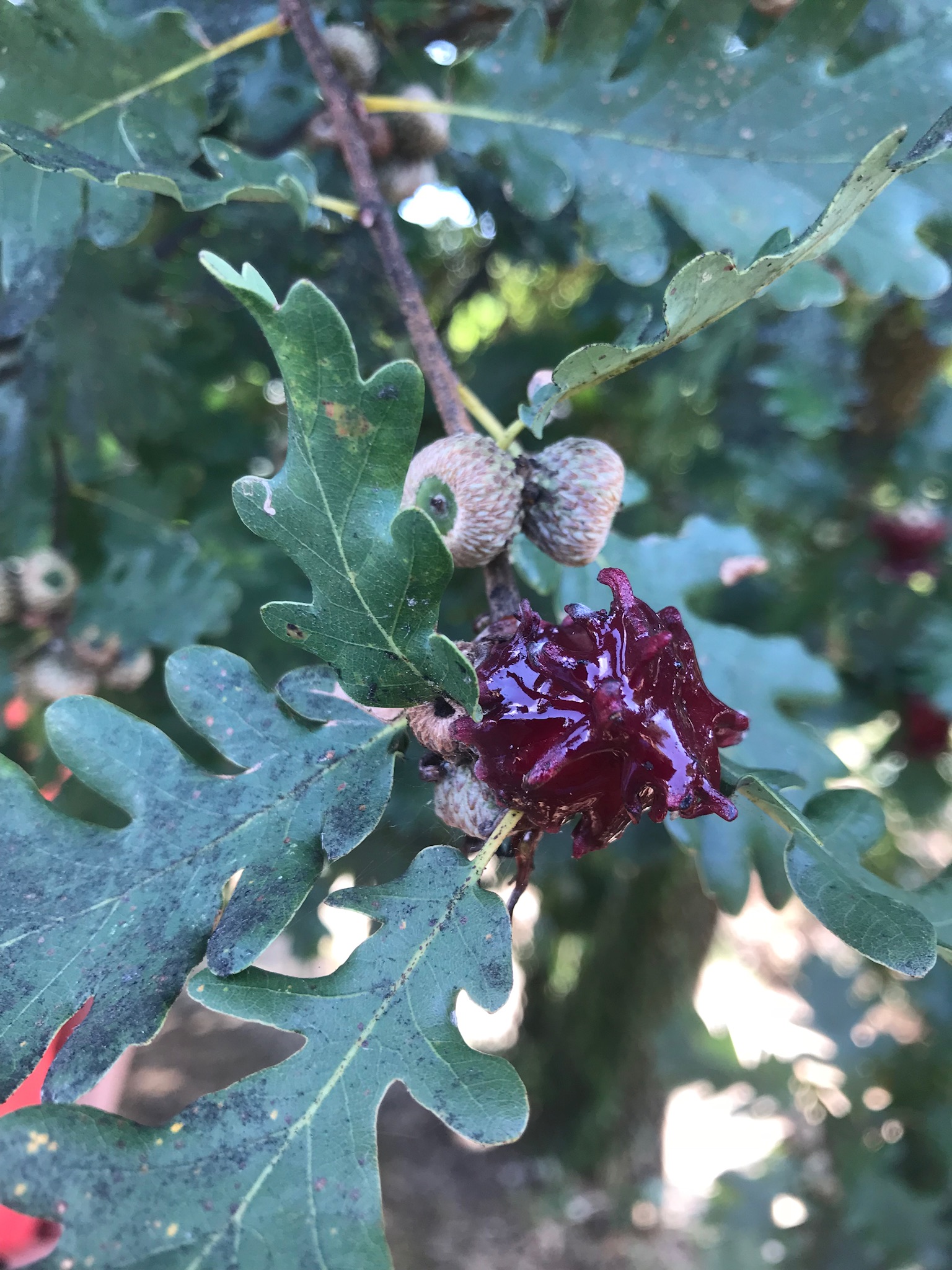
Very alien looking, and they were as sticky as they look.  I have no clue what they are, and neither did anyone at the farm.  Anyone have any suggestions?

Back down at the farm, we had a hearty lunch—there is no other kind of meal in Italy—with good enough wine that we ordered some to be shipped home.

Back on the bus, and onward through the Tuscany countryside.  How do you know it’s Tuscany?  The cypress trees:
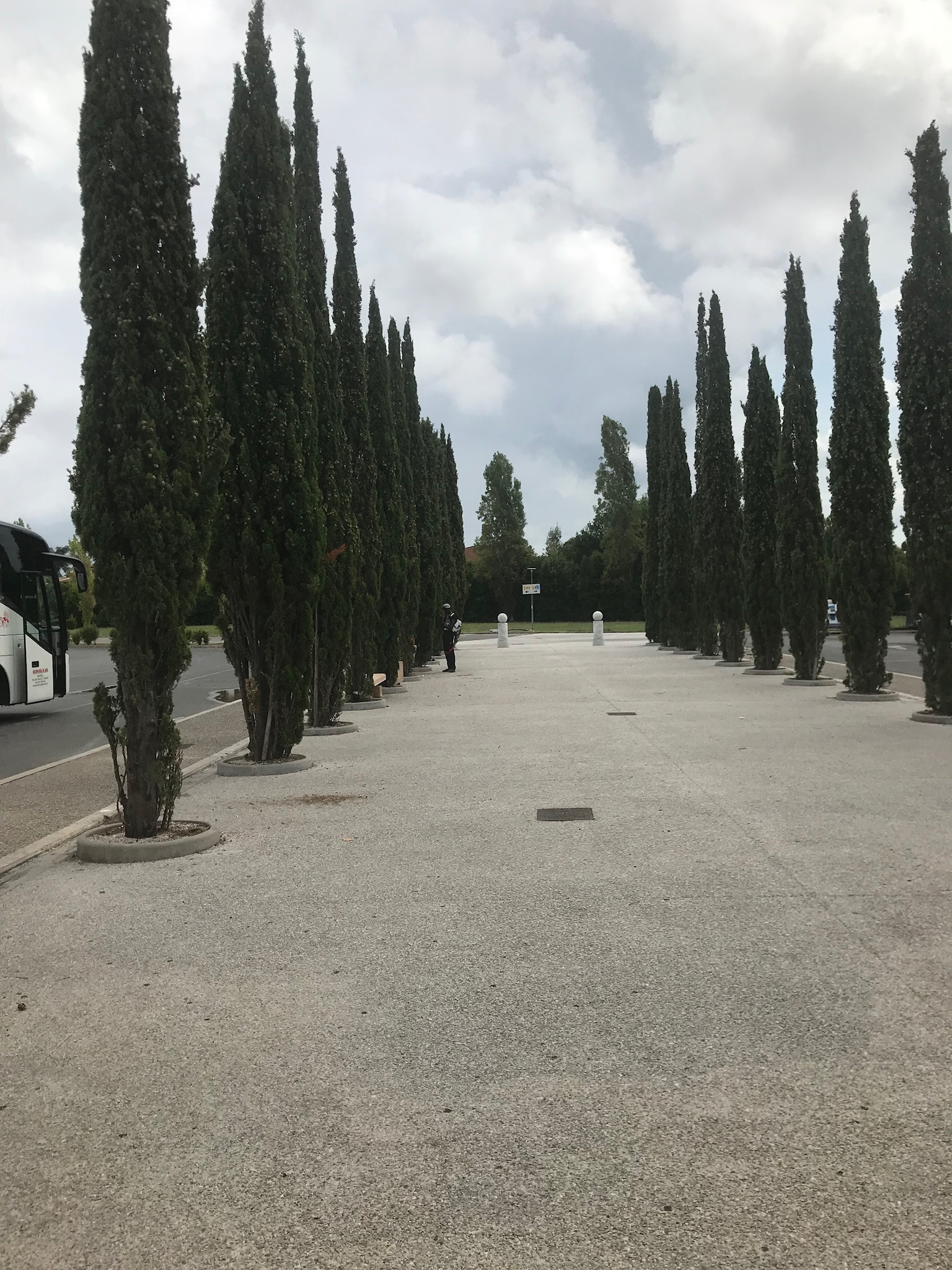
Here’s the thing, though: in the rest of Italy, cypress trees are associated with cemeteries and graveyards.  While Tuscany has decided they look pretty and has planted them all over the place, the rest of Italy thinks they look a bit creepy.

Pisa.

Too many photos, so I shall put them in an slideshow and you just click through.

[slideshow_deploy id=’7339′]

[I chose not to bring my laptop on this trip because toting the MacBook was just too much, but the iPad won’t allow me to add comments; check back next week after I’m back home to hear what I thought.]

tl;dr: the Baptistery was beautiful, the church was gorgeous, and we didn’t even really walk over to the Campanile, which I understand is famous for not being upright. Truly, if your time is limited, skip the Campanile and see the church.  And do not embarrass us by posing for a photo of you “holding up” the tower.  Oy.

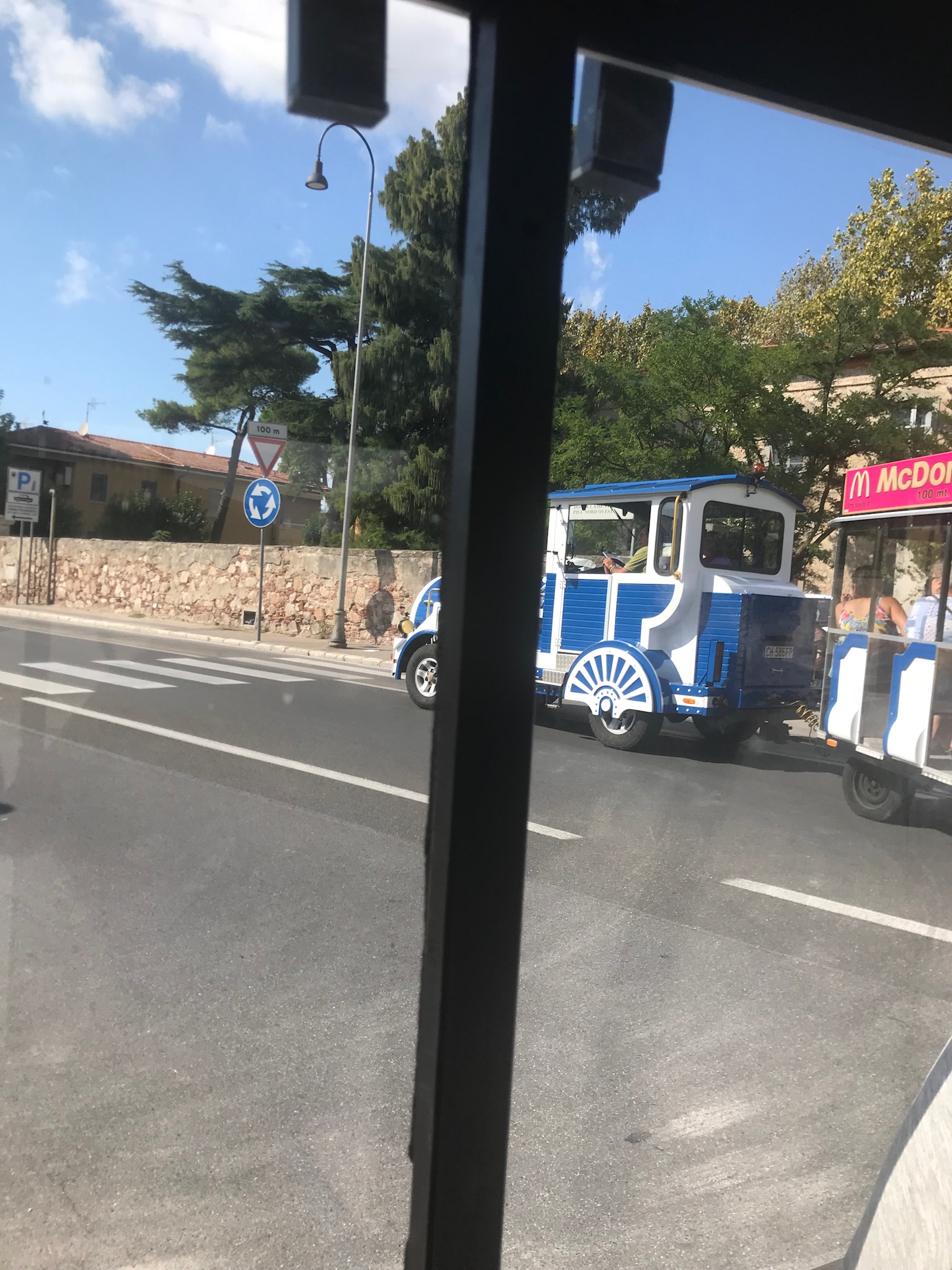
Often on this trip the bus could not pull up and disgorge us at the destination. We either had to walk, or in this case ride a little tram which usually transports elementary children to school.
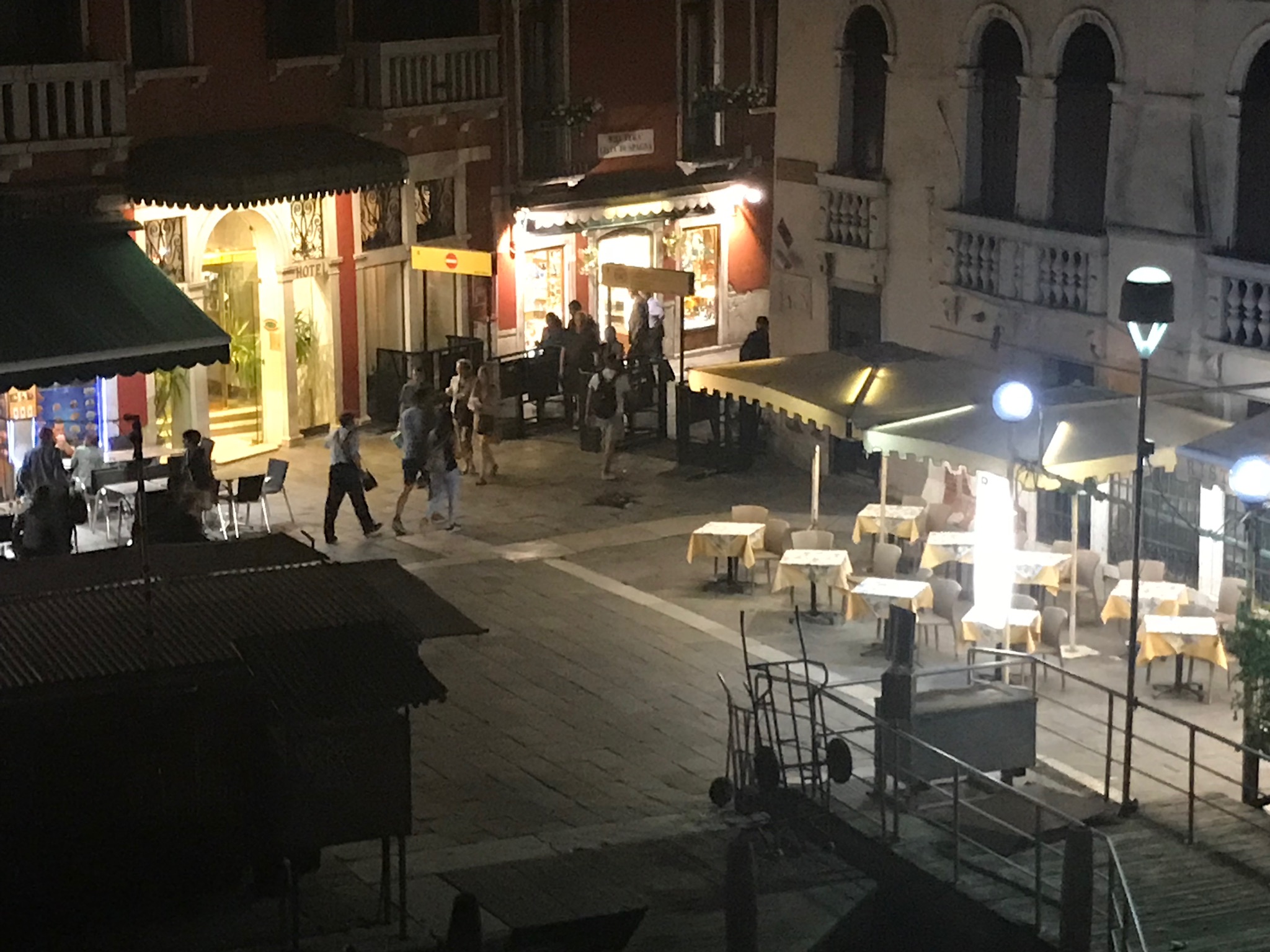
Finally we reached Florence and were on our own for dinner.  We had been advised to check out a new plaza with restaurants, but on the way down a shady-looking street…
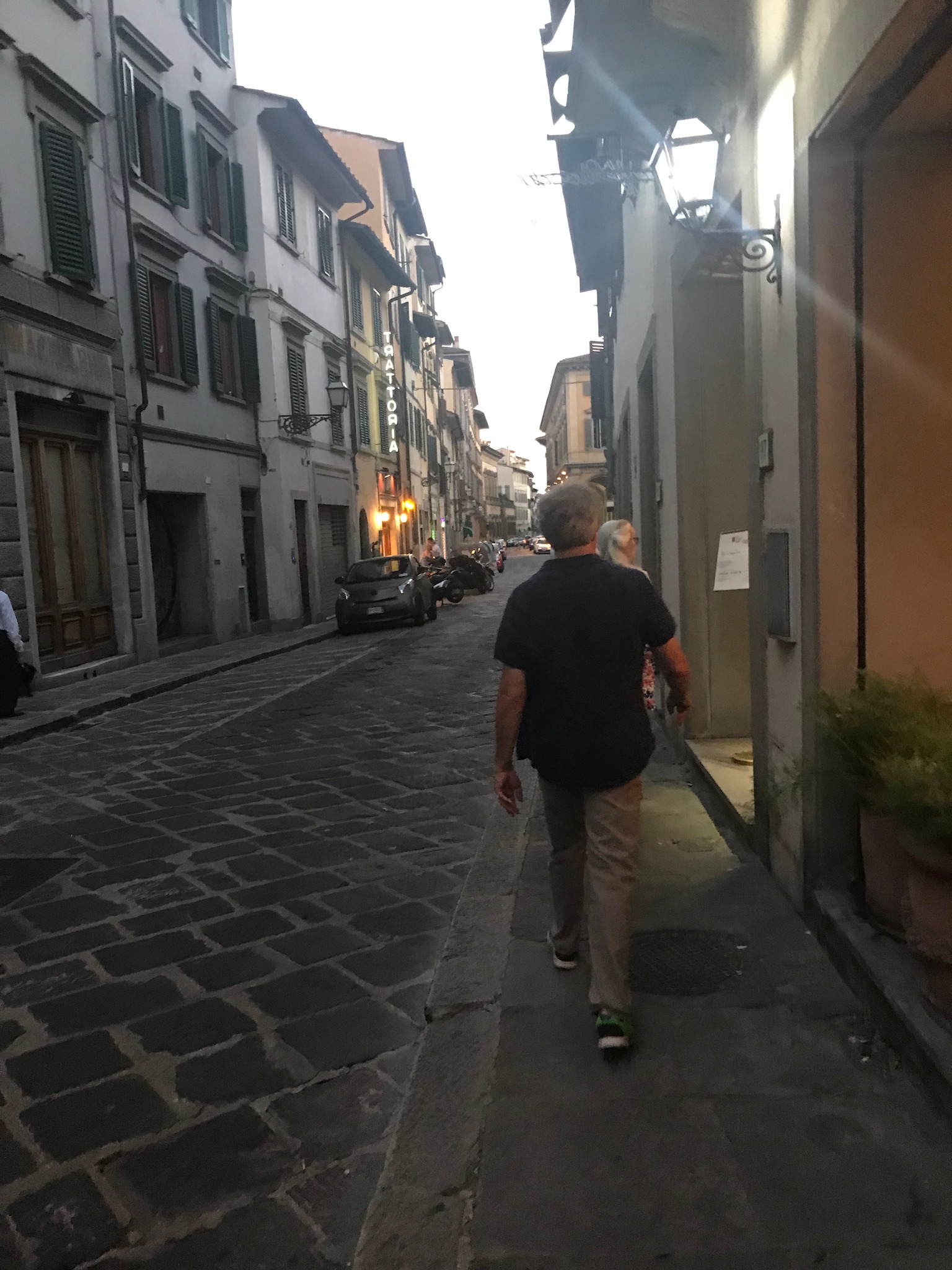
… we came across the Trattoria Tito’s.  Wait, cried the LFW, and she riffled through her Top Ten book.  This was in fact a highly recommended little restaurant, good food, and “theatrical,” whatever that meant.  We went in.
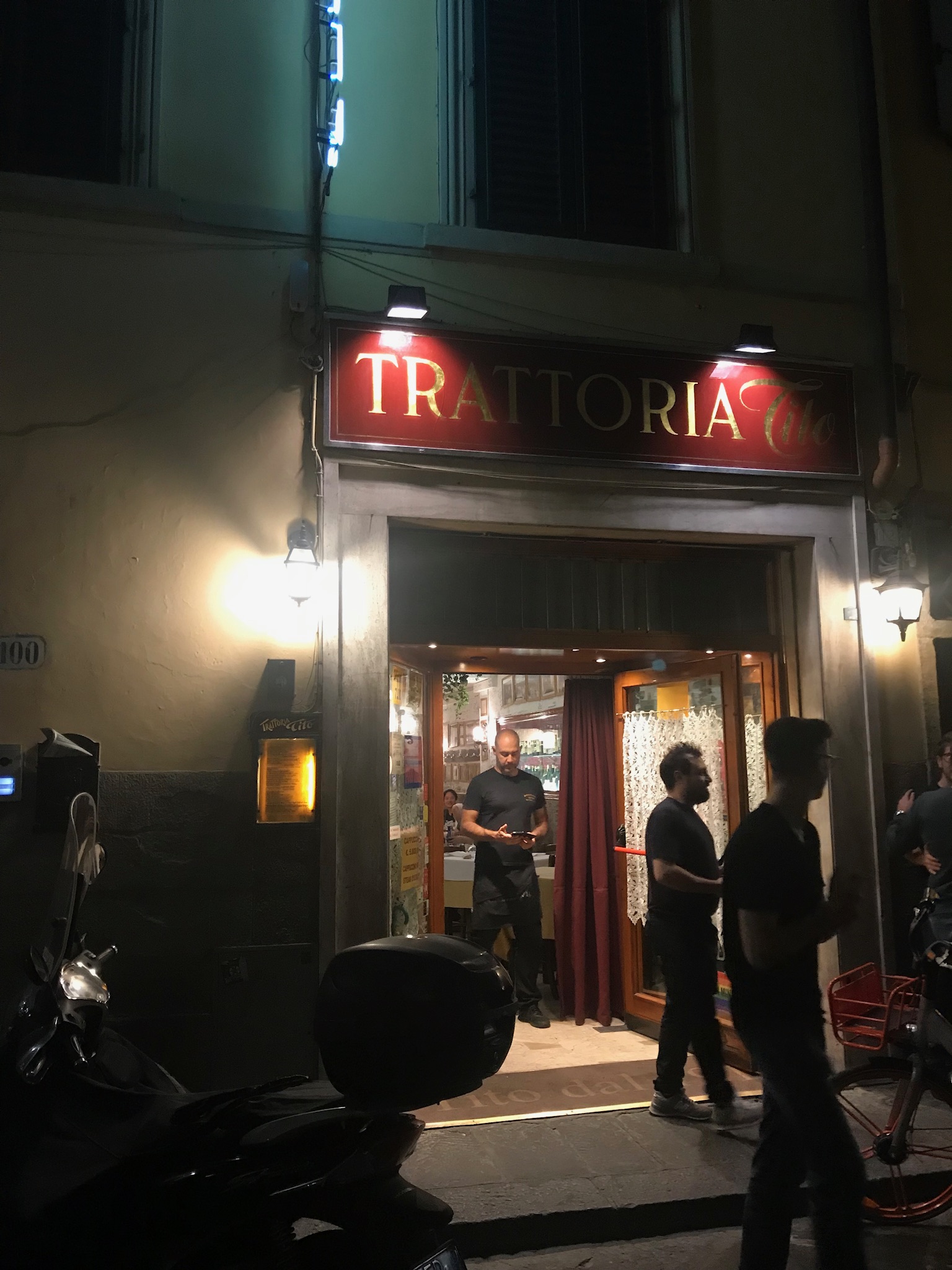
Great food, delightful waiters, and not expensive at all! We were asked if we had reservations; no, we didn’t.  There was a table open, but we’d have to clear out before 9:30. No problem, we said, we’re Americans; eating a meal in an hour and a half was not a problem.

And then we stayed until 11:00.  No one ever came to ask us to leave.  In fact, we even asked for our check at 9:20–the response was, and I quote, “No! Now we drink!” We then worked our way through shot glasses of homemade lemoncello and an amaro (bitter digestiv).

The whole place by the time we left was full of families, groups of friends, and one bunch of high-spirited high school boys who were a lot of fun to be next to.  When we told them we were from where The Walking Dead was filmed, they lit up with excitement. (They were offered their lemoncello at the front on their way out; they obviously had places to be and couldn’t dawdle all night at the table.)

Several of the other tables ordered what looked like a Huge Pile o’ Meat, but we learned the following day this was actually a Florentine specialty: a T-bone steak about three inches thick, cooked very rare, and then chunked up on a platter to be shared.

Bedtime, and tomorrow: FIORENZE!
Italy — Day 2


Here’s a fun thing to do: have a couple of Aperol Spritzes at lunch, plus a Negroni at Harry’s Bar, then hop on a water bus to cross the street to get to the Guggenheim Collection in time to watch them lock the front door.  But more about that later.

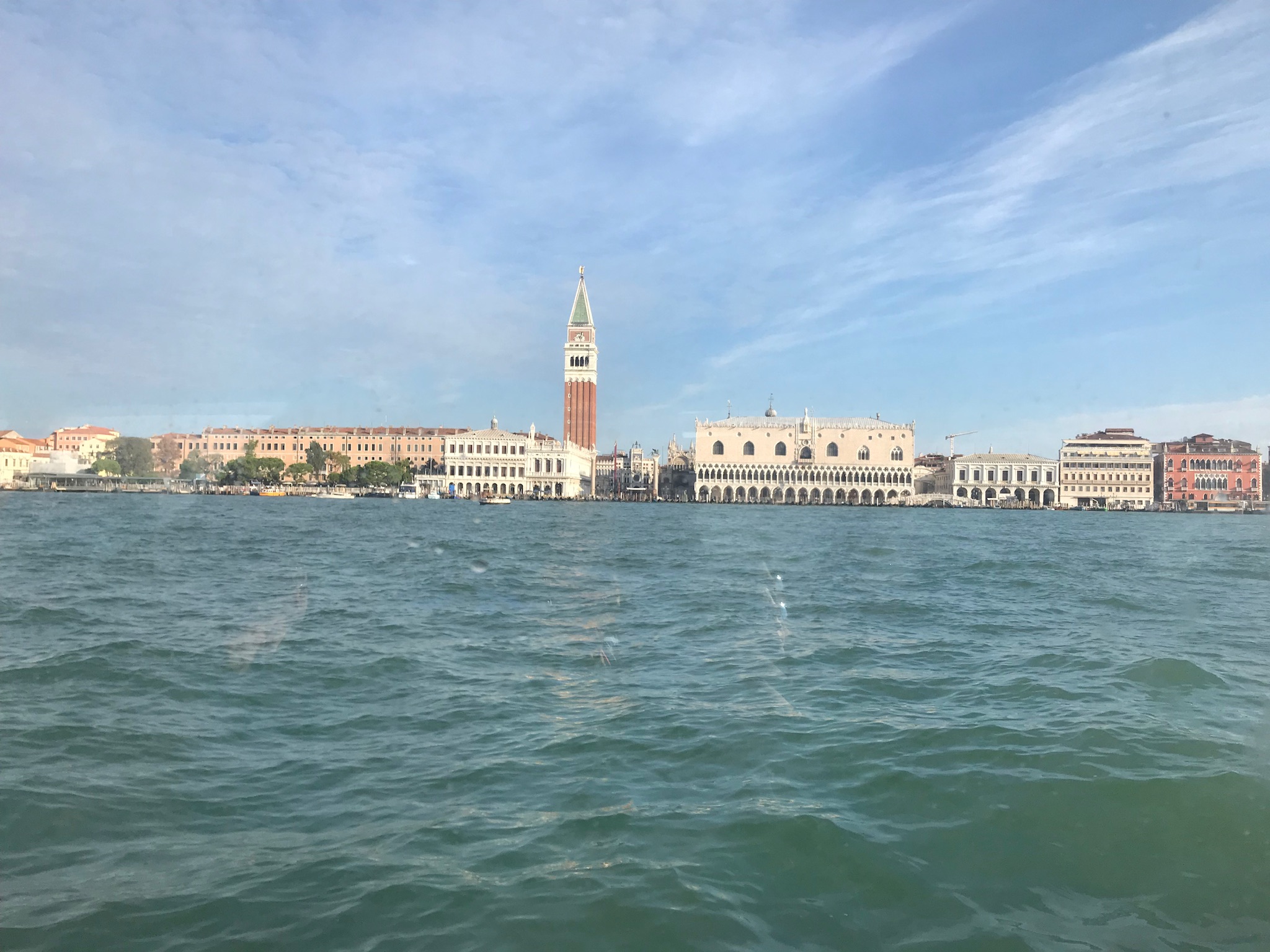
Venice has always seemed an odd place to me in theory, and it is no less odd in practice. I get it that living on islands surrounded by shallow, mucky lagoons would offer some protection, but once you had some money, wouldn’t you move to the mainland instead of building huge palazzos and cathedrals on sinking ground? [1]

Venice is as beautiful as the photos make it look. There are no complaints there.

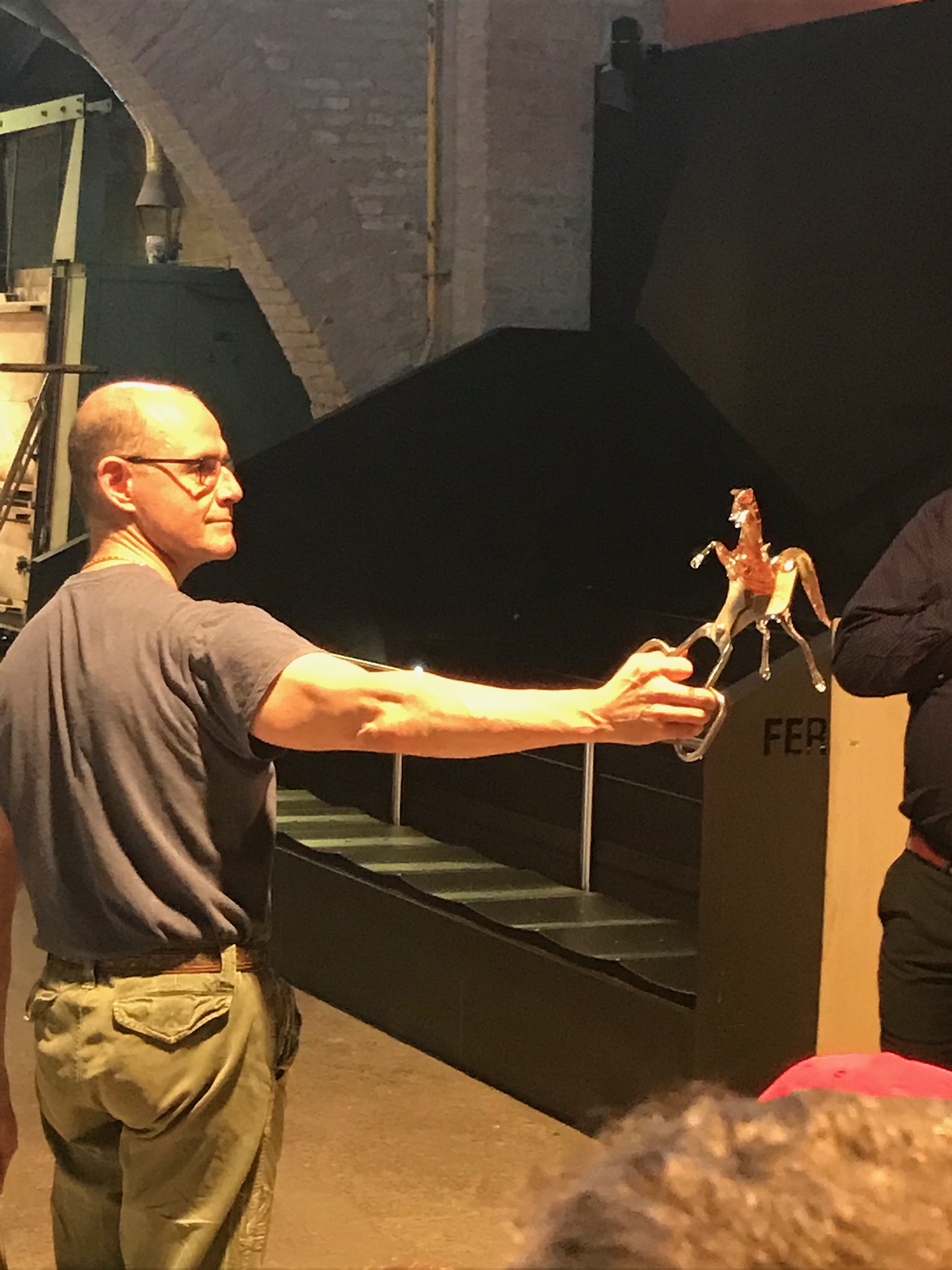
We are on a tour, with some scheduled times and with some free time. Today, the morning was chock full of moving around, starting with getting on a boat and heading out to Murano, the island where the tremendously gaudy glass is made. We were treated to a glass-blowing demonstration, and that’s always interesting, and then we strolled through room after room of glass items that I have chosen to describe as ‘exuberant.’

Quick history lesson: Venice started producing glass 1,000 years years ago, and for much of that time had a carefully guarded  monopoly on the process. When the business really got going, the Doge decided that the risk of fires from the glass furnaces was too much and “redistricted” the glass-blowers to Murano, and so there’s a bit of cachet to the hand-blown glass of Venice.

However, and I am being blunt here, most of what we saw was not creative at all.  It may not have been machine-made, but it was repetitive and standardized. It was also, as I’ve said, exuberant, which is a nice way of saying ‘gaudy.’

It was also expensive. I did find some cocktail coupes that were simple and elegant; they were also €150 and up—each. I love glassware, but the idea of serving cocktails in a glass that cost as much as a bottle of brilliant single malt scotch was off-putting.

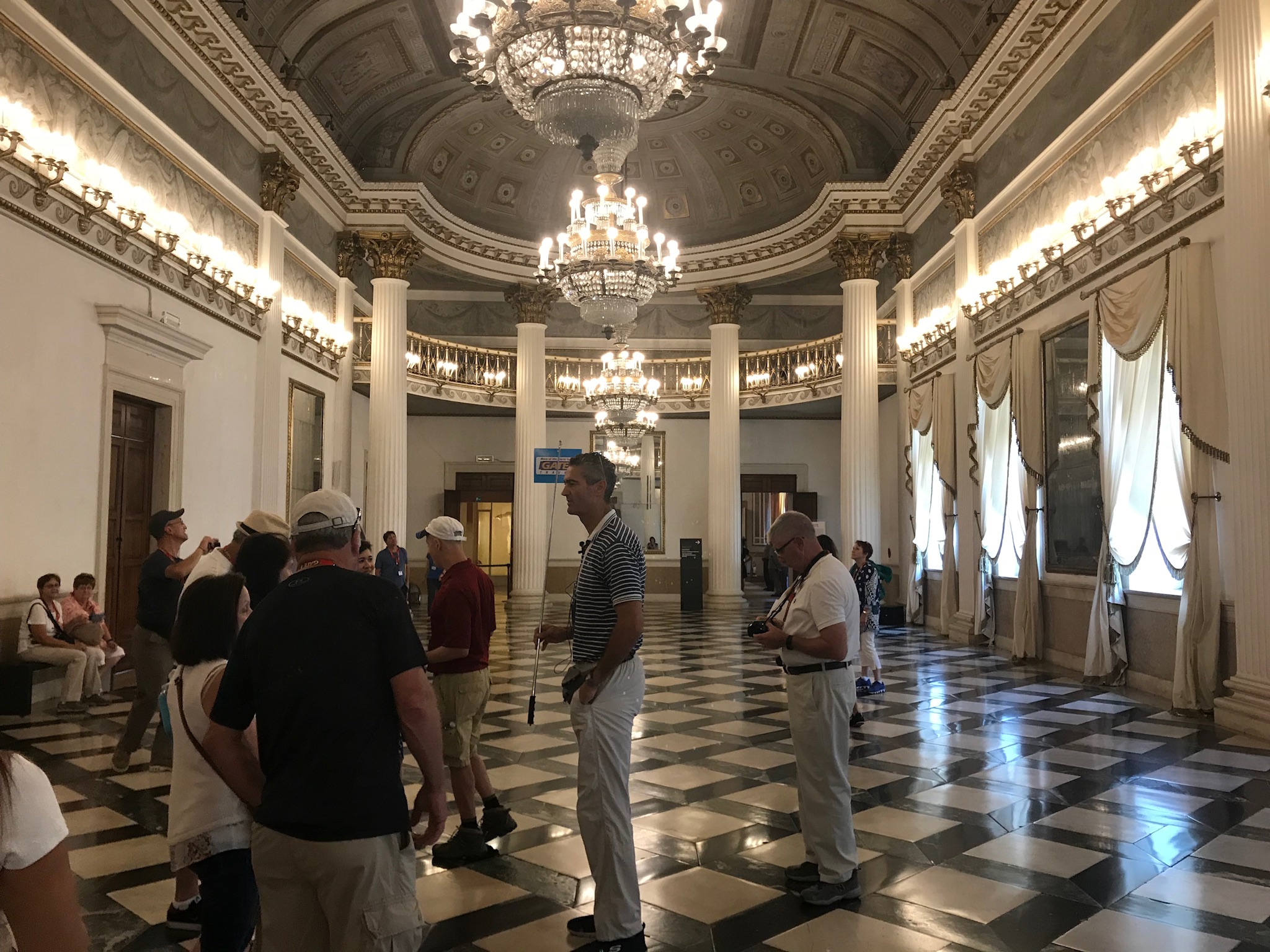
Back in Venice, we were introduced to Carlo, our tour guide for the morning. We were treated to the Museo Correr, which started well enough with the restored rooms from the Napoleonic era, including a lovely ballroom, but it degenerated into an endless stream of facts, dates, and names from poor Carlo, who seemed to think that we needed to know every single detail about whatever was in front of us.  When he started giving us dates on the model of the large gilded galley used by the Doge, including the  last time it was used, how the superstructure was stripped and burned and the ashes shipped to somewhere and processed to reclaim for the gold and then the galley itself was used as a prison for a couple of decades and finally dismantled in 1837… I took my earphone out and enjoyed the silence.

The ballroom. The LFW and I got in a couple of measures of a waltz.

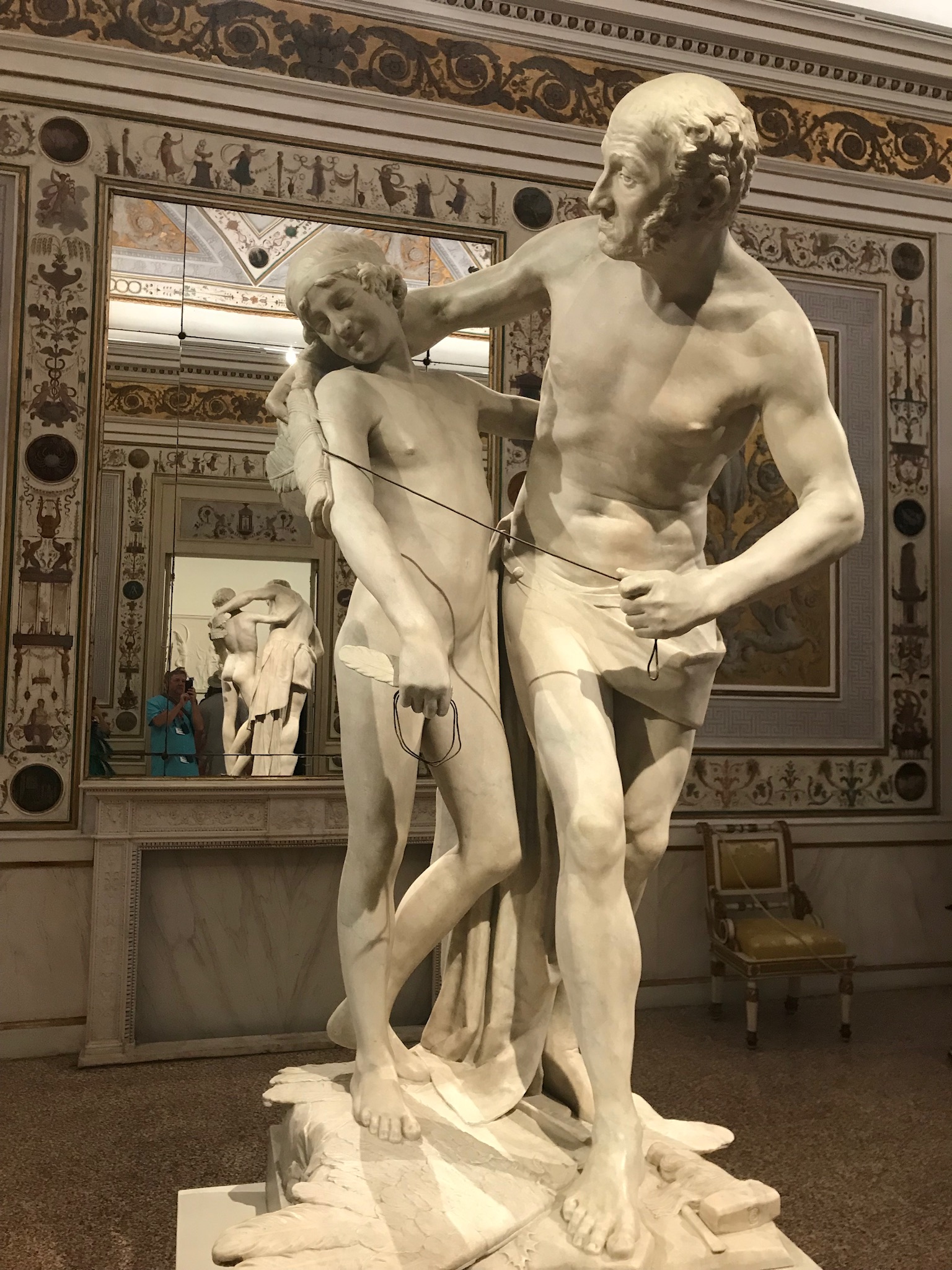
Sidebar: Canova was the famous 19th-c. Venetian sculptor, and as Carlo was telling us the entire myth of Daedalus and Icarus, I was reminded that I have an opera to finish.

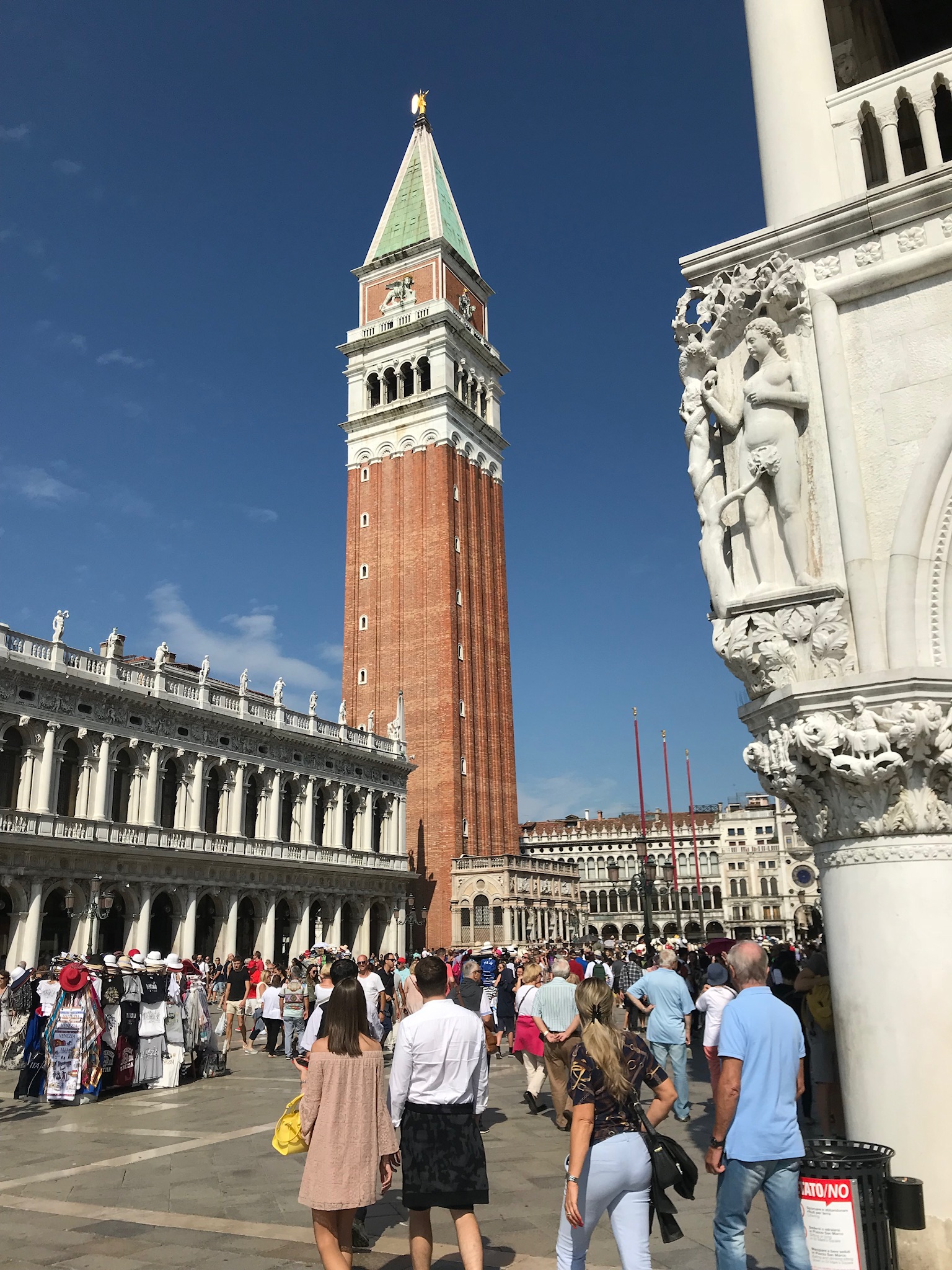
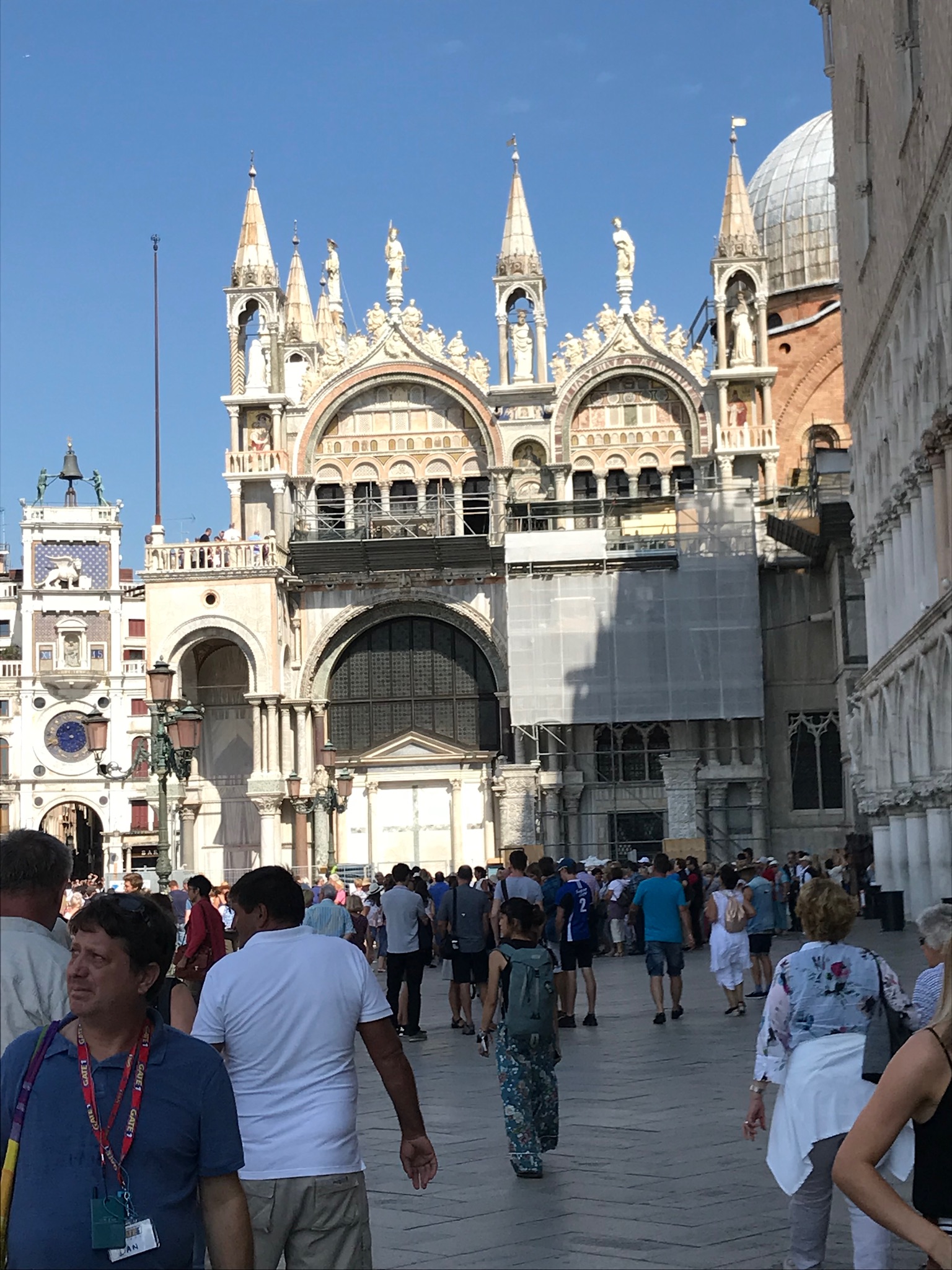
I continued to enjoy the silence as we spent some time in St. Mark’s, a stunningly Byzantine basilica: every surface covered in gold mosaics. It’s a beautiful church, but of course wherever you go there are all these tourists in your way. (In general one is not allowed to take photos inside the churches.)[2]

Finally our tour guide led us out, we told him Grazie, and sent him on his way.

Here’s a thing you need to know about Italy: they do not eat lunch until after 1:00, and dinner may not be until 7:30 or later. We were starving at that point, so we wandered aimlessly until we found a canal-side establishment and scarfed down a pizza.

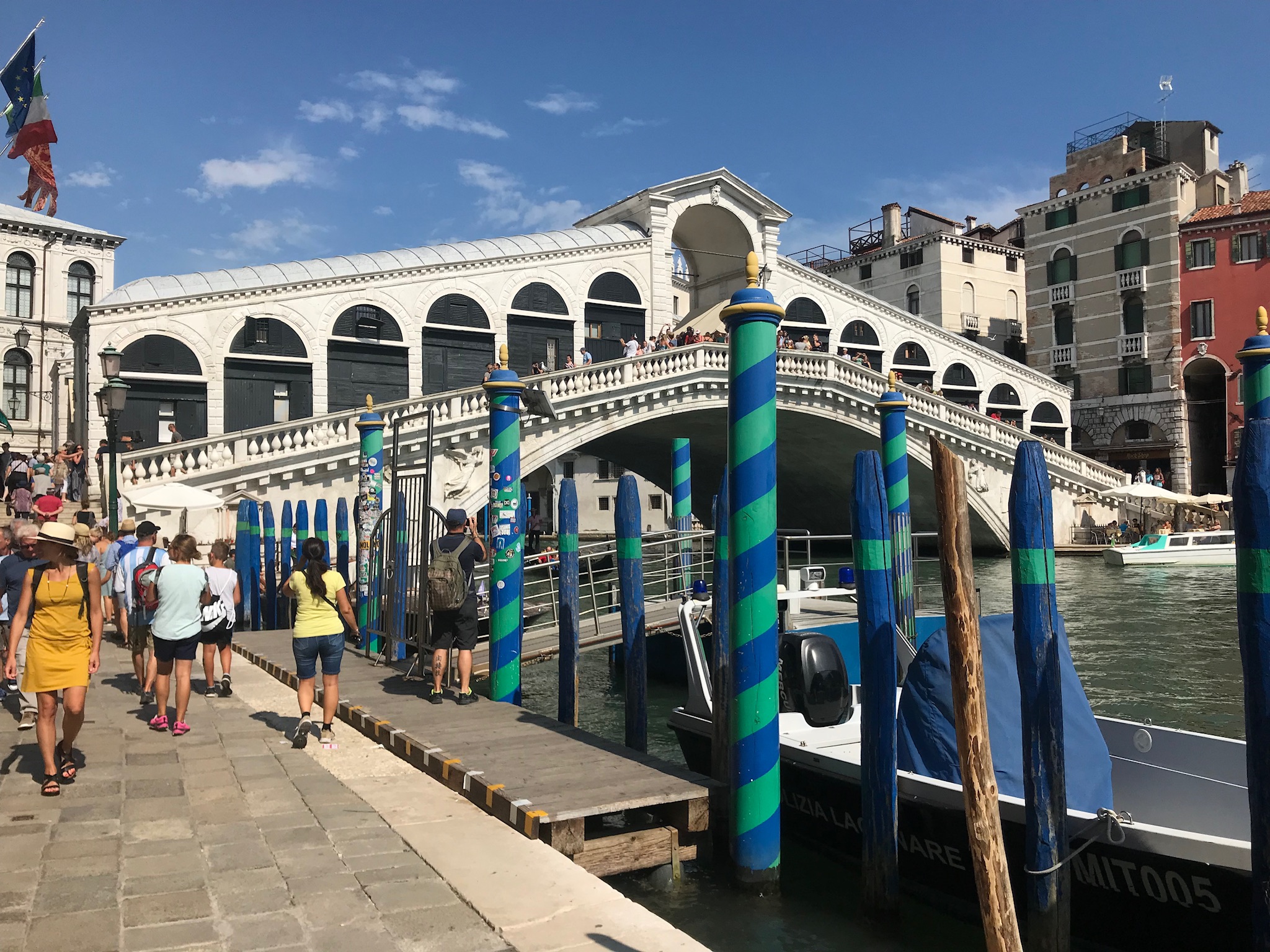
The trattoria was next to the Rialto Bridge, which you know from Merchant of Venice…

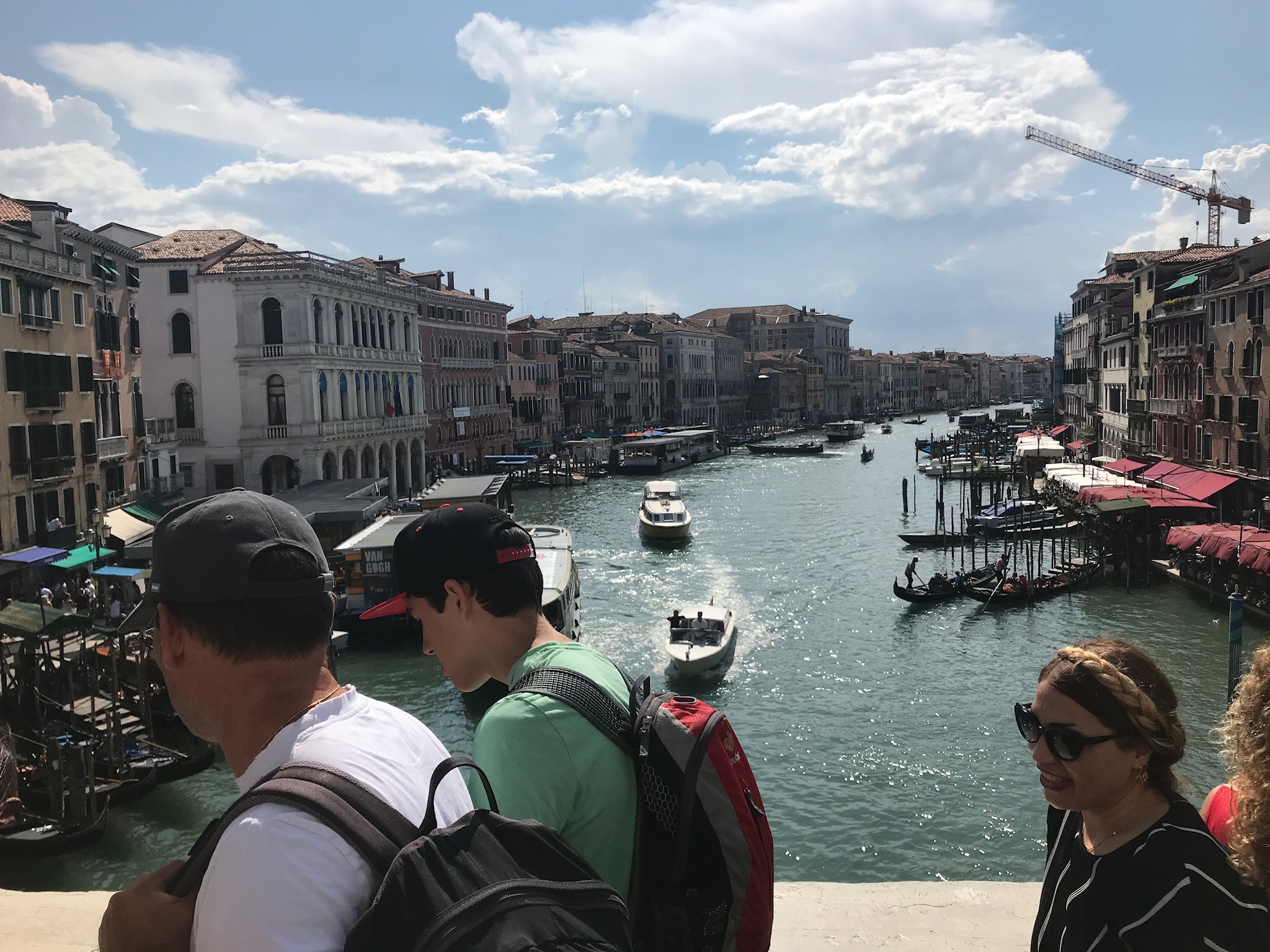
…and here’s a shot from the Rialto Bridge.

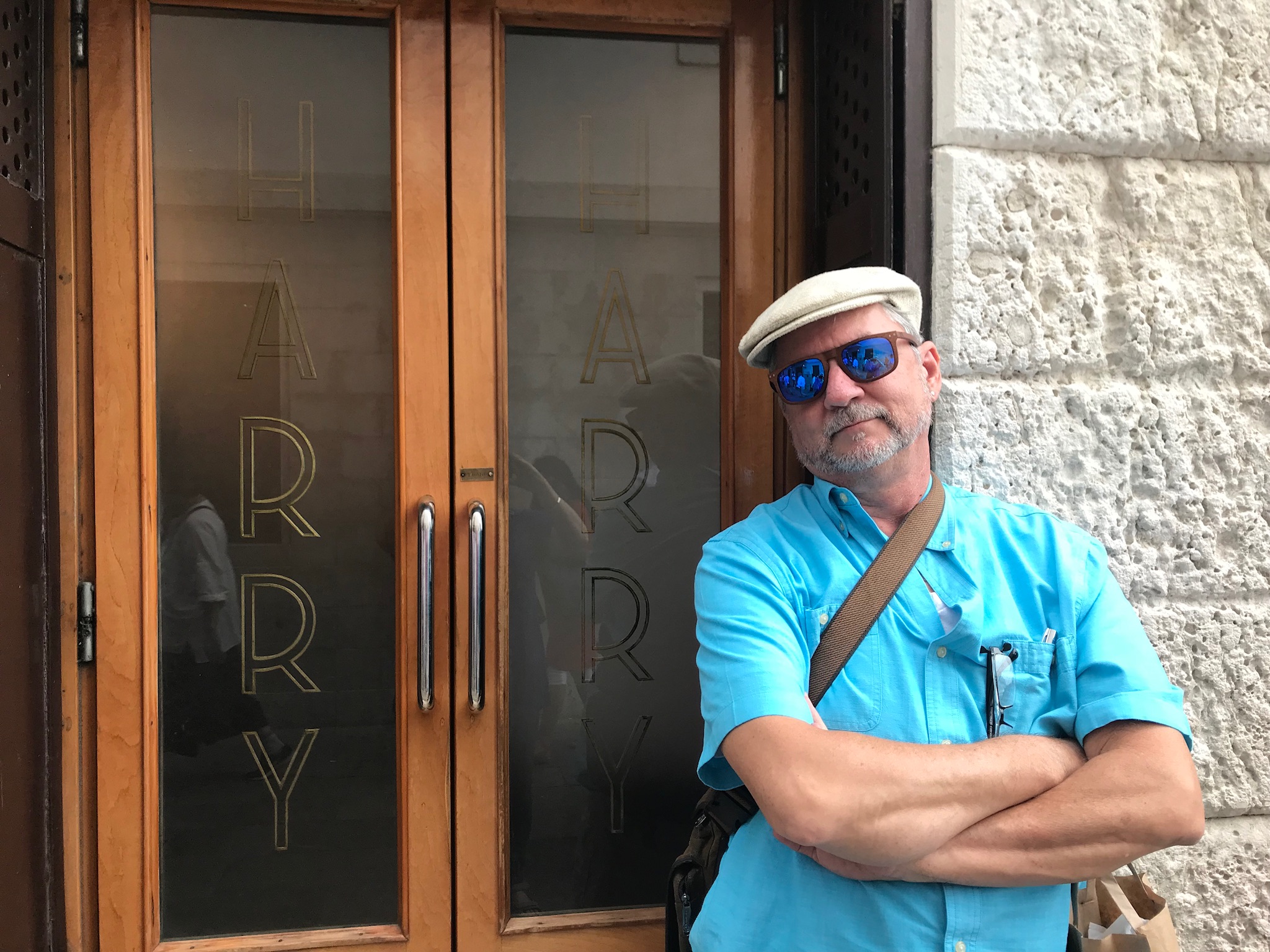
This was where we had multiple Aperol Spritzes. I had forgotten that third ingredient was prosecco, so by the time we wandered back into St. Mark’s Square to find Harry’s Bar — to follow in the footsteps of Hemingway, of course — we did not need that third cocktail that we all had.

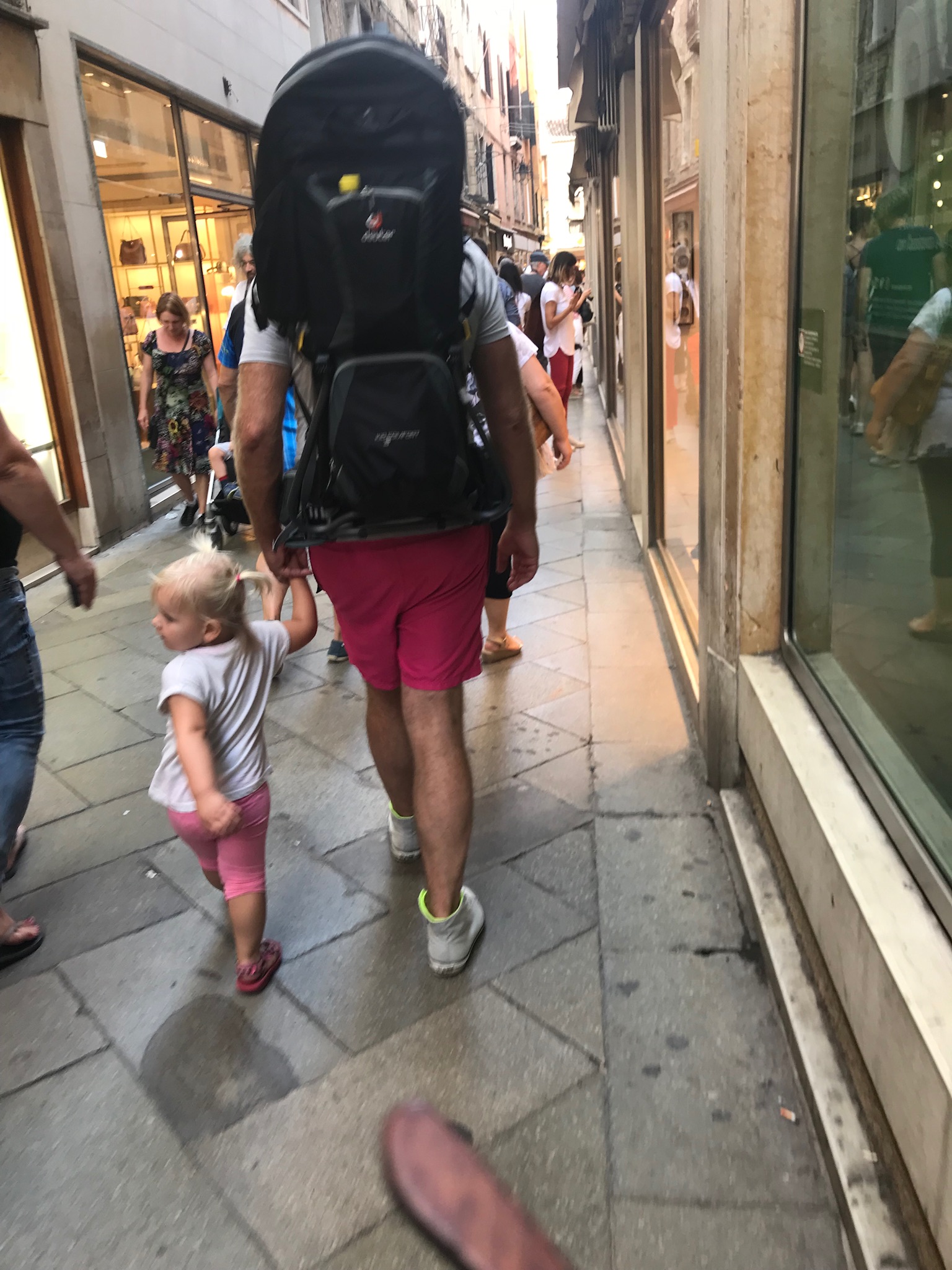
On the way back to Piazza San Marco, here’s the Dad of the Week, who has dressed like his daughter, which I thought was just adorable.

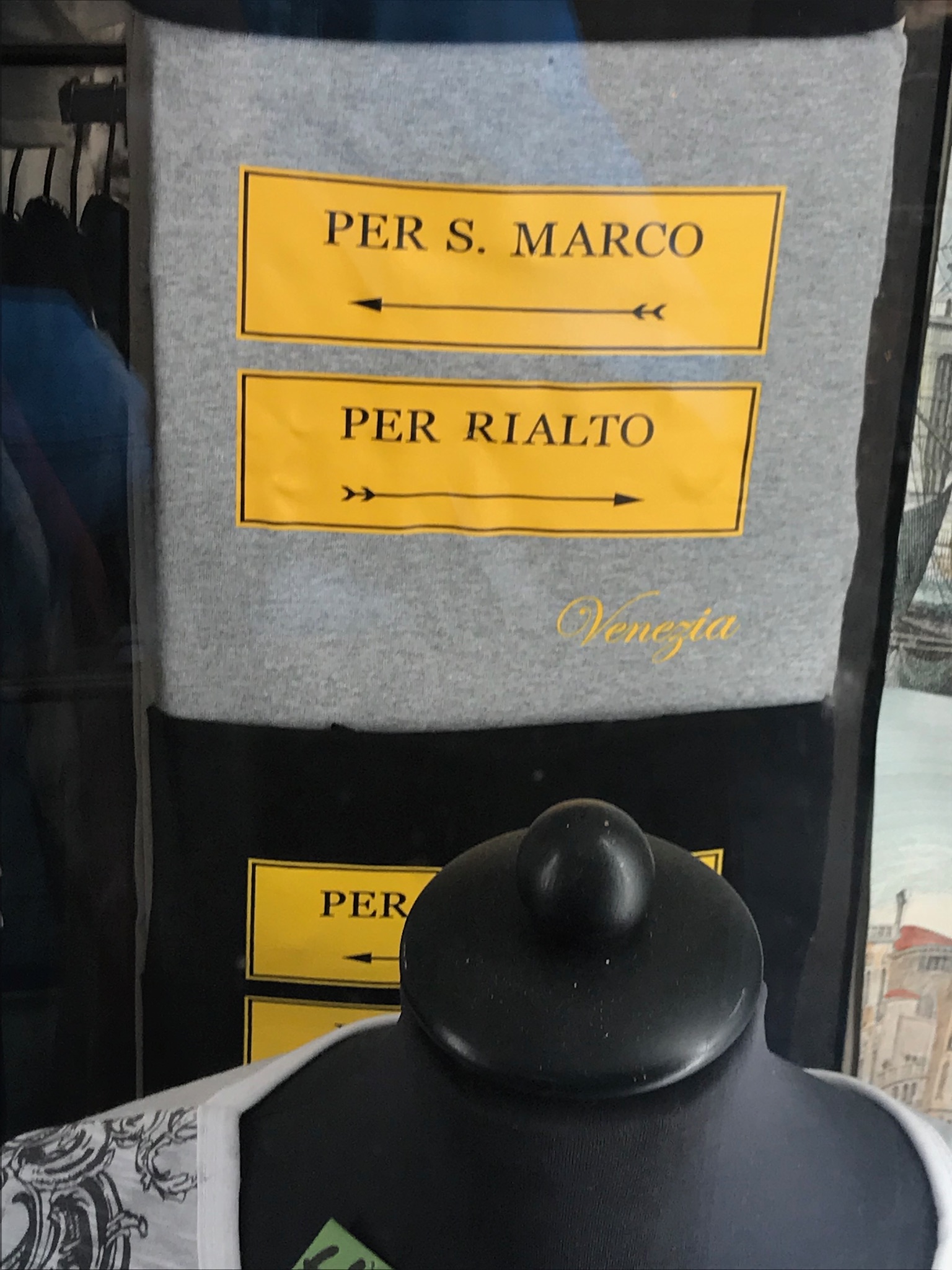
Also on the walk back, there was a t-shirt which sums up how to get around Venice:

These are the signs you see on buildings as you thread your way through the rabbit warren of streets in Venice, and as long as you can orient your hotel to one of the major landmarks, you really can’t get lost.  Plus, as Ignazio said, you’re on an island.

Here’s a fun fact about Harry’s Bar: it’s boring. The décor is stark without being lovely. They have all the usual wines and stuff, but their cocktail list is completely unimaginative, nothing more than standard stuff. It is well-made standard stuff, but it is merely standard stuff, and it is expensive.

As is my custom, I check out the backbar to see what they have and what they could make if I asked them.  One of our party wanted a Bijou, which I assured her they could make, since they had gin, sweet vermouth, and green Chartreuse.

But the waiter returned and said, alas, they could not make a Bijou. Whether they were lying or ignorant or lazy, I have no idea, but you can strike Harry’s Bar off your list of cocktail meccas.

The LFW is mistress of the Top 10 travel books, and one of her goals was make it to the Peggy Guggenheim Collection. We checked the map, and we were practically right across the canal from it. “Practically” is probably the wrong word, since to get there would be a 40-minute walk along the canal, across a bridge, and back, and we really only had 40 minutes or so until the museum closed.

So we took a water bus.

We have learned in our travels not to be afraid of public transport, and just because Venice’s happens to be boats was no reason to flinch now. We went to the nearest stop, bought tickets, hopped on, and were taken to the next stop, nearly directly across the canal and a hop skip and a jump to the museum.

We got there just in time to see them lock the door at 5:30, when their ticket sales ceased.

We went back to the museum gift shop and assuaged our sorrow with purchases.

Then we began the long trek back to the hotel, stopping to peek into an Anglican church that was not only open but having a service. It was a bit odd to see a Laotian congregation having an Anglican Church service in English, complete with projected responses and hymns, but there we were.

There were a couple of other churches we stopped in—no memory of their names—and they were variously Romanesque or Baroque and empty.

Finally, our feet were sore and it looked like rain, so Marc calculated that we should just hop another water bus and go straight to the hotel rather than walking the very long way around. And so we did.

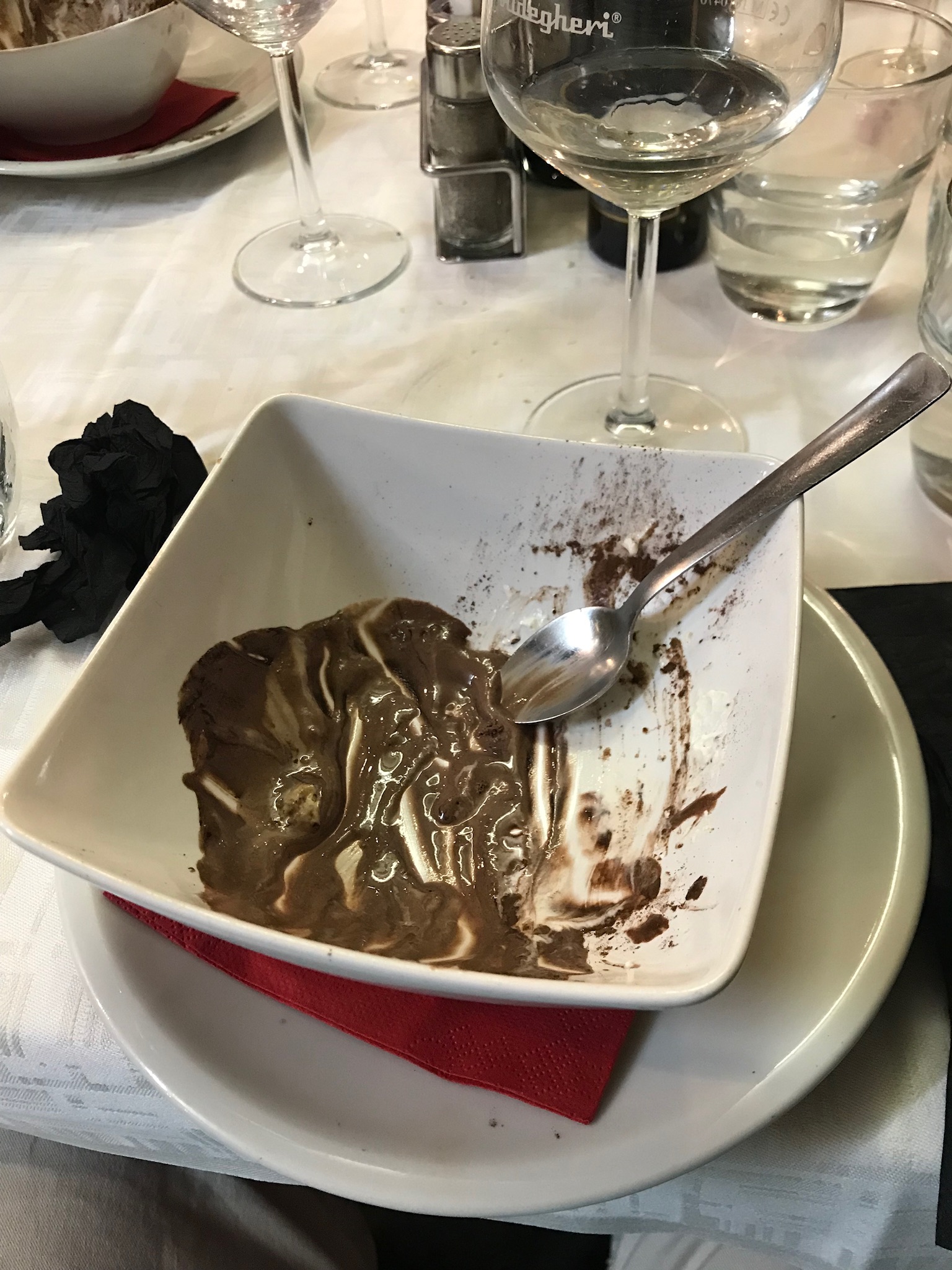
Dinner was at a great little trattoria around the corner on a cross canal, and by far the best dessert I’ve had in a long time: a chocolate ice cream wrapped around a vanilla ice cream that was this good:

And finally we slept.

—————

[1] My theory is supported by the fact that as soon as they built a bridge to the mainland, the population dropped precipitously. Venice now has the same population as Newnan.  Of course, it’s still Venice.

[2] Our tour manager Ignazio told us that they did a study back in the 70s and determined that the optimal number of tourists was about 7 million. Last year, there were 33 million.

Italy — Day 1

Air travel is miserable — that goes without saying these days — and rarely is it more so than on a 9-hour flight to Venice. Even worse, making the trip on what appears to be an antique 767: table trays that are broken; seats that do not recline; and there are no USB ports — what is this, a Conestoga wagon even?

Yes, we’re off again, this time to Italy. “Where in Italy?,” you might ask if you’ve never met my lovely first wife [LFW], because the answer is invariably “All of it, Katie,” and we’re starting in Venice. [1]

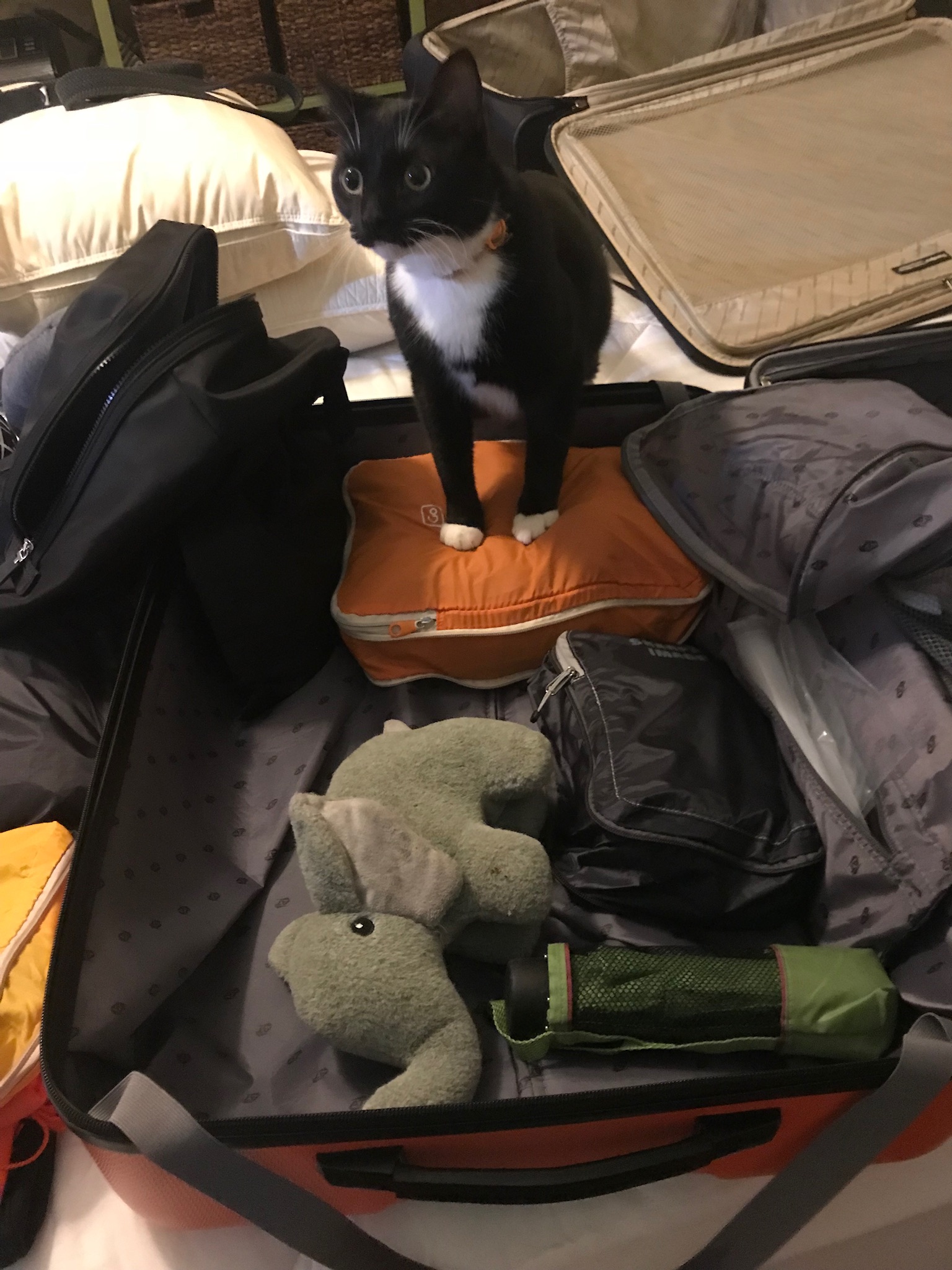
We started packing yesterday.  In what is now the Cutest Photograph on the Internet™, Cecil the Pest helped by packing his elephant:

He is An Goofball.

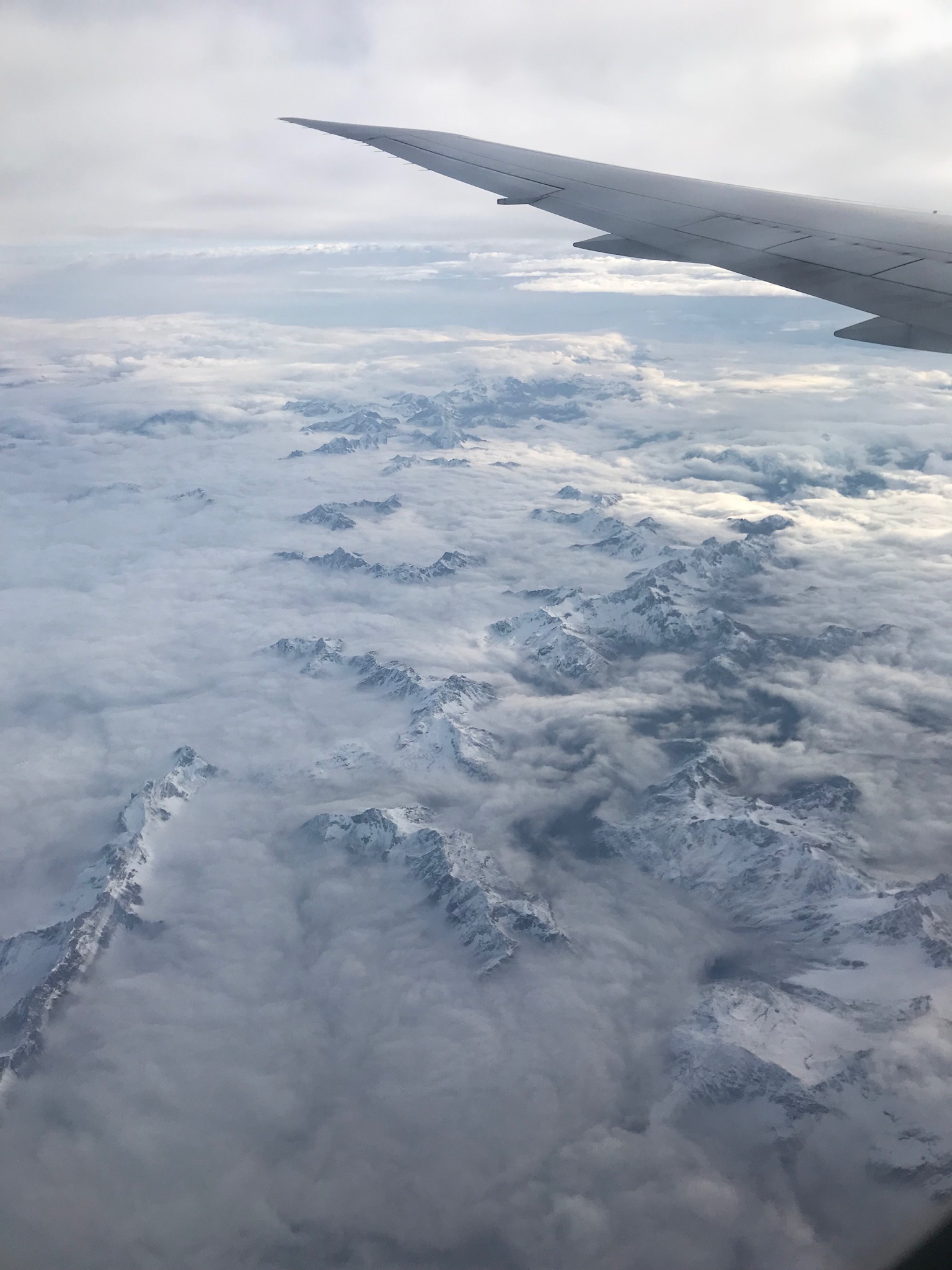
The flight was long, of course, but there were Alps:

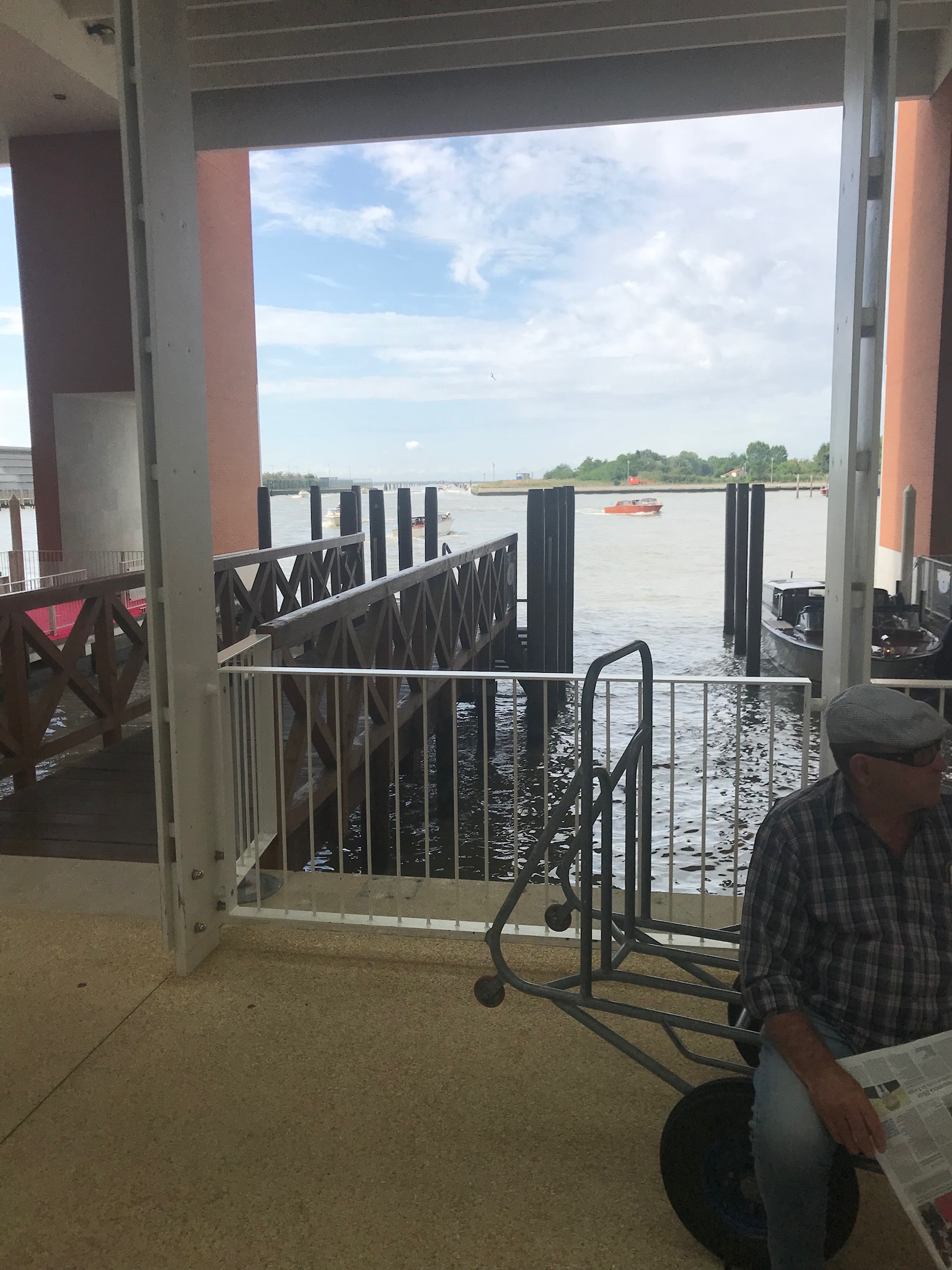
Hartsfield-Atlanta may be efficient and huge, but does it have water taxis?

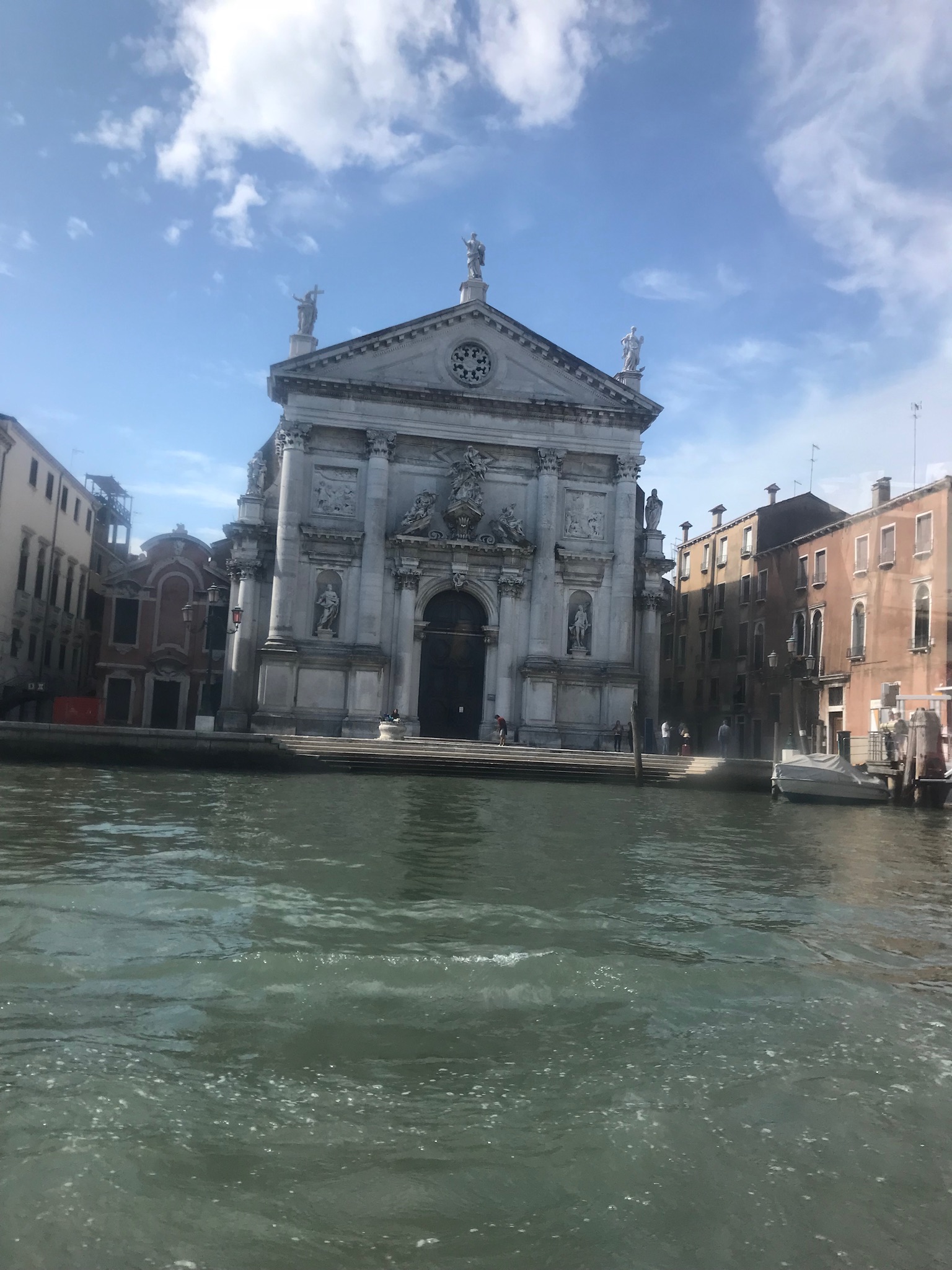
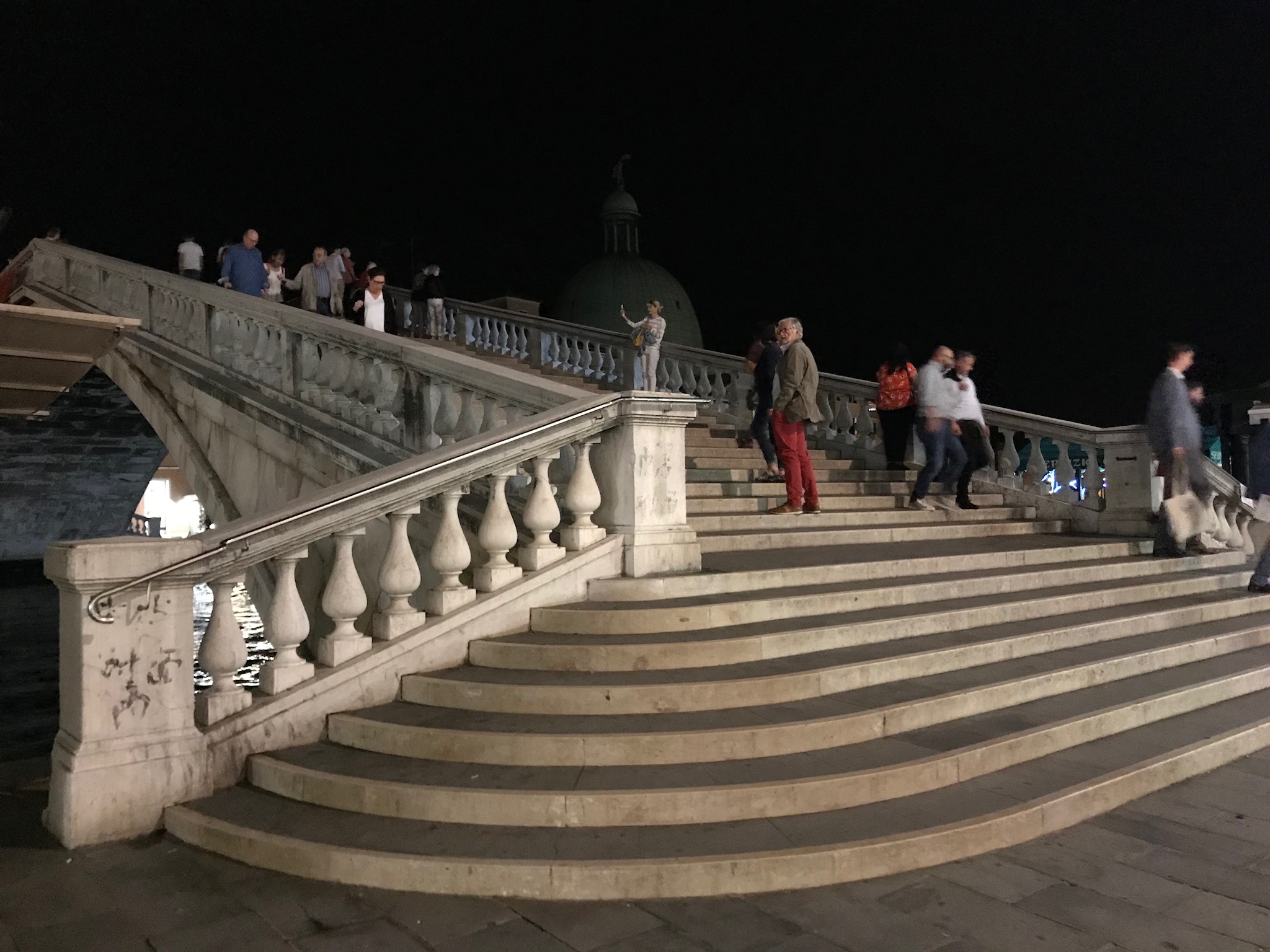
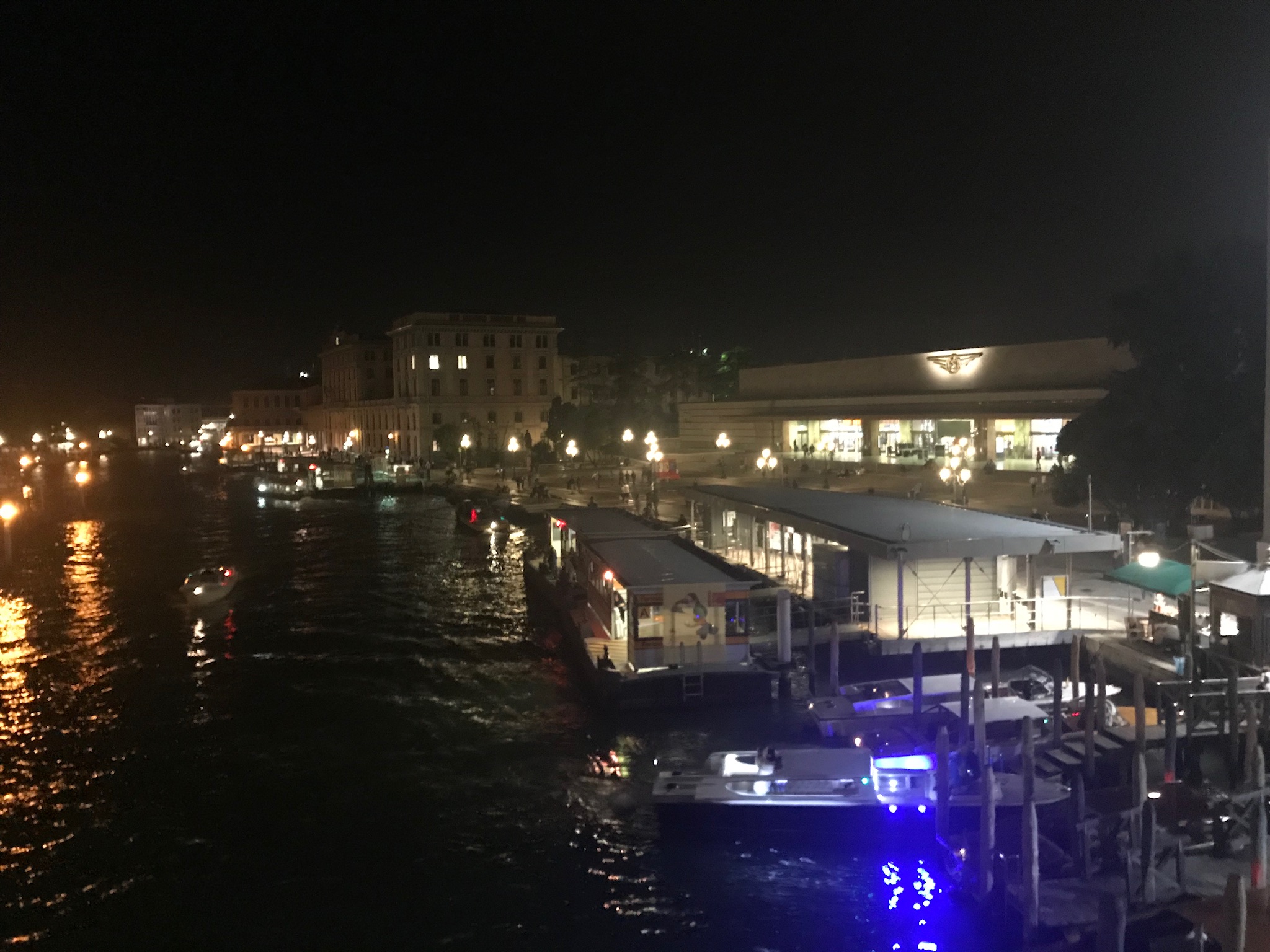
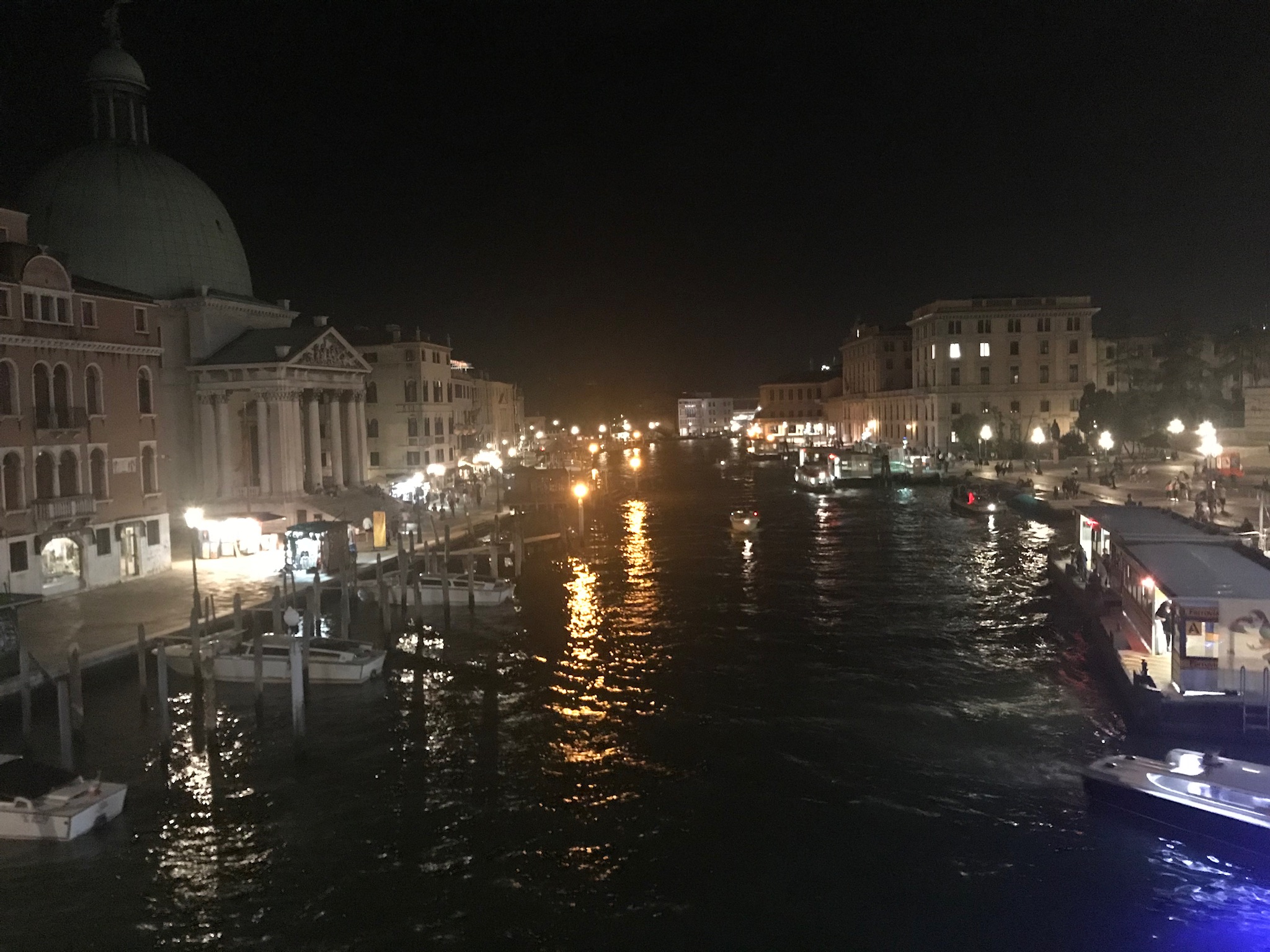
The ride into town, so to speak, was fun, zipping along in the boat, bouncing off waves and wakes. We arrived at the Grand Canal, and yes, it’s grand.

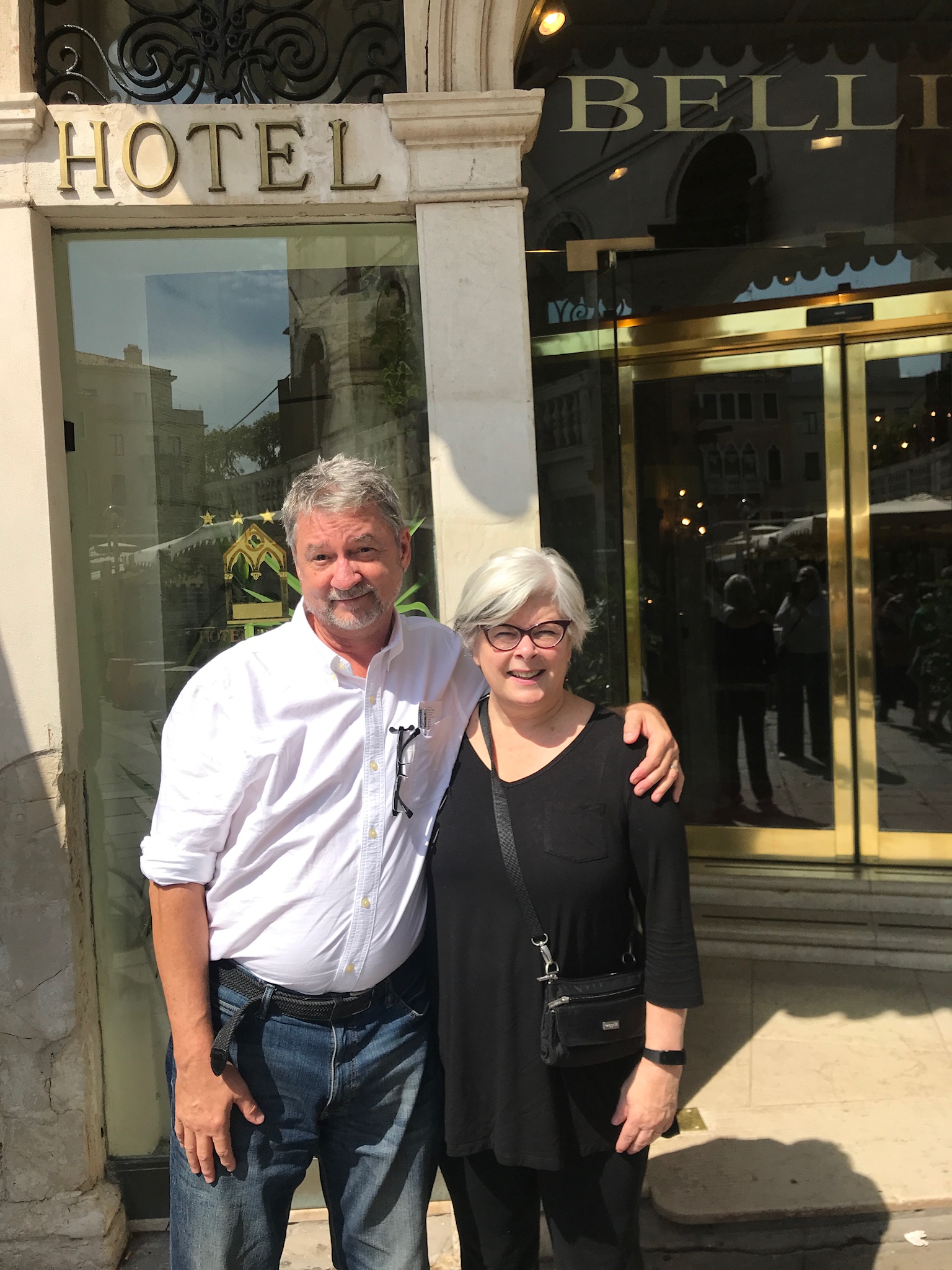
We are traveling with Gate 1, our first time with this group.  (You may recall that last spring we did the Danube with Viking River Cruises.) We have been put up at the Hotel Bellini, on the Grand Canal.

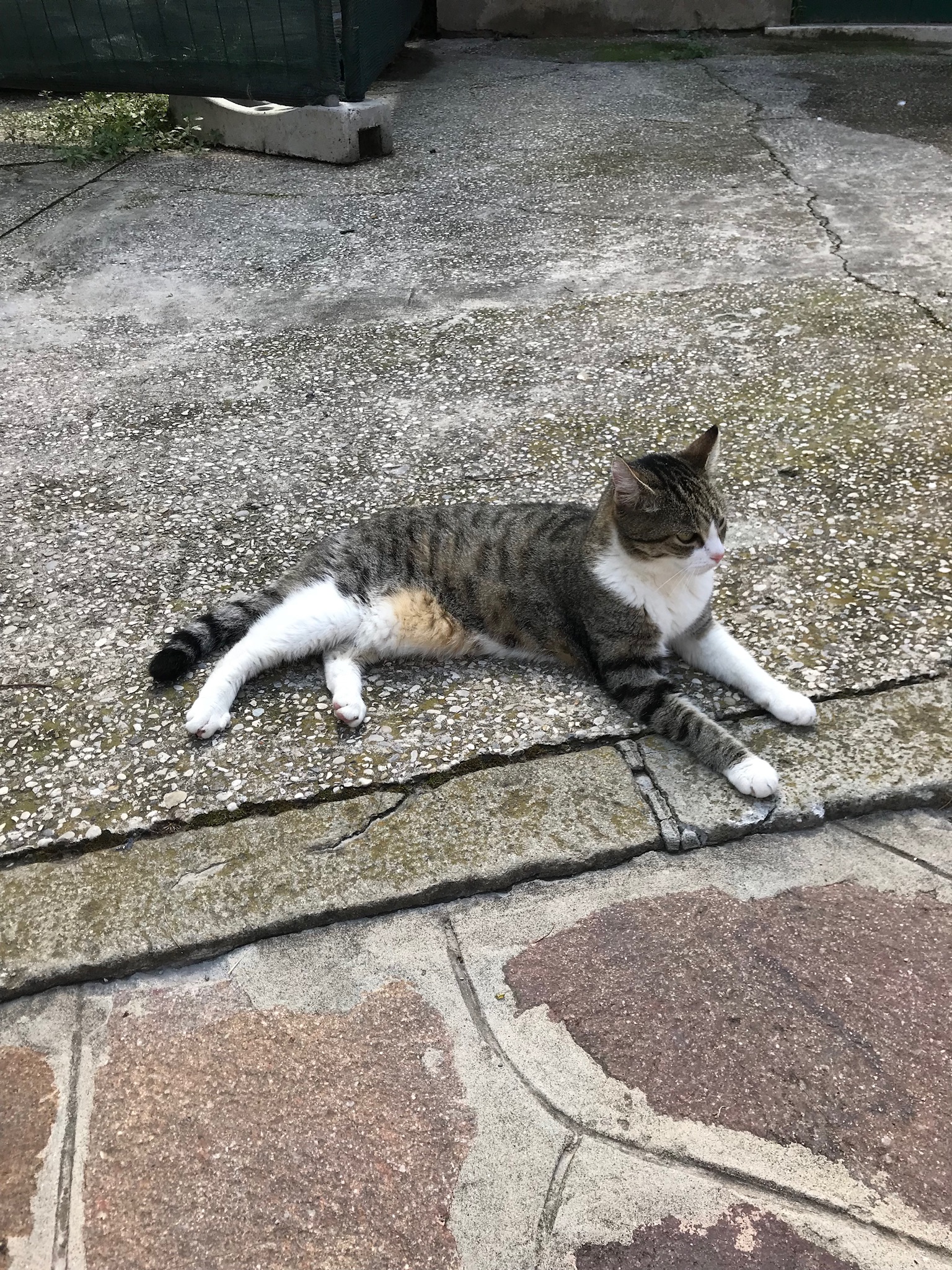
We strolled along our street, had lunch at Trattoria Pedrocchi, and strolled around some more along the Grand Canal and some side streets.  I was greeted warmly by a lovely long-hair black cat, who plopped for a belly scratch. I did not get a photo of him/her, but around the corner was this regal beast:

She deigned to sniff my hand.

We headed back to check into our rooms, whereupon we crashed until the official 6:00 meeting with Ignazio, our tour manager.  A lovely dinner at the hotel restaurant, and one last passeggiata along the canal.

Tomorrow: Murano and its appalling glass, plus San Marco Square and Harry’s Bar maybe!

—————

[1] This is our standard warning that we have four almost fully functioning adults living our house, so to those among my readers who are compulsive burglars—as my LFW seems to think you are—you can give that idea right up as a bad deal all round.

New Cocktail: The Golden Quartz

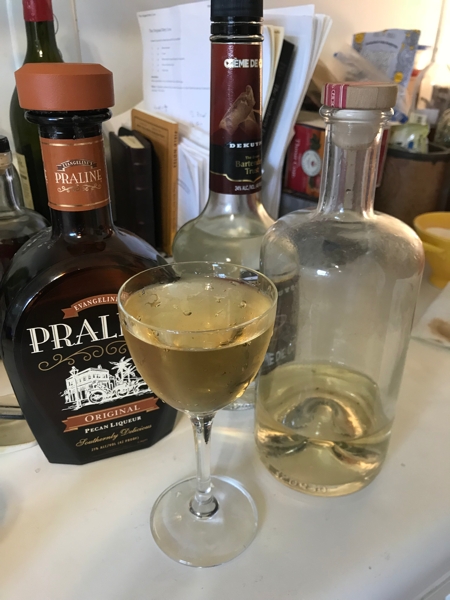
I’m not sure about the name,[1] but it’s better than the scurrilous suggestions I got on Facebook…

The other night I craved a sweet, dessert kind of cocktail, and for some reason this cocktail invented itself.

The Golden Quartz

  • 1.5 oz vanilla vodka, preferably homemade
  • .75 oz pecan liqueur
  • .75 crème de cacao

Stir with ice, strain into a coupe. No garnish, no bitters.

It’s sweet but not cloying, with a nice layering of the vanilla, chocolate, and nuttiness.

Vanilla Vodka

Take one or two vanilla beans and split them down the middle. Plunk them into a bottle of vodka and let sit for 7–10 days, testing after one week. Remove the beans.  You can strain the seeds out through a coffee filter, but you can leave them in as well.

—  —  —  —  —

[1] edited to change the name, in fact, from Amber Quartz to Golden Quartz

Labyrinth update: The Final Corner

The northeast corner of the labyrinth has been neglected for years.  Nominally a quiet sitting area, with a redwood glider nestled among ferns and lily-of-the-valley, it became an overgrown dead-end — lovely to look at, but useless as a meditative station.  Also, the redwood slats were rotten.

So when my brother-in-law Daniel made us a lovely bench for Christmas, I knew it was time to rework that corner. I pulled out the glider and began yanking out the undergrowth, clearing a spot for the new bench.  I cut a 3×5 foot piece of RAM board to give me a guide as to how much flagstone I needed, and to keep some of the undergrowth from growing back.

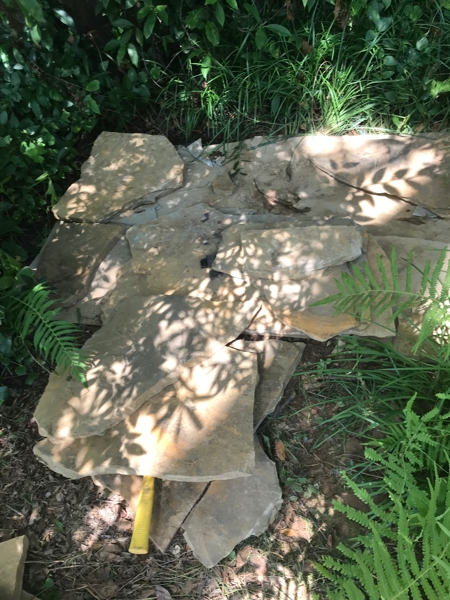
This was over a month ago, and that’s where the trouble started.  For years I have been heading out to Mulch & More on Highway 34 for my flagstone needs, but this time I was told they had a new policy: whereas before they had an open pallet of flagstone standing on its end so you could riffle through like records,[1] now they leave it lying flat and you have to buy what’s on top.

However, what was on top were small pieces of flagstone for which I had no use. I asked about the policy — they changed because they were getting stuck with “a lot of waste.” Hm, I thought to myself, and now you want me to buy your waste?

But I was determined to kill with kindness.  I kept going out there twice a week, smiling and waving and cheerfully leaving when there was nothing I could give them money for because no one else had given them money for the stone I couldn’t use.  Finally, this Monday, there was a piece of flagstone on top I could use.  I bought it, pointedly telling the office staff that it was great I could finally give them money for one piece of flagstone.  The young man who assisted me out in the yard confessed that he thought the policy was self-defeating, but what is one to do?

I posted about it on Facebook, and Craig recommended I try Vining Stone out in Sharpsburg. Yesterday I drove out there, and you will scarcely believe this, but even though they have basically the same policy, they’re not idiots about it. (Their words, actually.) I came home with plenty of stone to finish my project.

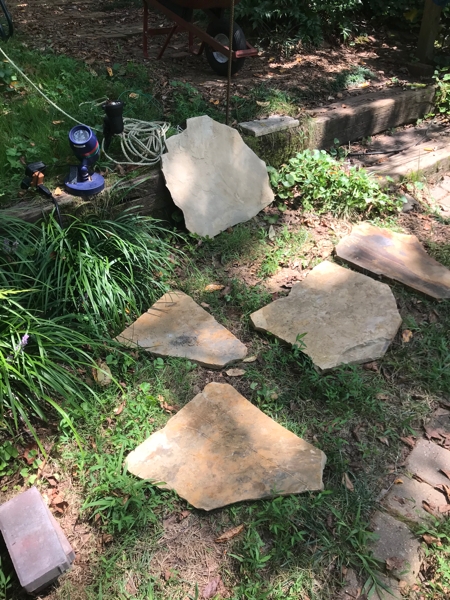
First pass:

I had to take all of that out in order to till the soil and rake it flatter.

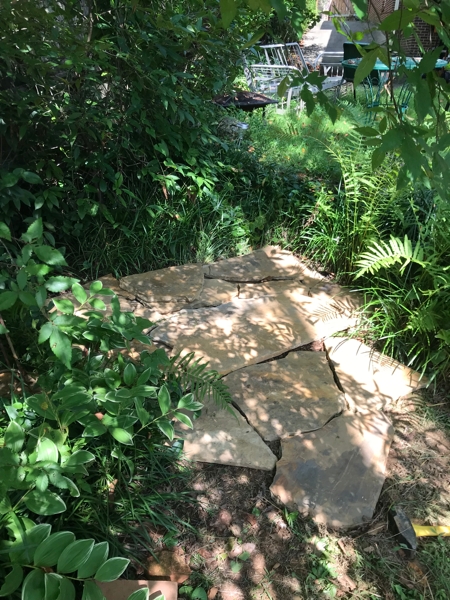
Second pass:

Still in rough shape.

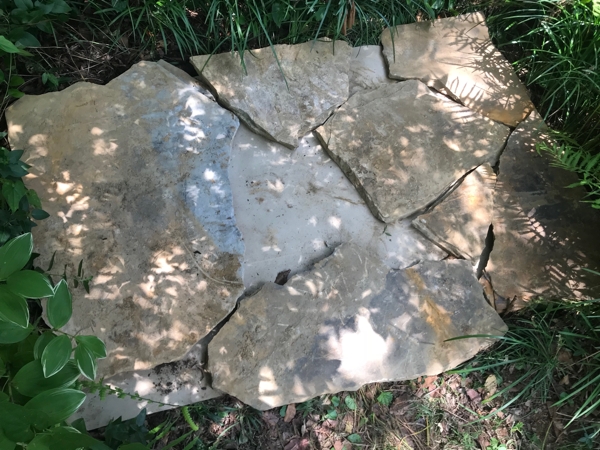
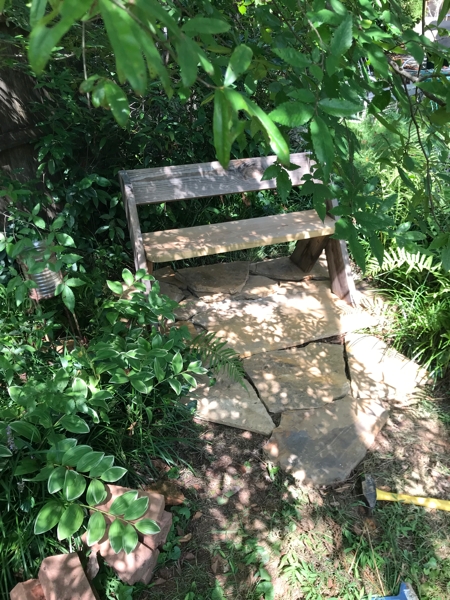
Finally:

For an Abortive Attempt, it will do. I’ll revisit it in the coming week. I can reshape some of the stones for a tighter fit, and I’d like to make the apron circular.

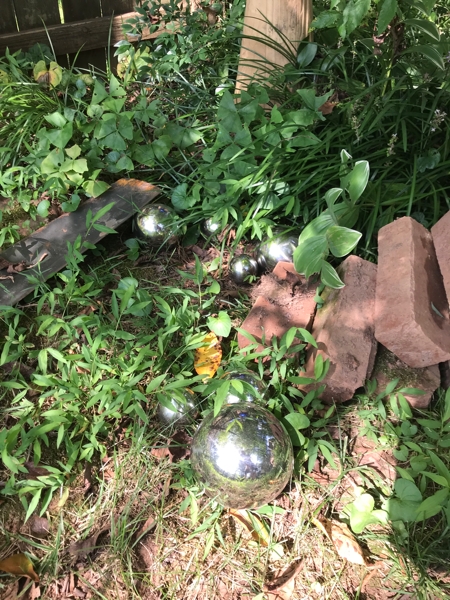
The next Successive Approximation will find a way to include these:

Anybody got a way to drill large holes in flagstone?

—  —  —  —  —

[1] Yes, records. I’m old. Get off my lawn.

New Cocktail: the Hot & Sour

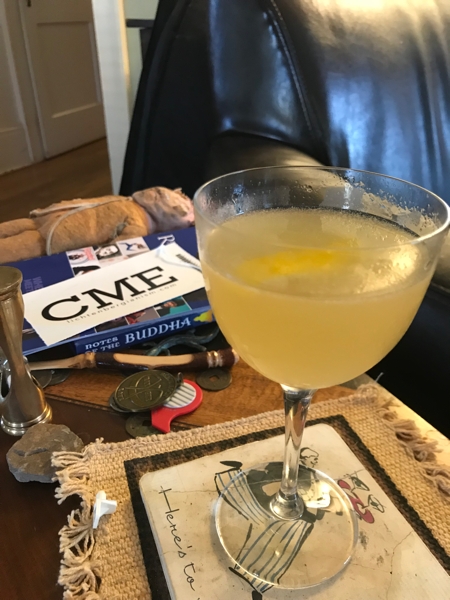
This is a beauty: the Hot & Sour

The Hot & Sour
  • 2 oz gin
  • 1 oz Ancho Reyes Chile Liqueur
  • 1.75 oz Oleo Saccharum sour mix
  • 2 dashes Dr. Adam Elmegirab’s Dandelion & Burdock Bitters

Shake with ice, pour into cocktail glass, garnish with lemon peel.

Very very nice.


Oleo Saccharum Sour Mix

There are multiple versions of this recipe online. This is the one I’ve settled on, but you can do all lemons, or any variety of orange instead of grapefruit.

  • 1 grapefruit
  • 1 large lemon
  • .4–.5 cup sugar
  • .5 cup lemon juice

Peel the grapefruit and the lemon. Place the peels in a medium bowl; add the sugar.  Muddle the peels with the sugar about a minute.

Leave for 4–6 hours.  The oils from the peels will puddle at the bottom of the bowl.

Add the lemon juice and stir to dissolve all the sugar.

Strain into a container. Refrigerate and enjoy!

New Cocktail: The Camino Flores

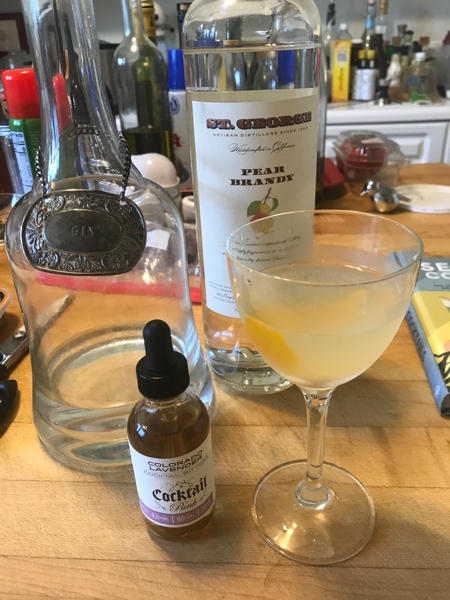
This one sprang from a desire to use my new bitters from Amor Y Amargo bar in NYC, specifically the Colorado Lavender bitters from Cocktailpunk.

Also, I had bought a while back a bottle of St. George Pear Brandy.  I should have known better, but hope springs eternal and St. George is usually not wrong.  The problem with pear brandy is that the flavor overwhelms anything you put it in; nearly ten years ago we were in Key West and during a rainstorm took shelter in an outdoor bar, where a young man who had fled investment banking for the island life struggled with us to make a cromulent cocktail using the stuff.  He failed, and I haven’t succeeded myself.

Until now.

The Camino Flores

  • 1.5 oz gin (Sipsmith preferred)
  • .75 oz lemon juice
  • .5 oz simple syrup
  • .25 oz pear brandy
  • 2 good squirts of lavender bitters

Shake the first four ingredients with ice; strain into a coupe. Dribble the bitters on top. Garnish with a lemon twist.

I go back and forth as to whether it’s cromulent or not, but others have told me it’s interesting enough.  I may try again tonight with maybe 1/3 or 1/4 oz simple syrup.

Anyway, enjoy!

(h/t to Marc for an idea for naming)

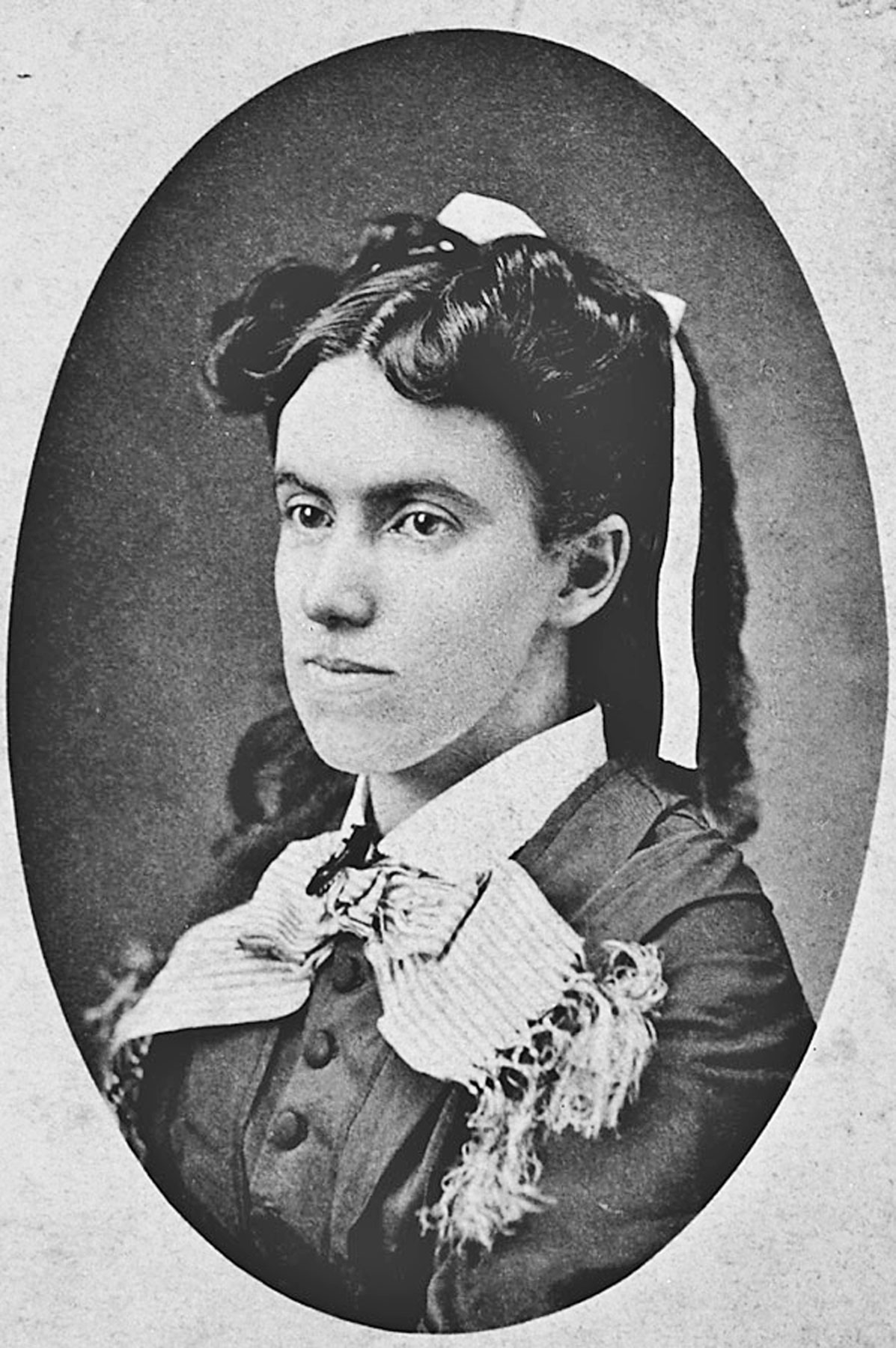
Wait, *that* Lottie Moon?

Lottie Moon-1.jpg

You remember Lottie Moon, don’t you?

She was the closest thing we Baptists had to a saint and/or martyr. She selflessly devoted her life to bringing the Word of God to the heathen Chinee, working her fingers to the bone for those little yellow children, and eventually dying for her efforts.

Every Christmas we had the Lottie Moon Offering, the Southern Baptist GoFundMe for foreign missions.  (We had another saint for home missions.  Can’t remember her name. I think she worked with the little brown babies out west.)

Well.

The other night her name came up for some reason, and I did a little dinner table research on her.

Y’all — Lottie Moon was a kickass trouble-making feminist with a professor boyfriend who himself got kicked out of Southern Seminary for his progressive ideas! She is a Netflix miniseries waiting to happen!

Why were we never taught this??[1]

Read all about it here.

—  —  —  —  —

[1] Actually, I know perfectly well why we were not taught this. It didn’t fit into the Paulian Pauline schematic that women should keep their mouths shut. This is the church that would have elected me — me — as a deacon before they would have my mother.

New York City 2018 — Day 4

Note: this is being written after our return.  Somehow there’s not an hour available for blogging when one is enjoying NYC.

Sunday

I charted our course for the Tenement Museum on the Lower East Side, and the easiest course was to walk over to 6th Avenue and hop on — you guessed it — the F train and head south.

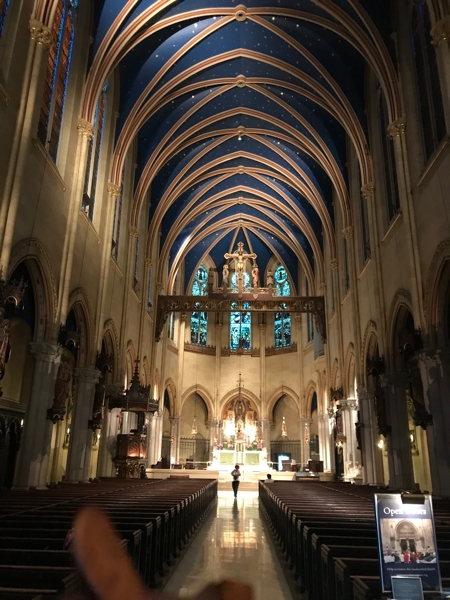
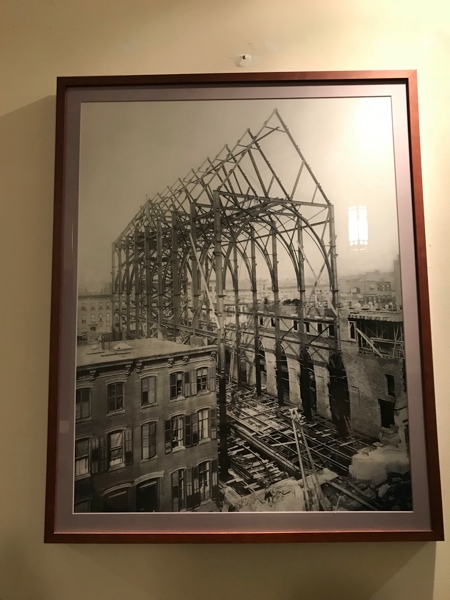
As we strolled past Times Square, there was a cathedral on the sidewalk, you guys!

This is the Church of St. Mary the Virgin, and it’s a perfectly cromulent Catholic church, except it’s Episcopalian.  High Episcopalian.  Like stratospheric Episcopalian: the church’s nickname is Smoky Mary’s because of the use of incense in services.  Plus a confessional and chapels and iconography and it looks like a Catholic church.

We were greeted warmly by a lovely lady who was either Scot or Welsh — I really couldn’t tell — who encouraged us to keep touring even though a “read” service was about to start, and when we demurred, took us into the parish hall to show us a couple of historic photographs of the place.

It was the first cathedral to be built using skyscraper techniques, i.e., steel girder scaffolding, etc.

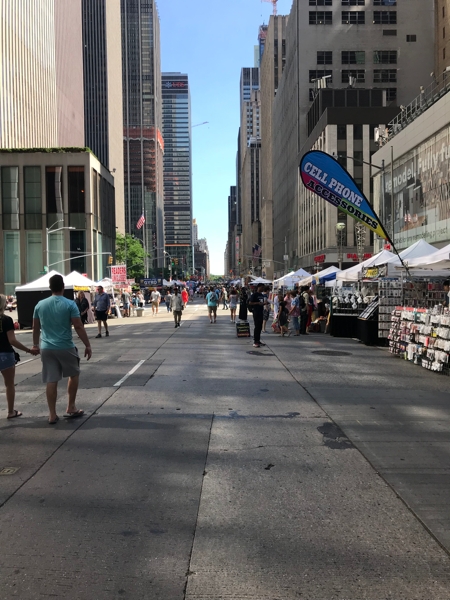
We thanked her profusely and moved on. When we got to 6th Ave, aka Avenue of the Americas, we were delighted to see a street fair.  (I don’t know that traffic was delighted, but hey, the streets were open, just not this one avenue.)

We browsed a bit and decided to head on down to the Tenement Museum as planned, then stop and shop on our return.

We’d been to the Tenement Museum the last time we were in NYC, and we said then we would return.  The museum has taken a tenement building built in 1863 and restored parts of each of the six floors to tell the story of an immigrant family who lived there at some point. Each floor is a separate guided tour, plus there’s a neighborhood tour. The focus of it all is immigration and the immigrant experience.

Last time we did the ground floor tour, a German lager saloon, with a middle-class German-American family.  The Lower East Side in the 1860s was the third-largest German-speaking city in the world at the time, behind Berlin and Vienna. Because of that wave of immigrants, we drink cold lager beer, not lukewarm ale.

This visit, we did the fourth floor Irish family, the Moores, who moved there from the infamous Five Points area (Gangs of New York territory) and found themselves the only English-speakers in the building. Although the privies in the back courtyard were connected to the sewer system, the building did not have running water or gas lighting in 1869.  Bridget had to walk down the stairs to fill her bucket with water multiple times a day; we were handed a bucket with gravel in it to demonstrate the weight she would have had to deal with along with her baby and maybe a toddler or two.

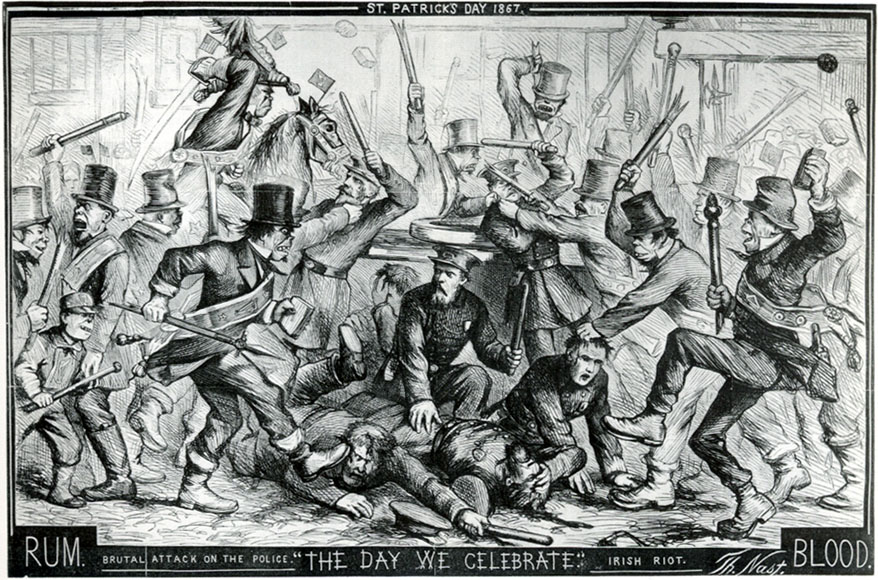
The Moores only lived there for a year before moving closer to the old St. Patrick’s, a more Irish-Catholic neighborhood. We were shown the virulent anti-Irish sentiment of the time — they were vicious savages, not really human.  Every image showed them as ape-like, primitive.  Here’s a cartoon by Thomas Nast, published in Harper’s after an incident at the 1867 St. Patrick’s Day Parade:

Rum. Blood.  Brutal attack.  Irish riot.

You’d never know that there were only a total of 7-10 people involved in the actual incident.

So: immigrants from an alien (read: “Roman Catholic”) culture are depicted as violent, subhuman criminals.  Thank goodness we don’t do that any more oh wait

Back to the street fair, where we both found things to intrigue us enough to purchase them.  I did not buy another singing bowl, however.

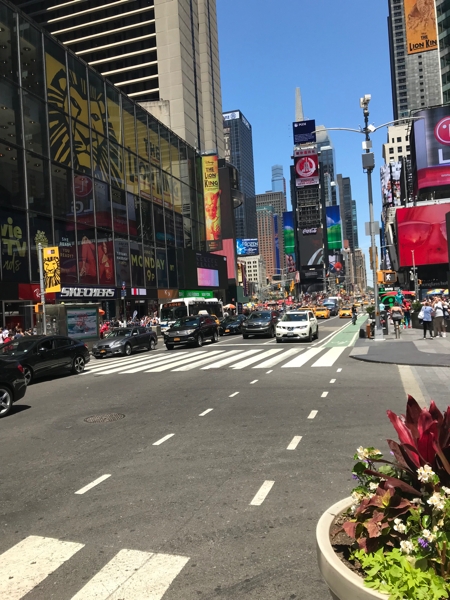
Heading back across Times Square, the heat was oppressive, and suddenly the place looked a lot like New York:

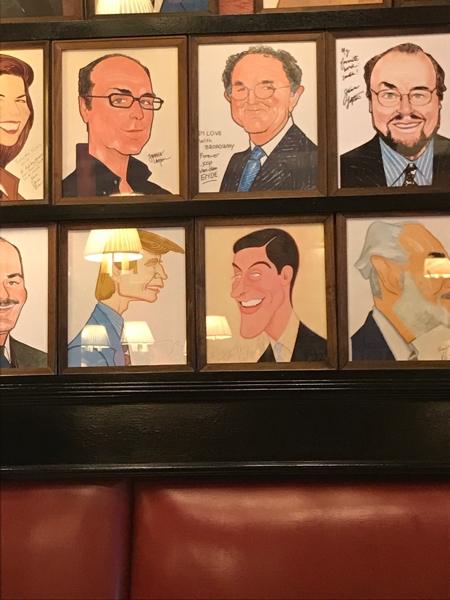
We lunched at Sardi’s — yes, Sardi’s — and it was amazingly civilized.  Quiet, calm, the waiter practically whispered.  We ate with Mike Funt’s buddy Dick van Dyke:

I texted him the photo and he asked if that were Trump next to Dick, but it’s Michael York thank god.

Our matinee was The Band’s Visit, this year’s Tony Award winner for Best Musical. What a gorgeous show — low-key, sweet, heartfelt, human. I have a low tolerance for Bway pizazz, and this show was blessedly free of all of that. There was only one “big” number, and it flowed naturally out of a sweet love ballad from a lonely boy. Suddenly all the characters we’d met during the course of events were there, and we had a gorgeous choral swell… and that was it.  No sequins, no glitz, no big orchestral crashing about, just the Alexandria Policeman’s Ceremonial Orchestra and the very human voices.

I highly recommend this show.  It’s based on the movie of the same name, and the plot is deceptively simple: an Egyptian police band has been invited to Israel to play for the opening of a new Arab cultural center in Petah Tikvah, but due to the bus ticket agent’s Hebrew accent and the band member’s Egyptian accent, they are given tickets to Bet Hatikva — a nowhere place in the Negev Desert. The local cafe owner Dina takes pity on them and lets them stay with her and her brothers overnight.  The next twelve hours or so we learn about each of their lives, and spoiler alert! they’re all human beings.

It’s just a lovely little show.  See it.

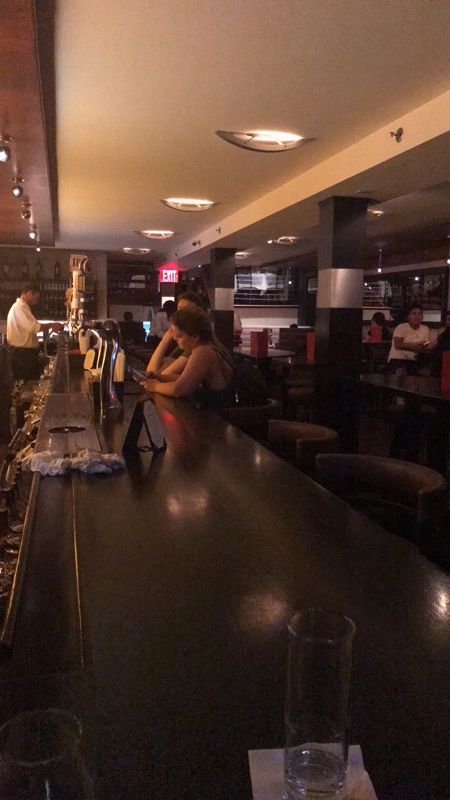
Quick dinner at the Glass House Tavern before heading over to New World Stages for our final show.  We really bonded with our bartender, Valerie, and the young man whose name we never learned.  This is called foreshadowing.

Our last show was Puffs, or Seven Increasingly Eventful Years at a Certain School of Magic and Magic. It was a treat. In it, if you can imagine, three kids at the Magic School meet their first year and go on to suffer the slings and arrows of outrageous fortune caused by one of their classmates and his fight against the dark overlord. We are treated to every detail, every character, every nuance of the Harry Potter books and films from the viewpoint of the hapless Puffs.  It’s adorable.

The parody is terrific, the young actors are skilled and hysterical, and the ending is sadder than you might think. Think of Rosencrantz & Guildenstern Are Dead… at Hogwarts, only with quick changes, and you get the idea.

Finally it was time to head back to Glass House Tavern for a final nightcap and a dessert. We chatted more with our handsome young bartender about his hopes and dreams — having grown up in Manhattan, he wants to finish school somewhere else. When it was time to wrap it all up, I decided we should give our Metro cards to our bartenders.  They were seven-day passes and were good for unlimited trips until Wednesday.

That’s when I found out that my back pocket was empty.

My wallet and my Waste Book were not where they were supposed to be, and there were two possibilities.  1.) They had slipped out at Puffs. (The Waste Book had slipped out at Travesties.) 2.) I had been pickpocketed.

We headed back to New World Stages. It was about 10:30, and of course the place was dark.  “Let’s go around and pound on all the doors,” said my Lovely First Wife, but I pooh-poohed the notion.  This was Sunday night; Broadway is dark on Monday.  Everyone would have headed home to begin their days off.

We went back to the room, where I called my credit card people and suspended my cards.  The next morning, we noticed a message.  It was the theatre; they had my things, and we could pick them up at the stage door until 11:30.  The night before.  Ugh. I  hate it when she’s right.  But she was right.

Thank goodness I use my passport to get through airport security, or I would still be in Manhattan.  On the plus side, I would have retrieved my wallet and Waste Book at this point.  I’ve emailed the theatre asking them to use the cash in the wallet to overnight everything back to me and to keep the rest as a donation, but I haven’t heard from them yet.  I’ll keep you posted.

Monday

We flew home and arrived safe and sound, albeit without a driver’s license or credit cards.  The end.

New York City 2018 — Day 3

Note: this is being written after our return.  Somehow there’s not an hour available for blogging when one is enjoying NYC.

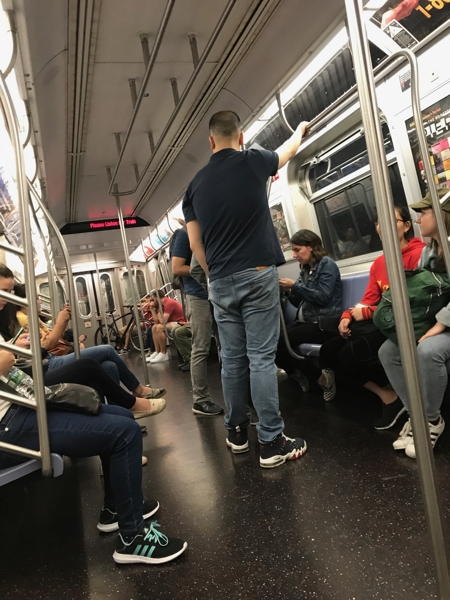
One last adventure from Friday night: we were returning from Symphonie Fantastique and, as is my practice whenever I’m in the Village at night, I could not locate the nearest subway stop. So we did what we always do, and that is head east until we hit Broadway. This time, we were on Houston St, and I know that’s a stop on multiple lines, so off we went. (In double-checking the map, it seems there was a station just north of HERE, the performance venue, which would have led straight to the hotel.  Oops.) We eventually found the Houston/LaFayette station and down we went.

The plan was that we hop on any “orange” train that came through (i.e., B, D, F, or M), hop off at 34th/Herald Sq (three stops), transfer to an N, R, or W train, get off at 49th, and we were home.

What some of us heard was “get on a B or D train,” so when an F train pulled in, I hopped on and turned to see the rest of the party looking idly about her as the train doors closed.

As we pulled out, I looked a the couple sitting there and said, “Well, 40 years was a good run, I guess.”  We laughed all the way to 23rd, which was their stop.

My phone had like 3% battery, so I used that to text the LFW that I would wait for her at Herald Square.  I also took a photo and got off an Instagram/Facebook post so everyone could share in the adventure.  Responses were hilarious.

I didn’t have long to wait until a D train pulled in — without anyone I knew on it. Ah, I thought, now she thinks only an F train will do, so I settled in for the wait.

Fortunately, the next train was an F, and there was my beloved Lovely First Wife. The rest of the train ride was uneventful.

Saturday

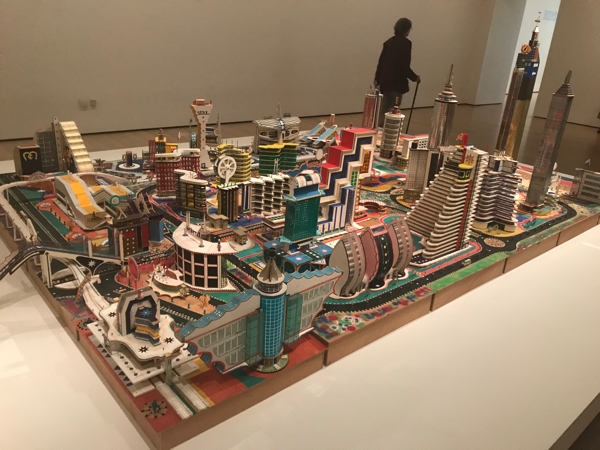
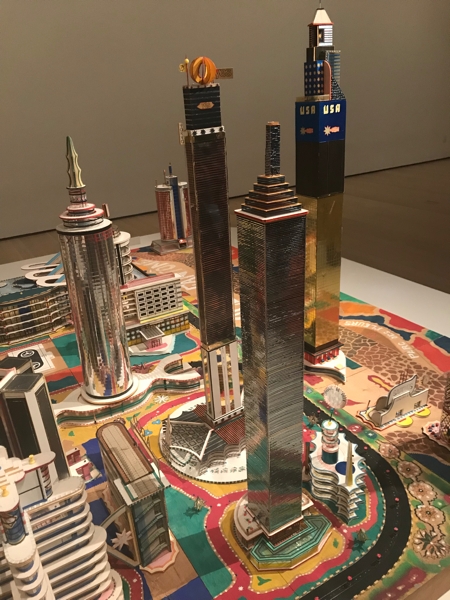
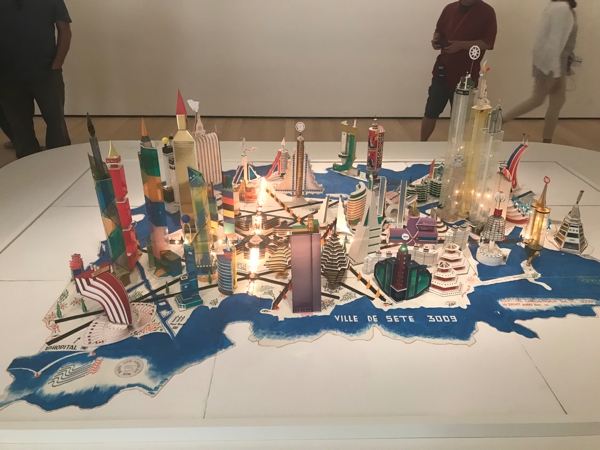
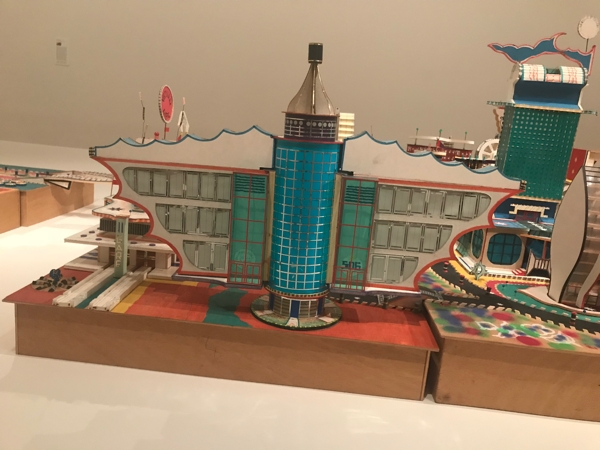
Our first stop was the Museum of Modern Art, aka MOMA. We saw two exhibits there. The first was Bodys Isek Kingelez: City Dreams. Kingelez worked in the Democratic Republic of Congo (then-Zaire), making what he called “extreme maquettes” of fabulous/fantasy buildings, images of hopes he had for his burgeoning country’s future. Gaudy and impractical, they provoke in an American viewer sensations of Vegas and Miami and Coney Island.

Everything is brightly colored.  Everything is clean. Everything is exuberant.

I posted this city to the Alchemy Facebook group with the caption that this was my new plan for the burn; the hippies needed to step up their game.

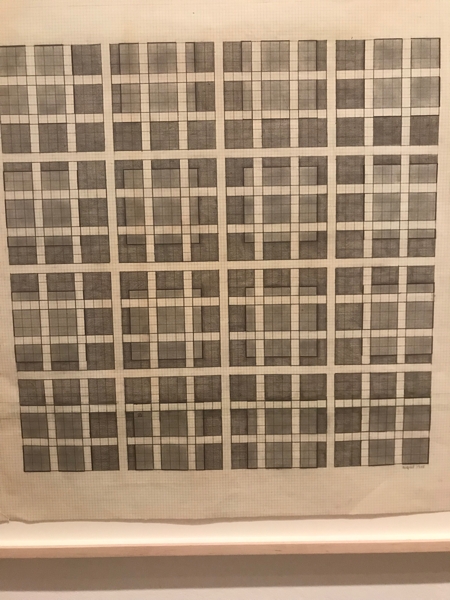
The other exhibit that we saw was Adrian Piper: A Synthesis of Intuitions, 1965–2016. This one was odd. At first fascinating, it soon became just weird and impenetrable: her obsession with numbers and ratios and patterns and scientific randomization was just opaque. You looked at all the handwritten notebooks — pages and pages and pages of “data” — and you might as well have been looking at the Koran. Her work really gave off a “somewhere on the spectrum” vibe, but that of course is my personal response.

The actual pieces were nice, though:

No we didn’t stroll the rest of the museum: we’ve been before and had a show to catch.  Plus, gift shop/bookstore time!

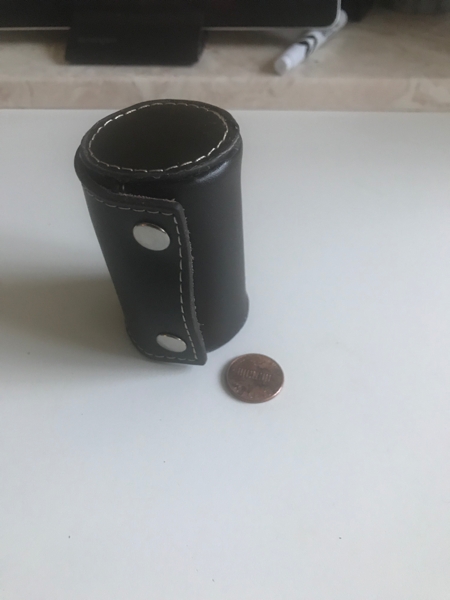
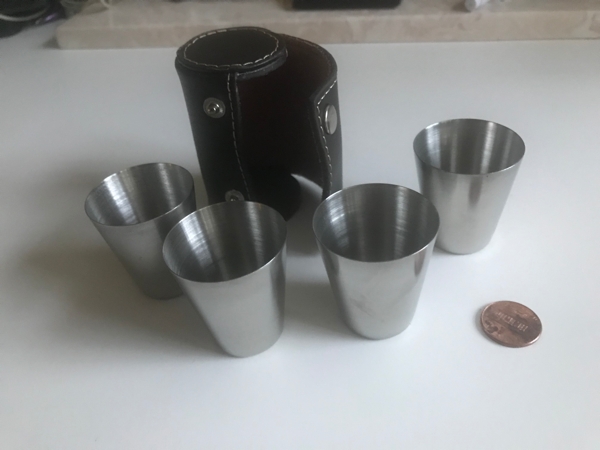
Look at this:

Penny shown for scale

A little leather case, and inside:

Four little stainless steel shot glasses! For $10, it’s a worthy addition to one’s burn equipment, I thought.

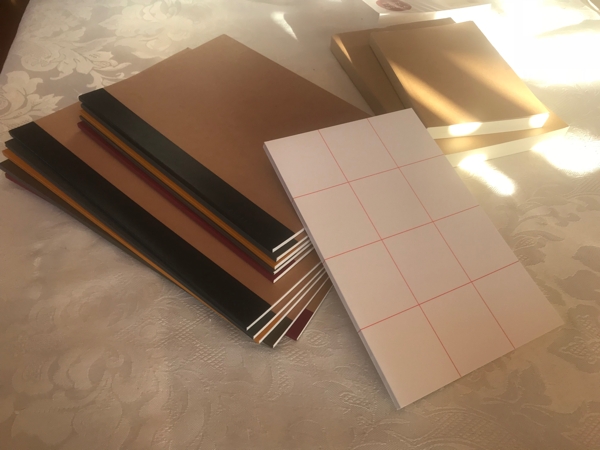
And then the notebooks, ohhh, the notebooks:

The white one with red squares — every page is like that.  I have a challenge for myself on that one.  The two in the rear are the smoothest paper I’ve ever felt; the sets in the front are lined journals. These last ones are Japanese, of course.

Normally I resist adding new Waste Books — I definitely do not need them — but these were beautiful and affordable: I think I spent $15 on the Japanese all told, and for my personal challenge, $8 was not too much for the grid journal.

Lunch, and then…

Travesties, by Tom Stoppard, is not an easy play. If I were asked to select a play from Stoppard’s oeuvre to direct for Broadway in this day and age, I think I would have gone with Jumpers, given its themes of shifting morality and brutal utilitarianism.  But for some reason Roundabout chose Travesties and snagged Tom Hollander to play Carr, the central character and completely unreliable narrator of his memories of Switzerland during WWI.

As I said, Travesties is not an easy play.  The language is thick, the ideas are thicker. Time shifts, time repeats, time resets. Stoppard flings limericks, Oscar Wilde, Karl Marx, Dada, music hall and more at us, fast and furious. This might explain the directorial decision to have the cast machine-gun their lines rather than take their time to make them accessible and — I don’t know — funny. Plus, it was so cold in the theatre that I was forced during intermission to go next door and by a Brooklyn hoodie. So that happened.

A short break, with dinner, and I don’t even remember where.

The evening show was Once on This Island, by Flaherty & Ahrens (Ragtime, Lucky Stiff, et al.) and it was magnificent. Circle in the Square’s stage has been transformed into a post-hurricane disaster area: sand, water, rain, wind, a downed telephone pole. The cast begins by picking up all the trash that’s been blown onto the beach; their pre-show cellphone speech was epic. The producers felt, quite rightly, that after the recent devastation in the Caribbean it would be tasteless to stage the show as prettily as the original production, and so the villagers are dressed in ragged, mismatched shorts and shirts — you know, like poor people; there’s a nurse (Lea Salonga) and a doctor from Doctors Without Borders. It leads directly into the islanders’ relationship with their voudou gods, which becomes much more of a thing in this production.

The plot is essentially Little Mermaid — the original, not the happy ending Disney version — and the beautiful cast delivered a powerful gut-punch of a show. As the islanders begin to tell the story of Ti Moune, four of them transform into the four gods of love, earth, water, and death who hover over the story like Homeric deities, only with a lot less spite. At first donning whatever is to hand to effect the transformation — a tablecloth, mosquito netting, boat paint — they return to the stage in full regalia and move the story along. There is some powerful powerful stuff going on in this production.

This show is a must see. Try to get seats in the far end of row D.

Cocktails somewhere, and then to bed.  No subways involved.