Lichtenbergianism: an update

When last we checked in on my progress, I hadn’t actually posted about my progress in writing Lichtenbergianism: procrastination as a creative strategy.

So here’s your first real progress report.

If we posit a length of about 30,000 words—not a very long book—then I’m more than halfway there, having scribbled about 19,000 words.

The structure of the book is as follows:

  1. Introduction to Lichtenbergianism
  2. Framework
  3. Precept 1: Task Avoidance
  4. Precept 2: Abortive Attempts
  5. Precept 3: Successive Approximation
  6. Precept 4: Waste Books
  7. Precept 5: Ritual
  8. Precept 6: Steal from the Best
  9. Precept 7: Gestalt
  10. Precept 8: Audience
  11. Precept 9: Abandonment
  12. The 10th Precept
  13. Conclusion
  14. Appendices
    1. The Lyles Scale of Compositional Agony
    2. The Arts Speech
    3. The Invocation
    4. SUN TRUE FIRE

Also, I have begun and have almost finished an actual book proposal to start submitting to publishers, although first I’m going to run it by a friend who’s an editor with one of them fancy New York publishing houses to prevent self-embarrassmentation.

Having said that, though, I have to say that when I started looking at what I’ve written so far in terms of submitting sample chapters, a lot of it is still misshapen and raw.  Like the chapter on STEAL FROM THE BEST, what is that even about, Kenneth?  I’m thinking that I’ve passed that first gush of creativity and am now starting to hack my way into the real part of writing, i.e., psychic pain.  Physical pain.  Will the Lyles Scale of Compositional Agony apply to writing?  Stay tuned.

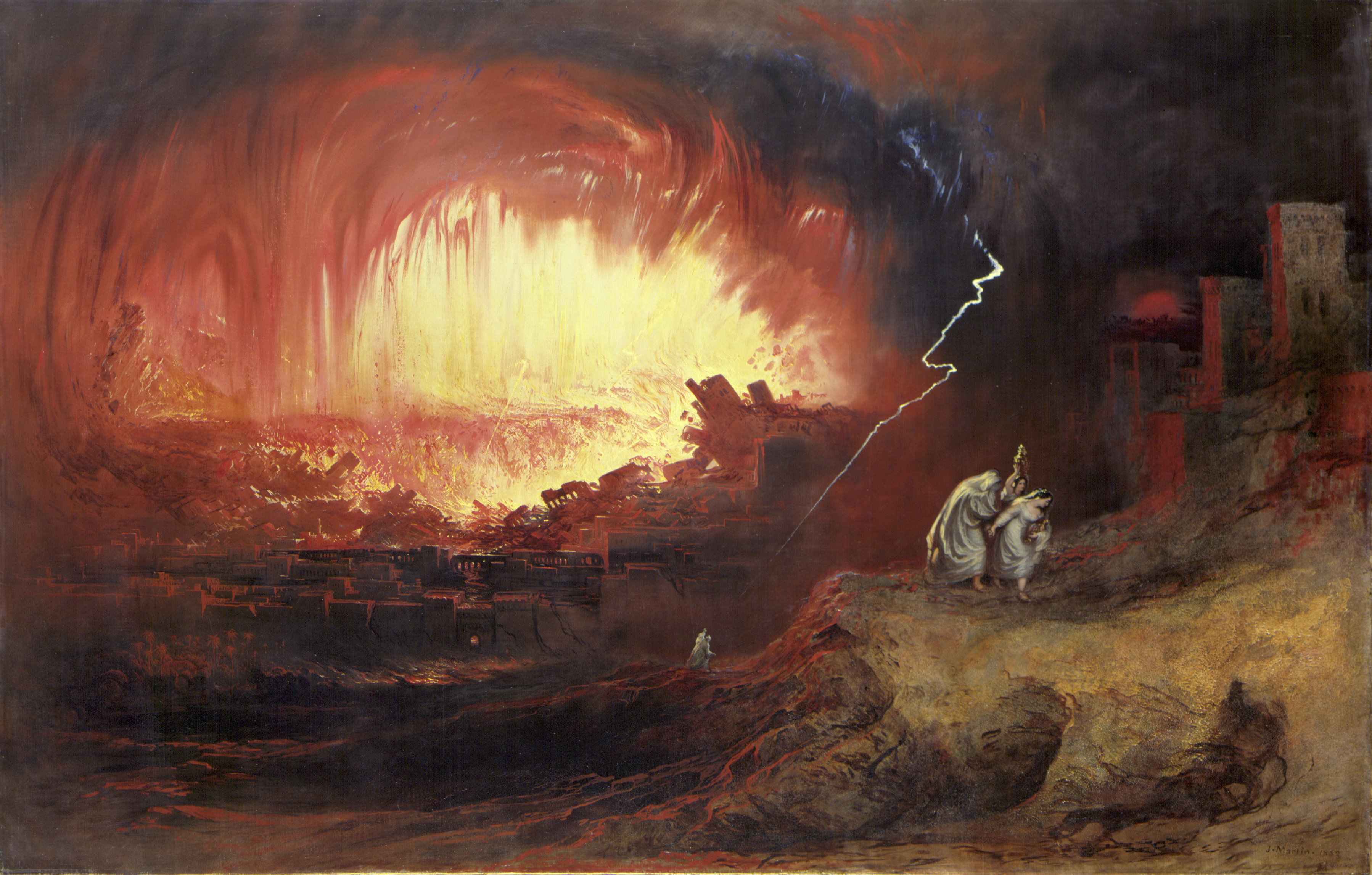
Right off a cliff (that’s a pun)

I promise I will once again blog about my creative efforts and cocktails and the labyrinth soon, but there’s just so much crazy out there clamoring for our attention.

Today’s crazy is a quote from a Baptist preacher in Nashville:

“We have to do something quickly, because there’s a cliff ahead of us, a civilization, and it’s within sight,” said Lydon Allen, a pastor at the Woodmont Bible Church in Nashville.
(Read more at http://wonkette.com/598063/god-turns-his-back-on-gay-hatin-tennessee-lawmakers#XHSlVK4E41COLxer.99)

This pitiful bleat is in reference to the Tennessee legislature’s failure to pass a bill nullifying the Supreme Court decision on marriage equality.  (I know, right?)

—click to embiggen—

It’s not actually coherent, but we’re going to give the poor man the benefit of the doubt because his meaning is plain: we have limited time to repent of our Somdomite[1] ways before we… Well, the country will… Um…

Okay, his meaning isn’t clear either.

Here’s what I don’t get about these apocalyptic warnings: they don’t actually mean anything.  None of it rises above Revelation-of-John style “beasts with nine heads” or “scarlet woman” ravings.  Sure, it’s scary, but what precisely are they telling us is going to happen if we don’t straighten up (!) and fly right (!!)?

There’s a cliff ahead of us?  Right ahead of us?  What does that mean in practical terms?  If we were talking about investing in new infrastructure projects, we could argue back and forth with numbers and data and historical precedent and facts so we could arrive at a decision on whether or not we need to keep the bridges from falling down.  But a “cliff”?  How are we supposed to make rational decisions about that?

The answer is, of course, that we’re not, at least not for these poor people who keep making these prophecies.  It’s all lizard-brain fear, all of it, and that’s enough for them and their followers.

But just once, I’d like someone to ask Rev. Allen, “What do you mean?  What, exactly, is going to happen if we don’t go back to stomping on gay people?  Names, Travis, I need names.”

I want a list of specific events, with a timeline, and then check in—very, very publicly—on the timeline to see if any of the terrible things have come to pass.  None of them will have come to pass, of course, not that it will matter to the End Times crowd, but I want these people marginalized and ridiculed back into their caves where we don’t have to pretend they mean anything to our society.

Thank you for listening.

—————

[1] [sic][2]

[2] cf.

I have some issues with you people

Some old friends are apparently avid supporters of Ben Carson’s candidacy for the presidency. They are devout, conservative Christians, perfectly nice people, but who clearly have a blind spot where this man is concerned. As far as I can tell, they want us to vote for him because he’s a virtuous man who can “bring this country back to God.”

I have some questions for them.

What does that mean, “bring this country back to God”? What kinds of policies do you expect him to enact in order to do that? How would those policies square with the pluralistic country we live in? Or would that become United States policy, to privilege Christianity over other faiths (or non-faith)?

Is the God you hope he will bring the country back to the God he worships as a Pentecostal? Or is there some other mutually agreed upon version you’re hoping for? Do you understand that there are different versions of even the Christian God in this country? Do you understand that there are versions of God that lie outside what you consider the “Judeo-Christian tradiiton”?[1]

Do you think that if we elect a devout Christian to the office that the nation’s problems will resolve themselves? Do you think that a Congress would naturally fall in line with this person’s policies?  Or will God simply intervene in our affairs?

What do you think Ben Carson’s policies actually are? How much do you understand about his take on the issues.[2] Is it possible that his understanding of some of these could be simplistic and based on erroneous information, or worse, magical thinking? Are the issues he lists enough to run a country, or are there other problems facing this nation which he does not address? How important are those problems?

Do you think that “bringing the country back to God” is the President’s job? Do you think that if we elect a devout man to the office that God’s protection will return to the United States? What do you mean by the phrase “God’s protection”? Is this different from sports figures thanking God for their victory?[3]

What, exactly, is it that you hope that will change about our country through divine intervention? Have you considered that your vision of a virtuous life and a virtuous nation might not be universal, i.e., that others have different ideas about what is virtuous and godly? Have you considered that these changes might be unwelcome in other people’s lives? How will that work absent change in legislation and policy?

Have you been praying for this country to achieve the results you hope Ben Carson will effect if elected? Has your church? How long have you been doing so?[4] If so, then why do you think those results haven’t already occurred? What do you think God has been telling you all this time in response to your prayers?

——————
[1] Do you understand that when you say “Judeo-Christian,” everything you associate with that term indicates that you actually mean “Christian”?

[2] Have you compared his issues page to other candidates? Trump’s? Sanders’? Clinton’s?  Does his list of issues seem more or less comprehensive to you than the others?

[3] Have you read Mark Twain’s War Prayer?

[4] Has it been since Jan 20, 2009? Why is that, do you think?

In which the Tea Party outdoes its own self

No one has ever accused the Tea Party of being intellectual giants. In fact, most of them would deny the accusation themselves.

But David Brat, the rabid weasel who ran against and defeated rabid weasel Eric Cantor because—incredibly—Cantor was not rabid-weaselly enough for Virginia voters, has set a new standard. After President Obama’s State of the Union address, Brat took to the airwaves to object:

“He’s using the Christian tradition and trying to bring about compassion by bonking Republicans over the head with the Bible,” Brat said. “It’s almost a comedy routine on what compassion and love is. He’s mocking his enemies in order to compel a larger federal state using the tradition of love.”

“Our side, the conservative side, needs to reeducate its people that we own the entire tradition,” Brat said. “If you lose the moral argument, you lose the policy argument every time, so we need to reclaim the moral argument, where we’re so strong.”

(full story here)

To which the world replied:

I mean… It’s just that…

I can’t even.

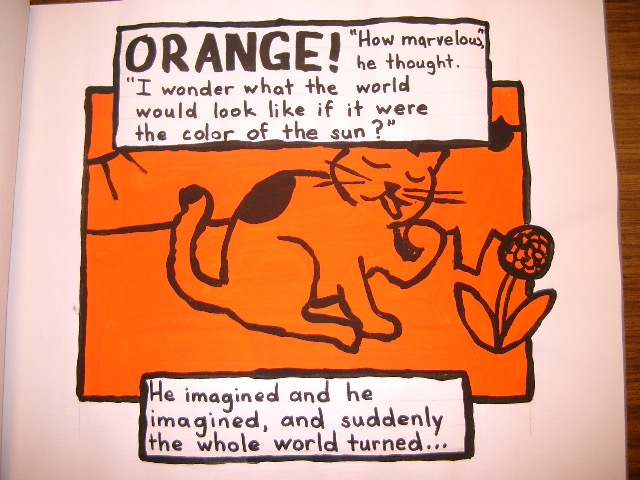
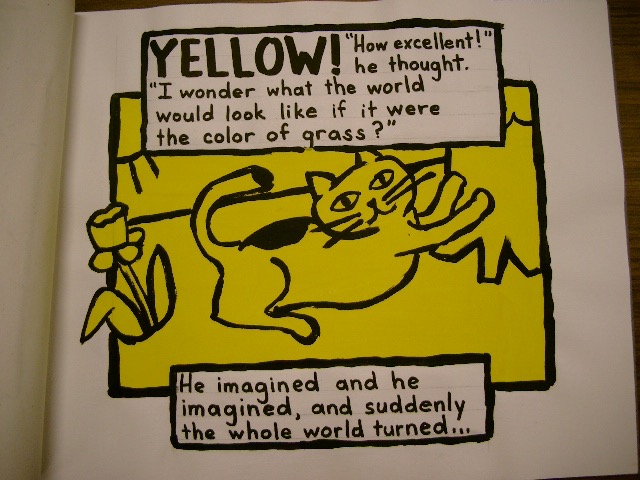
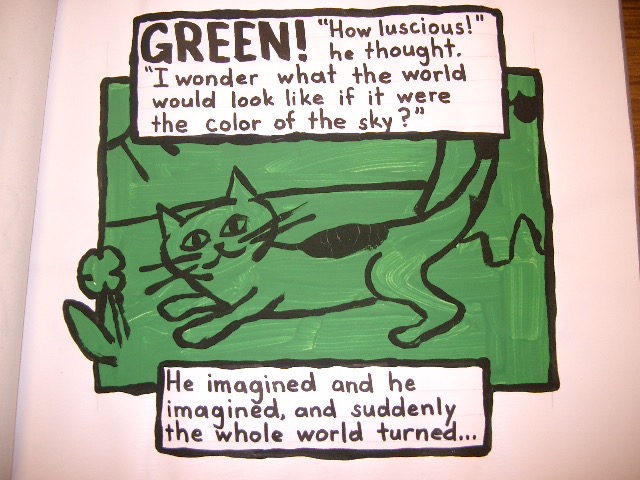
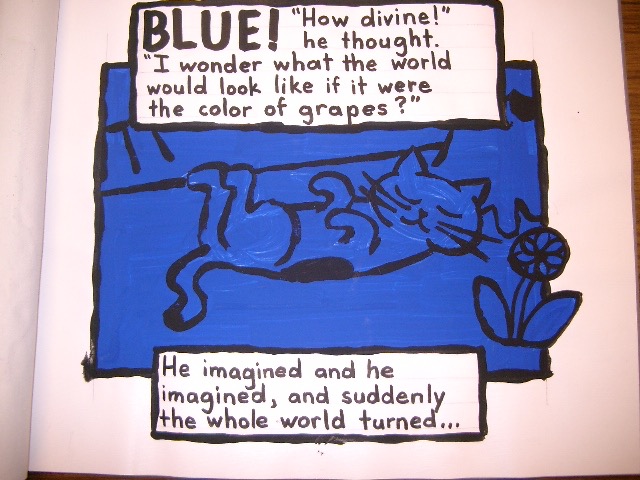
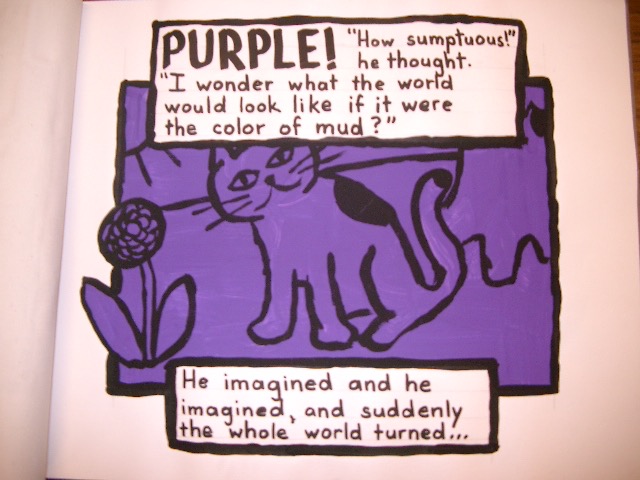
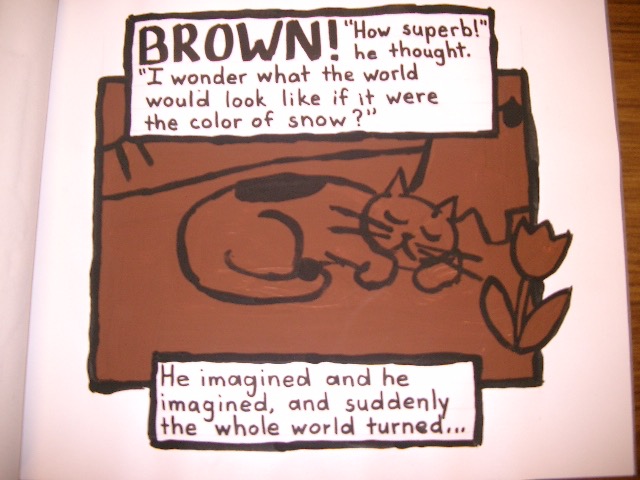
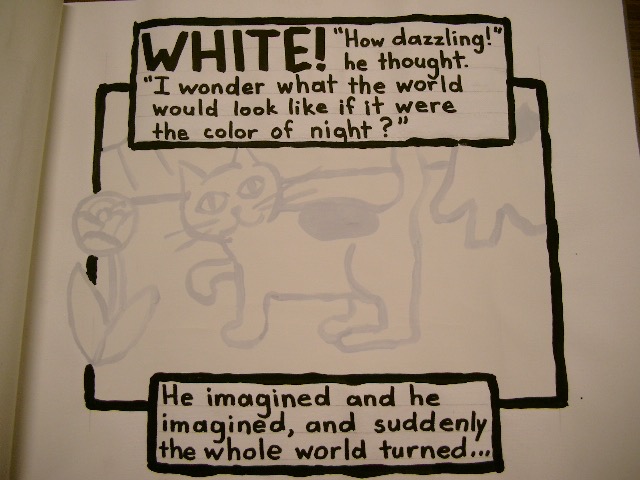
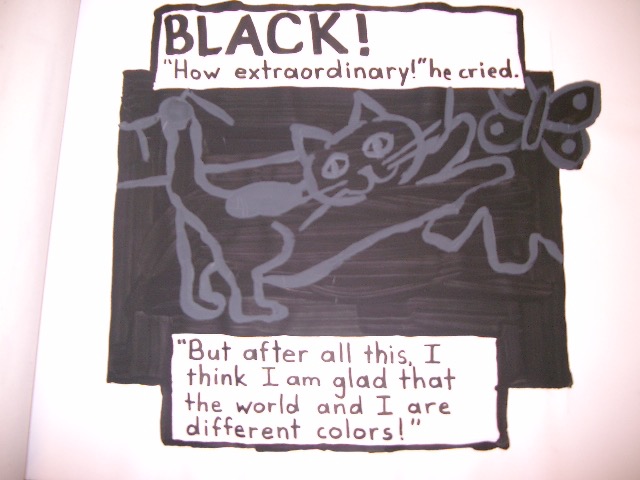
Sam Cat’s Colors

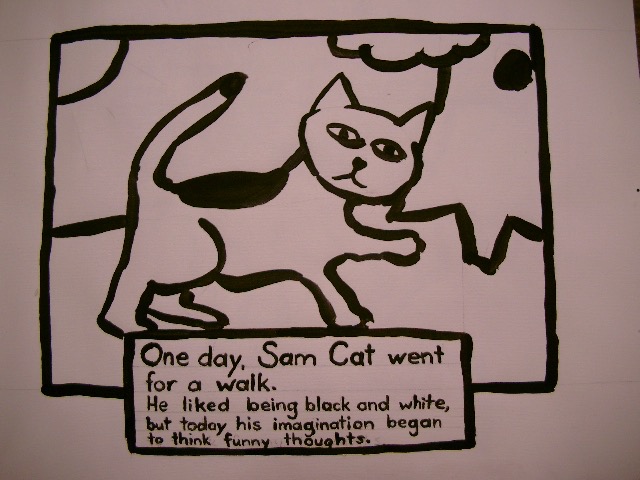
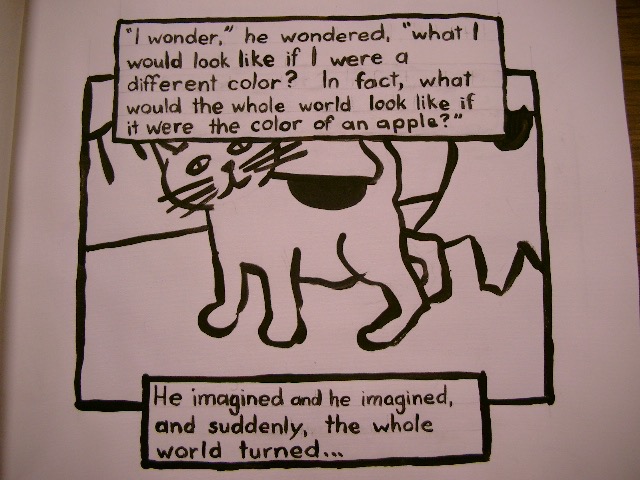
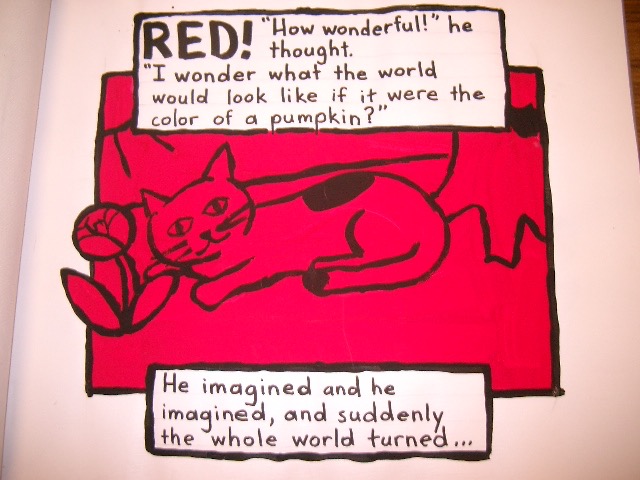
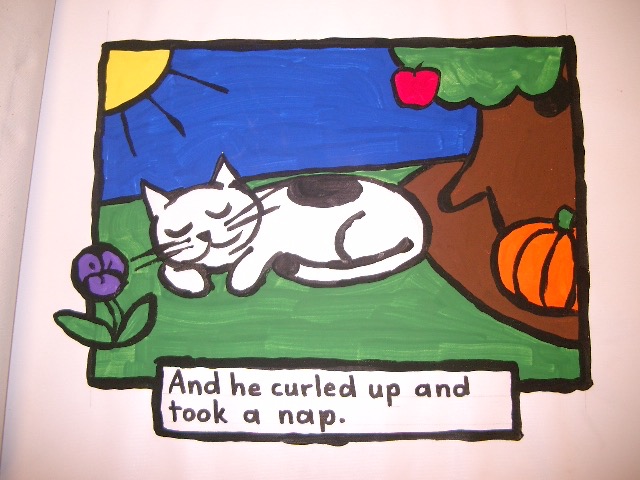
Once upon a time, I had a kindergarten teacher ask me to do a lesson on colors.  So I wrote a book.  As one does.

Today I found all the photos while looking for images of our Successive Approximation of the sunflowers for William Blake’s Inn (to illustrate the process in Lichtenbergianism) and thought it would be fun to show them off.

The original used a pad of canvas panels and tempera paint for the brilliance of the colors; my inspiration was my Maine Coon Sam.  I forget how I bound the pages; it may have just been clips on the edge.

—click to embiggen and see Sam in his full glory—

Here’s the book:

The presentation was simple: I’d read a page and at the ellipses would pause to let the kindergarteners guess which color was next.  The book also promoted the idea of imagination—and the attendant alternate realities—as a very good thing.  Finally, there’s the subtle vocabulary lesson of superlatives used by Sam Cat. All in all, a successful lesson I think.

Uncivilized discourse

I have to vent.

On Facebook this morning, a now-unfriended person paste-posted an image of what looks like a newspaper article outlining the deeply nefarious “Rules for Radicals” by Saul Alinsky.  Even if I hadn’t read “Rules”—which I have—this artifact didn’t pass the too-outrageous-to-be-true test.

So I commented that it wasn’t true, linking to the Wikipedia article on “Rules” and the Snopes article debunking the artifact.  (I also uploaded the graphic to the left; this is now my standard response to these idiocies.)

Another commenter then commented on the original, “Good to know, may I repost?” AFTER I HAD ALREADY DEBUNKED IT—but this is not my first time observing a rightwing nutjob’s blindness to the facts right in front of him.

Here’s why I’m seething: the next time this exchange percolated through my newsfeed, the original poster HAD DELETED ALL MY LINKS, leaving only my comment that it wasn’t true. He then commented, “To all my liberal friends—gotcha!”

WTF, dude.  “Gotcha?”  You posted a lie, I discredited it as a lie, and you have concealed that.  You have not deleted the post, you have not acknowledged that you slipped up and allowed your rabid weasel-brain to get the better of you, you have deliberately spread a lie as the truth.  Son of a bitch.

This person—it almost goes without saying—a fine, upstanding Christian in this town.

As the article says, “The Useful Idiots have destroyed every nation in which they have seized power and control.  It is presently happening at an alarming rate in the U.S.”

Quick rant

So this was on a friend’s feed today on Facebook:

I have a thought experiment here.  Let’s say that you go out on the playground and there’s this one kid who has a stick and he’s whacking the other kids in the face.

1. Do you

a) bemoan the lack of discipline in his home
b) take the stick away from him

2. Do you

a) take everyone back to class and ask them to bow their heads
b) take the stick away from him

3. Do you

a) give the other kids sticks and tell them to whack him in the face too
b) take the stick away from him

Such a dilemma, isn’t it?

Finally, someone listens to me

In yesterday’s post, I talked about my long-term admiration of Dmitri Shostakovich, and in passing referenced an earlier post about Luciano Berio’s Sinfonia.

I mentioned that my favorite version was the world premiere recording with the Swingle Singers and the New York Philharmonic, conducted by the epitome of 60s cool, Leonard Bernstein, but that it was out of print.

For at least ten years now I have raged as to why anything goes out of print these days, especially music. It’s all electronic files now anyway, right?  Why was RCA or CBS or Melodiya or Deutsche Grammophon not taking advantage of this to re-release every freaking thing in their vaults??

Well, inspired by my recollection of Sinfonia and its unavailability I went looking again, and look what I found:

http://www.amazon.com/Berio-Sinfonia-Concerto-Two-Pianos

Finally!  I’d like to point out to SONY/CBS Masterworks that I’m available as a consultant, in case they need other ideas on which to capitalize.

(Of course, I’m not so forward thinking that I didn’t at first order the actual physical CD instead of downloading the MP3.  I went back and canceled the CD and did the download—cheaper, for one thing—but part of me still wants that CD on hand.)

An anniversary

Today is the anniversary of the premiere of Dmitri Shostakovich’s Symphony No. 15, Op. 141, in 1962.

Eight years later, I returned from Governor’s Honors hungry for more: more art, more theatre, more music, more literature.  In Newnan at the time, the most immediate source of a lot of what I wanted was to be found at the Carnegie Library downtown. I’m sure the librarians there were thrilled to see a young patron digging into the more refined corners of the collection with such hunger and avidity; I know as a librarian I would have been.

The Carnegie had a small, weirdly eclectic record collection of classical music—about which I’ve written before—and one of the records I discovered was Shostakovich’s Symphony No. 4, a work which puzzles many critics but which I found to be a complete planet of musical ideas.  Since I was simultaneously reading The Lord of the Rings for the first time, the symphony became cinematically linked to the landscapes of Middle-Earth in my mind.[1]

You know how it is when you’re young: like a freshly hatched duckling you imprint on your first experiences, so that Eugene Ormandy’s interpretation of that work remains for me the standard against which all others must be matched.  I moved on to the composer’s 5th Symphony, his most famous, and then I started collecting the man’s works on my own.  He remains one of my favorites.

So you can imagine my excitement when it was reported in my senior year in high school—how?  How did I learn things like this back before the internet?—that he had written a fifteenth symphony, that it had been premiered in Moscow, conducted by the composer’s son Maksim, and that it had been recorded!  I began a waiting game until it was released here in the U.S.

By the time the recording came out, I was at the University of Georgia in my freshman year.  There was a record store on North Lumpkin St., and I checked it religiously until one day, there it was. I wrote my check—I’m telling you, I’m old—and scurried back to the dorm.

Back in the day, O my younglings, music came in these sizable cardboard sleeves with enough room on the back for a great deal of information.  The basis of my knowledge of music history comes largely from those liner notes, as we ancient ones called them.  The liner notes of Shostakovich’s Fifteenth seemed to indicate that the piece was a great puzzle to listeners and to critics.  What was the deal with the William Tell quote in the first movement?  The liner notes couldn’t pin that one down, almost suggesting that it was tacky (as did other critics at the time).  And then the quote from “Siegfried’s Funeral March” from Götterdämmerung in the final movement—was he resigned to his “fate”?

This inability to pin down the “meaning” of Shostakovich’s intent was in turn puzzling to me.  It’s like the reputation of the Fifth, with its final movement of triumphant joy.  At least, “triumphant joy” was the phrase used to describe that last movement, but from my very first encounter with the piece I found that hard t0 believe.  That was not joyful music; it was angry, furious, destructive music.  Why did anyone believe it was “joyful”?

In 1979, after Shostakovich’s death in 1975, Testimony was published.  It purported to be a book-length interview with Solomon Volkov and was immediately assailed by the Soviet authorities as bogus; the jury is still out as to its authenticity and there are strong arguments on either side.  Nevertheless, in it the composer says:

I discovered to my astonishment that the man who considers himself its greatest interpreter [the conductor Yevgeny Mravinsky] does not understand my music.  He says that I wanted to write exultant finales for my Fifth and Seventh Symphonies but I couldn’t manage it.  It never occurred to this man that I never thought about any exultant finales, for what exultation could there be?  I think that it is clear to everyone what happens in the Fifth.  The rejoicing is forced, created under threat, as in Boris Godunov.  It’s as if someone were beating you with a stick and saying, “Your business is rejoicing, your business is rejoicing,” and you rise, shaky, and go marching off, muttering, “Our business is rejoicing, our business is rejoicing.”

What kind of apotheosis is that?  You have to be a complete oaf not to hear that.[2]

Precisely.

Shostakovich’s relationship with the authorities—Stalin in particular—was always precarious.  His Fourth Symphony, my favorite, was pulled from rehearsal shortly before its premiere in 1936 after Stalin was offended by the composer’s opera Lady Macbeth of Mzensk . An editorial entitled “Muddle Instead of Music” appeared in the papers, condemning such modernist garbage.  The opera company closed the production and Shostakovich pulled his new symphony, which did not have its premiere until 1962.  His Fifth Symphony is subtitled “A Soviet Artist’s Reply to Just Criticism.” He kept his bags packed by the front door in case the secret police showed up to disappear him into the gulag; it had happened to others.

So with my first listening to Shostakovich’s new symphony, I heard him saying things that were pretty clear.  The William Tell quote?  The famous rhythm, of two sixteenths and an eighth, is also Shostakovich’s signature rhythm.  He relies on it constantly.  The triteness of the quote?  Shostakovich’s assessment of his own output: “This is what I have produced because of the regime under which I have struggled. Screw you guys.”  (The opening theme of the first movement is the same rhythm and indeed the same intervals as the Rossini.)

The other movements are shot through with references to his past compositions, culminating with that Wagner “fate” motif in the last movement.  There the massive passacaglia harks back to his Seventh Symphony (almost an inverted version of it, in fact), and the whole thing ends as the structure evaporates into fragmentary quotes of the symphony’s main themes, the percussion toys ratcheting out a clockwork reminder of his Fourth, his grandest failed experiment, the path not taken because he was forced from it.

Dmitri Shostakovich was a deeply unhappy, depressed, and grim man—and who can blame him?  He survived when others didn’t, and he kept his artistic integrity even while knuckling under to the despotic regimes of the USSR.  As his life came to a close—he had cancer as well as heart problems—he limned his misery in his final large work.

I raise my glass to him.

—————

[1] It is a tribute to Howard Shore’s genius that his score for the movies surpassed that linkage in my mind. As if Howard Shore’s genius needs a tribute from me.

[2] Shostakovich, D. D., & Volkov, S. (1979). Testimony: The memoirs of Dmitri Shostakovich. New York: Harper & Row.