Libertà!

There is an odd moment in Mozart’s Don Giovanni that perplexes directors and audiences alike, near the end of Act I.  The Don is giving a party, deliberately taunting his enemies, and as he welcomes them he seemingly out of nowhere cries, “Viva la libertà!”— “Hurray for Liberty!”  The others take up the cry, often coming downstage to deliver themselves of this stirring sentiment.  Trumpets and drums, which we have not heard since the Overture, make it a rousing, if confusing, moment, which vanishes as quickly as it appeared.

I was reminded of this as I tootled across the back roads of Georgia on my GHP RESA World Tour recently: my iPhone was set to play my 7500 tracks of music randomly, and that scene popped up somewhere between Statesboro and Waycross.  And that in turn reminded me of my experience at Atlanta Opera last season with their execrable production of Don Giovanni.

Costumes were fine, set was fine, the orchestra was good, and most of the singers were acceptable, although the Don himself was very shaky.  But none of them could act, and it looked as they didn’t have a director at all, because whoever directed it simply didn’t.  I am not exaggerating when I say that I could have blocked that entire three-and-a-half hour show in one rehearsal, one short rehearsal.  Everyone just came on, walked to their spot, faced downstage, and sang. It was excruciating.

Giovanni is a tough nut to crack.  Our main character is an abusive, self-gratifying, self-justifying sleazeball.  His servant Leporello is a codependent toady.  His opponents, the “good guys,” are both hapless and feckless, especially Don Ottavio, the fiancé of Donna Anna, whose father Giovanni kills in the opening scene while trying to escape from Anna’s bedroom.  Ottavio spends the entire opera dithering about who the killer is (Giovanni was masked) and whether or not it might not be maybe Don Giovanni and what he might maybe do about that if he could only be sure.  Maybe.  More about that in a moment.

I’ve never been sure how Mozart means us to take Giovanni.  He’s clearly a not-nice person, but he’s the main character, and the non-evil people are just tools in his hands (besides being simply tools like Ottavio and Masetto, the peasant lout whose fiancée Zerlina Giovanni tries to seduce.)  In the end, he is dragged to hell by the statue of the Commendatore, Donna Anna’s dead father, and it’s extremely unclear whether we’re supposed to be smug in our righteous condemnation of the brute, or overcome with admiration at our boy’s proud refusal to repent and to become “other than he is.”

So anyway, Atlanta Opera’s director failed to crack the nut, and the audience’s tolerance of the stage action got increasingly thinner until the final scene, when Don Ottavio rushes onstage, finally ready to punish the vile seducer, only to find that his dead father-in-law has beat him to it.  The audience howled with derisive laughter.

It got worse.  That climactic scene is followed by the lamest ending ever: Donna Anna & Ottavio, Leporello, Zerlina & Masetto, and Donna Elvira (Giovanni’s deluded stalker) all stand and sing what they’ll do next:

  • Let’s get married. (Ottavio)
  • Sure, but we have to wait a year. (Anna)
  • I’ll enter a convent. (Elvira, who has spent the entire opera essentially begging Giovanni to do her one more time.)
  • I guess I’ll find a new master. (Leporello)
  • We’ll go get breakfast. (Zerlina & Masetto)

Mercy.  Then there’s the rousing final sextet, where they all sing how good is rewarded and evil punished.

Sure.  Whatever.  Curtain.

As fate would have it, the next day after this performance I received an email from Atlanta Opera asking me to rate my experience.  With raised eyebrows and pursed lips, I set to it.

After a series of questions asking whether I thought it was appropriate for the Bank of America to be a corporate sponsor—sure, I said, just like a Mexican drug cartel: money is money—they asked what the most enjoyable part of the evening was for me.

I was able to reply truthfully that it was during the curtain call, when I had a vision: wouldn’t it be a blast if while our idiot good guys are singing their platitudes about good always winning out, we see behind them the devils from the finale climbing out of the floor and dusting themselves off; followed by the Commendatore, whose statue costume we noted looked a little ratty when we first saw it; followed by Don Giovanni himself, who pulls out a roll of bills and pays them all off.  He makes his escape while his enemies congratulate themselves on their virtue.

He is the 1%: throughout, he uses his position and his wealth to abuse everyone around him for his own pleasure, and even when they think they’ve got him cornered, he buys his way out of it.  We’ve seen it happen the entire opera, and so when he fakes his own death, we are not surprised.

Why Atlanta Opera doesn’t hire me, I’ll never know.

Anyway, back to libertà.  I hadn’t really given my epiphany a second thought since typing it into the email survey form with such grim pleasure, but when that scene played out on GA-121, it all made sense.  Giovanni, after inviting his worst enemies to a party where he intends to seduce Zerlina right in front of them, distracts them with cries of Liberty! Freedom!  And like the pitiful sheep they are, they sing right along while he moves in on the peasant girl (who never gives in, by the way).

What else are they going to do? He’s the 1%.  Suckers.

Fire pit addendum

We’ll see if this works.

I have planted dwarf mondo grass around the fire pit.  There’s a small batch in another part of the yard that actually feels very nice underfoot, so it’s worth a shot.  Unknowns: will it grow here?  Will it spread?  Will it tolerate the foot traffic?  Will it be the dickens to keep clear of twigs and pecans?

Only time will tell.  And then we’ll pave it over with stone.

A fire pit worthy of the labyrinth

Wednesday night I was out meditating by the fire in the labyrinth, and as I got things set up I noticed that the metal fire pit had rusted out pretty badly.  It was time to discard it and actually build the permanent one.

Those who  have been to the labyrinth in the last four or five months will have seen that I’d blocked out such a thing, literally, with blocks, and the metal fire pit was perched on top of those blocks.  So as the evening wore on and I was gazing into the fire, I came up with a plan.

I had of course done a little research on the web to see if there were an established method for this kind of thing, and I found several how-to’s.  But most of them involved digging down two or three rounds of stones and pouring a concrete base, then building the thing three or four rounds high above the ground.  They seemed excessive for what I needed.  Indeed, as I set to work Thursday night, it dawned on me that most of those instructions were for people who wanted a place for a bonfire for large groups of people to mingle around.  I needed something for a small group of people to sit around.

Anyway, as I gazed into the fire, I came up with a lovely little design that I thought might work.  Feel free to steal this.

Thursday night, in a burst of energy and inspiration, I got out and dug the first version of the hole:

That’s the basic idea.  Do you know how hard it is to dig a hole that is six inches deep and thirty inches wide in clay packed with construction debris?  It took a while.

Having dug the hole, I lined the whole thing with red lava rocks and raked it level.  (Take that, concrete-base-pourers!) The lower round of stones rests on that.

From there, I laid a complete round of a dozen stones above that.  Here’s where I had problems.  Knowing I did not have enough stones* to make two complete rounds, I went to Home Depot to buy ten more.  Alas, of course, they did not have these stones any more, so I bought ten of a different variety.  They did not match, nor were they the same size.  More of that in a minute.

I added more lava rock to the center to make it level, and I was ready to test it out.

Here it is in situ:

And from across the labyrinth:

For fire testing purposes, I went ahead and placed some of the alien stones in the upper round.

Notice the gap.  Feh.  I’m also running a line of bricks from the pit to the labyrinth.  Very crop-circle-ish, made even moreso by the fact that the pit is connected in a straight line through the center of the labyrinth to the lingam stone on the other side.  ::cue Twilight Zone theme::

The good news is that it functions brilliantly, even better than the store-bought ‘un.  The lava rocks, I think, provide airflow that creates a lovely fire throughout.

So now to Important Questions.  In watching the flames last night and wondering how the heck I was going to find four more of the old-style stones, I had a scathingly brilliant idea.  I had another, more “doh”-related, as I began to write this post.  I will share both, and we will discuss the two in comments.

Idea One: I can put the alien stones in the first row, with the gap facing the line of bricks.  The theory is that the fire would cast a stream of light out towards the center of the labyrinth.  (And by extension, to the lingam.  Of course.)

Idea Two: I have four more old-style stones—they’re in the bottom row.  I could just substitute the alien stones for the bottom row.

Pending discussion, here’s what I’m going to do.  This afternoon, I will reconfigure the stones to test the gap/stream of light hypothesis.  If it works well enough to be cool, we’ll go with that.  If not, then I reconfigure again and reclaim the necessary stones from the bottom.

UPDATE: After some frustrated cursing at the alien stones, which did not work in any position, I took my quest to the road, specifically to Lowe’s.  As it turns out, I must have bought the original batch from there, because there they were.  I bought more than enough to finish the job, and lo!:

The next phase: planting dwarf mondo grass around it.  When that dies, we’ll start laying down stones.

__________
*Stop it, Jobie.

A new drink

This past weekend, on the way home from the Slotin Folk Art Festival, we treated ourselves to dinner at Flip Burgers on Howell Mill Road.  Very tasty food, but it’s the bar that concerns us here.  I had a cocktail that was a kind of hybrid margarita: tequila, Canton ginger liqueur, and… a fruit juice I cannot remember.

So this evening, having stopped by Georgia World of Beverage to pick up some blue agave silver tequila—I already had the Canton, of course—I set about finding the recipe.  It was nowhere to be found.  I found other combinations, all of which sound lovely, but tonight I had to muddle through with my own wits.

It’s very tasty, so much so that my Lovely  First Wife, who recoils at both tequila and ginger in general, liked it.

Untitled Drink

  • 1 part blue agave silver tequila
  • 1/2 part ginger liqueur
  • 1 tsp agave syrup (I didn’t really measure, so let’s say “to taste,” which gives you permission to make and consume several of these.)
  • pineapple juice

Add tequila, ginger liqueur, and agave syrup to a shaker and shake with ice.  Shake vigorously, because the agave syrup does not dissolve easily.

Pour into a glass over ice, and fill with pineapple juice.

It’s sweet, but it has that bite from the ginger and that undercurrent of the tequila.  Enjoy!

New art

Today my Lovely First Wife and I went to the Slotin Folk Art Fest up in Norcross.  Some very nice stuff available up there!  I resisted several pieces, but if we had gone on Friday, I probably would have gone back today to buy some more stuff.

Here’s what I did buy:

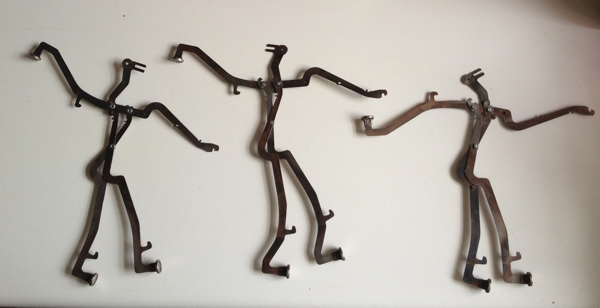
They’re less than a foot tall, and at 3 for $50, such a steal!  I haven’t decided where they’re going yet.  I’d love to mount them in that little fern bank in the middle of the labyrinth, but I don’t know if they’d be visible.  Clearly, mounted on a wall they’d be excellent.

As soon as I saw them, their atavistic energy made it impossible for me not to have them.  They hark back to some of the Lichtenbergians’ founding goals, don’t they?

They’re made from manual typewriter keys.

Labyrinth update, 7/25/2012

It is with trepidation that I arrive home from a summer at GHP—how will the labyrinth have thrived?  (Thriven?)  In 2009, the grass was largely dead.  I stayed home in 2010, so it was fine, and last summer it was OK.

But this summer’s heat had me worried.  My lovely first wife assured me that she had watered it religiously and that the grass was greener than it had any right to be, although she was concerned about the peacock fern in the center.

So yesterday when I got home, after I had unloaded the U-Haul trailer and returned it, then driven into my new driveway with the six-inch steel pipe property line marker sticking up next to it and exploding my tire (separate story), I headed back to see what the situation was.

Short version: not too bad.

The grass is green, and in fact seems to be giving the clover a run for its money.  I may try this fall to kill off the clover after all and reseed those areas.

It hasn’t been mowed, of course, but the biggest problem is the fact that last year’s bumper crop of pecans is erupting from every surface.  There are oak seedlings as well, but mowing over those kills them off.  Not so with pecans: they are just a root system with leaves for decoration.  Mow over them, and they’ll be back within a week.  Not only that, but as they grow back, the stems are just as thick as before, essentially turning into little punji sticks, so walking barefoot in the labyrinth becomes dicey.

No, I will have to get down on my hands and knees and dig up each and every one.  Not a problem.  It will give me plenty of meditative time, and labor is beautiful.

Labyrinth update, 5/12/12

We interrupt the muggings to bring you an update on the labyrinth.

My lovely first wife had been bugging me about what I wanted “to do” for my birthday, i.e., what exotic, extravagant trip would I like to take?  NYC, which is always good?  A quiet beach somewhere?  I found that whatever I considered, I didn’t really want/need it.

I finally realized that what I wanted to do was to stay home and work in my labyrinth. So I took Thursday and Friday off with definite plans.  I was going to a) build the permanent fire pit; b) create the stone circle for the westpoint; and c) install a sound system.

I wish I could relate a tale of hard work and satisfaction, a rebuilding of my soul and all that good stuff.  Alas, it didn’t quite turn out that way.  My spirit is not crushed and I am not defeated, but the whole thing is a bit of a shambles.

First, muscles in my lower back spasmed last weekend while I was moving firewood.  So there went the permanent fire pit, with its lifting of some four dozen heavy landscaping stones multiple times.  (It also means there’s still half a pile of firewood in the driveway.)

The stone circle was smoother on its path to failure.  For background, see here.  Simple idea, and not too terribly difficult in execution.  I set up my drill press on the work table:

I had measured where I wanted to drill the hole, and you can see my cleverly arranged piece of wood which gave me a uniform block against which to put the outer edge.  Drilling the pieces took very little time and was a pleasure.

I threaded each piece onto a cable:

Simple, simple, simple.  The big issue was the base pieces, but even that was simple: drill a hole for the cable to go through, and then from the bottom drill a larger hole for the rebar or whatever I was going to stick the thing on, and the smaller hole intersected the larger one.  Worked like a charm.

Lovely.  Perfect.  Except it didn’t work.

The theory was that like an arch the stones would be self-compressing; the cable was there to keep them in line.  However, the stones were too uneven to function like a classical arch, and the whole thing just flopped over when I tried to stand it up.  Not enough rigidity, and I’ll hear none of that from the likes of you, thank you.

So the westpoint once again lies dormant while I figure out the next step.

That was Thursday.  Friday, I tackled the sound system.  The goal was to install speakers that would a) be weather-resistant, i.e., I could leave them outside permanently; and b) spread the sound more evenly across the space.  For instance, when walking the labyrinth it was often hard to hear quiet music from the front of the labyrinth while rounding the far curves.

After much internet search, I found speakers that were in-ground and seemed to be just the thing.  No, I didn’t want the fake rock ones, or worse, squirrels or flower pots.  I ordered two, one for the northwest corner (by the dancing faun), and one for the front entrance.

I trenched in the cable (I now have 400 additional feet of bury-able speaker cable…) but left the speakers not buried so I can make final adjustments for the best sound.

The amp I ordered came in right after lunch, and I won’t bore you with the scrambling I had to do to get the bare speaker cables hooked up to the RCA inputs on the amp.  Short version: it seems to work and to work well.  I think the sound quality is not quite as good as the Califone portable boombox system I had been using—not enough highs or separation—but for basking in the labyrinth or hard sessions of meditative work, it should be fine.

The only glitch in my plan at the moment is that I awoke to rain, which puts the completion of the system on hold.  It also means that I won’t be able to be out in the labyrinth tonight to celebrate my birthday.

Oh well.  Successive approximation.  Onward, if not exactly excelsior.

Mugshots: The Newnan Crossing 100 Book Club

Ah, the acrid smell of failure…

I would call it a spectacular failure, except that would denote spectacle, and the Newnan Crossing 100 Book Club never crawled out from the mud, much less took flight.

The concept was simple, and I should be standing astride the world of elementary reading like a Colossus, not to mention filthy rich somehow, but I never found a way to make it work.

I got the idea from a book called The 100 Greatest Books for Children, or something equally ludicrous.  It occurred to me that it might be a good thing to challenge students to read some of the “greatest books for children,” and it would be even better to distract our better readers from the Accelerated Reader™ point treadmill.

For those who have never suffered through Accelerated Reader™, it’s a behemoth: Renaissance Learning wants to take over your school one computer and one child at a time.  For AR™, as it is commonly known, all the student has to do is to 1) read a book at his “level”; 2) take a computerized comprehension quiz; 3) accumulate points based on his score.

Simple, and actually effective as a strategy for helping low-level readers improve their reading skills.  However, for very good readers, it’s awful.  First of all, if a school focuses on the points and creates a competition based on them, the gifted kids go nuts.  It’s a piece of cake for them to read a Harry Potter book, take the quiz, and snarf up 20+ points, while the struggling reader (for whom the program is designed) is lucky to get 1 or 2 points for their little books.

Worse, the good readers will race through books so they can get even partial credit/points for a book, thereby destroying what pleasure there might be in tackling Harry Potter.  (Remember, the quizzes are low-level comprehension quizzes only: no higher thinking skills required.)

So my idea for the 100 Book Club was equally simple: the student picked one of the 100 Book Club books, read it, and wrote a review explaining how they liked it. There were over 800 books on the list (cataloged in the online catalog), each and every one either an award winner or a starred review in one of the library journals.  The aim was to read 100 of these books by the time you graduated 5th grade.

Kids could even go ahead and take the AR™ quiz if they wanted to, but passing the quiz didn’t get them credit for the 100 Book Club.  They had to write a review, and it had to be approved by me.

That was the problem, in the long run: we had no way to manage the review process that would keep it alive.  At first, I had folders for kids to use, but that was unwieldy.  Then I had the IT crowd install a group content management system that was supposed to provide every kid with his own book blog, but that was also unwieldy.

Finally, Follett Software Company upgraded their catalog software so that students could write reviews in the catalog.  Perfect!

But it didn’t work, and I think the main reason why is that I could never get the teachers to organize around it.  AR™ was much easier—the kids managed that on their own, and I handled the only rewards Newnan Crossing gave out, the aluminum dog tags for “Point Clubs.”  All the teachers had to do was to give the Renaissance Learning reading diagnostic and assign the kids their reading levels.

(To be fair, the best teachers worked very hard using AR™ appropriately, cajoling kids and encouraging them with praise, etc.  100 Book Club would have added a whole other layer of work which they could scarcely deal with.)

It was also nearly impossible for a kid to get even close to the 100 books unless they started in 2nd grade and read bunches of the “Junior Level” books before getting to 4th grade, and even then it meant reading one of these higher level books every week in 4th and 5th grades.  Not really do-able; I should have thought of that before launching it.  But “100 Book Club” is really catchy, isn’t it?

So the whole thing just sat there, nudged along by me for five years, but never really taking off.  If it had worked, we would have been graduating kids who not only had read some of the best books around, but who would also have learned to write well about their reading.

There were lots of kids, the cool kids, who hooked into the concept and regularly consulted the list of titles to choose their reading—they had found that Mr. Lyles spoke the truth when he said these books were better than the regular books.  But none of them wrote reviews; they took the AR™ test instead.

Oh well, in my charter school…

Note: I use the trademark symbol after AR™ because I always wanted to remind the teachers that this is a commercial venture.  We have to pay for the software and pay for each and every quiz.  Otherwise, many people think it’s just a wonderful gesture of kindness that someone does to help our students learn to read.