Five Easier Pieces: Stuck again

Stuck in the tango.  No sign of improvement.  We are at 6 on the Lyles Scale of Compositional Agony, with no relief in sight.

So instead of actually working on it, I have downloaded the trial version of Ableton Live, a piece of music software that I have been assured by several people will be the tool I need to create an orchestral performance track for Christmas Carol.

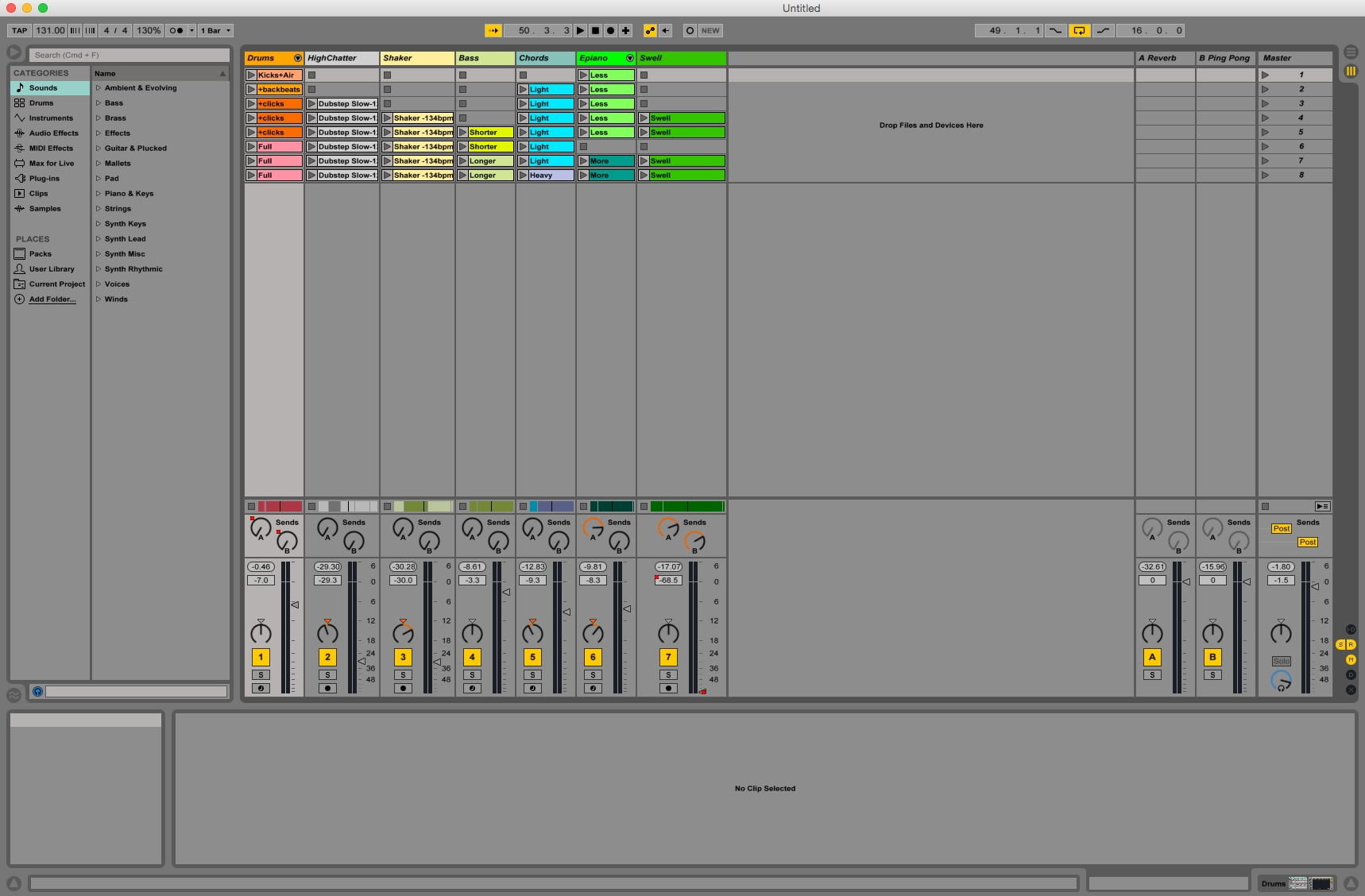
It has been more than 15 years since I had to tinker with such software, and back then—pre-Mac OS X days, even—the software I used was simple and straightforward.  But in the intervening years, the consumer end of such things has dropped off and the pros have taken over.  If you don’t know what I mean, look at the following screenshots from Live:

Click on it to get a full view.

No, really, click on it.

Oy.

It has two “views,” Arrangement and Session.  At this point—I just installed the thing—I don’t even know which one is which.  Here’s the other one:
Click on this one too.

Oy, also too.  ::sigh::

Cover me, I’m going in.  Updates as I surface.

10:10 am: I may have a clue.  In the second image above—that’s the Session view—each of the little colored boxes is a loop of some kind, either a beatbox or riff or some other kids-these-days item.  The columns are all using the same instrument to create the clips.  The rows are called “scenes,” and that’s where you combine/recombine all your whomp-whomp bits.  (That’s a technical term.)

So, for my purposes… We’ll use “Marley’s Departure” as our test case.  Here’s a score so you can follow along at home.  We have one measure of nervous diddling about, then two measures that repeat while the cast plays a scene about Scrooge seeing a ton of spirits like Marley hovering about the London streets, and then a final measure that we jump to when we reach the cue “…and lost the power forever!”

Here’s what I think will work: I go in, export each section as a clip.   Then I’ll have three scenes in Live, each one with one clip.  Hm… now I’m hazy.  Will someone have to “play” the piece live, i.e., click on scenes 1-2-3 in order (they loop until you click on the next one)—or can I line them up in the Arrangement view, loop the second one, then whoever’s in charge of the computer clicks some kind of NEXT button to skip to the third one?

Step one is to export those three audio clips from Finale.  Back in a moment.

11:00 am: Problems:

  • Each clip seems to have two seconds of silence at the end.  I think that’s a Finale export preference thing and should be easily fixable.
  • I figured out how to add the folder of exported .aiff files to the “browser” of Live—although you can drag-and-drop directly from the Finder, but when I drag them into the Arrangement timeline, there is no sound.
  • Clicking on each clip in the browser previews the clip, i.e., plays it, but again, dragging it to the timeline produces no sound.
  • If I drag a clip in Session view, I can click the Solo button and there is sound, but it’s muddy and clicky—which is not the case if I preview it in the browser.
  • The User Manual is of no assistance in this issue.
Five Easier Pieces: No. 4, a start

The fourth Easier Piece is a tango.  Why not?

Here’s what I came up with so far this morning:

Easier Piece No. 4 (Tango) | mp3

I’m exploring the power of repeats.

One thing I will decide as I go along is how long it should be.  It might be nice to have an extremely short, langorous dance—or we could really go for it with a passionate central section that steps up our game.  Comments are welcome.

Daily ritual

I’ve been reading Daily Rituals, by Mason Currey, as my bedtime reading.  It’s a very simple read: brief descriptions of the daily working habits of scores of writers, artists, and composers.  They don’t seem to be in any particular order, and a great many of them were already known to me, but it is nonetheless inspirational in a belaboring-about-the-head-and-shoulders kind of way.

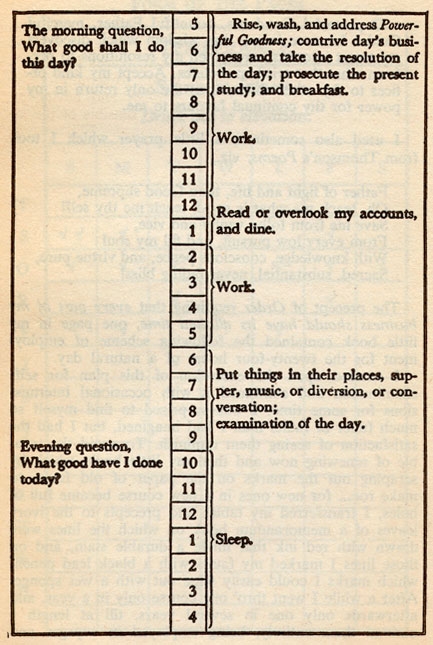
Ben Franklin had his daily ritual and even published it:

He was the first to admit that he found it difficult to follow this schedule, but that when he did it was productive.

So have I learned my lesson?  Sure—over and over again.

Back when I was fully employed and working on William Blake’s Inn and the penguin opera, I composed on Sunday mornings and Wednesday/Thursday nights without fail.  The iPad in the kitchen still beeps me every Sunday morning to remind me to get to work.

Since retirement, I have attempted to maintain a fuller schedule, to wit:

  • 6:00 wake, exercise (walking)
  • 7:00 shower, coffee
  • 7:30–8:30 do the morning’s email/Facebook checks while the lovely first wife readies herself for work (i.e., don’t start working until I’m free of interruption)
  • 8:30–11:30 compose, blog, research (upstairs/study work)
  • 11:30–1:00 lunch, crossword, surf the web
  • 1:00–4:00 read, write, correspond, run errands, household projects (downstairs/outside work)
  • 4:00–5:00 cleaning, kitchen prep
  • 5:00 et seq. cocktails, dinner, rehearsal, married life

Does it work? Mostly.  When I really buckle down, I’m able to knock out new music, blog regularly, write books, etc.  If I allow myself to be lazy, then nothing gets done.  (It is worth noting, too, that I follow this schedule only on weekdays.  Weekends are for debauchery fun.)

These past two weeks, for example, I have made real progress on Five Easier Pieces, writing and/or completing three of them, and yes, I’ve started the process of writing a book.

That book is Lichtenbergianism: procrastination as a creative strategy, and it’s based on a seminar on Lichtenbergianism a bunch of us gave at GHP back in 2013, a light-hearted—but quite serious—look at the creative process.

At first, I considered a series of blogposts for the Lichtenbergian website, but nothing was happening. I just wasn’t able to pull the swarm of ideas out of my head and put them into a coherent whole on the screen, topic by topic.

Then last week, as the weather turned warmer and I was able to return to the labyrinth for afternoon work, I pulled out my Lichtenbergianism field notebook and began writing in it, randomly.  So far I’ve been able to write about an hour every afternoon, just jotting down phrases and ideas and examples as they come to me.

In its own way, the process is a perfect exemplar of the the Nine Precepts of Lichtenbergianism:

  1. Task Avoidance: this book is not one of my Lichtenbergian goals this year.  I should be working on other stuff
  2. Waste Books: the work is being done in a waste book, in no particular order or organization other than the precepts
  3. Abortive Attempts: nothing I write is written in stone
  4. Successive Approximation: the more I write, the more organized and fleshed out it will become
  5. Gestalt: the more I write, the more I see what is missing
  6. Ritual: every afternoon, in the labyrinth if it’s nice and in the living room beside a fire if it’s not
  7. Steal from the Best: trust me, I will be referencing others’ findings and writings throughout
  8. Audience: I know who wants to read this, and I’m writing it for them
  9. Abandonment: not yet, but soon, I’m sure

So far so good.  The book and its composition are recursive: the more I write about each precept, the more I find it applies to the writing, which I then reference: “This book was started in a waste book…”

Eventually I hope to start turning the waste book material into blog posts for my fellow Lichtenbergians for their comments.  One of my gestalt visions for the book is to include sidebars and blockquotes from them about how they use the creative process in their daily work, much as we did in the original seminar.

So that’s my daily ritual.  For the moment.  I should really look at a fourth Easier Piece now…

Five Easier Pieces: No. 3

I think I’ve finished the third Easier Piece.  There’s still some slippery/bare harmonies in there, probably caused by parallel fifths/octaves but I’m not going to go check right now.  Let’s consider it done unless my theory teacher raps me across my knuckles.[1]

Five Easier Pieces: No. 3 (Étude Héroïque) | score [pdf] | mp3

—————

[1] The joke is on the universe, since it has never provided me with a theory teacher despite my specific requests that it do so.

Five Easier Pieces: Stuck

As is not unusual, I am stuck with a piece, in this case the third abortive attempt at one of the Five Easier Pieces.  Some really nice bits, especially the transition to the major key, but then it starts to wander, and I have no idea on how to end it.

I don’t know why, but recently I have avoided sharing my works-in-progress.  I don’t know why; it used to be my stock in trade to whine about how little I was accomplishing.  Perhaps it was better when I did, and so I’m sharing now.

No score, but here’s the mp3: abortive attempt #3

A ‘found’ poem

These Next 5 Minutes will ‘Change’ Your life

Shaving away: your ‘Savings’ on Razors.
Drive your Partner – ‘Crazy’ in Bed Tonight.
No more ‘struggling’ – to hook your bra!
Thousands of ‘Jobs‘ — are 2 Mins Away!
We Are Recruiting ‘New Agents’ In Your Area
We have a ‘huge selection’ – of printer ink
Stop your Dog — from ‘Pulling’ on Walks
Protect your — ‘Garage Floor’ Today!
Extra cushioning and ‘odor protection’
Find Hot-deals on winter—‘Cruises’
5 BIG ‘Early Warning’ Signs of Memory Loss?
Need ‘pricing’ on local assisted living options…
We have a ‘massive’ number – of active members…
Do Not Live in Fear: of Loud Noises !


These of course came from spam emails in my spam filter.  The mysterious thing is that on Feb. 4, the quotation marks vanished from all the subject lines!

In which I get serious or something

We spent this past weekend in Asheville, NC, and I have to recommend it highly.  Great food, fabulous art, and a kick in my creative pants!

One of the most fun things we did was to go to a bar/club called Lex 18, at which a DJ spins electroswing on Friday nights.  Do you not know what electroswing is?

Here you go:

Or here:

Or here:

You’re welcome.

The dance floor was filled with young persons who knew what they were doing, and it was fabulous.  (We also danced, for the record.)

Anyway, we visited studios and galleries and ate fantastic meals, and I’ve been inspired to get back to work.

Before heading up to Asheville, we went to Athens to hear Peter Schickele in concert.  He is now 80 and in a wheelchair, but his music has lost none of its charm, wit, or éclat.  It made me want to get home and produce music of my own.  For a change.

So this morning I sat down and got back to work on Five Easier Pieces, which has been on my plate for several years now.  I actually started a new file and played with some motifs, but when I went to save the file I found that I had a small flock of abortive attempts, so I opened those to see if there was anything worth looking at.

Lo! and also behold! most of them were actually pretty good, so I set aside this morning’s work and picked up two of them and filled them out.

And so, I present to you…

Five Easier Pieces (a companion to, and a partial apology for, Six Preludes (no fugues))

I.  No. 1 (Invention) | score [pdf] | mp3

II.  No. 2 (Waltz) | score [pdf] | mp3

There will be further reportage on the Asheville venture.

Missing a part of me

Here is part of what I wrote for my son’s wedding in October:

It is usually said at weddings

that the ring is a circular symbol

of the unbroken, never-ending nature of love.

That is certainly true,

but I would like to take a different tack today.

When you selected these rings for each other—

and I imagine that this is true

for all those here today who are married—

you took care to select something

that would be pleasing to its wearer—

because you will be wearing these rings for a very long time,

and no one wants their spouse to look down

and be reminded of how inappropriate their wedding ring is.

More than that—

it is a physical reminder of your vows today.

At first you will find its presence an odd thing

as you constantly play with it,

testing its right to be there

and marveling at what fortune or fate

brought you to this most excellent pass.

Eventually, its presence will no longer surprise you,

but your awareness of it on your finger

never goes away,

and I hope that every time

you rather absentmindedly fiddle with it,

you will feel—even if subconsciously—

the blessing of being married to the one you love.

Finally, your ring is an outward show

of your commitment to each other.

In a few moments, its presence on your finger

will tell everyone you meet

that you have come to be with the person

you are meant to be with,

and that you have vowed to be

with him or her for the rest of your life.

Thus others know of your blessing.

I post this today because two nights ago, as I sat by the fire with my lovely first wife, I looked down at my hand and realized that my wedding ring was gone.  Completely not there. At some point that day, it had slipped from my hand and vanished into the universe.

How? is the question that keeps hammering in my head.  How did I not feel it come off?  How did I not hear it hit whatever it bounced off of before vanishing?  I never take it off (except for the occasional MRI or stage role), so it had to work its way off.

I do remember washing my hands that afternoon as I prepared soup for supper and noticing then that it was loose.  Over the years, as I’ve gained weight, I’ve had it expanded a couple of times—it was originally a very small ring for a man.  It might even have been a woman’s ring; I forget.  But now as I age and my weight fluctuates, it has gotten looser.

It has stuck in my head that it might have vanished when I pulled off gloves, either my work gloves when I trundled firewood up to the front porch or the rubber gloves after I washed dishes.  But it’s not in the kitchen or in the yard.

I didn’t leave the house after I started cooking, so even though I called Home Depot and Kroger to ask them to be on the lookout, I know it’s in neither of those places.

Needless to say, we have scoured the entire house and yard multiple times.  We’ve gone through the trash.  I’ve disassembled the bathroom sink.  (The kitchen sink has a garbage disposal—I would have known if it had gone down that drain.)  We’ve swept under furniture, pulled sheets off the bed, and emptied coats, pants, and gloves every ten minutes.

It’s gone.

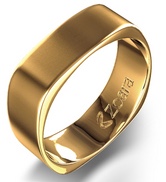
my wedding ring

It was square, gold, engraved, and it is still a part of me.  Everything I said in my wedding homily was based on my ring, and everything I said is true.  I am deeply wounded by its loss; it cannot be gone.

It is gone.