More sunflower waltz (Day 205/365)

A quick post this morning: I’ve been listening to the sunflower waltz over and over. It’s gotten to the point that I need to take a break from it and come back later with fresher ears.

But that won’t stop you from listening to it. Here’s an mp3 file of the sunflower waltz, as of 2/24. You will hear the thing start to peter out after the second climax, as the orchestra gets to the “counted the steps of the sun” line.

In case you’re wondering, as I was most of last night, how I’m going to get us down from this high perch, I think it will be relatively easy: finish out the verse with the “topaz tortoises” line, getting quieter as we go along, then use the “Dear William” phrase tossed back and forth from section to section to return us to the calm (and key) of the actual song. From there, we sigh back into the violas divisi, and let the chorus repeat the “They arranged themselves at the window” verse. Fini.

We’ll see if I get back to this today, what with Wadsworth tonight.

More sunflower waltz (Day 204/365)

It was as I suspected: lackluster piano scores can be camouflaged by bumptious orchestration.

Of course, one thing we’re looking at is that an orchestral score is not a piano score. A piano sonata, one by Scarlatti, say, is effective because it’s conceived for the sonorities of the piano. (Well, if Scarlatti wrote for the piano. Did he? Or was he a harpsichord/clavicembalo kind of guy?) Expanding the piano sonata to be played by an orchestra is a fruitless kind of excercise, because the sound-world created by an orchestra is not one inhabited by the sonata, i.e., piano sonatas do not scale up.

Likewise, orchestral pieces do not scale down. We will encounter this problem when we start working on William Blake’s Inn for real, because Milky Way, for example, is unplayable on the piano; I wrote it for the orchestra from the very beginning. Similarly, Man in the Marmalade Hat was never written for the piano alone (unlike most of the other early pieces); it has always required an unrealistic battery of percussion.

So yes, I’m being too picky to accuse myself of cheating through whiz-bang orchestration. Perhaps it’s an indicator that I’m starting to think in orchestral terms, which is problematic, because when will I ever have an orchestra at my disposal?

Another issue I’m having with the sunflower waltz is that it begins sweetly enough, a nice little accelerando poco a poco that gives us time for the sunflowers to nod to each other, wake up, establish themselves as “persons.” But it rapidly becomes this huge waltz, a glorious corps de ballet moment, and it doesn’t seem to want to back down. I made notes last night during intermission of Don’t Hug Me at NTC , Note to Laurel and Lamar: darlings, I love you, but that was an execrable waste of your brilliant talent, time, and the company’s money. I was in pain the entire evening, notes to back off the second climax and pull the thing back to a “Skater’s Waltz” kind of level, more in keeping with a small troupe of sunflowers.

But when I got home and listened to it again, that second climax did not want to be pulled back. So maybe we’re going to have a big, Tchaikovskian moment whether we want one or not. Oh well, if we get it into the studio and don’t like it, I’ll just write another one.

Now that I have Finale back up and running, it occurs to me that I still need to orchestrate Man in the Marmalade Hat and Make Way. Are those the only two I have left? [update: Heavens, no, there is also The Tale of the Tailor. ::deflating::]

More sunflower waltz (Day 203/365)

Okay, now the number of days is beginning to scare me.

It was another productive day, more work on the sunflower waltz in Two Sunflowers. I have gotten the piece mostly sketched out, and I think I’m about ready to begin quasi-orchestrating it, mostly because I’m having doubts about it. In the past, it seems, whenever I begin to think that the music itself is inadequate, I’ve found that by reorganizing it vertically, so to speak, I can rediscover why I thought I was “finished” with it in the first place. Hopefully that will happen here.

On the other hand, it’s still clunky, I think. Parts are lovely and interesting, but the in-between bits are lackluster. I’ll fiddle with it a little longer, probably, before investing the time to orchestrate the whole thing.

In other news, I got a new USB hub and everything works just fine. I think it was just a matter of the new laptop requiring USB 2.0 fixtures rather than the old 1.1 bits. It really helped in the work today to turn my back on the computer and just play with keyboard and paper.

Also, in looking over the blog here, I noticed that the new layout/theme does something funky with italics and bold. It makes the italics bold and the bold all caps. I don’t think I like that. I’m going to mess with the CSS stylesheet and see what happens. [Note: I did fix it. Now I’ve noticed that the theme is not fixed-width, which means that the line-length of the text may get too long for comfortable reading… Hm….]

Sunflower waltz (Day 202/365)

I was actually productive today, although as usual there were some technical glitches slowing me down.

I made a copy of Two Sunflowers Move into the Yellow Room and chopped off the front part. I added lots and lots o’ blank measures, and then pasted the “they arranged themselves” section at the end as a reprise. In between, in the blanks, I played.

The technical glitch I encountered is that my USB hub, which allowed me to plug in my wireless keyboard and the wide-format printer and the MIDI keyboard, no longer works with the new laptop. I can’t think of a single reason why that should be so, but it’s true. So if I wanted to work on paper, using the keyboard, I had to unplug the computer keyboard and plug in the MIDI keyboard, and vice versa. It was a pain.

However, I got lots done, with several interesting passages scribbled down. Nothing worth hearing yet, and all fragments, but as Marc said in comments to Tuesday night, it’s the getting ideas out there that makes it all work. I’ll try to start organizing the ideas more strenuously tomorrow.

It’s interesting that having waited this late to deal with it, the music can now reflect the ideas we had about the sunflowers, rather than the reverse.

Workshop, 2/20 (Day 201/365)

Another meeting of the workshop group tonight. In attendance were me, Marc, Galen, Molly, and Kevin McInturff.

We started by discussing items we had found over the week. I had two new puppet books to show. Marc had brought in some architecture books (one of Georgian period architecture, over which I drooled.)

I realized as I pulled in to the parking lot that after I got Finale 2006 working yesterday, I should have worked on extending the sunflower waltz, since that’s what we were working on tonight. Oh well. That’s what tomorrow is for.

[Yes, I played with Finale 2006 this morning/afternoon. Everything is as it should be with GPO sounds, in fact, better than it was, since it was working fine before except for the memory issue. Now that my new laptop has 3GB of memory, Finale 2006 performs fine. I can leave Finale 2007 out of the picture for the time being.]

Continue reading “Workshop, 2/20 (Day 201/365)”

Maintenance (Day 200/365)

Here we are at Day 200. Feels like it should be a goalpost of some kind.

Oh well. Today was the first day of my winter break, so I took this opportunity to do a little computer maintenance. I haven’t been working on my music much since getting the new computer, a delicious irony, I’m sure, because Finale 2007 has not functioned smoothly with the Garritan Personal Orchestra sounds. I decided to fall back on Finale 2006 until GPO is finally updated, but then it wouldn’t work because the authorization didn’t travel from the old laptop to the new one.

So I started the day with that issue, and it didn’t take long to fix. I haven’t had time to play with Finale 2006 to see if it’s all OK, but maybe I’ll do that tomorrow.

Then I began to update WordPress, the software that runs this blog. That went smoothly, updating both this blog and the Lacuna blog. You will also notice the new look to this blog. That was a new theme uploaded yesterday, and I liked it.

Then it got messy. I wanted to move the Lacuna blog over to lacunagroup.org, and then split it into two blogs, one for general Lacuna use, the other for Marc’s theatre training stuff. Easier said than done. Moving was not too difficult, but then things went squirrelly. The blog still functions, and Marc’s new blog seems to work, but the admin pages were incomplete. That’s where you actually write the blog posts, edit stuff, import all of Marc’s stuff from the Lacuna blog, etc. Pieces were missing, and I can’t make them show up. I got stymied at that point. I was supposed to do our taxes today too, but I worked off and on all day on getting WordPress to show me its stuff. Reminds me of my dating days.

Otherwise, the only other thing I did, not especially creative either, was to visit a travel agent and try to start piecing together the Honea/Lyles/Shankel trip to New York. I’ll spare you the details.

More images (Day 199/365)

Another source of ideas for William Blake, this one pure serendipity.

We were sharing with Marc and Mary Frances about our trip to L.A., and I happened to mention that apparently some of the women in the group thought that James Conlon, the music director of L.A. Opera, was good-looking. I googled him and found several images of him. Not bad. But one of the images led me to Tobias Picker’s website, an American composer the premiere of whose American Tragedy Conlon had conducted.

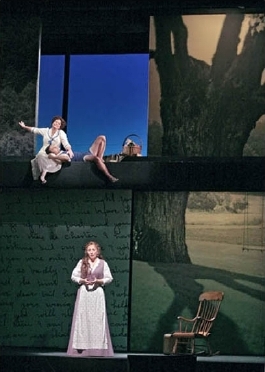
And there’s where I found this image:

Aha! I cried and shared with everyone else. This is a possible solution to the Inn: bilevel, with sliding panels. I’ll do some sketches this week and play with the idea.

Today I also tided up around the Lacuna website and my own, especially, the What I’m Reading Now bits.

Some images (Day 198/365)

One of my goals for my winter break this week is to knock off a whole stack of reading from the media center. I finished The Schwa Was Here, by Neal Shusterman, last night. It was very very excellent, honestly funny and thematically rich, a much better choice for the Newbery Award than, say, The Higher Power of Lucky, by Susan Patron (which did win this year’s Newbery.)

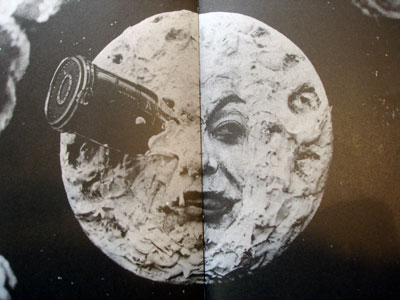
Today I knocked off The Invention of Hugo Cabret, by Brian Selznick, a thick, black book that is shorter than it looks: it’s a combination of cinematic/storyboard pencil drawings interspersed with the actual story. Very clever and well written. The plot leads back to the early French filmmaker Georges Méliès, and yes, you already know who he is, because you know this image:

Melies, man in the moon

This is from his classic A Trip to the Moon. At the end of the book, the hero Hugo Cabret attends a retrospective of Méliès’ films, and the book shows the following images, which I could not find on the internet and so had to photograph from the book. Continue reading “Some images (Day 198/365)”

L.A. musings, part 2 (Day 197/365)

So Mahagonny, despite blurbs from the L.A. Opera that it has been reviewed as “red-hot” and “like Las Vegas on steroids,” was a bore. (I reiterate that all participants were excellent; the piece itself is what sunk them.) What does that have to do with us?

I was struck by the fact that Mahagonny was originally a collection of poems by Bertolt Brecht, which were then set to music by Kurt Weill, and then wrestled by the two into a full scale performance piece.

Sound familiar?

On one front, John’s directorial choice to freeze the stage picture most of the time, I think we’re free and clear. His deliberate, static staging was supposed to appear monolithic, I guess; all these free spirits who were living with abandon in Mahagonny were in fact straight-jacketed by their own choices, maybe? Perhaps it gave a different impression from the orchestra section. In the balcony, it was stifling. (General note to directors: check your blocking from the balcony. It looks different from up there.)

At any rate, I don’t think we have that problem. Yet. Of course, we haven’t put any of our three pieces on their feet yet, but at the moment it looks as if we have all three of them moving throughout.

A second issue was that the characters were internally inconsistent. Was Lumberjack Jim an innocent or a debauchée? Did he have hope for the future or did he want, Samson-like, to pull it all down around their ears?

Again, we don’t have that problem. The rabbit is always officious, the tiger is always sweet-natured, the King of Cats is always pompously silly.

However, I think we will have to be careful with our decision to allow each piece to have its own universe, its own mise en scene. It may sound kicky for us to allow the tiger to be a human in “Sun & Moon Circus,” a puppet in “Milky Way,” and a Chinese dragon in some other piece, but we will need to be thoughtful about how the audience will tie these together. (I’m not saying we shouldn’t do it, just be deliberate.)

Finally, like William Blake, Mahagonny didn’t have a plot so much as an aggregate of incidents. I think that this was a problem for Mahagonny because they didn’t add up and in fact fought against being stitched together by the mind into a whole. Of course, that may have been deliberate on Brecht’s part, but it’s not something I would advise for any theatre practitioner.

William Blake is even less plot oriented than Mahagonny, but this is probably to our advantage. Because there’s no seeming build-up (the city gets larger, Jim meets Jenny, the hurricane approaches), the Inn is freed from that audience expectation. Instead, we can afford to drift from one piece to the next, like a kaleidoscope. In fact, I think we are well-advised to avoid trying to piece together any kind of bridge or storyline to try to tie them all together in some kind of coherent beginning-middle-end “plot.”

And that’s what I learned from Bertolt Brecht last week.