Random rants

I had a week’s worth of New York Times waiting for me when I got back from Munich. I can’t leave this nation alone for a minute!

Herewith are a couple of quick rants:

It seems we are considering a new way of achieving Eternal Lasting Victory Over Evil™ in the Near East, as we used to call it. We’re thinking of giving arms to that sea of troubles (i.e., the tribal factions in Afghanistan and Pakistan) and by letting them oppose the Taliban and Al Qaeda, end them.

Well, it’s never worked before, arming people who don’t like us but who appear to hate some of the same people we do, other than help create Al Qaeda in the first place, so why not see if it might not help this time?

In a really neat little story, the Belgian Federal Police have hired a handful of blind detectives. The reasoning was that their more acute hearing would prove useful in surveillance and in analyzing recordings, and so it has proved. The detective featured in the article, one Mr. Van Loo, is a neat guy and has chalked up several anti-terrorism cases. He’s able, when listening to surveillance tapes, for example, to tell where the person is calling from by listening to the ambient sounds and echoes on the tape.

I suppose our country could try hiring blind detectives to help with the Eternal War on Terror™, as long as they weren’t gay.

India has started requiring tourists to pay admission fees to national monuments like the Taj Mahal in rupees. They used to accept dollars, but they found they were losing money as the dollar slid more than 12% against the frigging rupee! What can one say?

In the Eternal War Against Brown People Who Mow Our Lawns™, we were successful in tracking down the arch-criminal Saída Umanzor, a maid. We quickly imprisoned her and were able to snatch her three children at the same time, including her nine-month-old daughter, who adhered to her communist/Marxist/socialist/liberal background and immediately refused to eat for three days. Something about being breast-fed and refusing a bottle or something. The arrogant infant also tried to hide behind her status as a natural-born citizen.

According to the Times:

Groups advocating curbs on immigration say that children of illegal immigrants cannot be spared the consequences of their parents’ legal violations just because they are American citizens (…or children! , Ed.)

“Children are not human shields,” said Ira Mehlman, a spokesman for the Federation for American Immigration Reform.

Hear, hear, Mr. Mehlman. Next thing you know, that damned baby is going to be squalling about equal justice for all. But let her; she and her whole family were deported later this week. Suck on that, brown underaged American citizen communist!

Tomorrow, Al Gore returns to the White House. It’s sort of embarrassing, really. It seems the man who won the 2000 popular vote also won the Nobel Peace Prize, and since the White House has always honored American laureates, it couldn’t find a way to back out this year just because Mr. Gore has been honored and vindicated every which way to Sunday. However, Dear Leader’s administration has overcome tougher realities than this one, so I look for the Eternal Terror Alert Level™ to be raised to PURPLE by tomorrow afternoon.

The Democrats continue to pass funding for Bush’s Eternal Iraqi Occupation™, and Bush continues to block it via his Congressional toadies and lickspittles like, oh, every one of Georgia’s delegation. Must be one of those Washington things.
Munich, Monday, 11/19/07

My, how time flies when you’re slogging through Munich.

As much as I would have liked to, it was just impossible to blog about each day. We’d get back to the hotel late, and then, if we wanted to be any kind of rested for the next day, we’d have to hit the sack.

So, apologies for not blogging the trip in real time. I will now attempt, in some multiple posts, to give the hilights version.

On Monday, Grayson took us to three major churches we had missed on Saturday.

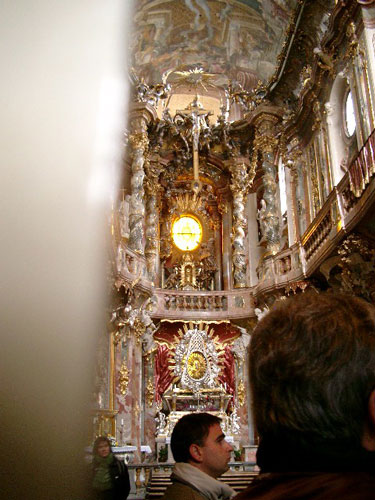
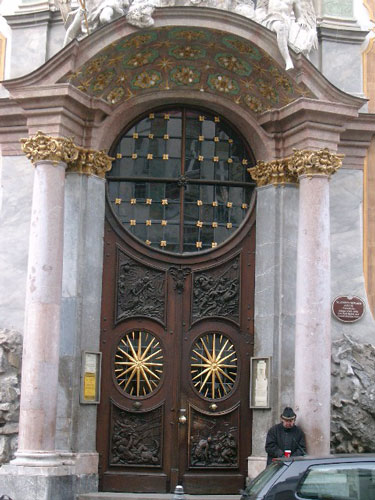
First, the Asamskirche: built by the brothers Asam as their private church (it’s sandwiched into a tiny lot beside the home of one of them), it was eventually opened to the public as it became more and more expensive to complete.

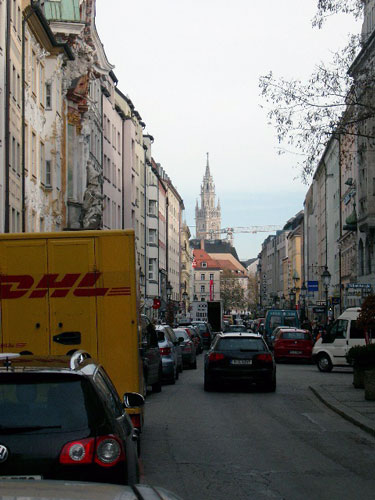
Here’s the street it’s on. No, that’s not it in the distance. That’s the Neue Rathaus. The church is on the left, above the DHL truck.

Here’s the door of the exterior:

And here’s the top of the exterior:

And inside?

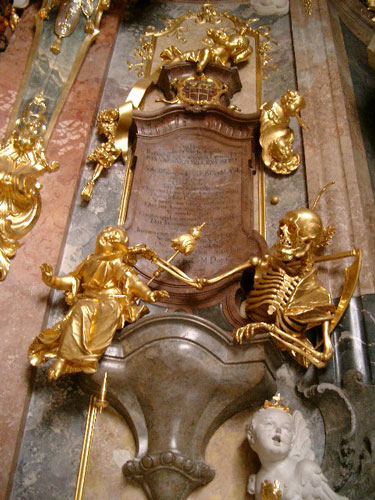
That last little bit is in the narthex: it’s an angel with a distaff, spinning the thread of life. Death is snipping the thread with his shears.

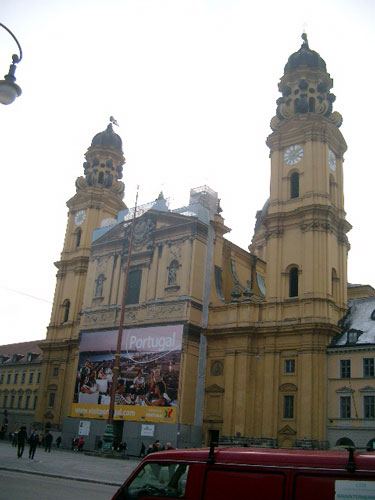
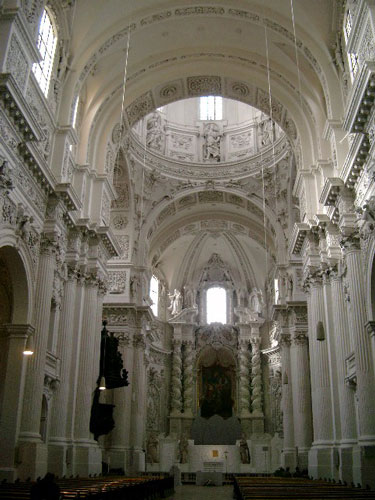
Our next stop was the Theatinerkirche, at the Odeonsplatz:

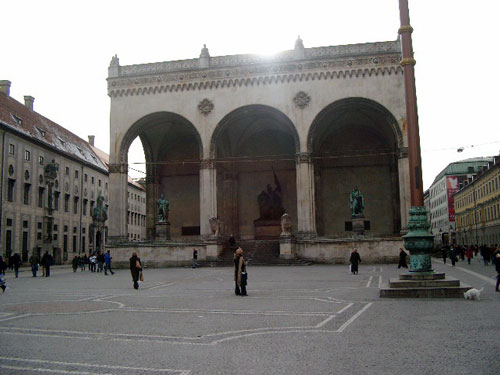
This is the Odeonplatz, built by Ludwig I, who did some town planning in the early part of the 19th century, including this nice little folly at the end of Ludwigstrasse, a main thoroughfare leading into town, lined with the magnificent buildings of the University. To the left is the Residenz, the palace of Ludwig’s Wittelsbach family, and to the right is the Theatinerkirche:

Notice the scaffolding across the front, and how it has both a photo-poster of the actual facade, plus an ad. Hold that idea; it will return.

And the inside:

Woof. “Soaring” and “baroque” do not begin to describe this interior.

The altar.

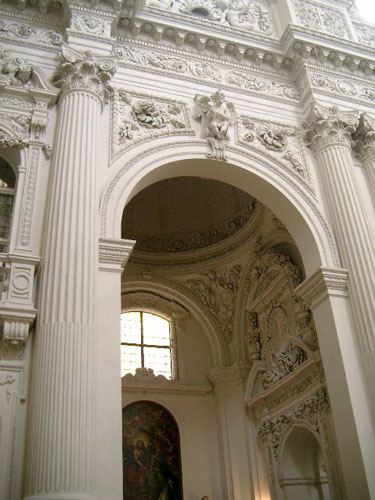
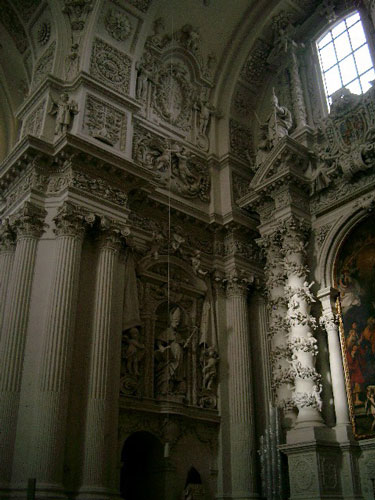
Architectural detail, above and below:

Part of what numbs the brain about most of these places is that these are actually, essentially, replicas. Most of Munich was damaged, like 90%, in the final year of the war. We were trying for the Nazi headquarters; without smart bombs, we got places like this. (The Nazi headquarters was unharmed. It is now a performing arts high school. Jews and queers, could it be any more poetic?) Anyway, Munich set about and rebuilt all of what you see here.

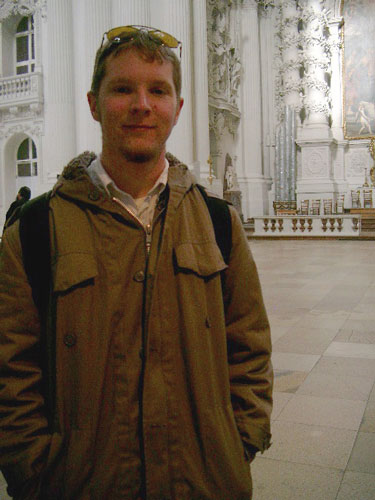
Our tour guide:

As you can see, he looks self-satisfied. Finally, he took us to his favorite church, the Ludwigskirche:

He likes its clean, neoGothic lines, and for some reason, its quasi-Renaissance frescoes.

At this point, the child begged off: he had work to do. We were astonished and pleased. We ate at a really crappy restaurant that was pretentious but awful. German haute cuisine is not quite there yet.

Munich, Sunday, 11/18/07

We slept in. Grayson came to the hotel, then off we went.

Our hotel is the Creatif Hotel Elephant. We chose it on the internet because the price was right, the location was good, and the design was irresistible. Here’s the exterior:

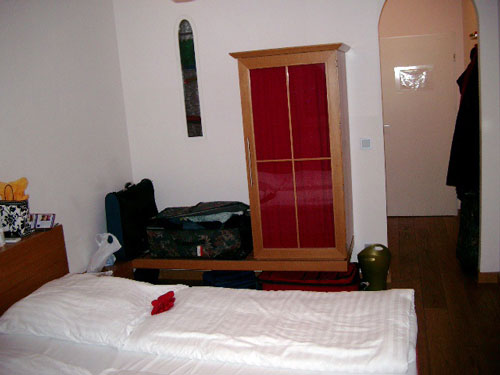
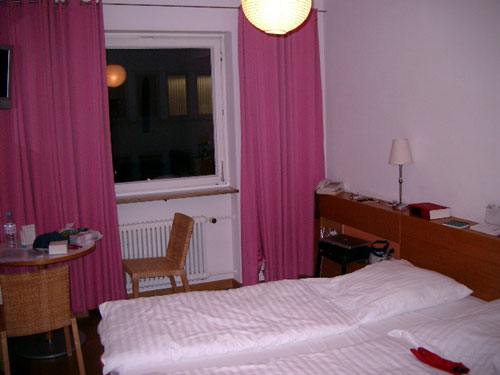
The rooms, recently renovated, looked bright and funky:

As it turns out, we like the Elephant very much. The room is very comfortable, with the duvets actually being a perfect sleep situation: we each have our own, so there’s no tugging at the sheets. The neighborhood is relatively quiet (although as Grayson pointed out, there is not much traffic to begin with and certainly none after 10:00.)

The staff is friendly; their English is good, and they don’t laugh too much at my German.

First we hit the Hauptbahnhof, right across the street almost, for breakfast and ATMs. I had a chocolate croissant, which I didn’t realize meant “with thick, goopy chocolate huddled at the end of the croissant.” Chocogoop, mmmmm.

Our agenda of the day was museums, specifically three of the four major museums. We took them in chronological order, starting with the Alte Pinakothek. This is the early Renaissance to late 18th century stuff, including the largest collection of Rubens on earth. Apparently, according to our tour guide Grayson, the whole museum was built around one gigantic Rubens, the centerpiece of the central hall. It’s about 30 feet tall, depicting the reward of the virtuous at the Last Judgment.

No world-famous works here, except maybe the Dürer panels of St. Matthew and Luke. Still, seeing such great work is still an education for the eyes and brain.

The museum itself (no picture; at this latitude the sun is always behind it) is magnificent: one long gallery of huge rooms on the back of the second floor with a secondary gallery of much smaller rooms (and smaller works) across the front. The exterior is therefore a long, thin building, fronted like a palace.

To get to the gallery, you climb this gigantic double staircase which was tacked on to the back of the building in the 1950s as they were rebuilding it. (Yes, we bombed the place. At least it could be repaired, with brick that deliberately does not match the original; its partner, the Neue Pinakothek across the street, was completely destroyed. Its building is modern.) The effect of the staircase is quite nice: the former back of the building was left, the brick scrubbed, the architectural detail mirrored on the new exterior wall. It’s quite a post-modern look.

Next was the Neue Pinakothek. Most of this was worthless 19th century Academic crap. I am not over-exaggerating. When we got to the period where they decided the best thing to do was to fall back and copy the Renaissance masters, I just started walking through the rooms without paying much attention.

Finally we hit the room where the late-19th century began to fall apart, and the art once again became interesting. You could tell that someone had been to Paris and seen what was going on. There were a handful of the French.

Lunch was at a little Italian place near the museums. Ginny said her spaghetti was good. My lasagne was not quite what we’ve been taught to believe Italian cuisine is like, nor was it warm.

Third and last on the day’s agenda was the Lenbach Haus. Herr Lenbach was a portrait painter of the gilded age, and he built himself this quite large Italianate mansion. It now houses the Blaue Reiter group, plus exhibits of new, and here I mean new, stuff.

The exhibit was very nice, showing the growth of the Reiter style through Kandinsky’s work and that of his lover and their best friend couple, none of whose names I remember. As they picked up adherents, those paintings joined the walls. I was delighted to see Paul Klee, one of my favorite artists.

After the three museums, I was parched, so we went to a bar and quenched our thirst before setting out for supper. This was at a restaurant recommended by our hotel, the Al Teatro, which true to its name was next to a Fox-style theatre. A show called Miami Dance was playing, and it looked truly trashy. However, Grayson resisted seeing it, too gay or something, so we ate and let him hit the bus to go home.

We headed back to the hotel and were soon asleep.

Munich, Friday & Saturday, 11/16-17/07

Already it’s a hassle:

At least one of the travel websites we’d gone to said to declare any electronics before leaving the country so that Customs wouldn’t give you a hard time when you brought them back in.

So after we made it to Concourse E, I went to do so: back down the escalator, where there was no visible office for Customs. At information, I asked and was given a paper slip, a pass to get to the Customs office. Where was it? “Around the glass.” I fumbled my way down a glass corridor, where a TSA lady sat at an office desk plopped in the middle of a hallway.

She looked at the pass, called on her walkie-talkie for a supervisor. Eventually one showed up. I needed to go to the Customs office to declare some electronics, I said. You don’t need to do that, he said.

Oh, OK. As we began to move back, I asked for his name, suggesting that it would come in handy if I were in fact hassled on my return to the country.

Well, we’re just TSA, he said, we have nothing to do with Customs. I need Customs, I said, I told the lady I needed Customs. Around there, he said.

On I went, allowed through two little stanchions by a polite TSA lady. Into the Customs office I went, where I was told by the Customs man that I could declare them if I wanted, but it wasn’t really necessary any more.

::sigh::

So back I went.

Only I was now in the international transfer area, and to get back to the other side, I had to once again go through security. I asked the polite lady who had let me through if she could let me go back through, but no, I had to do the whole security thing.

In my case, it’s not only the shoes and the jacket and the personal effects, it’s the laptop (out by itself) and my carry-on bag and my C-PAP, which is in the carry-on bag and has to come out. It takes three trays, plus the bags.

I get all the way through and am waiting for the final item, when here comes a TSA person with my C-PAP. Is this a breathing machine, he asks? Yes, of course. It has to come out of its case. Don’t touch it. You have to go back and unpack it and send it through. It’s the new policy.

New since ten minutes ago upstairs? When I went through upstairs, no one was aware of this new policy. So back I went, leaving my laptop and everything to the mercy of the continuing flood of international drug lords coming through.

He plopped the C-PAP case and a tray down and walked away. I peremptorily called him back to ask exactly what had to be unpacked. He pointed to the reservoir. I asked if he didn’t mean the motor part. He mumbled. I took both of them out. The next guy told me only the motor part needed to be out, and waited until I repacked the reservoir.

Finally I was through and began repacking all my crap. I was down to my personal effects, and that’s when I noticed my passport was missing. I was about to blow my stack when the first guy came back, bearing it.

Grr. It is no wonder that undercover people from the GSA were able to sneak bomb parts past security in all 19 airports they tried it in. They are inefficient and inconsistent.

An uneventful flight. The dinner was not bad. We watched Hairspray on the little monitors, and it was entertaining, although I was not convinced by Travolta in drag. He seemed to be in another movie altogether; his accent especially seemed more authentic than the rest of the cast was willing to commit to.

Fitful sleep, of course, and we arrived in Munich about 20 minutes late, 8:11 CEST.

There is no child to greet us, needless to say. He had all the information he needed, and at this very moment it is one hour past our original arrival time. I imagine he will wish he had written down all the info I’ve sent him over the past few weeks, like the hotel we’re staying at. There is no internet access here at the arrival gate. We may actually have to wait until we abandon hope and go to the hotel to email him and catch him up to speed.

Ginny has wandered off to the shopping area to see if she can find a cell phone for the week. I wish we had a camera crew with us; she has absolutely no German.

Soon we will have to figure out how we’re getting to the hotel on our own. An adventure!

It seems that the child had already booked an adventure with friends. He didn’t know exactly when or even what day we were coming in. (Can I show you the emails?)

We took a cab, which was stupid and very expensive. We’ll be taking the train back, needless to say.

The hotel is small and funky, very cute. Our room was not going to be ready until 2:00, so we left our luggage and headed out to see what we could see.

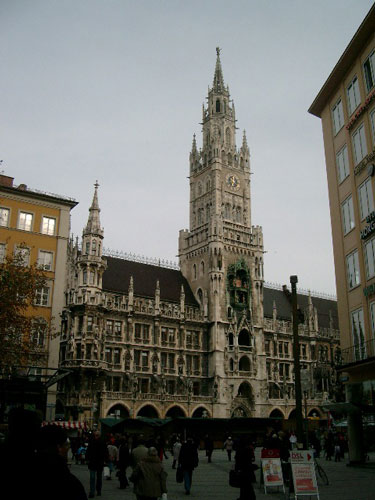
We managed to make it to the Marienplatz in time to hear the newly restored Glockenspiel play, with its double-tiered parade of carved characters. The Neue Rathaus in which it perches is an excessive pile of late Gothic civic pride:

We saw three major churches, each a different style: Peterskirche, majorly roccoco; Frauenkirche, quiet neoGothic; and Michaelskirche, a tremendous baroque effort. (I have no pictures. I don’t know why.) The Frauenkirche’s chorus and orchestra were rehearsing Bruckner’s Mass in F, which they performing tomorrow night. We may attend. It is gorgeous, especially in a space with a 5-second reverb.

We also stumbled across what passes for the Apple Store. Whee! I went in to play with the new operating system, Leopard, my first chance to do so. Very cool, as advertised. I tried to pull up this blog, just as a mark-leaving kind of deal, better than tagging buildings, I dare say, but that particular iMac was not hooked up to the internets. (Not really an Apple Store, was it?)

We finally wound our way back to the Creatif Hotel Elephant, where we found that someone had been looking for us, fruitlessly. Good. Serves him right.

After a nap, I finally got in touch with the child. He came back in from his suburban home and we walked the city with him, getting history and art along the way. We ate at one of his favorite restaurants, where the food was good if not exactly cheap. (Is anything here cheap at this point in history?)

He took great delight in correcting my faltering German, and especially clueing us in to the social niceties. Not just nochmal gin und tonic, but nochmal, bitte.

Overall: Munich is a beautiful city. Ludwig I did a massive building job post Napoleonic Era, and even after the city was bombed to bits in WWII, they rebuilt it all.

30 years later

Last weekend Ginny and I returned to the University of Georgia for the first real visit since we left, which was 30 years ago. What a long strange trip it was.

The occasion was the Department of Theatre & Film Studies’ invitation to the New Georgia crowd to come and share its collective wisdom with the student body. And what might the “New Georgia crowd” be, exactly? After they graduated (more or less) in 1977, David Wright and Wayne Knight went to New York City to break into show business. They found an apartment, and in their own words, “we were all like cockroaches: you open the door for one, and the rest streamed in.”

Others followed to the 71st St. apartment, fanning out to their own places, but never losing touch with the home base. These 10-15 UGA theatre students found jobs for each other, found places to live for each other, supported each other through the hard times, rejoiced when they triumphed. And every year they came together for a Thanksgiving feast.

The Dept. of Theatre & Film Studies thought it was important for their students to see what that kind of support group was like, a group that was still in touch with each other 30 years later. Also, I’m sure that the fact that one of the group was Wayne Knight helped in deciding to pull this thing together.

As it came together, there were more than a few of us from that era who had not gone to NYC who got pulled into the event: me, Paul Pierce from the Springer Opera House, Paul Gendreau from LA, a couple of others. Our tangentiality to the main New Georgia crowd didn’t seem to present a problem to the department.

There was to be a large dinner on Thursday night, a Friday full of sessions, and then a tailgate party and football game on Saturday. Ginny and I had planned to drive up Friday morning and lurk through the Friday events, staying in a hotel in Commerce before coming back on Saturday morning.

So I was a little astonished when we all got an email outlining the agenda for the day and I found I was part of a session with Paul Pierce discussing “Future Developments for Regional Theatre.” What? I quickly emailed back and said that was fine as long as everyone understood that I ran an adventurous community theatre, not a regional theatre in any sense of the word. Not a problem, they said, the students will love it. Which does not argue for any perspicacity on the part of current UGA theatre students.

Both Ginny and I had deep misgivings about going to this thing. Ginny, especially, felt she had gone far astray from the path we all thought we had set 30 years ago, and the thought of coming back into contact with those who followed that path did not make her happy.

I had different feelings, of course, because I essentially have followed the path I laid out for myself: teach, run a community theatre. But there’s always the Road Not Taken, isn’t there? I have absolutely no regrets over my choices; I have gotten exactly what I wanted and probably more than I deserved. But I don’t think anyone can avoid the wistfulness that comes with age: what if I had gone to New York? What would my life have been like then?

Solitary, poor, nasty, brutish, and short, in all likelihood. But at least one of those alternate lives had glittering prizes, didn’t it? I can’t even solidly imagine what those might have been, of course, but I know they’re there, in that other there. As Hemingway wisely says, “Isn’t it pretty to think so?”

Overall, the event was a lot of fun. The memories poured out, one former professor, now retired, showed up for the tour of the building just because he wanted to hear the stories he knew would emerge. Wayne, our most famous compeer, is still just as funny as he ever was, and seemed quite happy to be among those of us who knew where he came from. He and Paul Gendreau, also a tremendously funny guy, had a lot of interesting things to say about life in the Big Time at lunch, especially with the writers’ strike going on.

We were all appalled to see that the Fine Arts Building, after being renovated during our final years there, has not been touched since in any meaningful way. The department has expanded to fill the building, the music department got its own huge, new, shiny building on South Campus, and they are about to begin major expansion/renovation, but last weekend it was exactly the same as we left it.

That led to a lot of interesting frissons: seeing the costume shop, where most of us toiled in joy; the stages where we directed and acted; the classroom where Ginny and I first met. It seemed a lot smaller. At least one other former couple in the group had a similar experience, in a different classroom.

Everyone’s lives have gone nicely and everyone seemed happy. Of course, we were the ones who chose to return and whose lives have positioned us so that we could afford to. (Another plus to the Current Road, of course.) There were quite a few people whom we missed; some of them, we don’t know where they are.

You always wonder: how far off our glorious path have they wandered? It’s easy to say, Oh, that doesn’t matter, they should have come, we just would love to see them. But I know that if even someone as successful as Ginny and I are had qualms about attending a reunion for “real” theatre people, how much more daunting might it be for someone who is selling used cars in Indiana? If one thinks that one’s undergraduate degree was simply a stupid detour, an ill-conceived conceit of a clueless adolescent that gave no meaningful direction to one’s eventual life, how crushing would it be to have to revisit that decision in earnest?

And what a relief, truly, to know that I have never been faced with that particular Road.

NCLB

No Child Left Behind.

Well.

My sister Linda is a media specialist in Gwinnett County, where last year they gave their media centers zero dollars to buy books with, but that’s another story. A couple of weeks ago she forwarded to me a response she had gotten from her congressman, who shall remain nameless in his representation of Georgia’s Seventh District, about supporting H.R. 2864.

H.R. 2864 is an amendment to that most perfect of laws, No Child Left Behind. I know what you’re thinking, what kind of madman would advocate changing a law that has served our children so well? Without NCLB, how would we ever have gotten halfway to having every single one of our children performing at or above grade level? (In case you had forgotten, that’s the goal: in 2014, every single child will perform at grade level. We will achieve this by testing them until their ears bleed.)

But Rep. Paul Grijalva [D-AZ] has had an insane idea: what if we required every school to have a highly qualified library media specialist? I know, it’s crazy talk.

As you know, NCLB requires schools to verify that their classroom teachers are “highly qualified,” i.e., provide documentation of their competence in their subject area. This might mean passing a standardized test for teachers, well, duh!, or even having a degree in the subject. If you teach more than one subject, e.g., earth science and biology, then that means providing evidence of competence in both areas.

The more cynical among you have already spotted that “highly qualified” has nothing to do with “highly competent,” which is not adjudicated by NCLB, praise be to its name.

If you teach in a rural school, which by the DOE’s own calculations means about a third of all American schools, and you have to teach all kinds of things because it’s a little hard to get teachers out in the middle of Montana, don’t worry: you have three years to cough up evidence of competence in your field(s). If not, then you have to be fired. Because if we don’t fire you, there’s no way to get 100% of the students performing at grade level by 2014.

That’s “highly qualified.” As columnist Bob Herbert pointed out in his New York Times op/ed of 10/2/07, all that documentation and certification is not the same as effectiveness. (Of course, then Mr. Herbert weasels out of it with “New forms of identifying good teachers … have to be established before any transformation of American schools can occur.” Yup, that’s what we gotta do, all right, all right. Carry on.)

Why, you might ask, would I want to saddle media specialists with the burden of proof that their colleagues in the classroom have to bear? Allow me to point out that even if the amendment only required schools to have any kind of media specialist in their building, it would be a radical move. There are more than a few states which do not, in fact, require schools to have media specialists at all. So if we have to speak NCLBese to make sure schools have such a critical piece of the puzzle on hand, then so be it.

Back to Rep. X and H.R. 2864. My sister had emailed him, asking for his vote in favor of this amendment. Astonishingly, he responded that “quite frankly” he questioned “the need for a library media specialist in every public school.”

His reasoning? He sees maybe the need at the high school level, because high school students regularly engage in academic research for college. But “a fourth grade student has little need for a highly trained library specialist who can teach advanced research techniques.” What a fourth grader needs is a librarian who can “make reading enjoyable,” and “instilling a love of reading does not require an advanced certification in library media studies.”

Actually, Rep. X (I just know I’m going to slip up and call him John Linder in a moment), instilling a love of reading does in fact require advanced certification in your home state of Georgia. We have to have a master’s degree even to get into a media center in this state. So you’re wrong about that.

What else might you be wrong about? Those who keep harping on how our schools have to produce workers who are expected to maintain our nation’s competitiveness in the world economy, and I believe some might even be found in your party, Rep. X, might be startled to hear you say that we don’t need to teach our elementary students how to find and use information, how to evaluate information, how to solve problems with information.

They would approve highly of the fact that I start teaching second graders how to look up books and find them on the shelf, that in fact by Thanksgiving almost all of them can do it flawlessly, and that by the end of the year I have first graders and kindergarteners who have learned the same skill.

They would really approve of the fact that all of third grade spends the year learning to implement the Big 6 model using a wide variety of information sources, including the internet. These are eight-year-olds, Rep. X., and yet you would have me wait an entire year more before even trying to “instill a love of reading”? Are you talking story time, Rep. X? Honey, please.

And so you can see why, when talk turns to reauthorizing NCLB, all blessings upon it, I just roll my eyes. Look who’s doing the reauthorization. Can we test them until their eyes bleed?

Our world

Your president told reporters this week that Mukasey should be approved quickly by Congress, because “he’s plenty qualified to be attorney general.” And yes, he said it in exactly whatever Bush-parody accent you want to deliver it in. “Plenty qualified.” He said it in a first-ever, for him, press briefing in the Oval Office. He got the idea after seeing a photo of Truman doing the same thing. Pretty dang cool, huh? Maybe we should show him some photos of Nixon ending the war in Vietnam.

Meanwhile, Bush’s BFF Musharraf has all but declared martial law in Pakistan. That’s over there next to Afghanistan. Where Osama bin Laden is hiding. In the northwest regions so lawless that they’re simply referred to as the tribal “areas.” This is the country that already has nuclear weapons and has had them for some time.

Musharraf says he’s shut down the courts and the mass media out of security concerns. (He has left the Parliament functioning for the time being.) Dana Perino, White House press spokesperson, was asked about the situation.

Q: Is it ever reasonable to restrict constitutional freedoms in the name of fighting terrorism?

MS. PERINO: In our opinion, no.

Mercy. Didn’t that set off alarms in the press room? I mean, when the irony meter blows a fuse, doesn’t that set off an alarm somewhere? I guess not.

In Lahore, a name which I’ve always tittered over, not unlike the word titter, now that I think about it, the main protesters against Musharraf’s power grab are the lawyers.

Yes, lawyers. There’s something odd about the photo on the cover of the Times, a man in a suit and tie hurling a tear-gas canister back at the police. There’s something odd about all the photos of these black-besuited barristers taking to the streets. There’s something awfully Monty Pythonesque about it.

Including the following scene: Two new judges who had taken the oath of office under the emergency rule were forced to leave the courtroom by hundreds of angry lawyers shouting, “You’ve taken an unconstitutional oath; if you don’t go we will throw eggs at you.” Apparently they left.

So, lawyers, eggs, and support for the Constitution. I’m in. Anyone else?

Fedallini’s Catalog

It’s Tuesday, and I’m home with a raging cold, so not therefore up to writing an extensive post, but I did get some work done on Moonlight on Sunday that I could talk about.

In Act I, Thurgood (Groucho) is hiring Fedallini and Pinke (Chico and Harpo) to kidnap the girl so his son can be the hero. He expresses doubt that Pinke could die convincingly, whereupon Fedallini strikes up a cheesy saltarello and catalogs the many ways Pinke kicks the bucket.

Here’s the intro:

You think he look healthy,
like in-a da pink,
He no kick-a da bucket,
Dat’s what-a you think,
But he’s great at da croaking
and dat’s-a no lie;
Give him some room-a
And watch-a him die:

The rest of it’s in couplets, and I don’t have one I’m happy with yet, although this one comes close:

You can chop off his head wit’ da axes of steel,
He can cough up da blood like dat lady Camille.

One problem is that “I Would Never” is still fresh in my head (and why not, since it’s not complete, either) and that song’s triplet melody keeps intruding. No independent melody has suggested itself at this point, so I’m contenting myself with working on the words.

Another problem is that this kind of patter is very hard to write. It not only has to make sense and rhyme in a meaningful way (meaningful = within the sense of the lyric and often setting up a punchline if not a frisson of delight at the mastery of the lyricist), but it has to, more than most lyrics, be speakable. It can not trip the tongue. It can’t even approach tripping. That’s why the “dissociative disorder Delores” verse in “I Would Never” will be the first to be cut: dis-sosh-tive is impossible to sing.

There are two lyrics I’m very proud of that illustrate what I’m talking about, both from Figaro. The first is from Bartolo’s Act I aria:

Digging through cases for clarification,
I’ll cover our bases for alienation.

That’s damn good, folks. The crafty old lawyer is going to take up his housekeeper’s breach of promise suit against his enemy Figaro and has worked himself up into a lather at this point in the song. Notice the internal rhyming as well. Mostly notice how the singer’s tongue never has to make a false move here, especially if you ‘tip’ your r‘s like you’re supposed to.

The other example is from the end of the Act II finale, when Bartolo, Basilio, and Marcellina burst in, waving the contract and demanding justice. Each has a little outburst, starting in eighth notes but erupting into sixteenth notes halfway through:

MARCELLINA
See the contract that he’s signed here,
It’s designed to be unbroken
With his promises unspoken,
And I want to make it clear!

BARTOLO
As her lawyer, I’ll defend her
And intend to publicize it
So the world will recognize him
As a scheming profiteer!

BASILIO
As a man who’s known for living
Well, I’m giving testimony
That he promised matrimony
If he couldn’t pay the dear!

In each case, I went da Ponte one better and threw in that quick cross rhyme at the end of the first line. The –eer rhyme was the “anchor rhyme” of the scene, the one that was used across the entire scene. That was a handy way to signal a shift in the proceedings.

The point is that “patter songs” are devilishly tricky. It’s not enough to have something that rhymes and makes sense. It also has to be singable in a way that is much more comfortable than every other kind of lyric.

It occurs to me, just now, that Fedallini isn’t going to sing this song anyway, he’s going to speak it, so I don’t have to worry about the whole lyric/melody/character nexus at all. Well, that’s one problem solved.

Write, dammit!

Tomorrow is the first day of National Novel Writing Month, aka NaNoWriMo. As an example of mass hysteria, it’s pretty hard to beat. You simply go to the website, register as an offender, and then strive to churn out 50,000 words in 30 days. Many people do this. I know a couple.

However, I am not one of them. I often wish I were, which I know is insane, but I have this secret desire to have written a novel. Notice that I did not say that I hanker actually to write a novel; I just would like to have done it.

I did it once, of course. Back in the Adolescent Lit course we all had to take, we were given a choice of either a) reading and reviewing 70 young adult novels, or b) writing one. Ptttt, I said, if S. E. Hinton can do it, I can do it.

So I did it. Every Sunday morning at church, during the sermon, I’d outline the next chapter, then write it during the week. I think it ended up being fifteen chapters (not counting the “suppressed chapter 13”) and followed the fortunes of some teen members of a community theatre. Go figure.

I still can’t tell whether it’s any good, of course. The kids at ECHS I let read it (not all involved in the theatre, thank you) enjoyed it and clamored for more. The one agent I sent sample chapters off too several years ago returned it with a snippy note saying it wasn’t “creative enough,” whatever that means.

So why not do it again? I had started a sequel. The first one was Twelfth Night, New Day; it balanced the main characters’ emotional lives against the lunacy in Shakespeare’s play. The next one was called I Love You in Earnest, and of course our gang was doing Oscar’s masterpiece. I had decided to see if I could write a teen novel using a quasi-Trollopian discursive style (this was the early 1980s; it’s been done since), and the focus was going to be on a newcomer who was openly gay and how this raised the whole question of who is/who isn’t. You can see how that would dovetail into the whole Wilde/Earnest thing.

I never finished it. Either I lost steam, lost interest, got too busy at the theatre/GHP/whatever. I seem to remember not being able to figure out what would drive the plot; I had used a false alarm over sex in the first one and didn’t want to repeat that gambit. I had some vague idea of our newcomer’s performing an act of perfidy, but I couldn’t pin that down. What on earth could he do that would deserve the name? I didn’t want to involve his sexuality; that was a separate theme.

Anyway, here we are at NaNoWriMo and I envy those people who are going to crank out 1700 words a day. So what’s stopping me from becoming one of them?

The main reason is time, naturally. I have to crank out a dozen more songs before Christmas for Moonlight, and I’m getting nowhere fast on that project. Adding another daily task would be madness. Of course, part of me suspects that I might find my creativity charged by the daily task. Stimulating the brain to knock out the 1700 words every day might carry over to writing of lyrics and/or music. It might.

I could even make it about a guy writing a musical. I could.

Another very real reason, however, is that I don’t really have anything to write about. I know, I could just start writing. No one really writes a novel in November. They just write 50,000 words, which I suppose they wrestle into shape in the months between this November and the next.

But I really don’t have anything to write about, not like the way I have things to compose about. I have ideas and urges for the symphony, for Maila’s trio, for Moonlight, that I just don’t have for characters, plot, theme, and dialog.

There’s also the problem, and it’s personal, that any thing that I write about that looks even half like my life, and what else would I write about other than schools and theatres without having to go research the whole thing, raises immediate suspicions about just how much my characters are me. I’m thinking of our author Z now.

Finally, there’s the problem that I am not really an acute observer of humans, not even myself. In War & Peace, young Nikolai Rostov is finally about to see action in battle. He’s had a run-in with a superior over another superior who stole from his friend Denisov, and sitting on his horse waiting for something to begin, he starts to fret about this superior’s being so near to him and yet ignoring him. Within one paragraph, his mind concocts four different reasons for the man’s behavior. That’s the kind of incisive understanding of how humans work with which Tolstoy fills 1200+ pages and I can’t even imagine.

So, anyone else going to do it?

I Would Never

I worked on “I Would Never,” Groucho/Thurgood’s Act II novelty song, in which he sings (for seven verses and choruses) how he would never disparage a lady just because she had some hysterically funny thing wrong with her. I wrote the music for the verse, then started patching it together.

It still lacks an intro, in which he’ll introduce the concept (referring to Lydia and Egyptian Ella in the process), and it lacks the end, in which he lets loose with a long catalog of names. I’m also going to work in a Gilbert and Sullivan-esque chorus for him.

Here’s the piano score, and here’s the mp3. This is a long song.