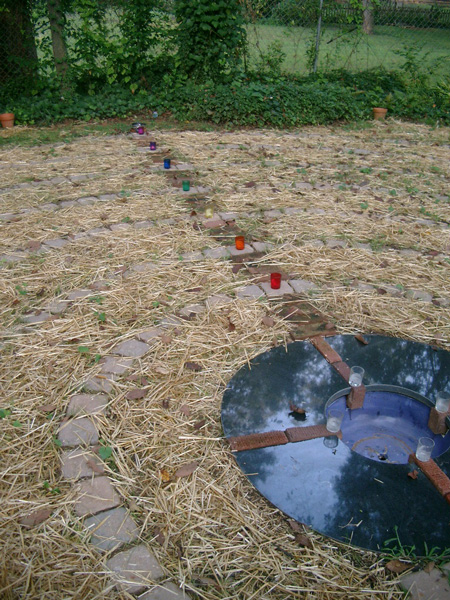
Labyrinth, 9/19/09

I bought a book on ferns last fall and uncovered it during a recent spate of cleaning. I got serious about looking for some new kinds of ferns for the back yard and actually found a nursery in Virginia, the Crownsville Nursery, that carries a great variety of them. Yesterday, a box arrived with my new babies:
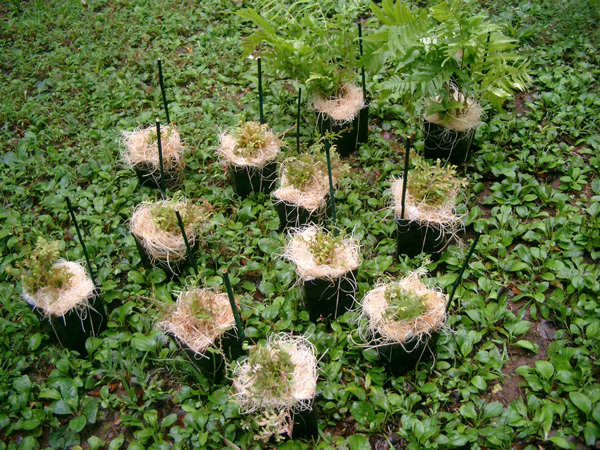
The packaging was quite clever: the packing straw is held in place with rubber bands, which keeps the potting soil from coming loose. Each pot has that stick in it, which kept the top of the box from crushing down or the pots from flying up. All of this actually allowed the larger ferns to travel free and unbroken. I was impressed.
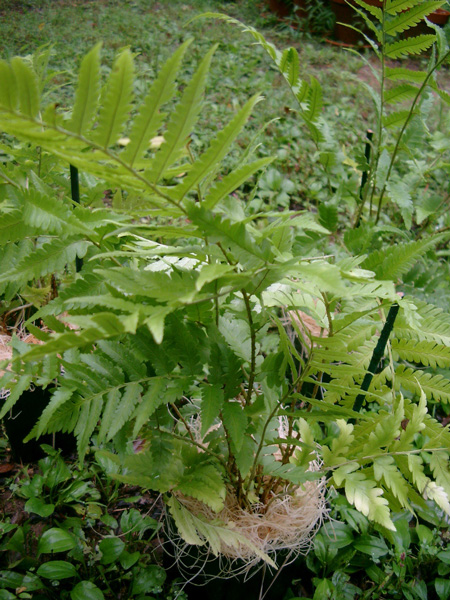
This is the Dixie Wood Fern, Dryopteris x australis, and I got three of them. They’re supposed to grow up to five feet in lenght/height, so I’m thinking of putting them in corners somewhere. I had planted some Ostrich Ferns in such places, but those died off over the summer and don’t seem to be reviving like some of the others that suffered similar setbacks.
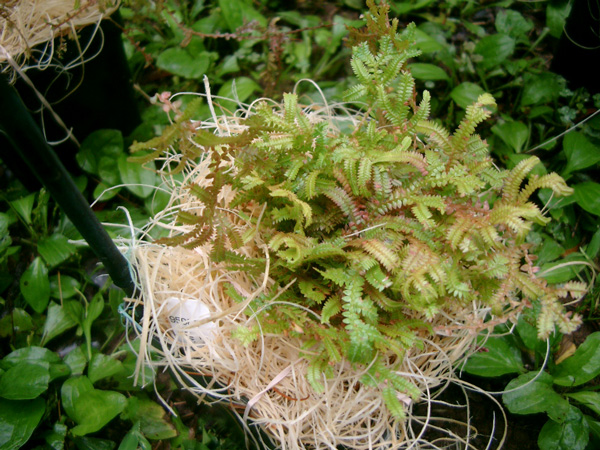
This is a Peacock Fern, Selaginella uncinata, and I got ten of these. They’re supposed to be a good ground cover and actually be an iridescent blue at some angles. I plan to cover the northern bank of the labyrinth with these, and if they do well there, and the Irish Moss fails to thrive in the middle plot, I may use them in the middle as well.

As I mentioned above, many of the ferns I planted last spring died back during the summer heat, but most of them are now putting forth new growth. The most hardy seem to be the Autumn Ferns; they didn’t even flinch at the heat. The Mexican Male Ferns that I planted at the entrance to the men’s loo seem to have perished altogether, although they shouldn’t have. The place I put them is usually moist. Perhaps this summer it wasn’t, however.

I need to go back and catalog the others I planted. I know some were Japanese Painted Ferns, and there was at least one other variety.

I love ferns. I think they’re beautiful in ways that flowering plants aren’t. I agree with the Japanese that flowers in a garden make it “hot,” and that a green garden is a calming one. So far, my semi-wilderness of ivy and ferns is fitting that description admirably.

Anyway, I was going to plant them this afternoon, but the rain has prevented me. Yes, I know I could go ahead and play in the rain, but I don’t wanna. Another task for later.

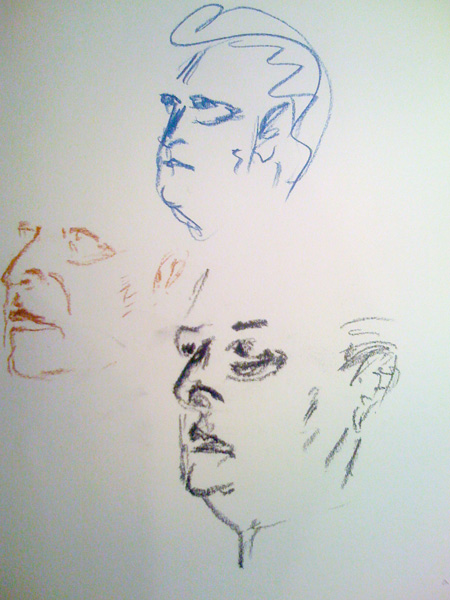
Portrait, 9/19/09

This is better, but I’m still not getting the proportions right. My face is taller than this. I measured it while drawing it, but it still comes out too short.

Also, I need to be moving into tonal issues, filling the paper with graphite rather than drawing lines on a white surface.

Listening

I’ve set the Havergal Brian aside for the moment, he’s just not doing it for me, and pulled out another CD from my shopping bag in the van. This one is Lamentate by Arvo Pärt. It is for piano and small orchestra, not exactly a concerto, but a suite of pieces that feature the piano as the “one” with which we identify.

I like it a lot, so went to load it into iTunes, then found out I already had. Clearly I have never paid attention to it.

It was written in response to Anish Kapoor’s gigantic sculpture Marsyas and in fact had its premiere there in the Tate Gallery’s Turbine Hall. I returned to that fact after listening to the piece twice and it makes an interesting difference in hearing it.

The music is very beautiful: stark, powerful, tender, and very sad. Pärt says that, inspired by the staggering vastness of the Kapoor piece, it is a lament for the living, who have to deal with the issues of death and suffering, who have to struggle with the pain and hopelessness of this world.

The large movements, like the first two, marked Minacciando and Spietato (“threatening” and “pitiless”) are awesome, but it is the slow movements that tear at your heart. The fourth, Pregando (“praying”), is a lovely meditation, while the ninth, Lamentabile, is Pärt at his breath-holding best. Using a modal scale, the piano and oboe trade a plaintive lament against a steady ppp ostinato. The upper keys of the piano give out frightened little bird cries while the lower strings sigh and dissolve, all in the enormous echoing cavern of the exhibit hall. I can only imagine what it would be like to sit beneath that gargantuan sculpture and hear this music.

This is music I want to write.

An idea for the labyrinth

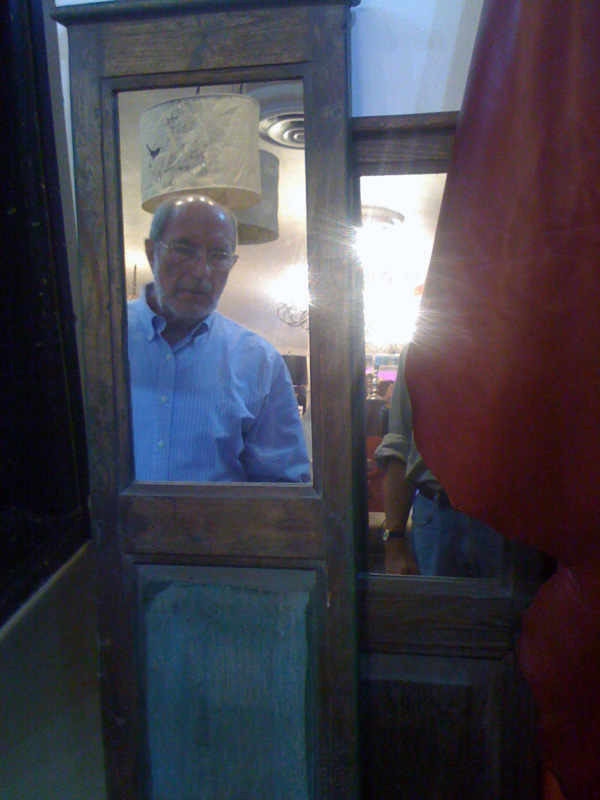
I was out on the Art Walk downtown last night, bought a new piece, and came across these at one of the antique places:

These look like pieces of old wall dividers, maybe like from between booths at a pub or something. The upper panel has been replaced with a mirror. (Yes, that’s Herman Fletcher in the first one. I’m in the other one.)

I’m thinking it would be interesting to have something like this, a tall one and a short one, installed together somewhere outside the labyrinth, so that as one walks it, one occasionally is confronted with one’s own image.

Reactions, anyone?

more Labyrinth, 9/12/09

That was such a lovely end to the previous post, I had to end it there. But I had more.

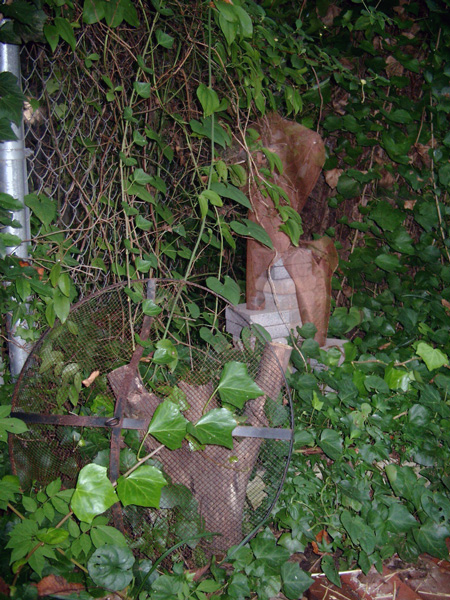
The periphery of the labyrinth is a wild mess of green: ivy, ferns, vinca, various “volunteer” organisms, a couple of things I’ve actually planted, all tumbled together and only moderately managed by me.

This spot struck me this morning. It is only partially deliberate, which makes it in a very Zen way quite lovely indeed.

The photo, of course, cannot replace the experience. You will have to come do that yourself.

Labyrinth, 9/12/09

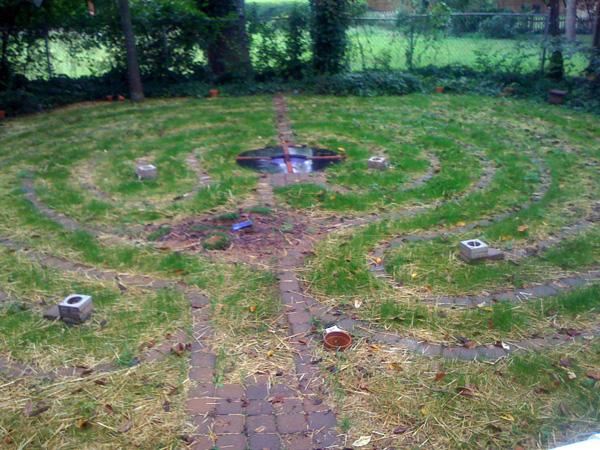
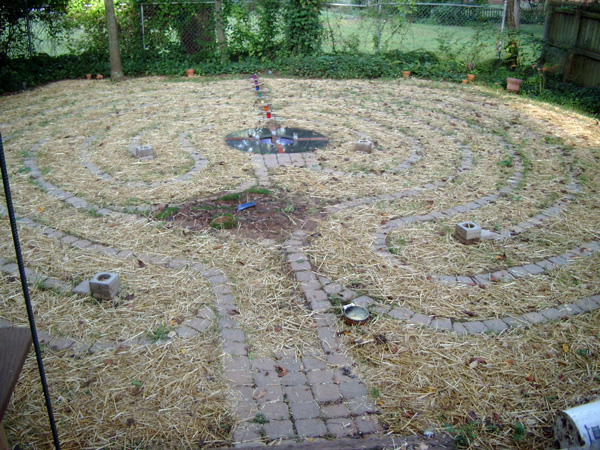
I spent last night, and now this morning, out in the labyrinth. I had only the fire and the labyrinth, no music, which is unusual for me. I listened to the sounds instead.

This is such an amazingly peaceful spot, and even in its recovery phase, an essentially beautiful one. Now the leaves are beginning to drift down, and unlike the pecans, which are a metaphorical as well as a literal nuisance, they are lovely as well.

I’m watching a hummingbird wander apparently aimlessly through the branches of the trees. Surely she can remember where the feeder is?

I’m also watching a lone candle still flickering from last night. It is my practice, after finishing up for the night, to leave the rainbow/chakra candles burning, as well as the four clear candles around the center. It’s a wonderful sight in the night.

Often many of them are still burning the next morning. But now, way more than fifteen hours later, one is still going.

You can just see it there, the indigo candle, the “third eye” chakra. Our inner eye, our sense of judgment, of wisdom. If we seek an answer, it is here we must find it.

Maybe if I sit here the rest of the day, I can hear what the question is.

Random listening

One of the benefits of tripling my hard drive space is that I can now add more of my CD collection to my iTunes. The fact that I long ago exceeded my old iPod’s actual capacity frees me up to add whatever I like, and now I have room to do so.

So until I can get over to the dark and cluttered corner that is my old CD collection and go through to see what I’ve been missing, Handel’s Water Music springs to mind, I simply snatched up a stack of CDs from the floor and transferred them to my van. I figure I need to at least listen to them again before deciding I need them on tap.

I seem to have purchased a great deal of Havergal Brian. I know I got his huge “Gothic” Symphony back in the day, and it begins well. And I think I had a few of his smaller symphonies on LP even, from the estimable Music Heritage Society.

Who is he? He has his own website and his own Wikipedia page: a composer more respected than loved (although his Society seems fairly idolatrous), and whose music tends to exasperate more than clarify.

Anyway, this particular CD is of the “Fantastic Variations on an Old Rhyme” and the Symphonies No. 20 and 25. Performance is by the National Symphony Orchestra of Ukraine, conducted by Andrew Penny. So there.

His music is challenging to say the least. It’s nominally tonal, but without a diatonic center. Themes tend to be dark and noodling, and there is nothing like development, just constant exploration, never looking back. Mood swings are precipitous and neverending. Suddenly, we’ll swing round a corner and hit a major chord, and then just dissolve away into the next vista. Movements don’t end, they just stop.

This might be fascinating, but it’s not, at least not so far.

I do have to say that the “Fantastical Variations” is a lot of fun, but it’s easier to hear because it is weaving incredible elaborations on a very familiar tune. (I won’t say what. Ask me to play it for you next time you’re around the fire.) The man had a gift of invention and of orchestration, to be sure.

And one has to admire his doggedness. Almost none of his music was performed, and none of it very often. He lived to be 96, and eight of his 32 symphonies were written after he was 90. None of his symphonies were recorded until he was 95. It is history such as this that makes me wonder whether I should hang it up, like Charles Ives, or keep going, as poor Havergal Brian did.