GHP

I am the director of the Georgia Governor’s Honors Program.

I accepted the job offer on Friday, April 1, and yesterday the State Board of Education voted to confirm my hiring. It is now official: I am the sixth director of the nation’s premiere summer gifted experience.

What a long, strange trip it’s been.

I attended GHP in 1970 as an art major. At the time, the program was housed on the campus of Wesleyan College in Macon. There were 400 students, and the program was eight weeks long. My life was changed forever, principally by my painting teacher Diane Mize, but also by the entire universe we created on that campus. For the first time in my life, I was surrounded by other people who were as curious about everything as I was. When the program was over, I curled up in the back seat of the car and cried all the way back to Newnan.

Forty-one years later, the program is at Valdosta State University, serving 690 students for six weeks. (We’ve been cut to four weeks for this summer for budget reasons.)

The program changed my life again when I began teaching there in 1984. The director of the program, Lonnie Love, hired me to revitalize the media support area, to serve as a liaison between GHP students/staff and the VSU library staff. I taught students how to design, produce, and present their research; back then, we’re talking actual slides and overhead projections. The overwhelming richness of the experience, my amazing faculty peers, the concerts, the performances, the kids, all were even more incredible than when I was a student. I cried most of the way home, not an easy thing to do while hurtling up I-75.

My life changed again when, after serving as the Macintosh computer lab instructor in 1996 and creating the program’s first website, Dr. Joe Searle asked me to become the assistant director for instruction in 1997. It was my job to guide the curriculum, to supervise and support the teachers, and just to make sure that the instructional half of the program worked as advertised. After thirteen summers in that position, I took last summer off, my first in fourteen summers.

At this point, those who don’t know what the Governor’s Honors Program is or how it works can go over and look at the Wikipedia article.

Here’s what many people want to know: yes, I will be leaving Newnan Crossing Elementary. The director position is a 12-month position, and we are heading into the summer even as we speak. I will retire from the Coweta County School System on May 1 (one retires on the first day of the month, I have learned); my last day at school will be Friday, April 29, essentially two weeks from now.

Because of Teacher Retirement System rules, I will have to wait 30 days before I actually start work at the DOE. However, I will not wait until June 1 before plunging in—that’s only three weeks before the staff shows up in Valdosta. I have already volunteered my time working on a couple of pressing needs, and I will spend the next six weeks volunteering even more. For example, we released the list of finalists on the day I was interviewed, and now 690 acceptance forms are waiting on my desk for me to enter the students’ data into the database. We still have three staff positions that have to be filled. I’m also responsible for the Byrd Scholarship, and all paperwork has to be out the door on May 18. All the arrangements with Valdosta State University over classroom space still have to be finalized, as well as a host of other details.

So as tempting as it might be to head off to the south of France for the month of May, I will be commuting to Atlanta on my own dime, plus still helping out at Newnan Crossing. It will be great fun. I’m sure.

I will miss Newnan Crossing without a doubt. It’s a fabulous school to work at: great principal, great staff, fun students, and my media center is a phenomenal space. And this will be the first time ever that I have not worked directly with students. It will be a big wrench to my psyche, to have a “grown-up” job.

But I’m also excited by the opportunity to be the leader of GHP as it heads into its second fifty years. I’ve been teaching in the program for more than half its existence. It’s been a part of my life for more than half of mine. I think I’ve already had a profound impact through my work in the instructional half of the program, and now I look forward to putting my stamp on the program as a whole.

I would be remiss if I did not publicly thank my predecessors: Dr. Joe Searle, director, 1996-2010; Lonnie Love, director, 1983-1995; and Cary Brague, associate director, 2006-2010. Each of these has done all the hard work in shaping the program into what it is now. I am honored to be their heir.
A good idea

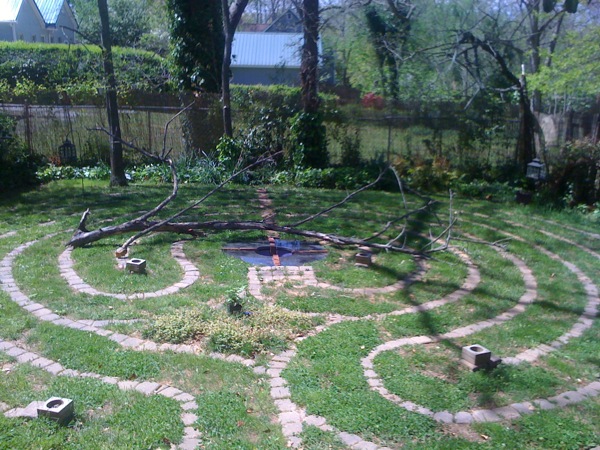
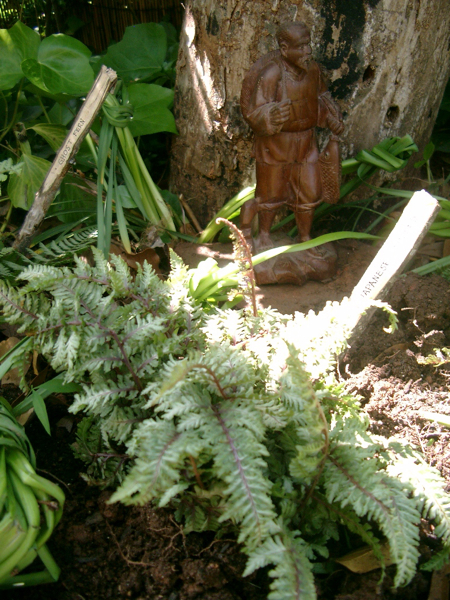
Yesterday I planted new ferns around the labyrinth. I’m running out of places to put them, unless I rip out the ivy altogether. If I could rip out all the big ivy and leave the English ivy, I might consider it.

Anyway, I’ve loaded in so many varieties that, dilettante that I am, I can not remember which one is which. I have a great book, Ferns for American gardens, by John T. Mickel, in which I have annotated which species I’ve planted and where, but sometimes when one is meandering about the space, one just wants to know, you know?

The obvious solution is a marker of some kind. After a little thought, I imagined that a pretty solution would be to make some in the ceramics lab this summer, small clay tablets with the names stamped in, then lash them to sticks with something funky. In the meantime, I thought, I could just run get some of those cheapo metal ones that you write on.

Then my lovely first wife reminded me of the neat idea we saw in a shop in Colquitt, GA.

Kind of hard to see, but the idea should be plain: take a stick, whittle off a flat white space, and write the name on it. I felt all folksy doing it. At least until I used a Sharpie™ to write the names. But now they’re all labeled. An added nice thing is that the sticks are all from the fallen Dead Tree.

I may still make some in clay this summer. Heaven knows I shall probably need the therapy.

A moment of silence

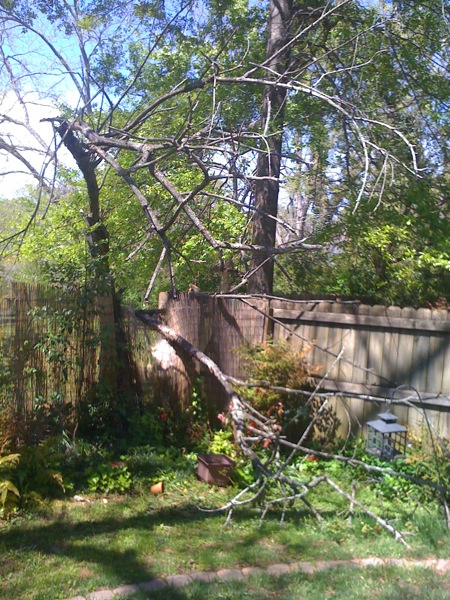
Habitués of the labyrinth will know of the Dead Tree in the northwest corner. I’m not sure what kind of tree it is/was. The arch of its branches suggest a flowering tree of some kind, like cherry or apple. It’s been dead since we’ve lived here as far as I know. (Prior to the labyrinth, we didn’t use the back yard much at all.)

I’ve valued its presence in the labyrinth, a work of art, beautiful and stark amidst all the green. My backyard neighbor once asked if I wanted him to cut it down for me, and I declined. I fumbled an explanation of how it just sort of was a kind of symbol or something. How does one explain one’s closeted mysticism to someone who just sees a dead tree?

As you suspect by now, the recent high winds have taken their toll on the Dead Tree: the top half of it broke off.

No damage to anything else—what is it with this space that seems to be protected?—and the rest of it still stands. I carried the large branch to the middle of the labyrinth to lie in state for the week.

After that, we will consign it to our fires.

In other news, there are still bare spots in the path. I will scratch more seed in. I also have about six new ferns to install on Saturday.

New word

This morning, as I lay semi-wakeful at the Highlands Inn—we had gone to the wedding of Michael and Catherine Giel in Decatur last night and decided not to drive home— I had an interesting dream. I was either working on a website or standing at a smartboard, and I was defining what essentially were nonsense words. One of them stuck in my mind, and I wrote it down upon arising.

The word is vuking, and what I remember most vividly was belaboring the pronunciation. It is, I am informed, pronounced VOO-king (not view-KING as some would have it), and after a couple of repetitions it dawned on my what a tremendously useful word it may become.

Feel free to add it to your vocabulary.

Ideas & Design

If you do not have Stumble as an add-on to your browser, you should. It’s a good way to waste time on the internet. I have come across many fun and useful sites using it in my downtime. Also my composing time.

Anyway, this morning I was up early, and resisting the urge to a) clean up my desk, which needs it badly; or b) take even a look at the cello sonata (you remember the cello sonata, yes?), I was Stumbling around the internet when this popped up: 100 Creative Furniture. Bad title, but fun post.

I love posts like this. I like seeing what other minds can do with ordinary objects, to make us “pay attention” to them again, as Milton Glaser would have it. Most of them are like the clothing you see on the runway in Paris or Milan, just conceptual pieces to show off. Just as you wonder whether anyone ever really wears that stuff, you have to wonder whether anyone ever really sits on some of those things.

Still, many of these look practical, and most provoke a little squee of delight as we recognize what the designer has done with “chair” or “sofa” or “shelf” or “table.” Almost none of them solve a problem other than the aesthetic “what if,” but that’s OK. Sometimes, as Lear says, it’s good to have superfluity.

It would be fun to put these into a slide show and show them to students (omitting always the buttocks) and assault them with the overwhelming fecundity of choice here, then challenge them to write about their favorite, or categorize them, or do something to engage the designers. Write a letter to one of the designers asking for changes in the design. Draw a sofa to go with the chair. Pick out a chair and a shelf unit for your bedroom. Examine your reaction to the “worst” of them and explain yourself. Match one of those outfits from Fashion Week to wear if you’re going to sit in that chair.

So many choices.

Fun weekend, and an addition to the labyrinth

We traveled down Hwy 27 on Friday to Colquitt, GA, where we stayed at the lovely Tarrer Inn, did Colquitt, and saw the famed Swamp Gravy.

It is worth the trip. If you don’t know what I’m talking about and are too lazy to click on the link, here’s the short version: the city of Colquitt decided to rescue itself from its doldrums back in the 90s by applying for some grants and creating a ‘folk life’ play from collected oral history. It was an immediate smash hit, and has been ongoing since then.

The town itself is almost nothing, and their grip on the tourism thing seems to extend mostly to having this fabulous theatre piece for a month of weekends twice a year. The building is an old cotton warehouse, and they’ve renovated it brilliantly, with a museum of local artifacts (without however any contextual explanations of any of the items on display).

The performance space is U-shaped stadium seating around a pit, with permanent multilevel platforms interspersed throughout. There is a large stage-ish area at the end of the U.

Community members from 4 to 70 rehearse the season’s play and then perform it for a month. The arts council collates a new script for October (or goes back to a previous script), and then it repeats in March. They also have a local show called May-Haw, which as the website says, is more for the townsfolk than the tourists.

Anyway, the show was good. This one was stories from the murals which dot the city (another of its attractions), all of which depict specific local events and people. On the whole, I thought it was probably weaker than their usual collections of folktales, ghost stories, and reminiscences, but parts of it were just glorious.

We intend to return to see another show. Yes, it was that entertaining. Plus, it warms my heart to see this tiny community pull off something this good.

I’ve said enough nice things, right? I can be a little catty now, can’t I?

Good.

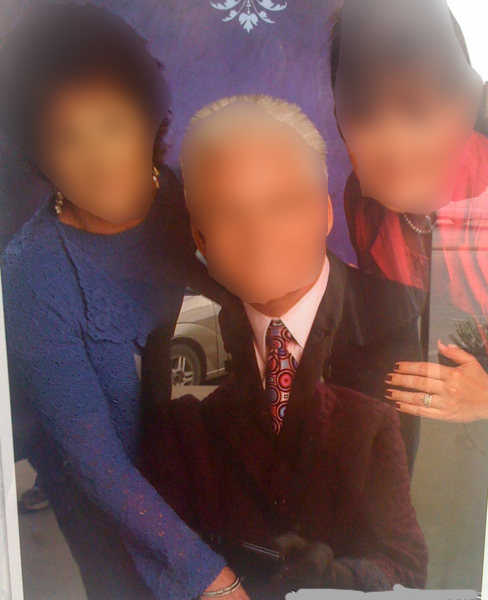
In the window of one of the stores was this poster, for a trio singing at a local church. If you are a Colquittian who has stumbled on my blog, my sincerest apologies because y’all are some of the nicest people we’ve ever met, but this sent us into hysterics:

The lady in blue: exactly what is her hand doing? I promise I have not cut anything off. In fact, I had to redact the name of the group just to make sure I got as much of the thing in.

I hope this doesn’t ruin my chances to be considered as director for some future Swamp Gravy, because I think it would be a lot of fun. (And Swamp Gravy, I have ideas. Ask me how the elephant story could have been a showstopper.)

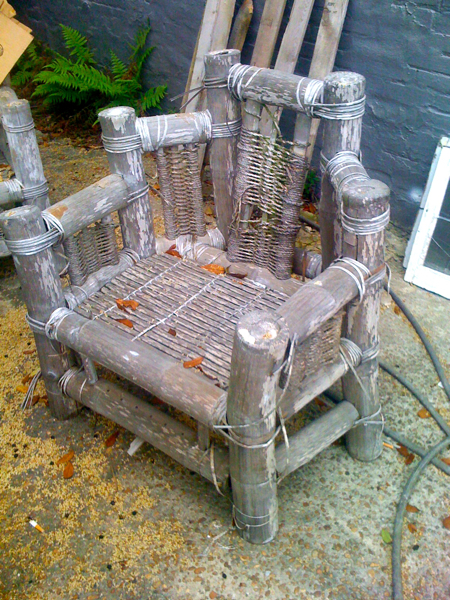
At one of the shops, an antiques/decor place, we came across this:

It’s bamboo. There was another chair like this, plus a ‘sofa’ and a table. Totally wobbly, so it would have to completely restored. I was thinking skulls on the uprights would be awesome. I could indulge in all my Mr. Kurtz fantasies. I did buy something from the shop, about which later.

This morning we started our drive back to Newnan, and somehow it became a thing for us to swerve off of HWY 27 to go take a gander at any and all small towns off the path. It was actually fun. Blakely—I think—had just had its “Peanut Proud” festival. (Colquitt has the Mayhaw Festival next month.) Bluffton had this enormous and ornate building, a former school perhaps, all boarded up. I wish we had a photo.

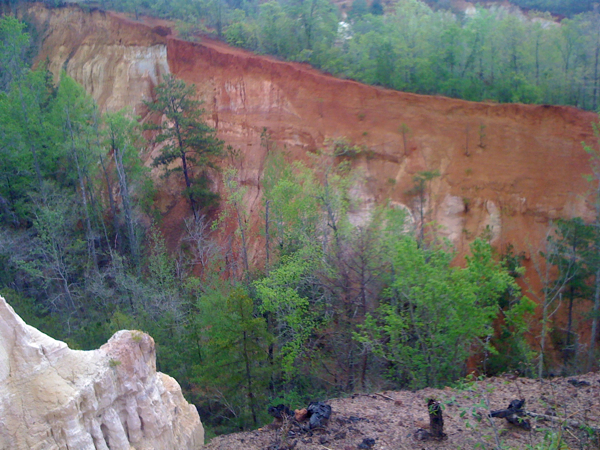
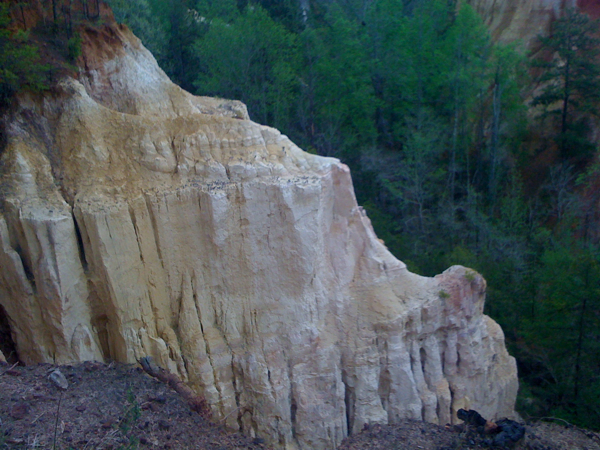
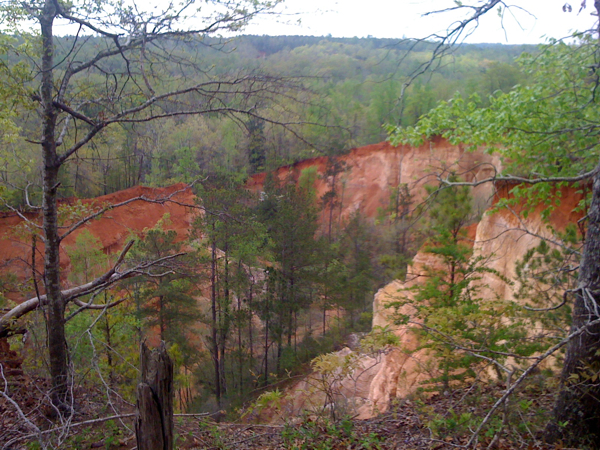
We stopped at Providence Canyon State Park:

Better pictures on the intertubes, but it was awesome. To see most of it, you have to hike, and we were prepared neither with shoes nor time, so we had to settle for these glimpses from the outer rim. It’s only 150 years old: settlers in the 1820s planted cotton, stripping the land of all vegetation and plowing up and down the hills rather than across. In 30 years, it looked like this. Can you imagine?

We also plan to return here to hike through the thing. There’s supposed to be a wildflower hike, but the website doesn’t mention it.

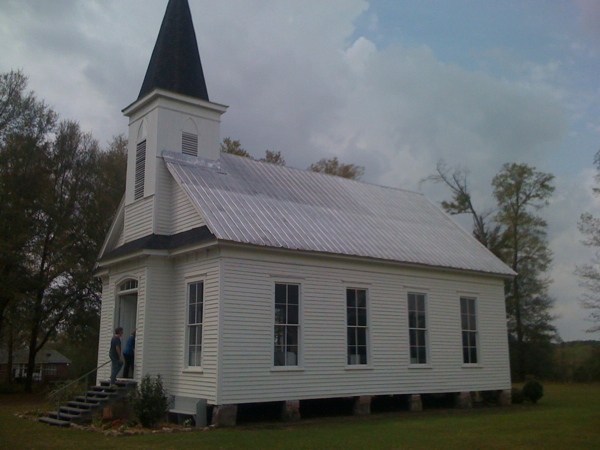
When we drove down Friday, we noticed a row of three small white churches off the highway. They all looked well-kept, and we thought it was odd to have three churches in a row like that. We jokingly suggested it was three hardshell Baptist churches, founded by three feuding branches of the same family. As we drove back up, we pulled off to see the Louvale Historical District. There doesn’t seem be an actual Louvale as such, but then we saw the three churches. They’re surrounded by a chainlink fence, but the gate was open, so we pulled up into the gate and looked.

As we looked, a car pulled up behind us, and a woman offered to show us around. Her daughter had gotten married in the Antioch Primitive Baptist Church, pictured above, and she had the keys. She explained that this was the Louvale Church Row, unique in the nation. Three churches and an old school, moved to this site and still active (the school is a community center). The buildings are immaculate, and the Antioch church was elegantly simple. And the acoustics were quite live! I’d love to perform there. (I just discovered that there’s a Historical Marker Database! Woot!)

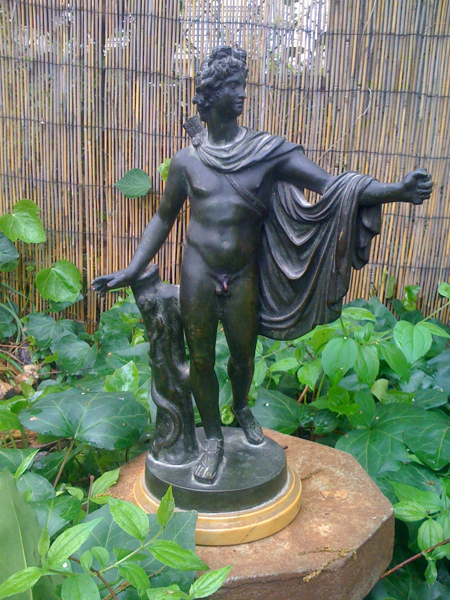
Finally we made it home and I was able get out to the labyrinth to install my purchase from Colquitt:

Yes, the Apollo Belvedere, a foot-high bronze. For those who don’t know already, here is the skinny on the whole Apollonian-Dionysian dialectic. I hadn’t really been searching for avatars of these two forces, but when I saw this—and the price was right—I had to have it.

Now I need a bronze Dionysus. This is the only even halfway well-known one I might look for, but it seems almost tame, kind of Apollonian. So I just might go for the Barberini Faun. That’s Dionysian.

I am relieved

Today’s email from Composer’s Datebook discusses Bartók’s Violin Concerto, and this passage struck me:

It was only in America, some years later, in 1943, that Bartók first heard his Concerto at a New York Philharmonic concert. He wrote, “I was most happy that there is nothing wrong with the scoring. Nothing needs to be changed, even though orchestral accompaniment of the violin is a very delicate business.”

Wow. This is what jumped out at me: “I was most happy that there is nothing wrong with the scoring.”

He actually was flying blind, not really sure that what he had inked in on the page would work in the concert hall. This is a great relief to me, because heretofore I had assumed that the great composers before this era knew how to write down precisely what they heard in their head, or if they didn’t hear it in their head they at least knew exactly what would produce the sound they wanted.

Not so much, it seems. I’m sure Mozart is the exception, but I’m going to go with a self-serving belief that many composers had to jigger with their pieces after hearing them played for the first time. At least I have a computer which will allow me to hear an approximation of what I’ve written.

Which actually ties in with a post I thought about writing this weekend after attending the Wadsworth concert. After hearing all this magnificent music (and some Chopin) played, I conceived a powerful desire to hear my music played live. I want to hear whether it actually works. Because of ‘the curse,’ of course, I’ve never heard any of my pieces played, but now I really have a hankering.

This puts me in an embarrassing position, because I have no more means now than I ever have had to have my music performed. Someone recently suggested that I pay local artists to play through the cello sonata, for example, but what if it’s too hard? That gets me nowhere, other than to put me back where I started 30 years ago, limiting my writing to the forces I have at hand.

It’s a conundrum.

A Chomskian post from the past

I was trolling through files on my hard drive, wondering what some of them were, when I came across a word processing document that impressed me. I was working on my specialist degree, five or so years ago now, and I think it was the piddling psychology class they make you take to give the psychology professors something to do. It was like the last class I had on my agenda, and like me, most of the students were old enough to be the professor’s parent. We were mostly amused by his efforts.

Anyway, there was some online discussion as part of the class, and this one was on Chomsky and others of that ilk. I had gone away for the whole week (could it have been that historical trip to the mountains that Thanksgiving?), and when I got back, I was bothered by the turn the conversation had taken. Most of the participants had taken “grammar” to mean “rules of speech,” and it took a pretty prescriptive turn. Silly.

This was my response, and I think it still reads well:

I notice there is some confusion in our discussion of Chomsky over the nature of grammar. “Grammar” is not that set of rules set up by the dominant power structure to govern our language, nor is it a set of exercises out of Warriner’s. Grammar, as Chomsky means it, is innate, that is, born with us, and it includes our ability to recognize and create sentences that no one has ever heard before nor ever will again. It is not literacy and it is not writing.

The comparison of transformational grammar to math [in the textbook] is interesting, since one of the biggest problems non-mathematicians have with symbolic logic is the idea that an argument/syllogism can be true even if the statements which make it up are false. To wit:

  • All women have three heads.
  • George W. Bush is a woman.
  • Therefore, George W. Bush has three heads.

The structure is perfectly valid, perfectly true, despite the fact that the premises are outrageous fabrications. This is grammar. The most famous example from Chomsky is the sentence, “Colorless green ideas sleep furiously,” immediately recognizable as a correct sentence even though it makes no sense. In contrast, “Dog the his ate brown under food tree the” is not a sentence in any language. Innate transformational grammar is what allows any child in our schools to a) recognize those words in that order as gibberish; and b) rearrange those words into a real sentence. If literacy is removed from the equation, any child in the school can perform that task without any instruction from us.

A thought experiment: take the “dog” sentence, and consider how you would present those words on cards to a non-reading child and ask him to put them in some grammatical order. If you decided to start simple and then ask the child to add the remaining words one at a time, you’d probably begin with “dog the ate food his.” How did you know that? That’s Chomskian grammar. The kicker is that eventually you come up against “under.” Even a moment’s thought is enough to show you that you can’t hand the child just the word “under” and expect him to proceed. You would have to give him “tree under the” and ask him to put all three words in, which he would proceed to do after rearranging them into a prepositional phrase. Finally, the word “brown” can go in any of three places, but only in those three places. That is transformational grammar.

Our concerns over “street” grammar and “standard” grammar are misplaced in this discussion. Standard grammar is one of the tools used by the dominant power structure to cement its influence, and anyone who intends to live profitably within that power structure needs to know how to speak and write it. Indeed, one of our duties as educators is to provide students the opportunity to avail themselves of that knowledge. However, bemoaning the decline or absence of that structure in our students is trivial. One might just as well compare the writings of Thomas Jefferson or Abraham Lincoln with those of our current political leadership and conclude that we were suffering from a precipitous decay in the public arena.

So, how would I use Chomsky’s theories in my media center? If I were coaching a student in his reading, I would (and do) rest comfortably in the knowledge that the child is capable of recognizing the sentence on the page, whether or not he is currently capable of translating those squiggly black marks under the illustration. The words on the page are not arranged randomly, but in a pattern that is born in the child’s brain and already expanded by his experience in the world so far. This is a hopeful, and helpful, hook: whether or not the child says, “Bobby be’s riding his bike” in his daily life, he will not be puzzled by the sentence, “Bobby rides his bike” on the page. Whether we then correct the child’s daily speech is a political choice, and with Chomsky, it’s all political anyway.

A brilliant idea

I have had a scathingly brilliant idea. I’m sure it’s not original, but it is exciting in many ways.

It occurred to me last night, as my head was hitting the pillow, that Pages (Apple’s word processor) will export files in ePub format. (This is in addition to PDF, .doc, and RTF files.)

You know what this means, of course? I can get students to write their stories or poems or essays, and we can publish them for iBooks on the iPad. We can create class magazines, or a school publication. Individual students who are assiduous enough to write books can see their handiwork distributed.

If they do their work on the iPads, they can “print” to the home computer, and I can prep the files there.

If they do artwork in ArtRage, we can lay it out in Pages and publish it.

If they do a comic strip in Comic Life, we can export it to PDFs and convert that to ePub via Calibre.

Students who are emerging writers can copy their work to SpeakIt and have it read back to them, helping them develop their inner ear.

We can build a library of student work. Students will want to read what others have written. Students will want to write in order to be read.

Turn, turn, kick turn , yes, it will work!