Another secret lust

I was tidying up my study a couple of weeks back—you can actually see the floor!—and uncovered this:
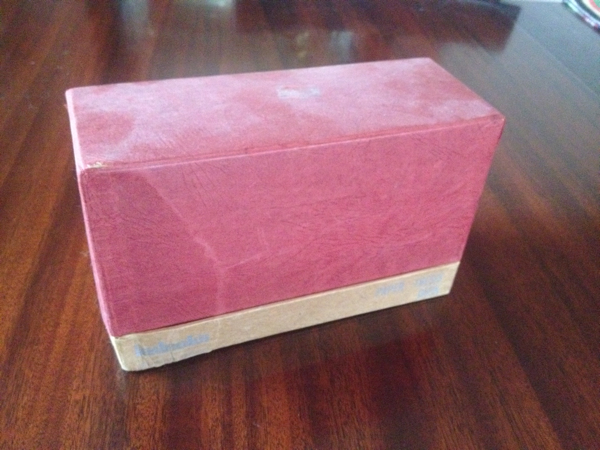
I remember it as if it were yesterday, walking through the bookstore at UGA, and coming across this beautiful, beautiful thing.  IT’S A BOX OF CARDS, YOU GUYS!
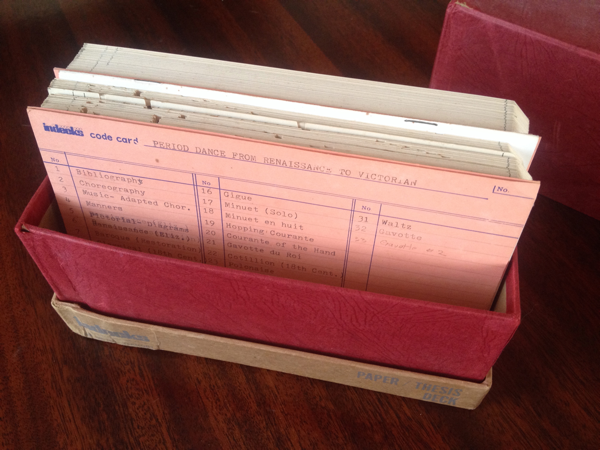
It was called Indecks, and what it was was a way to organize your notes on any research topic, and I was engaged in a huge one: an honors thesis on the work of the UGA Period Dance Group.  We performed social dances across five centuries, from Shakespeare’s time to the early 20th century, and none of it was written down or collated.  As chief researcher (and eventual president), that project fell on me.  I also needed, for reasons lost to my memory, an actual thesis/project to fill some requirement in the Honors Program.  (Probably something to do with Lothar Tresp’s time in the German army during WWII.)

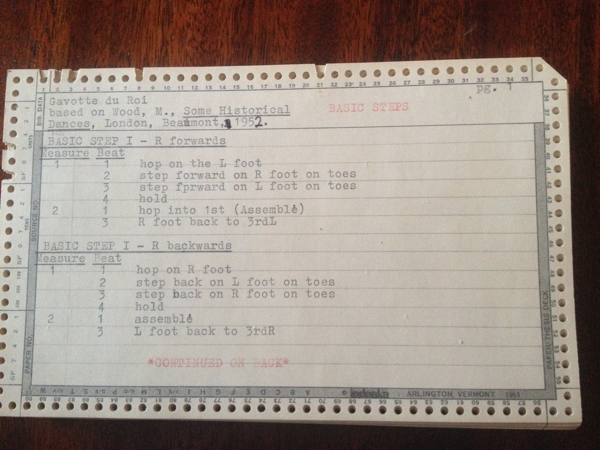
The white cards were your note cards:

But what are those little holes, you are asking?  IT WAS MAGIC, YOU GUYS!
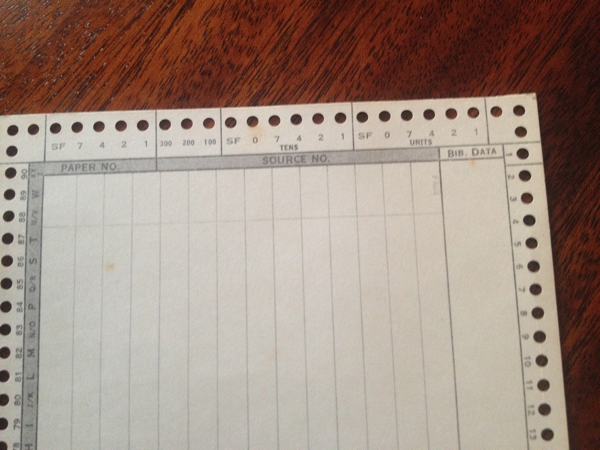
You could keep track of notes for up to eight papers, hundreds of sources, nearly a hundred notes per source per paper, and you didn’t have to keep them in any order!

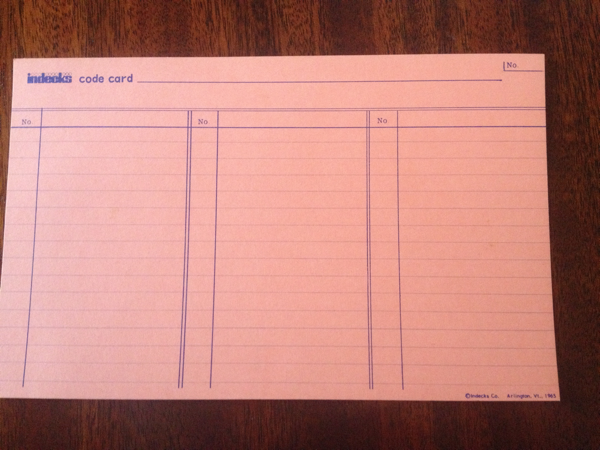
The orange cards were where you wrote down your sources/topics:
Here are mine:
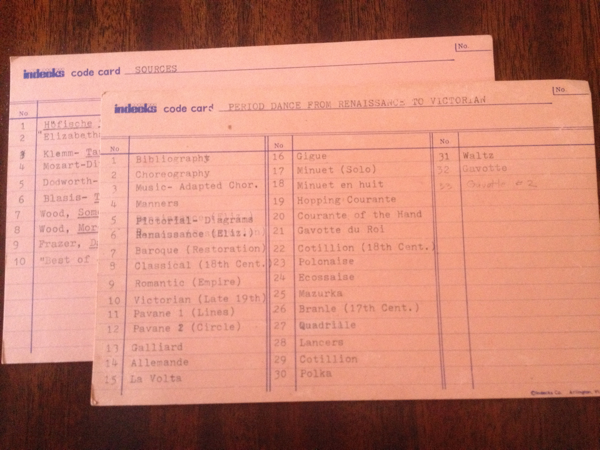
Then, as you completed a card, you would clip the hole(s) for the source on the side and for the topic around the other edges:
And HERE’S THE MAGIC, YOU GUYS:
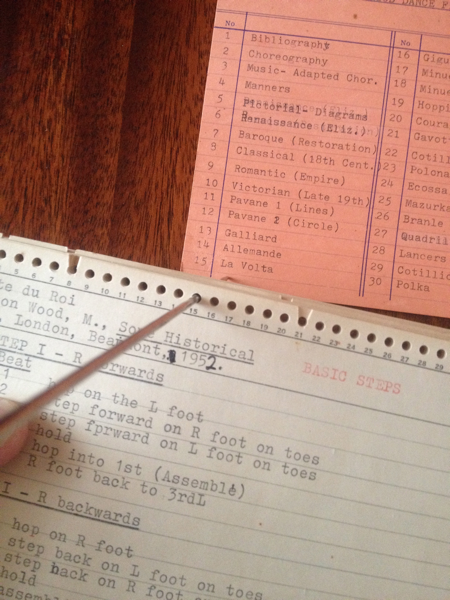
The box came with two steel rods, which you would insert into the deck and then loosely shake.  Here, I’m looking for the cards involving La Volta, a Renaissance dance, so I’ve inserted the rod into hole #15…

Et voilá!
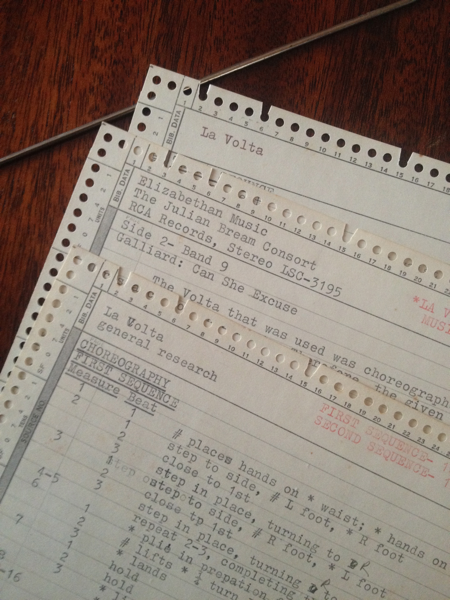
Out fall the cards on that topic.

AREN’T YOU ALL TINGLY IN YOUR TINGLY BITS??  This was awesome.  I could pull up any combination of cards/topics.  Give me all your Baroque dances, hole #7.  Give me all your adapted choreography for the Classical dances, holes #3 and #8.  Give me all the stuff I found in Allen Dodworth’s Dancing, source hole #5.

::sigh::

Of course, the more astute among you have realized that this is a kind of primordial database, thus beginning my lifelong lust of such things.  I tumbled to arrays early on in Applesoft BASIC and got good enough at using them that I was able to correct the computer instructor at GHP one summer when he was trying to use some other function to keep track of minors registration and the program kept crashing.  I also programmed an overdue books/fines system that all of Coweta County used until the state automated all the media centers.  When Apple Computer released FileMaker Pro, I ate it up and have used it to run everything from NCTC to Newnan Crossing to Newnan Presbyterian choir library to GHP to U.S. Senate Youth Program to Georgia Scholars.  (Pro tip: if you’re ever taking over a program from me, make sure you have a copy of FMP.  Otherwise, you’re borked, darlings, AND YOU KNOW WHO YOU ARE.)  I scorn anyone who uses a spreadsheet to keep track of such things; you people are lame-o losers.  DATABASES, BITCHES!

And what did I do with all those excruciatingly typed-out cards?
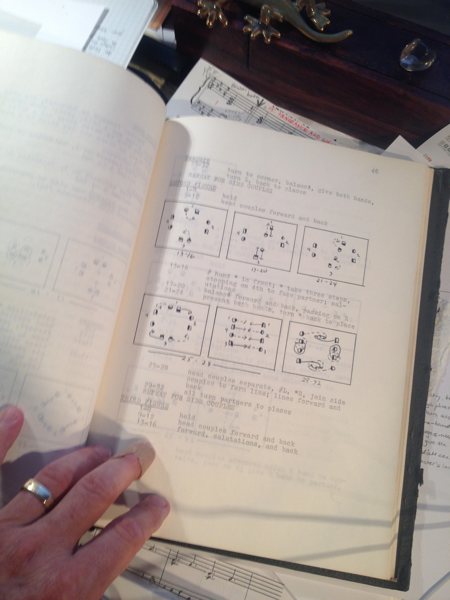
Ninety pages, typed with hand-drawn images, of sixteen of the dances performed by the Period Dance Group, including manners of each period, the original choreography of each dance, and the adapted choreography:
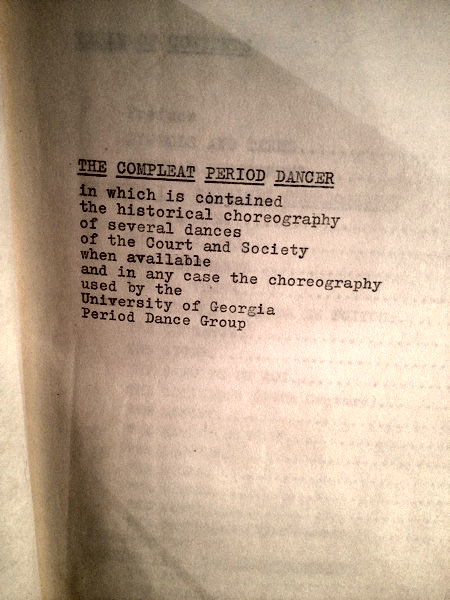
The Compleat Period Dancer was an immediate success—all the grad students wanted copies—and it remains a major resource for me to this day.

Lower on that title page is the date of the submission: June 4, 1974.  Forty years of SEXY SEXY DATABASE FUNTIMES, YOU GUYS!
Burning Man: mapping the field of ritual, part 4

Finishing our examination of Ronald Grimes’s mapping of rituals, from the second chapter of his Beginnings in ritual studies.

: Ritual sound & language :

What is the role of silence in the rite? … Do the people consider it important to talk about the rite, avoid talk about it, or to talk during it?  Are there parts of the rite for which they find it difficult or impossible to articulate verbalizable meanings? … How important is language to the performance of the rite?  What styles of language appear in it — incantation, poetry, narrative, rhetoric, creeds, invective, dialogue?  In what tones of voice do people speak?  … To what extent is the language formulaic or repetitious? … How much of the language is spontaneous, how much is planned?

I don’t have answers to any of these.  I have deliberately postponed any kind of planning on language/sound until Craig and I (and others, hopefully) get on our feet, as we say in the theatre, and start to play with it.  All I know is that when a participant exits the labyrinth, I must in some way connect with that person and offer one of the agones.  I honestly have no clue about how this will work.

I imagine that the offer of the agon will be formulaic, but then the rest of it is going to have to be improvised.

As for music/sounds, I’m not planning anything, but that could easily change as well.  As I said in our Theme Camp application, we would welcome drum circles and other musicians to contribute to the ritual as they see fit.  If our camp were bigger, say ten or more people, we could plan to have our own drummers in attendance.  As it is, we each have our own bells/bowls/shakers we can bring with us, but how we implement them I will leave to more shamanic minds than mine.  I can easily see a participant singing or playing an instrument or singing bowl or shaker while walking the path. It will be very interesting to report back what happens on the Playa as the community participates in the 3 Old Men ritual.

: Ritual action :

What kinds of actions are performed as part of the rite, for example, sitting, bowing, dancing, lighting fires (!), touching, avoiding, gazing, walking?  In what order to they occur?  … What are the central gestures?  … What actions are not ascribed meaning?  What actions are regarded as especially meaningful and therefore symbolic?  What actions are regarded as efficacious rather than symbolic?  What meanings, causes, or goals do participants attribute to their actions? … Which actions are repeated?  What gestures mark transitions?  What are the recurrent postures?  What qualities of action persist—quickness, slowness, verticality, hesitance, mobility, linearity, exuberance, restraint?  Are parts of the rite framed theatrically? … What parts of the body are emphasized by participants’ kinesthetic style?  … How do the social and environmental contexts influence the actions?  What actions are done with objects? …  What actions are optional, required?

Again, a bucketload of questions, some of which we can answer, splitting our focus between the officiants and the participants.

For the Old Men, for this Old Man anyway, here are some answers:

  • Performance includes standing, walking, dancing/movement (during the walking), and touching.  I would include the agones themselves as actions, and they are to my mind central and especially  meaningful.  I think from my perspective they are in fact efficacious rather than symbolic, although of course I have no control over the actual efficacy; I can only offer a gesture that I hope is effectively meaningful to the participant.
  • The agones are repeated, and they are themselves the transition from the journey of the labyrinth back to the world at large.  They are, however, optional: the participant may decline the offer, or even choose to exit where there is no officiant.
  • Again, not having gotten on my feet I’m not sure of the “qualities” of these actions.  In my head, I sense they should be slow, deliberate, nonthreatening, even the ‘struggle’ agon.  But I will not be surprised if, out on the Playa, the Old Men choose to become exuberant at least part of the time.
  • Body parts.  This is very important to me, since the whole impetus behind the 3 Old Men is of course our aging bodies.  The skirt will emphasize our torsos, specifically our bellies, which among our current participants are not taut.  I think too our arms and hands will play a large role by dint of holding the staff and engaging in the agones.  Also, if we go with the nude walk through the labyrinth as our opening, then all kinds of body issues will present themselves as part of the ritual.  One question that arises: do we paint just our heads and torsos, the visible parts of our bodies once we don our skirts, or do we paint our entire bodies for the trip through?  That will require some discussion.  (Sorry about the mental image…)

One question I have not resolved for myself is whether installing the labyrinth is part of the ritual.  I think it will be for me, although once we arrive on the Playa and set to work, it may become just a bloody chore.  Certainly we have no plans to take the thing down and re-erect it every day.

For our participants, the ritual action is pretty straightforward:

  • Approach the labyrinth.
  • Choose an entrance.
  • Enter the labyrinth.
  • Journey to the center.
  • Choose an exit.
  • Journey outward.
  • Choose whether to engage in the proffered agon, and if so, engage.

What meaning our participants assign to these actions is, as I’ve said before, anyone’s guess.

And that fact leads me to question whether what we’re doing is a ritual at all, since it is not part of an actual culture that produced it other than that of dirty hippie freaks like me and the 68,000 other Burners.  Still, my experiences with my own labyrinth have convinced me that this offering to the Burning Man community will in fact be received as a meaningful experience by those who participate.  In any event, I have an interesting anthropological study ahead of me.

Burning Man: mapping the field of ritual, part 3

Continuing our examination of Ronald Grimes’s mapping of rituals, from the second chapter of his Beginnings in ritual studies.

 : Ritual identity :

What ritual roles and offices are operative—teacher, master, elder, priest, shaman, diviner, healer, musician?  How does the rite transform ordinary appearances and role definitions?  Which roles extend beyond the ritual arena, and which are confined to it? … Who initiates, plans, and sustains the rite?  Who is excluded by the rite?  Who is the audience, and how does it participate?  … What feelings do people have while they are performing the rite?  After the rite?  At what moments are mystical or other kinds of religious experience heightened?  Is one expected to have such feelings or experiences? … Does the rite include meditation, possession, psychotropics, or other consciousness-altering elements?  … What room is there for eccentricity, deviance, innovation, and personal experiment? … Are masks, costumes, or face paint used as ways of precipitating a transformation of identity?

Well, that’s a lot to cover, isn’t it?

As for the role of the 3 Old Men in the ritual, I have noted in one of my Burning Man notebooks the following:

  • What are the attributes of the officiants?
    • solemnity
    • compassion
    • serenity
    • wisdom
    • openness
    • groundedness
      • not anger
      • despair
      • decay
      • aggression

I have avoided from the beginning calling them guardians, because they’re not guarding anything.  They’re there as anchors more than anything, providing a sense to the participants that there is mind behind the installation of rope and stakes.  They are also there to provide a sense of closure at the end of the journey, whether or not the participant elects to engage in the proffered agon.  (I think the Old Men can at least bow/nod/reverence an exiting participant—and I really need another term besides “participant.”)

So let’s just go with Elder, since that’s part of our gestalt anyway.

Transformation of appearances: this is one reason I’m leaning toward the idea of the Old Men opening the ritual by stripping from their regular clothes, painting their bodies, walking the labyrinth, then donning their skirt and staff.  It makes it pretty clear that we have become the Old Men.  The last question in the set addresses this as well, and I think it’s important.  Just as priests and shamans and judges put on specific garments to become their role, the 3 Old Men put on theirs.

The body paint thing is problematic, of course.  For one thing, it’s going to trigger associations with Butoh dance, with its visceral emotions and existential terror, and that’s not what we hope to project at all.  For another thing, it’s 100° out there and we don’t have showers.  Ew.  This is an idea that we’re going to have to consider carefully before committing to it.

Who is the audience and how do they participate?  All of Burning Man is the audience, all 68,000 of us.  Such is the nature of the festival, however, that we will be one of thousands of experiences available to people, and unless we are selected as an official theme camp and given a space where we might attract attention, we will be off on one of the side streets and will host whoever stumbles across us.

How our participants respond to the ritual is anyone’s guess, since nothing about it is prescriptive.  Our hope is that the experience is meditative and personally transformative.  (As for psychotropics… I’m shocked—shocked—that you would suggest such a thing might be possible at Burning Man.)  Our hope is that people find meaning in their walk through the labyrinth, and that engaging in the agon upon their exit gives an extra push to what they found in their journey.  Our hope is that they find themselves still thinking on it as they walk away or in odd moments during the week.

What room is there for eccentricity, deviance, innovation, and personal experiment? Honey, please.  You just defined Burning Man.  We would be idiots to presume that we’re not going to host Burners whose Dionysian impulses make a mockery of the solemnity of our setup.  And that’s OK: clowns can be priests; fools can be visionaries.  I expect to see people walking the labyrinth in silence and prayer; singing and dancing; giggling and inattentive; naked; stoned and lost; smirking and cynical; hurriedly.  I expect drummers and other musicians to join us.  I expect people to be puzzled or put off by the offer of an agon; I expect some to accept it gratefully, with tears, with joy.  I expect to be quizzed—”What is this about?  How do I do it?”  I expect to be ignored.  I expect to have others expect me to be something more than I have offered.

And I expect to be transformed by all of it, to learn more about my identity as an Old Man.

Tomorrow: ritual sound & language, and ritual action

Burning Man: mapping the field of ritual, part 2

Continuing our examination of Ronald Grimes’s mapping of rituals, from the second chapter of his Beginnings in ritual studies.

: Ritual objects :

What, and how many, objects are associated with the rite? … Of what materials are they made? … What is done with it?What skills were involved in its making?

This is an interesting aspect of 3 Old Men for me, since one of the aims in designing this ritual was to make it as simple as possible.  You may recall that my original idea involved three old guys in loincloths with staffs: next to nothing to transport or keep up with.  The addition of the labyrinth added a lot more cost and transportation issues, but our ritual objects are essentially the same: skirts and staffs.

Are the skirts ritual objects?  Skimming ahead in the chapter, I note that costume is an element of ritual identity.

So that leaves our staffs.  They too are part of the identity of the 3 Old Men, since they are part of the archetype of the Elder, our reclaimed masculine version of the Crone, but I think they are more than that.  I’m sure everyone remembers Gandalf’s claim at the doors of Meduseld that his staff was just an old man’s prop.  Just so: our staffs are our support, but like Gandalf’s staff they embody/symbolize our power as Elders.

The question of how they will be used is still to be determined.  I know that when we proceed around the labyrinth, I envision our staffs marking time as we move in unison.  It is probable that we will incorporate some kind of ritual/dance movement into our peripatesis using the staffs.  The agon involving the offer of struggle: will it involve the staff?  If not, then the laying by of the staff becomes ritualistic.

There is one more use of the staffs for which I’ve already planned: whatever other decoration there may be on them—and we haven’t decided even what they will be made of—there will be markings on them which will guide us in the actual laying out of the labyrinth.  That means there will be four staffs, not just three: laying them out in a square will give us the corners of the innermost octagon.  There is also a centerpoint and the width of the path marked to help lay out the positions of the stakes.  Sacred geometry, folks.

There are other objects that keep floating into the plan but which I keep rejecting.  I would love to add small stands at each entrance, beside which the Old Men would stand, each with one of the four elements: a bowl of water, a bowl of earth, a brazier of fire, a bell or smudge stick (for air).  Participants could use those as they see fit, either before entering or upon their exit.  The problem with the stands is severalfold: transportation issues, of course, and stabilization issues.  The winds are fierce on the Playa; everything has to be staked and tied down, and there is—as I understand it—a prohibition on campfires, tiki torches, etc., so the brazier would be problematic.  Perhaps if the 3 Old Men have a longer life with the regional Burns, the stands can make an appearance.

: Ritual time :

At what time of day does the ritual occur—night, dawn, dusk, midday?  What other concurrent activities happen that might supplement or compete with it?  … At what season?  Does it always happen at this time? Is it a one-time affair or a recurring one? … How does ritual time coincide or conflict with ordinary times, for instance work time or sleeping time? … What is the duration of the rite?  Does it have phases, interludes, or breaks?  How long is necessary to prepare for it?  … What elements are repeated within the duration of the rite?  Does the rite taper off or end abruptly? … What role does age play in the content and officiating of the rite?

Again we are dealing with two overlapping rituals, the Grand Ritual of Burning Man itself and the inner ritual of 3 Old Men.  Naturally, the grand ritual takes place at the same time every year, with its separate questions of preparation, etc.  Interestingly, you might think that the grand ritual of the Festival ends abruptly: burn the Man and go home, but it is not nearly that clear cut.  These days the Man burns on Saturday night.  Many people then leave on Sunday, but many also stay for the burning of the Temple on Sunday night, which has become an equally important part of the grand ritual.  (That is our plan.)  And when you think about it, even those singular high points in the grand ritual don’t have a clear ending: thousands gather for what is essentially a big bonfire.  Who decides when a bonfire is over?

For the 3 Old Men, these questions have not been answered.  In fact, despite Grimes’s warning that his proposed map is not to be taken as a checklist, I think that they provide us a useful guide in deciding how to complete our plans for the labyrinth.  Will this be a daily event?  At what time of day will we take up our positions as officiants?  (Conversations with veteran Burners suggest that dusk is our best bet.)  How long will we remain stationed?  How will we decide when it is time for peripatesis?  How will we decide when it’s time to stop?  If we are able to add to our troupe so that we have back-up Old Men—which I think would be awesome—how do we effect the ‘changing of the guard’?

Even the question of the age of the officiants is not firmly answered: at least one of our hopeful participants, i.e., needs a ticket, is not an old man at all and in fact will probably be quite disgustingly fit by the time August rolls around.  Can a 30-something don the skirt and staff?  A question of ritual identity we will need to examine.

 Tomorrow: ritual identity

Burning Man: mapping the field of ritual

I highly recommend, if you are interested in the inner workings of ritual, Beginnings in ritual studies, by Ronald L. Grimes.  It’s introductory, nicely analytical, and clearly written, unlike that other pillar of ritual studies, The ritual process, by Victor W. Turner.  Also useful and readable is Liberating rites, by Tom F. Driver.  (This is how we know I will never write a book on ritual: I don’t have a middle initial, since Dale is my middle name.)  I have not read Ritual theory, ritual practice, by Catherine Bell; every time I look at it on Amazon, it seems thickly written and more about ritual studies than ritual.  Perhaps later.

Finally, I found Theater in a crowded fire: ritual and spirituality at Burning Man, by Lee Gilmore, an excellent book for anyone who intends to create a ritual to take into a desert and share with 68,000 hippie freaks for a week.

Ronald Grimes, in chapter 2 of Beginnings, outlines a “map” of ritual elements for the use of those who study ritual in the field.  He warns that the map is not a checklist but an overall guide, and that if used carefully can provoke more questions (and questions about the questions), which can then lead the observer to a deeper understanding of the ritual being observed.

So what would an observer make of our ritual?

I am going to pause a moment and remind everyone that this little essay is completely theoretical, since at the moment the 3 Old Men is nothing more than scribblings in a couple of notebooks.  What will happen when we’re actually on the Playa is anyone’s guess—we will revisit Grimes’s map in September.

Here are some pertinent questions (out of scores Grimes actually posits), and some tentative answers.

: Ritual space :

Where does the ritual enactment occur?  If the place is constructed , what resources were expended to build it?  Who designed it?  What traditions or guidelines, both practical and symbolic, were followed in building it? … What rites were performed to consecrate or deconsecrate it? …. If portable, what determines where [the space will next be deployed]?  … Are participants territorial or possessive of the space? … Is ownership invested in individuals, the group, or a divine being?  Are there fictional, dramatic, or mythic spaces within the physical space? [Grimes, p. 20-22]

We’re dealing with three simultaneous ritual spaces, of course: Black Rock Desert, Burning Man Festival, and the labyrinth, one natural, the others constructed.  Within the Great Ritual of the Burning Man Festival, to which the 3 Old Men are themselves pilgrims, there are hundreds of smaller, dependent rituals, all of which—if divorced from the Great Ritual—risk being seen as purely artificial entertainment, carnival rides if you will.  But as Theater in a crowded fire makes clear, Burning Man provides a ritualistic structure that empowers its participants to invest all the smaller rituals with true meaning.  The labyrinth derives its potential significance from the Great Ritual.

I explicate this theory because the answers to most of the above questions reveal an artificial construct: I and my buddies built it; I designed it; guidelines came from my own study of labyrinths and the Festival’s 10 Principles, which of course are part of the Great Ritual. Again, we can revisit these questions after the Festival and see if there was more meaning to the process than we might think at the moment.

There are a couple of questions which I have not addressed in previous posts that we should look at.  Are we possessive of the space?  In our discussions so far, the answer would have to be ‘no.’  We’re not concerned with how participants might approach our offering.  They may be partying fools or they may be earnest meditators—we will accept what comes.  What rites will we perform to ‘consecrate’ the space?  Still playing with ideas, but my favorite so far is that we begin in mufti, place our skirts and staffs at our entrances, return to the empty entrance, strip and paint ourselves, proceed through the labyrinth to our posts, don our skirts and take up our staffs, and we’re ready for business.

Who ‘owns’ the ritual space?  My hope—probably one of the reasons I’m doing this—is that the group will own it.  3 Old Men, whoever and  however many there may eventually be, become actual officiants, caretakers, of this experience.

As for “where next” the 3 Old Men might set up, it has already occurred to us that we can do the whole Regional Burn circuit, can’t we?  That’s the advantage of being a dirty hippie freak.

Already I can tell this examination is going to take multiple posts.  Tomorrow: ritual objects and ritual time.


A short break

I want to chat about how the 3 Old Men and their Labyrinth coheres with some of the aspects of ritual as outlined in Ronald Grimes’ Beginnings in Ritual Studies, but I have been overcome with an urge to get back to my little notebooks and do some thinking/planning about how to actually construct the thing.  I’ll be back tomorrow.

My secret lust

Recently I had the pleasure of reading Grock, King of Clowns, the memoir of Adrien Wettach.  No, I had never heard of him either, but Mike Funt said I should read it, and so I found a used copy on Amazon and ordered it.

Totally delightful read, even though I had no clue as to who this man was or how he managed to retire to a 30-room villa in Italy as a millionaire after 50 years of performing as the most famous clown in the world. We live and learn.

But that has nothing to do with my secret lust.

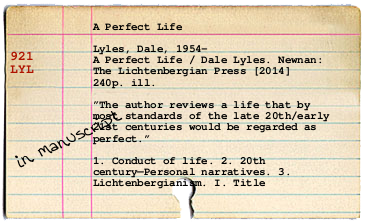
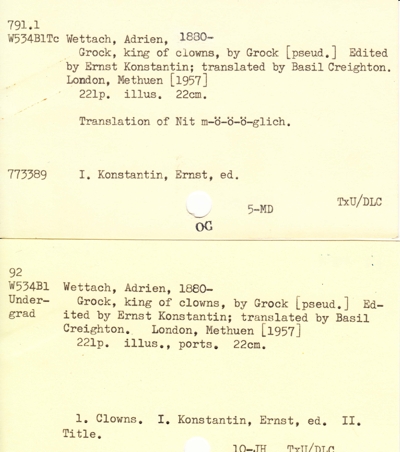
For this book was a discard from a university library, and tucked away in it were these:

::sigh:: Have you ever seen anything more beautiful?  The only way these could be more arousing would be if they were a complete set.  Still, I mustn’t complain.

Actually, these are two main entry cards, possibly from two different libraries.  Neither is what I would call complete.  The first one has the original title (Nit m-öglich) but no subject headings; the second has the obvious subject Clowns but not the original title.  There is also the difference of opinion as to where to put this book.  The first library puts it under Circuses in the 791’s, although they could have extended the number with the –092 standard subdivision for biographical works, i.e., 791.1092, although –09 would have been sufficient.  The second opts for the Biography section with the 92, the lazy librarian’s shortcut for the actual number, 921.  Either card is correct.

Both use Cutter numbers for the author rather than the first three letters of the author’s last name.  For the regular school library, that’s an unnecessary complication.  (So would be the extension of the Dewey Decimal number I suggested above. The purpose of such detail is to allow books on similar topics to be grouped together on the shelf, and how many books on the circus does a regular library have, after all?)

This just gets me going.  Even among media specialists I was a cataloging freak.  I loved cataloging, from the days when we still typed the cards ourselves (like these two) to online MARC records.  I knew the Dewey Decimal Classification Abridged edition by heart, and when we built the new East Coweta High School I ordered the full edition.  When it arrived I was physically tingly, if you know what I mean and I think you do.

The new library at ECHS was essentially empty, a blank slate, and over the next four years I got to fill it with 15,000 books, most of which I cataloged myself.  Sure, some came with catalog cards, and most books in those days (1988-1992ish) had full Cataloging in Publication records on their copyright pages, but, you guys, CIP was often hugely inaccurate.  The minions at the Library of Congress were often cataloging based on a title page alone, and that created some incredible howlers, DDC-speaking-wise.  I was compelled—compelled, I tell you—to correct them.

I was so in love with cataloging that I actually programmed an Apple ][e to print a full set of catalog cards for any given main entry.  The way it used to work was that, like the above cards, you had a “main entry” for a book. That main entry included titles, subject headings, editors, illustrators, etc., and after you typed that card, you then typed all the other cards.  Originally, subject cards had the subject line typed in red ink, but around the time I arrived we had settled on ALL CAPS instead.  (See here, for example.)

With my program, you typed in all the elements—author, dates, title, subtitle, publisher, subjects—and then the dot matrix printer spit out every card you needed.  It was awesome, and everyone in Coweta County used it until the state automated us in the early 90s.

Let me be clear: I am not one of those who misses the actual card catalog.  What a nightmare to construct and maintain!  What happens when a book is not returned?  Do you pull the catalog cards?  At the time, the main entry cards (plus title cards) were in one piece of furniture, and the subject cards were in another piece of furniture.  You’d be pulling all these cards from everywhere—pulling the metal rod out of the entire drawer, pulling the card, reinserting the rod, etc.—and, what, storing them?  Because then what if the book shows back up when lockers are cleaned out at the end of the year?  Then you have to refile the cards.  Ugh.

But the cataloging itself?  Remember this scene?  That’s how I feel about cataloging.  I was so notorious amongst my fellow media specialists that when new books came without cataloging, others would wait until I had input mine in the online system, then just add their copies to my main entry.  If the books came with electronic cataloging, I would go through and correct entries, add subject headings, and improve call numbers.  I was incorrigible.

I mean, look at this: Catalog card prøn!

Now go here and get your inner Dewey on!

Labyrinth: the new West point

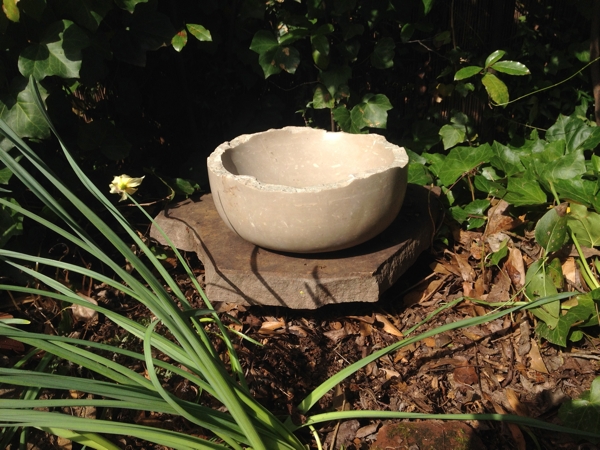
You may recall that last weekend I bought a limestone bowl at the American Craft Council show in Atlanta.  This was for the express purpose of installing it at the west point of the labyrinth.

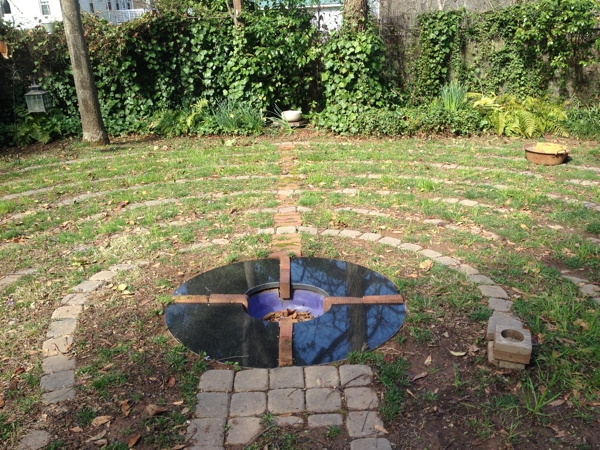
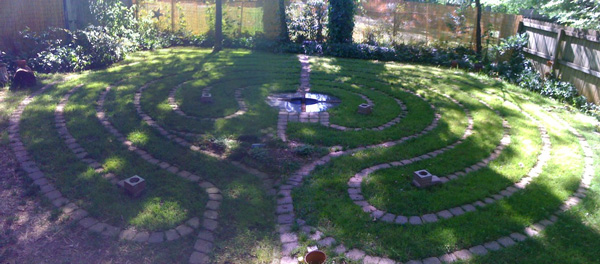
The labyrinth is aligned to the compass, with the entrance at the eastern end.  (When you see photos of the center, the bricks are in line with the points.)  Back in the day, the four elements were each associated with the four directions:

  • East — Air
  • South — Fire
  • West — Water
  • North — Earth

Easy enough.  Over the last six years, each of the four points has gone through various incarnations as I get a better feel for what belongs in the space, and water was the last of the points without a permanent feel to it.  I had settled for a glass bowl that I found at Ross (Dress For Less) for cheap—I had the local glassworker remove the pedestal and reattach it upside down in the bowl to serve as a place to put the candle while the bowl was full of water.

But it froze and broke during the polar vortex, and I decided that this time I would find a permanent solution.  As soon as I saw Brooks Barrow‘s creation, I hoped this would be it.

Oh yes.

Here it is in situ.  I cleaned out the new ivy growth and raked a bit.  Just now coming up are the Japanese painted ghost ferns that grow in front.  I could plant a couple more there just for effect; they’re such lovely plants.

Here’s a long shot of the bowl, from across the center of the labyrinth:

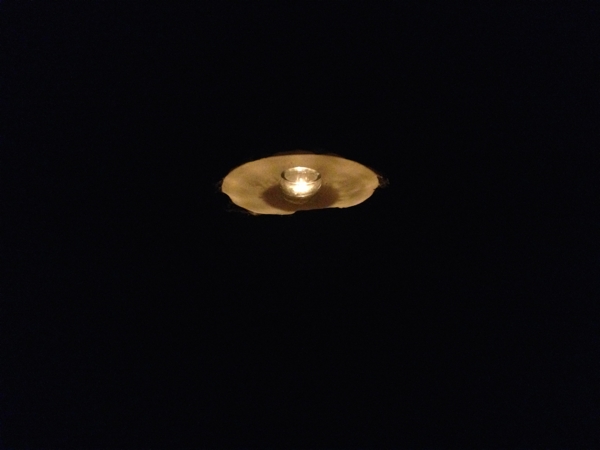
So last night some friends and I had an installation ritual; we used all four elements, with me carrying a bowl of water over to the new bowl.  I poured it in, lit the candle in the center and was immediately struck by how perfect it is.

It’s just this luminous pool of water floating there—perfectly stunning.  Because the bowl’s interior is shallower than the outside, you get a “big bowl” look from the outside, but the inside is this perfect little scoop of light.

Here’s the long shot:

Ta-da!  Finally, all four points are finished to my satisfaction.  I should pull all four together and do a blog post about them as a group.  (For one thing, they have rather tidily arranged themselves from tallest to shortest around the circle: Air–Fire–Water_Earth.)

So there we are, a new piece of the labyrinth.  Stop by and see it.

Burning Man: Order. Community. Transformation. Part Three

Transformation.  Ah, now we’re down to it.  The third—and to my mind the most important—aspect of ritual is transformation.  The whole purpose of ritual is, like the Hero’s Journey, to change the individual and his society.

From simple rituals like shaking someone’s hand upon being introduced to them [now our social interaction is different than it was a few moments ago] to bar mitzvahs [now the boy is a man] to Catholic confession [now your soul is unburdened by your sin] to GHP [now the student makes intellectual, emotional, and social connections that he/she didn’t before] to Burning Man […], we do not remain the same after undergoing the ritual process.

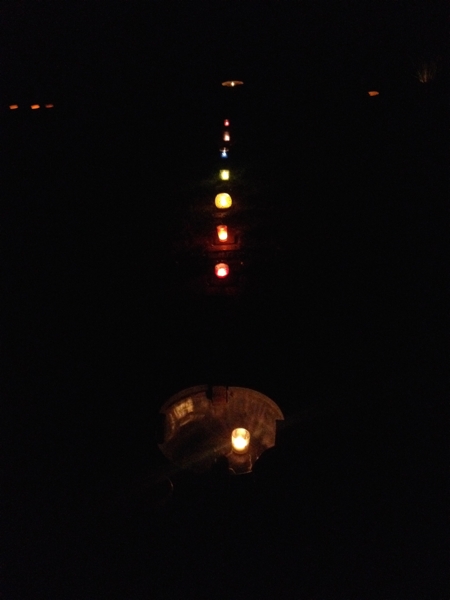
With a labyrinth, as I’ve said before, the change is entirely internal and personal.  Simply walking through a labyrinth is not likely to produce a change.  The trick is to walk it mindfully, to be open to its suggestions.  It is amazing to me the different ways my own labyrinth can speak.  Sometimes it’s the turning from one direction to another.  Sometimes it’s the approach to the center.  It has spoken through the length of the path; the return journey; what I was wearing (or not, as the case might be); the sculpture/totems at the compass points; the calligraphic patterns in the bowl in the black granite center; the chakra/rainbow candles along the Western Path; the view from the center.

I have taken problems in with me and found solutions.  I have had problems present themselves.  I have found peace, and I have found perturbation.  I’ve had profound revelations, and trivial realizations.  I’ve expressed gratitude, joy, bitterness, grief.

And it’s the ritual that does it.  Getting up from the fire (usually) and making the decision to approach the Path.  Standing for a moment at the entrance.  Walk. Listen.  See.  Stand at the center.  Return.  Exit.

Meaning and transformation: I haz it.

Who knows what we will find at Burning Man?  We’ve already talked about the structure of what we will offer, but we do not know what transformations that participants will end up with.  We cannot know.  We cannot even know what transformations will be wrought upon us.  But if we offer a ritual, and Burners approach it as a ritual, then transformation will occur.

Burning Man: Order. Community. Transformation. Part Two

Communitas is the second of the products of ritual.

It is easy to see why this is so: for a public ritual such as 3 Old Men, people come together to participate.  They have agreed, corporately, that this action is good and appropriate and that it must be done.

And by doing so, they bond themselves into a community.  They are part of something larger than themselves.  Indeed, they have crossed that line of liminality into something universal.

Note that this communitas is not tribalism (although certainly tribalism uses ritual to reinforce itself).  Those who commit to a ritual come to understand that they are part of the Order created by the ritual, and more importantly, the others in the ritual are part of the same Order.  They are a Community.

With the 3 Old Men, we offer the Burning Man community a ritual of passage: a hero’s journey from the outside to the center and the return, ending with an agon that assumes meaning according to the metaphor constructed by the participant.

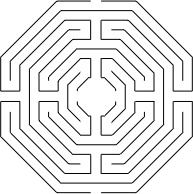
One thing that interests me about our ritual is that it differs from the experience of a regular labyrinth. A regular labyrinth offers one path in and one path out, usually the same path; the ritual is a meditation, seeking meaning and metaphor in the walk, undisturbed by conscious choices. In our labyrinth, on the other hand, choice becomes an integral part of the journey.  I don’t know if you’ve traced the pattern, but each of the four paths branches twice before returning to itself.  It is not a maze; there are no dead ends, and you cannot get “lost,” but you must at least pick a path (twice) on your journey to the center—and that’s after picking which entrance to use.

Once in the center, choosing an exit reverses the process, only this time, your choice involves a choosing, if that makes sense: more than the direction you exit, there are officiants standing outside three of the four exits, each offering a different agon.  Indeed, choosing to undergo an agon or not becomes a major part of the ritual.

More: the question arises of what happens when you have chosen to exit towards the officiant who offers a blessing, for example, and while you are making the journey outward, the officiants make their procession to another entrance.  Do you continue your path, exiting to an agon (or the absence of one) different from the one you had hoped to encounter?  Do you stop, return to the center, and exit to your original choice?  Can you do that?

Thus those who participate in the 3 Old Men’s ritual will find themselves involved in a communitas which they may not completely understand—it makes no demands of them to join a “community,” but it does lead them into a confrontation with a structure offered by three mysterious elders, a structure that asks them to regard the choices they make—and the choosing—and to construct their own meaning of those choices.  It offers them a brief liminal experience in the middle of the hurly-burly of Burning Man, and my hope is that that’s a good thing.

Tomorrow: Transformation.