You will recall that way back in January I lost my wedding ring. It has never shown up. We ordered a new one, the exact design, from our favorite jeweler, but a) it had to be special ordered; b) the company that makes them waits until there are enough orders to fill before filling them; and c) our favorite jeweler decided to retire. So we canceled the order and went looking.
Specifically we went looking in Asheville, our favorite new destination for art, food, and fun times. There was one artist whose jewelry I really liked the last time we were there, and so while we looked at All The Rings everywhere we went, I had a gut feeling that we’d find what we were looking for at this young woman’s studio.
However, when we drove by later in the day, lights were on in the studio and I did a quick U-turn to go check. She was in, and indeed, her work was what we were looking for. I picked a squarish ring (like my old one), with a bark-like finish, in white gold. (I had been wearing a replacement ring from Wal-mart—it was silver and I got used to the color. Plus, it seemed appropriate to shift tonalities.)
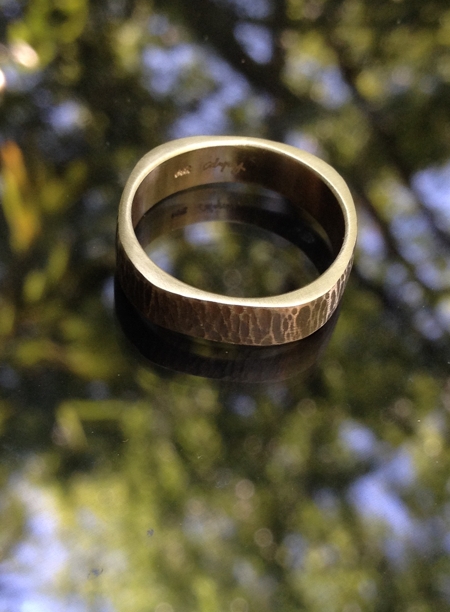
It took about a month and a half for her to craft the ring and get it to us, and it is a thing of beauty:
Here it is on the newly sealed and polished center of the labyrinth:
It’s not as square as my old one, and I will always miss it, but this is a beautiful thing and I love it. Thanks be to my lovely first wife!
For the record, I also bought a square earring with much the same finish while we were there.
Yes, I know—but I’ve been busy. I spent five weeks in Columbus, GA, as a guest artist at the Springer Opera House in a very lovely production of Born Yesterday, playing the drunken lawyer Ed Devery with as much professionalism as I could scrape together. The struggle was real, and that’s not the kind of thing I document in public.[1] My fellow cast members were boffo, and I think in the end I acquitted myself well.
Sure, I could have blogged about my continuing work on A Christmas Carol—I have made it to the “Finale” and will have it finished by the middle of June—but that’s dull blogging.
I could have blogged about the continuing outrages on the rightward flank of American politics, but Wonkette does that so much funnierly than I do.
Oh well—apologies all round.
So I’m back, and for my first post I’m blogging about a new cocktail, as is my wont.
This is the Molly 22.A, concocted for a dinner party honoring the graduation and 22nd birthday of young Molly Honea, who is now the proud possessor of two useless degrees from the University of Georgia. She has always demanded requested that I create a cocktail for special occasions, and by “special occasions” she means any get-together that she’s attending.
She likes gin—and we must applaud her perspicacity for acquiring such sophisticated taste in the mere one year she has been drinking alcohol—and citrus, so I started there. It was fruitful research.
MOLLY 22.A
1.5 oz gin
1 oz yellow Chartreuse
.5 oz lemon juice
1 dash lemon bitters
optional: .5 tsp grenadine (the real kind); a few drops kava extract
Throw the gin, Chartreuse, lemon juice, and bitters into the shaker. Shake with ice, strain.
If you have real grenadine, drop that into the glass and let it sink to the bottom. If you’re a dirty freaking hippie and have kava extract lying around, it’s fun to add that to the mix before you shake it.
Now the fun part:
MOLLY 22.B
Use vodka instead of gin. It’s a smoother drink, needless to say, without the interest of gin.
MOLLY 22.A.1
Use green Chartreuse instead of yellow. It’s less sweet and to my taste more layered.
So there you go. I do have a series of topics I’ll be blogging about, so you can dust off your link to the blog now.
—————
[1] To be clear, I have no problem documenting my struggles and failures, as longtime readers of this blog surely know. However, I never want my struggles to appear to reflect poorly on others—theatre is a hurly-burly process, and to an outsider it might appear that I’m placing “blame” for my own problems on others in the process. Nothing would have been farther from the truth.
I’m pretty sure I’ve blogged about this before, but the bizarrely synchronous events in my life seem to me to be considerably above the proper average that statistics have laid down for our guidance.
For example, it’s a rare day when the New York Times crossword puzzle does not have an answer that reflects directly on something going on in my life, often a phrase, name, or word that pops up on the television show my lovely first wife is watching while I am working on that very clue.
Today in rehearsal during a break in the action, I was not involved in whatever was being discussed and idly opened one of the prop books on the table in front of me. It was one of those bound volumes from Great Literature, and since I didn’t have my glasses on I could not read the text, but I could make out the headers on the left and right pages: CHARLES LYELL | GEOLOGIC EVOLUTION.
Well.
Flashback to teaching information skills to 3rd graders: one of my favorite activities to teach them how to use the dead-tree editions of the encyclopedia—because it was on the test that’s why shut up—was to have them look up their last name and see how close they could get. I had an introductory presentation which demonstrated guide words blah blah and finally I would light on LYELL, CHARLES. We’d scan the article and I’d show them how to extract the information they would need when they did their own name. (I would also point out multiple times that I hadn’t found my exact last name so stop whining you little twerps.)
(We would also then turn around and use the online World Book and lo! almost every kid would find someone with their exact last name—and those that didn’t ventured over to Wikipedia.)
That was certainly worth a nostalgic chuckle, but then just now I was reading a Wonkette article on our next never-going-to-be-President, Rafael E. Cruz, and there in the comments was the following:
It turns out it wasn’t until the Alverez team published their findings about the KT Impact in 1981 that Mass Extinction was even talked about in the science community, all thanks to Charles Lyell, a lawyer who argued that catostrophism was absurd and advocated a more natural cyclical theory to life on earth.
With a link to the Wikipedia article even. Mercy. It’s harmless, but it’s certainly also unnerving. I’ve learned to live with it.
update: Let’s add another one: using Slate’s Reincarnation Machine, I amused myself by following the chain of famous folk who died/were born on the same day, starting back from my birthday. Eventually we arrived at Otto I, who was in the crossword puzzle yesterday. (I also got Julius II in there somewhere. Fun web activity!)
another update: So yesterday I mentioned info skills at Newnan Crossing. One of the last lessons I invented was to teach a fourth grade class the difference between figurative and literal language. They had to create a Keynote presentation on the new iPads that illustrated the metaphors in a Shakespeare sonnet. I demonstrated with Sonnet 18 (“Shall I compare thee to a summer’s day?”); they had to go back to class and work on Sonnet 73 (“That time of year tho mayst in me behold”). This morning’s Writer’s Almanac? Sonnet 73.
That time of year thou mayst in me behold,
When yellow leaves, or none, or few do hang
Upon those boughs which shake against the cold,
Bare ruined choirs, where late the sweet birds sang.
In me thou seest the twilight of such day,
As after sunset fadeth in the west,
Which by and by black night doth take away,
Death’s second self that seals up all in rest.
In me thou seest the glowing of such fire,
That on the ashes of his youth doth lie,
As the death-bed, whereon it must expire,
Consumed with that which it was nourished by.
This thou perceiv’st, which makes thy love more strong,
To love that well, which thou must leave ere long.
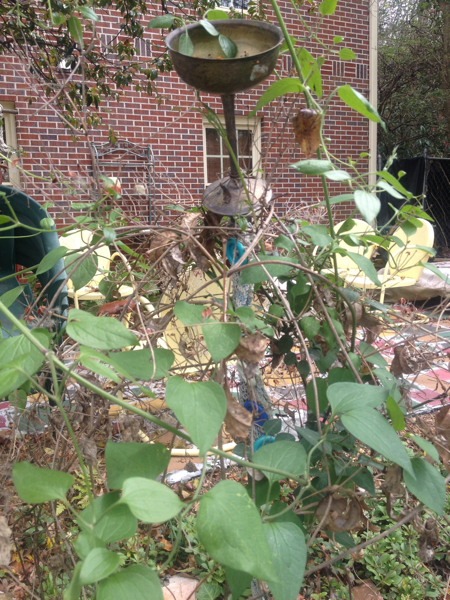
I finally remembered that I wanted to make a serious effort to find out what the two vines are that grow so prettily in the labyrinth.
This one:
…with its delicate little stems and beautiful, fern-like leaves, is actually a monster: Lygodium japonicum, an invasive climbing vine that—from the photos in that second link—is every bit as bad as kudzu or ivy. So far, it has shown no inclination to take over anything other than the wire structures I have provided for it.
The other:
…is Clematis paniculata, also known as Sweet Autumn Clematis. It is also invasive, and I have to say that I have found a strong cable of vine running through the ivy. I took the remaining seeds and planted them over by the fence in the hopes that I can convince the plant to take part in my eventual privacy fence. I will harvest more seeds next fall.
Longtime readers may recall that I used to maintain a wonderful herb garden, but in recent years I curtailed it quite a lot, since I just wasn’t here in the summers. Things would either go to seed or die from not enough watering, and it wasn’t worth the expense.
But since I am now at home, I find myself needing the parsley and the cilantro and the basil, and the expense has shifted to buying it in the grocery store and seeing much of it go to waste.
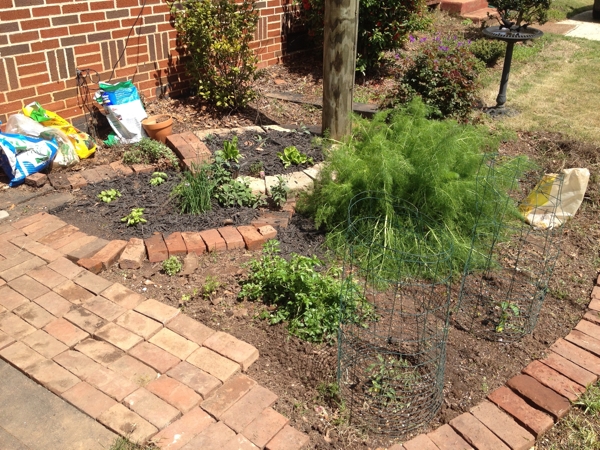
So here we are:
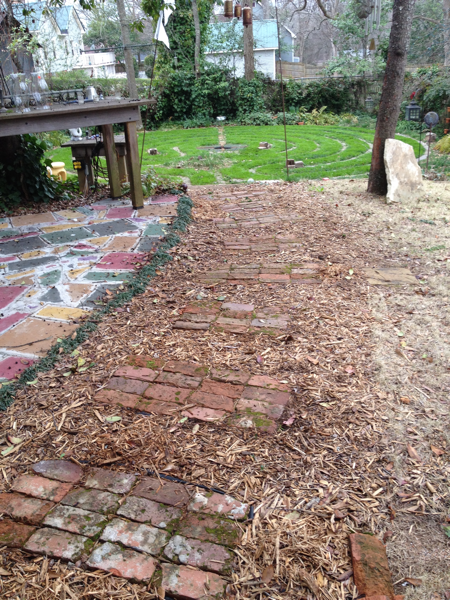
Several years ago one of us contracted with a yard service to keep everything edged. They promptly covered up my brick edging and left it to ruin. I have now uncovered the brick and even added to the path on the left so that we have an easier time getting to the garbage and recycling bins. All the bricking got raised and leveled.
You will notice that the Dill Bush That Ate Newnan is back—and this is after freezing to death twice this year. The other survivors are the parsley, chives, sage, and oregano. And the lovage made it back!
New: basil, of course; cilantro (although I had a couple of plants emerging as reseeds); tarragon; thyme; a couple lettuces and some kale; a tomato plant; and a serrano pepper plant. And catnip, which I’ve never planted before.
Around on the other side of the dill, I’m going to plant hummingbird/butterfly garden seeds and see what happens. If it works, it will be fabulous.
Of course, it’s in the back of my head that there’s no better way to provoke the universe into finding you a fabulous summer job that will require you to be away from home than to make this commitment.
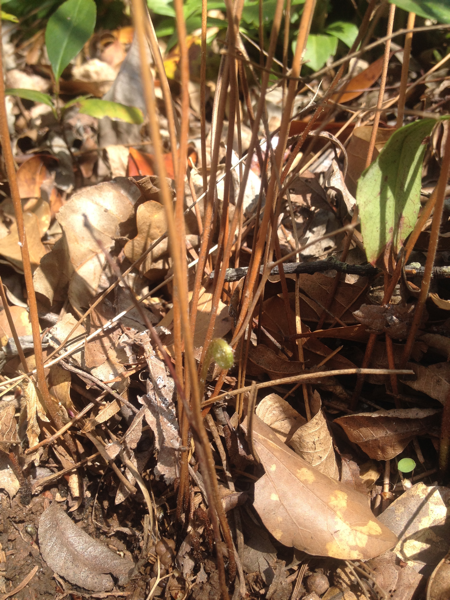
As the weather warms, little green things begin their return to the labyrinth.
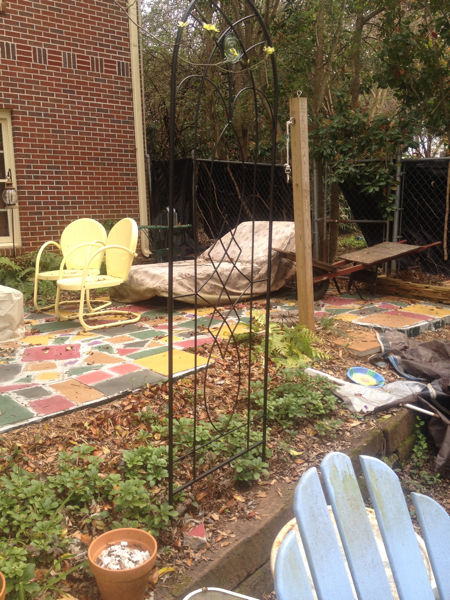
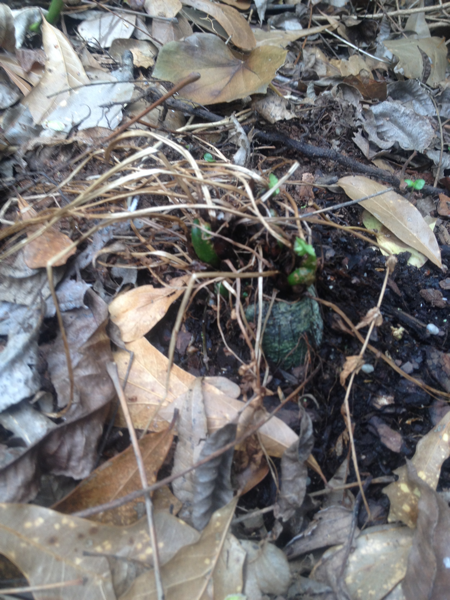
See that tiny little fuzzy, curled shoot? It is the reappearance of the fern-like vine—no, I don’t know its name—that appeared a couple of years ago. All those brown sticks are the remains of last year’s growth, and it’s already put out more tendrils since I took this photo. I had set up a wire cage for it to climb on, but this year I bought it its own home:
That should give it plenty of room to express itself.
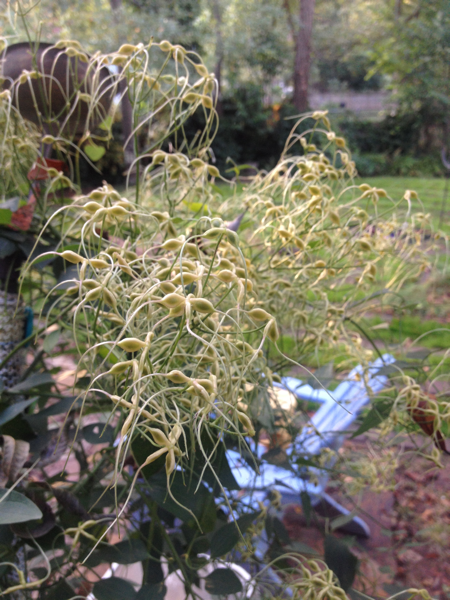
Another vine that just sprouted last year has returned, this one sending out new growth from the old:
Now that I know this, I can cut it back a little bit next year. This doesn’t look like much, but it puts out hosts of delicate little white flowers that have the loveliest smell, and then the flowers turn into these ghostly seed pods:
Those dry into fluffy seeds waiting to be carried away by wind and rain, although most of them are still in place. (If you’d like some to start your own vine, let me know.) I don’t know the name of this vine, either.
Ferns are beginning to return, including some male ostrich ferns I planted late last fall and which promptly succumbed to the cold. I was very pleased to see them make it back:
I’ll post more photos as they mature.
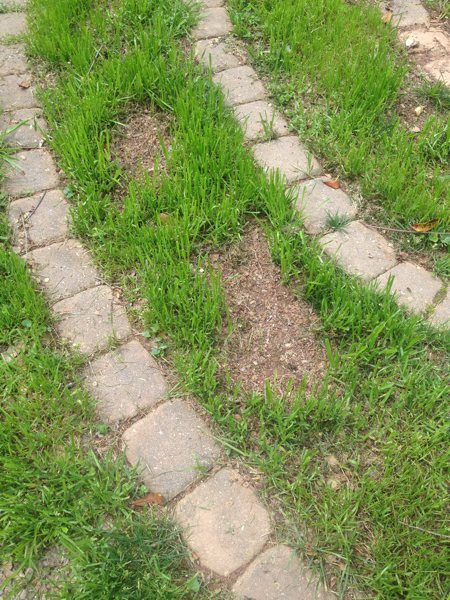
The only place where growth is not happening is in those pesky bald spots in the labyrinth. A couple of weeks ago, when it began to warm up and before it rained, I targeted those spots with specific loving care, raking out the areas and sowing fescue. So far? Nothing:
I had seen the Londonerry project a couple of weeks ago and was trying to keep track of it, because the Temple at Burning Man has always had an especial pull for me. From its very first incarnation, the notion that this enormous structure would serve as a place for meditation and redemption in the midst of the glorious circus of Burning Man was very appealing.
That seems to be the overall opinion as well: as the Temple grew in stature, Burners seemed to expect it to be there and treated it differently than the burning of The Man. Whereas The Man was a bacchanalian release of energy/tension/ecstasy, with drumming, music, and dancing, the Temple was usually observed in silence or in tears.
Not only that, but The Man used to be burned on Sunday night, the last night of the festival—now it’s burned on Saturday night and the Temple has taken its place on Sunday. The whole focus of Burning Man has shifted to accommodate the spirit of Dave Best’s structure.
For me, the trip to Burning Man has always been largely about being there for the Temple burn. I’m not sure why, but it exerts a spiritual call on my soul. I want to see if by experiencing it I can explain that call.
So when I read about the Londonderry project, I thought, “Well, that makes sense,” especially given the troubled past of the area. And today when I saw the article about the burn, the first sentence that jumped out at me was the one about the Presbyterian minister’s concerns that the burn would “leave people open to Satan.”
Really? That’s what you get out of this? People from different—if not opposite—backgrounds come together to build this beautiful structure; and then people from everywhere leave their grief there to honor their loved ones; and then all that pain and beauty is released through an awe-inspiring ritual—and all you’ve got as an emotional response is a fear that all of this leaves people open to Satan, whatever the hell that means?
No, you sanctimonious prick, what this leaves people open to is forgiveness and pure-T caritas, which apparently you know only as a word from your Greek class. It’s pitiable, it truly is, how badly some people misunderstand God and cannot see it even if it’s transpiring right in front of them.
Ten years ago today, my old AOL friend Noah flipped the switch on his server out in California, and I started this blog. [Picky readers will point out that I had started blogging over at Blogger some months before, but I defy them. I regard them as naught.]
I was still working at Newnan Crossing Elementary, about to finish my specialist degree in instructional technology; my lovely first wife was still in charge of lots of stuff at Piedmont Newnan Hospital; my son was still in high school. I was midway through my tenure as assistant program director for instruction for the Governor’s Honors Program. I was beginning the final push on finishing William Blake’s Inn. I had just made my second labyrinth, at Newnan Crossing, my ear was unpierced, and the Lichtenbergians wouldn’t exist for another two years.
Since then I’ve blogged in spurts, sometimes going for months without posting, but I always keep this tab open on my browser so that I’m reminded that I have this ongoing experiment to deal with, to write and share my thoughts with at least half a dozen people on this planet, to say things that I need to say.
The blog has never been—and never will be—a diary or personal journal. Whatever personal issues I’ve had over these years, you didn’t read about them here—I don’t think they’re interesting, first of all, and secondly I don’t think it’s necessarily beneficial to share these kinds of things with the wide world. If I’ve exorcised demons in writing, you may be assured that it was in some other venue/medium.
Mostly this blog has been a journal of my creative life, from my music to my writing to my adventures in Lichtenbergianism and hippiedom. It’s been fun reporting on my roadblocks in composing or my progress with Lichtenbergian goals or philosophical underpinnings of getting naked in the desert. It’s been fun ranting against the conservative idiocy that infects our nation. It’s been fun just putting one word after another while avoiding other tasks.
So ten years later, here we are: I’m retired, my lovely first wife now works at the Samaritan Clinic, my son is married, and this is my 1,416th post. Onward!
OK, so I’ve not been very productive. But I have accomplished some little bits.
First, you must know that I’ve been working on re-orchestrating A Christmas Carol for next December’s re-premiere. I haven’t shared any of that because it’s not very interesting, but here’s a taste:
This bit of underscoring takes us from the chimes of a neighboring church to the Ghost of Christmas Past’s teasing appearance, to their transportation to Scrooge’s past: the countryside, Martin and Oliver having a snowball fight, and then fading into the schoolroom.
The process of preparing sound files for December is not at all the same as simply re-orchestrating the show from an 11-piece ensemble to a full orchestra. Because I’m not actually working on documents for live musicians, there are lots of shortcuts and omissions. For example, if I transpose a harp sequence up a octave, I don’t bother moving it from the bass clef up to the treble clef because who cares? No harpist is going to have to decipher what I’ve written, and the computer doesn’t care—it will play the notes exactly where I’ve put them whether they look correct or not.
Repeats are another area: many of the pieces have vamps (bits that loop until the scene moves on) or repeated verses/choruses. For live musicians, repeats save paper and are easier to read. But the printed repeat signs are irrelevant to a computer program that I’m going to instruct to “loop this waveform until I tell you not to,” and so I’m leaving those out. In the above sample, there is a vamp on the flute part that you won’t hear because that will be taken care of in QLab, the multimedia sequencer I’m still exploring.
I’m in the middle of pondering whether it is going to be better to try to “slice” the repeat (with varying degrees of smoothness or accuracy) in QLab or to export each section of a piece separately so that the repeated section is clear and easy to click on. This may become critical in rehearsal, of “A Reason for Laughter,” for example, as we try to get Mr. and Mrs. Fezziwig in and out of their verses, or in “Country Dance” when we’re trying to learn new sections of the dance.
I also have been taking repeat signs out of pieces like “Country Dance,” where it’s just easier to string all the jumpbacks (from A—>B—>A—>C—>A) out into one long piece rather than deal with all my quirky repeat signs. In fact, I’ve stopped working on the music to blog here because the challenge of untangling “A Reason for Laughter” makes my eyes cross.
Anyway, as far as slicing vs. exporting multiple files for each pieces goes, I have lots of time between now and November, so I can play with all my options. (Who am I kidding? I’ll take the complicated way because it will make life much easier in rehearsal.)
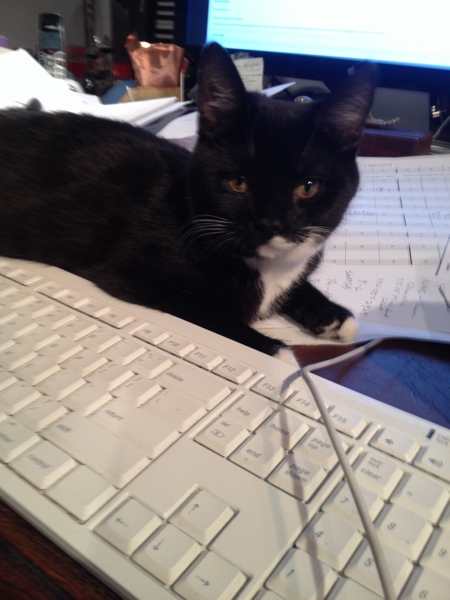
I have gained an assistant:
She is currently trying to keep me from typing—WHAT IS THE DEAL EVEN I SHOULD BE PETTING HER ANYWAY—and did you know that pencils, pens, and erasers make great rolly toys, especially if you knock them to the floor?
She’s been with us for a couple of weeks now but has so far refused to divulge her name, and she is the only cat I have ever met that, when you pick her up, goes limp in your arms and settles in for a cuddle. She’ll shift, turn over even to get more comfortable, but ask to be put down? Nope.
This is not the cat I was looking for—I prefer tabbies—but she is such a sweet-tempered beast that we were afraid to tempt fate by giving her away. I’m trying to get used to cat hair everywhere again. The turbo-purr helps.
Rehearsals continue for Into the Woods. You will have to believe me when I say it is not bragging to claim that my performance will be a tour de force—it would be for anyone handling the roles of Narrator, Mysterious Man, and the Wolf. Generally, the Narrator/Mysterious Man are combined roles, but the Wolf is played by Cinderella’s Prince. My playing all three requires some very quick changes indeed, and so the audience can not help but be dazzled by my facility, speed, and grace. There is one moment where I—as the Narrator—facilitate Milky White’s escape from the Baker’s Wife, only reappear seconds later as the Mysterious Man; I expect it to provoke laughter.
I am quite enjoying the chance to sing “Hello, Little Girl,” however. It’s delicious, nasty fun.
The show opens March 19 and runs for two weekends, Thu-Sun. Details here.
Lichtenbergianism: procrastination as a creative strategy is going well, if by “well” you mean “successfully avoid writing abortive attempts for Seven Dreams of Falling while not accomplishing an awful lot.” I sit in my writing chair—that’s an official thing—and start free-associating on one of the 9 Precepts, and before I know it I’ll have two pages in a minuscule field notebook almost filled. It’s exhausting.
So far, I don’t have any brilliant new insights to share from my writing; I’m still in the “dumping” phase, wherein all those things I’ve said and thought about the creative process over the years are finding their way out of the recesses of my brain onto the page. I’ve also begun collecting relevant bibliographic support, so that’s progress of a sort.
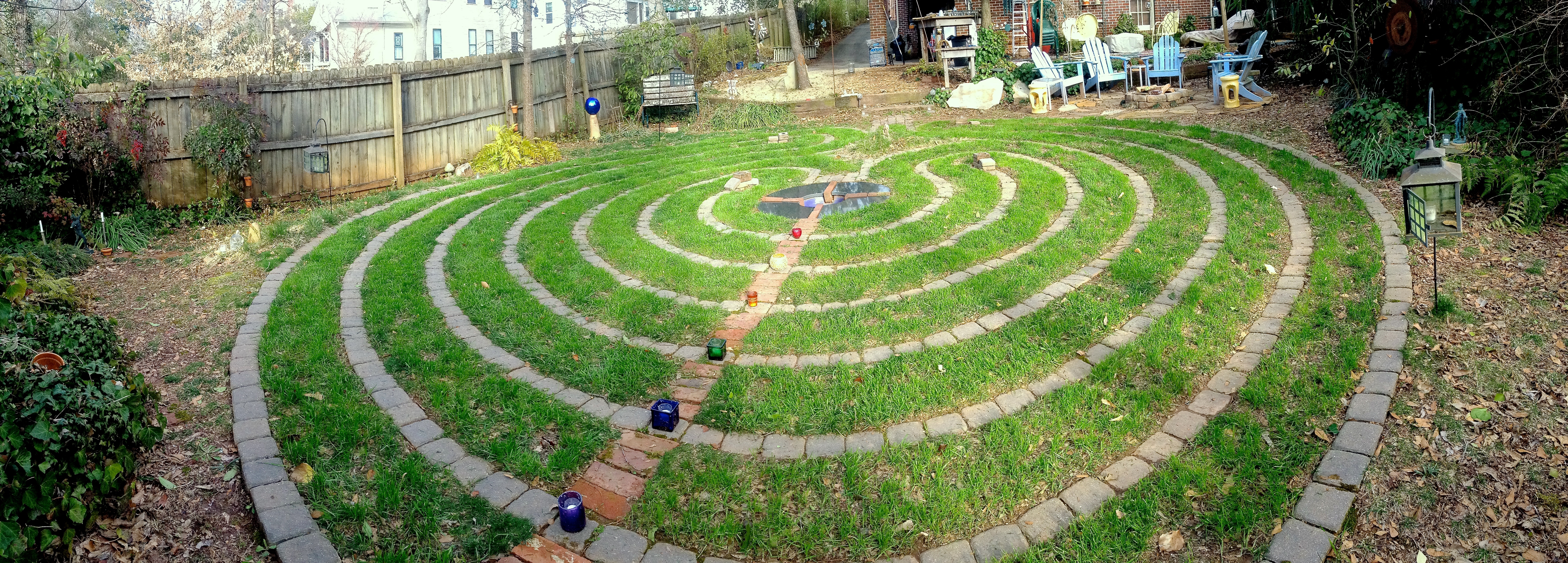
Finally, a look at the labyrinth:
—click to embiggen—
A panoramic shot from the west side looking back towards the entrance—not our usual vantage point. The winter rye grass makes for a lovely oasis of green, although I’m sure I’d be a better hippie if I learned to appreciate Nature’s own withered brownness.


 I was still working at Newnan Crossing Elementary, about to finish my specialist degree in instructional technology; my lovely first wife was still in charge of lots of stuff at Piedmont Newnan Hospital; my son was still in high school. I was midway through my tenure as assistant program director for instruction for the Governor’s Honors Program. I was beginning the final push on finishing William Blake’s Inn. I had just made my second labyrinth, at Newnan Crossing, my ear was unpierced, and the Lichtenbergians wouldn’t exist for another two years.
 Mostly this blog has been a journal of my creative life, from my music to my writing to my adventures in Lichtenbergianism and hippiedom. It’s been fun reporting on my roadblocks in composing or my progress with Lichtenbergian goals or philosophical underpinnings of getting naked in the desert. It’s been fun ranting against the conservative idiocy that infects our nation. It’s been fun just putting one word after another while avoiding other tasks.