A brief encounter

The other day I leaving the grocery store, and an older man was coming in. He was holding the hand of a young person, kind of grandchild age, maybe 13-14, and it was clear by the young person’s gait that there were some developmental issues there.

I say “young person,” because in the brief glimpse I had, I truly was unable to determine gender. Perhaps that was unimportant.

The child—and to avoid ungainly linguistic contortions, I am going to assign the pronoun “he”—was dressed all in black, black hair, eyeliner, and to top it all off, a black cape. He was committed.

It was not a particularly nice cape, just that almost-sheer velour material one gets in a plastic bag out at Party City. The child didn’t seem to have the attitude sported by most of our emo cadre, that sullen haughtiness that just dares you to stare or roll your eyes. This kid seemed a little wary, as if his outfit were camouflage that he was afraid was not quite enough to allow him to escape notice.

You can’t help but construct narrative, can you? Is this a look he’s seen and for some reason has taken on in order to “become” someone? Is it someone he admires? A musician perhaps? A movie character? Someone at school?

Does the (presumed) grandfather love this kid so that he willingly takes him to the grocery store in his freaky getup? Or does he cringe, knowing that most of the people in the store are going to be judgmental one way or the other?

All kinds of stories pop into and out of existence.

I will say that I am proud that my first reaction was to think that I should stop and say, “Hey, cool cape! Did you make it?” (knowing full well that he had not), just to validate his choices.

But of course I didn’t—I was on my way out, they were on their way in, and there are always too many variables to consider in such a split second. Would my approaching him give him a positive validation, or would it send him into an emotional tailspin? Would the grandfather appreciate the sentiment, or would I trigger some defensive response? What if I read the situation completely wrong and made it worse?

If I had seen them up and down the aisles of Publix and had time to figure it all out, I’d like to think I could have done a good deed by giving the kid a thumbs up. I’d like to think so.


Cocktails: The Best Friend

This one was an accident.

I had copied down a bunch of cocktails from the interwebs, and one of them was called New Friend, ringing changes on a classic cocktail called Old Pal, which in turn is based on the Boulevardier, which in turn is based on the Negroni.  Got that?

Here’s how it goes:

Negroni: equal parts gin, Campari, sweet vermouth

Boulevardier: rye, Campari, sweet vermouth

Old Pal: rye, Campari, dry vermouth

New Friend: rye, Aperol, Cocchi Americano

Yeah, that’s a big jump between the Old Pal and the New Friend, but it works.  You can read about it at Serious Eats.

But then I messed up.  In pulling ingredients, I got the rye and Aperol but then had a brain-fart and grabbed the new bottle of Amaro Nonino, which is not the same as Cocchi Americano.  But the drink was scrumptious, so I finished it before trying the actual New Friend.  (The Cocchi Americano is a vermouth, so it had a brighter, grapier flavor than the mellower Amaro Nonino.  Slight preference to the Amaro Nonino.)

Best Friend

  • 1 oz rye
  • 1 oz Aperol
  • 1 oz Amaro Nonino
  • orange peel

Stir with ice, strain into glass, garnish with orange peel.

Coloring books. Yes, coloring books.

Here, go read this.  I’ll wait. [NOTE FROM 2025: That link does not work any longer.]

tl;dr: a very long, quite well-written piece by a Christian author warning us about mandala coloring books being spiritually dangerous.

Okay, woo alert.  Since I am an Existential Mystic, my tendency is not to grant woo an independent reality, so perhaps it’s a little unfair for me to pick apart the writings of a Spiritual.  But the far ends of any scale are fascinating, so let’s dive right in.

Sure, click here if you want to risk your IMMORTAL SOUL!!!

One of the issues I have with die-hard Spirituals is that their belief in the reality of their particular woo is so absolute that it extends to all the other woo as well.  In this case, we have a carefully reasoned blogpost that provides proof of the dangers of simply filling in random spaces on a piece of paper: if you color a mandala, it will automatically open the door to your soul/mind/body and let demonic forces in.

Evangelical believers, particularly, are prone to this kind of thing.  Their understanding of God is that of a “personal God,” which does not mean (as most of them think it does) a God who is “mine”; rather it means a God who is “a person,” i.e., independently existing as an individual outside our reality.  The same applies for the idea of a “personal Satan” or “personal demons.”

This belief, coupled with some vague biblical literalism,[1] leads them to the understanding that not only do God and Satan have a real existence, but so do witches and demons and all those “other gods” whom generally our evangelical friends ridicule as nonexistent “false gods” but who really exist not really yes really.

In the same vein, they understand transactional magick to be real and effective: that’s the basis of their belief in intercessory[3] prayer. They easily transfer that belief to pentagrams, Ouija boards, Dungeons & Dragons, yoga, and yes, mandala coloring books—just touching one of these things is enough to unleash the hounds of hell whether or not you believe they’re “real.”  Just joking around at a sleepover with “Bloody Mary” or taking a hot yoga class will press the On button on the remote control, and, well, you’ve seen enough horror movies to know what happens next.

Here’s the interesting part: the only proof they ever have is their own belief in the reality of belief systems that otherwise they will tell you are not real.  It never occurs to them to say, “Hm, those other people are trying make sense of the Infinite, too—I wonder how similar their approach is to mine.  Maybe I could get further in my own faith if I paid attention to theirs.”

Nope.  Instead, because their Tao is the only Tao—they can NAME IT AND EVERYTHING, KENNETH—all those other paths to the Infinite have to be wrong.  Demonic.

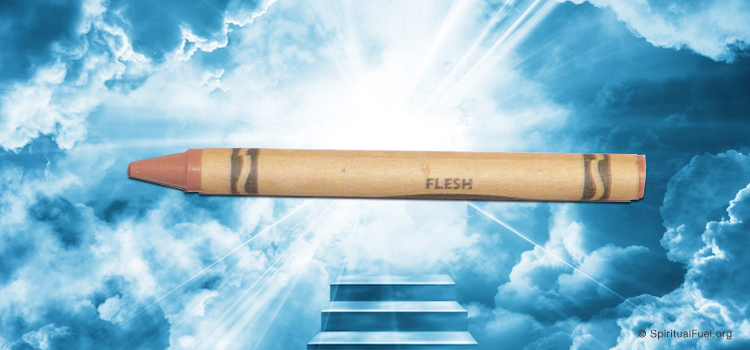
Coloring mandalas.  You may think there are 64 colors, but as we all know, there’s only one real Flesh.

Here endeth the lesson.

—————

[1] I say “vague” literalism, because no one reads the Bible literally literally.  No one.  They may believe it’s Adam & Eve[2,] not Adam & Steve, or that Noah took a gazillion pairs of animals on the ark (including diplodoci), but quiz them about owning slaves or sleeping with the maid or stoning a bride who everyone knows has been living with her new husband for two years, and their literal understanding rapidly evolves into something more metaphoric/historical/pragmatic.

[2] NSFW LINK!

[3] Or imprecatory.

Magickal Thinking

***A MUST SHARE***

A young man working in the army was constantly humiliated because he believed in God. One day the captain wanted to humiliate him before the troops. He called the young man and said: – Young man come here, take the key and go and park the Jeep in front. the young man replied: – I cannot drive! The captain said: – Well then ask for assistance of your God! Show us that He exist! The young man takes the key and walked to the vehicle and begins to pray…… …He parks the jeep at the place PERFECTLY well as the captain wanted. The young man came out of the jeep and saw them all crying. They all said together: – We want to serve your God! The young soldier was astonished, and asked what was going on? The CAPTAIN crying opened the hood of the jeep by showing the young man that the car had no engine. Then the boy said: See? This is the God I serve, THE GOD OF IMPOSSIBLE, the God who gives life to what does not exist. You may think there are things still impossible BUT WITH GOD EVERYTHING IS POSSIBLE. To the person reading this, I pray the Lord work A SUPER MIRACLE in your life today In Jesus Name I Pray.. Write ‘Amen’ to claim this prayer

This was posted, with a photo of a soldier crying, on Facebook by someone I would have thought to be a little more sophisticated in their faith.

First of all, why can’t these people write in English?  I know, I know, they probably aren’t native speakers, but even so—why would an educated person repost it?  If your goal is to witness to the heathen, why would you undermine the message with ignorant delivery?

Secondly, I am always amused at the straw men cum aggressive persecution complex these people have.  If this is from somewhere out there in the world and not the U.S., then perhaps captains make a habit of singling out Christian soldiers, but in our army, quite the reverse is true. Again, why would you post something that flies in the face of documented reality?

Finally, speaking of reality, really??  This author breaks the Spiritual Mystic end of the REMS Scale, just busts right on past the boundaries of the behavior the scale is meant to assess.  We have to assume that the author (at least the original source) created a parable and was not reporting on an actual event, i.e., that they knew and understood that the event could never have happened[1,] but the bottom line is that the story is put out there for people to believe that it could have happened, such is the magickal power of THE GOD OF IMPOSSIBLE.

Feh. I’m all for woo, but sweet Cthulhu I like mine on the sane side.  If I ever decided to evangelize for my particular Misunderstanding,[2] I would not use what amounts to the text of scam emails to convince people to join me in my compound. It might make my claims seem… incredible.

—————

[1] “How you know? You weren’t there!”  Honey, please.

[2]  My standard response to any religious discussion is, “I completely misunderstand God differently than you completely misunderstand God.”  Clearly, in this case, I really don’t misunderstand God anywhere in the neighborhood of either the original author or those who repost it on Facebook.

Finally, someone listens to me

In yesterday’s post, I talked about my long-term admiration of Dmitri Shostakovich, and in passing referenced an earlier post about Luciano Berio’s Sinfonia.

I mentioned that my favorite version was the world premiere recording with the Swingle Singers and the New York Philharmonic, conducted by the epitome of 60s cool, Leonard Bernstein, but that it was out of print.

For at least ten years now I have raged as to why anything goes out of print these days, especially music. It’s all electronic files now anyway, right?  Why was RCA or CBS or Melodiya or Deutsche Grammophon not taking advantage of this to re-release every freaking thing in their vaults??

Well, inspired by my recollection of Sinfonia and its unavailability I went looking again, and look what I found:

http://www.amazon.com/Berio-Sinfonia-Concerto-Two-Pianos

Finally!  I’d like to point out to SONY/CBS Masterworks that I’m available as a consultant, in case they need other ideas on which to capitalize.

(Of course, I’m not so forward thinking that I didn’t at first order the actual physical CD instead of downloading the MP3.  I went back and canceled the CD and did the download—cheaper, for one thing—but part of me still wants that CD on hand.)

New cocktail: the Quarter Moon

Here’s an as-yet unnamed a new cocktail:

Kitteh approved

The Quarter Moon

  • 1-1/2 oz bourbon or rye (bourbon preferred)
  • 1 oz Tuaca liqueur
  • 1/2 oz Averna Amaro
  • orange peel

Shake Stir,[1] pour into martini glass, garnish with orange peel.

It has a great bitterness to it which includes both the Tuaca’s vanilla/orange undertones and the orange peel’s fresh oils.  A bourbon version would be sweeter than the rye—worth trying!

update: The bourbon version is actually superior!  I’ve named it the Quarter Moon for no good reason.  The orange peel is essential.

—————

[1] Don’t know why I wrote “shake,” when cocktails without citrus juices in them are to be stirred, not shaken.  (James Bond was deliberately ordering his drinks diluted.)

Random photos from the labyrinth

Fall is here.

This isn’t autumnal color—ivy is evergreen.  But it’s still striking.

We recently cleaned out and culled our years of Halloween decorations.  This came to live in the labyrinth.

All the maple leaves are from the neighbor’s yard. The trees themselves are spectacular, especially in afternoon light.

I’ll say it forever: my labyrinth is a sacred space.

Happy birthday, St. Augustine, you %&^$#

Warning: this is an ill-thought-out post.

Today, according to the Writer’s Almanac, is the birthday of St. Augustine, he who wrote The Confessions to demonstrate his point that all of us are infected with sin, and whose ideas about “original sin” (i.e., because Adam and Eve ate of the fruit of the Tree of Knowledge, we have all inherited their “sinful nature”) became official Church doctrine.

Well.

“Watch that hand, buster!”

Of all the insidious kinds of woo on the market, I have to rank this one the worst.  Even when I was a small child, the story of Adam and Eve didn’t make sense.  First of all, what was wrong with gaining knowledge?  Was it not pounded into our heads that was the reason we went to school, to gain knowledge—that was supposed to be a good thing, right?  And here was God telling us don’t eat that fruit.

And why?  Reasons unclear, except that the Lord God Jehovah and his angelic gang seemed a wee bit petty about their privilege.

Then there was the inheritability of sin.  Somehow there was this little bead of BAD STUFF that was embedded in our souls, passed down from parent to child, and God hated us for it.  Sure, the adults in the room tried to soften that by saying it made God sad that we had this thing that we couldn’t help and was his fault in the first place, but the book is pretty clear: he was pissed.  He cursed the man and the woman, and threw them out of his special garden.

And why?  Did it actually solve anything?  Did it make them any less knowledgeable about good and evil?  Did it cleanse the Lord God’s creation of all the ickiness?  Quite the reverse: mankind rapidly spread over the earth like cockroaches, blundering their way through encounter after encounter with Jehovah and always coming out on the short end of the deal.

(Have you ever noticed that?  In other mythologies, there’s someone who’s able to outwit the gods.  Not Jehovah, man—the only person who came even close was Abraham when he tried to bargain the Lord God down to sparing Sodom if he found ten virtuous men there, and we know how that ended.  I’m thinking Jehovah was kind of dickish even in that, because if he’s omniscient he already knew there were not ten good men there. (For one thing, according to St. Augustine, no one’s good anyway.))

Then there was the crowd that tried to make it all about Free Will, and that it was our fault for disobeying God.  God gave us this Free Will, and we failed the test by exercising it.  All of us.  Forever.  Dick move, Jehovah.

And if there were ever a phrase to pitch a boy headlong into the morass of sinful thoughts, it would have to be “And they were both naked, the man and his wife, and were not ashamed.” [Genesis 2:25]  Woo boy!  Nekkid grown-ups!  I somehow knew that there must be something really cool about being naked—it was fun and felt good, for one thing.  For another, just like God told Adam not to eat that fruit because reasons, grown-ups didn’t want you to be naked.  Because reasons.

Of course, the prohibition failed in its prime directive, to keep me innocent of that knowledge of good and evil.  There were so many paintings of the couple available in art books that if the goal were to keep me ignorant of the human body, it was a complete failure.  I could not help noticing, though, that these portraits were missing some crucial information that I really wanted to know: down there.  I know I am not alone when I say I spent half the time gazing at Renaissance art mentally moving fig leaves.

Anyway, the puzzlement for me was that God seemed to be completely okay with nudity, but then for some unexplained—and inexplicable—reason changed his mind.  He plopped the two down in Eden, buck nekkid, and didn’t flip the switch that it was “shameful.”  What was up with that?  So many questions.  Suffice it to say that I have spent a lot of time since exploring my options.

In the end, I have come to view Augustine’s personal shame as one of the worst intellectual pogroms in Western culture, just a Scholastic meme to convince humans that they were separate from the divine.  It has never done humankind any good that I can see, so happy birthday, Augustine—good riddance.

Better.