Summer Countdown: Day 15

I wrote another Rondo fragment. This one turned into a fugue, which I don’t know that I can sustain. Given the nature of the piece, perhaps that’s as well. How about we just call it a fugato?

Stephen Czarkowski—he of the Symphony in G catastrophe—has requested a cello sonata for his own self for next year. He has some gigs lined up, he says. Sure, fine, why not? I figure I can use the sketch for The Labyrinth in Snow for the slow movement; it had a lovely cello theme, and it won’t be hard to convert the rest of it into piano accompaniment. I wonder when he wants it by? And how long should it be?

I’m writing this on Friday morning, at GHP. I’m about to head down to the Fine Arts building, where Maila Springfield will be playing with her trio for the jazz majors. She will not be performing the Preludes, not having had the time to get them ready, but she is prepping them for a tour the trio is doing next year. Which means I need to go ahead and get Nos. 5 & 6 written. (She says she particularly likes No. 3. I agree with her.)

Summer Countdown: Day 16

I took a stab at Rondo. I got one fragment done. (I’ve decided I’m going to work in fragments then sew them all together.) This one is quite cute, although I’m not sure how it’s going to fit into my plan of having the music go astray. More work is required.

I revamped this blog to include the material generally found over on my “real” website: all my music, the Arts Speech, the Invocation, and my translation of Marriage of Figaro. You might want to check it out over there on the left. There’s probably music you haven’t heard before. In fact, I still need to provide mp3s for a lot of the church choir music. That can be a distraction for another day.

Finally, I picked up the labyrinth after the storm. Lots and lots of tiny twigs all over the place. I’m now ready for a fire, if I ever have time to be back there any time soon. We leave for Valdosta this afternoon through Sunday , so no countdown days until I get back.

Summer Countdown: Day 18

I finished Prelude (no fugue) No. 2. How’s that for productive? Actually, I started work on it, decided it was too pretty, and started over.

Prelude (no fugue) No. 2: score | mp3

It’s actually more vigorous than I originally planned for it to be. The original idea was for a more gentle, gracioso, melodious thing, to become between the outrageous faux-counterpoint of No. 1 and the hyper-Romantic No. 3. Oh well. Now everyone has to wait until No. 4 to take a break. Because Nos. 5 & 6 are going to be tough for everybody.

I got bored waiting for our yard man to show up, so I devised a cover for Pieces for Bassoon & String Quartet.
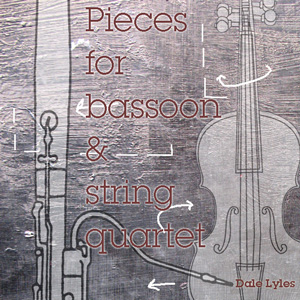
It occurred to me that I don’t really have a page for my instrumental music. Over on my “real” webpage, I have a page for my choral stuff, and not even my newest of that. I’m thinking of making the blog my web page, period, and adding a page for all my music. Because of course the only reason we haven’t heard more performances of Pieces for Bassoon & String Quartet is that people haven’t had a page upon which to find it.

Come to think of it, we haven’t heard any performances of PB&SQ. Michael Giel, what is wrong with you?

I’ve had on my to-do app, for days now, to reconstruct “Children of the Heavenly Father,” the ill-fated hymn arrangement that should have warned me off composing years ago. Why “reconstruct,” you ask, as well you might? Because it got left behind on hard drives gone by, on musical software so quaint that the young folk marvel that we could do more than bang the rocks together.

I tried half-heartedly to find a physical copy yesterday, but if the music exists —and I know it does, I just know it —it’s in a box of all the stuff I wrote for the Presbyterian choir, in the attic. Too hot, too icky. Much easier to find the computer file, I thought.

Right. You know those geeks who still have every computer they ever owned? That’s me. Almost. I did give my 7500 (is that right?) to the theatre, and I had even revved up the chip to a G4, baby. But I still have my SE/30, my PowerBook 190 (oh yeah, I had a laptop), my blue-and-white G3/G4. I would have my old MacBook Pro, but it was stolen last November.

So I sought out “Children of the Heavenly Father” on both the old PowerBook 190 and the SE/30. Neither would even come on. Well, to be fair, the SE/30 is over 20 years old, and the last time it even ran I had to give it a whack on the side to get the solenoid started. But still. It was heartbreaking.

Even I had been able to get either of them running, what then? None of the cables would feed into anything I have in the house, needless to say. And where would I have found a 3.5” floppy? And then how would I have gotten it onto my MacBook Pro?

And finally it dawned on me—even if I find the file—it’s from some music software so quaint that the young folk marvel that we could do more than bang the rocks together.

I drove to Sam Flax in Atlanta— and trust me, I only do that when nothing local will serve—to pick up my gallon of White Absorbent Ground that they had ordered for me. I also got a color wheel (thanks, Diane!), a tube of raw sienna (mine had completely dried up on me), and a palette knife. I used to have one—I probably could put my hands on it if I had to (ah, but I was wrong about where I thought it was)—but it was never as elegant or precise or as flexible as this lovely thing is.

Then back to Newnan, where I charmingly thought that perhaps a light rainfall —perhaps—might intrude on the evening, so I went ahead and set up candles and the makings of a fire in the labyrinth. Then upstairs I went to check on mail while dinner was in the microwave, and then back downstairs to find the deluge upon us.

I dashed outside to grab all the candles and cover the firepit. Modesty must draw a curtain over the state in which I finished my labors. I sat awhile in the torrents of water, luxuriating in that unrepentant sense of being completely wet when you have no reason not to be dry, until I realized that all that lightning was occurring right over my head. I tiptoed back up to the house, stripped off what remained, and toweled dry.

I actually repeated this, believing the storm to be past, although I was more sensible than to get a fresh change of clothes drenched. After the second rain-soaked reverie, however, I was done.

Throughout all of this, I completely forgot about our bedspread, freshly washed and hanging out to dry on the deck.

Summer Countdown: Day 21

I changed the one note in Prelude (no fugue) No. 4 that I was unsure about.

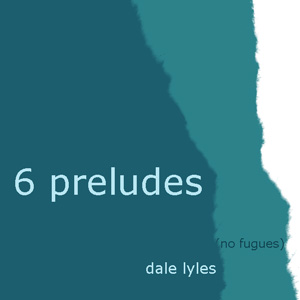
I futzed around and designed an iTunes “album cover” for Six Preludes (No Fugues). I just hate to see my music in iTunes with one of those blanks. It makes me feel like some unappreciated amateur. Oh, wait…

New opportunities from the American Composers Forum:

  • 2010 Finale® National Composition Contest: score for eighth blackbird (9/15)
  • Park Avenue Christian Church: SATB (9/1)
  • Lynn University Conservatory of Music: short orchestral (9/15) [Milky Way?]
  • Austrian Composer Society: orchestral work (9/30) [Milky Way]
  • National Lutheran Choir: SATB (9/30)
  • University of New Mexico: vocal or instrumental, solor or chamber, based on themes of folk songs available online (10/1)
  • Boston Metro Opera: vocal, choral, and operatic work (10/15) [William Blake]
  • Soli fan tutti: short chamber score (10/31) [Bassoon/String quartet]
  • Imagine Music Publishing: string orchestra (11/1)
  • Renée B. Fisher Foundation and the Neighborhood Music School: short piano works for student competition (11/13) [some of the Preludes?]
  • Opera Southwest: “a short opera in English using original music as a tool for educating elementary through middle school audiences in the areas of the sciences or humanities.” (12/1)
  • City Chorus (London): SATB for amateurs, 90th anniversary celebration (12/3)
  • Orchestra of Our Time: short score for chamber ensemble (12/31) [Bassoon/String Quartet]
  • Butler County Symphony Orchestra: an original 10 minute orchestral composition on the theme of “Space Exploration.” (2/1) [Milky Way, duh]
  • Earplay New Music Ensemble: scores for 1-6 players (3/31) [Preludes]
  • Second Life Virtual Concert Hall: “Especially interested in art noise, ambient, minimalism, computer music, music influenced by popular styles.” (ongoing)
  • Opus 21: solo/chamber ensembles (ongoing) [Preludes, Bassoon/String Quartet]
  • New York Miniaturist Ensemble: works composed of 100 notes or less [ed.: I think they mean “fewer”] (ongoing)
  • Ann Arbor Cantata Singers: SATB (ongoing)

Any suggestions about any of these? Discuss in comments.

Summer Countdown: Day 22

I worked more on Prelude No. 4, trying to extend the quiet, static upper melody over the simple whole note accompaniment. There were some nice things, but it wasn’t working.

I opened another file and started over with a different approach. That too had some nice bits, but it wasn’t working either.

Friday night, Craig was with me in the labyrinth, and among the many things we talked about was the reason we keep trying to create. As Craig says, he questions whether he has anything to say, or is he just making noise? That’s the trick, isn’t it? With this prelude, I keep trying to find the right notes , otherwise, I feel as if I’m lying to the audience.

I opened a third file and started over, and this time I think it’s working. I developed a chord sequence in the original file that I was going to end the piece with, and I think I’m going to use that same sequence in the new piece with the new approach. I may even retain the sequence of whole note chords as the ending.

It worked indeed. “Prelude (no fugue) No. 4” is now complete, although there’s one note I’m not sure about.

Prelude (no fugue) No. 4: score | mp3

No real work on the AFO piece.

I got a color-mixing assignment from Diane but did not start on it. It was an actual holiday, for one thing.

Summer Countdown: Day 24

Lichtenbergian goals:

I took a stab at destroying Resignation and got one or two interesting ideas out. Here’s where I just need to sit down and crank out crap until something grows out of all the manure.

I had sent the Preludes (no fugue) No. 1 and 3 to Maila Springfield, the insanely good pianist from VSU. Today I heard back from her: she had been practicing them and wants more. In fact, she and her husband and their saxophonist friend are going to play for the jazz majors at GHP the weekend I’ll be down there, and she wants to play them as part of that gig. So there’s a deadline, which is always helpful.

I worked some on No. 4, which is a complete reversal of No. 3: completely still music, mostly fading away, barely sustainable. I like what I’ve done so far. I may have that done by the early part of next week.

Lichtenbergian distractions:

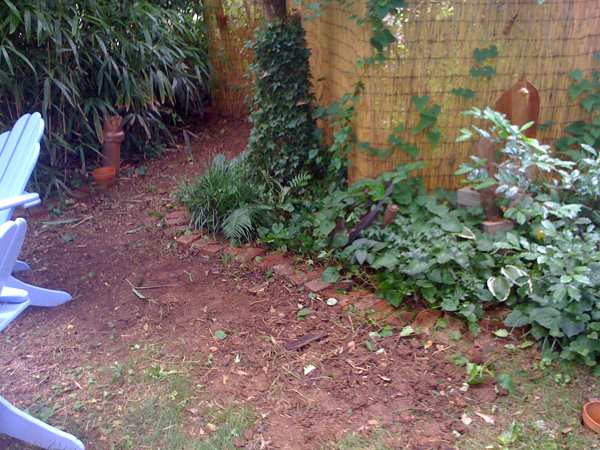
I worked a great deal in the labyrinth. I planted half a tray of St. Augustine grass plugs in the area between the firepit and the labyrinth. I’m going to see how well it grows there and what it will look like before experimenting in the labyrinth itself.

I also moved the logs left over from last fall’s tree fall. They were an attractive grouping, but they really blocked the entrance to the men’s loo.

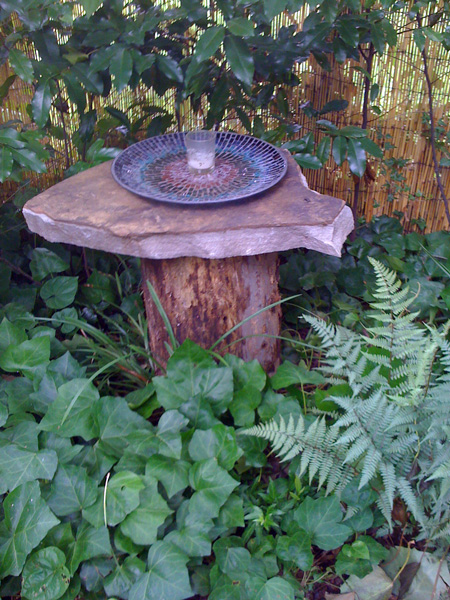
Since I was already moving those, I decided to go ahead and set one up over at the westpoint, since that’s where it would go eventually anyway. Then I set the great stone on top of it and put the mosaic dish I already had there on top of that. So I have a new westpoint (water) station.

Summer Countdown: Day 25

Lichtenbergian goals:

Nothing really, as befits Lichtenberg Day.

Part of the problem I’ve encountered with developing variations for Resignation is that the tune is so pure by itself that any kind of alteration feels like a violation. Anything I try to do to it degrades the music instead of adding interest.

The thing to do, obviously, is to completely destroy it.

Lichtenbergian distractions:

One of the books I brought home from school to read for the summer was Word after word after word, Patricia MacLachlan, a new book. Very short and quite lovely. I read it in one session before going to sleep the other night. Yes, MacLachlan is the author of Sarah, Plain & Tall. In this book, five 4th grade friends are in a class with a visiting author, and they learn how writing can shape their lives. As I said, it’s quite lovely.

I went to Atlanta to have lunch with my friend John Tibbetts, a young person of such life force that it’s impossible not to have a good time with him. Then I stopped by Sam Flax and picked up two tubes of gouache in colors that I do not have but apparently I need if I’m to paint portraits ever. (Really? Cadmium orange and cadmium yellow light? Really? As I said, I don’t know how to mix colors.)

Then back to Newnan, short errands, cook supper, and a languid evening with my lovely first wife. All in all, a solid Lichtenberg Day: I thought about composing, and I bought painting supplies, but I didn’t actually do any work.

Summer Countdown: Day 27

Lichtenbergian goals:

After days of trying to craft a response to Diane’s request for a full, uncensored accounting of myself, I gave up on polished elegance and just created a bullet list of blunt statements: I don’t know why I’m painting again. What began as a joke is now the focus of all my artistic efforts. I don’t know how to mix colors.

She responded, and here’s where we are: she recommended a couple of DVDs from an artist she respects as a teacher of portraiture , those have been ordered , and rather than a four-day long Art Camp, we’ll begin with a one-day work session, to be followed up with homework and further sessions. I’ll be heading up to Clarkesville on Sunday, July 11.

I finished Prelude No. 3. I am fairly pleased with the results, although the ending sounds too easy, and I am constantly haunted by the fear that my stuff is too short. When we hit the end, it sounds to me as if we’ve skipped a really major portion of a really good piece. But I don’t know what to do about it.

Prelude (no fugue) No. 3: score | mp3

I had an idea for Prelude No. 4, so I got the germ down in a Finale file. I need to go back and work on No. 2.

I need to go and start working on themes/variations for Resignation and Rondo. (Later, in the labyrinth, I did just that. Because of my inability, for the most part, to transcribe what I hear in my head , when I can force myself to listen for it , I usually just “draw” notes and the shapes of melodies in the little music notebook I work in. Later, I have to try to reconstruct whatever it was I thought I heard based on the literal scribblings in the notebook.)

Taking a break from the music, I applied white absorbent ground to pieces of cardboard for later painting.

Lichtenbergian distractions:

I finished The Red Pyramid, by Rick (Percy Jackson) Riordan. A ripping yarn, as usual. I also read some more of The Idea of Justice. Still tough reading, but I’m enjoying it.

Via dailylit.com, I’ve been reading Middlemarch and loving it, but I slipped maybe a week ago and now I have acres of it to catch up. Isn’t it funny how you get behind in something like that and you resist the simplest solution: just read? I also got behind in my crossword puzzle solving while I was at GHP for the week, but I’m almost caught up there. I dutifully read through all the New York Times art sections , one must stay courant, ne-c’est pas? , and clipped all the crosswords, stacking them chronologically. I’m almost through that stack, nearly caught up with the actual day I’m living through.

I was gratified to notice that they changed the layout of the crossword page this past week. You may know that the crossword puzzle is always on the corner of a page, so that you can fold the paper in quarters and have the puzzle and all the clues neatly in front of you. This past year, they’ve added a number puzzle called Ken-Ken to the page, and it was always right above or below the other side of the fold, only not quite far enough away from the fold to make it comfortable. Thus there was always a moment of refolding, which of course interfered with the self-satisfied Zen experience of solving the Times crossword.

This past week, though, the editors moved Ken-Ken to the other side of the page, so that after you fold the paper, it is tidily situated on its own quarter. One less design problem in the world.

Summer Countdown: Day 28

I kept working on Prelude No. 3, returning to the opening chord phrase and wrapping it with the sixteenth note arpeggiations. I stopped at one point and emailed it to Maila, who gave it a thumbs up for its playability. So I kept adding to it. Didn’t finish it, but got it longer. I think I have some ideas for wrapping it up. I’ll refrain from posting another mp3 until I have it finished.

I also sketched for a while, using my new proportional divider, and let me tell you, that is a very good tool to have. I purposely went back and redrew some poses that had given me particular trouble, and all of them were 1,000% better. Still haven’t used my circle guide, but irises and pupils are not my real problem.

Summer Countdown: Day 29

I heard from Wallace Galbraith in Ayr. In his first email, he essentially agreed with my assessment of the five pieces, but expressed no preference for any of them in a way that my American brain could discern. I asked for clarification, and he suggested that we move forward with Resignation and Rondo. So there we go. I have new goals. (He also proposed Waltz as a “third movement,” but I’m not sure what he means by that.)

I woke up with the start of a piano piece in my head, the first of a series I conceived earlier in the spring, Preludes, no fugues. This is mostly driven by my sense of guilt over never having written the Trio for piano, trombone and saxophone that Maila Springfield asked me to write three summers ago. I can at least throw half a dozen bagatelles at her.

So I was quite productive on that front: finished No. 1, conceived No. 2, and am halfway through No. 3. I’ll loop back to No. 2. Nos. 4, 5, and 6… this week, maybe?

Prelude No. 1, score | mp3
Prelude No. 3 (as of 6/27), score | mp3

The third prelude will continue with that opening theme now interwoven with the sixteenths, I think, in multiple octaves in both hands, more grandiose than the delicate opening. Since I cannot possibly play any of it, I’m going to have to be very left-brain about its construction: where can the fingers actually be at any given time? Can I notate it so that the quarter notes of the “melody” are distinct from the sixteenths? How is this thing supposed to end?

I also heard from Diane Mize. While her cabin is being repaired, she has asked me to write a goal statement for our Art Camp: what do I want to accomplish and why? This is supposed to be “uncensored.” No fair making me think. Or be honest. You can see how this has taken me two days even to get half a page written.