A modest proposal

I know everyone must be shocked—shocked—to find that charter schools in general don’t live up to their promise and in some cases are actually run by grifters.  I mean, no one could have predicted that a school run by a for-profit organization might not have its focus completely on the educate-the-kids thing.

(side note: Am I the only one to whom it has occurred that if it were possible to make a profit from running a school, we educators would be rolling in it?  Or states would be able to fund the rest of their budgets with the profits from the public schools?)

Still, let us agree that the basic principle behind the charter school movement is a valid one: if you allow these people to avoid standardized tests and/or “restrictive” rules and regulations, then Step 3: Profit!  Or at least highly educated, self-motivated learners.

If this is all it takes to lift children of poverty out of their slough of despond, then I’m all for it.  And so I propose the Lyles Accountability Trigger Law [LATL].

It is a very simple law.  Any time that a charter school is approved in any school district, whether by the district or by the state, then whatever terms are approved for the charter automatically apply to every school in the district.  See, that’s easy, right?  If freeing the charter school from <insert talking point here> will improve the education of its students, then why would you withhold that benefit from the rest of the children?  Ethically, how could you withhold from the majority of your students the great and glorious good that universally obtains to any charter school student ?

It is literally win/win/win for everyone everywhere!

Reading

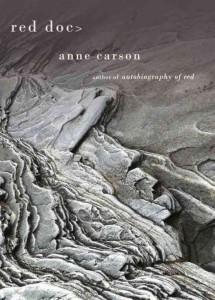
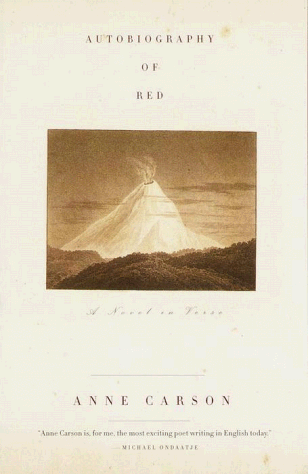
Here are a couple of books I have read recently and can highly, highly recommend: Autobiography of Red, and Red Doc>, both by Anne Carson.

They are amazing.  They were recommended to me by Daniel Conlan, a hardcore reader, during a discussion of Seven Dreams of Falling and its use of myth. Carson uses the mythical characters of Geryon, a red-winged monster, and Herakles, who kills him as one of his Labors.

autobiored

In Carson’s story, Geryon is a boy, still red and winged, who struggles through his autobiography to come to terms with who he is, both as a human and as an artist.  Herakles comes into his life as a teenager, a ne’er-do-well, only to part after a brief affair.  Years later Geryon, now a photographer, re-encounters Herakles and his new boyfriend in Buenos Aires.

It is gorgeously, sumptuously written in prose poetry, and your head spins with the imagery and music in the language.  You come to love and pity and admire Geryon while not quite hating Herakles nor his boyfriend.

Somehow Geryon made it to adolescence.

———

Then he met Herakles and the kingdoms of his life all shifted down a few notches.

They were two superior eels

at the bottom of the tank and they recognized each other like italics.

(Autobiography of Red, p. 39)

And then I ordered Red Doc>, the sequel.  It just came out last year.

From the back of the book:

“Some years ago I wrote a book about a boy named Geryon who was red and had wings and fell in love with Herakles.  Recently I began to wonder what happened to them in later life.  Red Doc> continues their adventures in a very different style and with changed names.

“To live past the end of your myth is a perilous thing.”

Well, that’s an understatement.  If Autobiography was gorgeous, there are no words for Red Doc>.  Hallucinatory, perhaps.  Hallucinogenic, even.

reddoc

Here:

DO NOT TURN his
photographs he had them
out the other day spread
all over the floor I said
who cut out the faces. He
said I can’t sleep I can’t
remember what to think
about when I’m sleeping I
said why think just sleep.
He said I found her bloody
eyeglasses in the grass
after nothing else was left
not even.  Not even what I
said. Not even the
stupidfuck white plastic
shopping nothing her
family could. Bury
identify keep turn. One
lens smashed the other.
Why cut I said he said
they needed more shadow.
Okay.     The    other
okay.      The     other
okay.

(Red Doc>, p. 94)

The beauty, it burns.  I’m about halfway through Red Doc>, and I’m taking it slowly.  Otherwise I emerge gasping for light with no clear idea of where I’ve been.

How is it possible to create something this beautiful?

Random items

No work on Seven Dreams today, but I have to mention how much fun Scott Wilkerson’s text is to work with!  It bodes well for the enterprise.  (It also bodes well that he has not complained or even mentioned that I cut about six lines from the “Fly and fall” text…)

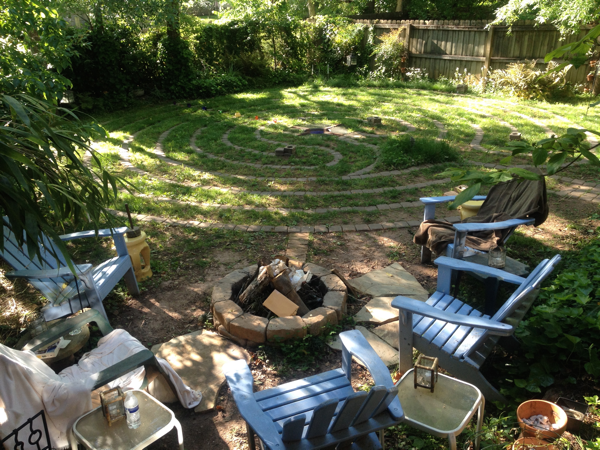
A couple of weeks ago a bunch of us were sitting by the fire out in the labyrinth and there was a rustling behind us up on the patio level.  I assumed it was one of the small set of feral cats that flit in and out of our lives, but when we turned to look it was a fully grown raccoon ambling across the yard.

“Oh hai,” it said, apparently surprised that four or five adult humans were sitting by a fire fifteen feet away, and fled.

Since a rabid raccoon had been picked up in the city recently, it was determined by some of our company that I should call the Animal Warden and have her set a trap.  I pointed out that the animal appeared to be perfectly healthy—if a bit absent-minded—and I was loath to depredate the biome like that.

But I did as I was told, and on Monday afternoon I went out to the labyrinth to read and write some letters, and there was a trap in the southwestern corner of the labyrinth.  There was also a cat in it.

It was of course not the one feral cat we’d like to trap and neuter.  This was a youngish feline, one I had not seen before, reddish shorthair, slightly Abyssinian in its aspect.  It was not happy to see me, although it was willing to sit peaceably as long as I didn’t get too close.

This was a dilemma.  I formed the opinion that this was someone’s pet—it didn’t have the clipped ear of a neutered-and-released animal— and I was very unwilling to turn it over the Warden.  What to do?

Fortunately for all of us—myself, the Warden, and the cat—late that night, after the Lichtenbergians had left and I had just finished walking the labyrinth, I heard in the distance a woman calling her kitty—and the animal in question answered most piteously.  It wanted to go home.

So that was that.  I got my glasses and the phone (for a flashlight) and opened the trap.  The cat streaked out of the labyrinth, over every intervening fence in its way, and was gone.  Freedom!

I called the Animal Warden—the fabulous Cyndi Hoffman—and left a message explaining why she would find the trap sprung but empty.  Late this morning (Wednesday) I thought I should check to see if we had caught any more cats.

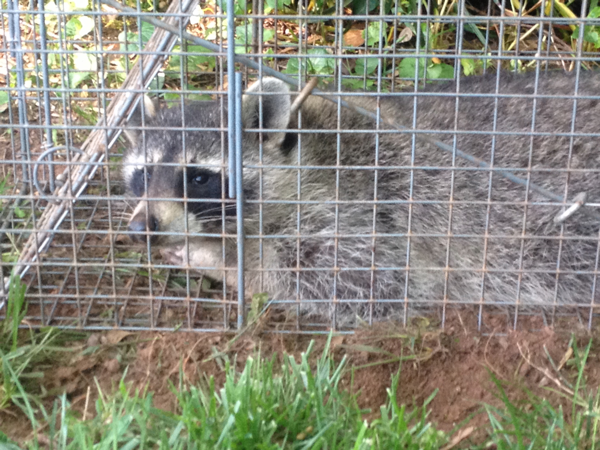
We had not:
rocky

Adorable, isn’t he/she?  Except when you approach the cage and it snaps at you.  It was willing to sniff at a proffered knuckle, but then snapped at that, too.  It did, however, eat the kitty treats I dropped in there, while Monday’s cat would not lower herself to eat such stuff.  Well, they were old.  This disdain of stale kitty bits was another reason I thought she was someone’s pet.   Wild carnivores are not so picky.

Soon, Warden Hoffman arrived and, after I made sure it was not a nursing mother, took the beast away to relocate its adorable ass.

I would like to state for the record that I have no objection at all to peaceful coexistence with wild life, even curious things like raccoons who tend to turn things over and misplace items in the labyrinth when I’m not looking.  But I did as I was instructed and must assume that all is right with the world again.

I did work on “Your Beauty” this morning and I think I’ve made a lot of progress.  We’ll see.  I’m not posting it because you’ve heard the pretty part already, and the part I’m working on now is so inchoate that hearing the computer version would make no sense at all.  I’m pretty sure Finale will let you at some point tell it exactly how/when/how much to speed up a beat, but I’ve never done it.  So before you hear the whole piece—once it’s finished—I will have to explore that.  Otherwise, it’s this stream of stupid-sounding eighth notes that just plop along.  It really needs human interpretation.
Seven Dreams: Dream One, “Fly and Fall”

Well, there’s one small part of Seven Dreams of Falling completed: Daedalus’s first number, “Fly and Fall.”

As you will recall—and if you don’t, go back and read the previous couple of posts—Daedalus is setting forth the idea that the annual Event, i.e., Icarus’s flight and fall, is a ritual both good and necessary.  It is “the story of us all,” as all good myth should be.

Some slight changes in the main body, but unless you were bugged by something and want to go back to hear if I fixed it, you can pick up the mp3 at 2:30 to hear the changed cadence from yesterday (as promised) and the thrilling conclusion of the section.

I will say that I have now done to Daedalus what I have issues with in many modern operas: there’s not a place for the audience to applaud.  The piece ends softly and will segue into Icarus himself, “Dream One,” so no applause for poor Daedalus.  I’ll make it up to him later in the opera.  After all, Icarus gets seven arias.

Dream One, “Fly and Fall” | score (pdf) | mp3

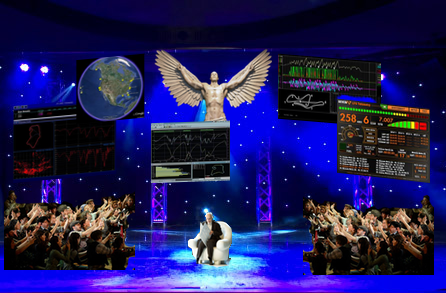
I have to say that I think this is pretty good stuff.  Here’s a slammed together idea of what I think is going on onstage:

I’ve also started a page for Seven Dreams so we can keep up with finished music.

update: I have a proposed solution to the applause problem: just bring the chorus back in for one more big “Fly and fall!” and wrap it up with a stinger.  We can come back in after the applause as the spotlight focuses on Icarus for his aria.  Compare the last 10 seconds of the above mp3 to this:

“Fly and fall” applause ending: score (pdf) | mp3

Express your preference in comments.

Seven Dreams: Dream One

Whattaya know…  Another day of 2-3 on the LSCA!

I had thought I might just fart around with unplanned/unattached melodies and harmonies, but I went back to the idea of working on the rest of Daedalus’s entrance in Dream One.  And that’s what I did.

Those who are keeping track of my compositional style might be surprised at the simplicity of the harmonies of this section.  It seems a throwback, I know, but I’ve decided that the opening will be relatively uncomplicated as they introduce the idea of myth and its supreme value.  Trust me, when we segue into Icarus’s actual dream in another few measures, there will be enough interesting harmonies to do you.

The first bit of this section is quasi-recitative, blossoming forth with the previously heard aria, then (new part) retreating again before the chorus joins in.

The usual abrupt ending, which I’m pretty sure is going to get a new tonality before heading into the final bit of this section.  Simplicity is one thing; cheesiness is altogether something else.

Dream One: Daedalus | score (pdf) | mp3

World Labyrinth Day 2014

The first Saturday of every May is World Labyrinth Day, and I’ve celebrated for a couple of years now.  So far, it’s been a private kind of meditation event.  Maybe next year I’ll open the labyrinth for walking at the 1:00 worldwide walk…

Yesterday was more private than ever: just me and my kilt and my labyrinth.

I spent the late morning and early afternoon out there, gardening, cleaning up, prepping candles, etc.  After everything was ready, I just sat back and wrote letters and read.

I walked the labyrinth several times, sometimes with music, sometimes with birds and leaf blowers.  Nothing earth-shattering, just profound gratitude for this space and my life.

My favorite time in the labyrinth is late afternoon into sunset: the light slants across the space (as above) and the grass burns green.  Day birds end their shift; the dusk crowd starts checking in.  Knots of winged insects catch the light.  Everything just breathes more calmly.  Soon it’s time to light the candles and light the fire.

And then it’s just beautiful.  A wise person sits and tries to hear the sermon.

The Fear Factor

Remember my post about conservative mindsets being based on fear and paranoia?

Exhibit A.

This was an elsewhere on the web ad link on one of the evil liberal blogs I read regularly.  For some reason, all those search paradigms that are supposed to be showing me cocktail recipes and cat videos keep pulling in the most incredibly stupid dreck.  And for some reason, I clicked on it this time.

Mercy.

No, I didn’t watch the video.  Yet.  It’s 34 minutes long, and I’m supposed to be writing an art song and/or an opera.

But I did scroll all the way to the bottom.  So much yummy craziness!  So much vague scariness!  So few links to supporting data!  As far as I can tell, in fact, there’s only this one page.  An ad.

Such a deal, though.  Seriously, aren’t you tempted to fork over $39 (plus s/h) for the opportunity to have all of this stuff to marvel at?

It’s porn, pure and simple, for the conservative nutjob mind.  They need to think that they will survive all on their own, striding manfully across the dystopian landscape while the weaklings are left behind.

Dangerous, dangerous thinking.  And yes, there are people who think like this.  Go search for interviews with the militia types who have swarmed to “support” Cliven Bundy.  It’s like listening to riled-up 10-year-old boys on a playground, or adolescent punks taking sides over some imagined slight.  Such tough, tough, super-lame chest-thumpings.

I have no solution, of course, other than to cede Nevada to them and make them all move there.

Seven Dreams: an abortive attempt

Here’s today’s abortive attempt.

I took the notes of our 12-tone row and splattered them in a descending cascade from the top of the orchestra to the bottom. I thought it might be a good stab at an opening to the show.

It’s not a sure thing: mp3

At the very least, it sounds sparse; that could be fixed with judicious tinkering.  This was after all just a splatter, not meant to be a finished product.

However, and this will probably seem odd, the last three notes—the ones that outline a V7 chord—simply sound too pat. I’m all about the tonality, but that cadence just made me wrinkle my lip.

Oh well, that’s the purpose of abortive attempts, ne-c’est pas?

Back to Tibbetts’ song.

Seven Dreams: a motif

A third thing I’m playing with for the opening of Seven Dreams of Falling is motifs, and the first motif is one that I used in Six Preludes (no fugues) for “Prelude (no fugue) No. 6.”

I got this from Sid Lonegren’s Labyrinths: ancient myths and modern uses (p. 139). He takes an eleven-circuit labyrinth:

an 11-circuit labyrinth

…and labels the circuits with the notes of the chromatic scale, starting with A on the outside circuit and ending with G# at the center.  When you walk the path, you encounter the notes in the order C# – A# – B – C – A – D – G – E – F – F# – D# – G#, which I have transposed down a half-step for the above motif.

It is of course a 12-tone row of serial music infamy, but when you play it there’s a definite tonal, if chromatic, pattern to it.  I mean, look at the penultimate measure: it outlines a V7 chord, of all things, leading straight back to our tonic note.  You may hear it in the “Prelude (no fugue) No. 6” here.

So I’m thinking it would be a valid thing to use this motif as a major element in an opera that centers in part on a labyrinth (technically a maze[1]).  The question will be how to do so.  (I’m already thinking about stealing incorporating some of the prelude.)

—————

[1] A labyrinth is unicursal: it has only one path to the center.  You cannot get lost in a labyrinth.  A maze is a puzzle; you would need Ariadne’s thread to get back out.