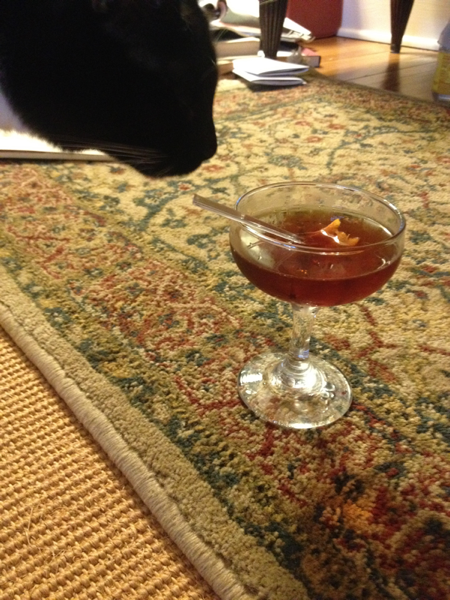
Shake Stir,[1] pour into martini glass, garnish with orange peel.
It has a great bitterness to it which includes both the Tuaca’s vanilla/orange undertones and the orange peel’s fresh oils. A bourbon version would be sweeter than the rye—worth trying!
update: The bourbon version is actually superior! I’ve named it the Quarter Moon for no good reason. The orange peel is essential.
—————
[1] Don’t know why I wrote “shake,” when cocktails without citrus juices in them are to be stirred, not shaken. (James Bond was deliberately ordering his drinks diluted.)
This quick rant is brought to you by the Lichtenbergian Precept of Task Avoidance: by writing this, I’m avoiding work on the Easier Piece #5.
—————
During a recent Facebook discussion about tax rates—and it was a discussion, not an insane bout of poo-flinging—we were treated to the old rightwing shibboleth of not wanting a higher, progressive tax rate on the wealthy because it would “punish success,” somehow disincentivizing the ruling class from being productive members of society.
I have never understood why people believe this kind of thing, other than they’ve had it hammered into their brains by the very people whom it benefits. It makes no logical sense.
I am supposed to believe that a class of people who are distinguished by their rapacious and never-ending greed would suddenly stop their money-making activities if we forced them to contribute more of their income to the common welfare? Leaving aside any worldviews about whether the government can even because reasons, that’s just stupid talk.
Why would the opposite not be true? Why, if we suddenly confiscated more of their income through progressive taxation, would the ultra-wealthy not double down to make more to keep? Seems to me that would be the more logical outcome, given what we’ve seen to be true about that class.
So we raise tax rates back to where they were when we had a strong middle class, and the upper classes contribute more, the government reduces the budget deficit, the economy improves, the middle class gets more money to spend and the upper class is more productive. What’s not to like?
I don’t know when I became averse to posting my abortive attempts, but I think it’s true that I have. I’d like to be generous and say that it’s because I like to surprise and delight my readers with a finished product, but the truth is probably closer to the fact that when what I’m working on is a deliberately “simpler” piano piece that will probably be only two minutes long, I don’t want anyone to know how ineptly I struggle with hacking my way through it.
I’ve whined before about not being able to play the piano and how it hampers my growth/expertise as a composer, and never has that been more true than with these bagatelles. (Another whine: my USB keyboard is extremely unreliable inside Finale, and today even playback volume became quirky. There’s an upgrade, but I can’t apply it until Christmas Carol is over in case it borks everything, which is what happened several upgrades ago.)
Oh well.
Here’s “Easier Piece #5” as of today: mp3 (only about 30 seconds of music; the rest is blank measures that I will fill up. With genius.)
<ETA> Here’s what I like about the piece so far: I like the way that the moving parts feel as if they are not bound by a specific meter. It sounds like it’s trying to be a waltz, but the bass line won’t cooperate. I like the almost clichéd fillip at the end of the main melody. I like the potential of the second theme, and the work I’ve done on the piece since posting this morning leads me to believe that it will end up as a sonata allegro. More later.
Here’s something you haven’t heard in nearly fifteen years: the Overture to Christmas Carol.
You may recall that last year, I labored for half a year to reconstitute the score for a small ensemble which never materialized. None of the original computer/MIDI files existed any more, and so I had to work from my original handwritten piano score. This was not a problem. But the overture was never written down—I composed it directly in the computer using the sequencing software EZ•Vision (which no longer exists.)
I was going to have to recompose the piece from the ground up, although I had a pretty firm idea that it consisted of the Christmas Waltz, 20 Questions, and People Like Us. Since the music I wrote last year never got used, I was gratified that I didn’t put the effort into the overture.
This year, though, I wanted my overture back. I cobbled together the opening by copy/pasting the Christmas Waltz, then pieced together the 20 Questions sequence—and then I just laid it to the side and ignored it for months. This week, though, since we open a week from tonight, I figured I’d better get in there and finish it.[1]
Today, I opened it up and began working, and by lunch I was mostly finished. Bits of “A Reason for Laughter” sneaked in, and I quite like that section—it’s definitely my recent style as opposed to my 20-something self. The final half is a neat orchestration of the “People Like Us” canon, and while it resembles what I remember from 20 years ago it, too, is more of my recent style.
The rest of today has been Successive Approximation all the way, as I tweaked and added and subtracted—then after premiering it at tonight’s rehearsal, I heard tons more that needed fixing. Tomorrow, I’ll probably futz with it again, but for the moment, Behold! An Overture!
[1] The other impetus was that I discovered yesterday that I have to gear up and supervise the construction of almost all the gowns in the show. In a week.
I have been surprised at my assiduity in writing Lichtenbergianism: procrastination as a creative strategy.
Here you can see that I have all that I need:
computer
coffee
reference works1
Assistive Feline™
new agey Pandora station (not shown)
Thus girded, I have written and written and written. If I have a goal of 25,000 words total, I am 370 words short of being halfway there.
I know this because Scrivener, the authoring software I’m using, allows me to track my progress. I’ve set a putative deadline of April 12, 2016, which is totally arbitrary of course, but the fun thing is that if I click the little “calculate session goal from deadline” thingie, then I only have to write like 130 words a day. Pfft. After allowing myself to revel in the idea that this is a really doable goal even for a Lichtenbergian, I turned it off and went back to a still-modest 500 words/day.
Still, today I knocked out more than 800 words, and that’s not bad at all. I may be up to 1,000 by the end of the day, should I decide to keep writing rather than making cookies for Fuzzy Labyrinth holiday sales. Or reading more on The Gift, an influential piece of work on my thoughts about creativity.
————— [1] I begin to realize the daunting task ahead of me in obtaining permission, even in a research setting, to use other people’s work in mine, particularly Georg Christoph Lichtenberg’s aphorisms as translated by R. J. Hollingdale.
I was mulling it over and thinking that I want Lichtenbergianism: procrastination as a creative strategy to be a relatively short book. I mean, it’s not a weighty philosophy to begin with, so I’m thinking it ought to be about the same length as Art & Fear.
So this afternoon I took my copy of Art & Fear out to the labyrinth to do a quick estimation of the word count and came up with about 34,000 words.
Well.
I already have 9,800 words just from transcribing my notes from the Waste Book [Precept #4]. Without even getting started, really, I’m anywhere from a quarter to a third of the way to my goal.
Today, according to the Writer’s Almanac, is the birthday of St. Augustine, he who wrote The Confessions to demonstrate his point that all of us are infected with sin, and whose ideas about “original sin” (i.e., because Adam and Eve ate of the fruit of the Tree of Knowledge, we have all inherited their “sinful nature”) became official Church doctrine.
Well.
“Watch that hand, buster!”
Of all the insidious kinds of woo on the market, I have to rank this one the worst. Even when I was a small child, the story of Adam and Eve didn’t make sense. First of all, what was wrong with gaining knowledge? Was it not pounded into our heads that was the reason we went to school, to gain knowledge—that was supposed to be a good thing, right? And here was God telling us don’t eat that fruit.
And why? Reasons unclear, except that the Lord God Jehovah and his angelic gang seemed a wee bit petty about their privilege.
Then there was the inheritability of sin. Somehow there was this little bead of BAD STUFF that was embedded in our souls, passed down from parent to child, and God hated us for it. Sure, the adults in the room tried to soften that by saying it made God sad that we had this thing that we couldn’t help and was his fault in the first place, but the book is pretty clear: he was pissed. He cursed the man and the woman, and threw them out of his special garden.
And why? Did it actually solve anything? Did it make them any less knowledgeable about good and evil? Did it cleanse the Lord God’s creation of all the ickiness? Quite the reverse: mankind rapidly spread over the earth like cockroaches, blundering their way through encounter after encounter with Jehovah and always coming out on the short end of the deal.
(Have you ever noticed that? In other mythologies, there’s someone who’s able to outwit the gods. Not Jehovah, man—the only person who came even close was Abraham when he tried to bargain the Lord God down to sparing Sodom if he found ten virtuous men there, and we know how that ended. I’m thinking Jehovah was kind of dickish even in that, because if he’s omniscient he already knew there were not ten good men there. (For one thing, according to St. Augustine, no one’s good anyway.))
Then there was the crowd that tried to make it all about Free Will, and that it was our fault for disobeying God. God gave us this Free Will, and we failed the test by exercising it. All of us. Forever. Dick move, Jehovah.
And if there were ever a phrase to pitch a boy headlong into the morass of sinful thoughts, it would have to be “And they were both naked, the man and his wife, and were not ashamed.” [Genesis 2:25] Woo boy! Nekkid grown-ups! I somehow knew that there must be something really cool about being naked—it was fun and felt good, for one thing. For another, just like God told Adam not to eat that fruit because reasons, grown-ups didn’t want you to be naked. Because reasons.
Of course, the prohibition failed in its prime directive, to keep me innocent of that knowledge of good and evil. There were so many paintings of the couple available in art books that if the goal were to keep me ignorant of the human body, it was a complete failure. I could not help noticing, though, that these portraits were missing some crucial information that I really wanted to know: down there. I know I am not alone when I say I spent half the time gazing at Renaissance art mentally moving fig leaves.
Anyway, the puzzlement for me was that God seemed to be completely okay with nudity, but then for some unexplained—and inexplicable—reason changed his mind. He plopped the two down in Eden, buck nekkid, and didn’t flip the switch that it was “shameful.” What was up with that? So many questions. Suffice it to say that I have spent a lot of time since exploring my options.
In the end, I have come to view Augustine’s personal shame as one of the worst intellectual pogroms in Western culture, just a Scholastic meme to convince humans that they were separate from the divine. It has never done humankind any good that I can see, so happy birthday, Augustine—good riddance.