Yippee (not to mention Heigh-ho!)

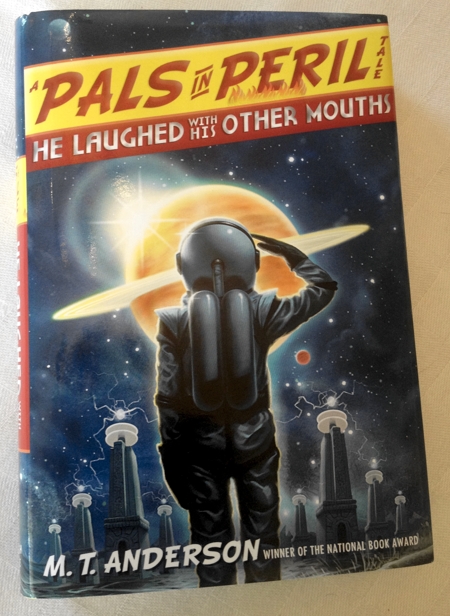
Look what came in the mail today, you guys!

I haven’t really blogged about M.T. Anderson’s Pals in Peril series, and so now I shall.

M.T. Anderson is a whiz of a young adult author whose range is fearsome: the dystopian classic Feed (you will never ever again think that Google Glass is a good idea); the alternative Revolutionary War history of Octavian Nothing; and on a completely different level, the awesomely silly Pals in Peril books.

It began with Whales on Stilts, and I was hooked.  Anderson took on the world of children’s book series and scored a direct hit. Lily, our heroine, is nothing special (although her dad obliviously works for a semi-cetaceous evil genius), but her friends Jasper Dash and Katie Mulligan lead such exciting lives that they’ve had whole books written about them.

Jasper Dash, Boy Technonaut, seems permanently suspended in 1930s brio.  (Think Tom Swift.)  Katie lives in Horror Hollow and is always having to deal with creepy supernatural goings-on.  (Think R. L. Stine’s Goosebumps.)  All three save the world from whales on stilts (with lasers!) in the first book, and from there it gets really silly.

Anderson is very funny, with the potshots at children’s literature and popular culture embedded so cleverly that most young readers will never see them.  But for adults of a certain age (mentally 9-13, I’m thinking) his wit is devastating.  Here’s a simple descriptive passage of their hometown:

Pelt—where Jasper, Katie, and Lily lived—was not a very exciting place… To pep up business on Main Street, store owners had put mannequins out on the sidewalk, advertising dusty sweaters or pillbox hats, but the mannequins were just assaulted by gulls.

No kid could possibly recognize the reference to Hitchcock’s The Birds, but the discerning adult will already have laughed out loud.

The pinnacle of the series so far is the third, Jasper Dash and the Flame-Pits of Delaware, in which Anderson’s world-creation is so supremely loopy that to this day it is one of the funniest books I have ever read.  It’s as if the absurdist anarchy of Green Acres were translated onto an earnest children’s adventure tale: much to the astonishment of Lily and Katie, every goofy thing that Jasper mentions turns out to be true in spades, up to and including the monks who live in grand seclusion in the mountains of Delaware.

[Our heroes are in Jasper’s Gyroscopic Sky Suite (because of course they are) heading to Dover to begin their trek to the monastery of Vbngoom in the mountains of Delaware.]

“Okay,” said Katie, “I really am only going to say this one time… [list of incorrect things Jasper has been saying about their destination] …and there are no—hear me—no no no mountains in—”

“Behold: Dover.  Capital of Delaware,” said Jasper.

Its domes and minarets lay before them, glowing gold in the sunlight amid the hanging gardens, the pleasant palaces, the spired roofs of ancient temples; in the harbor, the purpe-sailed ships of Wilmington plied the waves, and the dragon-headed prows of the barbarian kingdoms to the south dipped their oars in wrinkled waters while plesiosaurs turned capers at their sides.  The Zeppelin-Lords of frosty Elsmere drifted above the city, their balloons gilded with the tropical sun, eating sherbet on their porphyry verandas.  Huge tortoises fifteen feet across lumbered through the widest avenues, carry nomads’ tents upon their backs.  Processions wandering through the streets glittered with gold and ancient costumery.

Grand silliness, and yet at the end of the book I found my eyes quite moist as Anderson describes the monks of Vbngoom flying joyfully from trampoline to trampoline between the crags of the monastery, celebrating their victory over the robot gangsters.

But here’s a weird thing: I thought I had a copy of Jasper Dash, but I must have given it away—so I ordered a paperback copy, and Anderson has changed the ending.  It no longer includes that passage, with its boom camera pullback and pan up to sky and fade to black.  Instead, the writing fades into a montage of adventure themes before fading to black.  There’s a new appendix with the “state song” of Delaware, plus a copy of the letter the actual governor of Delaware wrote to Anderson, deliciously funny itself.  (Early in the book, Anderson excoriates writers who spend a couple of weeks in a country and then write books about the place as if they truly understand it.  He assures us he’s not that guy; he’s never even been to Delaware, so he’s completely untrustworthy.  However, since Simon & Schuster value accuracy in their books, Anderson instructs anyone who finds an “error” in his geography, etc., to put that in a letter and send it to //page turn// the Office of the Governor, followed by the full address of the Delawarian governor.)

I may have to go find a library copy to see if I’m completely inventing this memory of the ending of the book.

Still, you see why I’m excited about the newest Pals in Peril book.   Something fun without deep meaning to crack open—that’s the ticket!

I’m bored.

Having finished orchestrating Dream One and practically finished laying in the flagstone around the fire pit, I have written all the letters I can stand to write at the moment, so I am casting about for something to occupy myself.

I suppose I could tackle Five Easier Pieces, but I’m not that bored.  I think what I shall do instead is tinker with Dream Three, the libretto of which I don’t technically have but the tone of which I think I can work on without too many issues down the road.  Specifically, I’m going to take the Minotaur’s first speech from Scott’s script and pretend that’s my text.  Even if that’s not what we end up with, I will have the opening to the scene regardless; words are easy to adapt if you use a crowbar.

No, sweetheart, you’re just wrong…

Encountering the right-wing mindset on a daily basis is extremely wearying, and I only do it by reading the blogs/websites of people who actually dive into the fever swamps of The Blaze or Twitchy or—Chthulhu help us—World Net Daily or Focus on the Family.  I can not imagine a more soul-numbing job.

For me these days, it’s the jaw-dropping ignorance combined with the absolute certainty that the worldview which they have created from whole cloth inside their minds—completely divorced from evidence right in front of them—that gives me a bad feeling in my tummy.

I will give two examples, the second of which I would like to examine in a little detail.

The first is the right-wing nutjob [RWNJ] who went on the teevee and simply lied about how before the 1970s gun safety instruction was standard curriculum in elementary schools.  Why would anyone make up something like that?

The second example is equally egregious.  In Alabama:

In an effort to educate the public on the divine origins of America’s founding documents, Jackson County Commissioner Tim Guffey (R) has proposed erecting a Ten Commandments monument, as well as displays of the U.S. Constitution and the Declaration of Independence, outside the county courthouse.

“If you look at the documents that was written — the Constitution, the Declaration of Independence — they are all stemmed from the word of God, from the Ten Commandments,” Guffey, who proposed the projects at a recent commission meeting, told WHNT on Thursday.

The commissioner insisted that the Ten Commandments proposal is “not for any type of religion” and would only serve to “make people go back and study” the sacred history behind the country’s founding documents.

HuffPost, 8/15/14

Where does one even begin?

A good start would be to get a copy of the Constitution and a copy of the Ten Commandments and put them on the table in front of you.  Get yourself some colored highlighters.  (I was a little worried when I started this thought experiment, because it would not be easy finding ten different colors of highlighters.  Then I came to my senses…)

Get yourself a black marker, too.

Highlight the first Commandment.  Let’s use pink.

Now read through the Constitution—remember, it’s short, barely three pages—and highlight all the parts of our government that originate in the first Commandment.

What?  Nothing?  Okay, take your black marker and mark out the first Commandment so we can reuse the pink highlighter and not get confused.  (“Confused”—get it? Because Commissioner Guffey can’t… never mind.)

Highlight the second Commandment and repeat.

I won’t belabor the point, although if I were in a room with Tim Guffey in front of teevee cameras, you’d better believe we would pursue this to the excruciating end.

Even the most sociolegal of the Commandments are not found directly in the Constitution.  That is actually one of the glories of the document: it doesn’t engage in direct legislation, unlike most of the written national constitutions since then.  We get to change the laws willy-nilly; the framework not so much.

Mr. Guffey might dig in his heels and say that the ninth Commandment about bearing false witness is the source of our right to a jury trial, but a) I myself would guess that this document had more to do with that; and b) that whole “bearing false witness” thing might not be a good topic to bring up in his situation.

Because, as one commenter in one of the evil liberal blogs I read on the topic said, the authors of the Constitution argued over Every. Single. Word.  And if they had used the Decalogue as a source, they by Chthulhu would have said so.  (It’s worth noting, too, that Benjamin Franklin proposed that they have a chaplain open every session of the Constitutional Convention with a prayer, but the delegates shot that idea down with prejudice, possibly because they thought Franklin was punking them, as was his wont.)

I can vouch for this historical view—one summer (1987) at GHP I read every single volume of Max Farrand’s The Records of the Federal Convention of 1787.  Besides Jemmy Madison’s exhaustive diaries on every single motion and debate appertaining thereunto, Farrand collated everyone else’s diaries and letters to reveal the stunning process of cobbling together the world’s first—and best—written constitution.  It was an amazing event, and a fascinating read.

Further, we have The Federalist Papers, in which Madison, Hamilton, and Jay got completely down in the weeds and explained very publicly the reasons for the document looking the way it did.

In neither artifact do we have our Founding Fathers praising Jesus and just lifting our nation up in His Name, O Father God, amen.  It. Did. Not. Happen.  (Nor, to be brief, did it happen in any other source documents from the period.)

So are Tim Guffey and his fellow Christianists ignorant or lying?  They can’t be ignorant (oh all right, of course they probably are, but I’m giving them the benefit of the doubt), but given that whole “bearing false witness” thing, how could they be lying?

One explanation for this inexplicable mindset is that they are not lying—they actually believe these things to be true.  Their minds require these things to be true in order for them to make sense of the world, and remember that, to the conservative mind, the world only makes sense if it’s full of unimaginable horrors, horrors against which only their faith, their courage, their version of reality can save us.

Of course, that’s being generous, because Tim Duffey is lying.  Go back and read the other part of the words that he made with his mouth: this display of a specifically religious document on state property is “not for any type of religion,” which he immediately follows with

“The Ten Commandments is a historical document and it has nothing to do with religion,” he continued. “It shows that these founders had great beliefs in God and the Ten Commandments and His Word and it helped them get to the point where they were. Their feeling was God helped them build the Constitution and the Declaration of Independence. If you read all of the writings of John Adams, Patrick Henry, James Madison, Thomas Jefferson, John Jay, they speak about how that was their foundation that helped them interpret and write a great Constitution.”
Read more at http://wonkette.com/557310/alabama-idiot-thinks-constitution-based-on-ten-commandments-is-incorrect#bMSLpDJrm7ivvFDd.99

Highlights mine to underline the jaw-dropping contradiction.  (Not to mention the complete untruth about the writings/mindset of all the men he mentions, of whom only Madison had a direct role in writing the Constitution.)

So we’re back to the eternal dichotomy: is this man stupid or lying?

I have devolved into heavy sighing, shaking my head, and mixing another modified margarita.

update: Go look at the last seven paragraphs of this article on this year’s Faith and Freedom Coalition in DC.  The fear is palpable.  It’s pitiful, it really is because it’s not based on anything real.  Look at the sheer number of future tense verbs and infinitives: “wants to,” “plans to,” “going to.”  It’s all in their heads, and bless their hearts.

update redux [FFS edition]: Dear Mrs. McCarthy: Judy, sweetie, a raised eyebrow and pursed lip is not persecution.
A new drink

I have a spiral bound recipe journal, one of those cutesie retro things. The only thing in it is cocktail recipes, a mix of favorites and my own concoctions.  Go figure.

One of the earlier entries is a drink called the Burnt Orange.  I forget where I found it.

Burnt Orange

8 pt. vodka
1 pt. bourbon
1 pt. triple sec

Shake with ice, strain into cocktail glass.

I’ve made it with varying proportions depending on my mood.

The other night, I had all this fresh lemon juice that I had squeezed and, not wanting it to go to waste—naturally—I explored cocktails using lemon juice.  There was one, kind of a sidecar, but it was overwhelmingly citrusy.  My lovely first wife suggested adding a little bourbon, which I did, and it worked.  It reminded me of the Burnt Orange, so here is the Burnt Lemon:

Burnt Lemon

5 pt. cognac
3 pt. Cointreau
2 pt. lemon juice
1 pt. bourbon

Shake with ice, strain into cocktail glass.

It’s still pretty tart, but the bourbon mellows it out quite some.

There’s also a drink I worked on earlier in the week, but I will have to report back later after I’ve had time to make another one and get some taste tests around here.

Dream One, “And what of us?”

I think this worked out quite well.

Dream One, 4c. “And what of us/Let us joyfully gaze” | piano score [pdf] | orchestral mp3

While working on this bit, I dug into Finale and figured out lots of keyboard shortcuts for the things I do the most.  It’s incredible how well hidden some of them are.  I learned two or three versions ago to buy the Trailblazer Guide to accompany the software.  It’s not very in-depth, but it does have a lot of helpful hints on how to approach your workflow.  I got a lot more efficient with this piece—which is good, since I have six more Dreams to go!

And in case you hadn’t noticed, Dream One is now completely orchestrated.

The man with the pearl earring

A couple of years ago I decided that what I would give myself for my 60th birthday was a baroque pearl earring. Something to do with Shakespeare, maybe, although he wore a simple gold hoop.

Thanks to the tireless efforts of Ray DuBose (of R. DuBose Jewelers here in downtown Newnan) in scouring the world for a suitable pearl—I rejected about eight before we found one that matched my mental image—I have been successful.

Here is my latest folie:

I’ll post another one after I get a haircut and Ray finishes adjusting the setting—but I was too excited not to share.

Dream One, “My mother, bored and pampered”

In the best tradition of artists everywhere, I am declaring Ariadne’s aria abandoned completed, at least until I have to fix it for good.  It kind of works, and right now that will have to serve.

Besides thinning out some of the accompaniment in her big moment, I also finally got Finale to pay attention when I asked it to slow down the tempo.  Something got borked in the tempo marking itself; I deleted it and created a new one.  Who knows?  Finale’s technical support (staffed ENTIRELY BY UNICORNS YOU GUYS) certainly doesn’t.

Dream One, 4b. “My mother, bored and pampered | piano score (pdf) | orchestral mp3

I am hoping that the last section, “And what of us,” is going to be clear sailing, since it’s all motifs from earlier—Daedalus’s fly/fall motif and the machine music—and then the end is straight up copy/pasting from the opening number.

A new understanding of “Fly and fall”

I’m going to brag on my music, which I don’t normally do.  Bear with me.

Last night, in the labyrinth, I put on my headphones and gave a listen to “Fly and fall” (mp3) because I wanted to hear what it sounded like under the full moon, which was doing this incredible Dance of the Seven Veils with clouds and fog after the storm earlier in the evening.

Here’s what I heard:  it sounds like—I suppose because it is—a commercial for a new luxury car.  Daedalus is very proud of his achievement in sending his son skyward every year, and it shows.  Icarus is sleek, gleaming, fast, and sexy.   The monitors onstage would show this neatly packaged vision of the Event.

For example:

Cool, huh?  Yes, I spent time on that image (Icarus image credit here) instead of hammering out orchestration issues in “My mother, bored and pampered.”  Or napping.

Only at the end, in the unexpected key lurch, do we hear Daedalus’s actual excitement and pride—and with “just as surely fall,” his fear—for his son.

I do hope that I get hired to direct this thing.

In other news, Scott, make a note: I just noticed that in this annual Event, Daedalus is no longer making the flight himself.  That’s probably a point for Icarus to make in the great debate in Dream Four.

The firepit

Well, that turned out nice:

There are a couple of interstices that I have to plug—naturally, chair legs ended up going right where the stone ends—but otherwise it’s done.

When such things come back on the market, I want to plant creeping thyme or some such in the joints.

Have I said recently how much I love my back yard?  All of this—the labyrinth, the fire pit, the stone walls, the compass point sculptures, the patio, the hammock, the work tables—has come about since September 1, 2008.  Before, it was just weeds and scrub grass.  (The Child was not an outdoors kind of kid, at least not at 24 College St.) Then, for some reason, I decided to build the labyrinth.  It really was a Close Encounters kind of moment.  All the rest has followed from that.

I’ve learned some things—or at least had them confirmed—through my experience in transforming that space.  Grand plans can be awfully fun, but slow organic growth is usually a better way to go.  Nothing is permanent: if something doesn’t work, change it. Rip it out. Discard it.  Improve it.  Whatever it is, it will grow back.  Unless it doesn’t.  Make the space conform to your needs, not to some Platonic ideal of what the space “should” look like.  Be alert to what is missing and fill the gap with meaning.

At this point, there’s only one more major project to achieve, and that’s replacing the old bamboo fencing with something more permanent—and taller, for privacy issues.  (For kicks, click on that link—the difference in the firepit area is wonderful!)  Ideas for said fencing are already bubbling up in my head…