Another Tom Jones (Marc Honea)

From a procrastinate Tom Jones, Book II, Chapter 2:

“To deny that beauty is an agreeable object to the eye, and even worthy some admiration, would be false and foolish. Is not Love is like candy on a shelf? You want to taste and help yourself, do you not?” The Reverend began to warm to his theme, particularly as the question of Mrs. Quiver’s recent escapades required extensive commentary and earnest moral reflection. “Mind you, it’s not unusual to be loved by anyone. Nor is it not unusual to have fun with anyone.”

Let us briefly at this moment, dear reader, note how the Reverend was in no way oblivious to the true factitious presence of the lady in question. Her breathing, dare we go further and suspect panting, presence was tempting the periphery of his homiletic sights even as he nudged his arguments toward the politely non-disputable. “It’s not unusual to be mad with anyone. It’s not unusual to be sad with anyone.”

“And yet.” Mr. Norbutwait could not resist the opportunity for interjection. “She’s the kind I’d like to flaunt and take to dinner.” In his urgency he seemed most unaware that his punctuation of the Reverend’s disquisition had become a confession. He became transformed. “And she always knows her place. She’s got style. She’s got grace. She’s a winner.”

Alas, poor Norbutwait at this moment was a plaything of his humours. Mrs. Quiver’s eyes, however, betrayed nothing, and the Reverend’s extemporizing was not to be eclipsed by such fevered tender display. “We’re always told repeatedly, the very best in life is free and if you want to prove it’s true, baby I’m telling you, this is what you should do.”

The Reverend seemed to reverse course at this moment, and are you not, patient reader, wholly relieved. “These matters are of a very delicate nature, and the scruples of modesty should compel us, nay command us, even with our knowing it is never modesty’s place to command.”

We may discern the Reverend’s precipitous halt is noted by Mrs. Quiver, whose eyes catch the shuffling churchman’s at this point. It takes but the lady’s mouthing of a certain intimacy, “What’s new, Pussycat,” to Mr. Norbutwait’s surmise, to bring the Reverend toppling into an improptu translation a certain passage from one of Horace’s lesser regarded ecologues:

Just help yourself to my lips
To my arms just say the word, and they are yours
Just help yourself to the love,
In my heart your smile has opened up the door.

“O, dear lady, I long simply to touch the green, green grass of home.” The Reverend falls upon his knees with this expostulation and gathers a portion of Mrs. Quiver’s skirt in his hands and begins mopping his brow.

“But to make this the sole consideration of marriage,” said Lady Quiver, laying a hand upon the shoulders of the dear Reverend, shoulders that continued to lurch in tearful confession, “to lust after it so violently as to overlook all imperfections for its sake, or to require it so absolutely as to reject and disdain religion, virtue, and sense, which are qualities in their nature of much higher perfection, only because an elegance of person is wanting: this is surely inconsistent, either with a wise man or a good Christian. And this point I must come to Mr. Norbutwait’s defense. He always runs while others walk. He acts while other men just talk. He looks at this world, and wants it all.”

Mr. Norbutwait did not hesitate to take an opportunity so generously offered. “So I strike, like thunderball.”

“O why, why, why Delilah,” was what the Reverend muttered as he rose to his feet.

A Waste of Shame (Dale Lyles)

A Waste of Shame

In which the Adults of a pleasant Town are Ensnared in their Efforts to Protect Two YOUNG PERSONS from their Better Natures

CHAPTER THREE

As you have seen, dear reader, the virtues of small town living so often extolled by the more reactionary among us for its salutary benefits were not without their pitfalls. As the buttocks—and thighs—of our young hero, and heroine, continued to mature to perfection, it would take more than the perversity of this author for them to escape the notice of those among whom they lived. Divine forces perhaps could provide for such an escape, but I trust it is clear by now that divinity has little role in our proceedings.

It’s not as if, of course, these physical attributes were the topic of open discussion at the Music Committee meeting at First Baptist or the faculty lounge of Bretenton High School. One of the very real virtues of small town living is that such things cannot be discussed openly, and therefore the race of lust for youthful beauty is impeded by its very secrecy, born of shame and concealed in furtive heat. So no one admitted that he or she was enthralled by the very sight or thought of Tristan’s firm and perfect rear.

It must be said, however, that Mrs. Butler, First Baptist’s organist and a woman of not only of real talent and discernment but also of still viable personal attraction, was quite distressed to realize that her attention during warm-up of the youth choir during Tristan’s junior summer was often wandering from Mr. Temple’s capable baton to the boy’s sneakers, up his shapely bare legs to—Well, she was mostly able to quash those thoughts, quite consciously. But she was also conscious that the hair on those legs was continuing to darken and sprout.

“Such a nice young man, and growing so tall!” she allowed herself to think, and often told his mother so.

Blake Temple, young and handsome himself and new to his position as minister of music at First Baptist, like everyone else in Bretenton found the boy’s beauty startling and distracting. As he maintained eye contact with all the members of his youth choir, scanning the healthy young faces in turn, he found Tristan’s face disruptive to his rhythm; he lingered a second or two longer than he had been trained to do, returning Tristan’s bright smile, simply because Tristan’s handsome, open, friendly face invited him to do so. He was not bothered by this phenomenon, nor was he similarly overly aware of the young man’s haunches.

These kinds of thoughts may have remained unshared in most of Bretenton’s sanctuaries of adult power, but there was one place where these thoughts were not only common but expressed, indeed encouraged. I am speaking of course of the coaches’ office in the gym at Bretenton High School.

I am not suggesting for a moment that George Burton, the head coach, was lusting after the beautiful Tristan. No, indeed, all of his totally inappropriate remarks, made to one assistant coach or another, were about Jesse, and those were many and inappropriate. He assessed Jesse’s ass with a determined wonderment and was free with his assessment with the mostly younger men in his immediate employ, and some of them returned his enthusiasm, although without the element of determination that they failed to detect in him.

And yet. There was an anger, whenever Tristan was in his gym, that bubbled over a constant low heat, and the sight of the boy was a constant push on the dial of his control. His irritation with Tristan was irrational, a fact he knew but could not reject, and so he found himself constantly watching the boy, haranguing him, chewing him out for minor or imagined transgressions, all in the name of improving his character and correcting character flaws that, if pressed, Coach would have been unable to define.

Coach, if he had been forced to talk about it at all, would have said that his frustration with the boy was due to the obvious attraction that Jesse showed for Tristan, although if you will recall it was an attraction of which she herself was not aware. It was jealousy, he would have said, although naturally he would not have admitted this to anyone in his circle; Jesse was a minor even if she were not a student, and he was acutely aware of what happened to coaches who screwed little girls or even entertained such thoughts.

In his grimmer fantasies, he would succumb to a grim smugness when he considered that Tristan was not a minor, barely, and could be made to suffer the consequences of consummating any attraction he might feel for Jesse. This knowledge served as a ghostly justification for Coach’s abuse of Tristan Oh.

He also told himself that his more vicious moments were caused by his medication. Suffering from anemia, he received testosterone shots once a month at his doctor’s office. Besides the sore arm—he bruised easily with his fair skin—the irritation he felt could easily have stemmed from the wide fluctuations of testosterone in his bloodstream. Or so he reasoned; he never charted his outbursts on the gym floor and in the locker room against the dates of his injections.

But in fact, Coach’s anger stemmed from a simple and pure resentment of Tristan. Beyond the usual attributes of youth that the older generation holds as grudges—energy, untried sexuality, an unreasonably taut abdomen, to name a few—Tristan’s extraordinary physical beauty was an added goad to Coach’s aging despair. Like Blake Temple, he found himself looking at the boy more often than was usual for him, but unlike Blake, this engendered a discomfort that blossomed as rage in Coach’s soul. It was not Jesse’s ass that was disturbing George Burton, it was Tristan’s.

For his part, Tristan knew only that Coach didn’t like him. He was always yelling at him for no reason or for some trivial reason, and Tristan, not a young man accustomed to rebellion, simply tried to lay low. It never occurred to him, either, to try to please Coach. If he just tried to stay out of the man’s way, he could sometimes, though not often, get through practice or weight training without being yelled at.

Kanati and Selu (William J. Bishop)

Jeff gets there first:


Kana’tï And Selu: The Origin Of Game And Corn


William J. Bishop


The Strange and WONDERFUL History of WILD BOY, an Indian Foundling


FIT THE FIRST


AN INSTRUMENT OF INTRODUCTION, as is proper, for the rendering of the tale of the WILD BOY, a Cherokee infant, whose MARVELOUS AND MYSTICAL JOURNEY was first related by an aged SORCERER of that selfsame TRIBE, and the VERACITY of which was STEADFASTLY attested to by the WIDOW of the FORMER MAYOR of the Town in which said WONDROUS EVENTS, even though otherwise wholly unsubstantiated, were said to have occurred SIXTY-THREE YEARS prior to this Author fixing them into print.


Chapter One

It would be preferred, naturally, that a tale as lacking in verisimilitude as the one forthcoming were related as Testimonials, or even Memorials, from the persons who were said to have participated in their unfolding. However, that transference not always being practical, or even desirable, on occasion the responsibility for enshrining these events in letters will fall to a man of lesser experience — particularly insofar as experiences directly relating to the story in question — and so certain details may necessarily be omitted, or else invented, perforce, by the Author to illustrate the heretofore oral odyssey in anything more than a strictly perfunctory manner. Such being the case in this instance, the Author shall endeavour to restrain himself when presented with dramatic possibilities that, while doubtlessly engaging, have no real basis or root in fact, and particularly when said paths would do nothing to Enlighten the Reader in ways that are illustrative of character motivation, psychological subtexts, natural proclivities, foibles, et cetera.

With those caveats firmly in mind, let us begin our tale with a house — nay, something more akin to a wigwam — the stile of which aspired to be something more grand than that which could be afforded. This stoic abode leaned unapologetically against the eastern side of a hill, nearer the bottom than the top of it, neatly impressing upon one the notion that this perhaps once proud refuge was in the midst of some precarious descent. Dear Reader, look not too closely upon this withering abode, for doubtless it cannot bear the burden of such heavy scrutiny; the glare of the eye, the cluck of the tongue: such immodest sighs of disapproval could — as mercilessly as a cyclone or some other vile, unrestrained intemperance, Natural or otherwise — shatter the footings of this tender hospice, and send the stones of its foundation tumbling down the hillside like so many acorns in the whirlwinds. O Gentle Reader, do restrain thyself, I beg of thee. Withhold thy judgment until this seemingly modest tale approaches its promised magical fruition. If then, perchance, the Reader’s appetite is yet unsated, consume then the house and its occupants. The Author will not interfere. But until then — as an indulgence, perhaps? — abate, be contented, and accompany us, arm in arm, on our incipient Journey…

assignment: procrastinated Tom Jones

In the ongoing free-for-all in the Alice post, Kevin posted a quote from philosopher/physicist Georg Christoph Lichtenburg: “To do just the opposite is also a form of imitation.”

In the Wikipedia article, I found the following:

Lichtenberg was prone to procrastination. He failed to launch the first ever hydrogen balloon, and although he always dreamed of writing a novel à la Fielding’s Tom Jones, he never finished more than a few pages. He died at the age of 56, after a short illness.

And so our challenge is to write our novel à la Tom Jones (text here), but only “no more than a few pages.”

Today is Tuesday, albeit late, December 11. Your “few pages” is due by midnight, Saturday, December 15. Email it to me in some text format, and I’ll post each one as I get them.

There are some rules, of course.

Rule #1: You must use the phrase “dear Reader” at least once.

Rules #2: Let us agree that “no more than a few pages” actually means fewer than 1,500 words. If you must write more, write the d—n novel.

Other rules, in comments, as they occur to you.

Rule #3: Cut-off for rules is midnight, Thursday, December 13.

Rule #4: You cannot go all Five Obstructions on our ass, Marc.

Rule #5: You may ignore new rules, but save all radical versions of your work so as to discuss them.

Dream Land

I was actually able to work yesterday. I chose to forge ahead on the cute little number between Garrison and Elizabeth, “Dream Land,” in which they fantasize about how perfect life will be when they run away from their parents to get married.

Here’s what I added:

BRIDGE:
We’ll have
all of the money
to have all the fun we
deserve.
Summers in Maine
and winters in Spain,
Glamorous parties
with tables at Sardi’s
reserved.
Friends by the bucket,
a yacht in Nantucket,
We’ll face life unafraid
with dozens of maids
to serve us in

CHORUS
(in) Dream Land,
Life’s good
as it should be,
Everything’s peaches and cream,
We will be,
you and me, in
Dream Land.

BOTH:
Who knew that perfect wedded bliss
like this
could be ours today?
I know it’s true for me and you
when we both run away to find our

CHORUS

Insert Busby Berkely chorus ad lib.

I hacked out a couple of tunes for the bridge, but it’s got to work just right to point up those –erve rhymes. So far, it’s not functioning.

Alice in Wonderland

I haven’t blogged about seeing Alice in Wonderland, the new opera by Unsuk Chin at the Bayerische Staatsoper.

This is Ms. Chin’s first opera, and it premiered at the Munich Summer Festival this year. In other words, this is a really new work, and you know how I am, searching for new stuff that works.

Let me restate that. I am constantly examining new music, especially new opera, in the hopes that contemporary composers can speak to me (and presumably other audience members) in ways that composers of the past have. As I type this, for example, that old reprobate Wagner’s “Liebestod” from Tristan und Isolde is playing on iTunes. Even given the march of progress in tonality and all that jazz, can a new work elicit that kind of eyeballs-rolling-back-in-the-head response?

Generally not, is my finding so far.

My response to Alice has a lot of tangled threads, involving the nature of creativity (vid. sub.); the purpose of opera; and William Blake’s Inn, both music and stage version. So bear with me if I don’t get them all separated.

First, the music. Ms. Chin studied with Ligeti, and it shows. She allowed herself a little leeway in the melody department, but not much. Every other piece dissolved into polyphonic cacophony; once you’ve heard all four percussionists banging on everything in the room, you’ve heard it. Adding a few more trombones does not change the essence of the experience.

However, I think her score was generally solid. There were a couple of lovely moments in it, and more than several witty ones. (I think I caught a Mahler joke when the Mad Hatter was singing “forever” on the same notes that end Das Lied von der Erde.) I might even have liked it a lot if the staging hadn’t killed it, about which see more later.

The book was by David Henry Hwang, and it was not bad at all. (The opera was, amusingly, in English; I found myself reading the German subtitles more than half the time.) It follows the general outline of the book; some of the arias swerve off into some really nice surreal lyrics. Again, the design of the production completely undercut the actual libretto (which is in the souvenir program I bought). I’ll discuss the beginning and ending later.

Alice’s design looked, from the Staatsoper’s website, to be cutting edge European, so that was part of its appeal when I booked the tickets.

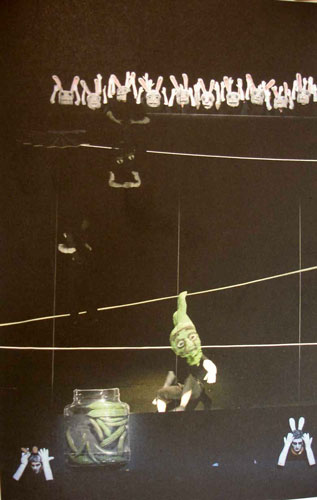
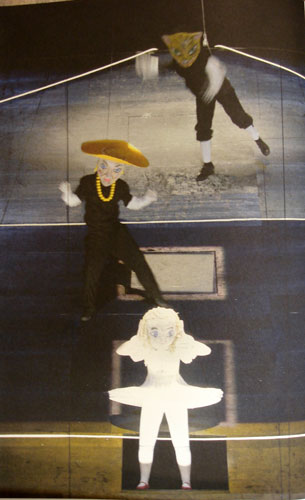
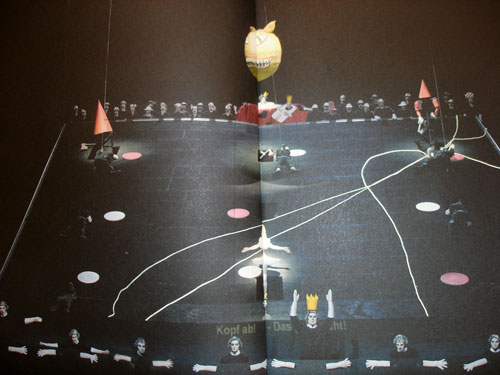
Behold:


But in fact the design killed the entire show. Look at the last one above. That huge raked stage was permanent. It was at a 45° rake the entire evening, which means that the nine performers (not singers) who popped out of the nine holes had to be tethered with wires the entire time. And that meant that they were more or less stationary puppeteers the entire show. Alice herself never moved from her down center hole. [Note to Marc: Shut up.]

The disembodied heads you see at the bottom of the set in their own separate trench are the excellent cast of seven. Those are not their arms/hands in front them. They are puppet arms, manipulated in unison usually by the cast.

Check out the third photo. That’s the Duchess and the first of many Cheshire Cat avatars. They are sung by the disembodied heads down front and pantomimed by the tethered performers. In place. If you’re thinking that this might get to be boring, you’d be right, especially since no one onstage ever had a face; they were all masked or puppeted. In fact, in one number, top of the second half (billed as an opera in one act, it nonetheless had an intermission halfway through), the puppets shook their heads once, then didn’t move for the rest of the scene. Oh. My. God.

That last photo also shows the chorus, in their separate trench at the top of the set. File on, file off. The children’s chorus appears at the top of the second photo. I don’t remember what significance the giant jar of pickles had, if any.

Static, static, static. I was especially appalled by this elaborate oratorio approach after intermission, during which I read Hwang’s libretto and found that he and the composer had called for a rambunctious staging. How do you get from the Tea Party scene and the Croquet scene to an immobile cast of puppets?

So let’s see if I can enumerate my issues.

The purpose of opera. As you may know, the old argument is “words or music,” which is more important? Richard Strauss even wrote an opera (Capriccio) to debate the issue, albeit comically. Of course, the debate ignores that there is another layer for the audience to contend with, and that’s the production itself. (Remember, especially for Mozart and fellows, there was no such thing as the disembodied opera of CDs or radio.) I have an Alexandrian solution to this Gordian Knot: theatre is most important. If it’s not viable theatre, then neither the words or the music are going to have the impact their creators hoped for.

In this case, while the music and the words might have provided a springboard for something entertaining and/or provocative, they were stopped cold by the designers and director’s choices. I was reminded repeatedly throughout the evening that our ragtag Lacuna workshop worked more magic with our cardboard-and-hot-glue version of “Man in the Marmalade Hat Arrives” or “Two Sunflowers” than what I was seeing on an international stage. I kept thinking that our methods and our goals breathed more life into our text than did the Staatsoper’s; Lyles and Willard were a lot luckier than Chin and Hwang.

Of course, Chin and Hwang themselves were the source of the bizarre opening and closing, two non-Carollian “dream” sequences. (Hello, the whole thing was a dream, remember?) The opening involved a boy dragging a mummified cat, singing, “It is my fate.” Honey, please.

The ending was worse: Alice was singing a plaintive “What kind of garden has no flowers?”, and the two old men (“twins,” according to the libretto) from the opening returned and commanded her to plant a garden. After some odd and pointless repetition, suddenly hundreds of balls/seeds/testicles? avalanched down the stage. (Previously, at the climax of the “Off with her head” sequence, there was an avalanche of heads. One stopped rolling about a third of the way down, and there it remained for the rest of the opera; no one could reach it to kick it into one of the manholes. A lesson for us all, I’m sure.) There was some “burgeoning” music, the stage floor was lit with colored dots, just as the stage floor had been lit with brightly colored lights throughout, so it was not an efflorescence of any kind, Alice pantomimed “wonder,” and it was over.

What?? Since when was Alice’s story an Amfortas’ wound myth? It was lame and ineffective.

I was very frustrated by the experience: Lacuna couldn’t find backing for William Blake’s Inn, and so it’s a dead issue for Newnan. Yet our vision for the piece far exceeded the Bavarian State Opera’s both in terms of creativity and effectiveness. I realize that’s a personal issue, but I get angry when an organization has the resources to do something really fabulous, something beyond what I could accomplish myself, and they don’t.

And no, they’re not allowed. I pay them to show me something that works, artistically, and they didn’t. If they were NTC or Lacuna, fine. I’ll take my chances and failure is OK. But at the professional level, and such an exalted level as this, I expect success.

Golden Compass idiocies

By now you’ve heard, and have probably received the emails, about the religious right’s newest hobbyhorse, the movie version of The Golden Compass opening this weekend.

Personally, I think the design of the thing looks like the price of admission. I intend, if nothing else, just to luxuriate in the subcreation. But I do hope it’s a good flick.

Our right-wing friends have no such concerns. As bloggers smarter than I have pointed out, they cannot conceive of art without a political purpose. (And yes, I know there are left-wing nutjobs the same way.) Every offering must be judged as to whether it will support their worldview or not. The idea that an alternate or even opposing viewpoint might have some artistic soundness or be a viable means of enlightenment never enters their brains.

Or how about this: The Golden Compass might have been written by what the right-wing Christianists are describing as a “devout” atheist, a neat dialectical position, to be sure, but what if it were a tremendously well-done work of fiction? Or film? What if it were a rollicking good time?

Ah, there’s the danger, you see. If children enjoy this movie — follow the argument closely, it tends to dissolve — then they will ask their parents for the book, and then… they’ll read it! And if they read it, they would be completely unaware that Philip Pullman is leading them down the path to eternal damnation, because in the third book, not in this one, you see, but in the third book, he reveals that the conflict the whole time is over control of the universe, because, again, pay attention here, the God of his particular and particularly fictional set of parallel worlds is, besides being tangible and comprehensible, worn out, a senile nothing. Heaven and the saints preserve us from Norsemen and science fiction conceits!

Yes, I understand they fear the children will be suckered in by the metaphor. I also understand they fear that the children will have their brains cracked open by art and too much light will flood in. I understand completely that their secret fear is that their children’s faith, and their own, for that matter, cannot withstand a different idea.

So, the newest email to make the rounds calls for a boycott, and, isn’t this just so subversive?, silent:

The weekend of December 7, 2007, we are encouraging all Christians to boycott your all movies at your local theatre. We are asking that for the entire weekend (Dec. 7-9), you not attend, rent, or purchase any movies. Hollywood understands one thing for sure: “If it makes money, we’ll do it”.

We, as a body of believers, can show Hollywood that although we are quiet, we still have strong voice. My hope is that we will let the silence in the theatres be deafening to the producers, actors, sponsors, and supporters of movies like “The Golden Compass.”

Oh, why not? Full speed ahead, I say.

Here’s what I predict, though: nothing will happen. On Monday, in the Times, I’ll read that Golden Compass topped the box office. The simple fact is that this subculture is actually very small, if loud and nasty. They haven’t caught on yet, but they never were winning the “culture wars.” There are no culture wars, there are only 21st-century Christianists who really really wish there were a Colosseum with lions, and since there’s not one, they project its façade every time they can and hope we’ll all think it’s real.

Read this!

Stop what you are doing right now, I’ll wait, and go buy The Uncommon Reader, by Alan Bennett.

One has just finished this wonderful bagatelle in about an hour or so, and one must say that it’s an exhilarating little romp through the meaning of reading, writing, and life.

The Queen, unnamed, but one knows who is meant, is led by her ill-bred pack of Corgis to a bookmobile at the edge of the gardens, and having blundered into it, checks out a book out of sheer politeness.

Hilarity ensues:

There was a sadness to her reading, too, and for the first time in her life she felt there was a good deal she had missed. She had been reading one of the several lives of Sylvia Plath and was actually quite happy to have missed most of that, but reading the memoirs of Lauren Bacall she could not help feeling that Ms Bacall had had a much better bit at the carrot and, slightly to her surprise, found herself envying her for it.

The Others do not know quite how to take Her Majesty. There are difficulties. Growth occurs; changes are made. And there’s a killer ending that is breathtaking in its cheekiness, and Mr Bennett is as cheeky as they come.

The evolution of creativity

There was an article in the NY Times on Tuesday on some recent thinking about where art comes from. Why do we draw and paint and dance and sing and, as the article stated, “[tell] fables of neurotic mobsters who visit psychiatrists”?

I make the point in my arts speech that the impulse to create is universal, not only in the sense that every child in our culture sings and dances and draws and pretends, but also in the sense that every culture on earth has some form of art. They may not have a name for the number 42, but they have stories or pots or decorative tattoos or nicely decorated penis sheathes (not to be confused with penis gourds, which are not usually decorated, since that would apparently be a bit much.)

Anyway. Scientists have been puzzled by the creative impulse, because it just doesn’t make evolutionary sense. Where did it come from? It’s so energy and time intensive, it doesn’t make sense from the evolutionary point of view. Some have posited it had to be a sexual display thing, but that doesn’t make sense when you consider the Lascaux paintings, for example. Others have said that it came from having such a large brain and being bored easily; it was an evolutionary hiccup.

But Ellen Dissanayake, an independent scholar, says that it is an evolved trait. She argues from an interesting standpoint, that among other things art makes us feel good, and things that give us pleasure generally have not been left to chance by evolution. Actually, my reading of The Blank Slate and Parasite Rex suggests that everything is left to chance by evolution, but I see what she means. Eating, sex, swirling a Q-tip™ in your ear, or is that the same as sex?, have developed to produce yummy sounds in us.

There were two ideas in the article that struck me as especially intriguing and worth thinking about/discussing.

The first is the origins of art. Dissanayake suggests that Chartres Cathedral, the “Resurrection” Symphony, and Notorious B.I.G. all derive ultimately from the ritualistic interaction between mother and child:

After studying hundreds of hours of interactions between infants and mothers from many different cultures, Ms. Dissanayake and her collaborators have identified universal operations that characterize the mother-infant bond. They are visual, gestural and vocal cues that arise spontaneously and unconsciously between mothers and infants, but that nevertheless abide by a formalized code: the calls and responses, the swooping bell tones of motherese, the widening of the eyes, the exaggerated smile, the repetitions and variations, the laughter of the baby met by the mother’s emphatic refrain. The rules of engagement have a pace and a set of expected responses, and should the rules be violated, the pitch prove too jarring, the delays between coos and head waggles too long or too short, mother or baby may grow fretful or bored.

To Ms. Dissanayake, the tightly choreographed rituals that bond mother and child look a lot like the techniques and constructs at the heart of much of our art. “These operations of ritualization, these affiliative signals between mother and infant, are aesthetic operations, too,” she said in an interview. “And aesthetic operations are what artists do. Knowingly or not, when you are choreographing a dance or composing a piece of music, you are formalizing, exaggerating, repeating, manipulating expectation and dynamically varying your theme.” You are using the tools that mothers everywhere have used for hundreds of thousands of generations.

This makes a lot of sense, I think. However, how we got from cooing at the infant to cooing at each other is still a question.

The other idea I found illuminating is a suggestion she made about the nature of art. Unlike our current perception of art and artists as singular, solitary expressions of individual agendas, art in most of our history has been mostly communal:

…among traditional cultures and throughout most of human history, she said, art has also been a profoundly communal affair, of harvest dances, religious pageants, quilting bees, the passionate town rivalries that gave us the spires of Chartres, Reims and Amiens.

Art, she and others have proposed, did not arise to spotlight the few, but rather to summon the many to come join the parade… Through singing, dancing, painting, telling fables of neurotic mobsters who visit psychiatrists, and otherwise engaging in what Ms. Dissanayake calls “artifying,” people can be quickly and ebulliently drawn together, and even strangers persuaded to treat one another as kin. Through the harmonic magic of art, the relative weakness of the individual can be traded up for the strength of the hive, cohered into a social unit ready to take on the world.

Of course, as a theatre person, I’m more ready to accept this idea than a painter or composer might be. It’s all communal for us, all “harmonic magic.” We won’t discuss “relative weakness of the individual.”

But it’s true that was my whole atttude with NCTC all those years. It was a place for all of us to come together to make theatre. I used to call it a place for the “citizen artist,” i.e., the non-professional, the “untrained,” the great unwashed. The undaunted. As the Equity actress whose name I’ve forgotten who drove from Atlanta to play Hermione in The Winter’s Tale said to me at the cast party, admiringly, “They don’t know they’re not supposed to be able to do this, do they?”

Indeed they did not. We began that production by having the large cast assemble on the stage and dividing: everyone who had ever done a play before on the left, those who had not on the right. Then I asked everyone who had never done Shakespeare before to join those on the right. Many people crossed over. Then I asked those who had never done Shakespeare with me before to cross. That left maybe three people on the left, maybe Craig Humphrey and Matthew Bailey and someone else. Having “leveled” the playing field, we then began to come together to make that play.

Basic instinct. Discuss.

War & Peace, Part 2, ch. 7-21

War: battle and retreat from Vienna.

I’ve picked up War & Peace again in a quiet moment during lunch today. I had, like an idiot, carried it with me to Munich, but if travel does anything, it robs the mind of the sharpness necessary to read a book like this.

It is brought home to me again how incredibly remarkable this book is. We observe in minute detail the personal stories of the battle and how senseless it all is, senseless in the fact that no one in their right mind could believe anyone was controlling the outcome.

Again and again, the movements of the French and the Russians are actually blunders. No one understands what’s going on, and whole battalions of men turn and flee without really knowing why, or, conversely, turn and save the day without meaning to.

We return again and again to the little artillery captain Tushin, who holds the center of the Russian line with his four cannons, setting a village on fire and bedevilling the French, or stopping their charges altogether. He never receives two orders to retreat, and in fact the French react to his insistent cannonade as if that is where the main Russian force must be.

Finally Prince Andrei arrives and stays with him until he understands that the order to retreat has been given. Then we get an incredible passage: as night falls, Tushin and his men are swept into “an invisible, gloomy river… flowing in the darkness, all in one direction, with a hum of whispers, talk, and the sounds of hooves and wheels.”

Tushin, after the adrenalin of battle, is in a daze, but still looking after his men and anyone else who shows up at the campfire, including young Nikolai Rostov. Tolstoy shows us men who are utterly drained, who cannot yet register the events of the day. Random snapshots of men, officers, wounded, horses, life, death.

Tushin is called to Prince Bagration’s tent, where for a moment it looks as if the day’s defeat is going to be pegged on his failure to retreat. Tushin is unable to speak clearly in his defense, and finally Andrei, sick of the whole business, tells what he saw and stands up for the captain.

The section closes with Nikolai Rostov nursing a severely bruised shoulder and deliriously wondering why he’s not at home where he’s loved.

Tolstoy’s ability to depict both the confusion of battle in all its panoramic horror and the inner confusions of his characters is mind-blowing. He uses his camera like an auteur, and we are swept along with it. He’ll pull the soundtrack as we hear someone’s thoughts, then cut to a totally different part of the battlefield, even introducing a brand new character in the midst of the excitement, expecting us to follow the action without pause. It’s amazing.