Art

I had an interesting experience last night, in which I encountered a work of art that affected me viscerally, aesthetically, and intellectually. It was especially powerful because I had not gone in expecting to be so affected.

The opera Orfeo ed Euridice by Gluck is one of those that everyone talks about being so wonderful, but I had never seen nor heard it. I made a feeble attempt yesterday at becoming familiar with it, but downloading it and giving it quick listen on the way up to the Cobb Energy Center (Atlanta Opera’s current home) wasn’t enough.

If anything, that prepared me to be disappointed. I found the piece to be ponderous, just so much early classical dithering. “Pretty.” I knew that these early works (like the works of Handel, Haydn, and Monteverdi) have found favor in the past forty years, but I also knew that it takes a pretty slick director to make them work, usually by layering “meaning” on top of the music. I was sanguine about my prospects for the evening. In fact, I stopped and bought a mini-Moleskine to slip into my jacket so that I could write down my ideas during intermission(s).

The notebook remains unsullied. I was captivated from beginning to end.

The music was beautiful. What was muddy and ponderous in the recording I downloaded was clear and limpid in performance. Part of that is the difference between live and recorded, part was the interpretation. While it rarely moved me or thrilled me the way that Boheme or Elisir d’Amore or Figaro do, it was simple and gorgeous.

(I’ll say right now that Gluck’s much-vaunted “reform” of opera is not just hype. Rather than a succession of florid vocal showpieces, the show was taut and moved right along, clocking in at 85 minutes without intermission.)

The production was designed by John Conklin, originally for the Glimmerglass Opera Festival. You can see photos here (pdf, but worth it). That was the first pleasant surprise: a hyper-competent intelligence guiding the look and feel of the thing. It didn’t overreach into vague postmodern metaphor, it simply provided a good-looking and coherent mise en scène for the action of the opera.

The performers were topnotch. Countertenor David Daniels knocked Orfeo out of the park. Yes, it took a little while to get used to an alto voice coming out of the throat of a man, but it didn’t take long. Katherine Whyte was a beautiful Euridice, and both she and Deanne Meek as Amore were very effective actors. (You may remember my complaint about the soprano in Elisir last time.)

But it was the direction of the piece that bowled me over. Lillian Groag did a phenomenal job of structuring stage pictures to fill the music. The overture was a harvest festival, with all the usual peasant business, ending with a joyous round dance that ended abruptly as the dancers realized with a shock that Euridice had fallen in their midst. That set up the opening number, which is a chorus of mourning. Orfeo’s punctuating cries of “Euridice!” began offstage, a nice touch: rather than a repetitive “woe is me” effect (as the original score suggests), we were led into action as he learns of her death and then comes onstage to confront it.

It was the ending, though, that sent me soaring out into the evening. This version of the story has a happy ending. Yes, I know. After Orfeo cannot resist Euridice’s pitiful pleadings, he turns and embraces her, and she dies a second time. It was actually quite affecting. So he lies down to die himself, but Amore shows up and rewards his corragio by bringing Euridice back to life again.

Happy ending, triumph of love, etc., etc. The chorus streams onto the stage to celebrate. The happy couple are seated, and before them two dancers, dressed in gleaming robes of white and gold, re-enact their story to the final chorus: they’re in love, she dies, he journeys, she awakens, they journey, he turns, she dies again.

And then…

The dancer Euridice does not arise again. The dancer Orfeo turns in puzzlement to Amore, but she has turned and is walking upstage. She’s leaving. The real Orfeo leaps to his feet, distressed. The chorus reaches out in dismay to Amore, and on the last note of the opera, she turns to look over her shoulder, her face an enigma. Blackout.

Whoa.

I barely had time to see it coming. What had been a lovely rendering of an 18th-century classic was suddenly wrenched into the 21st century. The original myth, with its themes of love and loss, was suddenly, awfully, terribly restored to its rightful focus, subverting the artificial happy ending of Gluck’s audiences and throwing our humanity into the bright light of mortality. Absolutely wonderful.
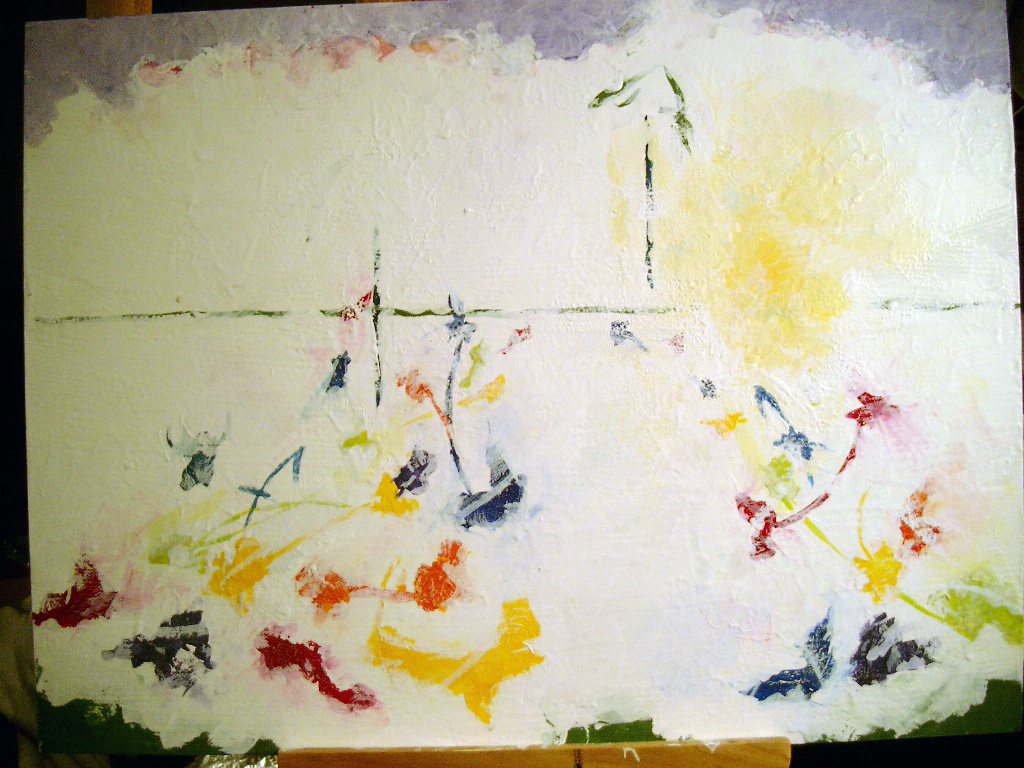
Painting, 11/12/09

The madness continues.

Click for full-sized image

Again, much change, and I don’t know why or whether it’s for the better. I look at the painting, I think, well, it needs more balance here, or it needs more movement here, or how about this color over here, or geez it’s all crap why don’t I just cover it with white?

The next to go will be the vertical line on the left.

I keep thinking about the little blobs swarming the yellow glow and being rebuffed, but I’m not sure that’s right either.

Painting, 11/10/09

I don’t know what possessed me, but I actually used my free time tonight to work.

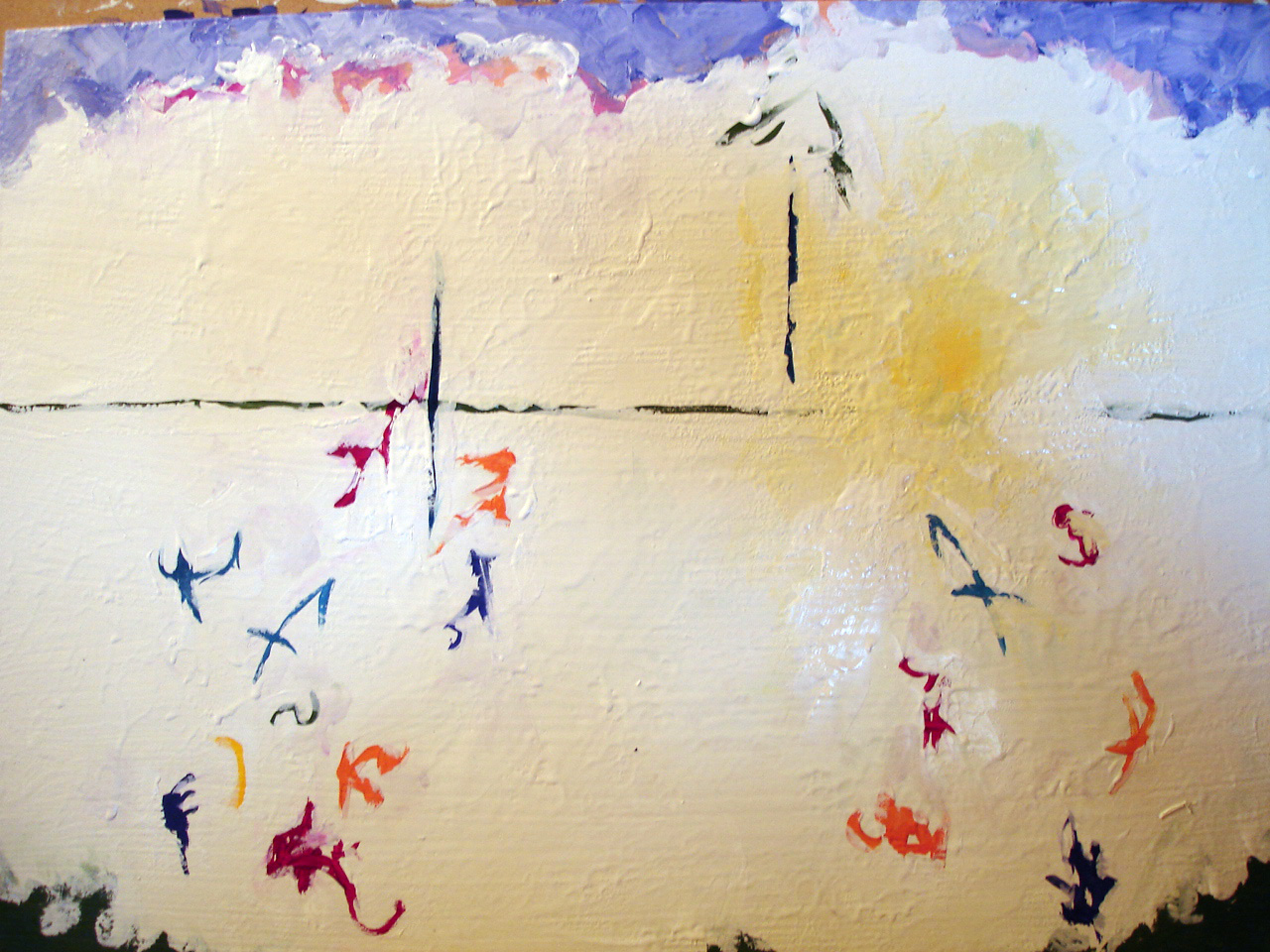
You may remember Field IV, begun during the Lichtenbergian Annual Retreat. Here it is after a little work on it tonight.

click for larger image
Click on it for a full-sized version.

The differences are small but significant. I’m still very not happy with it, but I’m discovering some things that I think will lead to success. Notice in particular that some of the blobs are now connected umbilically. I don’t know what that’s about.

Also, and it’s clearer in the larger image, the white seems to be losing in the battle to erase the color. It’s not as assertive as it covers the blobs.

Satanic influences

Heavens. One has to love a column which contains the sentence, “For example, most of the candy sold during this season has been dedicated and prayed over by witches.” It’s just so adorable. You can read it here.

You will notice that this is a cached version. By the time I had read the snarky summary at Huffington Post and decided that I would brave the original, Christian Broadcasting Network had taken it down. You would think such a devout organization would have firmer principles.

Shakespeare, as usual, gives us the exact phrase for this kind of thinking: “so excellently ignorant.” This woman has absolutely no evidentiary structure on which to base her world-view other than her belief in her own fictive lenses. Notice I do not say faith. This is not faith, it is narrative.

I can just imagine the firefight that broke out when this got “reprinted” at CBN. While many of CBN’s readers probably agree with her that Halloween is of the devil, I would bet about half of them looked askance at her hysterically ahistorical take on Harvest Home.

This is the kind of mindset with which it is useless to argue: the jargon, the fictive structure, the blinkered dichotomous worldview—this is a person who has settled into a dopamine fix which rewards the thrills most of us feel when we’re seven years old and nestling in a cardboard box while the monsters roam the backyard around us. This author wouldn’t even understand anything I have just said. She is a Flatlander, and any sphere who approaches her will be greeted by shrieks of “She’s a witch!”

Bless her heart.

New music, 10/28/09

I actually sat down and wrote a new piece of music last night. It’s a surprise for someone who would never read this blog, and its performance is far from assured, so I’m not going to post the actual score here.

I will link to the mp3, however.

It’s not done. I am going in tonight and kicking the last verse up half a step, that kind of hokeyness is part of what the piece is about, and then adding a semi-elaborate coda.

If it is scheduled for performance, I’ll let you know.

UPDATE, 9:09 PM: The mp3 is now the finished, cleaned-up version.

An idea

I can save the Republicans Party.

No, really, I can. My plan is super easy, and it’s a win/win/win situation.

Here’s the deal. I don’t know if you’ve been following it, but the New York 23rd District special election has gotten pretty strange. The official Republicans Party candidate is one DeDe Scozzafava. She has been endorsed by such luminaries as Newt Gingrich; Michael Steele says, “I support the Republican nominee, as a Republican Party chairman,” Steele said. “And that’s the way to go, right?

However: Palin, Pawlenty, DeMint, Rohrabacher, Tiahrt and other heavy-hitters have endorsed Doug Hoffman, who does not list any party affiliation on his site, nor does Scozzafava, if it comes to that, but is in fact the candidate of the Conservative Party.

Well.

It seems to me that this is a perfect opportunity for the old-guard Republicans to seize the control of their party back from the conservative whackjobs who currently hold it hostage. They have money, right? Aren’t they the rich people? Pay people to switch to the Conservative/Teabagger/Nutjob Party.

You can’t tell me that those rich white a-h’s don’t know how to do this surreptitiously. They’ve been funding “think tanks” and “fair and balanced” networks and “grassroots movements” for decades now. This ought to be a piece of cake. Just pay Glenn Beck enough money, and he can trigger a mass exodus of the 28%ers from the Republicans Party over to the newly powerful Conservative Party.

And there’s the win/win/win: the nutjobs have their own party that can cater to their anger and prejudice; the Republicans have their party back; and the Democratic Party might have some sane opposition.

Because, and here’s the entire point, the Nutjob Party is made up of barely 28% of the voters. They will never again influence an election. And that, my friends, is change we can believe in.

Revised The Movie Star

A couple of posts ago I invented a new drink, which Marc cleverly named “The Movie Star.” (It involves Canton Ginger Liqueur… Ginger, get it? I didn’t. He had to explain it to me. Doh!)

Tonight I revised the recipe:

  • 1 part Canton ginger liqueur
  • 1 part grapefruit vodka
  • 1 part lime juice
  • 1/2 part pineapple juice

Besides denominating the vodka specifically, I tripled the amount of fruit juice, so right away it’s healthier. Score!

Painting, 10/24/09

I’ll be updating this as the day goes by.

Here’s my first stopping point on Field IV:

Field IV @ 11:45

You can click on the image for a larger, more detailed view.

I continue to explore the idea of “erasure,” the fields of color on the bottom and top, the hieroglyphic figures (this time more “scribbly” and in color), all crowded out by the mass of white. There’s a big glowy spot in this one, too.

It’s clearly not done. I’m not even sure it’s started. It’s a couple of ideas I’ve been wanting to try, mostly in response to a commission from Seth Langer. Seth, if you’re reading this, this may be your painting, finally. Eventually.

More later…