Phoenix, 2/27/10

I didn’t post this yesterday because I was so disgusted, but as I work to finish the piece today, I might as well share what I nearly abandoned.

Score [pdf] | Sound [mp3]

Bleh. It just doesn’t work. But screw it, I’m going to hammer out the last third of it, duct-tape the “water” coda onto it, and mail it in. If they pick the thing, the joke’s on them.

Phoenix, 2/25/10

I have lost my mind.

Since the atonal screeching of the first third of the piece was starting to get to me, I thought I would go work on the end, which I intend to have a gentler, more puzzling tone.

Well, it is that.

It is very reminiscent of one of my really great masterpieces that has never seen the light of day, the last number in the aborted One Fish, Two Fish, Red Fish, Blue Fish[1] , which I later used as the extended coda for a bizarre and demanding Alleluia. Only that piece had the sixteenth notes in the accompaniment and all the voices had to do was to chime in gently with “Now we go to sleep” and ending with “From there to here/From here to there/Funny things/Are everywhere.”

This is a bit different.

Score [pdf]. Sound [mp3].[2]

[1] Fans of my music will fondly recall “Clark” from that lost work.

[2] Those who are paying attention to the file names will notice that this is phoenixwatersketch2. Yes, there was a first attempt, a much more singable thing. I like this a lot better.

An unexpected answer

In Seattle last week, we drove over to Fremont, a yuppie/hippie enclave full of funky shops and publicly funded street art. In one of the funky shops, full of locally made jewelry, decorative items and paintings, I was amused to see yet another jeweler making things out of old typewriter keys. There was TAB and SHIFT and :; and all the whole QWERTY gang.

But then I was startled to see a key I had completely forgotten about: MARGIN RELEASE.

Wow.

For those who have never had to use an actual typewriter—we’re not talking about those slick last-generation numbers that were actually word processors—let me explain the MARGIN RELEASE key.

First, you had to set your margins by positioning literal metal tabs on the left and right on a bar behind the platen. You also set tabs on the same bar.

Back in the old days, you had to keep a calculation running in your head as to whether the last word you were about to type on a line would actually fit between where you were and the margin. The margin would simply stop you cold in your typing, midword, if you miscalculated.

(Am I remembering correctly? Or was the little bell actually set to go off before the actual margin to warn you?)

If you did miscalculate, you just had to slide the carriage over to start the new line and then remember to go back and manually erase the foreshortened word.

Unless…

Unless the word in question was short by only one to three letters. Then, depending on the character of the document you were typing, you could choose to press the MARGIN RELEASE key, which, you guessed it, released the margin and allowed you to keep typing.

Nowadays of course the word processor does all your calculating for you. You just keep typing, and when the word is too long, it simply wraps to the next line. We live in awesome times.

I was brought up short by this artifact from my past. It articulated suddenly for me recent aspects of my life that have puzzled me and others in my life. The labyrinth, for example, seems almost like a Close Encounters kind of endeavor. Why? my lovely first wife kept asking as I transformed our barren back yard into some kind of alien landing site.

Why indeed? “Why not?” is not of course any kind of answer. I could only respond that the pattern appealed to me in some way I could not explain, and in the event, it obviously appeals to others as a space of refuge, contemplation, even power.

But now I have more of a partial understanding and answer: it’s a margin release. It allows me to push that button and temporarily go beyond the margins of my quotidian existence, to connect with parts of the universe that unfortunately are not available to me during most of the daily grind. However, my hope is that someday, someday, I’ll get the hang of it, and I can just keep typing off the edge of the page.

So I bought the MARGIN RELEASE charm, hanging on a silly ballchain chain, to wear as a talisman on my new Utilikilt. Look for it soon in a labyrinth near you.
Phoenix, 2/23/10

I have set myself the task of composing an a cappella SATB piece by Saturday in order to enter into a competition the deadline of which is Monday. That means I have to have it finished by Saturday so I can polish it by Sunday and pop it in the post first thing Monday morning to have it postmarked March 1.

(I’m also submitting the SATB arrangement of “Sonnet 18” to the Yale Glee Club Emerging Composers Competition , that goes in the mail tomorrow.)

Anyway, I asked my fellow Lichtenbergians to suggest a text yesterday. Lots of good responses from them, of course. I really really liked Mike’s suggestion of Edward Lear, and was set to compose “The Dong with the Luminous Nose” or “The Jumblies.” Ironically, in searching my hard drive for the text to “The Jumblies,” I came across a list I had started back in 2008 of my Lichtenbergian goals, and for 2008, one of them was to set “The Jumblies.”

I began thinking of textures for “The Dong” and had given quite a bit of thought to it, using the voices as orchestral accompaniment along with the text, but I think it’s too long. The piece has to be 4—8 minutes long, and I was having to cut sections before I even began. I wasn’t sure I could get it all done by Saturday. It’s not strophic; Lear wallows in the verse without regard to regularity, so I wouldn’t be able to cheat by repeating verses like I did with “Blake Tells the Tiger the Tale of the Tailor.”

Fortunately, one of Marc’s texts was equally tempting, and a great deal shorter if, naturally, a lot more opaque:

I don’t want to be a phoenix.
I want to be something learning to walk
Like the corpse at a funereal dance.
I want to learn the rainbow’s backstroke.
I want release from restraint.

What to do?

The sky scares me.
Graceless hands reach out of the clouds.
Are these those clouds of unknowing
The books talked about?
Am I crossing into wonder?

What to do?

I feel so helpless.
All the familiar doctors
Touching the familiar folds
And I quake in the same cold ways.

Am I made of water? Why?

What to do, indeed?

Here’s my first stab, score [pdf] and sound [mp3]. It’s only the first phrase. I’m thinking of marking the opening wail Keening, because that’s what Marc would do.

At the moment, I have a vague plan. The first stanza will be fairly knotted, as you’ve heard, with a little loosening at “I want release…” but knotting back up with “What to do?” The second stanza will, despite itself, begin to cross into wonder. The second “What to do?” will be unable maintain its confident despair. The last stanza will be almost resigned to its loss of nihilism. I’m almost certain that’s not what Marc intended.

Thinking in a cappella is very hard for me.

What to do…

Well, I’m back, sitting in the labyrinth on a gorgeous Sunday afternoon. I have nothing pressing on my agenda, so that means I have tons I could be doing:

  • Finish the northwest corner of the bamboo fencing: that’s where the now-dead tree was in the way of the fencers, so they just plunked down a post, then spanned over to the wooden fence with chainlink. Very ugly.
  • Sketch. I haven’t done so in weeks, and the ELP calls.
  • Actually try to get the grass seed into the dirt in the labyrinth. I’m leery of doing the raking thing, because it seems to me that it would rip up the roots of the grass that’s already there.
  • Work on a couple of blogposts, including the most recent Lichtenbergian assignment.
  • Read Twyla Tharp’s The Collaborative Habit: life lessons for working together
  • Read more of Little, Big, one of the most amazing books I’ve read recently.
  • Rework the lighting fixture at the southpoint of the labyrinth from copper wire mesh to solid copper.
  • Write a charming letter to the editor of the Times-Herald, explaining to sports writer Tommy Camp why his tongue-in-cheek take on curling was full of it.
  • Just sit here in the sun and my new Utilikilt.

update: Just so you know, I mostly sat there in the sun in my kilt. I read The Collaborative Habit but found it not very inspiring, mostly because I have covered all those bases with Lacuna Group. I wrote a very charming letter indeed to the Times-Herald. They should print it.

Out of the office

This evening, my lovely first wife and I will fly to Seattle, which will be our home base for infiltrating the Winter Olympic Games in Vancouver. We will be there for a week, so don’t expect any blogging from me unless I am overcome with the grandeur of it all and either borrow a computer from our hosts or assay the WordPress app on my iPhone. (I should try that now before we leave.)

It also means I won’t be getting any work done on the music I plopped out yesterday. Ah well, at least I’ll return home with a new Utilikilt.

At any rate, everyone behave while I’m gone.

Composition competitions, redux

I got the American Composers Forum newsletter yesterday and there on the front page was an article by Eric Whitacre, “Advice for the Emerging Composer: Competitions.”

Eric Whitacre, for those who do not know, is one of the major cool kids of contemporary choral music. His blog is here. Highly readable.

Anyway, he outlines some benefits for emerging composers to enter all these competitions. The first is exposure, which makes sense. Even if you don’t win, the judges will have seen your work. He says several times judges have contacted him to see if they could program his work that didn’t win the competition.

Second, he says, you’ll finish the piece. I’m a Lichtenbergian. ‘Nuff said.

Third, and I will quote him directly here:

In the last 18 years I’ve probably entered a hundred competitions and I have never won anything. Nothing. I lost the ASCAP Young Composers award three times (in three different years I entered “When David Heard,” “Lux Aurumque,” and “Cloudburst,” lost with all three.

And more of the same. Incredible. “Lux Aurumque,” sung here at a midnight mass in London. Didn’t win. His most recent post talks about getting a letter from the American Academy of Arts and Letters, rejecting his application for an award they had invited him to apply for.

He says not winning is a good thing. It helps make you stronger, if you’re smart, because it reinforces your sense of your own worth. Your piece should have won, dammit, because it was good, and you know that. It’s what keeps you writing more.

All in all, a timely and enjoyable article. And now I have yet another blog to keep up with.

AFO sketches, 2/12/10

Yes, I said “sketches.”

First of all, I took Marc Honea’s “Vibes” piece, which I will let him explain in comments, and which sounds like this [mp3]. He sent me a MIDI version of that, which I sucked up into Finale 2010, creating a score, after much mucking about, that looks this [pdf].

My only goal today was to slam some of those notes into a Finale file that would start playing with the orchestration to see if would even work as a string piece. My suspicion is that it’s always going to sound better and cooler in the computer version. However, here’s where I’m stopping for the day: vibes sketch 2/12/10 [mp3]. Four measures of bass vamping, then the first four measures minus the top notes, then the same four measures with the top notes added back in.

I couldn’t resist the glockenspiel.

About this time, as I took a break for coffee, it started to snow. I went out on the back deck and watched it begin to come down. Why not a piece called “The Labyrinth in Snow”?

Here’s what I’ve plopped down. It’s got some nice bits, but it’s still just noodling. Labyrinth sketch 2/12/10 [mp3]. The violin accompaniment will continue under the cello solo, probably quiet little triplets. In addition to the piano, there will be a solo violin as well. The three soloists will wind in and out over increasing flurries from the rest of the strings. I think.

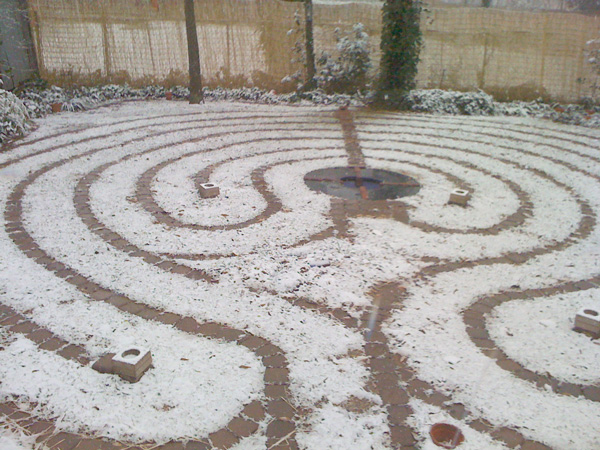
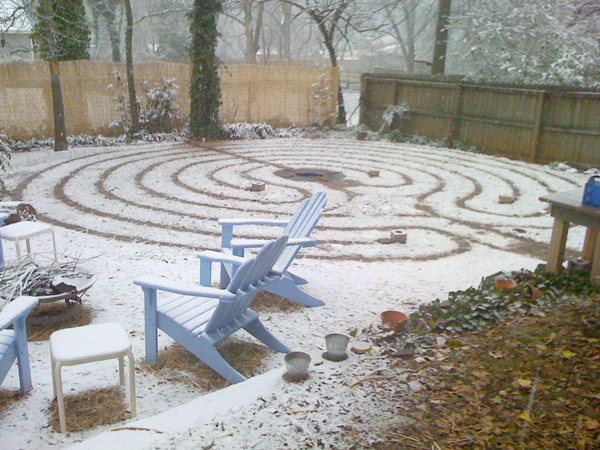
And just so you can share in it, here’s the labyrinth. In snow.

Update, 5:14 pm:

Here’s the most recent version, a little extended. I’m thinking about changing the opening to be a lighter, more mysterious, trill-y kind of thing. Labyrinth 2/12.b [mp3]