Here’s an I Ching kind of question:
If you get Chinese take-out, but leave the fortune cookie on your kitchen counter for a couple of weeks before eating it, does the fortune/advice apply to the day you ate Chinese or the day you ate the cookie?
Oh, you know, the usual…
It’s spring break for me, which means I have some time off to get some real work done on the Symphony.
Of course it’s not that simple. On Thursday we go up to Greensboro to see Grayson and hear his girlfriend’s junior recital (she’s a percussionist) and see his best friend in Cloud Nine. That means I really have only three days to get work done.
And of course there’s a whole list of other things that have to be done: the garden has to be mulched; the kitchen has to be cleaned, a bigger project than you might think; a sofa table has to be converted into an entertainment center; and finally, I have to figure out how to use that Miracle Putty as seen on TV to repair a whole list of items around the house. I’m sure there are other items that are not on my list. Yet.
Still, I have high hopes for getting III. Allegro gracioso finished this week, unless I start hearing voices again: “…in re: Straussian, less J. Jr. and more R., please…” Only the voices don’t say please, they say, “…or it will never work…”
Here’s a photo of the herb garden: I found thyme, added some spicy basil, and look at all the lettuces! That’s a new thing for me. We’ll see if it works or whether I’m going to be feeding rabbits and chipmunks.
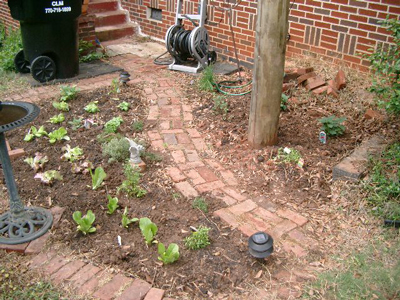
I love my herb garden. It’s right outside my kitchen door, so I have easy access to it. It started years ago as a tiny plot along the wall, with parsley, oregano, basil, and chives, and it’s grown into a respectable plot with a brick path down the middle.
But over the last year, it’s become overgrown with grass and weeds. The weeds are easy enough, but the grass digs in and it’s impossible to get it all out. Also, the rosemary had become overgrown, the parsley had been destroyed by the power company replacing the telephone pole in the middle of the garden (don’t ask), and most everything else was just looking ratty. It was time to take it down.
Wallace Stevens uses a garden in his poetry as a symbol of reality: the universe is chaos, and out of that chaos we organize what we can into what pleases us to call reality. This reality is our garden, and a creative person is one who looks for a way out of that gardem, for more chaos. And occasionally, it is necessary to raze the whole thing and start over.
In our real real world, it is necessary to raze the whole thing and start over. I saved the chives, one of the cilantro plants that had sprung up, and the oregano, although it might have been better to start over with that. I sprayed the whole thing with Round-Up™, tilled it up, busted up the soil, spread some mushroom compost over it, tilled it again, and let it sit.
Yesterday, looking for firewood for tonight’s meeting (I was quite unsuccessful, so any Lichtenbergians reading this: bring firewood!), I was at Wal-Mart, and loath though I am to patronize the place, I impulsively bought most of the herbs I need. They did not have English/common thyme and couple of other things, but I was able to get most of it.
I dithered about getting the plants in the ground, because the clouds were so dark, but again, I could not resist my impulses, and I dug in the dirt. My herb garden is replanted. I keep walking out just to look at it. I love my herb garden.
I love my herb garden because there’s nothing like being able to do any recipe that calls for fresh basil or dill or chives and just walking out the door with my scissors and coming back in with actual fresh basil or dill or chives. I love it because when there are no recipes, just you and the salmon or chicken or soup, it frees you to do whatever is possible. Roasted potato wedges? Just plop some chives, oregano, basil, and thyme in there. Salmon? Whip up a sauce with lime and dill. Playing with a vinaigrette? What’s your pleasure?
I have a couple of cookbooks and gardening books devoted just to herbs, most of which I don’t refer to any longer since I’ve become “expert” in the subject. Perhaps I should set those free.
So what all is in my herb garden? Chives, oregano, marjoram, tarragon, thyme, dill, cilantro, sage, basil, parsley, arugula, and rosemary. I used to try for lavender, but it just wouldn’t grow; it’s too hot here. (The tarragon is “Texas tarragon”; the French variety withers in our heat.) The arugula is new this year, and I suspect it’s going to meet a similar fate. I may plant some bee balm, and if I can find lemon verbena, it’s in there like a flash.
I tried lemon grass, and it grew well, but I used it so little that it wasn’t worth the enormous amount of space it came to take up. Likewise lovage, although I’d love to have some of that again. Mints are seductive, but they do run rampant. I actually planted some last summer, but the garden was so strangled with grass by the time I got home from Valdosta that even the mint couldnt’ survive.
I keep looking at fennel, but I don’t use it enough to warrant planting it. I’m curious about borage, calendula, and savory. Publix had a potted herb called culantro, which seems to be a big-leaved substitute for cilantro. I keep wondering whether garlic or horseradish would work in the garden. There’s always catnip…
Time to go out and look at my garden again.
It is important in life to have the right tools. That is why, after spending the afternoon at the Honeas, with four or five or six blue plastic cups with champagne (with orange vodka from Mary Frances’ freezer), I am glad to have bought this last week a tilling fork and a “claw,” so that I might break free the soil in my herb garden, bound by weeds and grass not yet killed by sprayed herbicide. My neighbors, who were watching (I know because they interrupted me, this Eastre afternnoon), are lucky that it’s chilly enough that a) I kept my jeans on instead of donning my kilt, and b) as Jeff has mentioned elsewhere, that I kept my kilt on.
It is also important, when you’re fretting about theme and variation and orchestration, to have Beethoven and his sixth symphony on your iPod Shuffle as you till your garden, so that you can listen to that first movement over and over to find out his secrets, his manipulation of those very simple motifs, over and over, broken up into serviceable bits, layered upon layered, saecula saeculorum, amen, until you are lost in the purity of it all: idea multiplied until it’s whole. Listen to it: it’s all there, nothing wasted, nothing extraneous. It’s all there, guys. Listen to it.
This is why George Lichtenberg eventually abandons his work. Anything else is surface.
Those who remember my post about transgendered men will appreciate perhaps the extra headspin of this article [via MetaFilter, for those who are wondering.]
A preview of what I have on my plate tonight:
I’ll have updated results later.
later: I got the first three done. Cras melior est.
::sigh::
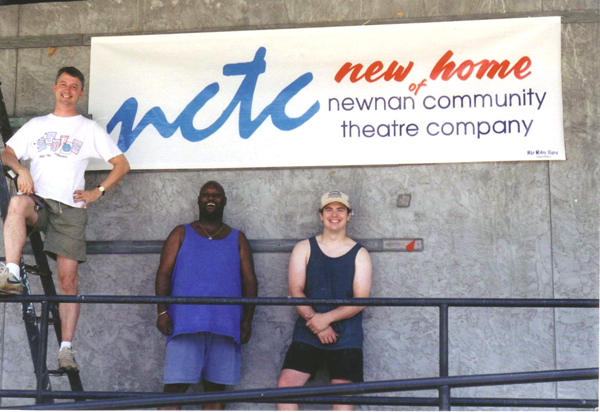
I came across this photo somewhere recently, tucked away in some satchel that I must have used on a more regular basis in a past life. As for most people, a photograph of myself is a lodestone, drawing my eye again and again to this representation of a being that I know must be me, but somehow doesn’t seem right. I set it aside, but it kept resurfacing on my desk, and it kept nagging at me.
Warning: this is all about me.
I just checked http://lichtenborgian.org, and the coming soon page is up, but I haven’t received any access info from Noah, nor can I see it in my FTP utility. I’ve emailed him and expect to hear from him as soon as he gets to his computer out in California. And then… then…

So over on the Lacuna blog, Jeff pointed us to a book review in the Times, of Stumbling on Happiness, the main point of which in its applicability to us Lichtenbergians is that humans are an easily deluded lot, mostly by ourselves, and mostly to maintain our happiness.
The author cites the notorious statistical anomaly that “90% of drivers rate themselves above average,” which is usually used to show how self-deluded most people are. Because, clearly, 90% of drivers cannot be above the 50% mark, can they? It’s like, as is often smirkingly said, Lake Wobegon’s children. Or NCLB test scores.
But I have some questions about this much-quoted and much-derided statistic. Could it not be a fallacy itself?
For one thing, what’s the scale of “good drivership”? For the 90% figure to be wrong, there would have to be an objective rating scale of good drivership that would allow you to place all drivers along it. What counts? Accidents? Slamming on brakes? Driving with coffee? Cell phones? Five mph over the speed limit? Six?
For all I know, the original study that created this zombie factoid had such a methodology. I’m too lazy to go find it. But my next question was, were participants in the study asked to rate themselves with this scale, or were they asked to decide where they would fall on such a scale without being given any details? I suspect the latter, which is actually okay as long as then they were asked to fill out some kind of survey which then would place them accurately along the scale.
Because, and this is the important part, I think that the unexamined assumption of the 90% deal is that drivers are distributed across this scale in a normal curve, i.e., 70% of drivers cluster around the 50% mark, and the rest of us are strung out on either side, with very few awful drivers and very few perfect drivers, just like IQ.
However, I doubt that. I think it entirely possible that we are not distributed in a normal curve, but a J-curve, and in fact most of us are better drivers on an absolute scale than not. In other words, while the researchers were applying a norm reference, the real world is working with a criterion reference. Most people quite rightly examine their driving habits and say, “You know what, I’ve never had an accident, and I can’t remember the last time I even slammed on my brakes or went down a one-way street the wrong way. I did cut that guy off on the interstate last week, but he was a bad driver.” And so they rate themselves “above average,” because in fact they are.
Okay, so maybe it’s not a J-curve, which would mean that most drivers are approaching perfect, but I’d be willing to bet that it’s at least a shifted normal curve, with that main 70% clumped around the 80% mark and not the middle.
Damned statistics.
My, how time flies when you’re slogging through Munich.
As much as I would have liked to, it was just impossible to blog about each day. We’d get back to the hotel late, and then, if we wanted to be any kind of rested for the next day, we’d have to hit the sack.
So, apologies for not blogging the trip in real time. I will now attempt, in some multiple posts, to give the hilights version.
On Monday, Grayson took us to three major churches we had missed on Saturday.
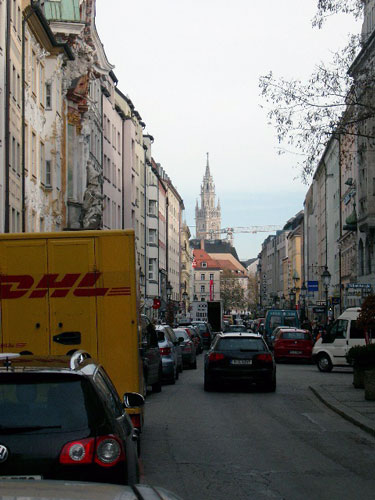
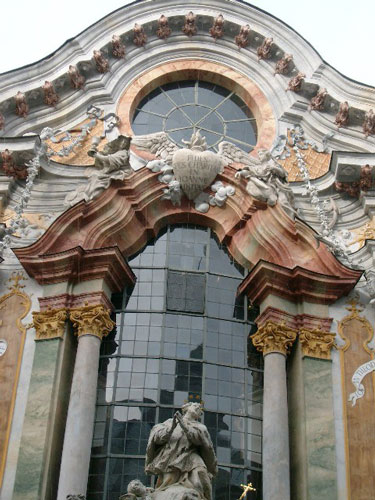
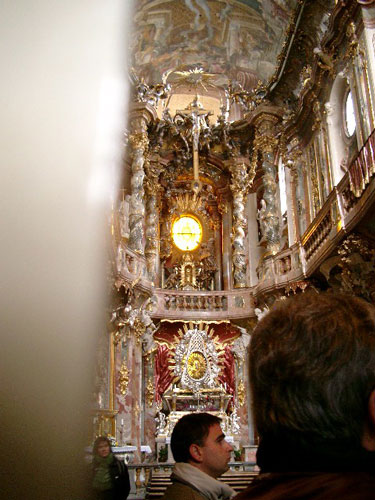
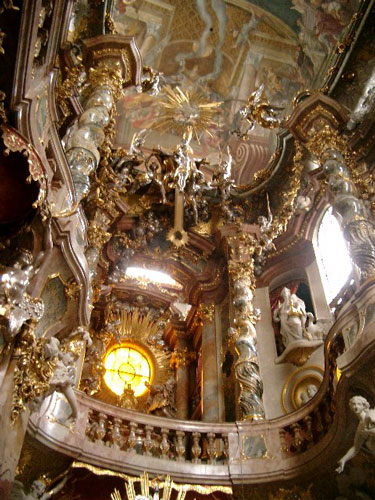
First, the Asamskirche: built by the brothers Asam as their private church (it’s sandwiched into a tiny lot beside the home of one of them), it was eventually opened to the public as it became more and more expensive to complete.
Here’s the street it’s on. No, that’s not it in the distance. That’s the Neue Rathaus. The church is on the left, above the DHL truck.
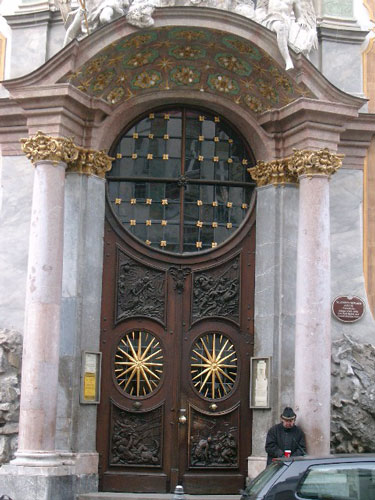
Here’s the door of the exterior:
And here’s the top of the exterior:
And inside?

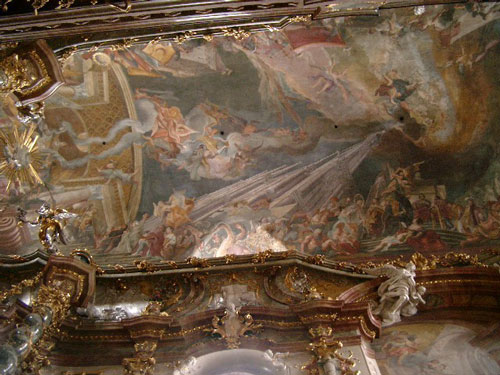


That last little bit is in the narthex: it’s an angel with a distaff, spinning the thread of life. Death is snipping the thread with his shears.
Our next stop was the Theatinerkirche, at the Odeonsplatz:
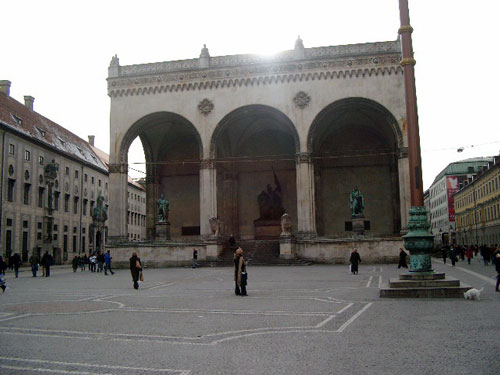
This is the Odeonplatz, built by Ludwig I, who did some town planning in the early part of the 19th century, including this nice little folly at the end of Ludwigstrasse, a main thoroughfare leading into town, lined with the magnificent buildings of the University. To the left is the Residenz, the palace of Ludwig’s Wittelsbach family, and to the right is the Theatinerkirche:
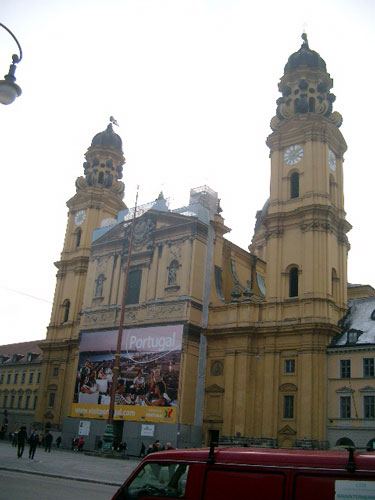
Notice the scaffolding across the front, and how it has both a photo-poster of the actual facade, plus an ad. Hold that idea; it will return.
And the inside:
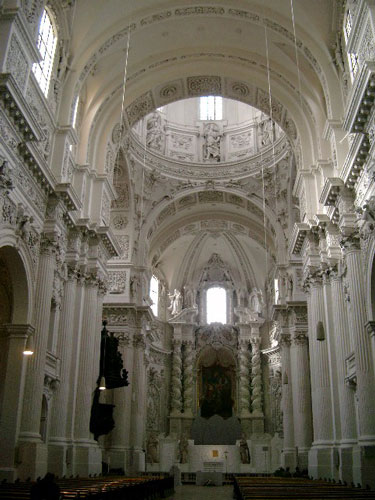
Woof. “Soaring” and “baroque” do not begin to describe this interior.
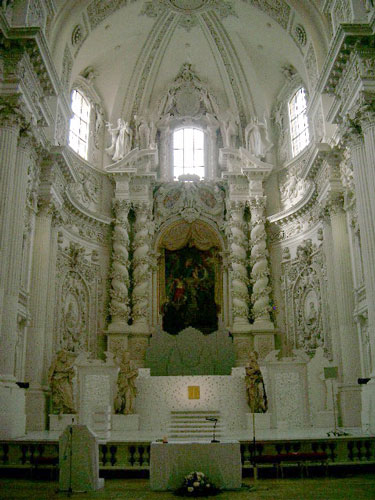
The altar.
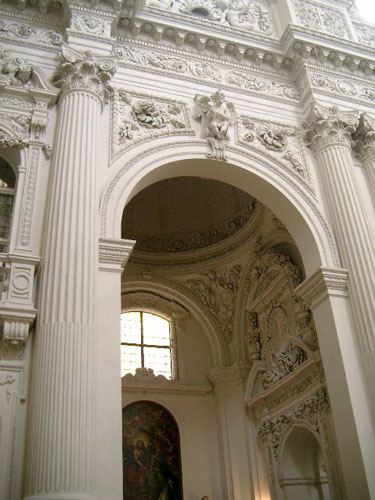
Architectural detail, above and below:
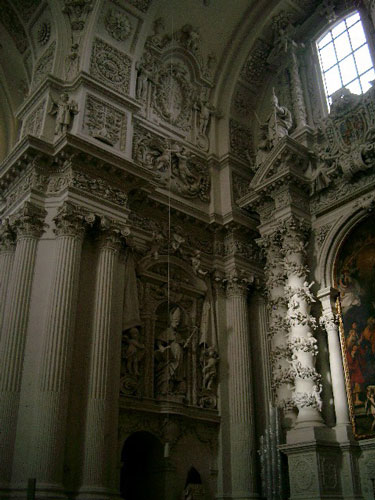
Part of what numbs the brain about most of these places is that these are actually, essentially, replicas. Most of Munich was damaged, like 90%, in the final year of the war. We were trying for the Nazi headquarters; without smart bombs, we got places like this. (The Nazi headquarters was unharmed. It is now a performing arts high school. Jews and queers, could it be any more poetic?) Anyway, Munich set about and rebuilt all of what you see here.
Our tour guide:

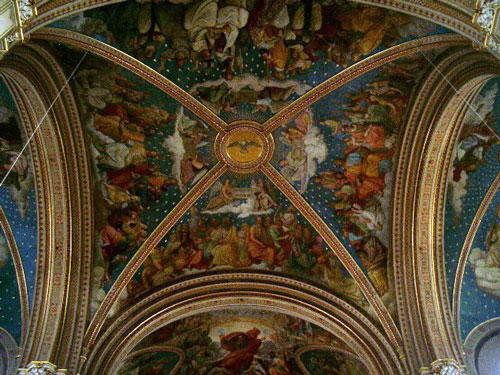
As you can see, he looks self-satisfied. Finally, he took us to his favorite church, the Ludwigskirche:

He likes its clean, neoGothic lines, and for some reason, its quasi-Renaissance frescoes.


At this point, the child begged off: he had work to do. We were astonished and pleased. We ate at a really crappy restaurant that was pretentious but awful. German haute cuisine is not quite there yet.