Vintage Cocktails, part 2

In yesterday’s post, I began rambling about the joys and challenges of exploring vintage cocktails, those drinks that have vanished from the beau monde for  one reason or the other, and we had gotten to the part where I’m enumerating the problems that arise with this hobby.

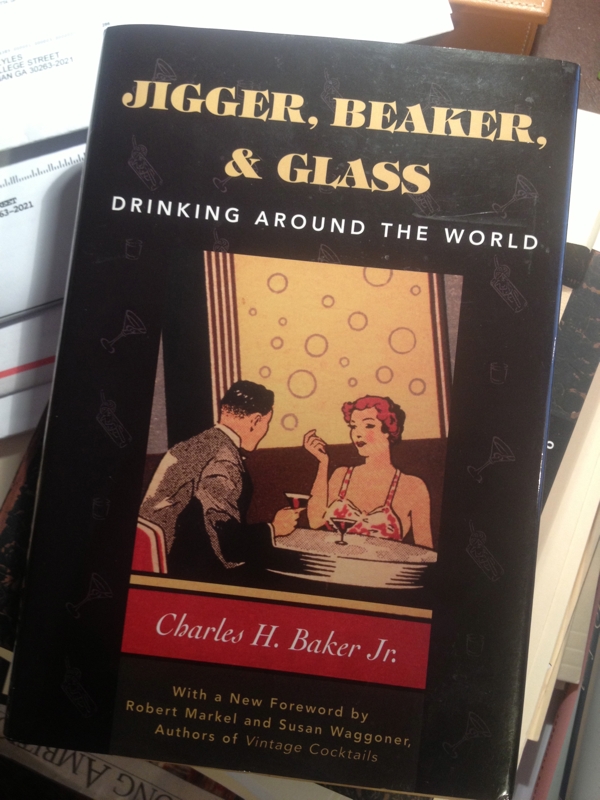
The first one was availability of materials, and it’s often a problem in Jigger, Beaker, & Glass, since it’s a reprint of a book from the 30s.  Everybody used to have pastis just sitting around, I suppose, but today you really have to look for it.

It’s not as much of a problem with this book:
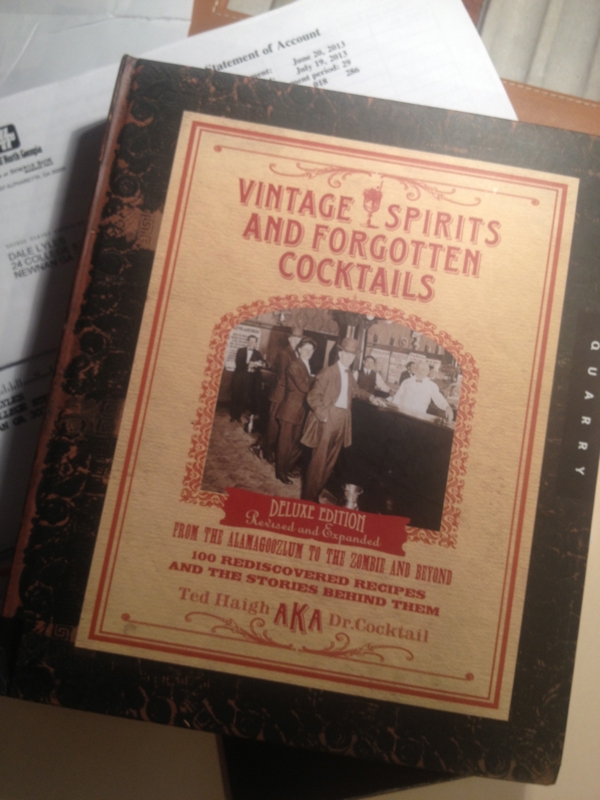
Vintage Spirits and Forgotten Cocktails, by Ted Haigh (no really), is a spiral-bound notebook of 100 recipes, accompanied by their histories and photographs of period bottles, etc.  Mr. Haigh (no really) made availability of materials part of the criteria for inclusion, and where the liquid in question no longer exists he lists acceptable substitutes.  There are still rarities—it took me forever to find Parfait Amour, for example, and that was before I got this book—but on the whole it’s a great book in that regard.

In fact, Mr. Haigh relates how he was involved with the revival of bitters as a staple of the 21st century bar.  I remember recipes calling for something as simple as orange bitters, and for the longest time there was no such thing on the market.  Finally my friend Jim discovered that the Fee Bros. were making bitters again (and Mr. Haigh talks about that), and he sent me a starter kit of orange bitters, orange blossom water, mint bitters, and regular Fee Bros. bitters.  Now of course there are all kinds of bitters on the market.  I’ve added lemon and grapefruit bitters, plus Peychaud’s from New Orleans.  Celery is next on my list.

I have taken to writing notes on the drinks in the margins, both in Forgotten Cocktails and J/B/G, so that I remember from one exploration to the next what I thought of any particular drink, including any notes to changes I might make the next time I make it.  I feel like the Half-Blood Prince.

And that leads to our second problem: vintage cocktails often taste funny.  Charles Baker lays down very strict rules about the number of ingredients in J/B/G, so that helps avoid the car crashes of some of today’s libations, but tastes change.  Most of those neo-glamorous Mad Men cocktails, for example, are sweeter than you might be used to.

A great many of the Forgotten Cocktails involve fortified/aperitif wines like vermouth or Lillet Blanc or Dubonnet Rouge, and to my palate they tend to overwhelm most cocktails.  (I am one of those who will shake gin in a shaker, pour it into the martini glass, then spray a light mist of vermouth on top and call it a martini.)  In the front of the book I have written that many of these cocktails have “a sticky/sweet foretaste, a bitter aftertaste, and a vermouth-like overtone.”  I then abbreviate that as SBVO for use throughout the book, and I tend to avoid recipes with more than a hint of vermouth.

Having said that, Forgotten Cocktails is more successful than J/B/G in its selection.  (I don’t think J/B/G was curated so much as poured out.)  Some of Baker’s concoctions are just plain funky tasting; most of Haigh’s are at least valid even I don’t like them.

The problem of taste means that once you’ve mixed one of these and you find that the thing is an assault on your sensibilities—what then?  Be resolute, my friend, and dump it.  Straight into the sink.  Don’t be a man about it and finish the nasty thing, or worse, finish it because it would be a “waste.”  Dump it.

Because we have to consider the third problem: Exploring these recipes can make for a very short night.  You are after all pouring a lot of alcohol down your throat, and it would be smart to stop before consuming three.  Don’t waste one of your slots on a vile drink.  Toss it and pick a new one.

The sensible option, of course, is to make a tiny version using the proportions of the recipe.  Teaspoons instead of ounces, so that you’re swallowing a tablespoon instead of half a cup.

For this you need the following device:
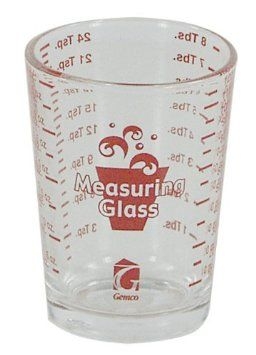
It has a four-ounce capacity, and it’s marked for tablespoons, teaspoons, ounces, and milliliters.  It’s an excellent way to make a tiny Algonquin Cocktail so you can confirm that it has too much vermouth in it ever to pass your lips again, without having to waste a whole jigger of rye.

So what fabu cocktails have I discovered that have become part of my stable of offerings?

The Miyako Hotel Special is one of my earliest discoveries (in J/B/G): gin, Grand Marnier, pineapple juice.  Yummy.

The Gin-Blind: gin, cognac, curaçao, orange bitters

From Forgotten Cocktails so far:
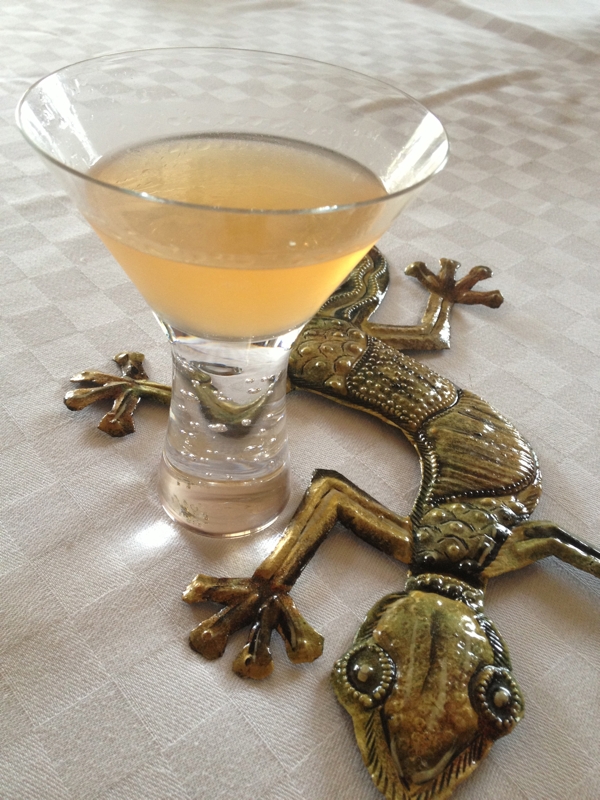
The Pegu Club Cocktail… and friend

The Bebbo: gin, lemon juice, honey, orange juice

The Brandy Crusta: lemon juice, cognac, orange curaçao, bitters

The Corpse Reviver #2: gin, Cointreau, Lillet Blanc, lemon juice, drops of absinthe

The Honeymoon: Calvados, Benedictine, orange curaçao, lemon juice

The Jack Rose: applejack, lime juice, grenadine

The Jupiter: gin, dry vermouth, Parfait Amour, orange juice

The Mamie Taylor: scotch, lime juice, ginger beer

The Monkey Gland: gin, orange juice, grenadine, absinthe (This one is phenomenal!)

The Moscow Mule: lime juice, vodka, ginger beer

The Pegu Club: gin, Cointreau, lime juice, bitters (This one is also phenomenal!)

The Seelbach: bourbon, Cointreau, Angostura and Peychaud’s bitters, champagne

The Twentieth Century (as in the train): gin, Lillet Blanc, creme de cacao, lemon juice

The Vesper (yes, the James Bond martini): gin, vodka, Lillet Blanc

The Widow’s Kiss: Calvados, Chartreuse, Benedictine, bitters

Those are the ones I’ve tried and would repeat.  There are quite a few I haven’t tried yet for lack of the proper ingredients.  (Swedish Punsch, anyone?)

I like my hobby—it’s always a blast to discover a cocktail from another age. It keeps the palate from getting bored with the quotidian gin & tonic, but beware:  once you start down this path you will have one more problem facing you, and that is that these are in fact forgotten cocktails.  You have to type your favorites into your notes and be prepared to whip out your iPhone at any point to show a bartender what you want.  However, most are extremely obliging if they have the ingredients, and the really good ones already have a copy of Forgotten Cocktails behind the bar.

Happy bon vivanting!
Vintage Cocktails, part 1

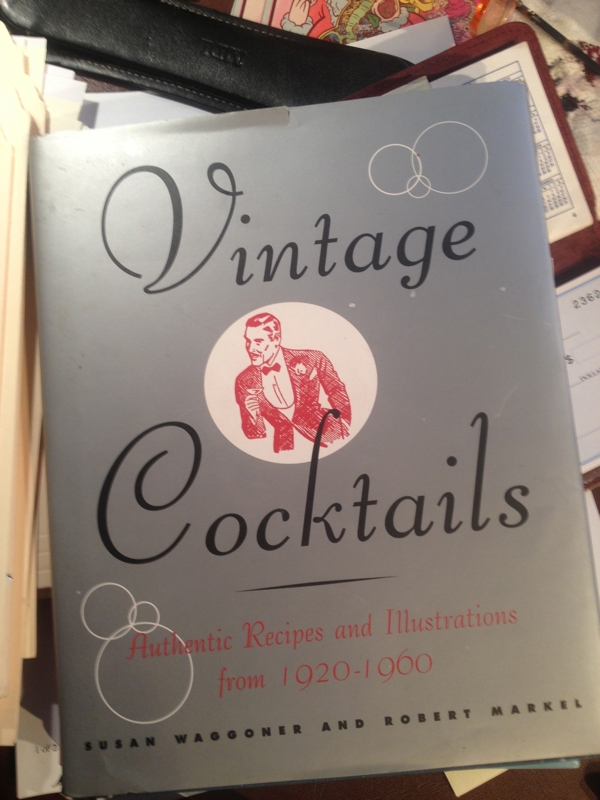
If you are at all of a drinking disposition—and who among us is  not?—you have spent time in bookstores/cookery* stores looking at books of cocktail recipes.  (Other than the two main books I am about to discuss here, buy the Ultimate Bar Book and be done with it.  Or pony up for the iPhone app Mixologist.  Trust me.)

Once your grown-up palate is accustomed to the basics, you start looking abroad, and the first thing you check upon being seated at any new restaurant is the cocktail list.  Do they have anything interesting, i.e., not a sweet argle-bargle for the ladies who lunch?  Leon’s in Decatur always has the most interesting, but not a lot of it is transferable.  What is one to make of their “bullet & trigger”: bulleit rye, zucca amaro, cocchi rosa, cherry, acid phosphate.  Wait, what?  Hold that thought, it will resurface in a moment.

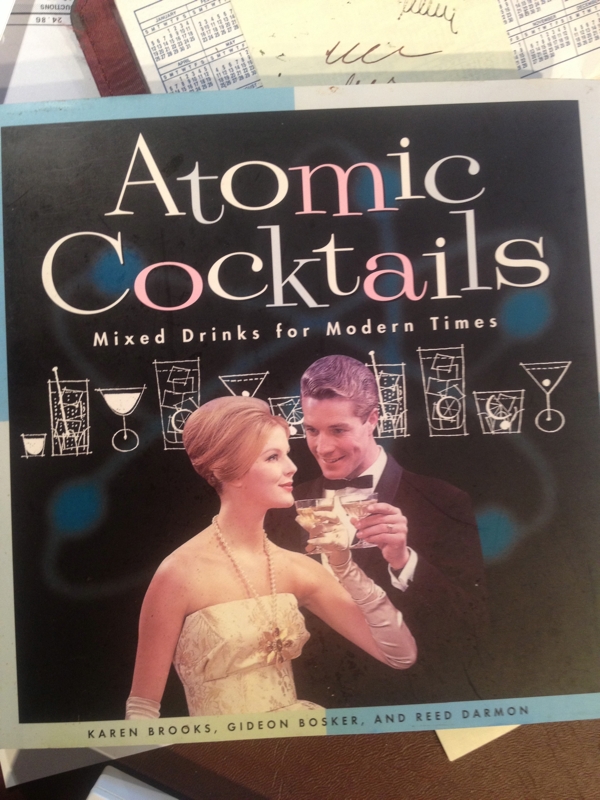
So as I browse through bookstores/cookery stores, one of my fascinations has been cocktails from the past.  What concoctions did our forebears enjoy, how were they made, and why can’t I just step up to the bar and order a “Miyako Hotel Special” without whipping out my iPhone?  I present a couple of those here:

These two are just chock full of COCKTAILS EVERYBODY ALREADY KNOWS ABOUT.  I mean really, a Manhattan?  Or a French 75?  Honey, please.  These books are just hipster posers for novices.

No, I’m talking about the seriously long-gone concoctions that no one any longer orders.  Just imagine Leon’s’s “bullet & trigger” fifty years from now.

Fortunately, I have two books that will sate anyone’s appetite for these things.  The first is Jigger, Beaker, & Glass: drinking around the world, by Charles H. Baker, Jr.  (It’s a re-issue of Baker’s original Gentleman’s Companion, and I just noticed features a new foreword by the authors of Vintage Cocktails.  Oops.)

Baker was a bon vivant who swanned around with Hemingway and the gang back in the 20s and 30s, and he collected cocktails.

From the original preface, in which he pooh-poohs Prohibition:

We also doubt if any lemonade social ever afforded a thrill like the moonlit night in Ceylon when we went to a Hollander friend’s beach bungalow out beyond Galle Face, where we swam in the blood-warm Indian Ocean and drank enough of his Flying Fish cocktails to do, and lay on the cool sand and listened to Tauber sing Dein Ist Mein Ganzes Herz on the gramophone.  Then when we swam again we slipped out of our suits to make the water feel better, and finally, when it was very late indeed, we dressed and said goodnight and vowed eternal friendship to our host; then for precisely no reason at all dismissed our waiting carriage with a flourish of gross overpayment and walked all the way back in our evening clothes through a new quiet rain to the jetties and the motor launch, just in time to prevent one of our best American cruising friends from consummating bribery of the Quartermaster on the good ship RESOLUTE into letting him hoist a purchased baby elephant—whom he said was Edith, and over whom he politely held a Burmese parasol of scarlet oiled silk—from a hired barge onto the forward cargo hatch in a sling!

Well, hello sailor!

Here he is talking about an actual cocktail:

THE RANGOON STAR RUBY, a Wonderful & Stimulating Cocktail from Lower-Burmah

In 1926 we disembarked in Burmah from a round-the-world ship, and spent several days there before hopping off to Calcutta in a little “Bibby” boat carrying a mess of Mohammedan pilgrims headed for Mecca as deck passengers, and who did all their own cooking right down there in plain sight.  In Rangoon we joined up with several folk in the Strand bar of evenings to chin about the romantic Mandalay country far up the Irrawaddy River, and to talk over gems with Hamid and his brother from Colombo and Bombay, and to acquire a really fine zircon for someone else and a set of star sapphire dress studs for ourself.  One American headed out on leave from certain ruby mining operations up-country told us he had invented himself a drink that everyone up at headquarters liked so well he was going to shout it to the world so that no man might be denied its virtues.  He popped behind the bar before we could say “knife” and whipped up the following mixture which, due to its color, he had christened the Star Ruby.

Take 1 jigger of good cognac, 1/2 pony of cherry brandy, 1/2 pony of French vermouth, 2 dashes each of orange bitters and lemon phosphate, then for added flavour 1 tsp of kirsch, or 1/2 tsp of maraschino.  Shake with finely cracked ice, pour into a wine glass leaving a little ice floating, and let fall 6 drops of grenadine in the center of this chilly expanse for the ruby color touch.

Who can resist that kind of style?  However, the experienced drinkers among us will already recognize a couple of problems.

Our first problem with vintage cocktails: many of the ingredients are no longer freely available.  Lemon phosphate, anyone? (Well, actually…)  It’s like trying to make a bullet & trigger at home.  (And don’t get me started on Cynar, which shows up with depressing regularity in modern cocktails, or at least did last year, and which is unavailable in any liquor store I’ve checked.)

And even the ones that are freely available—who has all that stuff lying about?  It leads to madness, trying to collect all those liqueurs and mixers and bitters and phosphates, and I should know: my bar now occupies the 1920s French pastry display case in my living room, two shelves in the front hall closet, and a separate bar for single malt scotches in the playroom downstairs.  But, hey, I can make you almost anything but a bullet & trigger.

It’s lunchtime, and I will postpone my further ramblings (and the second book) till tomorrow.

_____

* Cookery was the actual, honest-to-God subject heading from the Sears List of Subject Headings the last time I looked.  I think.  The PTB might have changed it to Cooking before I left the media center, but I don’t think so.

Checking in with the labyrinth

I know, I haven’t written about the labyrinth recently.  For that matter, I haven’t written anything recently, but I’m hoping to change that in the next few days.

Yes, I lost my dream job and will probably never see the Magic Square again, but hey, let’s not bicker about who killed whom, let’s check in with my second-favorite spot on the planet.  (Seriously, I will blog about all that. Some day.)

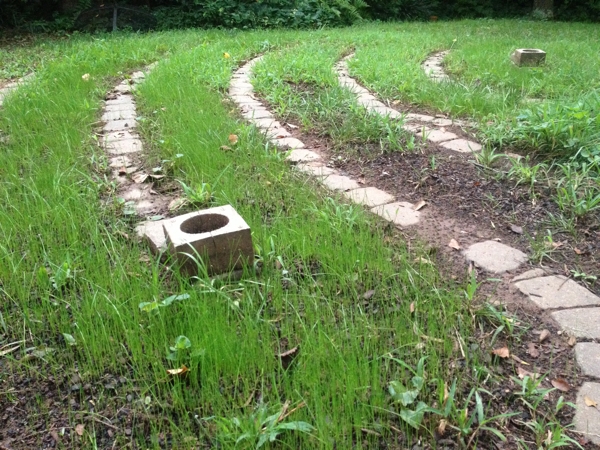
The large problem this summer is that the place is absolutely sodden.  It’s a marsh out there, and the rain does not promise to let up even this week.  It let up enough last Tuesday for me to get out there and reseed it where it was absolutely nothing but bare dirt, and for that the constant rain has been a benefit: barely a week later and tiny little wires of fescue are poking out of the dirt now.

Hardly worth admiring at this point, and it certainly precludes any use of the facility for another couple of weeks.

But there are a few things to admire at this point.  I was out there this afternoon and was delighted to see these:

These are spider lilies, and what is now the labyrinth used to be covered with them.  This was 20 years ago before we added onto the house, and the excavation of the basement dumped three feet of clay onto what had been very luscious soil.  As the link discusses, they pop up out of nowhere, and they’re quite lovely.  I’d love to have more of them return.  Perhaps I should go back to that link and buy some?

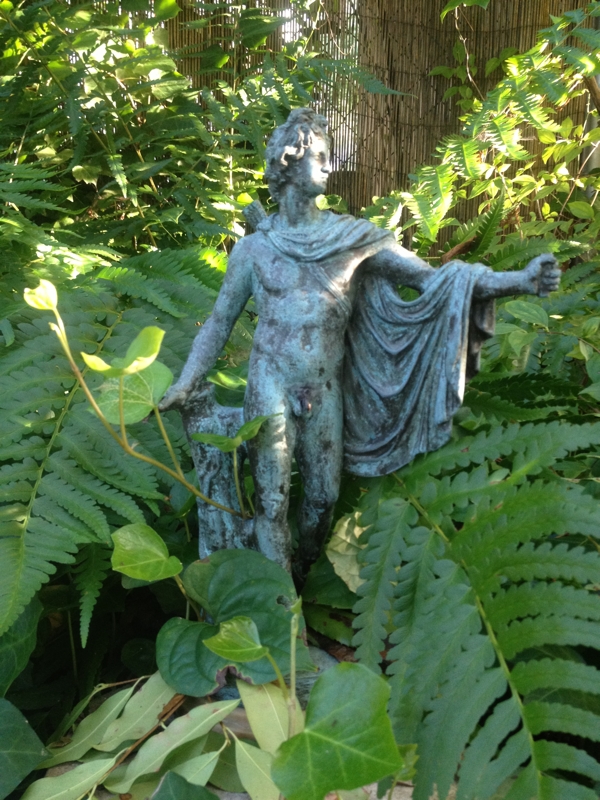
Next to the lilies is our old friend Apollo:

Doesn’t he look radiant in the setting sun?  Those are Dixie Wood Ferns behind him, plus ivy which will be beaten back as soon as I can get back out there.  His patina is real, because he’s really bronze.

His counterpart, the Dancing Faun/Dionsyus:

His corner, downhill from all the rain as it is, definitely needs some cleaning up.  Those are bristle ferns behind him, I think, along with some errant ivy and vinca major.

And finally, the northpoint:

Some tidying to do, but the outgrowth of the peacock fern is exactly what I had planned.  The clusters of tall fescue are kind of nice as well, although for the life of me I can’t understand why it infests the northern bank and won’t grow just one stone over on the path.

With any luck, the rain will begin to clear out this week and I will be able to get back there and really do some maintenance in preparation for the Vernal Equinox.  In the meantime, I need to get out there right now and see if the full moon is at all visible…

(later: It is not.)

The Game of Tiger

Walking around the Magic Square tonight, I witnessed scores of kids playing a game called Manhunt in the deepening evening out on West Lawn.  (Essentially, it’s a land-based version of the swimming game Sharks and Minnows.) I was reminded of the game of Tiger, that I and my siblings invented around 50 years ago (really??) to play in our grandmother’s back yard.

We played it endlessly, from summer dusk until deep night, and it never paled.  Even now, I think I would enjoy a good game if I could keep up with the young.

I came up with the idea after watching some television program about some explorer/adventurer—Lowell Thomas, perhaps?—who was “hunting” tigers in India.  What struck me dumb was the fact that the narrator adventurer was safely ensconced atop an elephant while native beaters went ahead in the waist-high grass, wherein a tiger might very well be lurking.  It might have been a man-eating tiger terrorizing the village, even.  It was damned creepy.

Anyway, the vacant lot down on the corner of Winfield and Dixon had at the time a small field of tall, dry grass, and so we played at the experience.  It was fun, and we soon codified it into a game.

The rules are simple:

  • There is a Home base.  Everyone gathers at Home.
  • One person is the Tiger.  The Tiger goes and hides somewhere on the grounds.  (Strict boundaries must be set, of course.)
  • After a decent amount of time, the rest of us call out, “READY?”
    • If the Tiger is not ready, he simply yells, “NO!” and we wait a little while longer.
    • But if he is ready, there is silence… deadly, deadly silence.
  • Then we all go hunt the Tiger.
  • If you find the Tiger, you yell, “TIGER!”; the tiger springs out with a roar; and you sprint for Home.  So does everyone else, needless to say.
  • The Tiger attempts to tag as many people as he can before they reach Home.
  • The last person tagged becomes the next Tiger.

That’s it, just a simple little reverse Hide and Seek.  But oh, the variations!

The Tiger, for example, is under no obligation to pop out upon being discovered, forcing the hunters to come closer to verify his hiding place.  (Any person who touches Home before the Tiger actually pops out is tagged.)

Nor is the Tiger obligated to remain hidden until someone discovers him, perhaps waiting until all the hunters have passed him by and then springing out between them and Home.  A particularly crafty Tiger might not even hide to begin with, just sneaking around in the gloom until he can spring out behind all the hunters.

As a hunter, you have options.  Sacrificing a little sister is one, for example.  Another is forcing the Tiger to chase you all the way around the house, staying just close enough to make it not effective for him to double back, so that you can dash for Home.  You could, if the Tiger is already guarding home, hide yourself and force him to come looking for you. (Standoffs at Home which dragged on too long could be terminated by majority vote and a subsequent countdown.)

There were five of us, plus any friends we had along for the trip, and so we always had enough to make the game interesting and complex.  Some of us were eager to be the Tiger, mainly because they had evil evil souls.  Others were as scared of hiding in the azaleas as they were of the Tiger itself.  Some hunted in groups, others headed off alone.  Was the location of a “NO!” a clue as to where the Tiger might be, or (remembering the evil evil souls) a deliberate deception?  You can see  how it might be addictive.

All in all, a game worthy of promulgation and preservation.

Another drink, as an apology, in the spirit of the day

It seems that I missed the party at which the young UGA ladies were to be fêted.  Although I was not given a deadline before which I needed to develop the signature cocktail, I nonetheless feel bad.

I have assuaged my guilt by revisiting one of the drinks I explored during the process.  Unfortunately, all I could remember that it was a tequila/pomegranate concoction, i.e., a margarita with pomegranate juice (of which I now had a refrigerator-plenty).  I could have gone in search of it, but overcome by my grief, I just made up a new version.  I’m sure it had a name already but since I had to reimagine the whole thing, I’ve given it a new name.

Srta. Dawg

  • 1-1/2 oz. tequila, your choice, but for the love of Dionysus, don’t use cheap stuff
  • 1 oz. orange brandy, e.g., Grand Marnier
  • 3 oz. cranberry/pomegranate juice
  • black salt
  • lime wedge

Rim the glass with the lime wedge and black salt; dump the wedge into the glass with ice.  Pour all the other stuff into the glass.  Drink.

The combination of the salt and the sweetness of the juice is a very nice touch.

If I choose to make another one—it is Cinco de Mayo, that distinctive American holiday—I’ll take a photo.


A new drink

I was asked recently to come up with a red and black cocktail for an upcoming graduation party, and so I’ve spent a lot of time playing with some interesting and not very appealing combinations.  It devolved into looking at any recipe online that had a picture of a red drink.

However, last night I got down to basics, and here’s my proposed solution:

Ms. Dawg

  • 1 oz. orange brandy, e.g., Grand Marnier
  • 1 oz. cranberry/pomegranate juice
  • 1 tsp. blood orange bitters
  • champagne/prosecco
  • lime
  • black sugar

Take a small slice of lime and juice the rim of a champagne flute.  Rim with black sugar.  Drop the lime slice into the flute.  Add the first three ingredients, then top off with champagne or prosecco.

Some helpful tips: Make your own Grand Marnier. (This is also useful.)  The blood orange bitters is amazingly available at Publix in the mixer section.  I haven’t checked locally, but both Michael’s and Hobby Lobby should carry Wilton Black Sugar.

Other than the black sugar rims making the young ladies at the party look awfully Goth, it should be a hit.


Marriage equality and language

With the gay marriage debate all over but the tossing of the bouquet, I have begun to wonder about language: how will it change to adapt and codify the new reality?

We went through the same kind of thing back when couples started living together instead of getting married at all: is she your “girlfriend”? “Roommate”? I had one friend in college who insisted on introducing her boyfriend as her LOVER, said practically exactly like that. It made me giggle then, and it still does. (She still introduces James as her lover, forty years later.)

Most of society has settled for “partner,” and in fact gay couples have benefitted from that so far.  But now we’re talking matrimony, and “partner” has already been codified as “unmarried sexytime person,” so that won’t really do. (Side note: when someone I don’t know well talks to me about their partner, there is always that slippery moment when I listen extra sharp to establish context: is he telling me he’s gay and in a committed relationship, or is he talking about the guy with whom he owns and operates the Harley-Davidson franchise?) (Or both?)

I brought up the topic last night in a discussion, and my lovely first wife promptly epitomized the problem by framing it as, “Which one’s the husband and which one’s the wife?”

That lays bare rather explicitly our sexual assumptions about it all, doesn’t it? It seems to me, I offered, that the first step is to disconnect what goes on in the bedroom (or at least our curiosity about it) from the terms we use in invitations, announcements, and office chitchat. It is not necessary for one person to be the “husband” and one the “wife” in a marriage, if by that we mean fulfilling traditional sexual roles.

We already have a useful term, of course, in “spouse.” Just like “partner,” it wouldn’t be hard for society to begin to prefer the gender-neutral term, but I suspect that for quite a while yet, we’re all still going to be curious about which flavor spouse we’ve invited to dinner.

Using “spouse” as a society would also help us reign in those who might insist on flaunting their sexytimes, which is not in good taste no matter who you are. A same-sex couple who insist on being called “husband” and “wife” are dragging the terms right back into traditional sex role territory that we should be glad to escape. We get it: you’re having sex. What no one wants to know (about any relationship) is the nature of the sex you’re having. It would be like a straight couple insisting on being referred to as “mistress” and “slave” outside the confines of their bedroom. What would the Dowager Countess say?

Not only that, but that way madness lies: if Joe tells me all about what he and his wife did over the weekend, and then Joe’s wife turns out to be a barrel-chested lumberjack, I think I am right to declare shenanigans. There’s also then the spectacle of two men claiming each other as “wife,” and on and on. Too much granularity when all we really need to know is whether you’re living with someone as partner or spouse, and if so, what gender they are just so we can be polite whenever we’re chatting about the weekend.

My prediction is that for a long while we’ll call all men who get married “grooms” and “husbands,” and women will be “brides” and “wives,” alternating with “spouse” when it feels right. Of course, it will all get easier over time: we will already know that Joe is married to Brett, or that Susan has a girlfriend, or who Dale means when he refers to his lovely first wife.

And eventually, we’ll simply ask our new coworker if he’s married and if the answer is yes, then, “Why don’t you ask your spouse to join us for drinks Friday afternoon?” without wondering in the least which flavor is going to show up at Alamo Jack’s.

Late Stage Capitalism

A couple of weeks ago, we were out to dine with some friends in a downtown Atlanta hotel restaurant. As we were leaving, I made a pit stop in anticipation of the drive home, and in the men’s room one of the urinals was dead.

I knew it was dead because it had been bagged and tagged. And on the great big red bag, in great big letters was johnnycovers.com.

Go ahead, I’ll wait.

Yes, that’s a thing. Do we live in a great nation or what?

That’s it. I don’t really have anything more to say about it.

A cool Christmas gift

I have two favorite Christmas gifts this year.  One, from my lovely first wife, is a simple brass bowl, a singing bowl from Tibet. Nothing to look at, but when you strike it the tone resonates for a full 1:50 minutes—probably longer if you were truly listening in a quiet room.  It’s astounding.

The other is at the opposite end of the spiritual scale:

Behold! the ice cube of my dreams!

My son gave me a silicone ice cube tray that makes ice cubes that are two inches on a side.  Other than being just hipster-awful, they are a gift from the gods.  I think all right-thinking people would agree that if we were able to identify the individual who invented half-moon ice “cube” makers for refrigerators, no grand jury would indict us for whatever violence we inflicted on him once we dragged him out of his house and through the streets.  Nasty, awful things that block the flow of tissue-restoring fluids from the glass to your throat—truly a crime against civilisation.

But these… They are majestic in their grand simplicity.  One drink, one cube: less dilution, perfect chill, and no blockage of life-giving liquids, ever.  Truly, a wise child to give so marvelous a gift.

The Hobbit

I went to see The Hobbit, and it was everything I thought it was going to be: a beautifully designed but completely overblown piece of self-indulgence on the part of Peter Jackson.  As soon as it was announced that Jackson had assumed directing duties and that the movie would now be in three parts, I knew what we were in for, and indeed, that’s exactly what we got.

There’s this idea out there that Jackson is a natural “story teller” of some kind, but nothing I’ve seen in LOTR or in The Hobbit (or God help us, King Kong) indicates anything but that he is completely unable to resist stopping the plot cold while he shows off his cleverness in some ludicrous “action” sequence.

Two thoughts on the matter: after The Return of the King won the Oscar—after—Jackson went back and shot that stupid skull avalanche in the Paths of the Dead.  Note: he didn’t edit it back into the film from the cutting room floor, he called the actors and the crew back to New Zesland, shot it, and inserted it, a scene that adds nothing to the plot or the characters, nothing to the mood of the sequence, nothing to the film.  It was the very definition of completely unnecessary “whizbang/stupid,” and that’s the sum of my impression of Peter Jackson’s vaunted ability to tell a story.

Second thought: the dwarves’ escape from Goblin Town is ten minutes of video game/pinball excess—fourteen tiny figures fleeing across rickety bridges, collapsing paths, etc. etc.  Their progress is hardly impeded as the camera swoops over, around, and through the cavernous space.  (I can only imagine the thing in 48 fps/3D… oy.)  Thousands of goblins/orcs swarm over everything, yet never seem to have the least effect on the outcome.  In fact, nothing has an effect on the outcome; by the end of the sequence, not one thing has changed.  It’s one big messy nothing-burger.  (Cf.: the collapsing stone arch in Moria…)

Compare this to the Escape from the Death Star: four different groups of characters who are all trying to get back to the Millennium Falcon without getting caught.  There’s suspense, action, and all of it is wrapped up in plot: rescue the princess, shut down the tractor beam, get the Death Star plans to the rebels.  Once we hit hyperspace on the way to Yavin, things are different than they were ten minutes earlier.

But Dale, you will object, a) the Goblin Town sequence had no such built-in plot point; and b) Lucas was working without the benefit of the technology we have now.

My point exactly: a) no plot point to drive?  Then skip it.  Give us a workman-like “flight through tunnels” with some twists, perhaps ending with one last bit of swordplay at the back gate (which, quite curiously, Jackson decided to leave completely unguarded)—and get them out of there.  Maybe take the time to give us some dwarf banter that might help define which one of those beings we’re supposed to know and like.

And b), that’s the mark of a “story teller,” isn’t it?  To use that amazing technology in service to the story—that’s the trick.  Peter Jackson seems unable to do that.  I have dire fears for the next six hours of this movie.  What do you want to bet that Bilbo’s cleverness in smuggling the dwarves out of Thranduil’s halls in barrels will be jettisoned in favor of yet another whizbang/stupid fight sequence?

As for Parts II and III, I intend to enjoy them—but only with a fast-forward remote in my hand.