Random items

No work on Seven Dreams today, but I have to mention how much fun Scott Wilkerson’s text is to work with!  It bodes well for the enterprise.  (It also bodes well that he has not complained or even mentioned that I cut about six lines from the “Fly and fall” text…)

A couple of weeks ago a bunch of us were sitting by the fire out in the labyrinth and there was a rustling behind us up on the patio level.  I assumed it was one of the small set of feral cats that flit in and out of our lives, but when we turned to look it was a fully grown raccoon ambling across the yard.

“Oh hai,” it said, apparently surprised that four or five adult humans were sitting by a fire fifteen feet away, and fled.

Since a rabid raccoon had been picked up in the city recently, it was determined by some of our company that I should call the Animal Warden and have her set a trap.  I pointed out that the animal appeared to be perfectly healthy—if a bit absent-minded—and I was loath to depredate the biome like that.

But I did as I was told, and on Monday afternoon I went out to the labyrinth to read and write some letters, and there was a trap in the southwestern corner of the labyrinth.  There was also a cat in it.

It was of course not the one feral cat we’d like to trap and neuter.  This was a youngish feline, one I had not seen before, reddish shorthair, slightly Abyssinian in its aspect.  It was not happy to see me, although it was willing to sit peaceably as long as I didn’t get too close.

This was a dilemma.  I formed the opinion that this was someone’s pet—it didn’t have the clipped ear of a neutered-and-released animal— and I was very unwilling to turn it over the Warden.  What to do?

Fortunately for all of us—myself, the Warden, and the cat—late that night, after the Lichtenbergians had left and I had just finished walking the labyrinth, I heard in the distance a woman calling her kitty—and the animal in question answered most piteously.  It wanted to go home.

So that was that.  I got my glasses and the phone (for a flashlight) and opened the trap.  The cat streaked out of the labyrinth, over every intervening fence in its way, and was gone.  Freedom!

I called the Animal Warden—the fabulous Cyndi Hoffman—and left a message explaining why she would find the trap sprung but empty.  Late this morning (Wednesday) I thought I should check to see if we had caught any more cats.

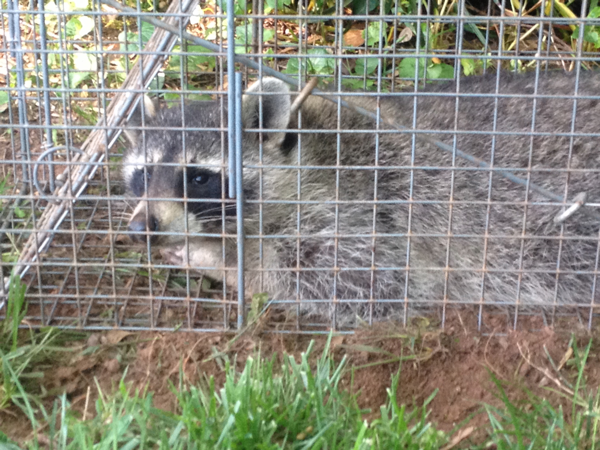
We had not:
rocky

Adorable, isn’t he/she?  Except when you approach the cage and it snaps at you.  It was willing to sniff at a proffered knuckle, but then snapped at that, too.  It did, however, eat the kitty treats I dropped in there, while Monday’s cat would not lower herself to eat such stuff.  Well, they were old.  This disdain of stale kitty bits was another reason I thought she was someone’s pet.   Wild carnivores are not so picky.

Soon, Warden Hoffman arrived and, after I made sure it was not a nursing mother, took the beast away to relocate its adorable ass.

I would like to state for the record that I have no objection at all to peaceful coexistence with wild life, even curious things like raccoons who tend to turn things over and misplace items in the labyrinth when I’m not looking.  But I did as I was instructed and must assume that all is right with the world again.

I did work on “Your Beauty” this morning and I think I’ve made a lot of progress.  We’ll see.  I’m not posting it because you’ve heard the pretty part already, and the part I’m working on now is so inchoate that hearing the computer version would make no sense at all.  I’m pretty sure Finale will let you at some point tell it exactly how/when/how much to speed up a beat, but I’ve never done it.  So before you hear the whole piece—once it’s finished—I will have to explore that.  Otherwise, it’s this stream of stupid-sounding eighth notes that just plop along.  It really needs human interpretation.
Seven Dreams: Dream One, “Fly and Fall”

Well, there’s one small part of Seven Dreams of Falling completed: Daedalus’s first number, “Fly and Fall.”

As you will recall—and if you don’t, go back and read the previous couple of posts—Daedalus is setting forth the idea that the annual Event, i.e., Icarus’s flight and fall, is a ritual both good and necessary.  It is “the story of us all,” as all good myth should be.

Some slight changes in the main body, but unless you were bugged by something and want to go back to hear if I fixed it, you can pick up the mp3 at 2:30 to hear the changed cadence from yesterday (as promised) and the thrilling conclusion of the section.

I will say that I have now done to Daedalus what I have issues with in many modern operas: there’s not a place for the audience to applaud.  The piece ends softly and will segue into Icarus himself, “Dream One,” so no applause for poor Daedalus.  I’ll make it up to him later in the opera.  After all, Icarus gets seven arias.

Dream One, “Fly and Fall” | score (pdf) | mp3

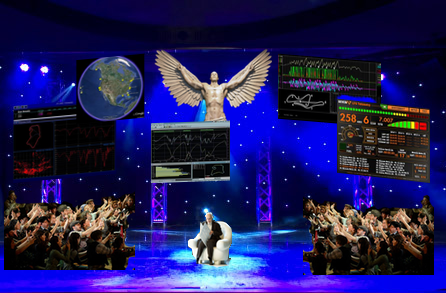
I have to say that I think this is pretty good stuff.  Here’s a slammed together idea of what I think is going on onstage:

I’ve also started a page for Seven Dreams so we can keep up with finished music.

update: I have a proposed solution to the applause problem: just bring the chorus back in for one more big “Fly and fall!” and wrap it up with a stinger.  We can come back in after the applause as the spotlight focuses on Icarus for his aria.  Compare the last 10 seconds of the above mp3 to this:

“Fly and fall” applause ending: score (pdf) | mp3

Express your preference in comments.

Seven Dreams: Dream One

Whattaya know…  Another day of 2-3 on the LSCA!

I had thought I might just fart around with unplanned/unattached melodies and harmonies, but I went back to the idea of working on the rest of Daedalus’s entrance in Dream One.  And that’s what I did.

Those who are keeping track of my compositional style might be surprised at the simplicity of the harmonies of this section.  It seems a throwback, I know, but I’ve decided that the opening will be relatively uncomplicated as they introduce the idea of myth and its supreme value.  Trust me, when we segue into Icarus’s actual dream in another few measures, there will be enough interesting harmonies to do you.

The first bit of this section is quasi-recitative, blossoming forth with the previously heard aria, then (new part) retreating again before the chorus joins in.

The usual abrupt ending, which I’m pretty sure is going to get a new tonality before heading into the final bit of this section.  Simplicity is one thing; cheesiness is altogether something else.

Dream One: Daedalus | score (pdf) | mp3

Seven Dreams: an abortive attempt

Here’s today’s abortive attempt.

I took the notes of our 12-tone row and splattered them in a descending cascade from the top of the orchestra to the bottom. I thought it might be a good stab at an opening to the show.

It’s not a sure thing: mp3

At the very least, it sounds sparse; that could be fixed with judicious tinkering.  This was after all just a splatter, not meant to be a finished product.

However, and this will probably seem odd, the last three notes—the ones that outline a V7 chord—simply sound too pat. I’m all about the tonality, but that cadence just made me wrinkle my lip.

Oh well, that’s the purpose of abortive attempts, ne-c’est pas?

Back to Tibbetts’ song.

Seven Dreams: a motif

A third thing I’m playing with for the opening of Seven Dreams of Falling is motifs, and the first motif is one that I used in Six Preludes (no fugues) for “Prelude (no fugue) No. 6.”

I got this from Sid Lonegren’s Labyrinths: ancient myths and modern uses (p. 139). He takes an eleven-circuit labyrinth:

an 11-circuit labyrinth

…and labels the circuits with the notes of the chromatic scale, starting with A on the outside circuit and ending with G# at the center.  When you walk the path, you encounter the notes in the order C# – A# – B – C – A – D – G – E – F – F# – D# – G#, which I have transposed down a half-step for the above motif.

It is of course a 12-tone row of serial music infamy, but when you play it there’s a definite tonal, if chromatic, pattern to it.  I mean, look at the penultimate measure: it outlines a V7 chord, of all things, leading straight back to our tonic note.  You may hear it in the “Prelude (no fugue) No. 6” here.

So I’m thinking it would be a valid thing to use this motif as a major element in an opera that centers in part on a labyrinth (technically a maze[1]).  The question will be how to do so.  (I’m already thinking about stealing incorporating some of the prelude.)

—————

[1] A labyrinth is unicursal: it has only one path to the center.  You cannot get lost in a labyrinth.  A maze is a puzzle; you would need Ariadne’s thread to get back out.

Seven Dreams, opening attempt

I’ve decided to be a badass composer and post my failures here as well as my successes.  (Wait, he thinks he’s had successes?)

Today I thought I would whack out a grand baroque chorus to open the show with, and I did but it doesn’t really work. However, the best way to get good work is to crank out the bad work, at least for me.  I can hear what doesn’t work and move on from there.  (For those who are new to my whinging composer posts, I start a file called “abortive attempts” and futz around in that before committing to a real score.)

So what doesn’t work about this?  It’s too rushed, not spacious enough. The text needs more breathing room.  It needs to sound more like the opening to this opera, and that means more tension, even in the pure tonalities of unexamined myth.

When finished, the text and the music will move on to a B-section, with the piccolo trumpet diddling little triplet figures, before returning to the big theme.  That will segue into the Zadok figures from yesterday, and Daedalus will have a quasi-recitative section before breaking into yesterday’s bit.

There are also some harmonic things that I thought might throw us off balance in a good way but don’t quite hit the mark.

In any case, it gives the flavor of what I’m going for.

score (pdf) | mp3

In other news, I avoided working on John Tibbetts’ song another day.

update: already improved it; will start completely over tomorrow nonetheless

Seven Dreams of Falling, Dream One

As most people who have to listen to me face-to-face know, I have recently accepted a “handshake commission,” i.e., no one is handing money over to anyone else, to write the score to Carey Scott Wilkerson’s Seven Dreams of Falling.  We were introduced by a mutual friend who hoped we would find such a collaboration fruitful and enjoyable, and indeed we hit it off right away.

Scott and I have been communicating for about a month now discussing how to turn his quirky little post-modern play into an opera, and we’ve made some good progress.  However, I haven’t really thought about actually writing any music yet.

Until today.  Or rather, last night, when my body and my brain conspired to keep me from sleeping, and one thing that kept running through my head was music for part of the opening scene, “Dream One.”  So this afternoon I thought, well, why not see if it actually comes out of my head?

On the LSCA, this tiny bit was between 2 and 3, so yea me!

Quick synopsis: Icarus’ flight and fall has become an annual event, webcast, pay-per-view.  His father Daedalus manages all the technical aspects.  Theseus has become their publicist while still managing his own annual myth, that of killing the Minotaur.  Ariadne has settled into embittered sniping; she runs a feminist blog and podcast.  The Minotaur—well, let’s talk about him later.  As the show progresses, Icarus decides he wants out of the myth, wanting to find life for himself.  Etc.

In Dream One, we open with a grand baroque chorus as the populace watches the Event on their iPads and phones.  We shift from the Chorus to Daedalus, and he sings of his son and the pride he feels in their continuing their myth for the benefit of the world.  That’s the part I wrote today, when the music shifts from piccolo trumpet and chorus to a Zadok-the-Priest-like figure in the strings and Daedalus steps into the spotlight.

So here are the very first notes written of the fabulous new opera, Seven Dreams of Falling, by Dale Lyles and C. Scott Wilkerson.  I should note that I decided to start with a piano score, which I will have to have anyway for rehearsals.  Those who remember the sometimes astonishing changes the William Blake’s Inn score underwent during orchestration may already hear timpani and chimes in the future.

score (pdf) | mp3

Your Beauty

I have debated about blogging about “Your Beauty,” the art song I’m struggling with for John Tibbetts, but I think I will.

I’ve spent about ten days whacking around notes in my music notebook, which is unusual for me.  I usually open a Finale file and play around there. In fact, I have a Finale file already created called “tibbetts abortive attempts,” and it’s got some real dead ends in it.

But I thought I would force myself to play on paper/keyboard instead of the screen, in the hopes that it would broaden my abilities to hear the music in my head and get it into the Real World more easily.

Amazingly, it did not.  I got three pages of scribblings, none of which seemed inspired to me, and so this morning I thought I would input some of it into Finale to see what it sounded like if it weren’t being stumbled over by my fingers.  It wasn’t excellent.

So I just noodled about a bit, and lo! there was the opening.  Simple, yearning, with potential for more.  We’re going to push on from there, and I don’t know how much I’m going to go back to the notebook as a tool.  It doesn’t seem to work for me.

Here are the first 21 measures of “Your Beauty”: mp3

Remember, the last part of anything that I put up while I’m working on it sucks.

Apology for no posting

I didn’t post yesterday because I was doing the State STAR Student selection committee thing all day and all night—such a great time with great kids!  About half of them were GHP alums, and in fact the State STAR was from last summer.

She proceeded to send me a lovely note on Facebook about how much the program had meant to her in general and me in particular.  She took a great many of my seminars, and the one on Licthenbergianism she said had a profound impact on her.  So the idea that I’m cut off from that part of life made me very sad.

And then today is Shakespeare’s 450th birthday, and I’ve been out in the labyrinth all afternoon getting ready for that.

So no blog post yesterday or today. Sorry.

A Lesson for Peter Jackson

In which I continue to guide and correct filmmaker Peter Jackson

The other night, we were watching nothing on television.  I left the room to get a snack, and when I returned, Cartoon Network was showing The Wizard of Oz.  We settled in, despite the fact that it would have painful commercials and we own the 75th anniversary DVD.  But the DVD was downstairs, and we were not so energetic as to retrieve it and then watch it from the very beginning.

Dorothy and company had reached Oz’s great hall and were making their requests, and then we were off to the West. As I admired the craftsmanship of the moviemaking, I felt curmudgeonly enough to comment that it had all been done without a stroke of CGI.  Matte painting, of course, but there was nothing that was not present in our physical world in that movie.

The scene which prompted this get-off-my-lawn remark was the climb up the crag by the Lion, Tin Man, and Scarecrow, following Toto back to the Witch’s castle.  Like Sam, Frodo, and Gollum’s climb to Cirith Ungol, the set is a simple plaster mountain, backed by fake landscapes.  However, it occurred to me that we didn’t get swooping camera shots showing us the vertiginous peril our heroes found themselves in (despite the fact that director Victor Fleming was addicted to boom-shots: remember the Confederate wounded at the depot in Gone With the Wind?); nor did we have to deal with someone falling and having to be rescued; nor did we have to suffer the Lion abandoning the quest only to return at the last minute on top of the castle.

You see where I’m going with this.

No, it was all very business-like: our heroes are risking their necks to climb that crag—we’re not even shown a scene where they have to decide to climb instead of using the road—there’s the “I hope your tail holds out” gag, and ta-da!  We’re hiding out somewhere over the entrance to the castle.

It didn’t take much for me to imagine what the sequence would have looked like in the hands of Peter Jackson.  Besides the aforementioned swooping, fake rescuing, and cowardly betrayal, we would also have had to endure an extended fight sequence with the Winkie guards when they jumped the Tin Man and Scarecrow.  There probably would have been hundreds of guards in the marching sequence, not to mention interminable CGI shots of the castle.  The charming detail of the Lion’s tail swishing through his guard’s coat would be gone, of course, since he would have fled way back on the crag.

Then, with a shudder, I thought of the other scenes that would be completely bloated and overblown: the flying monkeys attacking the heroes in the forest; the entrance to the forest—who knows what other perils they would have had to fight their way through before being attacked by flying monkeys?; the actual rescue of Dorothy from the room; and sweet Cthulhu! the chase around the parapets.  And that’s just in the second movie, Oz: The Desolation of the West.

And for what?  The story would not have been advanced one bit by any of this.  We would end up exactly where we were to begin with.  The mood would not be enhanced: hello, “flying monkeys” is already universal code for creepy/scary/terrifying.  (Sorry, Once Upon a Time, making their bites infectious doesn’t up the ante.)

So, Peter Jackson, go back and watch The Wizard of Oz.  Make your notes, give rein to your wildest impulses, flesh that sucker out.  Now go to a nice, quiet place and study why The Wizard of Oz is a great movie.  Look at your impulses and compare them to truly great movie-making.  Then figure out how to make part three of The Hobbit ninety minutes long.  You’ll be doing the world a favor.

For those who think I’m being too tough on poor Peter, here’s a thought experiment.  Suppose it were announced tomorrow that Peter Jackson was doing a remake of The Wizard of Oz.  (You may make casting suggestions in the comments.)  Can you doubt that it would be in two parts, and that all these concise scenes would now be action sequences lasting at least 15 minutes each (25 for the climactic chase around the castle)?

Would you want to see that movie?

(I do however want to see your suggestions for Peter Jackson’s version of The Wizard of Oz in comments.)
