Summer Countdown: Day 32

Lichtenbergian goals

I checked the range of the former viola part in its new habitat of third violin (in Waltz: Allegro gracioso). Fortunately, there’s a tool that does that for you, not only identifying notes that are out range of the selected instrument but offering to move each one up an octave (or to wherever else you like). It took no time at all.

Upon repeated listening, I think I can actually strip out a great deal of the piano’s doubling of the viola part. That doesn’t leave the piano with a lot to do, but what it does is critical. And I think the bass drum part can be assumed by the timpani altogether. The tempo as I have it set now may be a little too fast as well. Ah well, it all has to reach performance first anyway.

I emailed Wallace Galbraith with the link to the AFO page here, and explained more of what I had in mind for each one. Then I went on to Facebook and posted a link to yesterday’s post and invited everyone to come vote on their favorite. So far, it’s pretty much an even split between Rondo and Waltz, with Resignation coming in third. I am a bit surprised at how popular Rondo is, given its completely fragmentary status.

Lichtenbergian distractions

As predicted, the Artist Trading Card project is a complete time sink. I love it. I created four cards and all the packaging that goes with the mailing back and forth. To me, part of the fun of the project is the total look and feel I’ve come up with; I’ve turned it into a “thing.” You’ll see what I mean when your chance arrives in the mail. I could just use plain #10 envelopes, after all, but where’s the fun in that?

Speaking of which, I mailed off two ATC packages yesterday. I’ll announce tomorrow who’s getting them.

At the moment, my cards are tending toward dadaistic collage, although I may inject a figural study in there every now and then. I’m afraid the first four are not very well thought out. I was excited to get them out the door and so made them in a rush of energy if not creativity. Sorry guys. I’m doing better on this next set.
Vote early, and vote often

I have actually accomplished one of my goals for the summer: to create five sketches for the piece I’ve been asked to write for the Ayrshire Fiddle Orchestra. Let’s have some fun with it. Even though the AFO’s conductor, Wallace Galbraith, will obviously make the decision as to which , if any , of the sketches he wants me to complete, let’s take a vote.

In comments, vote on your favorite, or discuss why they all suck.

Vibes

This sketch is based on a piece generated by Marc Honea, playing with algorithms and synthesizers. Includes a glockenspiel.

score | mp3 (0:41)

The Labyrinth in Snow

A simple, Romantic-style work, featuring solo violin, cello, and piano

score | mp3 (0:42)

Resignation

This will be a theme and variation, based on the hymn tune Resignation, best known as “My Shepherd Will Supply My Need” , this is just the opening of the statement of the theme

score | mp3 (0:54)

Rondo Mobile

I wanted to try something closer to the AFO’s “house style” of fiddly-bits kind of fiddling, but not quite folk dance. The opening theme will return to home base repeatedly after going very astray, which it does almost immediately. This fragment is the least developed of them all. The eventual piece would be the wittiest, almost PDQ Bachian in its determination to fall apart.

score | mp3 (0:32)

Waltz: Allegro gracioso

This is an arrangement of the third movement of my Symphony in G, the only movement I’ve completed so far. Includes timpani & bass drum (playable by one percussionist) and piano.

score | mp3 (3:54)

Summer Countdown: Day 33

Alas, my Art Camp has been postponed. Diane is having work done on her cabin, and apparently her workers have told her that the entire thing has to be jacked up to do repairs on the floor. We will reschedule for July sometime.

Lichtenbergian goals:

I finished arranging the Waltz, except for checking the range of some of the viola notes in their new violin habitat. I think it sounds OK.

Lichtenbergian distractions:

I went on a road trip to Sam Flax in Atlanta for some paints in colors I did not have and need , it’s easier to paint grass if you have the right shades of green to begin with , a bigger portfolio to hold the largish studies I’ve been doing, a new watercolor pad in said larger size, a new sketchbook, also larger than the one I’m about to fill up.

I also bought a circle guide, a thingie for you to use to draw perfect circles. The book about drawing faces that I’m using insists that one is necessary for irises and pupils. I also bought a new jar of absorbent ground, the white stuff you paint on board for a base for the painting. With oils, you use gesso, but I learned from the helpful staff there one day that gesso repels water-based paints, so gouache wouldn’t actually work on gesso. Now I have them tracking down a quart size.

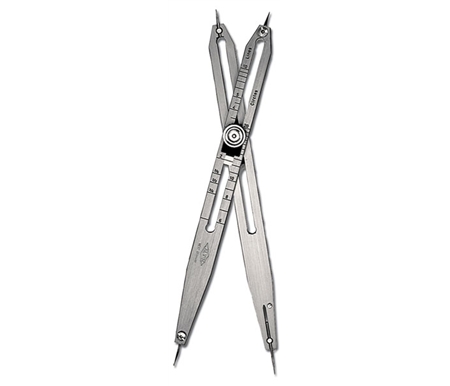
I wanted to buy a proportional divider. What is a proportional divider, you ask? It looks like this:

You use them in double-checking distances between your reference photo and your drawing, i.e., the distance between your subject’s pupils is a in your photo, and should be b on your drawing.

I looked all over but could not find one. Finally a helpful staff member showed me where they were: under lock and key in a case, because they are actually precision instruments costing $150 and up. I did not buy one. (However, in looking for that image just now, I came across a perfectly good wooden one designed for artists that’s only $30.)

And then, I came across an incredible Lichtenbergian distraction: Artist Trading Cards. This is so amazing that I have given it its own blogpost below.

Finally, I’m not sure whether this is a distraction or a goal. MakeMusic, Inc., who makes Finale, is sponsoring a new composition competition with the American Composers Form, of which I am a member. I think I’m going to go for it.

Summer Countdown: Day 34

A semi-productive day. I began arranging the Allegro gracioso from the Symphony in G for the Ayrshire Fiddle Orchestra. That sounds very productive, but I will confess that all I did was copy and paste the parts for the first and second violins, the celli and basses, and the percussion. I was very lazy and did not address the viola part and how I was going to transfer that to a group that doesn’t have violas, nor exactly where the piano would fill in some of the gaps left by the winds and brass instruments in the original.

I also painted a birthday card for Nancy Willard, whose birthday is Saturday, the same as Grayson’s. I’m going to count that because it was a painting of the labyrinth, and I actually did a good job with it. Consider it a study for the ELP, which naturally is set in the labyrinth.

Art & Fear: 6

The fear that you’re only pretending to do art is the (readily predictable) consequence of doubting your own artistic credentials. [p. 24]

Impostor syndrome, anyone?

Longtime readers of this blog will recall my incessant whining about my lack of formal training in music, despite the fact that I can create works like William Blake’s Inn or Pieces for Bassoon & String Quartet or “Sir Christémas.” I don’t do that whining any more, even though I know I am entirely outclassed in the music theory department by every “real” musician I know. Why worry about it? I’ve decided that if I’m ever sitting in on a rehearsal of one of my works, and the conductor turns to ask, “Did you really mean to write a G minor 13th chord here?”, I will cheerfully and honestly reply, “I have no idea what you’re talking about. It sounds like I want it to sound, though.” Or perhaps, like Anton Bruckner, just happily agree to let him “fix” it.

As the authors of Art & Fear go on to say, “After all, someone has to do your work, and you’re the closest person around.” If I’m able to get it out the door, why should I care that I don’t have the training that any music undergrad (or garage band songwriter, for that matter) has? He didn’t write the piece, I did. My only gripe about my lack of training is that I would be a lot faster at what I do if I had that knowledge, but even that, I’ve decided, is irrelevant.

In recent discussions with my friend/guru Craig, the idea of Asking Permission has surfaced repeatedly. He keeps asking what I mean by that, and I have to confess I’m not really sure why this keeps nagging at me. As Craig asks, “Asking Permission of whom? And for what?”

I think it may be related to this concept of Pretending, the idea that I’m not really supposed to be doing any of the things I do. As a “composer,” I used to feel very strongly that people who had made music the focus of their lives were at best tolerating my presence in their temple, and at worst sniffing, “Who let him in?” I’m all better now, thank you, but clearly that sense of needing permission to be there is still rattling around in there somewhere.

This is enormously ironic, because my role in the arts community in Newnan has always been that of the Permission Giver. I was the one who gave everyone else Permission to try anything they wanted, either in explicit terms (“Or course you can direct Godot, Jeff. Why not?”) or implicitly: as Jen, the Equity actress who played Hermione in Winter’s Tale said to me at the cast party, surveying all those happy amateurs, “They don’t know they’re not supposed to be able to do this, do they?”

The answers to Craig’s questions, of course, must be, “Of myself. And for whatever it is I want to do.” More work is required.

Summer Countdown: Day 35

Productive, that’s what I was.

I established a page on this blog as a repository for permanent material related to my piece for the Ayrshire Fiddle Orchestra, and posted the two sketches I had already created, Vibes and The Labyrinth in Snow.

Then I turned around and created two new fragmentary sketches: Resignation and Rondo Mobile.

Resignation is based on the hymn tune most commonly associated with “My Shepherd Will Supply My Need.” I’ve always loved Virgil Thomson’s choral arrangement of the hymn, and in casting about for something that would come close to Wallace Galbraith’s suggestion that I write “music with its roots in your part of the world,” I was reminded of it.

It’s a gorgeous melody, and all I really need to do is voice it. But I’m going to try to gild the lily by taking it into interesting variations and harmonies. We’ll see.

The Rondo Mobile came about as I tried to come up with something that was close to the AFO’s “house style,” which is largely traditional Scottish/Celtic folk/dance music: stolid harmonies, “fiddly” arpeggiations, etc. I didn’t want to write a dance, but something more “arty” that used skills they already had. A rondo, of course, is a piece with a theme that repeatedly returns after contrasting themes, ABACADA, etc. Mine has a perpetuum mobile ‘A’ theme, and my plan is to send it off the rails, further and further each time, before returning to its simple-minded patter.

I want to do one more sketch before turning them over to Wallace for evaluation. What does everyone think about trying to arrange the third movement, the Allegro gracioso of the Symphony in G? I’d probably have to include a piano with this one to fill in some of the non-string textures, and it would be better if we could have a bass drum and tympani on the side.

Oh, and I also squeezed out two or three more drawings.

Art & Fear: 5

More thoughts on the idea that each choice you make , each brushtroke, each sentence, each musical phrase , limits your final product.

Of course it’s true in the simplest sense. If I start with a big slap of red paint in the middle of the paper, I know that I’m never getting rid of it. Red just doesn’t go away. If I start with a musical idea, that idea already has determined whether I can write a sonata or a fugue.

(When Shostakovich was a student, he was assigned a fugue statement as an exercise. He worked all night on the counterpoint but could only cobble together something he knew was “wrong” in the academic sense. When he turned it in the next day, he discovered why he had had problems: he had copied the phrase incorrectly, with one note wrong. Such is the rigor of the fugue.)

However, I have found that when I’m working on my music, these “wrong turns” don’t often happen. I’m such a formalist that I generally have a roadmap to guide me, and even though I may find the going tough, I have a picture in my head of what the piece should be when I’m done.

In fact, that’s my main working method on larger pieces: listen to the playback obsessively and check for what’s “missing.” It may be the accompaniment to the melody is wrong, or the shift from one motive to another is clumsy, or sometimes it just needs more cowbell.

It is a comfort to me that this is how Beethoven worked. Mozart may have written his symphonies down straight out of his head, but Beethoven erased and scratched out more than he published. He rewrote the opening of his Fifth eight times before he got it “right.” So that’s why it doesn’t bother me to have a music piece that won’t yield up its secrets. I know that I just have to keep working.

It occurs to me too that composing is very different in that regard from painting. My painting so far is littered with abandoned works, stuff that I just can’t see a way forward on. My music, not so much. Only the Symphony in G, and nothing prevents me from picking it up again and jerking it into shape.

Art & Fear: 3

Art & Fear does suggest a remedy for the problem of destination for your work:

A. Make friends with others who make art, and share your in-progress work with each other frequently.
B. Learn to think of [A], rather than the Museum of Modern Art, as the destination of your work. [p. 12]

And that exactly is what I have in the Lichtenbergian Society: a group of creative men who joke about their procrastinatory proclivities, but who are in fact a vibrant core of collaborators. The fact that we gather at the Winter Solstice to record our artistic goals for the following year, and to confess progress, or not, on the previous year’s goals is enough to make them my [A].

But of course we gather throughout the year, and many times the question arises, “What are you working on?” We don’t exactly trot out our work and pass it around like the Inklings did, although I do show some of my paintings, but just the opportunity to talk about our work is enough. We also have our blog to share on, and I usually post any music in progress on my blog.

I guess I’ve solved the [A]/[B] problem for my painting. After all, most of what I’m working on in that regard is for the Lichtenbergians anyway. It’s with my music that I haven’t solved the [B] aspect quite yet. It would help if the Lichtenbergians could play in a string quartet. Lousy slackers.

Art & Fear: 2

And artists quit when they lose the destination for their work, for the place their work belongs. [p. 9]

Longtime readers of this blog will remember the creative crisis precipitated by the decision of my friend Stephen Czarkowski’s not to return to GHP in the summer of 2008. He had asked me to try my hand at writing a symphony for the orchestra, and I had reached a point of having finished (i.e., stopped) the third movement and being stuck with the final movement when the news reached me. (The first two movements never got written.)

For most of my creative life, I have been guarded in my output. I am not a fast composer; I have to struggle for everything I write. And so it has almost never made sense for me to attempt to write something that I know will never be performed. A full-scale symphony? Who would play it?

So Stephen’s offer was a gift from the heavens. If I wrote it, they would perform it. I could write without holding back. In fact, having heard Stephen conduct GHP students in playing Strauss’s Death & Transfiguration, I figured there was nothing that came out of my head which would pose any difficulties whatsoever. The news that it would not be performed that summer was like hitting a brick wall. It meant that it would never be performed.

Whoever the new strings person was (and it turned out to be a former GHP student of mine), I would be his boss and not his friend: I could not ask him to devote so much class time to the performance of my piece without a very real appearance of impropriety.

It was more than a year before I wrote another note of music. The 24 Hour Challenge was an effort to move myself out of that dreadful stasis, and I think it succeeded in many ways. For one thing, I was able to take one of the pieces, “Club-Foot Waltz,” and turn it into the “Waltz for Bassoon & String Quartet,” which then became this spring’s “Pieces for Bassoon & String Quartet,” and which I printed out as soon as I got home on Tuesday and mailed to my former GHP student at GHP, since I am not his boss for the summer (and am in fact now his friend) and can ask him to read through a piece just as boldly as any other third-class first-rate composer.

The problem of destination is illustrated in my work by A Visit to William Blake’s Inn. As much trouble as I had finishing that, particularly the epic “Blake Leads a Walk on the Milky Way”, thoroughly documented on this fine blog, I persevered to the astonishing conclusion, because I believed that it would be performed. I believed that it had a destination. If I had known that no one would have the slightest interest in it, I would have shelved it.

Now you would think that I would learn the lesson from these two episodes that Bayles and Orland try to teach in Art & Fear, that you have to aim your work at a destination that may not exist in your current universe, but I have not. Maybe as I progress through the summer and knock out the Ayshire Fiddle Orchestra piece in no time flat, and suddenly have the skills and inspiration to finish the Epic Lichtenbergian Portrait (not to mention the necessary reference photographs (ahem, Mike, Kevin, Matthew, et al.)), then perhaps I will look around me and decide, hey, why not? I can throw myself into projects that don’t have a light at the end of the tunnel: the Symphony in G, the mini-opera Simon’s Dad, and whatever else I can imagine.

But it’s going to take a lot of success with projects that do have a destination before I trust the universe to create things that don’t.

Thoughts on Art & Fear: 1

I have begun rereading Art & Fear, by Bayles and Orland. If you have not read this book, stop reading this blog and do not rest until you have your own copy in your hands. Do not borrow it, do not check it out of a library. Buy it. You need it.

My Lichtenbergian nature will not let me plunge directly into the artmaking that I have promised to do. I must have something to distract, to postpone. Cras melior est. So here’s the first of personal responses to my reading.

Basically, those who continue to make art are those who have learned how to continue, or more precisely, have learned how to not quit. [p. 9]

That’s what I like about this book: it states what is obvious once it’s been stated. Learning “not to quit” seems like a truism, a statement so clearly true that it needs no explanation, like “the sun rises in the east,” or “Dick Cheney is the embodiment of evil.”

In my Arts Speech, I make the equally unassailable case that not only do all children in every culture constantly draw, sing, dance, and pretend without let, so did all of us. Why is it that some of us, most of us in our culture, stopped?

In my own case, I know that I never did. I never stopped creating. So why is learning “not to quit” an issue for me?

For me, the answer lies in a subsequent statement in the book: “Artists quit when they convince themselves that their next effort is already doomed to fail.” It’s not that I believe necessarily that the next painting is doomed, or the next composition, but I know that I am more than likely facing a series of small, unrelenting disasters. I know that when I’m finished, the painting or the music will work just fine and in fact will probably be better than I first thought. It’s just that all the successive approximation I am going to have to hack my way through is just another way of saying, “Oh look, another failure” over and over and over.

That’s tiresome, and it’s no wonder that I fear it. For one thing, I have to assure myself that I have time to hack my way through the mini-failures on the way to success. I am not, at this point, a person who can just drop into the Flow. It takes a while for me to unhook the split focus that comes from sitting down to work when I know that any minute I’m going to be called back into the Real World to Pay Attention to Something. If I don’t sense that I have a sufficient block of time to go past the boundaries of everyday life into what Dissanayake calls the “liminal phase,” then I hesitate, fearfully, even to start the process.

A part of this is not having a space permanently set up for my activities, so that if I choose to compose, I have to clear a space on the desk for the keyboard, get out the score paper, etc., etc. If I want to paint, I have to set up all my painting crap, and since I’ve started using the labyrinth as my studio, it means hauling it all to the back yard, and then saving enough time to break it all down.

I know, that’s foolish, and one of the good things about this Summer Off is that I will be able to set up a regular schedule and have my space set up for that schedule. I think probably that I will compose in the mornings, because I can do that with my coffee; and paint in the afternoons, despite the heat.

To be continued…