For months now I have avoided downloading and installing the newest versions of Apple’s Pages, Keynote, Numbers, etc. The reviews I read were enough to convince me that many features that I need and use regularly had been stripped out in the update, and I thought, fine, I’ll be a cranky old man and hang on to iWork 09 forever. (It meant that I had to keep telling the computer to “remind me tomorrow” every day at some point, but that was a minor annoyance compared to losing styles.)
First of all, why? Why would you take options and features away from an application? Sure, if you’re Microsoft, you’ve got plenty you can trim away from Word and no one would know the difference, but Pages was a lean, sleek word processor. It didn’t need to shed anything.
Still, I kept checking back to see if some functions had made it back in as Apple is wont to do with updates. Finally it dawned on me that I could just stop by our local Apple reseller and play with Pages directly. Lay hands on it. See if the things I needed most were in there somewhere.
(I also checked out Yosemite, the new OS, because upgrading one’s operating system should always give one pause.)
Everything seemed fine, so I spent an entire afternoon last week updating the laptop and then the iPad. (Updating the phone will have to wait for a brand new phone.)
So, everything seemed fine, although both laptop and iPad are noticeably more sluggish. Styles, which I use extensively, were different and not as easy to use, but at least they were there.
And then, just now, I wrote the post about music in Pages—which I will do with longer, more involved posts—and went to paste it into WordPress here. For some reason, paragraph returns don’t get translated into HTML paragraph tags, which I always forget, but that’s not a problem. I just go back to Pages and do a find/replace: find all the paragraph markers and replace them with the appropriate HTML tags.
Except.
Pages no longer supports finding and replacing invisible characters like paragraph returns or tabs. In the old version, you could click on the Advance tab and select those characters from a menu, or you could even type them in like ^p. But now you can’t.
I tried showing the invisibles and copying the paragraph markers into the find/replace dialog box, but all that did was find double spaces. What??
Some internet searching showed that indeed this feature was missing and the only workarounds were horrifically clumsy.
And so, Apple—if you’re listening—I’m going back to Pages 09 and will not be using your supernew and extremely broken word processor.
All songs are born to man out in the great wastes. Sometimes they come to us like weeping, deep from the pangs of the heart, sometimes like a playful laughter which springs from the joy that life and the wonderful expanses of the world around us provide. We do not know how songs arrive with our breath—in the form of words and music, and not as ordinary speech.
—Kilimê, East Greenland Eskimo, recorded by Knud Rasmussen; Pharmako/Dynamis, p. 239
Where does music come from?
The question is not Why do humans make music?, but more like How do humans make music? and more specifically How do humans make new music? Where does it come from?
I get asked this question all the time about my music. How do I come up with it all? Where does those melodies come from? How do I decide what goes where? And how does someone without a lick of academic musical training create things like William Blake’s Inn and the Cello Sonata and Six Preludes (no fugues) and Seven Dreams of Falling and my super secret new project?
Hell if I know, is the short answer.
I just spent three days in the mountains on retreat with my fellow Lichtenbergians, and all I produced was about a dozen ways not to sing the phrase “Rip me from this darkness.” If I knew where music comes from, I’d have a lot more to show for my effort.
Here’s what I know about where my music comes from. The Minotaur opens Dream Three of Seven Dreams with a four line lament on his unhappiness. (At least he does in the original script; I’ve requested that the dialogue be retained for the libretto.) At the end of the scene, as he and Theseus are making love, those four lines return (amplified) with a completely different emotional impulse, so to speak.
I’m therefore working backwards: I know the end of the scene is an ecstatic duet, and so I start working on making that happen. Later, I’ll take the melodies associated with those four lines and scale them back into a lament, changing the key and orchestration, perhaps even the rhythms, so that the notes that ring in our ears as ecstatic love start out as unhappy loneliness.
I also know that one effective way for music to depict ecstasy is to have the orchestra whaling away in chromatic arpeggiation while the singer soars above it with a strong, simple melodic line. (See: “Liebestod,” Tristan und Isolde, Wagner.) So far, I’ve approached it by trying to come up with the strong, simple melodic line and seeing where that takes me, but alas—that strategy has failed me.
I could keep working away trying to come up with that line, but I think what I’m going to try for a while is the other approach: work on the orchestral whaling and then construct the melody to soar above it. If the accompaniment gives me what I need, then no one will ever know that the melody was an afterthought. Well, you will, but you’ll keep your mouth shut in interviews, won’t you?
So the answer to the question “Where does your music come from?” appears to be “from a cold, calculating brain, not from a deep well of inspiration what are you crazy?”
I have probably mentioned what a rabbit hole the study of cocktails is, what with all the odd liquids and liqueurs that one accumulates. I have the additional problem of people giving me stuff they come across that looks interesting, tasty, or just plain weird. (Pro tip: avoid the liqueur called Hog Master.)
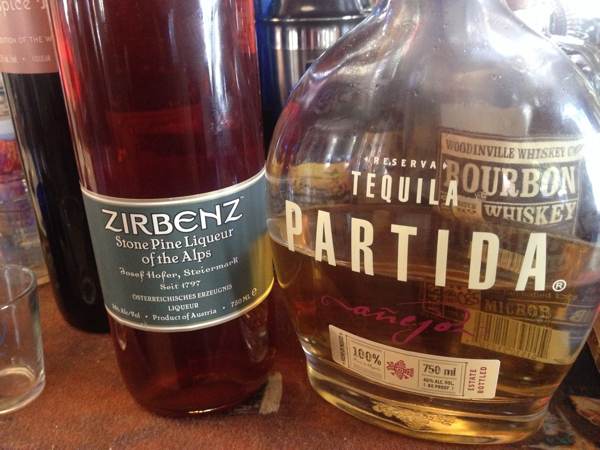
The latest is my “father-of-the-groom” gift from my son: Zirbenz, Stone Pine Liqueur of the Alps. It’s a product of Austria, and it tastes like a pine tree. Not unpleasant, but certainly not an easy taste to get used to.
I happen to be awash in some fine tequilas at the moment, and so I wondered if one could use the Zirbenz in a margarita.
Spoiler alert: yes, you can, and it’s yummy.
El Pino Margarita
1.5 oz tequila, in this case a very nice one indeed
1.5 oz lime juice (I usually use Rose’s Sweetened Lime Juice)
.5 – 1.0 oz Zirbenz Stone Pine Liqueur
splash orange juice
Pour it all in, give it a stir. Salt, of course, and on the rocks.
The pine gives a nice tang to the mustiness of the tequila, a complex layering of flavors. The splash of orange juice mellows the whole thing out.
I’m in the mountains, on our annual Lichtenbergian Retreat, wherein we are each to bring some creative work on which we’ve been slacking. Since my recent work on Seven Dreams is the very definition of “slacking,” i.e., “no work at all,” I’ve brought it with me to jumpstart the process again.
(To be fair: 1) I ran out of text; 2) I was getting ready for and attending Alchemy; 3) my son got married. Still, I bet Wagner didn’t let things like that slow down his ego work.)
At any rate, I’m in the Blue Ridge in a great cabin with four other Lichtenbergians—none of whom, I’ve noticed, seem to have brought any work at all, but let that pass. I’ve brought the snippets of text which I have demanded respectfully requested begin and end Dream Three. Hey, they’re Scott’s actual text from the original play, so I figure it’s not a problem.
Even if it is a problem, even if he ends up sending me a completely different text, I figure I can play around with scene setting and thematic/harmonic bits that I can then use with the new text. As I said last night, measures full of sixteenth notes can be very flexible. Bring on the words!
Here’s the part you’ve been reading for: whining.
In Dream Three, Theseus and the Minotaur have had enough chitchat about their respective ritual fates and are getting it on. The four lines of the Minotaur’s opening aria return, this time with a partner. So, ecstatic duet, right?
Since I haven’t written any real music since August, I’m just aiming to produce crap the entire weekend, just getting my crapping muscles back in shape. I don’t expect to use anything that comes out of my head in the next 48 hours—though one never knows.
My problem is that many of the halfway decent bits I’ve scribbled down are more Broadway than La Scala. Don’t ask me what the difference is, there is one and I know it when I hear it. So do audiences, and so do critics. So I keep scribbling, breaking up some of the Broadway tunes with odd harmonies or melodic intervals, and it sounds more La Scala, but then it’s not very soaring or ecstatic.
Yes, I am modifying my music to please unknown critics. On a personal level I have no desire be known as the opera world’s Frank Wildhorn or Andrew Lloyd Webber: singable tunes, loved by unsophisticated audiences but scorned by all right-thinking persons. As Noel Coward said, “It’s extraordinary how potent cheap music is.”
On an artistic level, opera voices are not show voices, and the same melodies that fit comfortably on Neil Patrick Harris’s voice or Patti LuPone’s sound weak under Erwin Schrott’s or Anna Netrebko’s. You want to please the audience and please the singers, and so you have to move them through the notes differently, if that makes sense, and there’s more than a little element of athletic showing-off in the opera world. If you make it too easy, they’ll disdain it.
I’ll get it done. I just have to get back in the groove of pushing it all out—instead of blogging about it—because if I can produce a big enough pile of crap, there should be a pony in there somewhere, right?
Last week, all the philosophizing, planning, designing, building came to fruition as I packed my car to the max and headed to LaFayette for my first ever Regional Burn, known as Alchemy.
I’m not going to give you a lot of details, because above all Alchemy is a safe space for those who go there and I am not going to breach that implicit agreement we all have that, for a lack of a better phrase, what happens at Alchemy stays at Alchemy.
But what an experience! As you produce your ticket at the gate, the hippies greeting you welcome you “home”—and while I can’t go that far, I will say that I felt an enormous sense of belonging as soon as I pulled onto the farm. Our assigned campsite was the first one inside the farm on the left, and as I pulled up and started to unload I knew that it was going to be an amazing event.
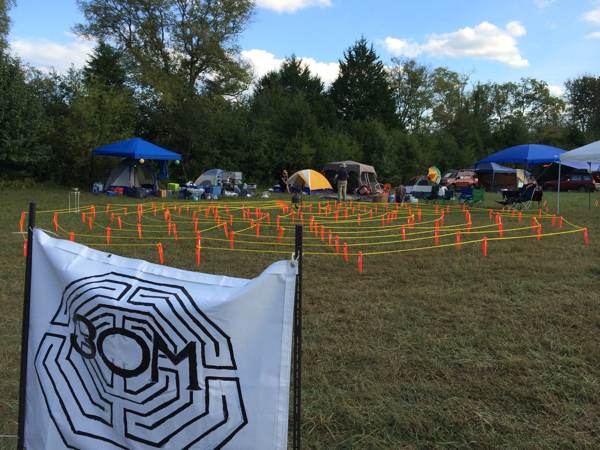
I put my tent up quickly just so I wouldn’t be doing that in the dark, then set about working with the others to get the labyrinth set up. As in our dress rehearsal, the method for laying it out worked flawlessly, although one of the long ropes was inexplicably six feet short. We never did figure out why.
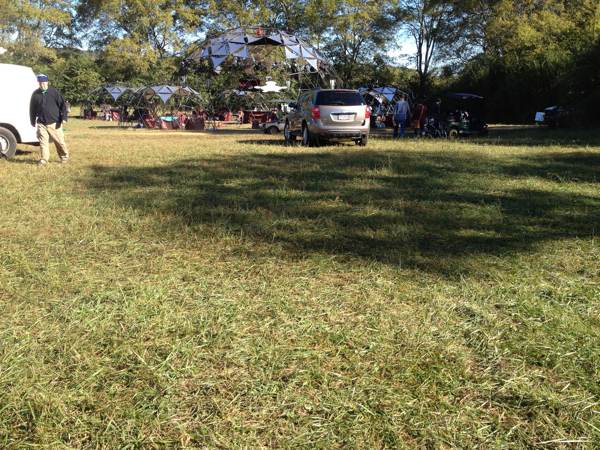
Here’s a shot of our camp:
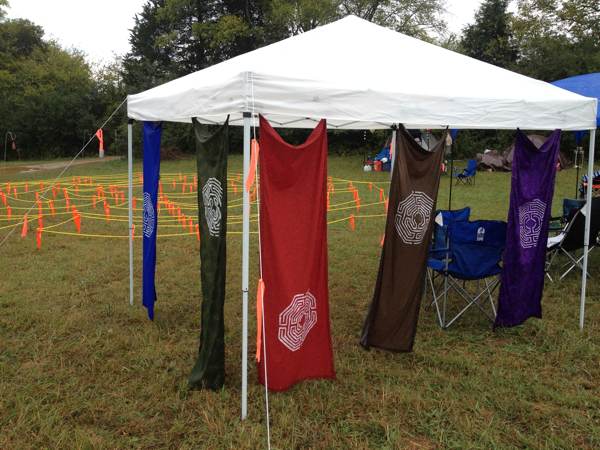
And here’s a shot of our canopy with the banners I whipped up last week and didn’t even share with you:
By 6:30, we were ready for our first ritual—we had decided to do sunrise, sunset, an hour later, and midnight, but that almost immediately got changed. Dawn was going to be too cold or too wet, and as for sunset, well, I misread the sunrise/sunset charts, not factoring in daylight savings time. Not a problem. We moved the sunrise session to noon, and just went for sunset and an hour before instead. (By the time temperatures had dropped into the 30s on Saturday night, we also ditched the final midnight session, instituting the policy that the Old Men don’t perform their ritual when the ambient temperature is lower than 55°.)
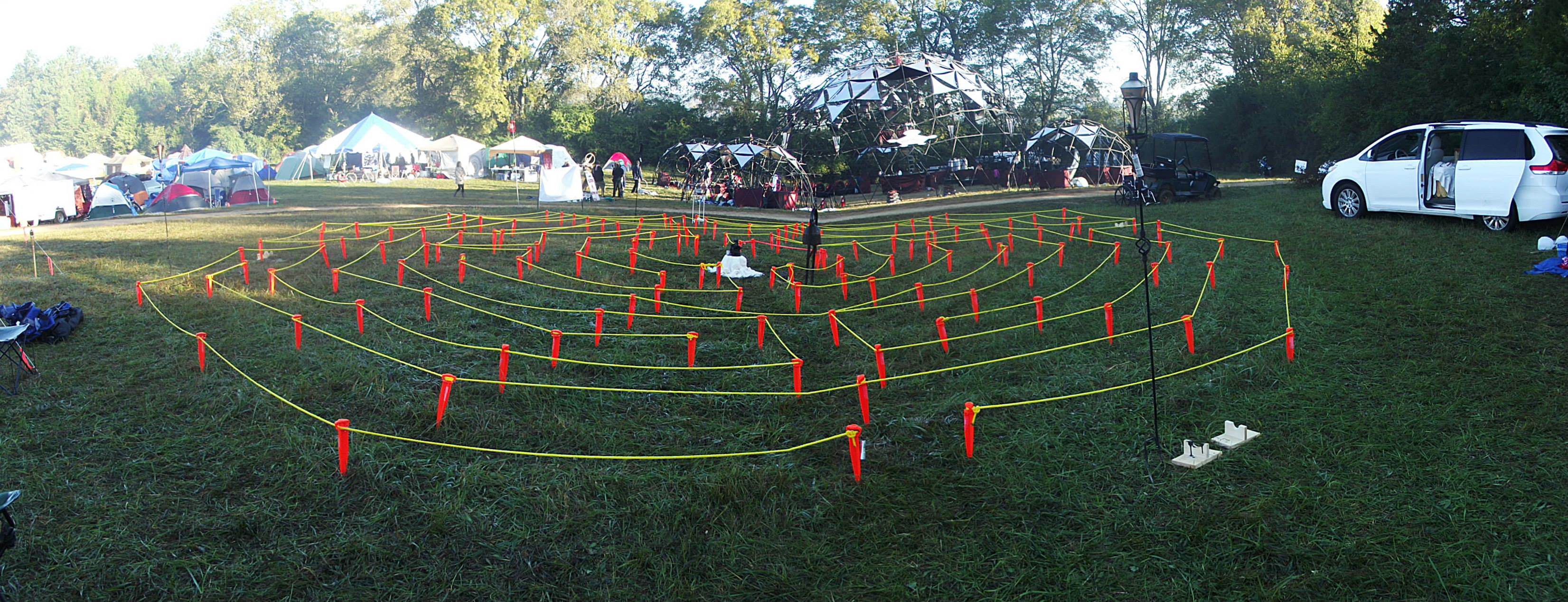
Here’s a lovely panorama shot of the labyrinth, looking across the road to our neighbors, Incendia:
Click for larger version.
In the center, we placed a small altar for people to leave and to take whatever they wished, and the bell from my labyrinth. I will share one experience that made me happy: a group of young people entered the labyrinth while the Old Men were in session. They were happy and giggled their way to the center, mock-racing each other to enlightenment. Once in the center, they found the mallet and one of them rang the bell, which uttered its usual nondescript clang.
But then one of the young men, in a cowboy hat that lit up, stopped and said, “Hey, listen you guys… ” and he struck the bell again and said, “No listen… it shouldn’t be doing this… listen…” and he listened—because he had heard the bell continue with its incredibly long reverberation, on and on and on. He left in a more contemplative mood than the one he entered with. (We saw that a lot, actually.)
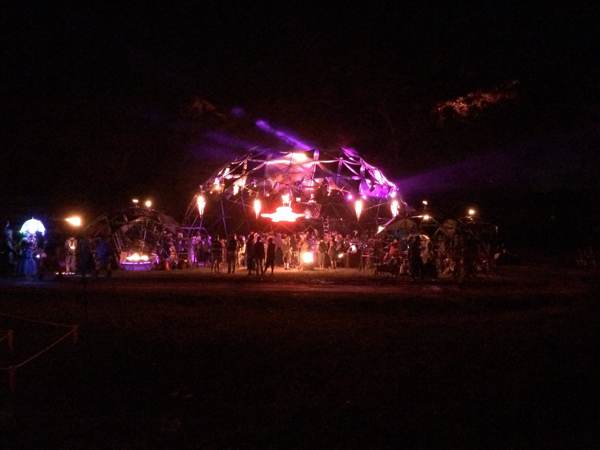
Incendia. My oh my. We watched a team of tawny youths clamber up and up and up building that structure all day on Thursday, and then as night fell, we were stunned and delighted to see:
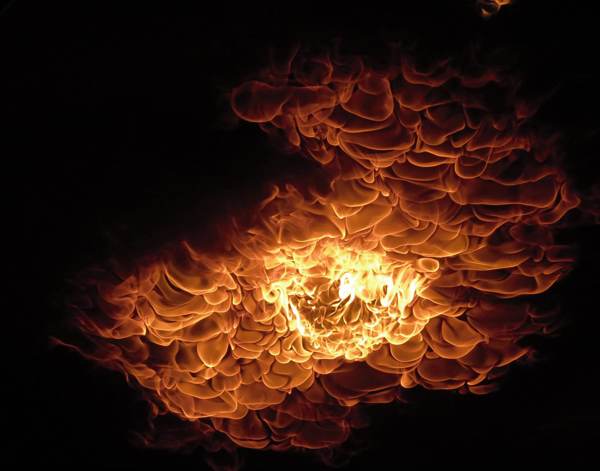
Incendia was the hit of the entire Burn: the large dome was a lounge, with seating, bar, DJ, projections, and fire. This is what the ceiling looked like:
That’s spurts of propane billowing out into never-ending clouds of flame, and it’s as fascinating in real time as you might imagine. Each of the smaller domes housed its own fire sculpture, and those ceilings were the same. It was amazing, and the place was packed until 3:00 or 4:00 in the morning. (Earplugs were a must on our side of the road.)
So for three days, we did our ritual, answered questions and discussed the impetus behind the project, and sucked up the positive energy all around us. I will say that I was just a wee bit proud when people were surprised to find that we were all Burn virgins; apparently 3 Old Men gave off the vibe of being old pros at this. (It also dawned on me that we were freaking selected as a theme camp by Burning Man itself. Sometimes ignorance of the odds is a great way to develop a project.)
The camp is large: 3200 Burners, two-thirds of them in registered theme camps like us, and the variety therein was impressive. Art, food, drink, interactive things, games, just a wild smorgasbord of creativity and openness. Again, details would be over-sharing, but the energy was palpable.
Everything culminates in the Burn itself on Saturday night, in which a two-story structure known as the Effigy is set on fire in the most spectacular way imaginable. I have never been witness to as much controlled pyromania as that Burn, and I found that watching those enormous pillars of flame erupt from tubes surrounding the Effigy, followed by the Effigy itself vanishing in the largest fireball I have ever seen, produces only one possible response: ecstatic, joyous laughter.
It’s a very powerful feeling to watch a structure burn that you were just inside and on top of, and on which you’ve written your own thoughts about life/loss/change.
The next morning, Sunday at dawn, the Temple, another smaller structure, was burned. Part of my labyrinth was in there: the artist put out a call for frames; I had some in my kindling pile and although I was out of town at the time I sent her directions on where to find them in my back yard. I ran into her at the Temple and she excitedly told her boyfriend that I was the one with the amazing back yard.
Click for large version
Afterwards, we went back down the hill to the camp, had one final meal together, then broke camp. By early morning, before most of the rest of the hippies were up and about, we were all gone.
Here’s what I learned. The Burn’s 10 Principles are a great way to run an event, and their impact has remained with me. I learned to be more Radically Inclusive of other people, which is sometimes a problem for me. I learned a lot about Radical Self-Reliance, never having camped before—I like it, at least for Burns! And Leave No Trace has become a mantra for me; next time I will volunteer as a MOOP* Fairy, part of the onsite volunteer staff.
The guiding philosophy behind 3 Old Men turned out to be exactly correct, and I found—even as I watched beautiful, taut young bodies parade past—that I was proud of me, of where I am and how I got here. More amazingly, that was how the taut young bodies responded to me as well. The ritual was simple and effective, and we had a decent amount of participation in those sessions, although we’re working on ways to make it easier for people to challenge themselves to enter the labyrinth. (Again, no photos, but the 3 Old Men in full regalia—paint, skirt, staff—were imposing to the point of being totemic.)
And mostly I learned that I am made very happy being in a setting where everyone there is free to let their own little freak flags fly without fear of judgment. I soaked up all that joy like a vampire, and I am committed to continuing this journey with my fellow Old Men. We’re making plans to go to other Burns and to recruit more people to our roster as we go. I’ll keep you posted.
——————
*MOOP = Matter Out Of Place, i.e., whatever was not there when you got there. I am still worried that our MOOP score will suffer because of the spills of kaolin body paint we left behind.
About half the photos in this post were taken by Roger Easley, photographer extraordinaire and a member of 3 Old Men.
This is not an update. It’s just that I haven’t blogged in a while and I wanted to assure my legions of readers that I’m still around.
The reasons are what you might expect: getting to Alchemy—Alchemy—returning from Alchemy—decompressing from Alchemy—starting final preparation for my son’s wedding next weekend. All that kind of thing.
I promise I have a lot to share—just no time to do it right now.
Remember how I kind of wanted jewels for the eyes of the lizard on the staff but never really went back to the idea?
I was in Michael’s picking up some white acrylic paint for one last 3 Old Men project—Alchemy is this week, YOU GUYS!—and there was this whole series of new paint substances. This one looks like glass or clear sugar candy, and I snatched it up. Ooohhh…
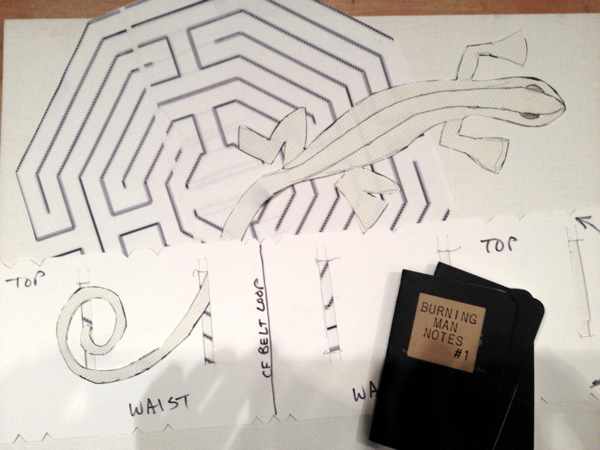
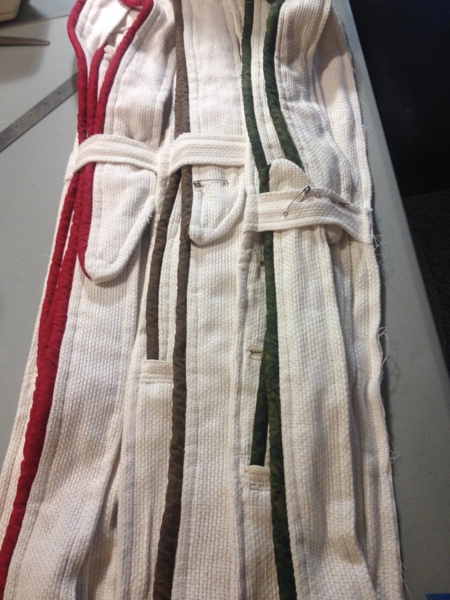
I have not been boring you with all the step-by-steps of getting the other four skirts made—you’re welcome—but I do want to show off. Here are three of the four waistbands:
I’m missing enough material to have made the fourth one (although this morning it dawned on me that when I cut out two of the skirts, I should be able to find that).
Aren’t they beautiful? You can’t really see the buttonholes through which the sashes will weave, but they’re beautiful. The belt loops are beautiful. The sashes are beautiful.
If I’m assiduous, I could have three of the four skirts entirely finished today and have time to go outside, do some planting, and in general enjoy the lovely fall weather. I’ll keep you posted.
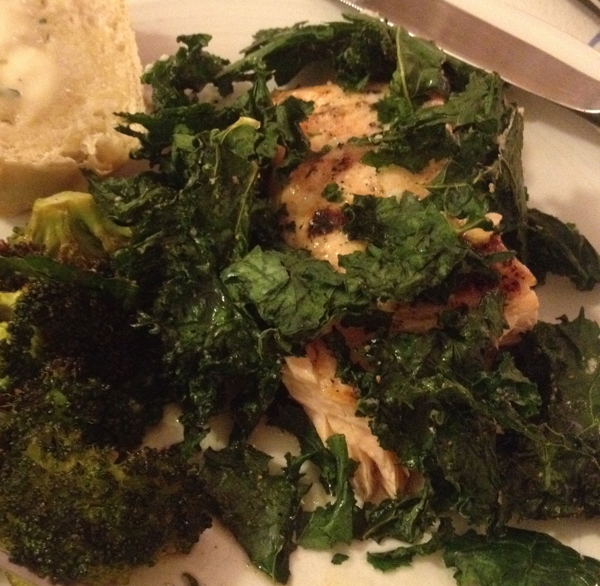
This is not really a recipe, just a concatenation of ingredients that turned out fabulously well:
It’s just kale chips sprinkled on grilled salmon. It was suggested that perhaps I should put the salmon on a bed of kale chips, but sprinkling them on top lets them stay crisp/crunchy. Also, the kale chips by themselves were oversalted; the salmon was lightly seasoned, and together they were quite a tasty balance.
Kale chips: olive oil, sea salt, white pepper; bake at 300° for 10 min, turn the baking sheet, bake for another 15 min.
Salmon: marinate face down in lemon juice, garlic, and olive oil; turn over, season with salt and black pepper. Grill.
I have been so focused on sewing skirts for 3 Old Men that I haven’t really had time to get out to the place that is my center: the Labyrinth.
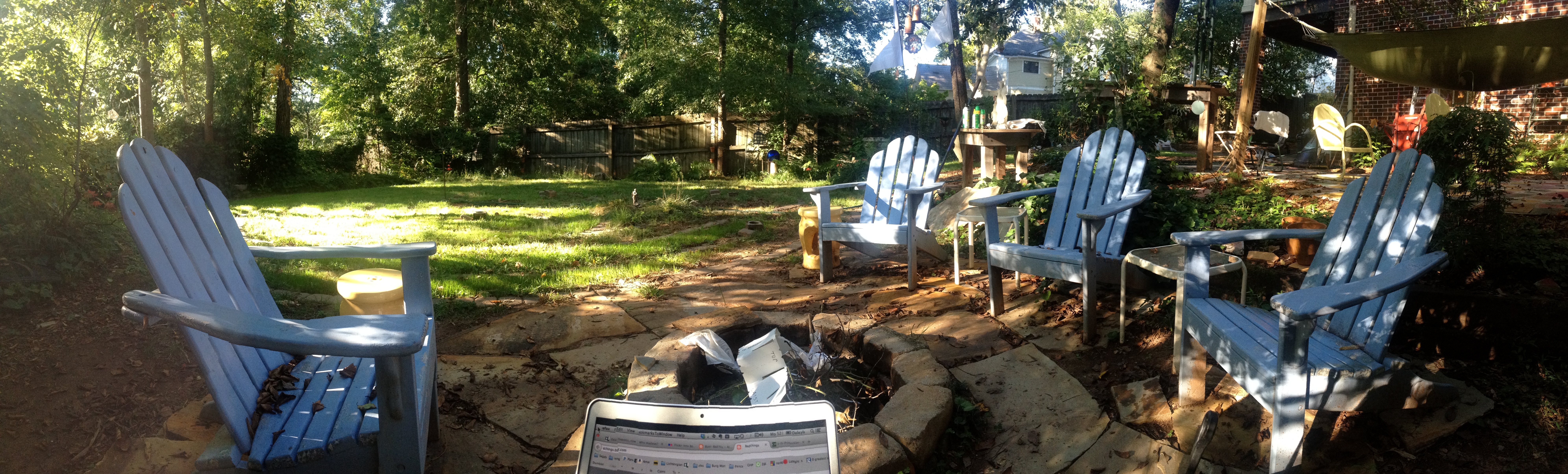
Here’s what I’m seeing:
Click for full size photo.
Why is this the most beautiful spot on earth for me? Let us count the ways.
It’s a labyrinth. Duh.
I built it. By myself, with my own two hands.
I designed it. It includes a couple of features that I have seen nowhere else in my research:
The western path, i.e., a path of bricks that lead from the center to the west. Sometimes, you need to take the high road home.
The hidden path, i.e., there is a fully paved path leading from the entrance to the center. I dug a trench, laid out the full walkway, allowed myself to walk the path to the center and back once, then covered it and laid out the labyrinth over it. So there is a path straight to the center—but we can neither see it nor use it.
The center is an omphalos: a navel, an axis. The black granite circle rims a ceramic bowl that I made—and the cracks that happened as the clay dried are now golden hieroglyphs.
It’s green. Green and white are the only colors I’ve used down here, although the spider lilies that show up right about now are a lovely and welcome surprise.
It has a firepit. I cannot over-extol the virtues of a firepit.
It has four points: the gate at the eastpoint; the Richard Hill “Sun” sculpture at the southpoint; the Brooks Barrow limestone bowl at the westpoint; my earth sculpture at the northpoint. Each offers a post at which you can hook into their specific energies.
It, further, has a sculpture of the Belvedere Apollo (near the southpoint); and a sculpture of the Dancing Fawn, stand-in for Dionysus, at the northwest point. You get to choose.
It has a sound system. Yes, it does: two in-ground speakers, one up by the entrance, the other in the ferns by Dionysus. At certain points in the evening, it’s nice to be able to walk the labyrinth and be able to hear even the quietest pieces no matter where you are.
It has a great view of the full moon—but you have to get out of your seat by the fire and go stand in the labyrinth. This is a feature, not a bug.
It has an energy that you have to experience and cannot be described. Arrive early, an hour before the sun sets. Sit. Watch. Listen. Then we’ll light the fire.
 I wish to make a complaint.