3 Old Men: mapping the field of ritual, redux, part 2

I’m revisiting my explication of 3 Old Men in terms of Ronald Grimes’ Beginnings in Ritual Studies.

: Ritual objects :

[original post here]

What, and how many, objects are associated with the rite? … Of what materials are they made? … What is done with it? … What skills were involved in its making?

Back in March, I talked about the staffs and the skirts and indeed those became the major ritual objects, but there’s a lot more to discuss now that we’ve actually done it.

When we met in September for our technical runthrough/final dress rehearsal, it was clear that the four of us had had a wonderful time designing and making our staffs. Mine was the simple blue staff with the rings of wire and the copper lizard. Craig’s was hand-carved with a serpent surmounting it. Michael’s was a spiral-cut wooden curtain-rod which he had painted and trimmed along the spiral grooves. Joe’s was this phantasmagoria of styles, a different look-and-feel every foot or so, ending up with a steampunk top into which he could insert a glowstick. (We also had a fifth one for volunteer Old Men; Michael made it and I’m afraid I don’t have a firm memory of it.)

The staffs became therefore a focus of our own particular energies and styles. I’m sure none of our participants paid the slightest attention, but it made a difference to me.

One thing we did not use the staffs for was to lay out a central octagon for the labyrinth. It was completely unnecessary: we measured the space so that we’d have room for the entire thing, then staked out the center, aligned the points of the compass, and then used the triangle to place the stakes. I did use the markings on my staff to place the stakes at the appropriate distance from either side of the short “blue” rope, so that was both useful and necessary.

The skirts were particularly fine as objects: they set the Old Men apart as Other in a really beautiful but undefinable way. Together with the staffs they left the viewer with no choice but to understand that these men were figures of power.

Back in March I posited creating stands at the four exits, one for each of the four elements, but Black Rock Desert’s windy environment wouldn’t permit it. They would have been superfluous, as it turns out.

I did whip up a stand for our bowl for the body paint, and that turned out to be very effective. We moved it around from exit to exit until we settled on the north side, which was the side by the road—almost literally by the road. By creating a place for the body paint, it gave the ritual itself a beginning and ending in space. Once or twice participants used the body paint themselves, and that was nice. (Only one, a much younger man who had spent some time chatting with us about the whole thing, stripped and painted himself before walking the labyrinth. I thought we’d have more.)

At the dress rehearsal, Craig suggested that I bring my gong/bell from the labyrinth, and that was an amazing addition. As the weekend progressed and we actually developed details in the ritual, the bell became an important part of that. (See the discussion on ritual action in a couple of days.)

Craig also built a little altar in the center for people leave and take ritual items, and by Cthulhu that worked! People seemed to know without being told what to do—or maybe that’s a universal dirty hippie freak thing.

Finally, the labyrinth itself was fabulous. We could if we wanted make the construction more ritualistic, but it didn’t feel to me as if that were a problem. The tawdriness of the materials—the fluorescent orange and yellow in particular—might be problematic in establishing the sacred nature of the space (well, it is for me), but I keep coming back to the basic issues of visibility and safety. I don’t know that it bothered the audience.


3 Old Men: mapping the field of ritual, redux

Back in March, I blogged a lot about the theory and practice of the 3 Old Men ritual troupe as I prepared to head out to Burning Man.  This was before I found out that we were not able to go this year.  We did, however, go to Alchemy, the Burn-like event in north Georgia, and as I reread those posts from March I thought I should go back over some of the ideas and talk about them as they eventually played out in real life.

The background is Beginnings in ritual studies, by Ronald L. Grimes, and I did a series of posts on his chapter of “mapping the field of ritual.”  What I’d like to do is spend a few posts looking at his questions again and see if there were any unanswered questions or surprises in the event itself.

: Ritual space :

[Original post here]

Where does the ritual enactment occur?  If the place is constructed , what resources were expended to build it?  Who designed it?  What traditions or guidelines, both practical and symbolic, were followed in building it? … What rites were performed to consecrate or deconsecrate it? …. If portable, what determines where [the space will next be deployed]?  … Are participants territorial or possessive of the space? … Is ownership invested in individuals, the group, or a divine being?  Are there fictional, dramatic, or mythic spaces within the physical space? [Grimes, p. 20-22]

Rather than the vast and inhospitable Black Rock Desert, Alchemy takes place on a green tract of farm land in North Georgia.  Hilly, wooded, with roads, a lake, and even camp showers, it’s not quite as an austere environment as Nevada.  It did require—when I submitted our application to be considered as a theme camp—knowledge of the territory, which I didn’t possess but on which my fellow Alchemists were happy to advise me.

As it turned out, we were placed right at the entrance to the site.  There’s a giant windbreak/hedge across the eastern side of the property, and the main road cuts through it—and there we were, first camp on the left.  Nice, flat, and accessible.  At first I thought we might have been slighted as newbies; for the first 36 hours of our experience, there was a steady stream of traffic pouring past our camp, not quite conducive to quiet meditation. But the team leader who actually placed us there told me he thought we would benefit from the foot traffic to our neighbors across the street, Incendia, and he was right.

Consecration was simple—I smudged the circle and the center, and then our team members, and we were off.  In the future I would like to incorporate that moment of sacralization for each time we perform the ritual.

In March I talked about the Great Ritual of Burning Man itself and of the smaller rituals such as 3 Old Men.  Because of the smaller scope of Alchemy and shorter life-span (both in terms of longevity and of duration), I did not sense a Great Ritual there other than the liminal experience of crossing that boundary and committing to life with the dirty freaking hippies for four days.  Lots and lots and lots of smaller rituals, of course.

We had interesting territorial issues, in that the 3 Old Men’s performance was compelling, but daunting: it turned out that many passers-by were so impressed by the ritual that they regarded entering the labyrinth as a real test.  Most looked interested but avoided participation.  As we worked through the weekend, we developed ways to make it clear to people that they were welcome, and as word spread we got an uptick in participation.  I think as we continue to attend Alchemy and other events, we will build a reputation and more people will be willing to take the plunge.  Still, I’m kind of impressed that what we had made it clear that this was not a silly thing.

Ownership did become invested in the group.  While I think everyone still looks to me as a guiding force, I was delighted that everyone felt comfortable in creating new aspects to the experience.

Besides the labyrinth itself being a mythic space, the center became more important as a focus, a fact I’ll talk more about in the section on Ritual Objects tomorrow.

Today in crapping out music

Yes, I know it’s Thanksgiving, but I woke up from dreaming about a) men getting tattoos, and b) the symphony.

Leaving aside the tattooed men for the moment—oh, GROW UP YOU PEOPLE—I decided to slip upstairs while I could and crap out some notes.  I had gotten the fourth movement nicely started, and then it nicely ground to a silence, which was my intent.  The problem with grinding to a silence is that then one must start back up.  That’s where the dilemma is, and that’s what I woke up dreaming.  If I had actually dreamed a solution, that would have been fantastic, but I didn’t.  I just awoke to the need to do something about it.

For the moment, I’ve been falling back on my “abortive attempts” strategy: putting in a double bar (to mark my place) and just plopping out new sounds to see if I can trigger something that works.  I’ve also been going back into the file of the original fourth movement and stealing stuff I liked from there to see if it will fit in with the new stuff.  Which it should, because as I said previously I’m not starting from scratch, just rewriting what I’ve already done.  So far, it’s a good stopgap measure: the old work is not bad stuff, and it may get me started when I’m actually able to sit down and work all day on it.

You will have noticed that I have not shared any of this.

So, tattooed men.

Let’s see if I can find a nice, pretty, safe-for-work image of what was running through my head last night…

That’s kind of it, although I recall the tattoos as being more geometric than tribal, just big blocks of black.  We were at some kind of social gathering, and all the men had these tattoos on their arms.  (Click on the image to see the whole page of some very nice tattoos.  And then click on this link to see some absolutely beautiful tattoos!)

Other than my long-term fascination with tattoos, I don’t have any explanation for the dream.  The whole concept of marking oneself appeals to me, and it would be disingenuous of me not to recognize that part of the appeal lies in what I take to be an inherent masculinity in the concept.  (Certainly the young men on the tribal page are healthy exemplars of manly manliness.)

However, I’ve always shied away from the idea of large tattoos on my own personal body.  The two I have are small and discreet.  If you didn’t know I had them, you’d never know.  I think it’s because I have no confidence in my ability to carry it off, masculinity-speaking-wise.  I don’t have the broad chest or shapely biceps that the specimens you see on the internet have, and I never did.  One doesn’t want to look ludicrous, after all.

I’ve been forbidden to get more tattoos because some of us don’t find them appealing so it’s kind of a moot point to think about the topic, but there are at least three that I would get if I could.

The first is my lovely first wife’s signature.  You’d think that one would be appealing, but no.  I’ve informed her that if she dies, I’m showing up at the funeral with her name tattooed on me and everyone will think it’s sweet.  Probably I’d want that one on the inside of my wrist.  (FYI, I have a sheet with her signature already filed away.)

The second is a lizard.  I hesitate to use the term “spirit animal” out in public, but it’s an animal that has recurred in my meditations and in my art collecting, and one day I realized that I have half a dozen of the critters sitting around my study and the labyrinth.  It must mean something.  I don’t have a design picked out, and I’m not sure where I’d put it.  Maybe as I continue to evolve into an Old Man, I’ll get a rather large one on my chest.  Break down that particular barrier. (For a very interesting explication of what tattoos can mean, I highly recommend Seven Tattoos by Peter Trachtenberg.)

The third one is the Lichtenbergian motto, Cras melior est, which translates as “Tomorrow is better.”  This is my friend Kevin’s idea for his tattoo, and I don’t know why it didn’t dawn on me previously.  Upper arm, perhaps, or my shoulder blade?  As I said, it’s a moot point, so I don’t spend a lot of time pondering the issue.

There may be others.  I seem to recall wanting four, but nothing is bubbling to the surface at the moment.  The important thing for me is that none of them are decoration.  The tattoos on the two pages to which I’ve linked are beautiful, but many of them seem to be sheerly decorative, “tribal” in the sense of “trendy/in-crowd.”  That’s not what I’m after.

I think that the best word to describe what I hope for in getting a tattoo is incorporation.  (I will now pause to let Marc shiver with a frisson of sinthome or whatever it is he shivers with.)  The marks I want on my body—permanently—are markers: some thing, some idea, some force that I want embodied on my body and in my living.  I crave the commitment.

Hm.  I did not plan to write about tattoos this morning.   Wonder what that’s about?

And another thing!

For the past month I’ve been re-reading this blog, which is almost ten years old.  Due to one upgrade to WordPress or another, older posts have been displaying some weird and disturbing characteristics.  All oddball “special characters,” like anything umlauted or accented, got converted into some universal code.  I’ve let them go.

But the conversion of em-dashes, i.e., “—”, into space-comma-space cannot stand.  It makes me look like an illiterate purveyor of comma-spliced sentences.

So now I have to take the time (I’m in 2010) to open each post and find and replace all those instances of space-comma-space.  Ugh.  Two more and I will program a macro to do it all.

later:

Or I could do this.  I could, you know.  I think.  Or you might never see this blog again…

Problems

Do you know what is FUN?

Finally getting your brain in gear to compose again after at least a month of not being able to, and TECHNICAL ISSUES TAKE UP ALL MORNING.  That’s what is not fun.

Short version: I have keyboard controller, i.e., it doesn’t make sound on its own, which plugs into the computer via a USB cable.  I use it to a) input notes into Finale (itself a charming bundle of issues); and b) noodle around on a small software synth.

So when it stopped working recently, I was nonplussed.  It would play for four or five seconds, then stop sending MIDI data to the synth/Finale altogether.  Restarting it or rescanning the MIDI would fix it, but only for another four or five seconds.

I’m trying to get better about composing with the keyboard rather than just plopping notes on the screen, and this issue was not helping my efforts.

I have replaced the USB cable, reset the MIDI setup, etc. etc. etc.  It took me an hour and a half via Google just now to try and discard three different solutions, and then finally stumbled across someone in an Apple Support forum who figured out that his USB cable (essentially a power cable) was too long.  The computer wasn’t sending enough power to the keyboard to keep it running.

A shorter cable would fix it, but my set-up doesn’t allow for a shorter cable.  (I mean, I could clean off my desk, I suppose, but that would take a day and a half…)

A powered USB hub—one that plugs in and delivers power on its own— was a suggested solution, and of course I have one from days gone by.  Dug it out, and that may have fixed the problem.  I’ll report back.  Later.  After I’ve composed more than the two measures I squeezed out this morning before being sucked into the Intertubes.

So…

I did an odd thing today.  I pulled out the fourth movement of the Symphony No. 1 in G and started over on it.

Started over.

My original plan this morning was to open the old file and do some Things to it to fix it, the first of which was to expand the note values of the lento section to be more legible: 32nd note triplets in an extremely slow tempo (as in, 12 notes to a single beat) were simply too hard to read. The plan was to use a built-in utility to make each 32nd note into a 16th note and redistribute All The Notes into new measures.

However, since none of the empty measures up and down the orchestra were real rests, those measures didn’t get doubled and redistributed.  Therefore, on playback, nothing was aligned—woodwinds were wandering in and out when they should have been in sync with the strings—and though it might have been “interesting” it was not good.

So I used a utility to make all the empty measures real rests and tried again.  (There was also an issue with the pickup measure not doubling.)

Now everything lined up, but none of the dynamics moved with their notes, i.e., ffs and pps and pizzicatos were way off.

Finally, after giving it a good listen, I decided that everything I’ve done since April 2008—and here I am referring to my entire life, not just my composition—has made it necessary for me to scrap the old stuff and start over.

I’m not starting from scratch. The opening mood and main theme will remain the same, but I’m rewriting it from the ground up.  Literally: the swirling triplets that were in the violins are now in the celli and basses and are actually completely different notes.  There’s a new countertheme that probably will grow in importance, and harmonies are a little different—and likely to become even more different—than before.  It’s an adventure.

What prompted this?

Yesterday my lovely first wife and I went to the Atlanta Symphony Orchestra to hear a concert that featured a kinda-premiere of a symphony by Richard Prior, a professor at Emory.  It was competent but not thrilling, and while I don’t think I’m at the same technical level as Dr. Prior, the experience made me think that I should take another look at my own symphony in the belief that it might actually be more interesting.

So there we go.  The suspense is terrible; I hope it will last.

The roar of the chainsaw, the smell of the art

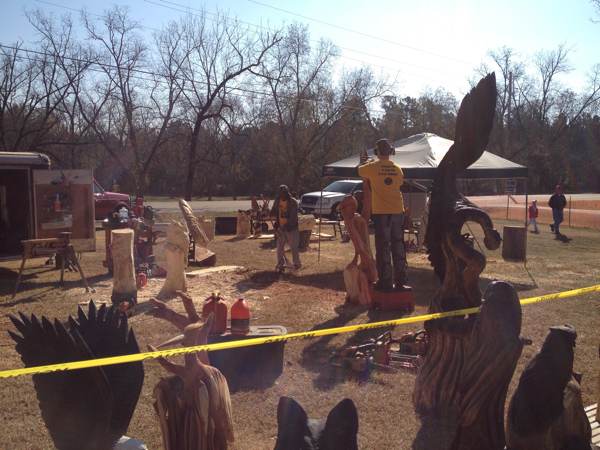
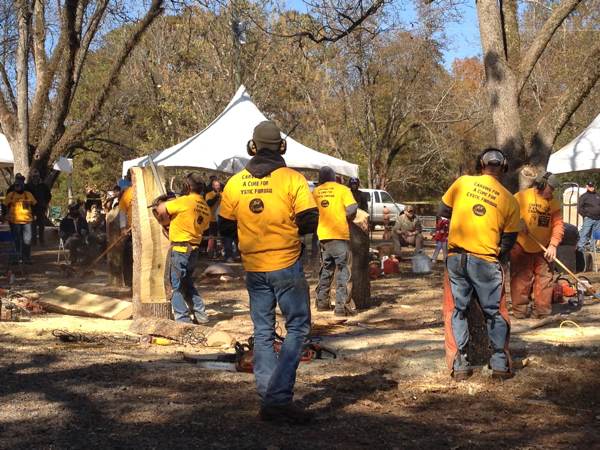
On Saturday we motored over to Gray, GA, for Chaptacular, which — despite what conclusion your filthy mind has already leapt to—is actually an art event hosted by Chap Nelson on his spacious property as a fundraiser for the Cystic Fibrosis Foundation.

The full event name is Chaptacular Chainsaw Carving Bash, and it was more than, again, what you were expecting.

About twenty carvers from all over the country—including a national champion and an international champion—were on the premises, hard at work by the time we got there.

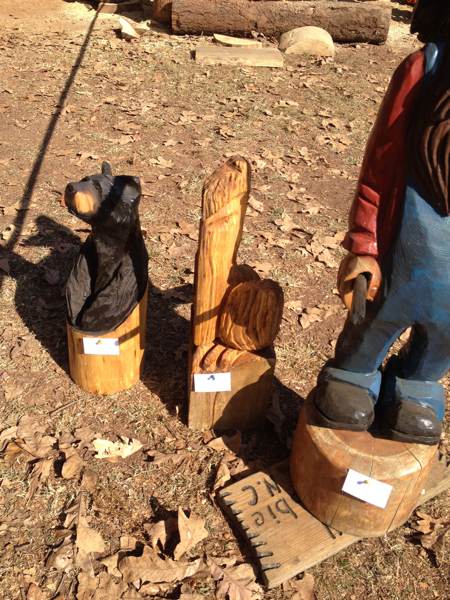
A lot of the work (all of which was for sale) was much what you would expect:

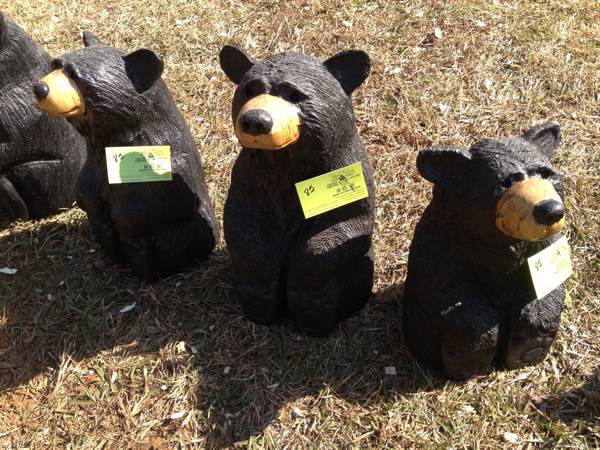
Lots and lots of bears: little ones, like these; big ones; happy ones; sad ones; silly ones.  You name it.  But there were other subjects as well:

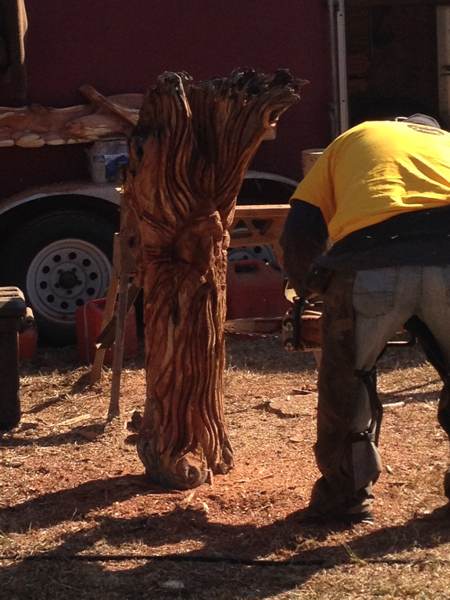
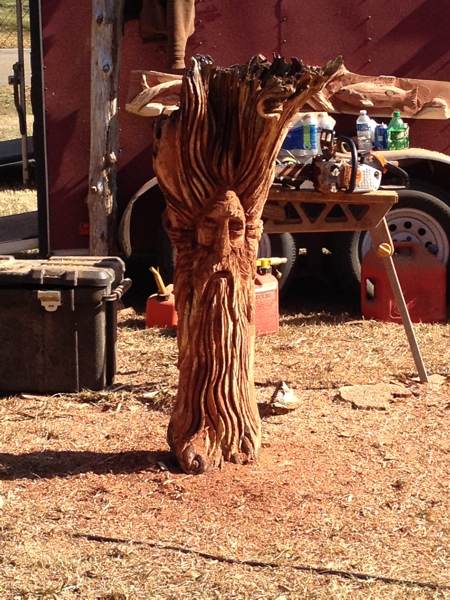
Stop it, you perverts!  That’s a pelican.  I think.  Lots of Green Men/wood spirits:

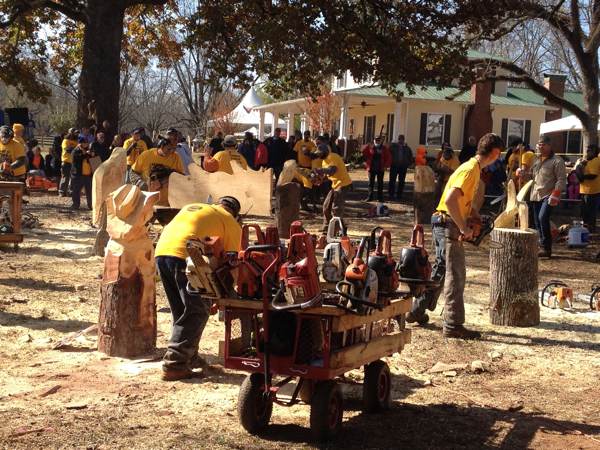
Watching these people work was fascinating.  It’s all I can do to cut a log in half with my chainsaw, and here they were wielding them with surgical precision.  Like “real” sculptors, they had a whole set of chainsaws in different sizes, plus buffers and grinders and sanders.

Soon after we arrived, most of the artists assembled for the “quick carve” event.  It’s mindblowing.  About a dozen of them stood in the carving area, each with a large block of wood and his tools, and after a brief intro from Mr. Nelson, they started their chainsaws up and went to work.

http://dalelyles.com/images/chaptacular14_quickcarve.mov

Go ahead, click on it.  It’s only 30 seconds long, and it’s tiny, unfortunately; if you do full-screen, it goes grainy.  Sorry.  But do look carefully at the man on the far right of the video, slightly behind the guy in front.

Here’s a good look at him from the other side, on the left.  For the longest time, all he did was saw straight down through his block.

Hold that thought.  After 20-30 minutes of ungodly noise—it really did become hysterically mind-numbing because nobody stopped, nobody paused even for breath—shapes began to emerge.

As you’re holding that thought about the short guy with the tall block, hold a new one about the young man on the right.

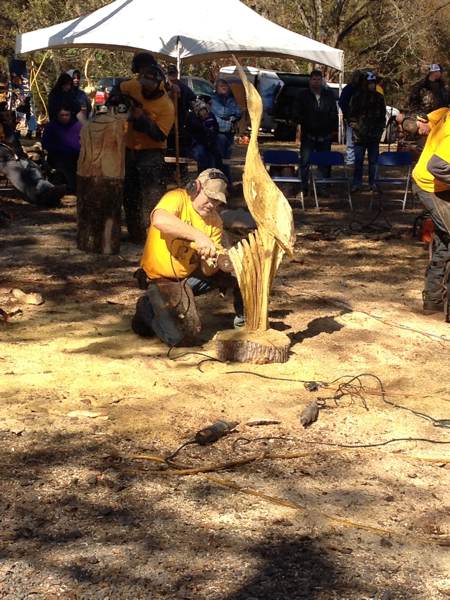
Here’s what the short guy ended up with:

This is the national champion, and he got here way faster than the other artists.  (Unfortunately, for our tastes, he ended up spray-painting the heron.)

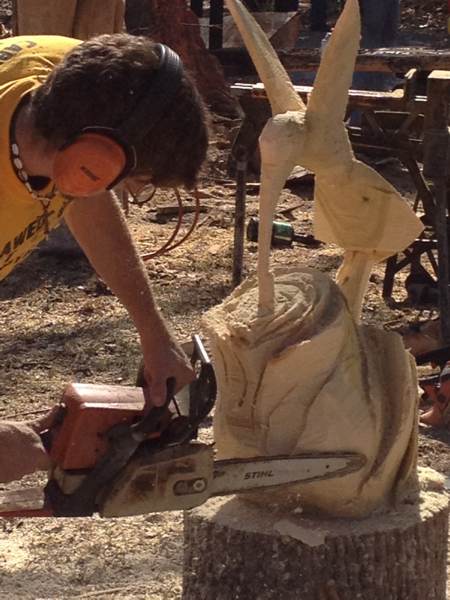
Okay, back to the young man:

Ambitious, to say the least, and I don’t think he got it very finished by the time the carve was over.  But it was still amazing to watch.

It wasn’t all bears and green men:

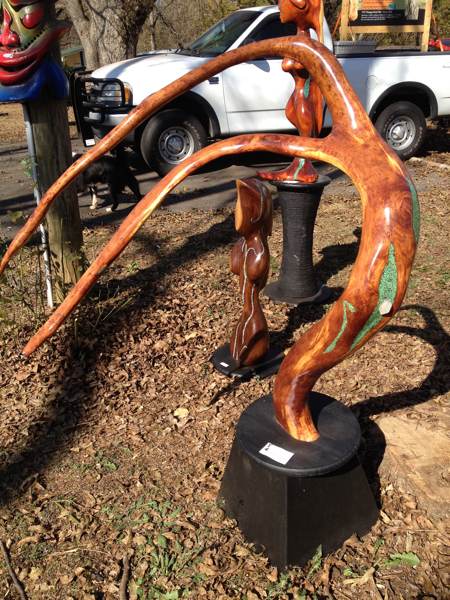
These are inlaid with turquoise and crystals.  Not tremendously balanced, artistically-speaking-wise, but they were different from the surrounding work.

As you might suspect, most of the work was not something I would own, but as a demonstration of the creative process it was amazing.  It was the ultimate “take a block of wood and remove everything that isn’t a heron” experience.

The one piece I almost bought and would have if I still had two incomes:

It  would have gone in the southwest corner of the labyrinth, maybe.  Unless it proved to be too large to fit in, in which case I would have given it to Craig for his labyrinth.  (Who am I kidding?  I would have made it fit.)

Finally, if you’re in the market for a bear, this is the place to be.  They had an auction of pieces donated by the artists, all proceeds of which went to the CFF.  And good deals were to be had thereby.  I highly recommend marking your calendar for next year’s event.

A quick look into the labyrinth

Yes, I’ve been “quiet.”

Have a couple of photos of the labyrinth from this afternoon.

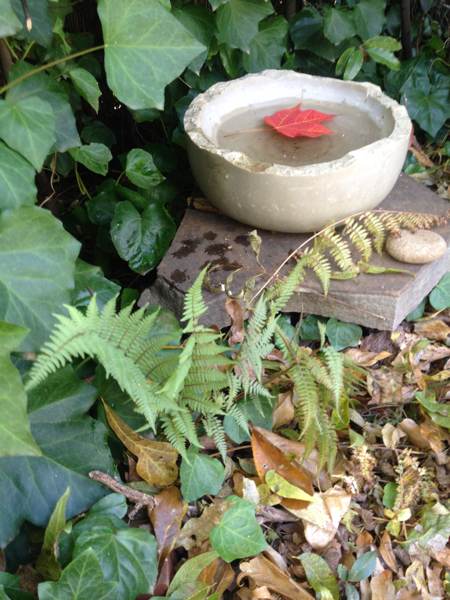
The bowl from the west point.  The maple leaves were everywhere; I tried to get a nice shot of the freshly mown labyrinth with a couple of them scattered about, but I needed a real photographer to do that.

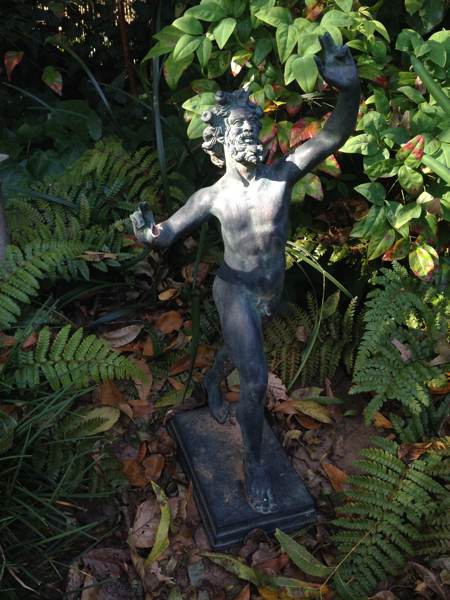
Our dancing fawn, aka Dionysus.  Look carefully at his right hand—his thumb has cracked off.  I’m sure I will have to replace him after the snows of winter, but as Shakespeare always reminds us, “Every fair from fair sometime declines.

This would be fun

Who among us has not fantasized about winning the lottery?  It’s a regular source of amusement for me, and this week’s elections got me to thinking about how I could use my money for political purposes.
Let’s assume I win the $250,000,000 lottery.  That’s a comfortable sum.  And then let’s assume that I simply put that in the bank and live off the interest.  Even at extremely low rates, I’d still have an annual income of around $5,000,000.  Still comfortable.

At our current tax rate, I’d owe about 39% of that in income taxes.  I’m not doing the actual research and/or math at this point—once I have a $5,000,000 annual income, I will pay lackeys to do all that—but if I were taxed appropriately, say at the rate under Ronald Reagan (blessings be upon him), I’d owe even more than that.

So what I would love more than anything is to taunt the average—and by “average” I mean “poorly informed rightwing idiot”—voter with a flagrant waste of my income, just because I can.  I’d make a video and release it on YouTube and wait for it to go viral.

Let’s take a look:

INT: GRACIOUSLY APPOINTED LIBRARYDALE:
Hello. My name is Dale Lyles, and I am extremely wealthy. I'm rich, and I'd like to talk to you about taxes.

You've been told that taxing people like me is bad for the economy, and you keep voting for people whose main goal is to prevent the government from taxing people like me.

So here's what I think about that.
DIFFERENT ANGLE. WE SEE "ACCOUNTANT JEFF" IN THE BACKGROUND.
DALE:
If the government were to tax my annual income at the same level they did while Ronald Reagan was President, I would owe an additional $1,000,000 in taxes. Isn't that right, Accountant Jeff?
CU: JEFF
GFX: "Not an actual accountant"
JEFF:
That's right. One million dollars.
CU: DALE
GFX: "Actual amount, though"
HE TOASTS THE VIEWER
DALE:
One million dollars.

Think of what your schools could do with a million dollars. Or how many streets could be repaved or bridges fixed. Or how much assistance could be provided to the homeless.

Instead, it's mine to keep. Thanks, voters!

And now I'd like to show you something.
NEW ANGLE: DALE REACHING FOR BOX; HE OPENS IT AND TAKES OUT THE JEWELRY.DALE:
I took that million dollars and bought this jewelry. It's a lovely ring and earring set. One million dollars! That's pretty incredible, isn't it?
CU: HE LAYS JEWELRY ON ANVIL, INCONGRUOUSLY OUT OF PLACEDALE:
I bought these beautiful pieces of jewelry because I can. I have an extra million dollars at my disposal, thanks to your votes. And now...
MS: HE SWINGS A SLEDGE HAMMER ONTO THE ANVIL, SMASHING THE JEWELRY INTO WORTHLESS BITS.DALE:
There. A million dollars.
HE SITS, BRUSHING THE BITS ONTO THE FLOOR.DALE:
A million dollars for your schools and community.

Outraged? You think I should have donated that money to the community?

Why would I do that when you've made it clear through your vote that you want me to keep it?
CU: DALEDALE:
You want my million, start electing people who will tax me for it.
INT: LIBRARY, DALE IN EASY CHAIR WITH CHAMPAGNE; JEFF IN BG; DALE TOASTS THE VIEWERDALE:
Till next year... cheers!

My position is unassailable in conservative terms: it’s my money, and the government should have no interest in it.  Surely—surely—the average voter would begin to realize that “government” is, by extension, him.

Surely—surely—the average voter would begin to realize that even though this is a stunt (although make no mistake: I would buy a million dollar set of jewelry and smash it to flinders, a fact I would document in further videos/talk show appearances), it’s the whole taxation argument in a nutshell, and while I may be a crazy rich liberal, this is exactly what the über-wealthy among us do every day.

Perhaps they might even realize that, sure, the only person I “hurt” doing this is myself, but it doesn’t hurt me at all.  I’m rich.  I will always have more than that, and that would be true even if I were taxed out of that million dollars.

::sigh::

Isn’t it pretty to think so?

Magick

First of all, I am in a bad bad mood after yesterday’s elections.  Voters returned some profoundly evil men to office (I’m looking at you, Kansas, Michigan, Maine, and Florida) and where evil was not an issue, venality and stupidity certainly were.

So I have an open tab in my browser with this on in the background.  It helps.  (I have it on the Content setting.)

In order not to go sit in the sun and play solitaire on the iPad all day, I’m making myself blog.  You might very well ask why I don’t make myself compose, but then I would have to direct a withering stare in your direction.

A couple of months ago I was trying to put together the ceremony for The Child’s wedding, and it occurred to me that I could use a poem I wrote several many years ago, “Epithalamium.”

(This is going to be a long and rambling post.)

Barbara Petzen is a former student who went off to a glorious academic career at Columbia and then Harvard, with a stint at Oxford as a Rhodes Scholar somewhere in there.  At some point in the early 90s she got married and asked me to be her matron of honor.  Barbara is a free spirit—which should be obvious—and so I made sure to call her before flying to Boston to see what I should wear.  “Whatever you like” was her unacceptable answer; finally I got her to tell me that Tom would be wearing a tux, and so I brought mine along.

So I was more than a little surprised as she drove me to my hotel that she told me that she and Tom wanted me to read a poem at the ceremony.  What poem? I asked, hoping against hope that she would hand me a piece of paper, which of course she didn’t because it’s Barbara why would you even think that?  No, she wanted me to pick one out.

I pointed out to her that I worked in a library and that if she had mentioned this to me even two days previously, I would have been able to pull together something really nice.  She was unconcerned.

I spent the next day stumbling around Harvard trying to find a library—they have lots—which was a) open (they were on winter break); and b) accessible to the hoi polloi.  Needless to say, I was unsuccessful, and so I retreated to my hotel room and wrote a sonnet for the occasion.  It went over very well, to the extent that I was asked at the reception where I had found the poem because it was so very very nice.

So for The Child’s wedding, I thought I might reprise my performance.

The problem was, I didn’t have a copy of the poem.  It was not on my laptop, nor was it in any folder or notebook that I could find.  Nor could Barbara find a copy in any of her stuff.  She even had two old hard drives resurrected in the attempt, to no avail.  I took in my old blue-and-white G3 to see if its hard drive could be resurrected, but it was gone.

Finally, I was forced to conclude that “Epithalamium” was a lost work.  Such a pity.

But here’s the point of this post:

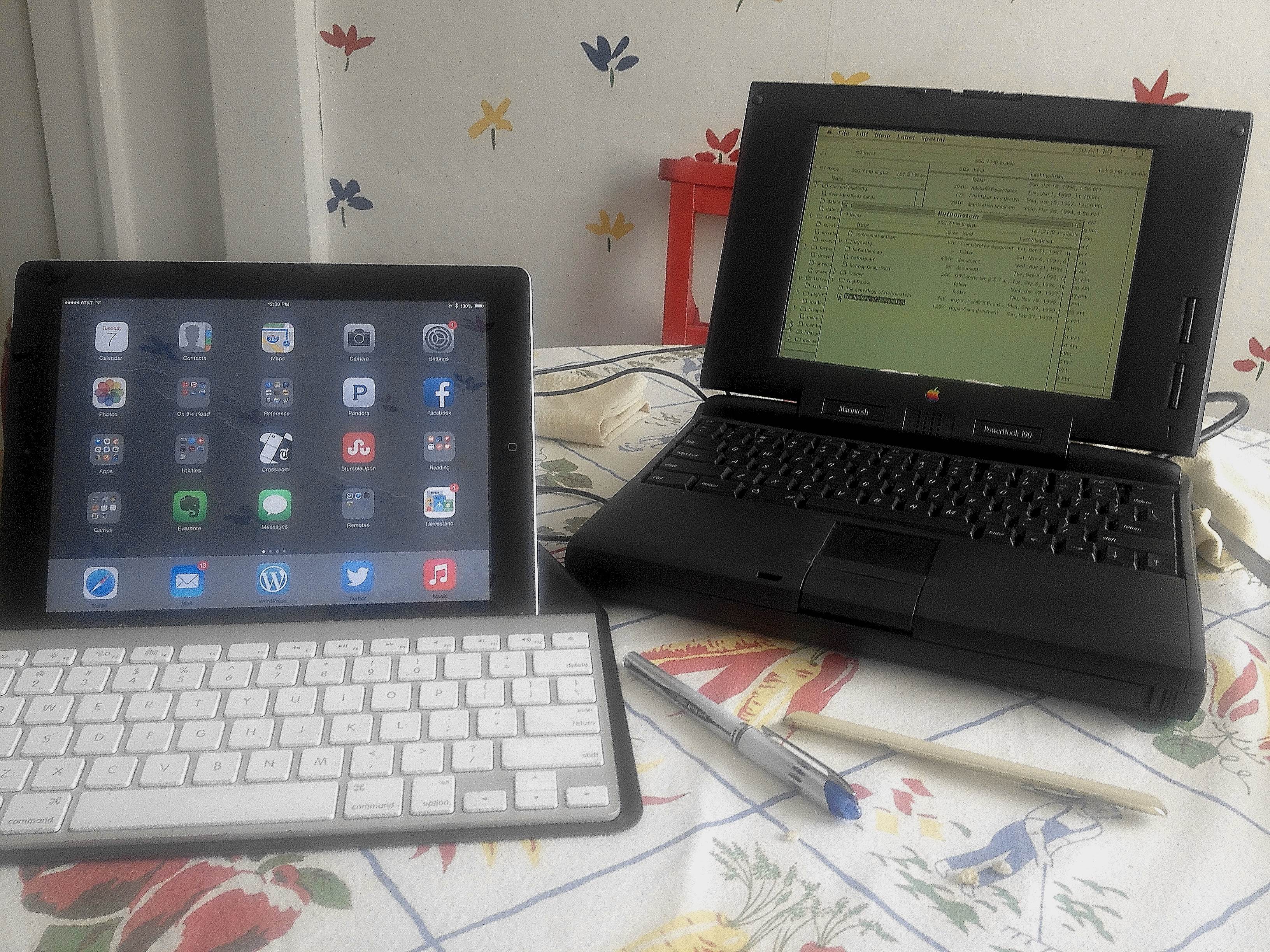
Click to embiggen.

On the left we have my iPad with its stand and keyboard.  On the left is a PowerBook 190, still viable, and still running OS 7 (!).  It would have been the computer I was using back when Barbara got married, at least the one I toted back and forth from home to school, so I had hopes the poem would be on it. (It wasn’t.)

Look at the difference twenty years makes!  Both are representative of the top of the class of portable computing at the time of their release, but mercy, how far we’ve come.  Yes, an Apple Macbook Air would be a more direct comparison, but how would that even be fair to my little PowerBook?  The iPad is bad enough: in every way it’s smaller, faster, more powerful.  It’s wireless.  It syncs itself.  Its screen is bigger.  It has color.

The poor little PowerBook would not have the memory—or the hard drive space—to run any of the major apps on the iPad, and the iPad is chock full of them.

The idea that I would use my laptop to play my entire music library would have floored me.  In the early 90s, my collection was just beginning the shift from LPs to CDs—the LPs (more than 300) were recently tossed from a closet at Newnan Crossing; the CDs still clutter a corner of my study and I increasingly wonder why.  Now it’s all on my current laptop, and most of it is on my iPad.  And that’s not counting the music services like Pandora or Songza available to me on both.  (Or randomly generated cat purrs…)

I can watch freakin’ movies on the iPad.  I can take photos on the iPad. I can create videos on the iPad.  I can take my finger or stylus and handwrite music which will play back for me, or use GarageBand to create whole pieces.

The iPad will show me satellite views of anywhere I want to go, and then get me there, all the while keeping me informed about traffic.  I can control my TV, my wireless sound system, even start my car with the iPad.

All the fonts on the PowerBook were bitmap; you’d have to be insane to use a bitmap font today, assuming you could even find one.  (Of course you can find one.  What was I thinking?)

That’s not even considering the ecosystem that each exists in—I can’t think of a way to compare them.  (And that’s not even mentioning that I can do all of this stuff on my phone in my pocket.  For a similar post to this one, see here.)

And even so, the PowerBook was just as magickal as the iPad.  I could send email, chat in chat rooms, set up and run a network, produce documents on laser printers, electronically catalog 10,000 books in my new media center—none of which I could do even ten years before that, and as for twenty years before that: no.

Let me clear: I am not one given to oohing and aahing over where we might be in another twenty years.  What with yesterday’s elections, I’d say we’ll be lucky still to have fire and the wheel, and so I will content myself with looking back and marveling how far we have come from the past.  It’s all perfectly cromulent magick.