Not an update

This is not an update.  It’s just that I haven’t blogged in a while and I wanted to assure my legions of readers that I’m still around.

The reasons are what you might expect: getting to Alchemy—Alchemy—returning from Alchemy—decompressing from Alchemy—starting final preparation for my son’s wedding next weekend.  All that kind of thing.

I promise I have a lot to share—just no time to do it right now.

3 Old Men: staff update

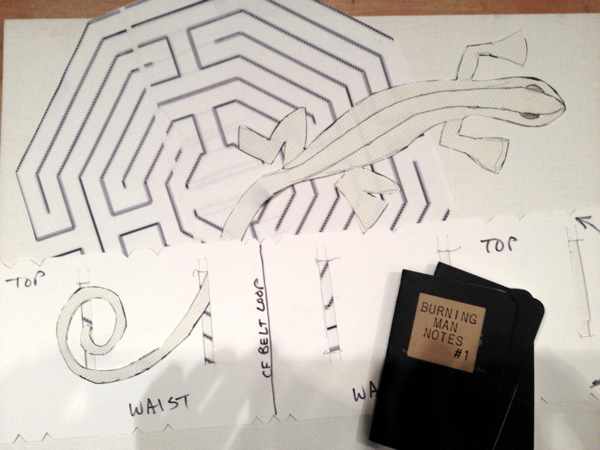
Remember how I kind of wanted jewels for the eyes of the lizard on the staff but never really went back to the idea?

I was in Michael’s picking up some white acrylic paint for one last 3 Old Men project—Alchemy is this week, YOU GUYS!—and there was this whole series of new paint substances.  This one looks like glass or clear sugar candy, and I snatched it up.  Ooohhh…

3 Old Men: the skirt (day whatever)

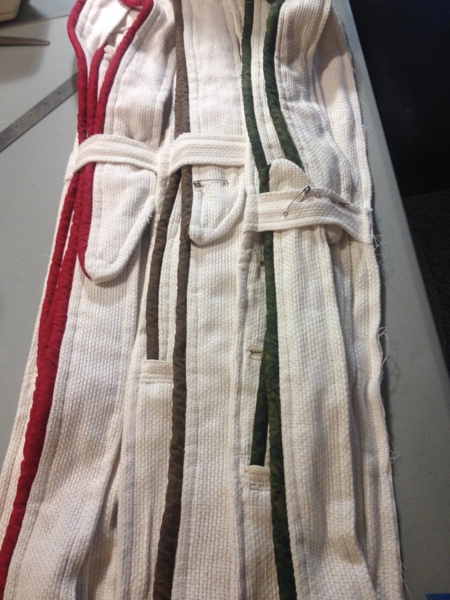
I have not been boring you with all the step-by-steps of getting the other four skirts made—you’re welcome—but I do want to show off.  Here are three of the four waistbands:

I’m missing enough material to have made the fourth one (although this morning it dawned on me that when I cut out two of the skirts, I should be able to find that).

Aren’t they beautiful?  You can’t really see the buttonholes through which the sashes will weave, but they’re beautiful.  The belt loops are beautiful.  The sashes are beautiful.

If I’m assiduous, I could have three of the four skirts entirely finished today and have time to go outside, do some planting, and in general enjoy the lovely fall weather.  I’ll keep you posted.

A quick foodie post

This is not really a recipe, just a concatenation of ingredients that turned out fabulously well:

It’s just kale chips sprinkled on grilled salmon.  It was suggested that perhaps I should put the salmon on a bed of kale chips, but sprinkling them on top lets them stay crisp/crunchy.  Also, the kale chips by themselves were oversalted; the salmon was lightly seasoned, and together they were quite a tasty balance.

Kale chips: olive oil, sea salt, white pepper; bake at 300° for 10 min, turn the baking sheet, bake for another 15 min.

Salmon: marinate face down in lemon juice, garlic, and olive oil; turn over, season with salt and black pepper.  Grill.

My center

I have been so focused on sewing skirts for 3 Old Men that I haven’t really had time to get out to the place that is my center: the Labyrinth.

Here’s what I’m seeing:

Click for full size photo.

Why is this the most beautiful spot on earth for me?  Let us count the ways.

  1. It’s a labyrinth.  Duh.
  2. I built it.  By myself, with my own two hands.
  3. I designed it.  It includes a couple of features that I have seen nowhere else in my research:
    1. The western path, i.e., a path of bricks that lead from the center to the west.  Sometimes, you need to take the high road home.
    2. The hidden path, i.e., there is a fully paved path leading from the entrance to the center.  I dug a trench, laid out the full walkway, allowed myself to walk the path to the center and back once, then covered it and laid out the labyrinth over it.  So there is a path straight to the center—but we can neither see it nor use it.
    3. The center is an omphalos: a navel, an axis.  The black granite circle rims a ceramic bowl that I made—and the cracks that happened as the clay dried are now golden hieroglyphs.
  4. It’s green.  Green and white are the only colors I’ve used down here, although the spider lilies that show up right about now are a lovely and welcome surprise.
  5. It has a firepit.  I cannot over-extol the virtues of a firepit.
  6. It has four points: the gate at the eastpoint; the Richard Hill “Sun” sculpture at the southpoint; the Brooks Barrow limestone bowl at the westpoint; my earth sculpture at the northpoint.  Each offers a post at which you can hook into their specific energies.
  7. It, further, has a sculpture of the Belvedere Apollo (near the southpoint); and a sculpture of the Dancing Fawn, stand-in for  Dionysus, at the northwest point. You get to choose.
  8. It has a sound system.  Yes, it does: two in-ground speakers, one up by the entrance, the other in the ferns by Dionysus.  At certain points in the evening, it’s nice to be able to walk the labyrinth and be able to hear even the quietest pieces no matter where you are.
  9. It has a great view of the full moon—but you have to get out of your seat by the fire and go stand in the labyrinth.  This is a feature, not a bug.
  10. It has an energy that you have to experience and cannot be described.  Arrive early, an hour before the sun sets.  Sit.  Watch.  Listen.  Then we’ll light the fire.

3 Old Men: the skirt (day 5)

First of all, apologies for not really blogging.  Events have all conspired against me blah blah blah.  I hope the Bad Etchings have entertained you in the meantime.

Recently on Facebook I did one of those challenges where I listed ten books that have impacted me.  Today, as I was working on sashes for the four Old Men skirts, I was reminded of one that truly changed my life, one that didn’t occur to me while making the list because its lessons are so deeply embedded in me that it never surfaces for trivial things like the Facebook list.

That book is Cheaper by the Dozen, by siblings Frank B. Gilbreth and Ernestine Gilbreth Carey.  The movie is irrelevant, and in fact I don’t much remember the charming shenanigans of the Gilbreth family in the book.  What I do remember is what their parents did for a living: both mother and father were famous efficiency experts, and what they discovered through their motion studies in factories changed my life forever.

Put in its simplest form, it’s this: if you have a multistep task that you have to do repeatedly—as most factories have to do to assemble their products—then you perform each subtask of the final task all at the same time before moving to the next subtask.

So with my six sashes, I cut all the monks cloth panels first, then serged all six, then cut all six colored linings, then marked them, etc.

At the turn of the last century, as America geared up to become the industrial powerhouse it became, the Gilbreths played a key role.  We already knew about standardizing parts, but we were still in craftsman mode.  Even in the new automobile industry, we were apt to have crews who assembled the whole car from start to finish.

The Gilbreths changed that.  They showed to the way to Ford’s assembly line; as the great man says in Ragtime,

Even people who ain’t too clever
Can learn to tighten
A nut forever,
Attach one pedal
Or pull one lever
(source: http://www.lyricsondemand.com/)

And so on we moved.

The main way it makes the individual craftsman more efficient is that you’re not always shifting mental gears for the next subtask.  Instead, you can settle into the rhythm of pinning the monks cloth to the lining, for example, and then once that’s done, set up the new rhythm of basting the two pieces together.  And so on I moved.

The other major strategy I got from the Gilbreths—and which I do remember played some part in the hilarity of the book—is arranging your parts and pieces so that they are 1) within easy reach; and 2) in the same order that you’re going to need them.  I can’t tell you how many times I have caught myself in some project or other reaching across myself or the product to pick up something I needed.  I almost always stop myself and rearrange my workspace.  I hope that the Gilbreths would approve.

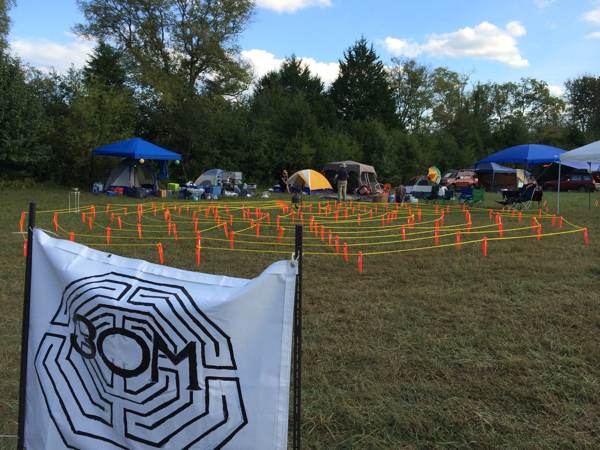
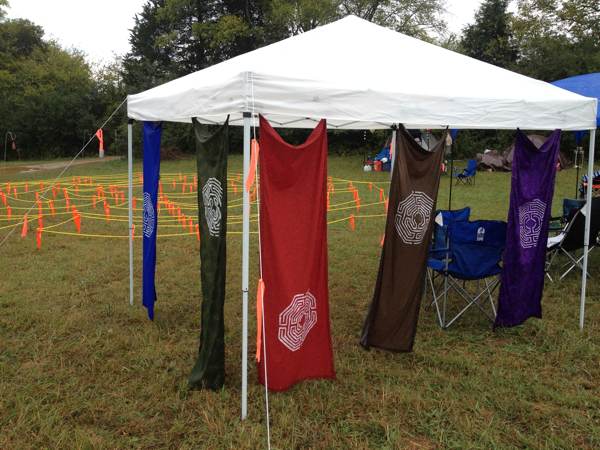
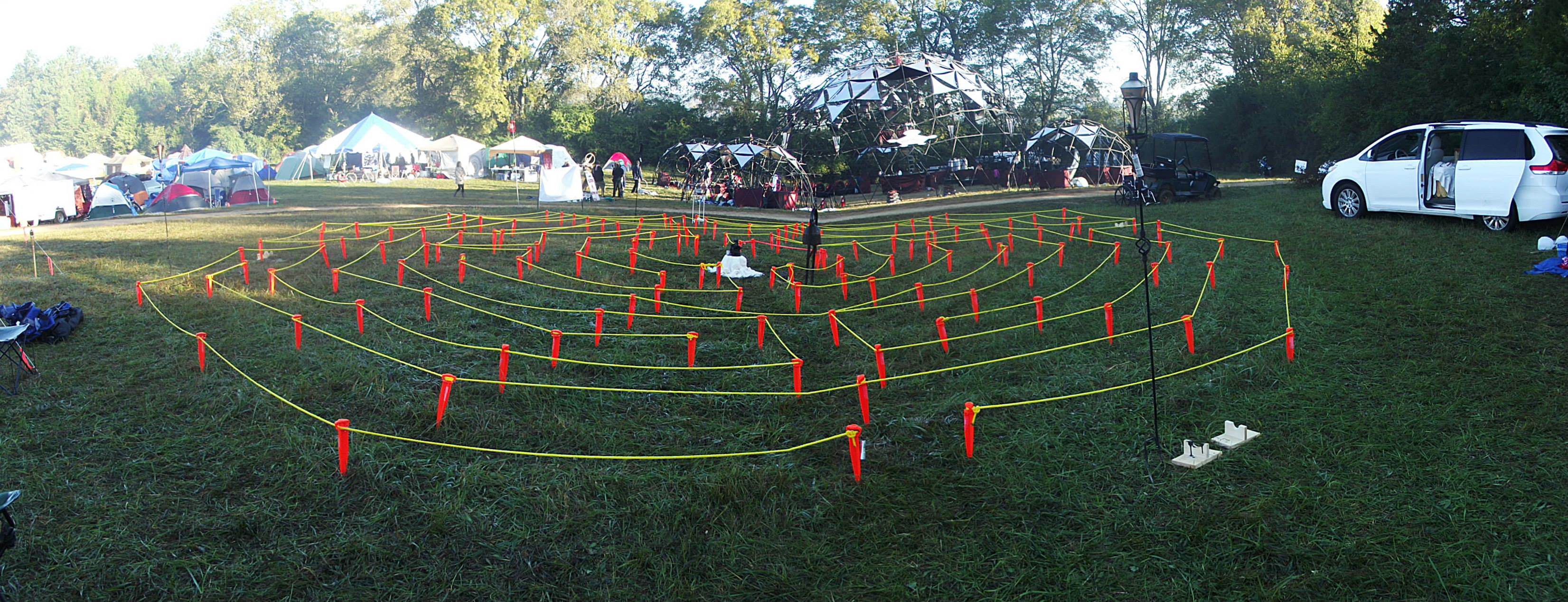
Last Saturday, members of the 3 Old Men ritual troupe met to assemble the labyrinth for the first time and to run through the ritual.  I am drawing a discreet curtain over our experience—sometimes you, dear reader, need to encounter the sacred directly and not through my reportage—but I would like to show you the labyrinth.

You will recall that I had designed an octagonal labyrinth with four entrances, to be made of 144 tent stakes and about 1000 feet of rope.  You may also recall that I designed the method by which we would lay this out, by using a triangle of rope like the Egyptians.

And you know what?  It worked.

Here’s our Egyptian triangle:

Staked to the center, the ropes form a right triangle when pulled tight, creating a 22.5° arc at the center.  The two long ropes are marked, indicating where the stakes are to be driven (with a few variances).

Here’s that in action:

Give or take a couple of boneheaded mistakes—missing an outer stake, not taking the long ropes all the way to their last stake, that kind of thing—it worked beautifully.

Look:

It’s going to be a wonderful thing we’re doing at Alchemy and, next year, at Burning Man.  I’ll talk more later about the actual experience of walking this particular labyrinth.

3 Old Men: the skirt (day 4)

So I rebuilt the sashes, and they work much better.

The new layout:

I laboriously cut the monks cloth along the weave, serged the edges, and basted it onto the lining.

I gave myself a broader strip in which to enclose the piping.

Et voilà!

They’re much cleaner with no loose edges to torment me.

In other news, I took a deep breath and finished the waistband and attached it to the skirt.  I’m all done except the center back seam, which I will do today.

However.

I pinned together the waistband in the back and tried the thing on.  I am not at all pleased with the results.  The waistband is a marvelously beautiful piece of work, but it’s too bulky.  I’m going to have to play with it more, especially this weekend when the Old Men meet to put together the labyrinth for the first time and test drive the ritual.

And no, I am not posting photos of the skirt in situ, as it were.  You will have to attend a Burn to see that.

update, 9/12/14: After working with a couple of entirely new designs, I revisited my finished skirt and decided to try just cutting off the top three inches of the waistband, i.e., the floppy, un-rollable mess.  Et voilà, it worked.  The result is clunky in a really groovy neo-Phoenician way.  I think the team is going to approve.

3 Old Men: the skirt (day 3)

It’s awfully useful being a polymath, don’t you think?  For example, once you understand that a doughnut is the same as a coffee mug, then it’s just a short jump to sewing.

Because one thing that fascinates me about costuming was how you can take a variety of oddly shaped and definitely flat pieces of fabric…

…and turn them into…

It has never failed to amaze me.

So it’s a good thing that I have a spatially oriented science-fu brain, because today nearly drove me around the bend.  I can’t imagine trying to figure this out without a lifetime of watching spheres turn inside out.

I was working on the sashes for the waistband.  The hard part was that we—and by that I mean Craig—decided that we needed a strip of color on the sashes.  That means covered piping, plus a lining to give the monks cloth enough body to survive being tied repeatedly.

Here are three of the four colors:

Here’s what makes this hard: the sash is sewed as a tube, then turned inside out.  (See the belt loops for a simpler example.) That means you have to figure out how to enclose the piping along the seam so that when you turn the whole thing inside out, you get a flat sash with the colored piping emerging from the seam.

I sketched some possibilities, but mentally I knew they wouldn’t reverse properly.  Finally I had to build a prototype out of muslin:

See the circled part?  That’s the casing for the piping.  [N.B.: Jobie is not allowed to comment on this photo.]

When you turn this inside out, it looks like this:

So that works.

First step is to baste the piping into its casing:

Then apparently magic happens, because I have no photos of the layering/ironing/pinning process.  It was not fun.  I have decided that I will be a) serging the edges of all pieces of  monks cloth; and b) basting them onto the lining.  Otherwise, there are too many loose edges that don’t get caught up into the seams.  In fact, if I serge the edges of the monks cloth—just now realizing this… doh…—I can just straight stitch the whole thing.

(Now I’m wondering if I need to back up and re-do my sashes…)

Here it is, unturned:

Again, Jobie is not allowed to comment.

And what does it look like when finished?

It really is pretty.  But I think I’m going to remake them tomorrow.

3 Old Men: Skirts (day 2)

So I didn’t document the first day.  Sue me.

I went to draft the pattern for my skirt, and I knew that something about the topology of the waistband was not going to be right.  I had been drawing it attached to the skirt itself, i.e., all one piece, just because I was hoping to have an easy job of it.

But of course—and especially given the redesign I had to come up with—the waistband had to be a separate piece.

The aforementioned redesign:

There will be two separate sashes (more about which tomorrow) that will be sewn into the two outer buttonholes, then weave their way across the front, go around the back through the belt loops, and back to the front, to be tied through the front loop.

So each waistband will have three belt loops, six faced buttonholes, and two sash halves.

Here we go.  First, the belt loops are lined with muslin for a little sturdiness.  I’m making two huge lengths and then cutting off what I need.  Here they are all pinned:

And heavens bless my old friend Stella Lang, who loaned me her serger for this project.  Here’s the above edge all serged:

That may be hard to see, but with a fabric like monks cloth, serging is a must.  Otherwise the stuff just unravels.

That tube now gets turned inside out, pressed flat, and topstitched on the sides:

I cut out 28 rectangles of muslin—planning ahead, since each skirt will need six, and there are four Old Men in the troupe.  Marked them where the buttonhole will go, and positioned them on the waistband:

I feel like Marcel Duchamp, except that he had the luxury of randomosity.

Those get zigzagged down and up: 1

Those get slit, and we add the belt loops:

Those facings get turned through to the back:

Tomorrow I will topstitch around the buttonholes, create the sashes, stitch those in, probably topstitch across the middle of the waistband, then add a backing layer of monks cloth.

Easy, right?  And I only have to make three more!

—————

1 Actually, I should have just straight-stitched them in a rectangle around the cutline; it would have made for a tidier turn.  But on the whole I’m going with overkill with this monks cloth.