Lamest. Ad campaign. Ever.

OK, so this is a totally irrational rant, but something in me snapped and I just have to get this out of my system: Yo, Georgia Natural Gas, what is up with that natural gas dude?

Is that not the lamest ad campaign ever? It’s not witty, it’s not retro, it’s not subcultural. It’s just retarded.

First of all, it’s a guy in an Izzy suit, only with a face cut out so you can see the poor bastard. What kind of advertising company in Georgia abrades the public’s consciousness with memories of Izzy? A retarded company, that’s what kind.

Secondly, this freak’s little pronouncements on his billboards are not pithy or cute. They’re just retarded.

The whole thing is so incredibly lame that you have to wonder, what were they thinking? The goal could not possibly have been to entertain us, or to charm us, or to endear themselves to us, because the whole concept is retarded. What are they trying to do? To enrage the public so much that their only recourse finally is to climb the billboards and deface them with spraypaint? Because that’s what I’m about ready to do.

You know what would make a good website? I mean, in a sick, retarded kind of way? Go to every single one of this creature’s appearances and stalk him. Really: get a friend, and both of you show up at every single event, smiling and beaming and getting both of your pictures taken with him. Every time. Pictures of you hugging him, kissing his cheek, with your face painted blue. Make a big hairy deal out of it. Ask him when his next appearance is, and be there. If he ever makes up a date, claim that you waited hours for him when you see him at his next gig. Blog your adoration of the Gas Guy. Invite others to share in your fascination. Watch the webclicks mount up as all of Georgia laughs itself silly over this retarded, retarded advertising trope.

And maybe then, and only then, will Georgia Natural Gas blow this little fart out.

The Penultimate Peril

I have just finished reading The Penultimate Peril, Book the Twelfth in A Series of Unfortunate Events by the inestimable Lemony Snicket. This is a completely subversive book.

First of all, there is no way this can be considered children’s literature. In tone, in style, and in philosophical underpinnings, this book is the equal of David Foster Wallace’s Infinite Jest or David Mitchell’s Cloud Atlas. I’m not joking. Snicket has extended his marvelously snarky Victorian narrator’s voice into something that is meta-post-modern wonderful, a word that here means “full of wonders.”

The basic “mirror” motif, the convoluted sentences, the convoluted plotting (which was always circular and inconclusive and in any case grinds to a halt, about which more in a moment), the moral uncertainty: by the time Snicket reaches the end of this, the longest of the books, it all has spiralled out of control and dissipates like the smoke of a building burning to the ground.

I was about to type “moral ambiguity,” but it occurs to me that morality in this book is not ambiguous. The cartoon-character versions of good and evil which have sustained the series still operate, but they are reflected back and forth in Snicket’s moral mirrors so often that we end up looking at multiple images, splintered and reassembled into scary chimeras of truth. The climactic sequence, absolutely thrilling in its breathless action, takes a while to register, but Violet, Klaus, and Sunny take action against the forces of evil in ways that are in themselves questionable, and there is one moment in the ultimate penultimate peril which is truly shocking. The children’s acceptance of a kind of Realpolitik is disturbing, but then again, dear reader, have we not spent the previous eleven books wishing they would just kick butt? And now, finally, they have.

I say “finally” because it is my belief that this is the end. I know Mr. Daniel Handler, Snicket’s spokesperson, has been quoted as saying the last book will come out in the fall of 2006, but I have reason to believe he’s lying. He has always hinted there would be thirteen books in the series, and there are: twelve in the history of the Baudelaires, and the Unauthorized Autobiography which came between Books Eight and Nine. The location of this book, the Hotel Denouement, is an in-joke, of course; the denouement of a play always comes at the end. Technically, as Snicket points out, the denouement is not the very end, but also technically, the denouement is the untying of the knots of the plot, which signally does not occur in this book. “Unravelling” would be a more apt translation in this case. Snicket throws out enough hints and clues and observations to lead us to a gorgeously complex denouement, but he does not do it. I believe he has chosen to leave all the loose ends loose.

The title of the book, Penultimate Peril, suggests that there is one more volume to come, but this book reads like a finale. The ambiguity of the Beaudelaires’ situation, of VFD, of Olaf and Snicket and all the rest, is reflected (!) in the ending, which at face value is just another cliffhanger, but which I believe is the final ending. Do we get answers? Do we get a happy ending? Do we get an unhappy ending? No, no, and no. And that’s Mr. Handler’s joke.

A brilliant book. I shall be very disappointed if there is another. Unless of course he does tie up all the loose ends. Bastard.

Music for the soul

A couple of summers ago, I went to check on how World War I was going in the classroom of my friend Dave Adams. When I got there, Germany was still posturing, the U.S. was still smug and quiet, and everyone still hated France. While Europe parleyed, music played. I complimented Dave on the music, and he offered to make me a copy of the CD, which he had put together from his collection. He called it his Music for the Soul CD; its contents represented music that resonated deeply for him.

The idea of creating a CD that was filled with music that had special meaning for your soul is right up there with the “10 books for your desert island” meme, but unlike your mythical shipwreck, this is one you can actually do, although I have to say that if you don’t have iTunes, you really really want it on your computer before you try.

I don’t think it would surprise anyone to find that mine is devoid of pop music.

Here’s my list:

  1. Allegretto, mvt. 1 of Symphony No. 2 in D, Sibelius
  2. Prelude, mvt. 1 of Cello Suite No. 1, J. S. Bach
  3. “Juice of the Barley,” an English country dance
  4. Allegro, mvt. 1 of Piano Concerto No. 2 in b minor, Dohnányi
  5. “The Hours,” from the movie soundtrack of the same name, Glass
  6. “Komm, eilet und laufet,” mvt. 3 from Easter Oratorio, J. S. Bach
  7. “Towards the Dream,” from Dreamtime Return, Roach
  8. “Prelude and Fugue No. 7 in A major,” from the 24 Preludes and Fugues, Shostakovich
  9. Fratres, Pärt
  10. Canon in D, Pachelbel
  11. “The Breaking of the Fellowship,” from The Fellowship of the Ring, Shore

The amazing thing about this lineup is that it seems all of a piece. There is contrast between tracks, but there’s an odd coherence about it all. Even the last track, the Fellowship of the Ring piece, segues neatly back into the first track, the Sibelius. One thing that helps the coherence is that most of the works seem to be related to the key of D: D major, b minor, A major, etc.

This CD must truly be my music of my soul, because I never seem to tire of it. I have gone months at a time with nothing in the CD player in the car but this, and it never palls. Even the child has noted that there’s something interesting about the CD, both as a whole and in its parts.

Stylistically, of course, it’s all over the place: baroque, post-romantic, minimalist, new age, movie music, for god’s sake. What could possibly hold it all together?

And why is this music for my soul? What does this say about me? I shall hazard a guess. It’s complex, esoteric, cerebral. It’s melancholy, mostly underneath but occasionally on the surface. It’s coherent, no 12-tone horrors here. It moves, none of it is static, the Glass, Roach, and Pärt notwithstanding. And much of it is inward-looking. Yep, that about sums me up.

Random reminders

Today I was running off some News from the Media Center newsletters and putting them in teachers’ boxes, and a few memories flooded back: I print my newsletters on paper I’ve recycled from the copier at the Governor’s Honors Program, so things will show up on the backs of stuff that remind me of what an incredible intellectual playground GHP is.

Today, there was an entry on war from the Stanford Encyclopedia of Philosophy, from Daniel Byrd’s course on Just War; a piece of music score paper with handwritten music theory assignments; the Black Knight scene from Monty Python and the Holy Grail, in Latin, along with the lyrics to “Oops, I Did It Again” and “We Are the Champions”; an algorithm for a “super-random” number generator; and pages from my own “Sonnet 18” in progress.

There might just as well have been material on emotional attachment disorder, Anglo-Saxon poetry, comic book heroes, the history of the Bible or the Koran, microgenetics, Shakespeare, architectural elements, business law, the Arabic alphabet, Machiavelli’s The Prince, orchestral parts to Stravinsky’s Firebird or Haydn’s Lord Nelson Mass, personality traits, or Stanislavsky’s acting theories.

This is the kind of stuff that fills the six weeks of every summer in Valdosta as we make our way through the program. Just imagine the kind of student who eagerly devours this material, imagine nearly 700 of them, and imagine the teachers who bring it all to them. This is the life I lead each summer.

Finally, evidence for Intelligent Design

A couple of weeks ago I was stuck at home with pneumonia, and one afternoon, after one part or other of the Lord of the Rings trilogy finished, I found myself face to face with Maury Povich. Merciful heavens. I have never seen a more wretched hive of scum and villainy, and I ran a community theatre for over twenty years.

It was almost enough to make one abandon one’s belief in Intelligent Design. I mean, really, who could think that an intelligent force would design creatures capable of those kinds of choices? In one sitting, I saw a woman fail a lie detector test and thus be proven a multiple adulterer; a woman confess to her fiancé that she was having an affair with her female neighbor; and a woman dying of colon cancer confess to her boyfriend that she’d been unfaithful more than 100 times and couldn’t be sure that their two children were his. I missed the segment where a man confessed to his wife that he made pocket money as a male prostitute, but that’s probably just as well.

There ain’t nothing intelligent in the incredibly untidy lives these people have lived, nor in their insane compulsion to confess their missteps, nor to do so on national television. If one were looking for patterns that betrayed the presence of an Intelligent Designer, one would not find it on Maury Povich. Quite the contrary.

I suppose that if one examines the tenets of Intelligent Design, no one is making the claim that this Force (whoever she is) is necessarily benevolent, and I know there will be those who take refuge in the old shibboleth of Free Will, but if I’m going to invent an all-powerful Intelligence who can operate outside the laws of the physical universe, I would hope I at least had the sense to make sure that He/She/It had our best interests at heart.

That got me thinking, in my fevered, antibiotic-induced way, about other particular shibboleths of the IDers. One of their favorites is the eye: how remarkable, how complex it is; surely it couldn’t have just evolved, could it?

Oddly, I remember thinking in 4th grade, as we studied the structure of the eye, that something was screwy with its design. I mean, the cones and rods are backwards, aren’t they? Shouldn’t they face toward the incoming light in order to be most efficient? And what’s up with the blind spot? Why would you run all your cabling out through the middle of your CRT?

And then I thought… testicles. Testicles. If there were ever any fleshy bit that just screams out “random selection,” surely it’s testicles. What kind of Intelligence would design something as stupid as testicles? Let’s face it, guys, any one of us could come up with better ideas on how to stow those puppies in a better place.

For one thing, we might have decided to make sperm a little tougher so that they could survive at 98.6° instead of having to be stored in little dangly pouches outside the body. We could have snuggled them up there somewhere and encased them in protective cartilage or something. Could have made that a pretty useful kind of thing, too, sort of a built-in implant kind of thingie.

But no. There they are, all wrinkly and silly, just waiting to be whacked by a teammate or opponent, or a lover, or even an excited 18-month-old. What’s intelligent about that? Not much, in my opinion.

Discernible purpose in the design? I suppose you could make a case for pleasure, that they’re awfully fun to play with, if not to look at, but I don’t imagine that’s the kind of case that most Intelligent Designers are willing to make in public. So what kind of Intelligent Force would design such a thing?

And then it occurred to me, in a flash of inspiration. If one is willing, as that President Bush has recently said, to explore all sides of the controversy, then the answer is pretty obvious: testicles are clearly the product of the fiendish Intelligence of the Flying Spaghetti Monster.

Isn’t it obvious, guys? We were made in his image, right down to the noodly appendage. This is the only possible explanation that fits in with the agenda of the IDers: Testicles are a testament to the FSM’s almighty power, not to mention his sense of humor, and are a daily reminder to half the population of his presence, or at least of his impetus.

So there you have it: either we can think that testicles are the result of one too many random switches being thrown, an evolutionary path that hung a right instead of a left (sorry…) a long time ago, or we can recognize the overwhelming Intelligence behind their design. Seems an easy choice to me.

Another Katrina story

Last night I had dinner with some people with whom I don’t want to dine again for a very long time. I don’t see them on a regular basis, but I’ve known them for many years.

Our dinner conversation turned, of course, to the Katrina disaster, New Orleans in particular, and for the next ten minutes I heard nothing but abuse of the city and its inhabitants. One person who had grown up there flatly said it should not be rebuilt, that it was a hell-hole. Others repeated right-wing half-truths that clearly had already taken root after being planted by that President’s team of spinners. No one expressed any sympathy for the people who had lost everything. No one expressed horror at the terrible catastrophe that overtaken fellow Americans. No one mentioned the failure of our national government to provide the kind of assistance before and after the disaster that is clearly its function.

Here are phrases I heard last night: “New Orleans has more public housing than anywhere else”; “Why would they go back? They were all renting anyway”; “The oil companies wouldn’t locate their refineries there because the cost of the bribery was too high”; “Everybody knew you bought your drugs from the cop. He got it free from people he busted”; “It was just a dirty place”; “You can’t tell me they couldn’t have gotten out.”

The last few times I’ve gotten together with these people I have had uncomfortable experiences because it’s been clear that they’ve drifted farther and farther to the right, but last night I was repulsed. Unable to think of anything to say without absolutely losing it or without embarrassing my hostess, I maintained a stony silence and left the table as soon as I had finished eating. This has gnawed at me; I should have rebuked them and left entirely.

These are people who are extremely active in their church. You would call them religious. The empty Baptist phrases spill out of their mouths with the ease given to the true believers. But last night, I strained to hear even an echo of “whatsoever you do unto the least of these, you do unto me,” and I failed.

I’ll tell you what I did hear, however. I heard that if some other person or group of persons is different from you, i.e., not middle class, white, and sanctimonious, if those persons are poor, or lazy, or criminal, it is appropriate and just to wish them misery, destruction, and death. If they do not fit within the narrow parameters of your narrow faith/vision, then let them die.

And what I want to know is, how is this different from those faithful who drove the planes into skyscrapers?

Theater drops Klan play | ajc.com

It seems (Theater drops Klan play | ajc.com) that the Arts Station theatre got cold feet over hosting a staged reading of a play about Klan rallies at Stone Mountain. It seems that the opening monologue was not only “racy,” but also “inciting, and slanderous about Jews and Catholics,” according to the director. So they’ve canceled the reading.

I have some questions, since I don’t know any of the people involved, nor have I read the script. I did, of course, run the Newnan Community Theatre Company for over twenty years, so I might actually have a little insight here.

First of all, every theatre has its mission. Ours was to provide a wide variety of theatrical experiences for our audiences. Notice the plural. We didn’t have an audience, we had several different audiences. This allowed us to do whatever interested us as artists, since we were not interested in limiting ourselves to material that it was safe to bring the kids to. (I use the past tense here because of course I cannot speak for the company in any official capacity, currently led by the inestimable Dave Dorrell, but they’re doing just fine without me.)

So my first question is, What is Arts Station’s mission? Is this the kind of play they seek to do? If not, then why did they agree to the staged reading? If it is, then why back off?

Did no one read the play before they agreed to do it? Did the playwright tack on the monologue after they got into rehearsals? How did the “problem” with the monologue go unnoticed until announcements had been made?

Was this an actor problem? Did some actor suddenly decide that “he” couldn’t say those words?

Why the sudden panic over community relations? Are their audiences so generally unsophisticated that such venomous language genuinely offends them personally? Their lineup is hard to read, but it doesn’t seem to be very “hardhitting.” That’s not a condemnation, by the way; it’s all a matter of what your mission is.

Aside, re: the language issue: there’s a good young adult novel, The Day They Came to Arrest the Book, by Nat Hentoff, about the attempted banning of Huckleberry Finn on the usual bogus racial issues, and for me the climactic moment is when a young black student addresses the school board and tells them, “I’m smart enough to know when I’m being called a nigger, and that’s not what this book is doing.” I’ve always assumed any audience that I’ve attracted is smart enough to know that the language in the play is not being addressed to them personally, nor is it being delivered personally by their friends and neighbors.

Still, this was just a staged reading, an agreement that you’ll give the playwright a chance to hear his words out loud, to hear if they work, and to share them with an audience who, because you’ve taught them, understand this is a work in progress. You even put up big red posters in the lobby warning them about the language and subject matter.

And if the opening monologue is too much, that’s when you work with the playwright to say that you understand what he’s trying to do, but it’s not working the way he wants it. Or something. You don’t tell him that you just can’t say those terrible words, because the time to do that was before you agreed to the reading.

And you don’t put out disclaimers that it’s the playwright and not you who’s doing the offending, because again, you agreed to an artistic partnership, and part of that partnership is that you agree with his message. You can warn people to gird their loins before the curtain goes up, but apologize for what you’ve produced? Grow some artistic balls, people. (That’s a generic commandment; again, I have no details about the situation at Arts Station, so I would not presume to issue directives to them.)

One more set of questions: Was this a board thing? Did some board member get antsy and then worry began to pile up and then panic began to set in and then “it was decided” that it would “better” if they didn’t go ahead with this thing?

Ah, well, who knows? Theatre companies are precarious, byzantine organizations, and those like Art Station who actually do provide playwrights with venues for new work are to be applauded. It’s just that when something like this actually hits the newspapers, unlike, say NCTC’s production of Pericles, which hadn’t been done anywhere in the Southeast at the time, or our world premiere of David Hyer’s Lying in State, currently playing at the Barter Theatre in Abingdon, VA, nor even our Mozart’s Marriage of Figaro, with a new translation, none of which got any coverage at all, then one does have questions.

Fun things to do with your SACS visitors

Yes, I’ve been lazy. It’s easy to get that way when you’re at the Georgia Governor’s Honors Program for six weeks, working with amazing kids and fabulous teachers 24/7. Here’s a little stopgap before I actually get inspired.

Those of you who are not educators might like to know that every five years or so your schools must be accredited, which means we must produce reams and reams of paper that documents that we are worthy. For us in Georgia, the accrediting organization is SACS, the Southern Association of Colleges and Schools. We crank out these volumes in preparation for a visit from the “SACS team,” which sweeps through like locusts in a three-day visit and not only reads our reports [::stifles snicker::] but also visits our classrooms and interviews random teachers and students and parents.

So, in order to better prepare us for our SACS visit, here are some fun things to do for your SACS visitors (Guess which one of these I actually did):

  • At breakfast, put food into your pockets, “for later.”
  • Whenever you meet a SACS team member, inquire amiably about this “SACS thing” and how they “got into it.”
  • When asked what the school’s mission is, say that it’s to “test the children until their ears bleed.”
  • Hang a black leather mask and cat-o’-nine-tails in your closet door.
  • Do the same, only in 1st grader size.
  • Whenever a team member’s back is turned, say, “Oops!” and then just smile broadly when they turn around.
  • Display the filthy limericks your class wrote on a bulletin board.
  • If asked about the emergency plan, just pat your pocket and say, “If anything comes up, I’ll know how to handle it.”
  • Replace all the alphabet charts with the Russian Cyrillic alphabet.
  • When queried about the school’s improvement plan, comment that you “don’t really cotton to all this modern stuff.”
  • Have e-Bay up on your browser, and periodically run over to check it.
  • Share with the team members your students’ exemplary ITBS score sheets, with the names obviously whited out and written over.
  • Keep the class hamster in your pocket. Or in your hair.
  • If asked what stumbling blocks you see preventing you from implementing your action plan, say, “The county administration.” Or “No Child Left Behind.”
  • Reach into your purse repeatedly and take a swig from the small bottle you keep there.
  • Say, “Class, can anyone tell me what Billy did wrong this time?”
  • Keep asking, “You’re not writing this down, are you?”
  • Give the children noogies.
  • Reward the children with skull tattoos.
  • Announce to the class, “Y’all go to the media center and read for a while. Miss _____ is tired and needs a nap.”
  • Shout “Food fight!” in the cafeteria.
  • Be showing Rambo, Part III when they walk in.
  • When asked about any aspect of the SACS report, give a wrong answer and then say, “No, wait, that was last time.”
  • Keep smiling!

Till next time!

At last it can be told

You know, that son of a bitch George Lucas would never return my calls, and now he’s finished up the whole cycle with bunches of light sabre fights instead of a deeply mythical twist.

Disclaimer: at this point, I haven’t seen Episode III. I am satisfied that it is better than the first two (I believe Buckaroo Banzai is better than the first two, and that is one lameass movie!), but my current rant has not been influenced by anything so vulgar as actually having seen the film.

So how should it have ended?

First of all, we have to go back and change Episode II as well. That movie was interesting for about ten minutes, when Count Dooku told whoever he was torturing, was it Anakin or Obi-Wan?, that he had built the clone army to fight against the Sith, since the Jedi Council was so obtuse. There was an interesting plotline: three sides to the upcoming cataclysm, one of them a renegade Jedi. Is he fighting for or against the Sith? Is he or isn’t he a Sith himself? You see the suspense that we could have been treated to, not only in Episode II but through much of Episode III as well. But no, Dooku was lying, of course, and the whole movie deflated.

Instead, imagine we’ve plunged into Episode III with this massive round of combat, intrigue, and betrayal going on. You got the Sith Lord, the Senate, Dooku and his army, the Jedi Council, replete with Yoda, Obi-Wan, Anakin, Mace Windu, Datare Gister (the “Fat Knight”), and the whole gang. Padmé and Anakin are married, secretly, and she runs to hide (on his orders) from the carnage as one Jedi after another is betrayed.

Things get more complicated till we get to where we need to be, i.e., Palpatine is Emperor and Sith Lord, Dooku is defeated by Anakin, and finally we have Anakin fighting two of the remaining Jedi, Obi-Wan and Datare Gister, on the edge of the volcano. He taunts them with the classic “No man may hinder me,” and of course Datare Gister, the Fat Knight, pulls off the Darth-Vader-like mask he’s always worn, and of course it’s Padmé, fat because she’s gi-normously pregnant. She stabs at him, he falls in, she goes into labor, wrap it up quick and leave it there. We don’t have to see it all, George. We know what happens after that. We saw Episode IV-VI, remember?

So anyway, I’d like to thank the Academy, and all the little people.

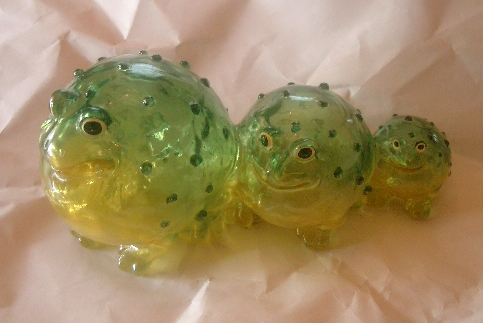
Reading the frogs

Ponder this:

I mean, what the hell, right?

This object was discovered in our local Big Lots, where truly one can find some beautiful things. This was not one of them.

It’s plastic, of course, and it was made in China, of course. But why? Bear with me here, there’s a lot to unpack.

If you go to Big Lots or Wal-Mart or Target looking for a spatula, you will find spatulas in varying shapes and sizes. A spatula’s a spatula, and the amount of thought that goes into the design varies with the presumed “reader” of the spatula. Basic flat spatule, metal or plastic, slotted or not, depending on the intended use; basic stem; basic handle. It is a utilitarian object, one that does not require a lot of thought as to its design. Design has to be deliberately applied to a spatula above a certain level (and I’m ignoring industrial design here, humor me.)

For example, beyond the basic metal spatule/black plastic handle concept, you may get different colors as we move up the design scale, in case your kitchen utensils need to contribute to the ambience. And sometimes, you may get that frisson of delight as you come across Michael Graves’ stuff in Target: oh, look, he’s designed the spatula. Isn’t it pretty? And if you move on up to Restoration Hardware or some other really trendy boutiques, the spatula is no longer merely an utilitarian object, it is an objet.

But for it to get that far, someone has to push it. The spatula doesn’t require that level of design to exist. No one has to suffer any artistic angst to get it out the door.

This is not the case with our little frog friends. Our little frog friends are not utilitarian in the least. They are, as hard as this might be to believe, decorative. There is not a reason in the world for them to exist, except for one: someone thought that people would want to buy our little frog friends in order to bring beauty into their lives.

Well.

In order for our frogs to exist, someone had to think, “Out of all the limitless possibilities of the universe, what I think would be best to create would be three puffed up toad-frog-things, in diminishing sizes, made of transparent injected plastic. Hollow, yes, that’s good. And gentle, anthropomorphic smiles on their faces. But otherwise not really recognizable as any member of the genus Rana as we know it. And to make it really pretty, tint the plastic so that it goes from apple green on top to chartreuse on the bottom. We’ll have to handpaint the eyes and lips, though.”

Lips??

So the artist goes to work creating this objet, and then all the terrific machinery of industry has to swing into action to create the molds, the plastic, the assembly line, etc., etc., and then the Midwestern Home Products company of Wilmington, Delaware, has to import them and distribute them. The questions still crowd in: did these go straight to Big Lots, or did they try their fortune in some tonier place first? Did Midwestern HP (of Delaware), purveyor of other fine products, cause this to be created? (There is some evidence that they did.) And if not, then who in China thought that the American public had a heretofore unidentified need for plastic frog triplets?

There is much about our little frog friends that might be understandable, if not forgivable, if they had been made by some artisan, hand-made-by-hand as we used to say in the costume shop: their squalid cheerfulness, the inexplicable bloated forms, the bizarre, hedgehog-like warts. If we knew that this was one of a kind, or maybe one of a limited series perhaps, from the hands of a not-very-competent glassblower, for example, we could wrinkle our brow, smirk in a self-satisified and über-conscious manner, and let it go with a knowing laugh. The creator hit a dead end. He screwed up. It happens, and you shouldn’t put it out there to be bought, but there it is.

But it’s not. It’s mass-produced. There have to be hundreds of these things, if not thousands, that were stamped out of the assembly line and shipped off to beautify the world. I for one cannot comprehend this.

It produces in me the same feeling I get when my wife and I go antiquing. There, on dusty and unregarded shelves, are legions of tschotschkes produced by the same inexplicable process that produced the frogs. They are without merit, and they are abandoned. No one is going to buy them, ever again. They have no cachet, they are not collectable, they are not even kitsch. They are, to be unkind, jetsam.

This has always caused me a little distress, seeing all this junk just sitting around these shops. It’s not that I empathize with the tschotschkes, you should know me better than that, it’s just the whole Darwinian waste of it all. It’s as if society, in the hopes of achieving some items of permanent beauty, spawns all this crap just to make sure that something survives.

And there’s the appalling thought that for these things to have arrived in the junk shop, someone had to buy them first. That is, someone once thought these little pieces of landfill were beautiful enough to bring into their lives to enrich them. And then someone thought they were beautiful enough not to throw away, but to buy, at whatever discount rate, in hopes of reselling them in the shop. Merciful heavens. What would dear Oscar say?

Still, I suppose I could look at it optimistically: so strong is the creative spirit in humans, that even people who are hopelessly second-rate artists force out these pitiful objects in the belief that they are beautiful. Do they ever realize that they’ve failed? And the people who buy them: are they abject Philistines, or is the human need for beauty so strong that people respond to it in even the most feeble embodiment? Should this objet distress us, or should we rejoice in our little frog friends as representative of humanity’s most divine impulse?