When Gwinnettians attack

Kevin demanded that I respond to this article:
Gwinnett teacher who refused to alter grade is fired | ajc.com

Well.

This is very messy, and everyone involved deserves a spanking.

The football player should be spanked (Let me! Let me!) for falling asleep in class. And also for not taking his lumps like a man. Little punk.

The teacher should be spanked for using academic grades as discipline. That’s a no-no, county policy or not. Is everybody listening? Grades are a poor reflection of the assessment of a student’s knowledge in your class, but that’s what they must be a reflection of. Not “effort,” not “notebook keeping,” and certainly not behavior.

If you want to teach students that behavior has consequences, then either use the regular disciplinary procedures of the institution or institute a “life skills” grade in your class, if that falls within board policy. But don’t alter the record of a student’s achievement in your class just to get back at him.

We used to have attendance committees in this county, back when we were taking another stab at doing something about kids who didn’t come to school. Every semester, we’d meet and look at appeals from kids who had missed too many days of school and who were thereby automatically flunked. One young lady appealed her automatic failure in this one class, pointing to the A’s she made on all of that teacher’s exams. We gave her the grades: if she could miss half that teacher’s classes and still make A’s on the exam, somebody wasn’t doing their job, and it wasn’t the kid.

The teacher should also be spanked for not recognizing that insubordination is pretty cut and dried. You’re ordered to comply with well-established policy, you refuse, you’re fired. What a maroon. He should have done himself and his students a favor by knuckling under, then circling back around and gutting the football player another way.

The administration of Gwinnett County School System should be spanked, and probably for more reasons than this. Why did they allow this to get out of hand? Why did they expose themselves to the suspicion that after ten years of turning a blind eye to an outstanding teacher’s lameass grading policy, they suddenly pounce when a football player’s grades are in question? The article doesn’t say, but I’m betting that the episode threw the kid’s eligibility into jeopardy. And we all know that’s a no-no.

Above all, Gwinnett County, you don’t throw out perfectly good science teachers. You probably need them.

So, Kevin, spankings all ’round. And then after the spanking…

Turtles all the way down

I was going to write about King Lear today, and I may yet, later. But in the meantime, eyes must be rolled and lips pursed over the state board of education in Kansas, hosting a little show trial for creationists before they vote to allow Genesis to become part of the state’s science curriculum.

But no, I hear them say, they’re not creationists. Oh, no, they’re proponents of intelligent design. G*d didn’t create the world… but it couldn’t have happened without him. Her. Them.

Honey, please. I am not about to get into arguments pro/con on this blog, because the whole thing is preposterous. But two comments made by the creationists testifying before the Kansas board bear examination.

One is the whole “teach the controversy” shibboleth. Charles Thaxton, creationist chemist and author of a book that says so, said, “There is no science without criticism.” He and his cohorts are described as arguing that Darwinism has become a dangerous dogma, and they are simply open-minded.

Fooey. Anyone who believes that Darwinism isn’t constantly examined and challenged by scientists of all stripes needs to vote Republican. All science is constantly critiqued. That’s what experiments are for. That’s what peer-reviewed journals are for. Biologists and their compeers have been bickering about the details of the evolutionary process since before Darwin sailed on the Beagle.

But suggesting that science should include ideas that cannot be tested is not open-minded, it is lame-brained.

Witness the other statement, by another chemist, one William S. Harris. He and his fellow travelers had been dazzling the Board with the complexities of RNA and all that jazz. “You can infer design just by examining something, without knowing anything about where it came from,” he said. Referring to the scene in The Gods Must Be Crazy in which the Bushmen marvel at a Coca-Cola bottle thrown from a plane, he said, “I don’t know who did it, I don’t know how it was done, I don’t know why it was done, I don’t have to know any of that to know that it was designed.”

Well. That was not exactly the Bushmen’s response, was it, Dr. Harris? If they had thought like that, they wouldn’t have assumed it was from the gods, would they? They would have realized it was a man-made object, albeit one from a society whose technology they could not fathom.

No, the Bushmen did not infer design. They inferred divine intervention, and that’s exactly what the intelligent designists want us to infer as well, despite their disingenuous pose.

Not only that, but while the complexities of life on this planet may cause some of us to infer an intelligence behind it all, they do not necessarily imply that at all.

One day an incident occurred in my elementary media center that put this in perspective for me. I was working at my table on my spiffy PowerBook laptop, using my graphics tablet pen as a mouse, when one of our special education students stopped by to watch in wonder as I worked. Finally she asked, “Mr. Lyles, is your computer magic?” I gently explained that although it looked like magic, it was just a very complicated machine, and demonstrated the tablet for her.

These people fall in the same category: it’s too complicated for us to explain, so it must be the work of powers beyond our comprehension. It is a lazy, intellectually dishonest way of looking at the world.

Turtles, all the way down.

Education research

I just completed a course in education research. Well, technically I haven’t completed it, because my main project, if it’s accepted by the instructor, can’t even take place until this summer, but in any case the course is over.

Here’s what I’ve learned: all data is bogus.

I know you’ll find this difficult to believe, but scientific research can’t seem to pin down what works and doesn’t work in our schools. “Smaller class size,” says the Kentucky study. “Not really,” says a study from London. “Accelerated Reader,” says Renaissance Learning and all its ‘research institute’ fronts. “Not likely,” says other studies.

“Read to your kids,” says all kinds of studies. “Nope,” says a study released today by the feds, which says nothing parents do makes as much difference as how much money they make and how much education they got before having children.

Well.

What’s the deal here? Big Pharma does this all the time: control group, test group, crunch the numbers, and hey presto! reliable data. And Vioxx.

So why can’t education do the same thing? This is an easy one: they can’t control the variables. Ever. In any way. Sure, you can “take them into account using statistical methods,” like chicken feathers and eye of newt, I suppose, but the problem there is garbage in, garbage out.

However, there is a bigger problem with educational research, and that is measuring results. Scratch a study and you’ll find they’re all about the same thing: increasing student achievement.

Quick: what is “achievement”?

You see the problem. Even if we all agreed that “student achievement” was properly measured by the standardized tests we have or might develop, which we don’t, by the way, the problem remains that the variables going into the results of standardized tests are just as squirrelly and uncontrollable as those skewing the study itself.

Here’s a direct quote from the horrible, horrible textbook from the course which just ended: “Of course, if the mechanisms underlying the creation of academic achievement were understood completely, and if each of the variables was measured well, then a longitudinal survey… could provide adequate information on causal effects.” [Haertel, G. D. & Means, B. (Eds.). (2003). Evaluating educational technologies: Effective research designs for improving learning. p. 196-7]

This of course is the classic Ham & Egg routine from vaudeville: “If we had any ham, we could have ham and eggs, if we had any eggs.” But nobody’s laughing, somehow.

Until we all agree on what achievement is, until we have a universal standard to measure and ways to measure it, then all educational research must be regarded with suspicion.

An amusing little contretemps

Here’s an amusing story from the New York Times, today, May 5, 2005, p.A11:

“American officials rushing to start small building projects in a large swath of Iraq in 2003 and 2004 did not keep required records on the spending of some $89.3 million in cash and cannot account at all for another $7.2 million, a federal watchdog reported yesterday.”

Well.

You might think that I, liberal as I am, might choose to rant and rave about this. After all, can you imagine the wingnut echo chamber’s rant if Head Start couldn’t account for $96.6 million? What would Rush and Sean and Anne say? I think we can agree that they’d be apoplectic.

But I’m not.

It’s not that much money, is it?

See, here’s a $100 million. (I’m going to round up for tidiness’ sake.)

It takes ten of those to make a billion dollars.

And what has Iraq cost us so far? Can we be charitable and agree on about $190 billion? I mean, that’s not even $200 billion. Then we’d be talking real money.

So here’s that amount. See if you can find our $96.6 million.

See, $96.6 million is just not that much to get excited about, is it?

What to do with smart illegal immigrants

You will want to go read this article: La Vida Robot. Go ahead. I’ll wait.

Wasn’t that the most wonderful article? Did you click on the scholarship link before you came back here?

This would be the best part of having won the lottery, reading a story like this one, and before you even get to page 2 of the story, click on that scholarship link and donate your little heart out. I could not only pay for their education, but pay for their access to appropriate legal counsel, and perhaps alleviate some of their families’ problems. And what would it cost? Not even half a million. If I just paid for their school, it would only be about $200,000. I’m assuming their legal counsel would add another $100,000, lawyers being lawyers.

Incredibly, there are those who read this story and who have a different reaction. There are those who read this article and take umbrage that anyone would want to allow these illegal immigrants access to American education. Why should we allow these wetbacks to take one of the limited state school slots in place of one of “our own”? Why should we spend our tax dollars on these people, these undocumented losers who sneak across our borders and steal jobs from honest Americans?

Or, to put it another way that probably the wingnuts wouldn’t, why would a nation like ours seek to embrace the best and brightest minds we can find and provide for their future, here, with us?

I put my money on the future with the best and the brightest.

Bang on a Can

OK, new topic. We all have daydreams about what we’ll do when we win the lottery. I’m putting mine on my blog as I come across them.

Today, for example, I received a very nice invitation from the folks at Bang on a Can, the new music concern in NYC. They’re having a fundraiser in conjunction with Bob Hurwitz of Nonesuch Records, on Tuesday, April 19, 2005, and I thought, why not? They’ve done some interesting things in the past, although frankly much of it is earsplitting, but hey, I’m always ready to be intrigued, and since money is no object now that I’ve won the lottery, let’s do it.

So I figure we’ll do it up right: a $10,000 Bang Benefactor donation, which entitles me to a 10-person table for drinks, dinner, and the concert, plus luxury accomodations, meals, and tickets to the BOAC Marathon in the Berkshires this summer, plus season-long recognition as a sponsor, plus four tickets to the BOAC All-Stars concert on April 29. That’s a pretty sweet deal.

This is assuming I can find nine other people who would like to attend with me. Perhaps I could put an ad in the Times-Herald:

Wanted: Adventurous persons who can stand new music, to accompany local aesthete to dinner and a show. Apply at P.O. Box 1039C.

I keep buying CDs of new music, trying to keep up, seeing if concert music is making any progress in reclaiming the human ear after losing it so disastrously with that soulless sojourn into serialism in the middle of last century. So far, it’s pretty hit or miss. Any one of the pieces I’ve heard that have been written since 1980, say, can be interesting in itself, but when you start lining them up and comparing them, most of them are much alike. Too much brass, too many broad leaps in the “melody,” too many 2nds and tone clusters in the harmony. As they cycle through the iPod, I find them impossible to identify, just so many angst-ridden tone poems.

And what are we to make of John Corigliano’s comment [pdf interview] that the 2004 Pulitzer Prize for music, awarded to Paul Moravec’s Tempest Fantasy, startled him because of its sunny nature? “I’ve never in my life ever seen a Pulitzer Prize go to a piece that is effervescent, not for the last 40 years,” he mused. Apparently recognizing that the overwhelming tone of much new music is tortured, he adds, “I think that it’s very important for us to have that rich experience in art and not to think of art in this romantic twisted view that art is only about anguish and angst. It isn’t. The best works of art of the 18th century were often comedies.”

Still, some new music can be exhilarating, and my official position is that people should keep writing it, because eventually some of it is going to work. It’s like when eminent musicolologist Prof. Peter Schickele refers to the “lesser but nevertheless competent composers that dotted the musical landscape of the Age of Enlightenment” in his lectures on P.D.Q. Bach: I think it takes all the ballast of less competent work to produce the geniuses of Bach (P.D.Q. and otherwise) or Mozart.

So, buy the $10,000 ticket, I say, and support new music.

This thing is taking place below Houston St., so clearly we’d need to stay at the Soho Grand, which is a really cool hotel. My treat. Since it’s on a Tuesday night, we’d have to fly in that day and back out the next morning so that people wouldn’t have to miss that much work. Not me, of course. I won the lottery and don’t have to worry about such things.

Governors, business, and the toughening of standards

On Feb. 28, the estimable New York Times reported on one of the seemingly biweekly governors conferences. (Perdue on the phone to Schwarzenegger: “Hey, I’ve never been to Rhode Island either! Let’s go talk about inner city crime!”)

At this particular conference, they were rattling around about No Child Left Behind, or as we call it at my school, Every Child Dragged Along, and the Times reported that the governors said that “business leaders” said that workers were arriving without the appropriate level of skills. The governors responded by deciding to “toughen the standards,” i.e., make the tests harder. Well, thirteen of the governors did. Those big ol’ important states didn’t. But thirteen of the smaller ones did.

Workers without skills? What does that mean?

Let’s assume for a moment that these leaders of business cannot possibly be talking about college grads. And let’s be a little more generous and assume that they are probably not talking about graduates of any of our technical schools.

So what does that leave us? High school graduates? Are we talking about high school kids not having “skills”?

Okay, well, then, I think it’s wonderful that the leaders of our business world are concerned that their workers come to them without a firm knowledge of the Kellogg-Briand Pact of 1928, or the Bohr model of the atom, or the difference between a Petrarchan and a Shakespearean sonnet.

What? That’s not it? That’s not what they’re whining about? Oh, skills, not knowledge. I get it. They have an unacceptably large number of high school level workers who cannot read, write, compute, etc. Well, that’s different.

Now I can totally see why the governors would immediately want to make the tests harder.

Are these people actually the leaders of our economic system?

If it were me, I’d be taxing the hell out of business to pay for elementary reading coaches, to pay for a radical restructuring of K-2, to pay for whatever it would take so that every child who is capable would in fact be reading by 3rd grade. But that’s me, liberal that I am.

Last year, I was at the Georgia State STAR Student banquet, where I heard a leader of business actually say, “If we raised the graduation rate in Georgia to [some number I’ve forgotten], it would add an extra [some number in the millions] to our state’s economy.” He said it to a room full of Georgia’s absolute best educators and students, apparently without realizing that all of us were thinking, “So what you’re saying is that it would be worth it to Georgia’s businesses to give us that amount of money to improve schools?”

But, liberal that I am, I don’t think that’s what he was suggesting. I think what he and the governors want is for us to take those students who would have dropped out thirty years ago and, by sitting on them harder, turn them into the 12% who actually graduated, and that’s just the ones that graduated, not the ones who went to college. And then, you see, the profits will just roll in.

Well, not to the schools, but you get the idea.

Writing on paper

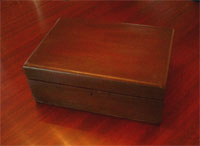
The writing desk, closed
Here is the antique travel writing desk that my wife gave me for Christmas. (I have a thing for old, wooden boxes.) It’s about 12 inches wide, 8 inches long, and 4-1/2 inches tall, much bigger than a Mac Mini. It has a lock, but we do not have a key.

The outside is plain, unadorned, smooth wood, perhaps cherry. We know nothing about it, not when it was made or by whom, or where.
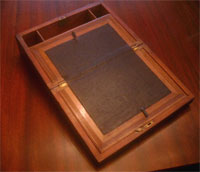
The writing desk, open
When you open it, you find that the two halves are not split evenly across the box, but at a slant, so that when it’s fully open the inner faces slope up to the inkwells and pen holder.

Whoever owned it before me had replaced the writing surface, no doubt leather and no doubt eaten away, with a nasty black felt, attached (as it turned out) with a spray adhesive. At least it was easy to remove, and I replaced it with real leather, firmly glued on with craft glue.
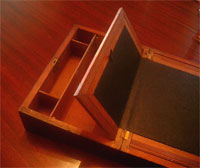
The writing desk, with lid open
Here you can see one of the lids lifted up to reveal the storage beneath. The lids are made of oak, with four or five fluted grooves cleanly and precisely etched around the writing area.

The two lids are held in place by the single piece of leather. The bottom half has a small brass latch that holds the lid in place as you lift it, the actual top half of the box, back into place.

Earlier this week I noticed that the long storage area in the middle had little notches on the side panels, which suggests to me that there was another little piece of wood that rested there, which makes sense. Pens could rest in that shallow area and not get banged around so much. I’ve bought a piece of thin birch plywood, some stain, and some red suede leather, and this weekend I will recreate that little shelf.

It was earlier this week that I actually got to put it to use. I was home all week with strep throat, and by Thursday I was looking for something to do. In the mail, I received a nice thank-you note from Paula Chambers, the fabulous once and future media specialist for the Governor’s Honors Program. She was thanking me for making the trek down to Bainbridge for her retirement party, and I thought, I know, I’ll write her a letter.

It must be understood that I am a stationery junkie. I love beautiful, elegant, or unusual stationery. I have lots of it.

But I do not write letters. Who does? And to whom? Almost all of the people with whom I want to share my thoughts are at the other end of a very short stream of electrons. Writing a letter is now a special effort for a special occasion… like having strep throat, I suppose.

So I fetched my best stationery: gray, 100% cotton rag paper, my name nicely stamped in dark green ink; envelopes lined with dark green paper; very Slytherin, very elegant. I thought I would start by stocking my writing desk, but no, the stationery is too wide. Very well, I’ll have it trimmed next week.

Out comes the fountain pen, and I begin writing. The leather is soft, and the pen pushes at the paper with a scratching sound that is amplified by the hollow wooden box beneath it. It is a struggle to make my handwriting even, legible, connected. More than once, the fingers that are more used to typing go awry and letters are pulled beyond recognition into shapes like twisted coat hangers. The word letter itself threatens to fall apart every time I write it: big loop, little loop, two no-loops, little loop, squiggle…

But I keep writing to my friend Paula, absorbed in the very act of putting pen to paper, and ideas about writing on paper emerge and wallow across the message. I’m afraid by the time I’ve finished, six pages in all, she must wonder what has possessed me.

I tell of the blog I found that led me to an artist on the web who was clearly excited to have discovered this absolutely amazing substitute for the Moleskine Cahiers notebook: take 8-1/2 x 11 paper, cut it in half, punch holes in it, and put it in a 3-ring binder! And all the comments were equally ecstatic, either having already tried this for themselves, or thrilled to have stumbled across such an incredible solution. “The thing I like about loose-leaf binders is that you can move stuff around in them.” And I thought, Is this satire?

Are these people for real? Do they live in some milieu where only Moleskine notebooks have even been considered, and a trip to the Staples on 42nd St, or more likely for this crew, on Water St, is a revelation? I’ve had a Moleskine, they’re perfect, they’re beautiful, they’re a gorgeous way to record your life and organize it, but the only way? Deliver me.

I myself have used so many different ways to record my ideas, my tasks, my appointments, that I can scarcely remember them all. I have, however, swung wildly between writing it all down in a succession of notebooks and planners, and typing it all in to whatever application seemed easiest to use at the time. Incredibly, I have never used a PDA, nor have I ever wanted to. It seemed to me to be too much duplication: I have a laptop, I have a black leather notebook that zips up, why would I need a clunky little device to replace either?

It seems to me that all the systems served me well, but it has been my written ones that have served me best. There’s something about the physicality of the writing, again, that is seductive. And overall, the black leather notebook is more likely to be right there with you, not needing a battery or a plug or a network or a printer. It opens immediately for your inspection of your completed duties and appointments (people to call, things to produce, other to do, things to buy, runs my adapted overprint of a Day Runner page), and you can see your successes and failures at a glance, and dutifully carry the failures over to the next day.

And the flipping of pages back and forth, moving through time like some kind of extradimensional being, lighting on today, calculating one month from now, skimming back, seeding necessary tasks along the way, until I reach today again and can release time’s flow back into its normal channel, now I know what I need to do next, only the flipping of pages really feels right.

And yet, when I returned home from Governor’s Honors this past July, the black leather notebook faded and by the end of August was gone. As I look at it now, I never used it past the middle of September. I didn’t even buy the 2005 calendar and run it through the printer to stamp it with my own structure of busy-ness.

It’s all back on the laptop now. Pristine, color-coded, carefully displayed and ready to beep when I’ve told it to.

But this writing, this pen against paper against leather over wood, this ridiculous New York artist who has saved the world with a 3-ring binder, even the act of opening the black leather notebook to find where I abandoned it, I crave the act of writing, the sewing up of past and present in scribbled hieroglyphs here and there across pages.

I think I may get myself another Moleskine notebook for the summer.

Here we go!

Those of you, and I think there must be… oh, two?, who have been following my ranting over on the Curriculum Liberation Front blog on Blogger will not be surprised to find that I’ve moved the whole thing over here to my website, where I can actually do more with it. Look: categories! Pages! Links!

I just got this up and running this morning, so expect to see changes… Actually, that’s a hoot, since no one will even know of the existence of this place for a few days! I’m talking to you as if you exist, and you can’t possibly exist, dear reader, until I create you. Hey, Marc, is that post- enough for us all?

added this afternoon: To make it even more post-, I’ve moved all my Curriculum Liberation Front posts from my blogspot.com blog over here and given them their original timestamp. So at the moment, the bulk of the postings have been posted before this blog even was created. Kewl.

A moratorium

I hereby propose a moratorium on the word important in any GPS enduring understanding or essential question.

Today I attended a very good session for third grade teachers on “unpacking” a standard. When it got down to writing essential questions, it was amazing at the number of EQs that contained the word important. What got me to thinking about the issue was an EQ that my team wrote on the writing standard. We proposed, “Why is writing so hard?”, the idea being that we would tap into the students’ dislike/fear of writing and springboard into the various solutions as suggested by the elements of that standard.

The crowd reaction at first was one of excitement, but then it was suggested that the EQ was too “negative,” and the next thing we knew, the EQ had been amended to “Why is writing important?”

Well.

If the purpose of an essential question is to provoke discussion and exploration, and it is, then why in the name of all that’s engaging would we shy away from a provocative question like “Why is writing so hard?” and replace it with some teacher-talk like “Why is writing important?” There isn’t a kid on this planet who doesn’t see right through the “important” BS: it’s just a trap to enforce the student’s compliance with the teacher’s view of things. It is humbug of the most offensive sort.

I completely understand that not every teacher would want to lead off with such an in-your-face EQ, but honey, please. Most of the EQs were simply lesson plans in disguise. Do you really want to dig into whether “following the rules of grammar helps you understand written and oral communication?” ::yawn::

So we could have rewritten the question, “Are there ways to make writing easier for me?”, or “What can I do to make my writing better?”, or any other question that actually sounds like it might be asked by a student, preferably a question that produces some interest in seeing it answered.

Therefore, teachers, a new commandment: Thou shalt not write essential questions that merely embed thine unfiltered instructional agenda without any attempt to understand how a student in thy care might actually think.

Because that’s important.