I was only a little more productive, forcing myself to play with Artist Trading Cards. I made four or five new ones, just doodling, really. Did a lot of reading.
The Idea of Justice
Grayson gave me The Idea of Justice, by Amartya Sen, for Father’s Day. I began reading it today while basking in the labyrinth. It contains sentences like
An appropriate understanding of social realization , central to justice as nyaya , has to take the comprehensive form of a process-inclusive broad account. It would be hard to dismiss the perspective of social realizations on the grounds that it is narrowly consequentialist and ignores the reasoning underlying deontological concerns.
Okay. I’m already reading it with a bookmark sliding down the page, line by line, to keep my eyes on track. I guess I need a word wall to help keep the dialectics sorted out. I got it that he’s not a transcendental institutionalist (Hobbes, Locke, Rousseau, Kant) but rather a fan of realization-focused comparison (Smith, Condorcet, Bentham, Marx, Mill), and I think I’m on his side.
For example, the term nyaya above is one of two basic Sanskrit jurisprudence concepts. Niti is organizational propriety/behavioral correctness , the Law (which as Mr. Bumble reminds us, “is a ass”) , while nyaya is realized justice, i.e., an inclusive view of human behavior. The Western example he gives of niti is Ferdinand I (Holy Roman Emperor) and his dictum, “Fiat justitia, et pereat mundus”: Let justice be done, though the world perish. As Sen wryly notes,
it would be hard to accommodate a total catastrophe as an example of a just world.
Precisely. He also gives an Indian term,
matsyanyaya, “justice in the world of fish,” where a big fish can freely devour a small fish. We are warned that avoiding matsyanyaya must be an essential part of justice, and it is crucial to make sure that the “justice of fish” is not allowed to invade the world of human beings… No matter how proper the established organizations might be, if a big fish could still devour a small fish at will, then that must be a patent violation of human justice as nyaya.
So far, the path he seems to be taking us down is one that I already have a sense of as being the proper one.
Summer Countdown: Day 31
ATCs
Summer Countdown: Day 32
Lichtenbergian goals
I checked the range of the former viola part in its new habitat of third violin (in Waltz: Allegro gracioso). Fortunately, there’s a tool that does that for you, not only identifying notes that are out range of the selected instrument but offering to move each one up an octave (or to wherever else you like). It took no time at all.
Upon repeated listening, I think I can actually strip out a great deal of the piano’s doubling of the viola part. That doesn’t leave the piano with a lot to do, but what it does is critical. And I think the bass drum part can be assumed by the timpani altogether. The tempo as I have it set now may be a little too fast as well. Ah well, it all has to reach performance first anyway.
I emailed Wallace Galbraith with the link to the AFO page here, and explained more of what I had in mind for each one. Then I went on to Facebook and posted a link to yesterday’s post and invited everyone to come vote on their favorite. So far, it’s pretty much an even split between Rondo and Waltz, with Resignation coming in third. I am a bit surprised at how popular Rondo is, given its completely fragmentary status.
Lichtenbergian distractions
As predicted, the Artist Trading Card project is a complete time sink. I love it. I created four cards and all the packaging that goes with the mailing back and forth. To me, part of the fun of the project is the total look and feel I’ve come up with; I’ve turned it into a “thing.” You’ll see what I mean when your chance arrives in the mail. I could just use plain #10 envelopes, after all, but where’s the fun in that?
Speaking of which, I mailed off two ATC packages yesterday. I’ll announce tomorrow who’s getting them.
At the moment, my cards are tending toward dadaistic collage, although I may inject a figural study in there every now and then. I’m afraid the first four are not very well thought out. I was excited to get them out the door and so made them in a rush of energy if not creativity. Sorry guys. I’m doing better on this next set.
Vote early, and vote often
I have actually accomplished one of my goals for the summer: to create five sketches for the piece I’ve been asked to write for the Ayrshire Fiddle Orchestra. Let’s have some fun with it. Even though the AFO’s conductor, Wallace Galbraith, will obviously make the decision as to which , if any , of the sketches he wants me to complete, let’s take a vote.
In comments, vote on your favorite, or discuss why they all suck.
Vibes
This sketch is based on a piece generated by Marc Honea, playing with algorithms and synthesizers. Includes a glockenspiel.
The Labyrinth in Snow
A simple, Romantic-style work, featuring solo violin, cello, and piano
Resignation
This will be a theme and variation, based on the hymn tune Resignation, best known as “My Shepherd Will Supply My Need” , this is just the opening of the statement of the theme
Rondo Mobile
I wanted to try something closer to the AFO’s “house style” of fiddly-bits kind of fiddling, but not quite folk dance. The opening theme will return to home base repeatedly after going very astray, which it does almost immediately. This fragment is the least developed of them all. The eventual piece would be the wittiest, almost PDQ Bachian in its determination to fall apart.
Waltz: Allegro gracioso
This is an arrangement of the third movement of my Symphony in G, the only movement I’ve completed so far. Includes timpani & bass drum (playable by one percussionist) and piano.
Summer Countdown: Day 33
Alas, my Art Camp has been postponed. Diane is having work done on her cabin, and apparently her workers have told her that the entire thing has to be jacked up to do repairs on the floor. We will reschedule for July sometime.
Lichtenbergian goals:
I finished arranging the Waltz, except for checking the range of some of the viola notes in their new violin habitat. I think it sounds OK.
Lichtenbergian distractions:
I went on a road trip to Sam Flax in Atlanta for some paints in colors I did not have and need , it’s easier to paint grass if you have the right shades of green to begin with , a bigger portfolio to hold the largish studies I’ve been doing, a new watercolor pad in said larger size, a new sketchbook, also larger than the one I’m about to fill up.
I also bought a circle guide, a thingie for you to use to draw perfect circles. The book about drawing faces that I’m using insists that one is necessary for irises and pupils. I also bought a new jar of absorbent ground, the white stuff you paint on board for a base for the painting. With oils, you use gesso, but I learned from the helpful staff there one day that gesso repels water-based paints, so gouache wouldn’t actually work on gesso. Now I have them tracking down a quart size.
I wanted to buy a proportional divider. What is a proportional divider, you ask? It looks like this:
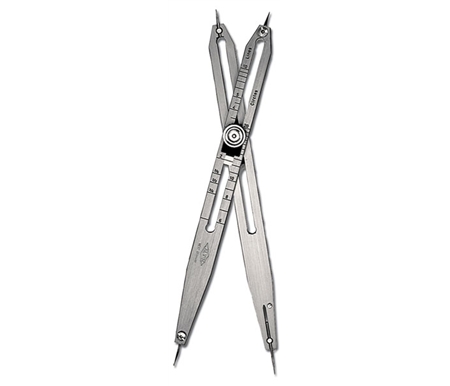
You use them in double-checking distances between your reference photo and your drawing, i.e., the distance between your subject’s pupils is a in your photo, and should be b on your drawing.
I looked all over but could not find one. Finally a helpful staff member showed me where they were: under lock and key in a case, because they are actually precision instruments costing $150 and up. I did not buy one. (However, in looking for that image just now, I came across a perfectly good wooden one designed for artists that’s only $30.)
And then, I came across an incredible Lichtenbergian distraction: Artist Trading Cards. This is so amazing that I have given it its own blogpost below.
Finally, I’m not sure whether this is a distraction or a goal. MakeMusic, Inc., who makes Finale, is sponsoring a new composition competition with the American Composers Form, of which I am a member. I think I’m going to go for it.
Artist Trading Cards
As I was rummaging around Sam Flax yesterday, I stumbled across a small display of Artist Trading Cards supplies. I had completely forgotten about the concept, which I stumbled upon a couple of years ago and bookmarked as a neat thing, but which I’ve never gotten around to doing.
I never let a valid Lichtenbergian distraction pass me by, of course, and the materials were inexpensive, so I bought two packs.
Simple explanation: pieces of cardstock, 2-½ x 3-½, you put art on them and trade them. (Needless to say, you don’t have to buy the cards. You can cut up your own cardstock to the correct size.)
Here are some links:
- Basic Wikipedia explanation
- A consortium (I like the concept of the swap thingies they have going on.)
- An amazing gallery of work (Click on the names on the right to be overwhelmed.)
Some examples, all from the above links:


But Dale, you ask, what has this to do with me?
heheheh…
One day, perhaps tomorrow, perhaps next week, but soon , you will receive in the mail a little box, and in that box will be two ATCs, one from me. There will also be three blanks. You will make three new ATCs, two of which you will mail back to me. (Postage and labels will be included.) I will keep one and mail the other one to the next victim artist.
It’s a game, see? We’ll all have fun. I’ll post the current player two days after I mail the box and post the samples that come back to me.
If you want to play and you’re not sure I have your mailing address, email me. Don’t bother letting me know you don’t want to play. Of course you do.
Summer Countdown: Day 34
A semi-productive day. I began arranging the Allegro gracioso from the Symphony in G for the Ayrshire Fiddle Orchestra. That sounds very productive, but I will confess that all I did was copy and paste the parts for the first and second violins, the celli and basses, and the percussion. I was very lazy and did not address the viola part and how I was going to transfer that to a group that doesn’t have violas, nor exactly where the piano would fill in some of the gaps left by the winds and brass instruments in the original.
I also painted a birthday card for Nancy Willard, whose birthday is Saturday, the same as Grayson’s. I’m going to count that because it was a painting of the labyrinth, and I actually did a good job with it. Consider it a study for the ELP, which naturally is set in the labyrinth.
Art & Fear: 6
The fear that you’re only pretending to do art is the (readily predictable) consequence of doubting your own artistic credentials. [p. 24]
Impostor syndrome, anyone?
Longtime readers of this blog will recall my incessant whining about my lack of formal training in music, despite the fact that I can create works like William Blake’s Inn or Pieces for Bassoon & String Quartet or “Sir Christémas.” I don’t do that whining any more, even though I know I am entirely outclassed in the music theory department by every “real” musician I know. Why worry about it? I’ve decided that if I’m ever sitting in on a rehearsal of one of my works, and the conductor turns to ask, “Did you really mean to write a G minor 13th chord here?”, I will cheerfully and honestly reply, “I have no idea what you’re talking about. It sounds like I want it to sound, though.” Or perhaps, like Anton Bruckner, just happily agree to let him “fix” it.
As the authors of Art & Fear go on to say, “After all, someone has to do your work, and you’re the closest person around.” If I’m able to get it out the door, why should I care that I don’t have the training that any music undergrad (or garage band songwriter, for that matter) has? He didn’t write the piece, I did. My only gripe about my lack of training is that I would be a lot faster at what I do if I had that knowledge, but even that, I’ve decided, is irrelevant.
In recent discussions with my friend/guru Craig, the idea of Asking Permission has surfaced repeatedly. He keeps asking what I mean by that, and I have to confess I’m not really sure why this keeps nagging at me. As Craig asks, “Asking Permission of whom? And for what?”
I think it may be related to this concept of Pretending, the idea that I’m not really supposed to be doing any of the things I do. As a “composer,” I used to feel very strongly that people who had made music the focus of their lives were at best tolerating my presence in their temple, and at worst sniffing, “Who let him in?” I’m all better now, thank you, but clearly that sense of needing permission to be there is still rattling around in there somewhere.
This is enormously ironic, because my role in the arts community in Newnan has always been that of the Permission Giver. I was the one who gave everyone else Permission to try anything they wanted, either in explicit terms (“Or course you can direct Godot, Jeff. Why not?”) or implicitly: as Jen, the Equity actress who played Hermione in Winter’s Tale said to me at the cast party, surveying all those happy amateurs, “They don’t know they’re not supposed to be able to do this, do they?”
The answers to Craig’s questions, of course, must be, “Of myself. And for whatever it is I want to do.” More work is required.