Behold!

I was out walking the labyrinth one night last week, concentrating on the classical element Earth, hoping for some insight into making the percussion piece more true, and what I ended up with was a flash of clarity about the northpoint.  After all these years, I knew what it should look like.

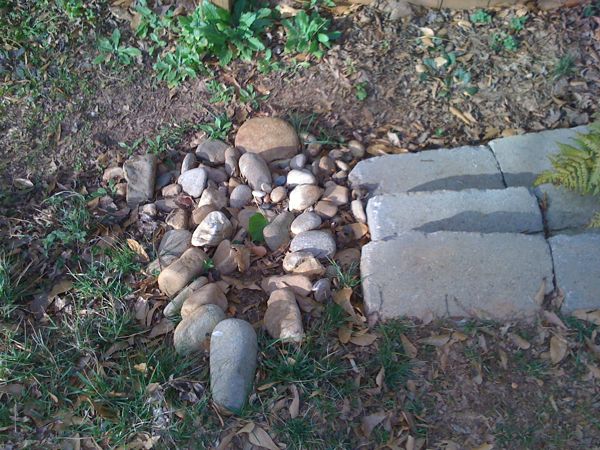
Here’s a shot of what it kind of looked like:

Except for the addition of a large square stone at the top, by the path, that was it.  Not very interesting and not very inspiring.

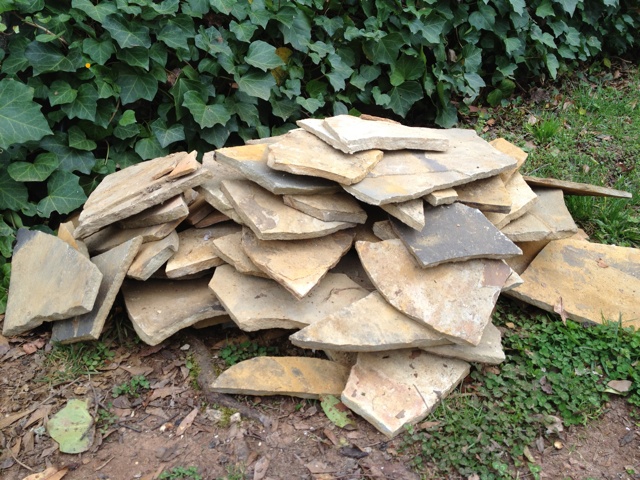
So this morning I dropped the cat off at the vet and headed over to Mulch and More, where I picked up the following:

I overbought, but that’s OK.  I have another project in mind for which I can use them.  It’s fieldstone, by the way.  (Also by the way, I took today off because I had to meet with the lawyer to probate my mother’s will.)

This took a lot less time than I thought it would, so much so that I barely have any documentation of the process.  To wit, I stripped away the existing stones:

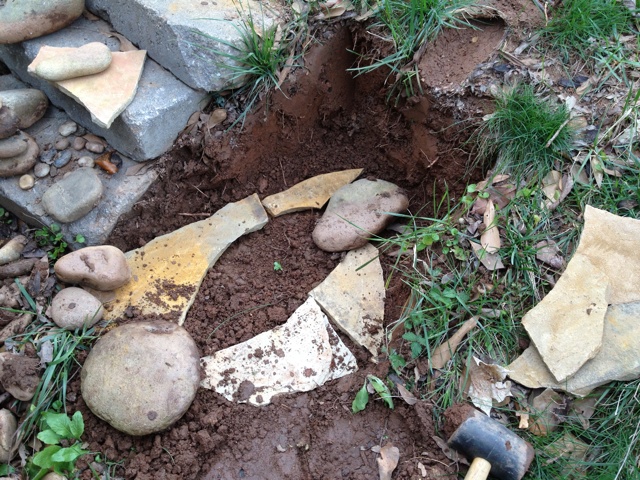
I dug a hole, leveled it, and laid out the base:

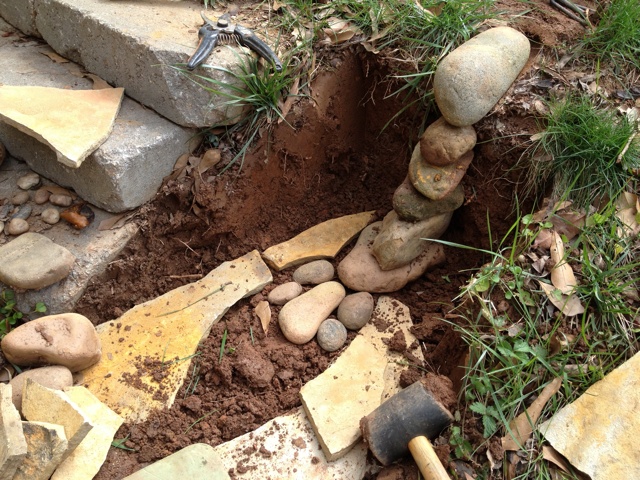
I built the little towery thing (and yes, you have another image in your mind, or will…):

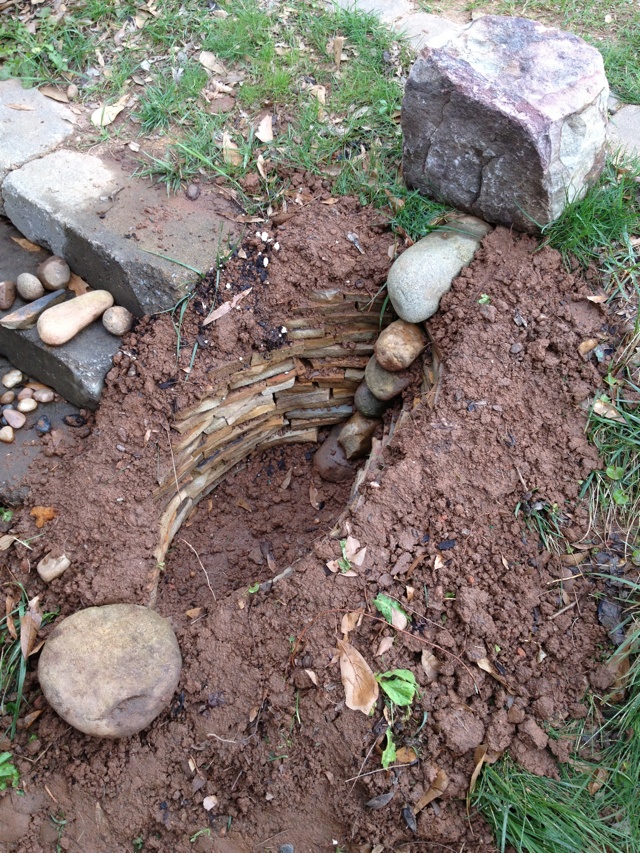
Notice the stones lying in the bottom.  More about that later.  After that, it went so quickly that I didn’t get any more photos until it was done:

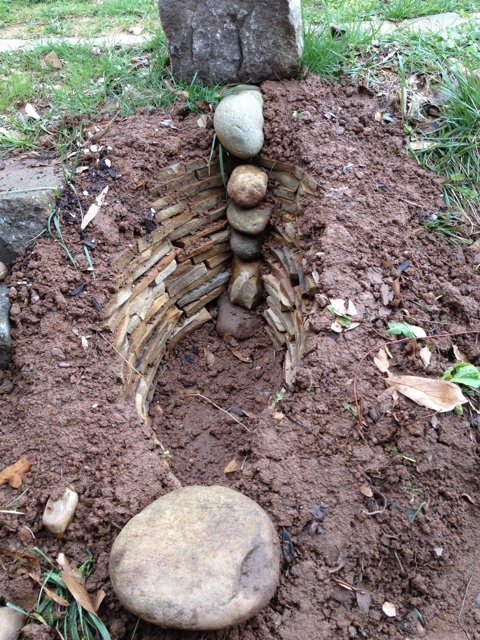
And from a more head-on angle:

It’s pretty interesting, I think.  It makes a very good impression from the path looking down, but it didn’t photograph well.  I will be anxious to see how the bank of dirt holds out against the rain this weekend.  And I’m ready for the peacock fern to cover it immediately.

So what do you think?  Should I leave the bottom of the structure just plain dirt?  It would make it easier to maintain in many ways—just scrape the leaves out or spray it with Round-Up.  The other option is to fill it with the stones I stripped from the old structure.  I may play with that to see how it works.

UPDATE: After a lovely evening out by the fire last night, I can report that it functions quite beautifully with a plain dirt floor.  It is now raining heavily; I do wonder what it will look like by Sunday morning.

An interesting Leap Day

Today, I have outlived my father.

In 1988, Grayson was born on Sunday, June 26.  That Friday, July 1, my father and mother were going out to the car to bring Ginny and Grayson home from the hospital—I was back in Valdosta—when he dropped dead of a heart attack, 292 days after his 58th birthday.

Thanks to the miracle of iPhone apps, a quick calculation for 292 days after my 58th birthday gives us February 28, 2012.  Yesterday.  Today, Leap Day, I have lived longer than my father.

This factoid is merely that; it has no real meaning for me, no superstitious portent or deep emotional wound or anything halfway approaching metaphysicality.  But when one gets to be a certain age, the hermetic elasticity of time exerts a fascination. Parents are not supposed to outlive their children, although my father’s mother certainly did (vid. sub.), so it’s entirely natural at some point in most people’s lives to look at their parents as figments of the past.

I often wondered whether I would “make it,” so to speak, given the genetics of the men in my family.  My father and grandfather both developed diabetes and both died before they were 59.  However, my father’s mother lived to be 99, dying of natural causes, and my mother just died at the age of 79 of cancer, so the genetic slot machine is just as likely to grant me another 20-40 years as not.

As I approached my 58th birthday last year, the fact that I was now ticking down to that metaphysical deadline was in and out of my thoughts quite a bit, but since then I haven’t really given it any thought.  I’ve been busy.  But last month I realized that I must be coming up on it, so that’s when I whipped out my iPhone and had Siri crunch the numbers for me.  (Ironically, today when I asked her to do it again so I could confirm all the math for this post, she balked.)

As I said, it has no meaning for me, just a curiosity.  It’s like the time about 15 years ago that my lovely first wife and I were visiting her parents for her father’s birthday, I think, and upon doing some math in my head I realized that we were at that point older than my in-laws were when we got married. Freaky, as the kids would say.  Or would have said 40 years ago.

I thought about having a vigil out by the fire in the Labyrinth tonight and meditate on it all, but the weather has turned yucky.  Perhaps tomorrow night, if things have dried out a bit.  Maybe I can come up with some meaning.

L’chaim!

The Labyrinth in February

I was very happy that today was clear and bright, and surprisingly warm.  I had work to do in the labyrinth.

I often feel like a bad steward at this time of year. The labyrinth is relatively grassless and muddy, and just looks abandoned. That’s kind of silly to think so, because it is February after all.  All the grass is dead everywhere.  But still.  My sacred space should always look cared for.

So today I was able to get out and rake it clean of all the tiny little twigs that the squirrels in their terrible ADHD have rained down on us, then mow it—although there wasn’t a lot to mow—then use the trimmer to edge the paving stones.

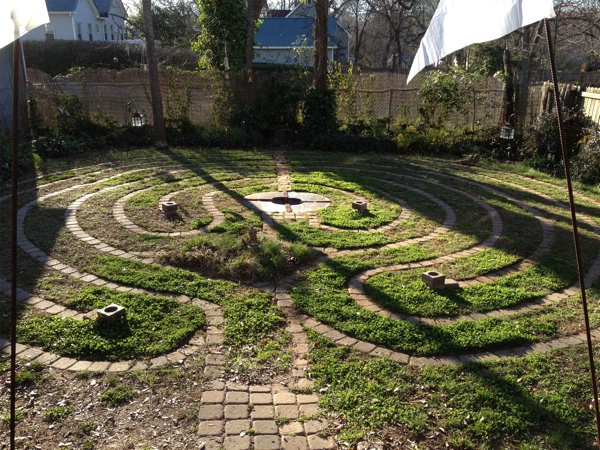
Behold:

You will see that there is green there and wonder why I’m complaining.  This is the clover that I am allowing to take over.  Since the last time I posted about the labyrinth, it has grown quite a lot.  That’s where the edging becomes necessary, because it will completely cover the paving stones if left to its own devices.  You can see, though, that the clover provides a nice ground cover.

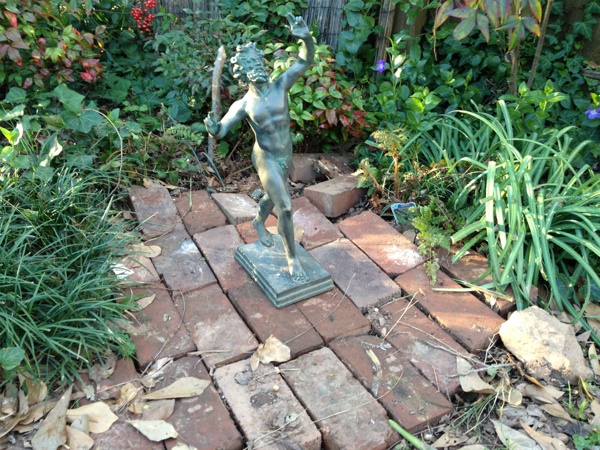
A couple of weekends ago, I got out and revamped the southwest corner.  A couple of years ago I planted a variety of nandinas, and those are coming along quite nicely.  This is where I positioned the Dancing Faun, but it was all kind of hugger-mugger.  So I got in, pulled up all the ivy, laid out some brick, and moved a couple of bristle ferns that were not doing as well as they might in a nearby location.  Now our Dionysian proxy has a stage:

Once the ferns grow up (and I’ll probably add a third one), he’ll be nice and lush.  I need to find little spike/stands for votive candles so that sojourners get a good look at him from the labyrinth.  Placing them around his feet is not very effective.

My labyrinth is still a refuge for me, although I haven’t been able to be out there a lot.  During the winter it’s a little hard, because you have to commit to building a fire and sticking it out with the cold as long as the fire is going.  Now that we’re beginning our approach to the Vernal Equinox, it will get a little easier.  Plus, I have a goal of burning all the Christmas greenery before the Equinox.

The labyrinth in autumn

I haven’t written about the labyrinth in a while.  It’s still there, and I still get out there for meditation and work, but not as much as I’d like.

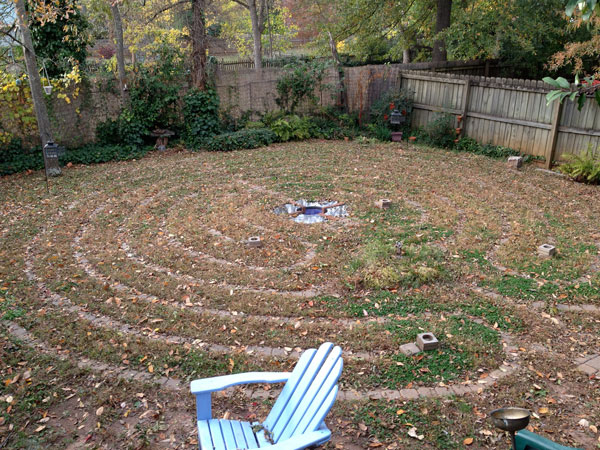
Here’s a shot from today:

The grass is going dormant, although the clover is still green.  Before tomorrow night I’ll need to get out and run the mower over it all to mulch the leaves.  Some Lichtenbergians are coming over to discuss The Ego and the Dynamic Ground, a book about transpersonal psychology.  I’ve been reading it back and forth on the train to the office, and it is utterly fascinating.  Another post, or series of posts.  All I will say at this point is that it reflects exactly my experience in the labyrinth.

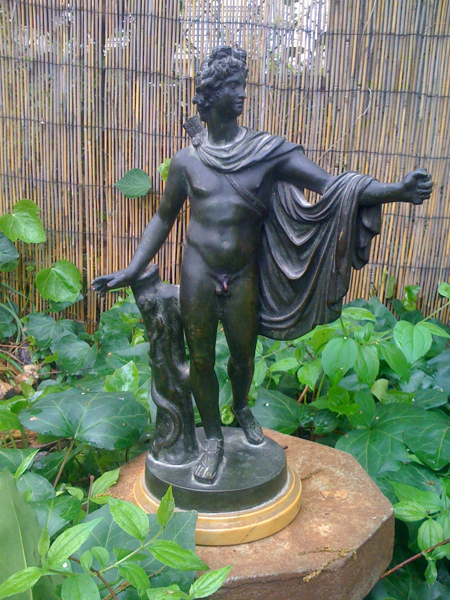
There are a couple of additions to the place.  You may recall the Apollo Belvedere:

Apollo, of course, was the Greek/Roman god of the sun, but also of medicine, music, and rationality, among other things.  He stood for the creative aspect, the putting together of things, the holding together.

Opposed to all of that was Dionysus, the god of wine, libido, and dissolution.  Dionysus (and his analogs of Pan and Shiva) stood for the destructive process, the taking apart, the letting go.

It does not take a Nietsche to realize that a wise person accommodates both these forces in his life and brings them into balance and alignment.  Easy to say, not so easy to do, of course.  But I’m working on it.

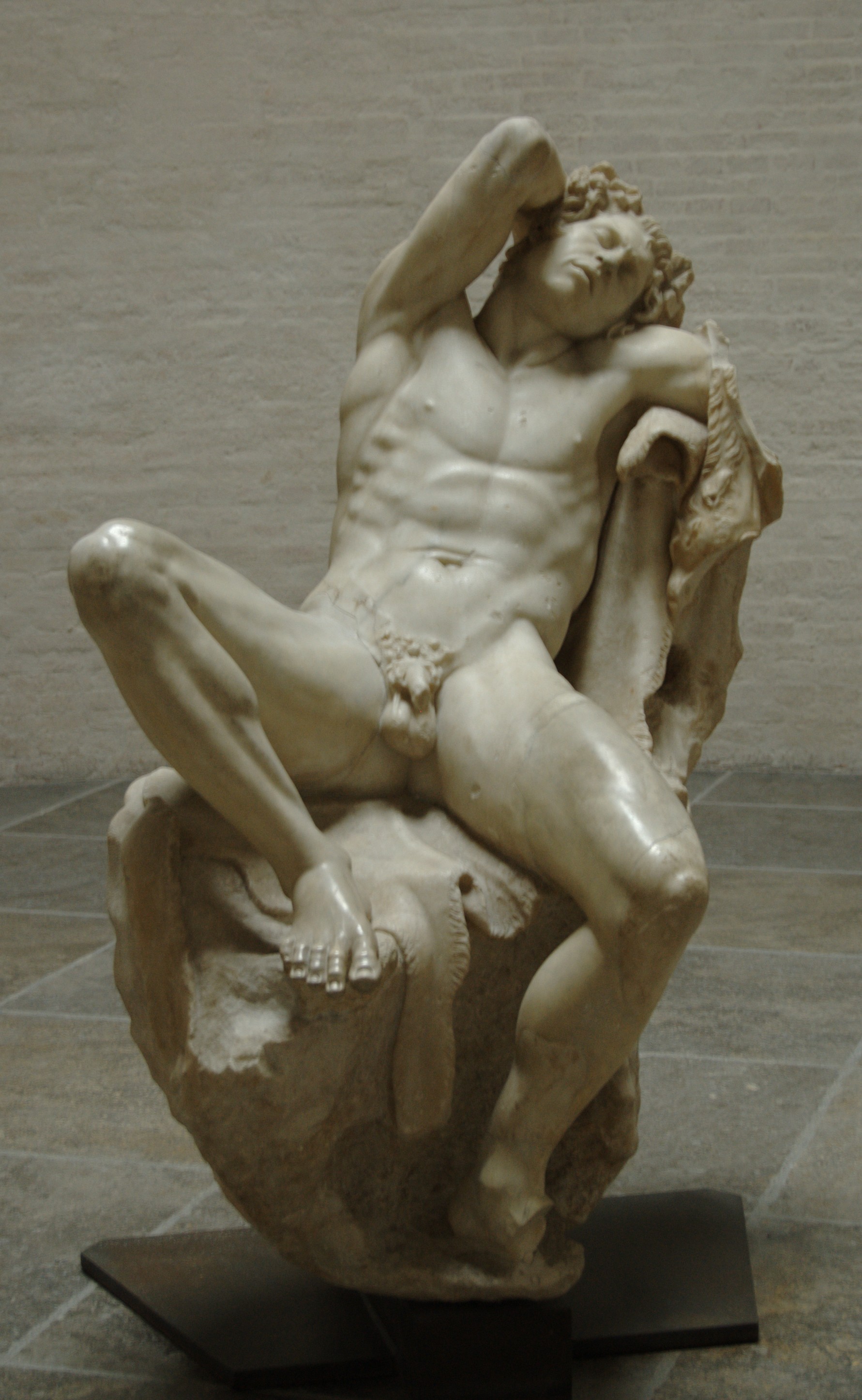
Anyway, I’ve been looking for a statue for the labyrinth, but the one I really wanted (the Barberini Faun) was only available in nearly lifesized copies costing $10,000.  That much dissolution I did not need.

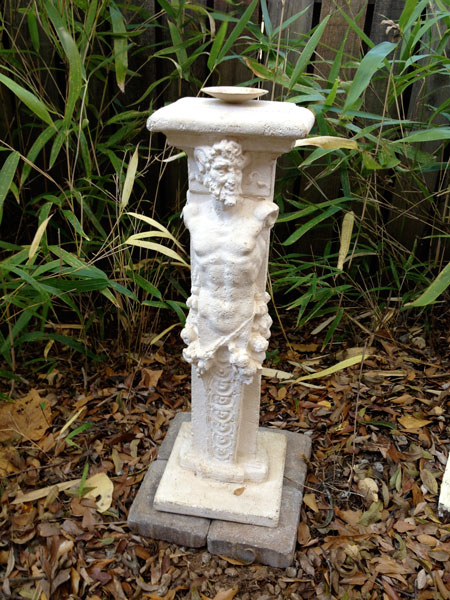
As an interim, I found this at Decor Encore downtown:

A charming little satyr plinth candle holder.  It’s actually double-sided, and I have it up in the bamboo in the driveway to light your path downwards.  No, that was not a metaphor.

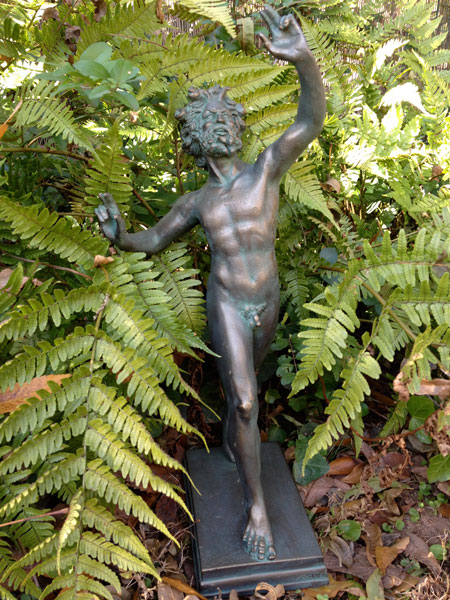
My big find, however, is the Dancing Faun:

Isn’t he beautiful?  As much as the totally oblivious dissolution of the Barberini appealed to me, this faun (the original is from Pompeii) is in a state to which I aspire: ecstatic abandon.  The photo does not do it justice; no photo can.  The piece is meant to be seen from all angles, and it changes depending on where you stand.  (Yes, he has a tail, right above his taut runner’s buttocks.)  This angle gives a better idea of the extreme contrapposto, the Hellenistic Mannerism—if I may slam two periods together—that motivates this work.

Next to him, Apollo looks kind of soft around the edges, doesn’t he?  Balance, dear reader, balance.

All those years

I’ve been meaning to post on how much I am enjoying my job these days. “Director of the Governor’s Honors Program”–I never get tired of saying it, and those of you who have had to endure my saying it know that I can’t manage it without grinning.

I’m still petrified that I’m going to screw up in a major way, but so far my blunders have been minor and the kind that only someone a lot more anal than I would have caught. Nothing irremediable yet, so I think we’re OK.

One of the projects I’ve been working on is adding all the GHP participants ever to a master database. For the past 15 years or so, it’s easy: you just import the students from that summer’s database into the master database. (Remind me to tell you how Galen Honea and John Tibbetts II saved western civilization.  It’s true!)  But there are 35 years of students who don’t fall into that category.

My predecessors, who started the project, got a lot done, but this week I discovered I was missing about 20 years. Not a problem. Earlier, I had organized all the archival files, so it’s a piece of cake to go pull a folder and start typing in the list. It’s not that big a deal, since all we’re including is the year, the campus, the major, first name, last name, and school. The database looks up the system, and I can make it auto-enter the year, campus, and major. I also have devised it so that it will auto-fill the name and school based on what’s already in there, so I can rip through an entire year (about 600 students) in an afternoon.

From the very first year I worked on, 1976, names started jumping out at me: kids who grew up to teach at GHP (and are still teaching); kids from Newnan, etc. I’ve started seeing kids I taught. It’s neat in a maudlin, nostalgic kind of way.

Today, the full impact of my project hit me: I’m typing in 1976 through 1995. That is, essentially, from the year I started teaching to the year before I returned to GHP full time in 1996. I’m going to be seeing a lot of names in the next couple of weeks, a lot of people who have come and gone, a lot of memories of relationships that of course no longer exist for the most part.

This is a major part of growing old, of course, the bittersweet reflections on les neiges d’antan and all those beautiful times and faces that fade. Part of wisdom, I think, is the ability to look back with nostalgia but not regret. It would be very foolish to be bitter about losing the past, would it not? There are those who do, I know, but madness that way lies. You can’t reclaim it—although of course there’s always Facebook for reconnecting, which I have certainly availed myself of—so I’m thinking that kind of reaction must be pathological fear of having nothing left in you. Am I making sense?

To be sure, I had better have plenty left in me if I’m going to play at being the Director of the Governor’s Honors Program. Every day and every way taxes my ability to learn new procedures, especially the arcana of state finances. But—it’s fun. Pure, exhilarating fun. Along with the bittersweet carpal tunnel syndrome that comes from typing in 1800 kids whose lives were changed one summer.

New York

Last weekend I took my lovely first wife to New York City for her birthday. We saw two exhibits and three shows, plus did a little shopping. It was a spectacular time.

We had never been to the Fashion Institute of Technology, down on 27th St, but the museum is free, and so we went. There was a nicely done exhibit of sportswear from the late 19th century to the present with some lovely examples. I especially liked the baseball shirt from the 1920s.

There was an exhibit of illustration masters students’ thesis work, and a lot of it was that surreal, drug-inspired stuff that litters the internet and magazine ads. (Although, have you seen the new Heineken commercial? Who spent that much money to do something that crafted for such a low-rent product?) The good stuff was all children’s illustrations: whimsical and beautifully rendered.

The highlight was an exhibit of items from Daphne Guinness’ “collection,” aka “her closet.” Daphne Guinness, for those who don’t know—of whom I count myself one—is a heiress of the ale concern. She’s excessively thin, tall, and glamorous, and she has made it her life’s work to be seen at events, dressed in over-the-top, one-of-a-kind outfits.

Having seen the Alexander McQueen exhibit at the Met back in June, we were not unprepared for the utter bizarreness of this woman’s clothing. There was nothing in the exhibit that was not beautiful, but all of it was grotesque. Quite a fun time.

Our first show was Anything Goes at the Sondheim Theater. Frankly, it was a disappointment. The actors were good, solid voices, etc., etc., but the direction was lame. Kathleen Marshall is a first-rate director of this kind of thing, but here she was simply off her feed. The couples choreography, i.e., the Fred and Ginger stuff, was no better than you would see at any senior play hereabouts. The lighting was the best thing about it.

Our second show was Sondheim’s Follies at the Marquis Theater, and here we were in the hands of a master. What a perfect piece of art! And how perfectly staged! The cast was a revelation on all counts, and the choreography was thrilling. It made up for the lackluster matinee in every way.

I was only vaguely familiar with the show, having listened to the original cast album at some point, but never having read it or seen it. It had not resonated with me, musically, as have some of Sondheim’s other shows, A Little Night Music and Into the Woods in particular. But in performance, the show packs a wallop. Nostalgia, in its original sense of pain, was the overwhelming mood. The ruined theatre, beyond saving, houses the (literal) ghosts of showgirls past, and of the lives of the four main characters.

By the end of the show, we have seen and understood who Sally and Buddy, Phyllis and Ben have been and are, but at the end of the night we are no closer to seeing what happens tomorrow than they are. Other choices, other lives. Good stuff.

On Sunday, we hit the Hell’s Kitchen flea market, where I bought a Tibetan singing bowl and a couple of other doodads. We hit MOMA for a couple of exhibits there. There was a major DeKooning retrospective: I don’t think I knew that he was a major abstract expressionist. The portaits were all I’d ever seen, and I despise them. His other stuff though I quite liked.

There was a small installation of Cy Twombly’s assemblages, just junk he found lying around, nailed together, and slapped some white paint on. They were fun and interesting in a put-this-in-the-labyrinth kind of way. It made me want to spend a week in the back yard playing with the concept.

Finally, it was time to see The Book of Mormon.

Oh my. I am not at all a fan of South Park, but this show is a work of genius. Imagine the most profane, obscene, sophomoric take on religion and faith and First World/Third World issues and personal growth and cultural blindspots. Now imagine it transmitted via the dippiest Glee episode ever. Now imagine it winning the Pulitzer Prize. That’s The Book of Mormon.

Looking at it simply as a Broadway show, it wins on all counts: performances? Genius. Songs? Savagely gleeful, genius. Sets? Genius. Costumes? Genius. Choreography? Genius. Book? Double genius.

Nearly a week later, I’m still mulling over moments from the show and the important underlying themes and ideas. That’s the kind of theatre we need on Broadway, not the idiotic pablum of Spiderman or Mary Poppins.

Those who have assailed the show for irreligiosity are flat out wrong. And stupid. Does the show make fun of Mormons? Yes, indeed, because there’s no way to put any religion onstage and examine its most closely held myths without one’s tongue firmly in one’s cheek, and Mormon mythology is sillier than most.

However, those who get blocked by the irreverence of the portrayal of Jesus appearing to the warring tribes of Jews in preColumbian America—not to mention those who get blocked by the unbelievable obscenity of the village pageant—have missed the other point the team is making about faith and religion, and that is the silliness of the myths should not distract us from the point of the matter: our job while here is to make a better latter day—for everyone.

It is worth noting that the one scene that depicts an actual religious activity—that of the boys baptizing the villagers—is done simply and beautifully, without a trace of irony.

So, good trip all round. We’re going back next year, but delaying the trip by a week so we can hit the BAM Next Wave Festival. Anyone want to go to Brooklyn?
My apologies

Look at this, I haven’t blogged in a month! I was going to call this post A Shame and a Disgrace, but that’s the title for another post I need to write.

I don’t really have an excuse, except that my brain is too full to let any of it out. And part of it, of course, is stuff that I don’t need to be letting out on a blog. Blogs are not diaries, people, not if you’re smart. But I’ve sworn an oath to do better.

So let’s start with the tree crashing into the labyrinth.

Previously, you will recall, the dead tree gave up the ghost after a storm, and after letting it lie in state for a day or two, I cut it up and put it over on the woodpile. Then not even two weeks later I had a Sunday free and clear. It was so free and clear that after I took care of a couple of chores, I was going to go sit in the labyrinth and read all day. Bold, radical, that’s just the way I roll.

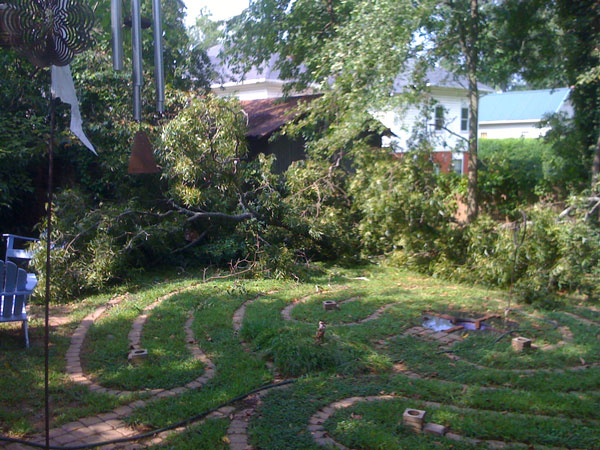
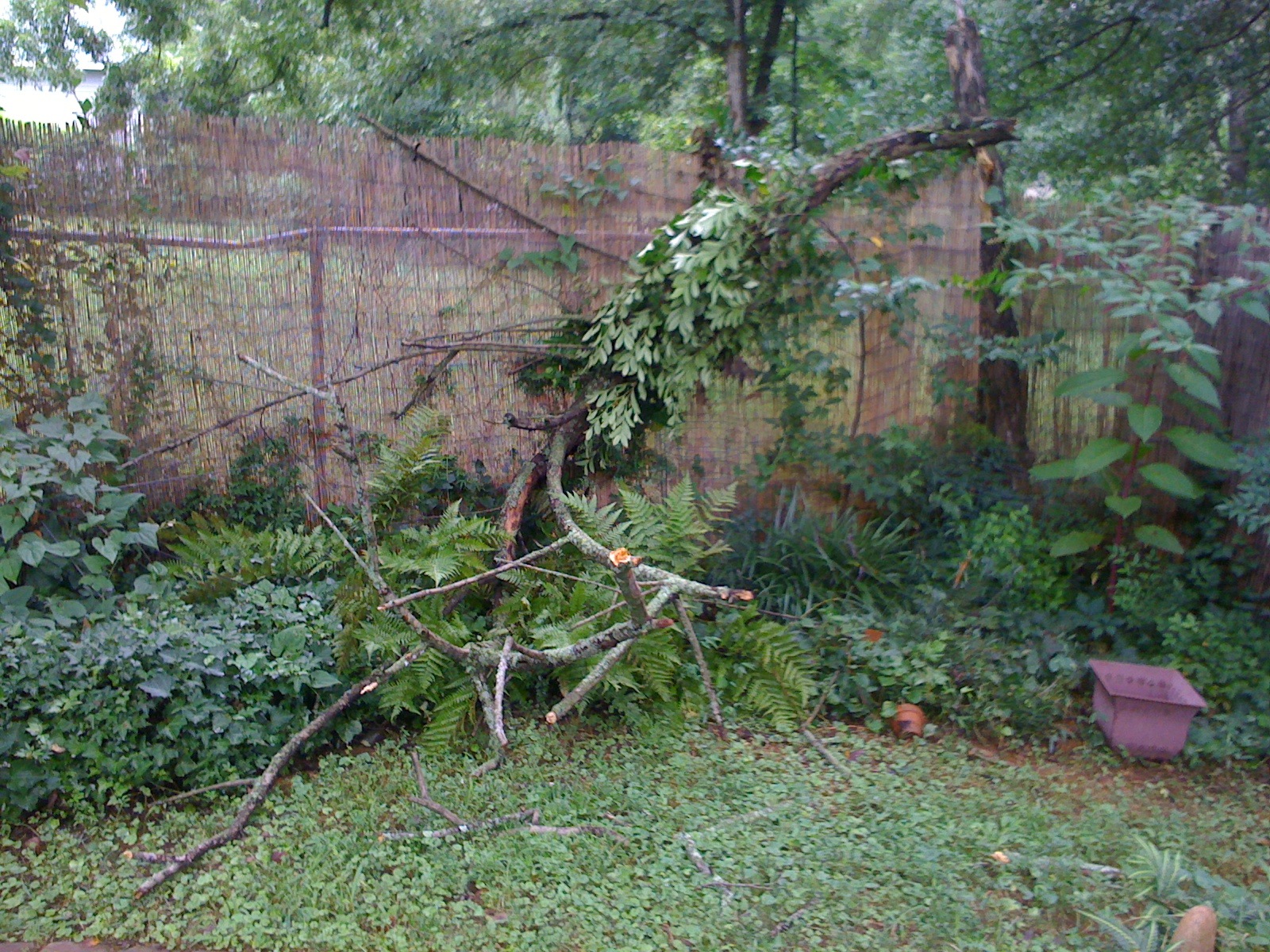
I came downstairs from my study to let my lovely first wife know that I was heading out to the labyrinth for the day. Our den faces the back yard, and as the words were leaving my lips, a noise came from before and I saw a complete third of the neighbor’s pecan tree crash into the labyrinth.

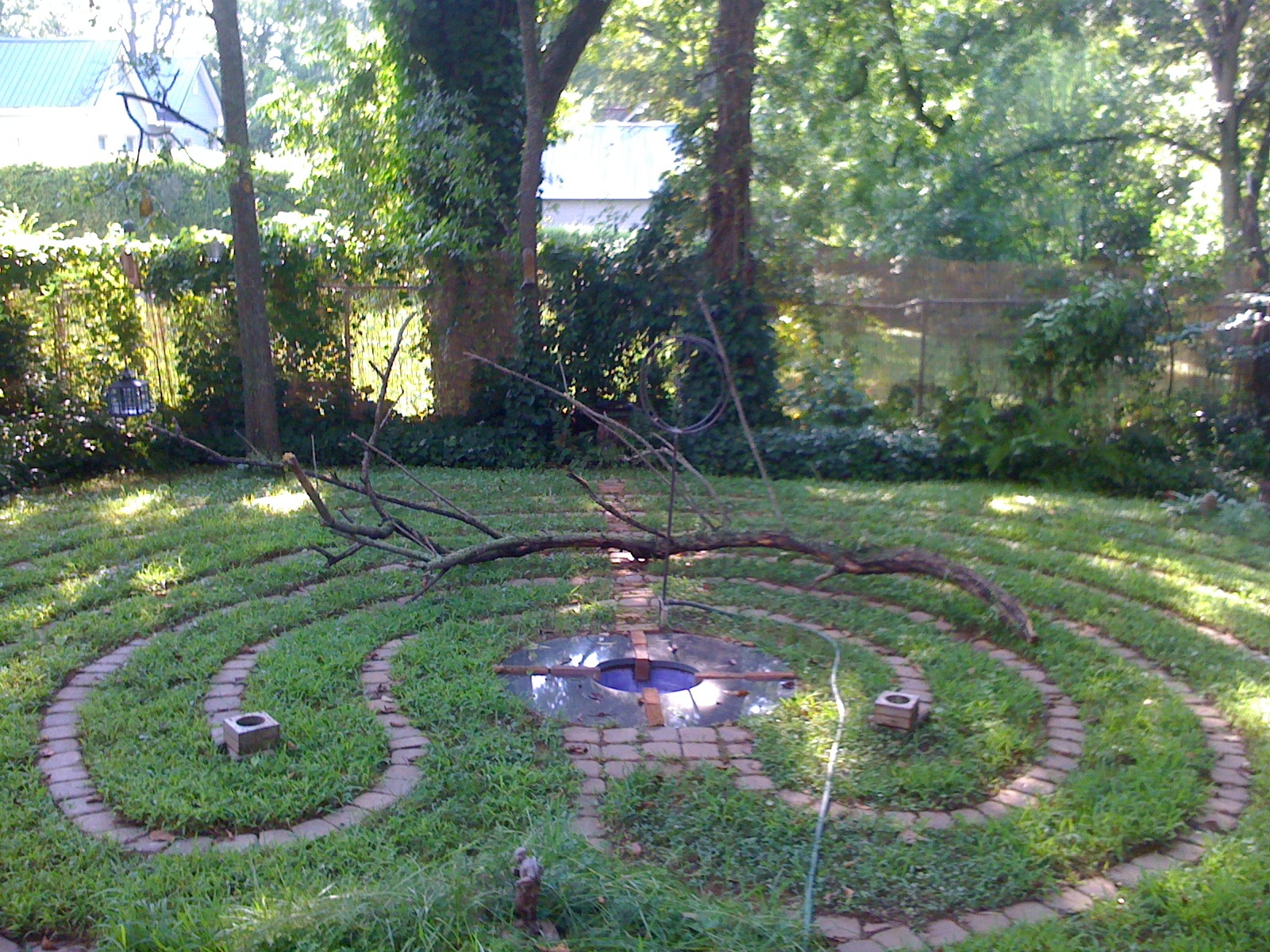
Of course we tumbled straight downstairs and out to see what had happened:

Huge. Well, there went my free and clear Sunday. I went to change into my work kilt and get started clearing it away.

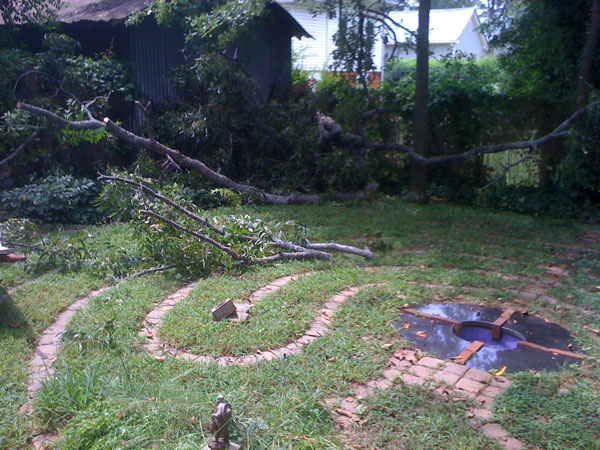
Step one, for those of you have have never had to do this kind of thing, is to strip away all the branches and leave the trunks. That’s not hard at all, of course, and becomes an analytical kind of puzzle, especially with an enormous tangle like this one.

Here’s the result:

It’s actually kind of easier to see how big the tree was when you’re just looking at the main trunks.

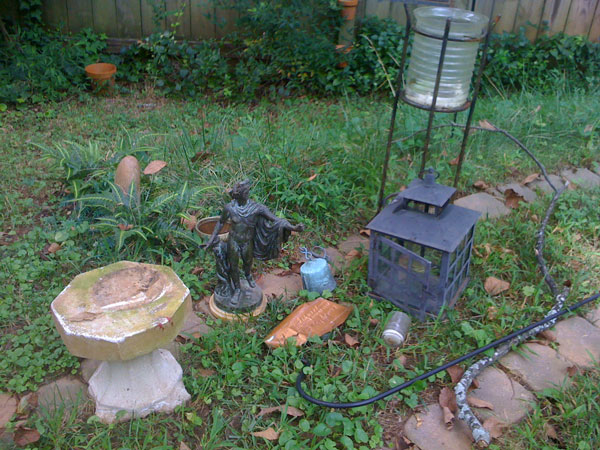
Habitués of the labyrinth will have noticed that the tree crashed right onto several areas where there was stuff that should have been smashed: the south point, the west point, Apollo, a candle stand, more than a couple of clay pots, the bells and lamps in the small oak tree, ferns, that kind of thing.

Nope:

Not one thing was damaged in the least, except for the stand for the lantern. It was bent slightly and was easily hammered straight. Apollo was knocked off his stand, but as I said on Facebook at the time, that’s good for him every now and then, amirite?

The fence right under the tree was dented, but even the bamboo fencing simply bent and didn’t crumble. It was really odd.

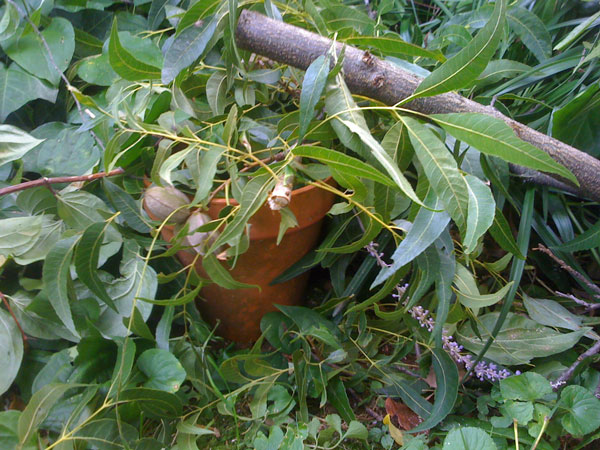
As I cleared away the limbs and prepared to whip out the chainsaw to hack up the trunks, I discovered this:

Completely undamaged. Truly bizarre.

By the time I was ready to whip out the chainsaw, my neighbor Joe showed up with his chainsaw as well. He had stopped by first thing in the morning because he had been outside and seen the tree fall, too. Now he was back to help, and I appreciated the assistance. (Especially after we did some maintenance on my chainsaw and managed to reinstall the blade backwards, rendering it temporarily useless.) So mostly Joe cut and I hauled for a while, till Joe had to go home and do other things.

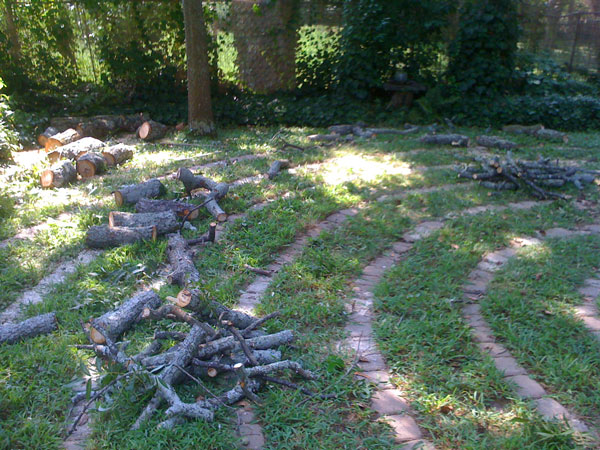
I continued on my own (this was after lunch), and by late afternoon:

Take that, Nature! It’s all now firewood, an honorable end in the labyrinth, fuelling the flames of meditation and philosophical discussion.

As to what caused it to fall, who knows? The tree is perfectly healthy, as was the huge limb itself. Pecan trees have an inconvenient habit of shedding anyway, and this limb had grown all the way out over the labyrinth, plus was loaded down with pecans—I spent a lot of time raking and bagging hundreds of the things—so maybe it just got too big to sustain itself and cracked off.

The task itself was actually kind of pleasant, since my goal for the day had been to spend it in the labyrinth anyway. So there’s one thing I’ve been up to.

Sad news from the labyrinth

The Dead Tree is dead.

I had noticed when I got home from GHP that it had sagged quite a lot. I had to trim it so that I didn’t gouge my eyes out walking the labyrinth in the dark. I figured it would go with the next storm, and it did.

It’s lying in state until tomorrow, when I have to do some maintenance back there in preparation for a Lichtenbergian gathering this weekend.

It was a beautiful thing, stark and unforgiving. Even my lovely first wife, who generally doesn’t go for metaphorical landscaping, thought it was beautiful.

In other news, I think I’m going to replace the bamboo reed fencing with actual bamboo fencing. More privacy afforded, don’t you know.

Your iDevice and navel lint

This is not a real blog post, but I’m not going to return and create an account on all the online forums I visited yesterday just so I can tell everybody how to fix the problem. With any luck, anyone searching the intertubes for the problem can find this post and avoid a lot of foolishness.

Short version: Sunday night I plugged in my iPhone to recharge it, back it up, and generally update it. (Yes, Turff, I’m looking at you.) I got this mysterious message that a USB device is drawing too much power, and in order to protect my computer, it was shutting off the USB device, i.e., the iPhone.

Well.

It would charge in the wall, and no other USB device prompted that message, so I went looking online. There was all kinds of guessing going on, including the astounding comment that “Apple technicians seemed unaware of the issue.” Excuse me? Who did they think put the error message in there for this eventuality? Guesses about trashing the .kext files or something (only, later, the same commenter said, oops, don’t do that, because that will permanently disconnect your keyboard, which is also a USB device on your laptop. Who knew?) and other such feckless posturing abounded.

I took it to the VSU Bookstore today, where they allowed me to hook the phone up to a MacBook Pro there, same message, so it’s the phone. My computer lab instructor Josh Marsh said that his Mac guru friend swabs everything with rubbing alcohol when confronted with issues like this, so I went off and bought some, plus some Crayola paintbrushes with which to administer the isopropyl.

I turned the phone off and swabbed it. That turned the phone back on, so I turned it back off. In peering into the power plug area, I noticed that the base of the area looked, well, not smooth and metallic. I took a pin and carefully stroked the base, and lo! wads of isopropyl-soaked navel lint emerged.

Eww.

I worked at it further, using the pin and a X-acto blade, carefully, oh so carefully. Enormous amounts of navel lint covered my desk, covered it, I tell you. Then I plugged the phone in, and presto, it worked.

The reason I even thought about the navel lint solution was that the same thing happened with the earphone port. I had lost the left channel in my earphones, and I finally noticed that the plug was not pushing all the way in, and in fact seemed to push back out. I went digging (carefully, oh so carefully) with a safety pin and dug out enough navel lint to form a small cat.

Tomorrow I shall drop by the VSU Bookstore and let them know of the solution. I imagine that real techies don’t know this problem because a) they probably don’t keep their iDevices in their pockets; and b) they buy a new one so often that they’ve never seen the navel lint problem.

So, future Googler from teh future, you’re welcome.

Update: I spoke too soon, I think, because the USB message returned. Now I think it has something to do with confusing the USB sprites by hotplugging my piano, my printer, and my phone into the same port. Specifically, it seems to be the keyboard and the phone confuse it since they both draw power directly from the computer.

Fortunately, I am of an analytical and inquisitive mind, my newfound blueness notwithstanding, so I wondered if my earlier success was caused not by navel lint removal but by having to print something previously. I plugged in the printer, printed something, and lo! the phone was OK.

This has not occurred before because my printer at home is networked wirelessly. Here, the DOE’s computer is USBed to my laptop. Both it and the phone have to be plugged directly into the laptop to be seen. The keyboard can go through a USB hub, but even that has to be plugged in. (My graphics tablet occupies the other port permanently.)

Anyway, problem solved. We hope.

The herb garden

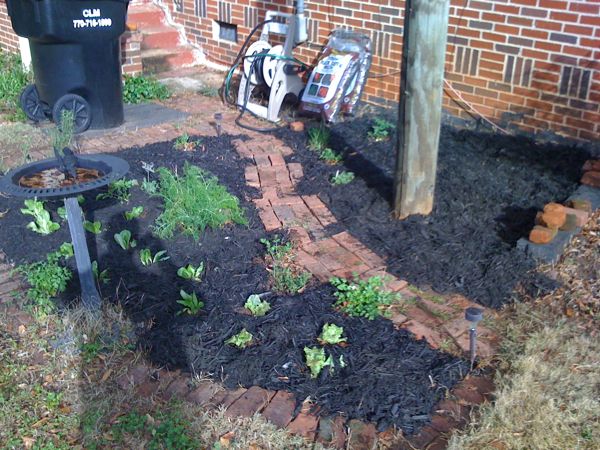
You may remember the herb garden:


So young, so fresh…

But then…

The dill plant that ate Newnan. It’s taller than I am and may weigh more than me for all I know. And who knew lettuce would grow tall if completely unharvested? And then there’s the cilantro all going to seed. I could harvest that and call it coriander.