Composition competitions

The American Composers Forum website is broken, apparently, so rather than having all the opportunities just listed on the site, they sent out the entire list via email, which is what they used to do.

Since my flameout with the symphony, I haven’t really bothered looking at all the various competitions and calls for scores that flooded my inbox every month. Since I wasn’t writing anything, what was the point? Now, however, the AFO commission has gotten me moving, albeit slugglishly, so I printed out the list.

First of all, what’s this obsession with younger composers? About a third of the competitions were for composers under the age of 30 or 40. Screw them. I like the Yale Glee Club approach: “Composers should be in the early stages of their musical careers.” That’s me, right? I’ve had nothing published and precious little performed. If I’m not emerging, I don’t know the meaning of the word.

These are all opportunities with deadlines in the next six weeks, so I’m going to be submitting stuff I’ve already written for the most part. Just this morning I arranged my Sonnet 18, originally for men’s chorus, and on YouTube here, for full SATB. That should fit the bill for most competitions: unpublished, and unperformed in this arrangement.

But I’m also looking at several orchestral/chamber opportunities. I don’t know exactly what I’ll do for those. There’s always the orchestral arrangement of “Milky Way” that I did for last summer’s abortive Chinese event, but that wouldn’t be small enough for a chamber competition. I haven’t examined all of those carefully yet, so I may have to chuck some of them.

There’s the National Opera Association’s chamber opera competition, and for that I think I’m going to submit William Blake’s Inn. Why not? What’s the worst they can do to me? Blackball me?

There are two wind ensembles who are both celebrating their anniversaries with a call for fanfares. That could be a lot of fun to work on, although I’m not very comfortable with the band sound.

At any rate, that’s where I am, compositionally-speaking-wise, at the moment.
Getting into GHP

This past Saturday I had the pleasure of interviewing candidates for GHP’s strings program. If my top candidates play as well as they think, Michael Giel will have a very good summer indeed.

At the end of the lunch break, I slipped over to Pebblebrook’s theatre, where art students were undergoing their interviews on the stage. Each student had spread out the requisite number and types of pieces on the stage floor, and the interviewers were walking around quizzing them about their work.

I realized with a small shock that I underwent that same process forty years ago.

Forty years ago.

Forty years ago, I walked into a room with my portfolio, spread it out over a couple of chairs, and was interviewed by two men. I remember not being able to answer one question about the type of drawing one of my pieces was, the answer was “contour drawing”, and I remember that the men were very entertained by my answers in general.

I remember some of the pieces in that portfolio, and I cannot believe that I made it into the Governor’s Honors Program as a visual arts major. I was not that good. However, at the time, all students had to take the Ohio Psychological, essentially an IQ test, and while academic majors had to score at least in the 90th percentile, fine arts majors could get away with the 70th. I scored something like 98, so I’m sure that tipped the balance in my favor.

On the other hand, perhaps my interviewers understood that giftedness is potential, not achievement, and they saw in my work a student who had the potential to achieve, given the training I’d get at GHP. Certainly I hadn’t had it up till that point. Our schools had no art classes; I took lessons out at the Rec Center from Tom Powers (of Powers’ Crossroads fame).

Clearly, though, I would be unable to get into the art major today. Our kids are phenomenal, as you’ll agree if you’ve followed my blog for any length of time and read my posts about the art exhibits each summer. The level of technical expertise and artistic sophistication would put my 16-year-old self, and indeed my 56-year-old self, to shame.

However, as Diane Mize, my painting teacher from the summer of 1970, has reminded me, art instruction in the schools forty years ago sucked. I might have been better prepared, better trained, if Newnan High School had be better able to teach me.

And as she has also reminded me, whether or not I was a good painter I was at heart an artist, one that deserved to go to GHP and who took all that it had to offer and transformed his life with it.

Forty years ago.

New music

And we’re off. This morning I heard from Wallace Galbraith, and here are the answers to my questions:

  • around 70 players – 56 violins, 6 cellos, 2 basses, 1 accordion, 3 guitars, 1 percussionist and 1 pipe
  • 4-5 minutes
  • “it would be interesting and challenging for us to play music with its roots in your part of the world – please feel totally free to let your imagination roam!” [Uh-oh. Do we need to discuss this?]
  • “a deadline – it would be useful to be able to start work before Easter 2011 so let’s say the beginning of March”

Let the agony begin.

New music?

The Ayrshire Fiddle Orchestra, which has visited Newnan from our sister city of Ayr before (2005), will return to these shores in the summer of 2011. I have been asked to write a piece for them.

We’ll see.

Of course I want to, and I’ve agreed to the project, without question, having emailed their founder Wallace Galbraith this afternoon to introduce myself and get the ball rolling.

But we all know what happens when someone makes plans to perform a work of mine. Inexplicable complications ensue, up to and including sudden, unexpected retirement and H1N1 epidemics in China.

However, we shall proceed as if no such omens from the universe were expected.

So, what shall we write? You can hear the orchestra on their downloads page: very competent, sprightly interpretations of mostly Celtic dance pieces. They don’t list violas as part of their instrumentation, and the photos are too small to see. I see an accordion in their large group, and I hear a drumset on the mp3s, but the first question I asked of Wallace was what instrumentation would be coming next summer.

I also asked about length. I’m guessing we’re not in the market for anything as long as “Blake Leads a Walk on the Milky Way.”

Finally, I asked about character: would they prefer something closer to their usual repertoire, or would they like to show off in a different direction?

My goal is to write three to five sketches based on Wallace’s response and let him pick the one he’d like to see finished.

Oh, and I asked for a deadline. Of course.

Labyrinth: the Cloud Sculpture

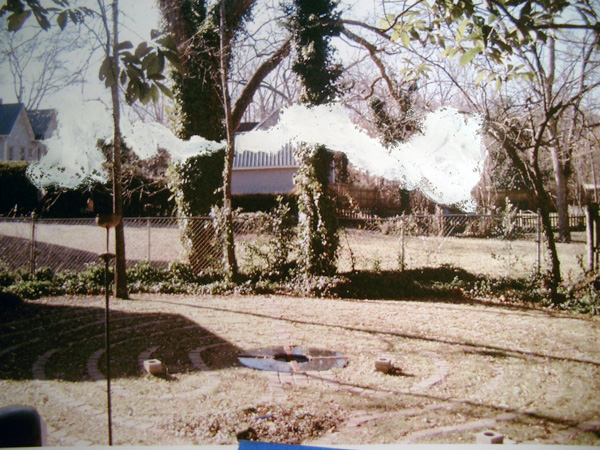
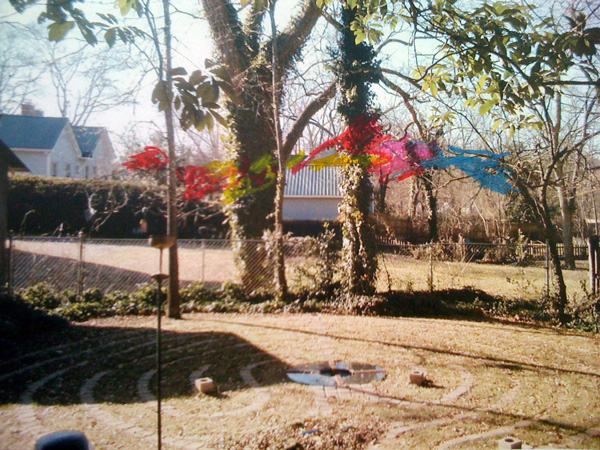
Just when Jeff thought it was safe to presume there would be no baroqueness, I unveil the Cloud Sculpture.

Several years ago we were in Decatur, doing their Christmas Thursdays thing, and in one of the shops they had these “cute” lawn ornaments constructed of screen mesh, painted and shaped. I thought at the time that one could do damage with such a concept, and I promptly bought a roll of screen mesh and a can of black paint.

And what did I intend to do with this material? I don’t know. Something like this, perhaps?

I did this earlier this afternoon, just oil pastels on a photo of the labyrinth.

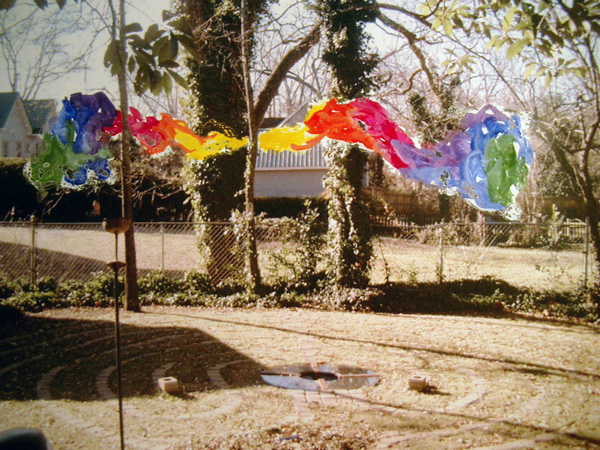
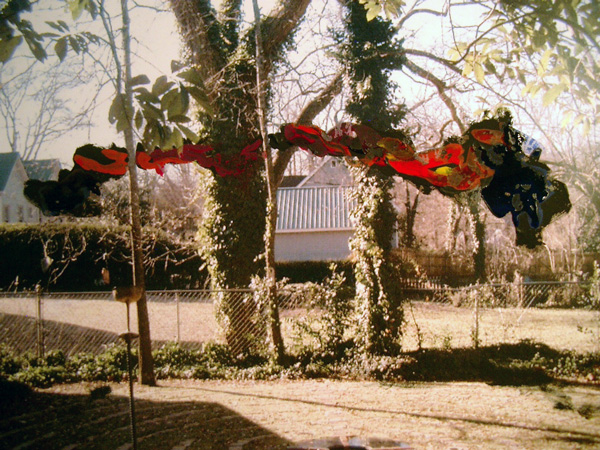
Here are some more studies, done upstairs later with gouache:

I think it extremely unlikely that I will even attempt such a thing, materials to hand or not. But what a staggering concept, eh wot?

Moral thermometer

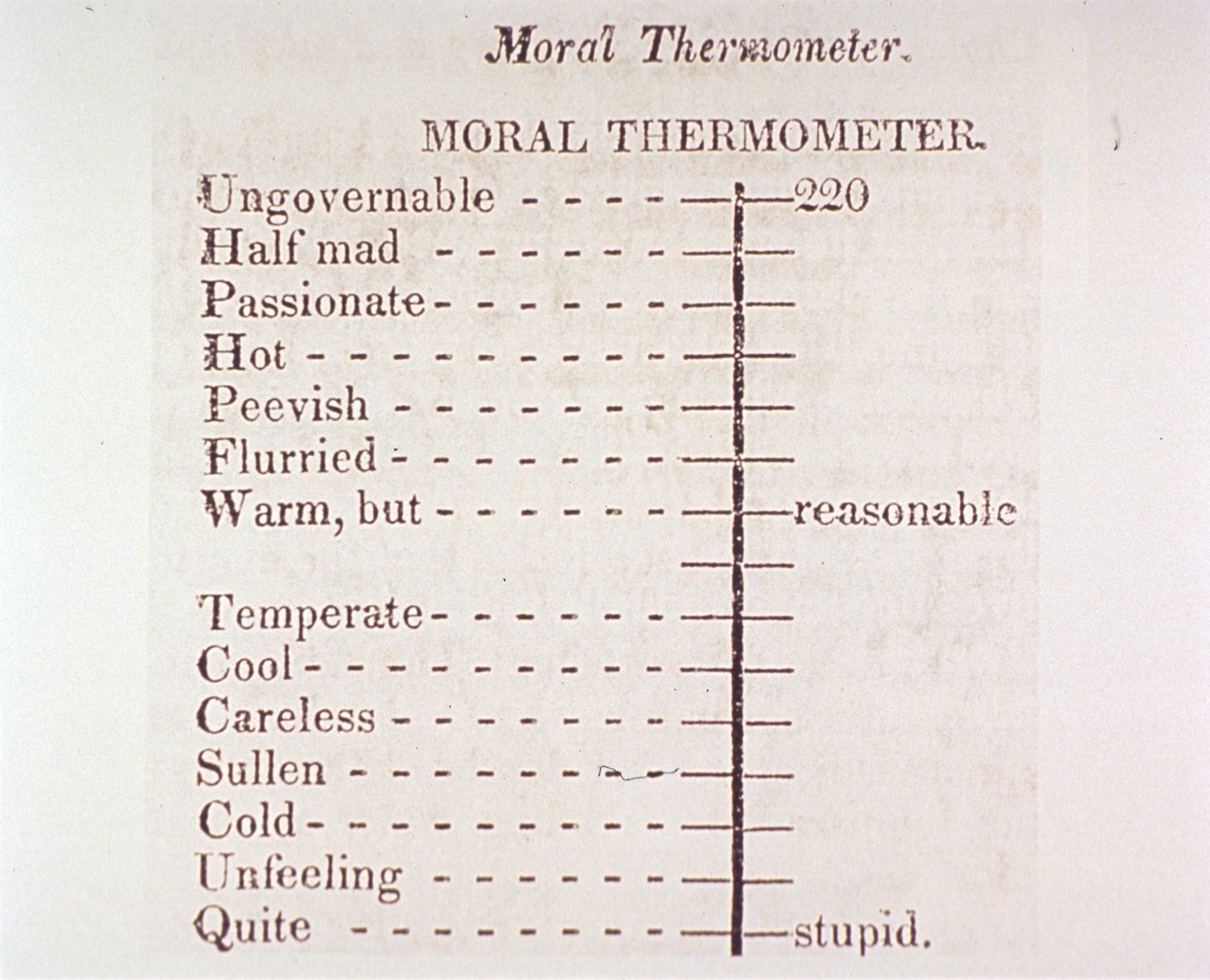
Snowbound as I am, I have been surfing the Intertubes and came across the National Insitute of Health’s Images from the History of Medicine, and specifically this image:

It appeared in the Journal of Health, v. 4, p.5 (Philadelphia, 1833).

I don’t know quite what to do with it other than to be amused by it in some undefinable way. I’d love to see it in context, to read the article to understand exactly what the medical community thought it was clarifying. I thought about making some kind of Assignment for the Lichtenbergians, but I couldn’t define what it was I thought should be done with it.

So, commenters, what are your thoughts?

Listening experiment

Not really an experiment so much as a controlled experience. I noticed, or thought I noticed, that iTunes was focusing on certain CDs to the exclusion of others. So I created a smart playlist for classical/orchestral music which excluded anything that had been played since June 1 of this past year.

I was right. There were a couple thousand tracks, some of which I had not heard since 2007 or even earlier.

That’s what I’ve been listening to for the past week, and I’ve got three and a half days of solid music still to go.

At the moment, I’m hearing Bach’s Keyboard Concerto #2 (Murray Perahia on the pianoforte) as if for the first time. It’s gorgeous, of course.

In a scan of the contents of this playlist, I notice that iTunes tends to shun the first CD of any 2-CD opera set. I’ve been hearing the ends of operas, but not their beginnings. Actually, I haven’t been hearing most opera, and some other thorny 20th-century stuff, at all, since at school I had been listening to a “culled” classical playlist that excluded stuff that I thought might drive other people crazy. But since my clerk’s been abolished, I listen to whatever I damned well please, and everyone else can just catch up.

As Charles Ives once said, as he beat a concertgoer over the head with his program, for protesting the “modern” music being played, “Stop being such a God-damned sissy! Why can’t you stand up before fine strong music like this and use your ears like a man?” (The music in question was that of Carl Ruggles, which is still tough going even today.)

Lichtenbergian Goal #6

Lichtenbergian Goal #6: in conjunction with all of the above, produce a lot of crap, i.e., produce boatloads of work

Right. This one may be the hardest one of all.

First of all, it requires time. It’s all fine and good to say that the more you produce, the more likely it is that you’ll produce something of value in the midst of all the crap, or that “10,000 hours of practice” blah blah blah and you get good at whatever it is you’re doing. But producing a lot of crap also requires that you have the time to do it, if you’re going to be mindful of what you’re doing.

And that’s the problem anyway, isn’t it? Lichtenbergians don’t really procrastinate, we just don’t have time available to us to sit down and work. Just now, for example, I was stopped in the middle of a sentence by the appearance of my lovely first wife with marching instructions for my day off. This is in my upstairs study, where she never comes, at a time when normally she should be at work. And that’s just for a quickie morning blogpost, never mind the ELP or the symphony.*

Real life intervenes. Leaf by Niggle. Family and friends. Nine-to-five. We wait for a block of time that never comes, and we keep pushing our hearts’ desires forever ahead of us, out of reach.

, , ,

* Polemics aside, I am bound in honesty to say that my lovely first wife is not a stumbling block to anything I need to accomplish. Quite the contrary: she is amazingly supportive in almost never demanding my presence when I’m trying to get something done. Just had to say that.

Clarification

When I said I had a “dread feeling” about getting started on A Perfect Life in the previous post, I didn’t mean that I have some silly premonition that I’m running out of time to do this. I meant that I have a real dread of the messiness, the incoherence of how I think I need to approach the project.

I have a vague image of what a finished version might look/read like, but of course I cannot sit down and start writing that finished version. First of all, I only have a vague image. Duh.

Second of all, there is no second of all. I only have a vague image of what should be in the book (“Everything!” is the only answer I can get out of the Muse), and absolutely no idea of where to begin.

So I must simply begin. Open the book and start writing about my life and how I live it, here in Newnan, on College Street, in the late 20th/early 21st centuries.

How I wake up and get ready. What College Street looks like, winter, spring, summer, fall. My study. Driving through downtown. Walking through downtown. Being married. Being a father. What I wear. What I don’t wear. Front porches, their decline and fall. School. Parks. The theatre. Lichtenbergians. Lichtenbergianism. The ELP. William Blake’s Inn. The changes in all of the above over the years.

“Everything!” says the Muse.

And that fills me with dread. My stomach churns and my shoulders tense up even as I type this.

“Everything!”