24 hour challenge #13

From Dave, way back in 2009, 3-187-13:

they are given to
hold close, not
air, not each other

From “Knee Lunes,” by Robert Kelly.

No, I don’t know what to do with this, nor have I ever.  See you tomorrow night.

[If you’re just joining us, here are the instructions for the 24 hour challenge, as well as previous efforts.]

4/23/13, 10:36 pm

Okay, it sucks, but really, I don’t even.  I mean to say, wot?

24 hour challenge #13, “Knee Lunes,” for Dave: score [pdf] | bassoon [mp3]

The return of the 24 hour challenge: #12

I know.  It’s rather unbelievable.  What have I gotten myself (back) into?

But in a longstanding Lichtenbergian tradition, I have resurrected 2009’s 24 hour challenge in order to avoid working on Five Easier Pieces, of which I have exactly three abortive attempts.

For those who cannot recall exactly what I am talking about, head over to the 24 hour challenge page and refresh your memory.

And here we go:

From Mike, who will be astonished to learn that his numbers (4-1081-33) finally came up:

Come Sweete & frolick then with vs
Noe Longer doate on Telaphus
A youth aboue thy fate
A wanton Wench & rich beside
Hath him in twofould bondage tie’d
Nor does he proue vngrate.

That’s ll. 31-36 from “Maecenas Birthday,” by the Roman poet Horace, translated by one Thomas Pestell, an early 17th c. poet about whom not even Wikipedia has a thing.

Let’s see if I can get this up by tomorrow midnight.

4/19/13, 8:58 p.m.

Well, what do you know?  I did it.

A little background: entries #12, #13, and #14 have all been on sticky notes on my monitor since 2009.  I had to look at them every morning and every night, right above my Lichtenbergian chalice.  So it’s not as if I haven’t give these scraps some thought.  Even before I had to stop the 24 hour challenge because of decamping to Valdosta in June 2009, I knew that I wanted to set this one as a kind of Cole Porter beguine, a song for a 1930s chanteuse, as it were.

See what you think.  I think the tempo could be a little slower.  It would have to be interpreted, of course, by the artistes.

24 hour challenge #12, “Maecenas Birthday” for Mike: score [pdf], bassoon [mp3]

Spotlight on… me?

Working on Spamalot has been a treat, but it’s also felt a little strange, and I finally realized that part of the reason why must be that I am in fact unused to performing.

Think about it—since I started directing theatre in Newnan in 1975, here’s a list of the shows in which I had roles:

  • Hotel Paradiso, Maxime
  • Midsummer, Oberon (1979) & Theseus (1997)
  • Twelfth Night, Antonio
  • The Dining Room, various
  • You’re a Good Man, Charlie Brown, Schroeder
  • Love Letters, Andrew
  • Pericles, Gower
  • Henry VI/3, Clifford
  • Into the Woods, The Baker
  • Marriage of Figaro, Count Almaviva
  • Wit, Dr. Kelekian
  • Auntie Mame, Mr. Babcock
  • Coriolanus, Aufidius/various

That’s it. Out of the hundreds of shows done in Newnan for the past 38 years, I have had roles in fewer than twenty of them, and only five of those could be considered lead roles, and only one of those was a starring role.

And Arthur, King of the Britons, is a starring role, the kind that gets your name up in lights on the marquee if not the top of the Playbill title page. That’s hard for me to wrap my head around, actually.

It’s not because I am unused to being a star, because in GHP Land I am a huge star where hundreds of people whose names I do not know think I am wonderful and gush on Facebook that they saw me at some function or other. (It’s mostly amusing and of course bunches of fun, but even on that small scale I am acutely aware of the responsibility to be perceived as cheerful and gracious to my “fans.”)

That’s not what I’m talking about with Arthur, however. Arthur is not about being a star, about stardom, it’s about handling a starring role. On one level, of course, there’s nothing different about it than any other role—you learn your lines, your songs, your choreography (eventually), and you use your skills to evoke laughter/tears/delight/horror/whatever.

On another level, though, there is a huge difference between being Arthur and being the Third Peasant from the Left. There is a responsibility to the production that does not weigh in the same way on the Third Peasant; if he flubs a lyric or a step or screws up the timing on some gag, hardly anyone but his mother will notice, whereas if I screw up something, it has the potential to wrench the whole show out of its frame.

There is also a curious sense of dividedness inherent in the role. On the one hand, there is a huge amount of attention being showered on me, but at the same time, it’s not really me, it’s Arthur. This is true of any role, of course, and it’s one reason some people have a hard time committing to playing the truths of an unpleasant character, but it’s magnified in a very weird way in a starring role. I can see why some actors would become irritating divas: if you confused Arthur’s “stardom” with your own, you might begin to believe that it was you that everyone loved so incredibly much. That way madness lies.

I’m not sure even now that I’ve adequately explained how odd playing a starring role is for me. I’m sure anyone reading this is likewise puzzled, because I imagine that most people would never associate “shy, self-deprecating modesty” with me. But dammit, I’ve been working on that, and now here’s a stumbling block in my path to enlightenment. Which you can see for yourself March 13-24 at Newnan Theatre Company.

Triumphant return

Yes, it is true. I have been cast as Arthur, King of the Britons, in the first non-touring production of Monty Python’s Spamalot in Georgia, at the Newnan Theatre Company.

And yes, that means that my triumphant return to the Newnan stage is exactly as I left it: singing the lead role in a musical comedy as a clueless aristocrat.

Am I being typecast?

A Proustian moment

I had an odd moment last night at Newnan Theatre Company. Second night of auditions for Spamalot, learning a dance sequence on the mainstage. I happened to look up, and there on the ceiling were some letters of the alphabet, chalked onto the black paint.

It took me a moment to realize that it was my handwriting.

These were the positions of the wings and drops for Mozart’s Marriage of Figaro, my farewell piece as artistic director of Newnan Community Theatre Company, aka Newnan Theatre Company. Other than an uncomfortable wedging of Coriolanus into the space one night back in 2008, Figaro was the last time I performed on that stage, and that was ten years ago.

From the sublime to the ridiculous…

Fragment #3

A while back, I bought a CD called Nouveaux “Brandebourgeois,” i.e., New Brandenburgs. The conceit is that this musicalologist Bruce Haynes has grave-robbed J.S. Bach’s other works to piece together six more Brandenburg Concerti such as the man himself might have written if he had gotten the job in Brandenburg and become a court composer instead of a church composer.

A brave attempt, but fruitless. The more I listened, the less they worked. As a composer, I have found that themes know themselves what they’re for: a sonata, a choral work, a symphony, a fugue. It doesn’t do to try to force a song theme into a symphony, nor vice versa.

And so even when I didn’t know the original pieces, the fake concerti never took flight. All those cantata themes were just not agile enough to dance through the intricacies of the Brandenburgs.

A lesson to us all, I’m sure.

Libertà!

There is an odd moment in Mozart’s Don Giovanni that perplexes directors and audiences alike, near the end of Act I.  The Don is giving a party, deliberately taunting his enemies, and as he welcomes them he seemingly out of nowhere cries, “Viva la libertà!”— “Hurray for Liberty!”  The others take up the cry, often coming downstage to deliver themselves of this stirring sentiment.  Trumpets and drums, which we have not heard since the Overture, make it a rousing, if confusing, moment, which vanishes as quickly as it appeared.

I was reminded of this as I tootled across the back roads of Georgia on my GHP RESA World Tour recently: my iPhone was set to play my 7500 tracks of music randomly, and that scene popped up somewhere between Statesboro and Waycross.  And that in turn reminded me of my experience at Atlanta Opera last season with their execrable production of Don Giovanni.

Costumes were fine, set was fine, the orchestra was good, and most of the singers were acceptable, although the Don himself was very shaky.  But none of them could act, and it looked as they didn’t have a director at all, because whoever directed it simply didn’t.  I am not exaggerating when I say that I could have blocked that entire three-and-a-half hour show in one rehearsal, one short rehearsal.  Everyone just came on, walked to their spot, faced downstage, and sang. It was excruciating.

Giovanni is a tough nut to crack.  Our main character is an abusive, self-gratifying, self-justifying sleazeball.  His servant Leporello is a codependent toady.  His opponents, the “good guys,” are both hapless and feckless, especially Don Ottavio, the fiancé of Donna Anna, whose father Giovanni kills in the opening scene while trying to escape from Anna’s bedroom.  Ottavio spends the entire opera dithering about who the killer is (Giovanni was masked) and whether or not it might not be maybe Don Giovanni and what he might maybe do about that if he could only be sure.  Maybe.  More about that in a moment.

I’ve never been sure how Mozart means us to take Giovanni.  He’s clearly a not-nice person, but he’s the main character, and the non-evil people are just tools in his hands (besides being simply tools like Ottavio and Masetto, the peasant lout whose fiancée Zerlina Giovanni tries to seduce.)  In the end, he is dragged to hell by the statue of the Commendatore, Donna Anna’s dead father, and it’s extremely unclear whether we’re supposed to be smug in our righteous condemnation of the brute, or overcome with admiration at our boy’s proud refusal to repent and to become “other than he is.”

So anyway, Atlanta Opera’s director failed to crack the nut, and the audience’s tolerance of the stage action got increasingly thinner until the final scene, when Don Ottavio rushes onstage, finally ready to punish the vile seducer, only to find that his dead father-in-law has beat him to it.  The audience howled with derisive laughter.

It got worse.  That climactic scene is followed by the lamest ending ever: Donna Anna & Ottavio, Leporello, Zerlina & Masetto, and Donna Elvira (Giovanni’s deluded stalker) all stand and sing what they’ll do next:

  • Let’s get married. (Ottavio)
  • Sure, but we have to wait a year. (Anna)
  • I’ll enter a convent. (Elvira, who has spent the entire opera essentially begging Giovanni to do her one more time.)
  • I guess I’ll find a new master. (Leporello)
  • We’ll go get breakfast. (Zerlina & Masetto)

Mercy.  Then there’s the rousing final sextet, where they all sing how good is rewarded and evil punished.

Sure.  Whatever.  Curtain.

As fate would have it, the next day after this performance I received an email from Atlanta Opera asking me to rate my experience.  With raised eyebrows and pursed lips, I set to it.

After a series of questions asking whether I thought it was appropriate for the Bank of America to be a corporate sponsor—sure, I said, just like a Mexican drug cartel: money is money—they asked what the most enjoyable part of the evening was for me.

I was able to reply truthfully that it was during the curtain call, when I had a vision: wouldn’t it be a blast if while our idiot good guys are singing their platitudes about good always winning out, we see behind them the devils from the finale climbing out of the floor and dusting themselves off; followed by the Commendatore, whose statue costume we noted looked a little ratty when we first saw it; followed by Don Giovanni himself, who pulls out a roll of bills and pays them all off.  He makes his escape while his enemies congratulate themselves on their virtue.

He is the 1%: throughout, he uses his position and his wealth to abuse everyone around him for his own pleasure, and even when they think they’ve got him cornered, he buys his way out of it.  We’ve seen it happen the entire opera, and so when he fakes his own death, we are not surprised.

Why Atlanta Opera doesn’t hire me, I’ll never know.

Anyway, back to libertà.  I hadn’t really given my epiphany a second thought since typing it into the email survey form with such grim pleasure, but when that scene played out on GA-121, it all made sense.  Giovanni, after inviting his worst enemies to a party where he intends to seduce Zerlina right in front of them, distracts them with cries of Liberty! Freedom!  And like the pitiful sheep they are, they sing right along while he moves in on the peasant girl (who never gives in, by the way).

What else are they going to do? He’s the 1%.  Suckers.

New art

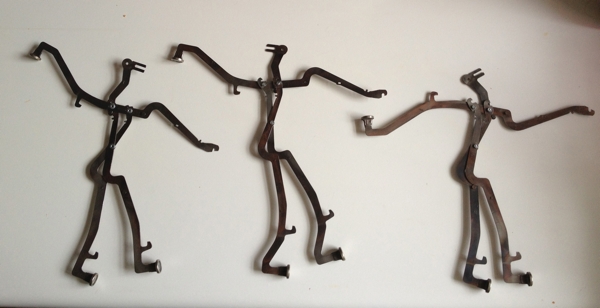
Today my Lovely First Wife and I went to the Slotin Folk Art Fest up in Norcross.  Some very nice stuff available up there!  I resisted several pieces, but if we had gone on Friday, I probably would have gone back today to buy some more stuff.

Here’s what I did buy:

They’re less than a foot tall, and at 3 for $50, such a steal!  I haven’t decided where they’re going yet.  I’d love to mount them in that little fern bank in the middle of the labyrinth, but I don’t know if they’d be visible.  Clearly, mounted on a wall they’d be excellent.

As soon as I saw them, their atavistic energy made it impossible for me not to have them.  They hark back to some of the Lichtenbergians’ founding goals, don’t they?

They’re made from manual typewriter keys.

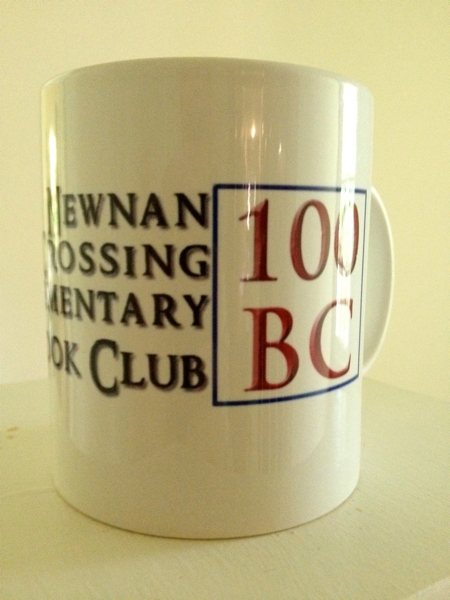
Mugshots: The Newnan Crossing 100 Book Club

Ah, the acrid smell of failure…

I would call it a spectacular failure, except that would denote spectacle, and the Newnan Crossing 100 Book Club never crawled out from the mud, much less took flight.

The concept was simple, and I should be standing astride the world of elementary reading like a Colossus, not to mention filthy rich somehow, but I never found a way to make it work.

I got the idea from a book called The 100 Greatest Books for Children, or something equally ludicrous.  It occurred to me that it might be a good thing to challenge students to read some of the “greatest books for children,” and it would be even better to distract our better readers from the Accelerated Reader™ point treadmill.

For those who have never suffered through Accelerated Reader™, it’s a behemoth: Renaissance Learning wants to take over your school one computer and one child at a time.  For AR™, as it is commonly known, all the student has to do is to 1) read a book at his “level”; 2) take a computerized comprehension quiz; 3) accumulate points based on his score.

Simple, and actually effective as a strategy for helping low-level readers improve their reading skills.  However, for very good readers, it’s awful.  First of all, if a school focuses on the points and creates a competition based on them, the gifted kids go nuts.  It’s a piece of cake for them to read a Harry Potter book, take the quiz, and snarf up 20+ points, while the struggling reader (for whom the program is designed) is lucky to get 1 or 2 points for their little books.

Worse, the good readers will race through books so they can get even partial credit/points for a book, thereby destroying what pleasure there might be in tackling Harry Potter.  (Remember, the quizzes are low-level comprehension quizzes only: no higher thinking skills required.)

So my idea for the 100 Book Club was equally simple: the student picked one of the 100 Book Club books, read it, and wrote a review explaining how they liked it. There were over 800 books on the list (cataloged in the online catalog), each and every one either an award winner or a starred review in one of the library journals.  The aim was to read 100 of these books by the time you graduated 5th grade.

Kids could even go ahead and take the AR™ quiz if they wanted to, but passing the quiz didn’t get them credit for the 100 Book Club.  They had to write a review, and it had to be approved by me.

That was the problem, in the long run: we had no way to manage the review process that would keep it alive.  At first, I had folders for kids to use, but that was unwieldy.  Then I had the IT crowd install a group content management system that was supposed to provide every kid with his own book blog, but that was also unwieldy.

Finally, Follett Software Company upgraded their catalog software so that students could write reviews in the catalog.  Perfect!

But it didn’t work, and I think the main reason why is that I could never get the teachers to organize around it.  AR™ was much easier—the kids managed that on their own, and I handled the only rewards Newnan Crossing gave out, the aluminum dog tags for “Point Clubs.”  All the teachers had to do was to give the Renaissance Learning reading diagnostic and assign the kids their reading levels.

(To be fair, the best teachers worked very hard using AR™ appropriately, cajoling kids and encouraging them with praise, etc.  100 Book Club would have added a whole other layer of work which they could scarcely deal with.)

It was also nearly impossible for a kid to get even close to the 100 books unless they started in 2nd grade and read bunches of the “Junior Level” books before getting to 4th grade, and even then it meant reading one of these higher level books every week in 4th and 5th grades.  Not really do-able; I should have thought of that before launching it.  But “100 Book Club” is really catchy, isn’t it?

So the whole thing just sat there, nudged along by me for five years, but never really taking off.  If it had worked, we would have been graduating kids who not only had read some of the best books around, but who would also have learned to write well about their reading.

There were lots of kids, the cool kids, who hooked into the concept and regularly consulted the list of titles to choose their reading—they had found that Mr. Lyles spoke the truth when he said these books were better than the regular books.  But none of them wrote reviews; they took the AR™ test instead.

Oh well, in my charter school…

Note: I use the trademark symbol after AR™ because I always wanted to remind the teachers that this is a commercial venture.  We have to pay for the software and pay for each and every quiz.  Otherwise, many people think it’s just a wonderful gesture of kindness that someone does to help our students learn to read.

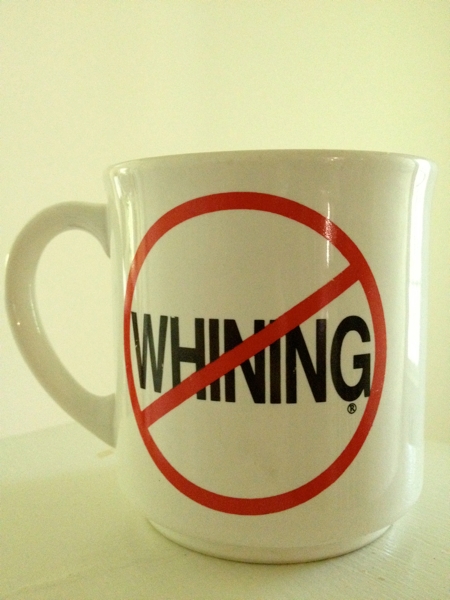
Mugshots: No whining!

And I mean it.

This mug is actually more ritual than neurosis.

I found this mug in the gift shop at Montreat, the Presbyterian mountain conference center.

As usual, a little history: growing up at First Baptist, I was aware of Ridgecrest, where Baptists had their summer music camps.  I never went to one, and I’m not sure why.  It’s possible that my family could not afford it, and very probable that I was too insecure to go to something like that.  (Maybe there is more neurosis here than I thought: I was in many ways a blighted child.)

Montreat is right over the ridge from Ridgecrest, and I became aware of it while serving as music director for Newnan Presbyterian Church, a position that I discovered I had been appointed to while I was away at GHP in 1990.  Because of GHP, though, I was not able to attend that music camp either.

However, in 1995 I was not doing GHP, and it was decided that the church would send me to Montreat.  I was actually excited about this: a week in the mountains with 300 musicians, studying music and conducting and arranging. Plus, we got to sing!

There was a select chorus, but you had to send in an audition tape, and I was too insecure to do that. When I got there, though, it seems that a lot of people were too insecure to do that, because they were having auditions the first afternoon.  So I went, and I made it into the group.  That was cool, because we were singing the Duruflé Requiem and a couple of other pieces, and our conductor was a British man whose name I forget—he was John Rutter’s conductor.

There was also Alice Parker—yes, Alice Parker of Robert Shaw/Alice Parker fame—and she was awesome.

Anyway, on Wednesday, I got a phone call: Ginny’s paternal grandmother died.  I had to leave to drive to Abingdon for the funeral.  The only time in my life that I got to go to music camp, and I couldn’t even stay.  Not that I’m bitter or anything.

So, the mug: I found it in the gift shop at Montreat and I snapped it up.  It’s perfect for a church choir director, of course, because choristers are notoriously whiny.  I won’t say mine were.  I will not say that.  Just not going to say that.

Two years later, I was the assistant program director for instruction for the Georgia  Governor’s Honors Program, and as I was packing for the summer this mug made the cut to go.  It became my ritual to bring the mug with me to the first staff meeting on Thursday morning while wearing my Space Ghost “Don’t make me use the spank ray!” t-shirt.  Those two items were my staff management policies in a nutshell, and I think they were effective: a firm hand, but a light touch.  [Jobie, do not go there.]

Whining is pointless and should be stamped out wherever it occurs.  Whining is, as far as I’m concerned, just a way to tell me that you don’t want to be there, and for GHP staffers I can make that happen.

Whining is not bitching.  Bitching is OK, because bitching is targeted.  Bitching can identify a problem that I will then invite you to help solve.  Feel free to bitch to me.  But whining?  Go do that somewhere else.

And please don’t be like Jobie, who strives to provoke me into using the spank ray.  Such a nerdvert…