The roar of the chainsaw, the smell of the art

On Saturday we motored over to Gray, GA, for Chaptacular, which — despite what conclusion your filthy mind has already leapt to—is actually an art event hosted by Chap Nelson on his spacious property as a fundraiser for the Cystic Fibrosis Foundation.

The full event name is Chaptacular Chainsaw Carving Bash, and it was more than, again, what you were expecting.

About twenty carvers from all over the country—including a national champion and an international champion—were on the premises, hard at work by the time we got there.
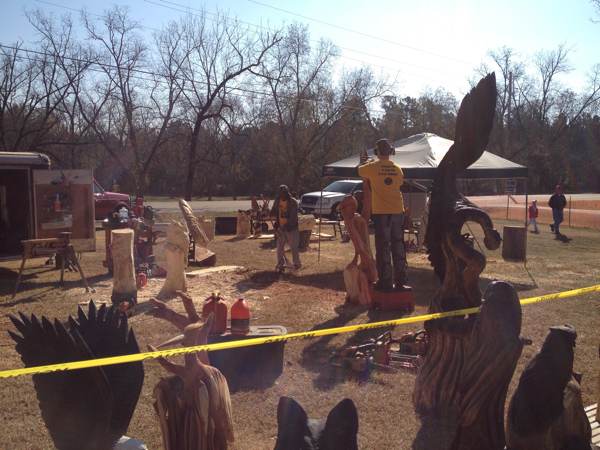
A lot of the work (all of which was for sale) was much what you would expect:

Lots and lots of bears: little ones, like these; big ones; happy ones; sad ones; silly ones.  You name it.  But there were other subjects as well:
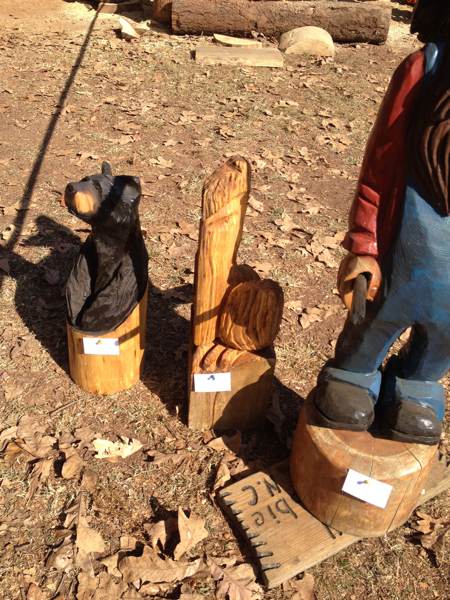
Stop it, you perverts!  That’s a pelican.  I think.  Lots of Green Men/wood spirits:
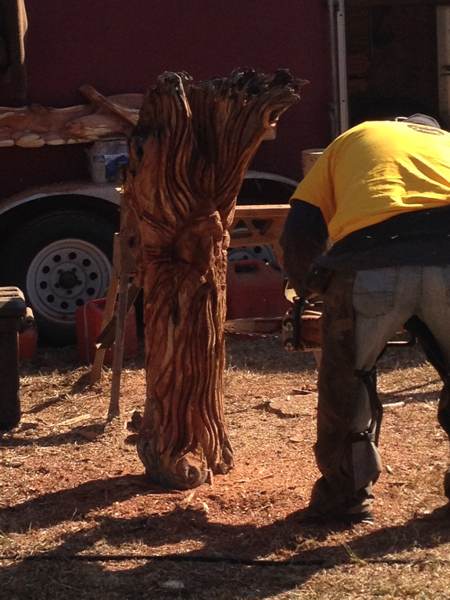
Watching these people work was fascinating.  It’s all I can do to cut a log in half with my chainsaw, and here they were wielding them with surgical precision.  Like “real” sculptors, they had a whole set of chainsaws in different sizes, plus buffers and grinders and sanders.

Soon after we arrived, most of the artists assembled for the “quick carve” event.  It’s mindblowing.  About a dozen of them stood in the carving area, each with a large block of wood and his tools, and after a brief intro from Mr. Nelson, they started their chainsaws up and went to work.

http://dalelyles.com/images/chaptacular14_quickcarve.mov

Go ahead, click on it.  It’s only 30 seconds long, and it’s tiny, unfortunately; if you do full-screen, it goes grainy.  Sorry.  But do look carefully at the man on the far right of the video, slightly behind the guy in front.

Here’s a good look at him from the other side, on the left.  For the longest time, all he did was saw straight down through his block.
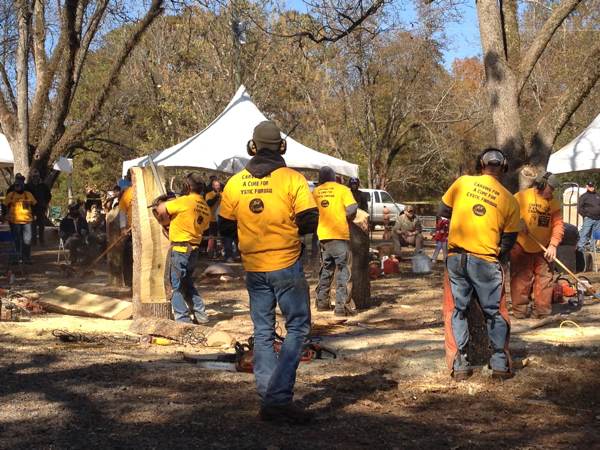
Hold that thought.  After 20-30 minutes of ungodly noise—it really did become hysterically mind-numbing because nobody stopped, nobody paused even for breath—shapes began to emerge.
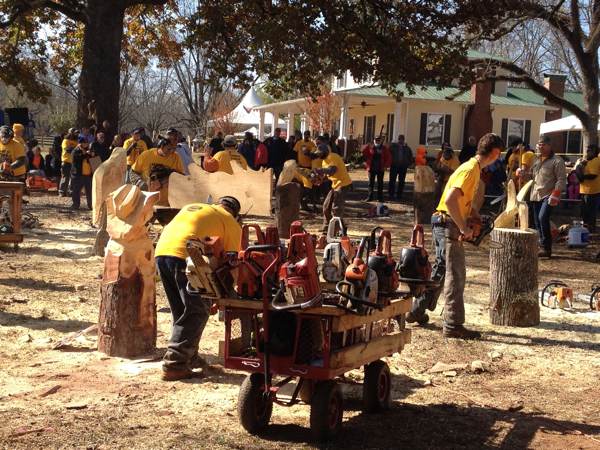
As you’re holding that thought about the short guy with the tall block, hold a new one about the young man on the right.

Here’s what the short guy ended up with:
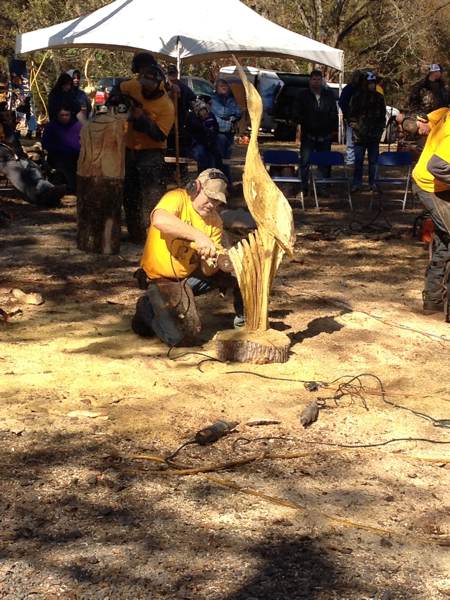
This is the national champion, and he got here way faster than the other artists.  (Unfortunately, for our tastes, he ended up spray-painting the heron.)

Okay, back to the young man:
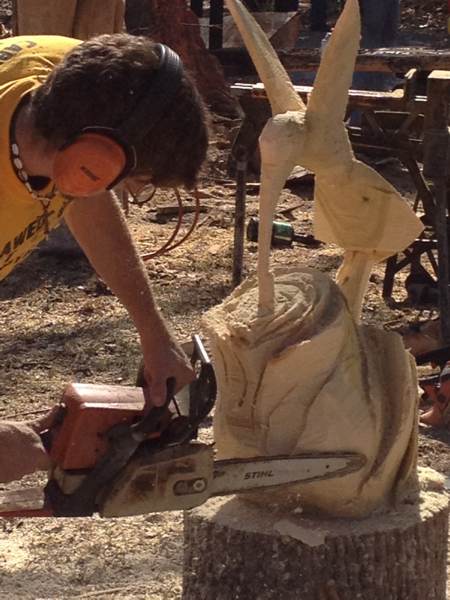
Ambitious, to say the least, and I don’t think he got it very finished by the time the carve was over.  But it was still amazing to watch.

It wasn’t all bears and green men:
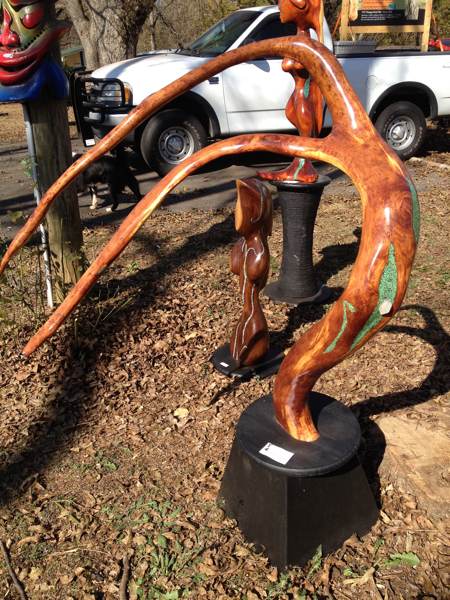
These are inlaid with turquoise and crystals.  Not tremendously balanced, artistically-speaking-wise, but they were different from the surrounding work.

As you might suspect, most of the work was not something I would own, but as a demonstration of the creative process it was amazing.  It was the ultimate “take a block of wood and remove everything that isn’t a heron” experience.

The one piece I almost bought and would have if I still had two incomes:
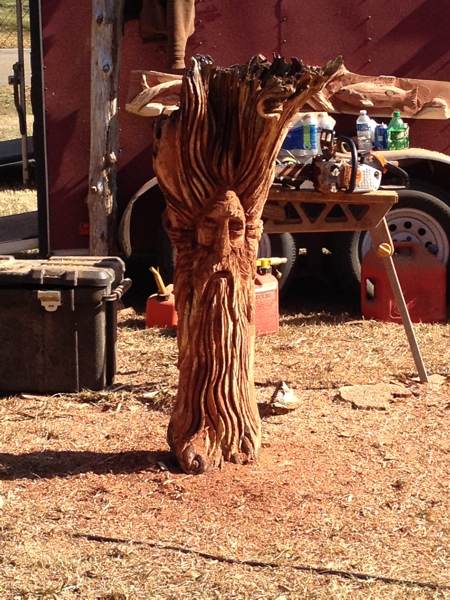
It  would have gone in the southwest corner of the labyrinth, maybe.  Unless it proved to be too large to fit in, in which case I would have given it to Craig for his labyrinth.  (Who am I kidding?  I would have made it fit.)

Finally, if you’re in the market for a bear, this is the place to be.  They had an auction of pieces donated by the artists, all proceeds of which went to the CFF.  And good deals were to be had thereby.  I highly recommend marking your calendar for next year’s event.
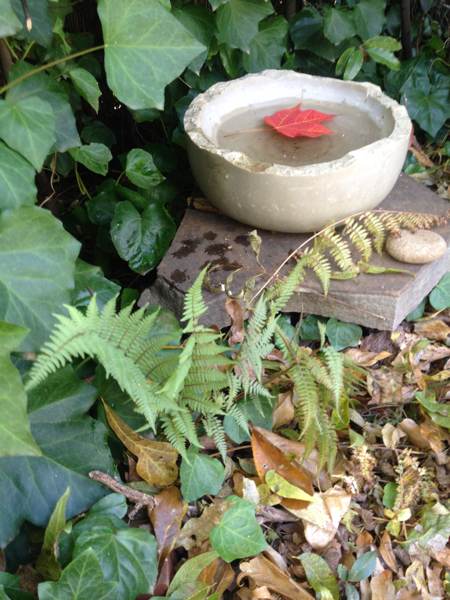
A quick look into the labyrinth

Yes, I’ve been “quiet.”

Have a couple of photos of the labyrinth from this afternoon.

The bowl from the west point.  The maple leaves were everywhere; I tried to get a nice shot of the freshly mown labyrinth with a couple of them scattered about, but I needed a real photographer to do that.

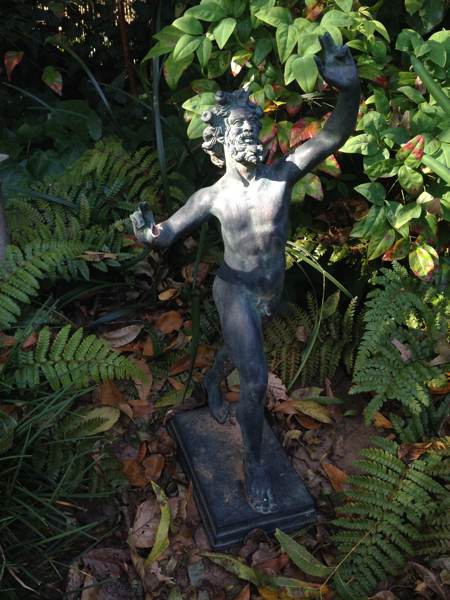
Our dancing fawn, aka Dionysus.  Look carefully at his right hand—his thumb has cracked off.  I’m sure I will have to replace him after the snows of winter, but as Shakespeare always reminds us, “Every fair from fair sometime declines.

This is why we can’t have nice things

I wish to make a complaint.

For months now I have avoided downloading and installing the newest versions of Apple’s Pages, Keynote, Numbers, etc.  The reviews I read were enough to convince me that many features that I need and use regularly had been stripped out in the update, and I thought, fine, I’ll be a cranky old man and hang on to iWork 09 forever.  (It meant that I had to keep telling the computer to “remind me tomorrow” every day at some point, but that was a minor annoyance compared to losing styles.)

First of all, why?  Why would you take options and features away from an application?  Sure, if you’re Microsoft, you’ve got plenty you can trim away from Word and no one would know the difference, but Pages was a lean, sleek word processor.  It didn’t need to shed anything.

Still, I kept checking back to see if some functions had made it back in as Apple is wont to do with updates.  Finally it dawned on me that I could just stop by our local Apple reseller and play with Pages directly.  Lay hands on it.  See if the things I needed most were in there somewhere.

(I also checked out Yosemite, the new OS, because upgrading one’s operating system should always give one pause.)

Everything seemed fine, so I spent an entire afternoon last week updating the laptop and then the iPad.  (Updating the phone will have to wait for a brand new phone.)

So, everything seemed fine, although both laptop and iPad are noticeably more sluggish. Styles, which I use extensively, were different and not as easy to use, but at least they were there.

And then, just now, I wrote the post about music in Pages—which I will do with longer, more involved posts—and went to paste it into WordPress here.  For some reason, paragraph returns don’t get translated into HTML paragraph tags, which I always forget, but that’s not a problem.  I just go back to Pages and do a find/replace: find all the paragraph markers and replace them with the appropriate HTML tags.

Except.

Pages no longer supports finding and replacing invisible characters like paragraph returns or tabs.  In the old version, you could click on the Advance tab and select those characters from a menu, or you could even type them in like ^p.   But now you can’t.

I tried showing the invisibles and copying the paragraph markers into the find/replace dialog box, but all that did was find double spaces.  What??

Some internet searching showed that indeed this feature was missing and the only workarounds were horrifically clumsy.

And so, Apple—if you’re listening—I’m going back to Pages 09 and will not be using your supernew and extremely broken word processor.

Where does music come from?

All songs are born to man out in the great wastes. Sometimes they come to us like weeping, deep from the pangs of the heart, sometimes like a playful laughter which springs from the joy that life and the wonderful expanses of the world around us provide. We do not know how songs arrive with our breath—in the form of words and music, and not as ordinary speech.

—Kilimê, East Greenland Eskimo, recorded by Knud Rasmussen; Pharmako/Dynamis, p. 239

Where does music come from?

The question is not Why do humans make music?, but more like How do humans make music? and more specifically How do humans make new music? Where does it come from?

I get asked this question all the time about my music. How do I come up with it all? Where does those melodies come from? How do I decide what goes where? And how does someone without a lick of academic musical training create things like William Blake’s Inn and the Cello Sonata and Six Preludes (no fugues) and Seven Dreams of Falling and my super secret new project?

Hell if I know, is the short answer.

I just spent three days in the mountains on retreat with my fellow Lichtenbergians, and all I produced was about a dozen ways not to sing the phrase “Rip me from this darkness.” If I knew where music comes from, I’d have a lot more to show for my effort.

Here’s what I know about where my music comes from. The Minotaur opens Dream Three of Seven Dreams with a four line lament on his unhappiness. (At least he does in the original script; I’ve requested that the dialogue be retained for the libretto.) At the end of the scene, as he and Theseus are making love, those four lines return (amplified) with a completely different emotional impulse, so to speak.

I’m therefore working backwards: I know the end of the scene is an ecstatic duet, and so I start working on making that happen. Later, I’ll take the melodies associated with those four lines and scale them back into a lament, changing the key and orchestration, perhaps even the rhythms, so that the notes that ring in our ears as ecstatic love start out as unhappy loneliness.

I also know that one effective way for music to depict ecstasy is to have the orchestra whaling away in chromatic arpeggiation while the singer soars above it with a strong, simple melodic line. (See: “Liebestod,” Tristan und Isolde, Wagner.) So far, I’ve approached it by trying to come up with the strong, simple melodic line and seeing where that takes me, but alas—that strategy has failed me.

I could keep working away trying to come up with that line, but I think what I’m going to try for a while is the other approach: work on the orchestral whaling and then construct the melody to soar above it. If the accompaniment gives me what I need, then no one will ever know that the melody was an afterthought. Well, you will, but you’ll keep your mouth shut in interviews, won’t you?

So the answer to the question “Where does your music come from?” appears to be “from a cold, calculating brain, not from a deep well of inspiration what are you crazy?”

I’ll keep you posted on the results.

I’m back—now with extra whinging!

I’m in the mountains, on our annual Lichtenbergian Retreat, wherein we are each to bring some creative work on which we’ve been slacking.  Since my recent work on Seven Dreams is the very definition of “slacking,” i.e., “no work at all,” I’ve brought it with me to jumpstart the process again.

(To be fair: 1) I ran out of text; 2) I was getting ready for and attending Alchemy; 3) my son got married.  Still, I bet Wagner didn’t let things like that slow down his ego work.)

At any rate, I’m in the Blue Ridge in a great cabin with four other Lichtenbergians—none of whom, I’ve noticed, seem to have brought any work at all, but let that pass.  I’ve brought the snippets of text which I have demanded respectfully requested begin and end Dream Three.  Hey, they’re Scott’s actual text from the original play, so I figure it’s not a problem.

Even if it is a problem, even if he ends up sending me a completely different text, I figure I can play around with scene setting and thematic/harmonic bits that I can then use with the new text.  As I said last night, measures full of sixteenth notes can be very flexible.  Bring on the words!

Here’s the part you’ve been reading for: whining.

In Dream  Three, Theseus and the Minotaur have had enough chitchat about their respective ritual fates and are getting it on.  The four lines of the Minotaur’s opening aria return, this time with a partner.  So, ecstatic duet, right?

Since I haven’t written any real music since August, I’m just aiming to produce crap the entire weekend, just getting my crapping muscles back in shape.  I don’t expect to use anything that comes out of my head in the next 48 hours—though one never knows.

My problem is that many of the halfway decent bits I’ve scribbled down are more Broadway than La Scala.  Don’t ask me what the difference is, there is one and I know it when I hear it.  So do audiences, and so do critics.  So I keep scribbling, breaking up some of the Broadway tunes with odd harmonies or melodic intervals, and it sounds more La Scala, but then it’s not very soaring or ecstatic.

Yes, I am modifying my music to please unknown critics.  On a personal level I have no desire be known as the opera world’s Frank Wildhorn or Andrew Lloyd Webber: singable tunes, loved by unsophisticated audiences but scorned by all right-thinking persons.  As Noel Coward said, “It’s extraordinary how potent cheap music is.”

On an artistic level, opera voices are not show voices, and the same melodies that fit comfortably on Neil Patrick Harris’s voice or Patti LuPone’s sound weak under Erwin Schrott’s or Anna Netrebko’s.  You want to please the audience and please the singers, and so you have to move them through the notes differently, if that makes sense, and  there’s more than a little element of athletic showing-off in the opera world.  If you make it too easy, they’ll disdain it.

I’ll get it done.  I just have to get back in the groove of pushing it all out—instead of blogging about it—because if I can produce a big enough pile of crap, there should be a pony in there somewhere, right?

3 Old Men: the skirt (day 4)

So I rebuilt the sashes, and they work much better.

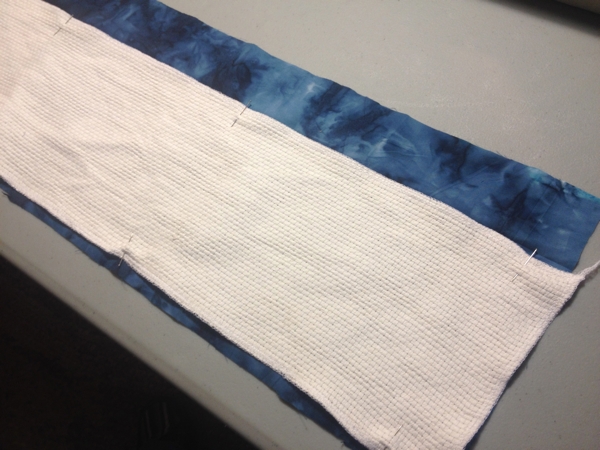
The new layout:

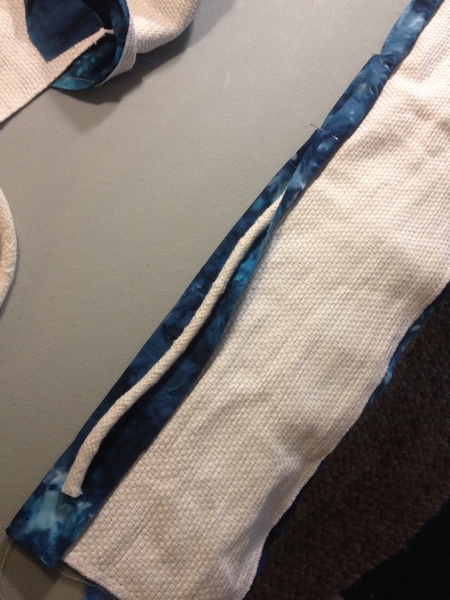
I laboriously cut the monks cloth along the weave, serged the edges, and basted it onto the lining.

I gave myself a broader strip in which to enclose the piping.

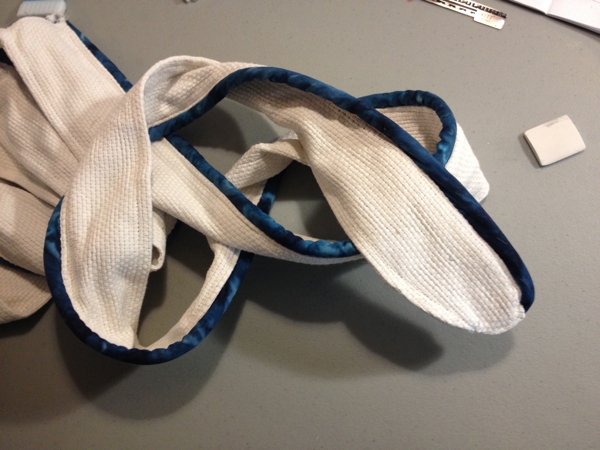
Et voilà!

They’re much cleaner with no loose edges to torment me.

In other news, I took a deep breath and finished the waistband and attached it to the skirt.  I’m all done except the center back seam, which I will do today.

However.

I pinned together the waistband in the back and tried the thing on.  I am not at all pleased with the results.  The waistband is a marvelously beautiful piece of work, but it’s too bulky.  I’m going to have to play with it more, especially this weekend when the Old Men meet to put together the labyrinth for the first time and test drive the ritual.

And no, I am not posting photos of the skirt in situ, as it were.  You will have to attend a Burn to see that.

update, 9/12/14: After working with a couple of entirely new designs, I revisited my finished skirt and decided to try just cutting off the top three inches of the waistband, i.e., the floppy, un-rollable mess.  Et voilà, it worked.  The result is clunky in a really groovy neo-Phoenician way.  I think the team is going to approve.

Behind on everything

As you can tell, I’m running behind on everything, so no time to blog with any thoughtfulness at all.

So, to make up for all the time you’d otherwise waste reading a week’s worth of blogposts here, have a link: http://www.smithsonianmag.com/smart-news/500-years-worth-book-illustrations-have-just-been-liberated-print-180952621/

WARNING: Do not click on that link. And if you do, DO NOT CLICK ON THE FLICKR LINK.

Just don’t do it.

In other news…

I recently renewed my membership in the American Composers Forum and immediately began looking over the Opportunities available to members.

So far today, I have submitted the following:

  • Fresh Squeezed Opera Company: They were looking for new arias, etc., so I submitted “My mother, bored and pampered,” promising to orchestrate it for their small ensemble if they select it.
  • Denison University Tutti Festival: I submitted two works, the Pieces for Bassoon and String Quartet, and “Blakes Leads a Walk on the Milky Way.”

I’m also considering inquiring about the Sacramento State University’s odd little posting about premiering works and students studying the history of such premieres.  I mean, why not?  Who says I can’t whack out a new piece for chorus and small ensemble by “early November”?

I’ll keep you posted about further submissions as I continue to explore the Opportunities.

I’m bored.

Having finished orchestrating Dream One and practically finished laying in the flagstone around the fire pit, I have written all the letters I can stand to write at the moment, so I am casting about for something to occupy myself.

I suppose I could tackle Five Easier Pieces, but I’m not that bored.  I think what I shall do instead is tinker with Dream Three, the libretto of which I don’t technically have but the tone of which I think I can work on without too many issues down the road.  Specifically, I’m going to take the Minotaur’s first speech from Scott’s script and pretend that’s my text.  Even if that’s not what we end up with, I will have the opening to the scene regardless; words are easy to adapt if you use a crowbar.