Day 365

Well, here we are. The end of the experiment. Was I able to be creative every single day for an entire year?

Short answer: of course not, if by creative we mean “producing something new.” Many was the day I had no time, nor the energy, nor the ideas even to commit failure to paper. I knew that going in, needless to say.

At one point in the year I know I expressed envy of those on the web who were doing similar kinds of projects, producing a drawing or watercolor or small oil or photograph every day. I don’t know that I would have overcome my reasons for not producing every day if I had been producing a concrete thing rather than music (my focus for the most part), but it seemed to me at the time that they had an advantage over me. (So why didn’t I just whip out a watercolor those days?)

Would I able to claim that I was creative every day if we don’t mean “producing something new”? Perhaps. As I read Out of Our Minds and skimmed back through some other books like Fearless Creating and Twyla Tharp’s Creative Habit, I was reminded of what I already knew going in, that creativity is not production. It is a process that must include plenty of incubation as well as consumption of material. However, I think I claimed those days.

Mostly what I have found is that I do best when I’m a) on a schedule; and b) on a deadline. If I set aside Sunday mornings and then two evenings a week to compose, then I actually do compose, or at least fail at it. And the days in between, I am thinking about the stuff I’m working on.

The schedule also means I have the time to get in the groove. It takes me about twenty minutes to warm up, so to speak, and to get ideas flowing out of my head. At least that’s the case with composing. Writing, I can do on the fly (witness my dog-walking lyrics) if I’ve set myself a framework. I can spew some music while walking, but it’s all guesswork, since I have not yet achieved my goal of being able to transcribe what’s in my head.

Having learned all of this, I think I’m able now to set up the conditions under which I will be most productive. I may be able to, in the future, modify those conditions, but for now, I know what works for me.

So what did I accomplish this year?

First and foremost, of course, was the completion of William Blake’s Inn. A project that has occupied me off and on for twenty-five years, I was on the last leg of the journey when I started this project: finishing Blake Leads a Walk on the Milky Way. It took me over a month to do that.

Next it was orchestrating the entire work. (I think I may have started orchestrating some of the pieces in order to distract from Milky Way.) This project is not quite finished, of course. I have not yet officially orchestrated The Man in the Marmalade Hat Arrives and Blake Tells the Tiger the Tale of the Tailor. They’re quasi-scored using various instrumental sounds in the piano score, but I don’t have actual orchestral scores for them yet. Unless someone in Newnan, GA, steps up to organize the production, my widget says we have 447 days until opening night, those two items will remain on the back burner.

At the same time, I started the “Highway 341” poem. I used that as a fallback item on days when I didn’t/couldn’t compose, but I haven’t worked on it since shortly before finishing Milky Way. I guess at that point the Inn took over. Well, it’s still a pretty good start, and I can return to it in the coming year. I would have to go back and do some deep thinking, of course, because I’ve gotten it to a point where I would actually have to start writing about the feelings that inspired it to begin with. And those were never very clear.

I also began, last August, noodling around on my symphony. Needless to say, I haven’t given that any thought since September either, but that is going to be my major project this fall and winter: Stephen Czarkowski has asked for it for next summer’s orchestra. Not exactly a commission, but hey, a request is as good as, right?

Also accomplished this year: Lacuna’s workshopping of the William Blake pieces. Very nice, lots of fun, and very very creative. I like working this way. I don’t like working without a permanent home: my van looked like one of those crazy people with all their prized possessions stacked inside. For months. But the give and take of the workshop sessions was invigorating. If the world premiere gets a green light, then I truly look forward to developing the entire scenario in this way.

I learned how to use CSS (Cascading Style Sheets) on websites, and that has been a very good thing.

I adumbrated and fleshed out the 100 Book Club at school. By the end of the year, we were up and running, but not at full speed. I’m looking forward to figuring out how to ramp that up this year. If it works, I will truly have something amazing to share with the educational community: a reading program that challenges our best readers to read thoughtfully and deeply and then to write about their experience.

I wrote The Invocation, which still stands up as valid. In a similar vein, we established the phase successive approximation as our mantra.

I began work on songs for A Day in the Moonlight, sketching out three so far. Once I get school started and am able to establish a schedule for myself, I could finish that by Christmas. Warning: I’m not orchestrating this baby. I’m just providing vocal/piano scores.

I rediscovered my Stars on Snow album of new age music and began to play with some of those files in Logic Express, Apple’s sound sequencer, which I began to learn how to use this summer.

I got inspired and wrote “Dance for double bass duo and marimba” which not only was greeted warmly by everyone concerned but which was premiered at the final GHP concert. I have a recording, but they were playing from the back of Whitehead Auditorium. I’m going to play around with it in Logic and see if I can beef it up a bit.

As a sidelight of “Dance” and the readthrough of Milky Way, I found myself suddenly in demand as a composer. Other than the Symphony, I have two requests for pieces. One of them is a serious request and I’ll work on it this fall. This is a very strange place for me to be in. I’m still sorting through that.

And I made a mug.

Something else got accomplished this year: a very small community of very smart readers helped me out. I’ve been checking out the posts, it’s taking me a very long time to write this, and I come across posts like this one. The post itself is very good, I think, but it’s the comments that blow me away: literate, thoughtful, witty. I like writing for you guys.

Next? I will finish the songs for Day in the Moonlight, and I will write my Symphony No. 1 in G major. That’s enough to be going on with. Of course, if a project coordinator materializes for William Blake’s Inn, then I’ll be back at work on that.

Will I keep blogging? I’m sure I will, although I may not blog every day. We’ll see. Don’t expect anything for a few days, anyway. My study is still unclean from GHP.

Checking back, I noticed that I started this project on August 1. Shouldn’t I have finished on July 31? How did I lose four days? Oh well. I knew that was bound to happen as well.
Day 364

One day to go, but before we get serious, a response to yesterday’s post on copyright and the flux of the Commons, from Jeffrey R. (for “Raline,” we think) Bishop: listen to this. Some of us have way too much time on our hands. As I said yesterday, I’m thrilled that the planet is mashing up William Blake’s Inn. However, if he starts getting rich off of it, I’m going to sue his ass off for an unauthorized derivative work.

Tonight, Kevin McInturff called to chat about a couple of things, but one thing he asked me in particular: do I think that having blogged about my 365 days of creativity has made me more creative?

Yes, I do, actually. It made me more conscious of wasting time, and even though there were plenty of days tagged “not” (39 to be precise, 11% of the year), usually those were days when real life simply left me no time to do any work. The days I actually goofed off were pretty few.

Though my audience was small, you guys were an audience. I was highly aware that you read what I wrote and followed my ups and downs, and that made me determined at least to write every day, whether I had accomplished anything or not. Kevin suggests that those days were often more interesting than the ones where I gloated about my triumphs.

Will I continue doing this? Let’s see tomorrow.

Stuff less bad? (Day 362/365)

So, I thought, what if I put the first part of the chorus (and all of the verses) in the minor, and then switch to major with the end part? This is what that sounds like (along with the inevitable ritard at the -ex rhyme.)

In other news, last night I watched The Five Obstructions. In it, two Danish filmmakers play. Jørgen Leth, the elder, agrees to remake portions of one of his first films, The Perfect Human, under amazingly restrictive obstructions set by the younger, Lars von Trier. For example, the first little movie must be made 1) with no edit longer than 12 frames (about half a second!); 2) in Cuba, where Leth has never been; 3) without building a set; and 4) answering the elliptical questions in the original narration (Why does he move that way? How does he move that way?)

The frame movie is a documentary of the two men as they move through this process, which takes a couple of years. I’m not sure what von Trier is up to, he seems awfully abusive in his intent, and Leth seems quite sanguine about it, but it’s a fascinating study in creativity. Leth is apparently incapable of making crap, which is von Trier’s stated goal. No matter what the obstruction, Leth turns in a gem. This seems to irritate von Trier, until he finally makes the fourth obstruction one so hideous that both men blanch: it must be a cartoon.

Needless to say, the cartoon that Leth turns in is a masterpiece. So the fifth obstruction is even nastier: von Trier will direct it, Leth will be credited as director. Leth also has to narrate it, reading a letter to von Trier from him that von Trier has written.

Finally von Trier gets his wish: it’s crap. The narrative letter is opaque in a way that only Marc can explain for us, but it’s essentially a nannie-nannie-boo-boo that von Trier has written to himself about his failure to bring Leth down. The visual accompaniment, made up of black and white shots of the two men culled from the footage, is pedestrian, and that’s being kind.

What’s fascinating about the whole venture is the way that Leth scribbles down all the instructions, the obstructions, furrows his brow, goes away very depressed, and then sets about remaking his 1967 movie, itself a perfect gem and included on the DVD, using the obstructions as tools. He expresses this directly after the first one: the 12-second edit was like “a gift.”

And von Trier recognizes his error right away. He switches from technical limitations to personal issues, but nothing slows Leth down. It’s a truism, but it’s fun to watch two geniuses confirm it: limits are a spur to creativity, not a hindrance. One of my most creative productions ever was the 1997 Midsummer Night’s Dream, when NCTC had $200 in our checking account. (It was one of those years when I relinquished the treasurer’s duties to someone else.) We could buy practically nothing, and so everything we did had to be made from what was on hand. It absolutely worked.

Of course, that was luck, having on hand materials that lent themselves to that particular creative solution. And I would certainly not want to tackle a fullscale William Blake’s Inn with no money, in fact, I am in the process of not doing that even as we breathe, but limitations are certainly one way to get yourself moving if you cannot decide how to “be creative” next.

Bad stuff (Day 361/365)

I whacked out a melody (and harmonized it) for the chorus of “I Would Never” this morning, but I don’t like it. It doesn’t sound like something that Groucho would sing. It’s OK as a melody qua melody, but it doesn’t match the lyrics in a way that I like. Oh, it’s perky enough, especially for those variant lines at the end. That part might stay. It’s the first part that needs work.

Oh, you want to hear it? I don’t know that I should expose myself as such a fraud so close to the end here.

Here you go: iwouldneverchorus.mp3 It starts with “I… would…” held on two fermata’d notes, and then launches into it.

Here are the lyrics:

I would never (he’d never)
I’d never (no never)
deride or disparage an ex:
I’m such a defender
of the delicate gender,
my feelings so tender
for all of the opposite sex.

For Carol was crazy and Lucy was gay,
And as for poor Karrie, well, what can I say?
For much as I’d love to have wrung all their necks,
I’d never, no never, disparage an ex.

4 days to go.

A little bit (Day 360/365)

I didn’t get a lot done today, at least not on this song. I had been humming out some possibilities, though, on the road to here and there, and by late evening was ready to commit something to Finale.

Well, not even the whole song, actually, just the tagline, “I’d never, no never, disparage an ex.” It was between getting all these other household/family things done, and to serve as a reminder of what was in my head.

It was also an exercise in being able to transcribe what I was hearing without using a keyboard. You perhaps know, if you’ve been reading this blog for a while, that I consider my fairly weak in many music basics. What any kid in a garage band can do, sing a line and transcribe it straight to paper, I’m never sure of.

I think that’s a weakness that I could fix if I just stay out of my study and away from the keyboard. The more I practice this kind of thing, the more apt I will become, ne-c’est pas?

5 days to go (!)

I Would Never (Day 359/365)

Up early this morning so that the painters can come finish the hall and Grayson’s bathroom, and I worked on verses:

Dissociative disorder Delores [thanks, Marc!]
Offered multiple ways to have fun.
When she sang it was always a chorus,
But then she would flourish a gun.

Romanian gymnast Ivana
Had many intriguing techniques.
But then she would take a banana and
Put you off of fruit salad for weeks.

Then there’s the lovely Vanessa,
a scrumptious, delectable dream:
Every time I’d begin to caress her
She’d grab both her buttocks and scream.

I thought I could love Amaryllis,
A waitress I stumbled upon,
But then she would give me the willies
when she followed me into the john.

I need to write actual music for this, but Roger-the-guy-who-fixes-the-air-conditioning is on vacation this week, so I’d have to drag all my stuff down from the study and set it up. I may do that next week if he’s not available soon.

By the way, the big finish will be a huge catalog of names, like a cadenza in a concerto, ending with

[huge catalog]
Leilani, Lolita, Letitia, and Lou,
Ula and Uma and Ursula, too:
For though they were total emotional wrecks,
And never forgetting the excellent sex,
I’d never, no never, (What, never?, Well, hardly ever…) disparage an ex.

I Would Never (Day 358/365)

I’m on a roll. Herewith the chorus to “I Would Never”:

CHORUS:
I would never (he’d never)
I’d never (no never)
deride or disparage an ex:
I’m such a defender
of the delicate gender,
my feelings so tender
for all of the opposite sex.

For Carol was crazy and Lucy was gay,
And as for poor Karrie, well, what can I say?
For as much as I’d love to have wrung all their necks,
I’d never, no never, disparage an ex.

In the last bit, that would change with each repetition.

For Maggie was toothless and Eleanor lisped,
And Susan would sunbathe till burnt to a crisp,
And Alicia most closely resembled T. rex,
But I’d never, no never, disparage an ex.

And that last bit I wrote while writing this post. I’m getting very good at this particular trope.

[a short while later]

For Chloe was cross-eyed and Doris a drunk
And Rita regrettably smelled like a skunk.
So I’ll say it again , if no one objects,
I’d never, no never, disparage an ex.

For Gladys had gangrene inside of her thigh,
And Molly made innocent children to cry.
For though many have given me herpes simplex,
I’d never, no never, disparage an ex.

Whee!

[even later, after another dog walking]

Amanda had scurvy, Felicia was fat,
And Winifred would end a sentence with “at.”
Because with them all I had excellent sex,
I’d never, no never, disparage an ex.

I can’t stop myself. Now I need to pile up actual verses the same way.

Thurgood’s Song (Day 357/365)

Double-ha! I walked the dog tonight and actually wrote lyrics to Thurgood’s song in Act II, wherein, if you will recall, he abuses all kinds of women along the lines of Lydia the Tatooed Lady and Egyptian Ella by denying that he would ever abuse those kinds of women.

The song will be in triple time, like “Lydia.”

Three verses so far (not counting Marc’s lovely “Dissociative Disorder Delores):

There’s a lot you could say for Gertrudë
She was clean and she came when you called.
But I’m afraid I could not have been rudah
When I found she was totally bald.

And then I was dumped by poor Mimi
Because I failed one of her tests:
It was bad that I ran away screaming
When I found that she sported three breasts.

I was ready to wed my dear Julia,
But she threw a wrench in my plan:
“Oh darling, I’m sorry to fool ya,
But you see that I’m really a man!”

And so on and so forth. The chorus will be something like, “I would never… I would never…” something something something.

8 days to go.

Dance for Double Bass (Day 351/365)

The last full day here in the Land of Pan-Dimensional Mice, and it’s a pretty sad time. I’ll talk about that tomorrow, perhaps.

We end it all with the Prism II concert, wherein the music department dazzles us with dozens of pieces. This year, it was not just good, it was phenomenal. All the pieces were well performed and well selected. They ended with the orchestra playing St.-Saëns’ “Bacchanale,” which is rousing good fun, followed by a “mosaic” of each of the areas playing a brief part of some piece from the summer. I was okay till the brass played their piece. It’s a sombre, gorgeous piece, and I don’t know the name of it, and I began to melt. The pianists gathered round Clara Starkweather, and she played the Rachmaninov. I began to squint. The vocal majors sang “Everything I Own,” and that did it. The kids onstage were crying, Kay next to me was crying, I was crying. I cannot type this without crying.

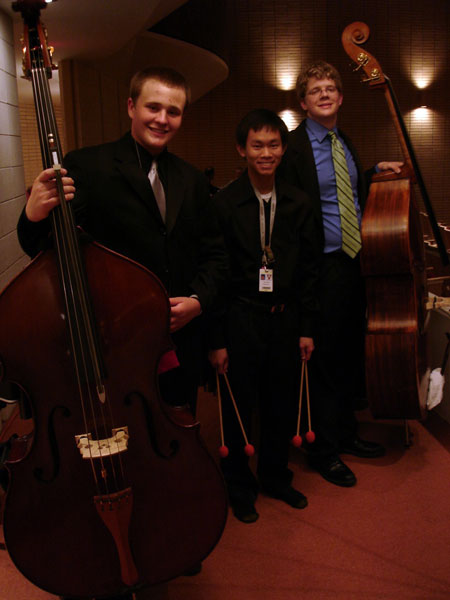
Here are my boys: Alex Edwards, Viet Cuong, and Jack Meisburg. This is before the concert. I had sneaked in the stage door, avoiding the crowd of 800+ people who were stuffed into the halls and heating the area up to 98.6° and beyond.
As you can tell, they’re pleased and excited to be giving the world premiere of “Dance for Double Bass Duo and Marimba.” I must say, I was pleased and excited for them.

It was about two-thirds of the way through the concert, and it was good. I was sitting under the marimba, almost, so the balance was a little off for me, but the double basses played with éclat and accuracy.

The piece is marked “dangerously,” and I think they did a nice job of pushing their tone into that area. Viet nailed the bravura passage at the end. It would have sounded a bit better, perhaps, if they had been on the stage rather than in the VIP/handicapped seating area at the back of Whitehead, but that’s quibbling.

So that was exciting. After the concert, I went backstage to congratulate them, picking my way through the sobbing musicians. Viet, who had become a star in his own right with a killer xylophone piece, was beaming. Jack was a little moist around the edges. Alex was comforting Jason, who was doubled over a music stand in grief. I expressed my thanks, and they were all over-grateful in their response. It was my pleasure.

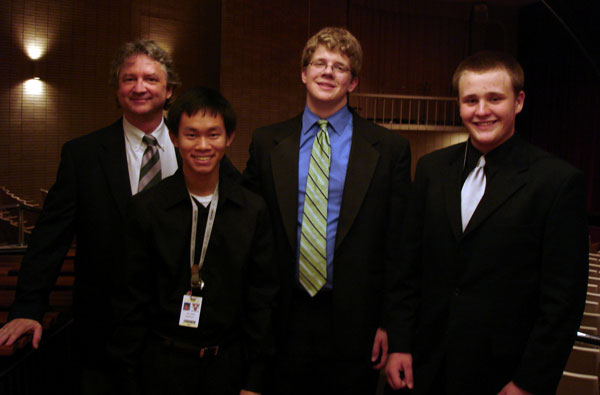
Here we all are together:

14 days to go.

Milky Way (Day 350/365)

At 11:00, I went to the chorus room and worked with the vocal majors on “Blake Leads a Walk on the Milky Way.” They learned it quickly and it sounded good. They seemed to enjoy it and appreciate it.

At 11:30, we moved into Whitehead Auditorium, where the orchestra was just beginning to sightread the piece. There were too many woodwinds, which I gently fixed, and there were issues with the legato-ness of the playing, which I can correct in the score. All the arpeggiation in the cellos was a problem as well.

Other problems for the reading were the multiple time signatures and the players trying to count their rests. Also, Stephen was conducting in 9 or 12; maybe this was helpful for subdividing the triplets, but it was confusing to me and the choir.

In short, we didn’t get a solid reading of the piece in the short time we had available. Still, it was fun to hear an orchestra working on it, and I think they would have been able to knock it out of the ballpark if they’d had the usual Czarkowski treatment of it.

They ended up playing Alex Depew’s “Winds of Autumn,” and it was quite lovely. They were a little further along with his piece than mine, since it was simpler to play. I wish Stephen had it a little more polished, because it would be entirely appropriate to play at Convocation as the concluding piece.