The Great Cross Country Caper, Day 3: San Francisco Opera

Dear Mr. Pickett,

I got to see the San Francisco Opera’s production of your new show, Delores Claiborne, last night. I bet lots of people have offered you their thoughts; here are mine.

First of all, I think you were entirely correct in thinking that Stephen King’s novel would make a good opera, and for all the reasons you talked about in the program. The characters had issues, big issues, and the ways they chose to work through those issues are no more ridiculous than Rigoletto or Lucia or Tosca.

My personal taste for opera is that it must be theatre first, to which the old argument about words and music must defer. I’d like to talk about all three, if you don’t mind, starting with your music.

It seemed to me that in the preshow lecture, when you were asked about Michael Daugherty‘s comments about your student work back at Julliard, you were a touch defensive about being influenced by Elliott Carter and Charles Wuorinen. I’m sure if they had been my teachers, I would have gone all 12-tone and atonal as well; after all, one has to make good grades, and all that midcentury nonsense was the fashion of the time.

However, I think you still resist your natural affinity for tonality, and to the detriment of your opera. To really break our hearts, you have to engage our emotions, and my experience has been that you can’t do that if you’re challenging our heads. I followed your patterns last night, but sometimes that just devolves into bean-counting, you know?

Some of your atonal work last night was effective and appropriate, but more often your better work was lyrical: “Six pins not four” and “Accidents can be a woman’s best friend,” for example. (Was that a Siegfried joke in Vera’s aria? If so, it was delicious.)

In general I disapprove of the modern fashion of writing vocal lines consisting of nothing but whole notes. It must be easier to sing, but it makes hash of the language and therefore of the character’s motivation. How many times did you have a character singing a preposition on a longer note than its object? It was silly. It also makes your work sound academic, and that is not a compliment.

Another aspect of the long note vocal lines may sound ridiculous to you, but if you picked up the pace of what your characters are saying, then you can pack a lot more in. The show was only two and a half hours long, and as I’ll discuss in a moment, it could have been longer, but you could have given us a lot more in that two and a half.

So let’s talk about the words. Sandy McClatchy had some effective work as well—I really liked the line “There should not be stars” in Selena’s aria during the eclipse—but on the whole I found the lyrics shallow and not up to the task of portraying the complex inner lives and motives of the characters.

I realize that audiences have a hard time accepting in English the kinds of over-the-top lyrics they regularly enjoy in Italian. But it is still possible to give us the fire and ice of a Tosca in words that make us thrill to the metaphors and poetry. Sandy’s libretto mostly failed at that.

Finally, let’s talk about the theatre.

I didn’t see a dramaturg listed in your creative team. You need one.

Let’s start with the biggest problem, the ending. We’ve been promised a “shocking revelation” from Vera on the night she died, but I’m here to tell you that there was no one in that audience who thought she actually had children. Her confessing to that lie was not shocking, it was sad. That one flaw completely deflated the denouement.

Nor are we given a reasonable explanation of why Delores harps on how much she hated Vera when we’ve just seen her behaving in a tender, if resigned, manner to the old woman. We were anticipating a big reveal in that scene which would have triggered some kind of anger/hatred in Delores. We didn’t get it.

So here’s your alternate ending, free of charge:

  • Vera starts with her “I lied” lyrics, confesses that she had no children. Delores is not surprised. Just as Andy says that the whole island knew that Delores killed Joe, everyone knew that Vera invented adoring offspring. Not a shocker.
  • Vera repeats, “I lied,” and we assume that she’s going to keep on about the kids, but no, she confesses that she never killed her husband, she just told Delores that to goad Delores into killing Joe. If you want to get really tawdry, Vera can have had an affair with Joe and needed to get rid of him. (Why does she keep seeing her husband in the corner? She’s delusional—it’s all ambiguous.)
  • Either way, Delores now realizes that she might have had other options to rescue Selena and herself. Acrimony ensues. Vera’s confusion mounts. She flees to the stairs. Delores does not push her. She falls.
  • She begs Delores for deliverance, but Delores taunts her: she wants Vera to suffer. Vera dies. Delores breaks down, cradles Vera’s body, sings a tortured farewell.

Screw Stephen King. Go with this version.

I will say that we were shocked that Delores’s final aria was so short. This should have been her “Mama Rose” moment. The current lyrics are an acceptable coda, but the body of the aria should have been a showstopper.

If you shortened your vocal lines and/or added 30 tight minutes to the show, you could show us more of the relationship between Vera and Delores, adding some truth to Selena’s complaint that her mother didn’t help as much as she thought she did. You could show us more of Delores and Selena’s inner lives.

By the way, were you aware that Selena was a name for the Roman moon goddess? There’s some metaphor in there. Poetry. Mythos.

This has been rather long and perhaps a little harsh. Let’s end with the good stuff.

The cast was very very good, weren’t they? I’m writing this on the road and don’t have my program with me, so forgive my failure to remember their names. You were fortunate to have such wonderful singers for whom to write, and their commitment to your music was obvious.

The staging was brilliant, beautiful, and impressive. I’ve never seen projections used so beautifully.

Act 2 was theatrically sound; your music was much more powerful and propelled the action much more effectively, up to the point where Vera failed at shocking us. But even then, that was the script’s fault, not yours.

And finally, at the end of the show, I found myself wanting more of Delores. Part of that was the failure of the scenario to dig deeper, but largely it was due to your ability to create interesting characters who engaged the audience. (I haven’t talked about Joe: great character, great actor/singer. Kudos all round.)

If you were preparing this show for Broadway, you’d find that you as the composer had a little more power over how it looked, but even moreso, you’d also have the support of a more powerful director and a dramaturg, and when audience surveys showed that the ending was flat, you could avail yourself of a show doctor to advise you. It is very unfortunate for Delores Claiborne that the world of opera does not afford you that power.

Cheers,

Dale

—————

On the way to Hoover Dam (Day 5), I read the New York Times and the San Francisco Chronicle reviews.  <georgetakei> Oh my. </georgetakei>
Implied projects

Let’s look at all the creative projects implied by the mess in my study.  I think I’ll just list them.  Commentary would be superfluous.

  • A Perfect Life, a rambling memoir of sorts of what life was like for an educated upper middle class white male in the turn of the 21st century
  • painting:
    • the Field series
    • the Epic Lichtenbergian Portrait
    • general drawing
    • Artist Trading Cards
    • learning to mix colors, especially for portraiture
  • rescore A Christmas Carol
  • rescore William Blake’s Inn
  • find a home for William Blake’s Inn
  • archive all the GHP stuff
  • compose
    • Five Easier Pieces
    • the Symphony
    • a song for John Tibbetts II
    • other stuff…
  • continue my reading/writing/exploration of ritual and meditation
  • make the little icon/box
  • learn counterpoint so that someday there might actually be a Six Fugues (without preludes)

Wow.  That’s not a lot.  You’d think I would have already gotten all this done.

Stuff

I began unpacking my old office stuff, and doing so raises an issue: what to do with all that stuff.

I had four large plastic tubs filled with stuff from my office: books, folders, decorative items, a veritable medicine cabinet, a small flock of tools, rulers, pens, inks, markers, sticky notes, labels, teas, a coffee maker, memorabilia, and an  “idea card stadium” with hundreds of idea cards.

All of this flotsam was largely in duplication of stuff I already have at home.  Those of you with an office know how it is; you need a second stick of deoderant at work for those days when your brain can’t even manage the unconscious ritual of your morning toilette.  (Oh, right, like that hasn’t happened to you…)
So what is one to do with an actual duplicate desk?  How does one merge two worlds when one of them no longer exists, especially when there’s barely enough room for the one that’s already there?

Truth be told, that’s why it’s taken me a month to even look at those tubs.  It wasn’t going to make me all maudlin about my cubicle in the Twin Towers overlooking the Capitol—I just couldn’t manage thinking about where I was going to put everything.

I’ve kind of done it.  At least the tubs are empty; not everything has found a home yet, nor will it for a while longer.  But the tubs are empty. Now I’m looking around my study and thinking I need to completely overhaul it so that I will have a place for all my stuff.

Why I could go to work for 36 years and not be bothered by the fact that I didn’t have a place for all my stuff is quite irrelevant.  Now that I’m at home all day every day and rapidly approaching that new period where I will actually start being productive/creative again, it is critical that I reorganize/redesign/restructure the study so that I have a Place. For. All. My. Stuff.

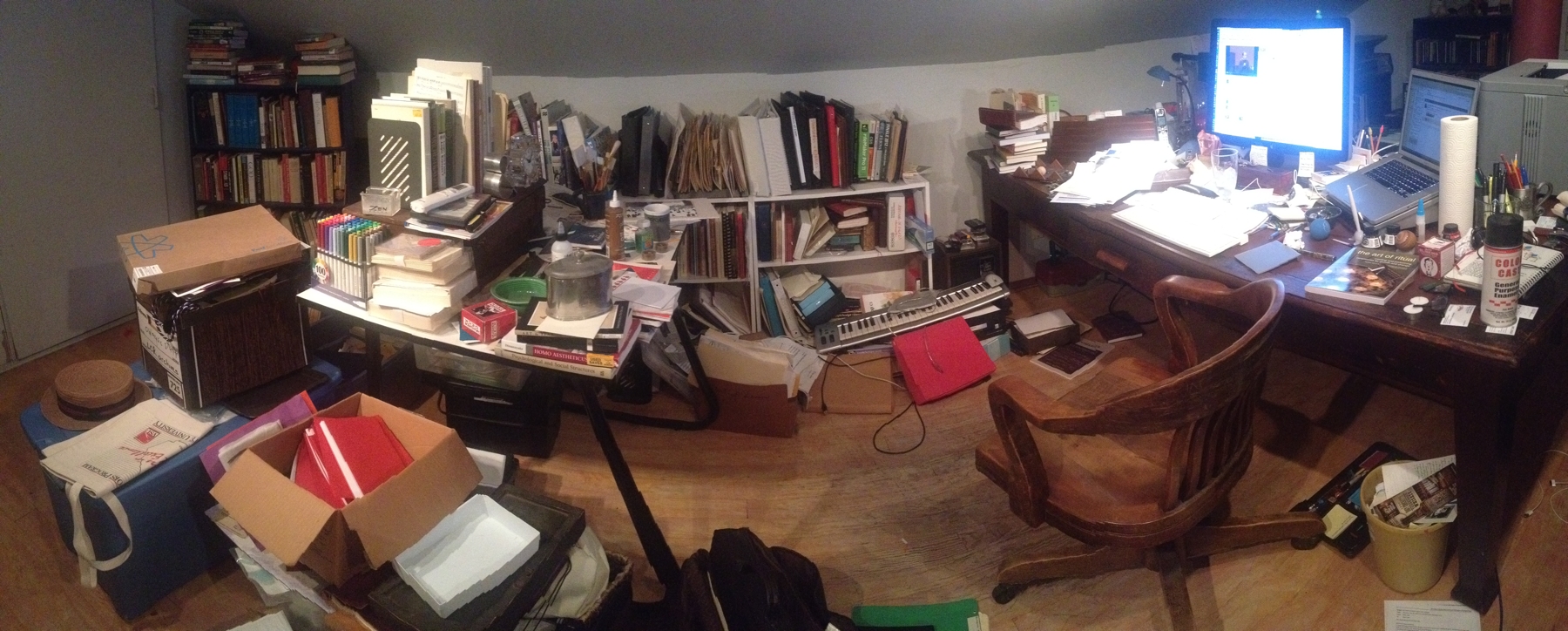
I mean, look at this:


click to embiggen


Let’s just look at the stuff here and pinpoint why it’s even in my study.

On the left, a big blue tub of material I used to carry to GHP as assistant director.  It didn’t make the trip in 2012 or 2013.  Atop that is a box of my old choral music, and on top of that is memorabilia from my office.

Ignore the books in the back.

At the bottom of the photo, underneath where you can’t see it, a tub of material from Lacuna Group’s work on William Blake’s Inn.  Atop that, a painting (unfinished) from the Field series; a box of art paper and envelopes; to the right of that, a desk tray, and an old wooden box with office supplies, and under that, the large blank book in which I will write A Perfect Life (some day).  To the right of that, my leather satchel, formerly used for travel to the office, now my Lacuna kit.

On the table, markers, glue, paint for various thinks, like Artist Trading Cards and more paintings; books on the creative process; more cards/envelopes.  A large wooden box with drawers of music score paper and other implements.  On top of that, two DVDs on mixing colors; books on orchestration and composition, rhyming dictionaries, drawing books, and three study scores: Brahms’ 4th, Shostakovich’s 15th, and Strauss’s Death & Transfiguration.

Under the table where you can’t see them, my drawing box/kit, a Lacuna Group tub for our “bear/giraffe” piece, and the original pages of my Mozart’s Marriage of Figaro.  Plus two blank Moleskine notebooks that I have just now reclaimed to begin doing morning pages.

On the shelves behind the table, books, but also folders of materials for setting to music; copies of William Blake’s Inn and A Christmas Carol; stationery; blank books, some of which have ongoing narratives in them (Figaro, William Blake, the Symphony, etc.); a box of videocassettes of the 2002 production of Figaro.

In front of the shelf, a folder of paperwork for my mother’s estate; full scores for William  Blake and the Symphony, plus a pile of scores of three decades of abortive attempts; the keyboard; letters from Craig, and trailing out there on the right, more stationery and a book on counterpoint.

On the desk itself, on the left, a stack of books on ritual and liturgies, topped by The Book of the Labyrinth.  Behind those, the source books for the 24 Hour Project, plus folders of texts.  The little triangle thingies are a fold-out box that originally held Singer sewing machine attachments and which I am configuring as a little assemblage/icon piece.  Behind that, the aforementioned idea card stadium, noticeably empty.

A stack of papers that haven’t found a home yet, including my separation paperwork from the DOE; another blank book, half buried; two computer keyboards (duplicates, remember?); desk detritus; the copper of my Lichtenbergian Chalice, silently affirming my inactivity; a small wooden pencil box containing ink pen nibs for lettering in The Book of the Labyrinth; the computer monitor, with two sticky notes of 24 Hour Challenge texts; a lifetime supply of sticky notes; the laptop; inks for Book of the Labyrinth; another book on ritual; a blinking red reindeer nose; pens; paper towels; a reference book on knots.

You can ignore the trashcan.

Continuing on the other side of the desk…

click to embiggen

 
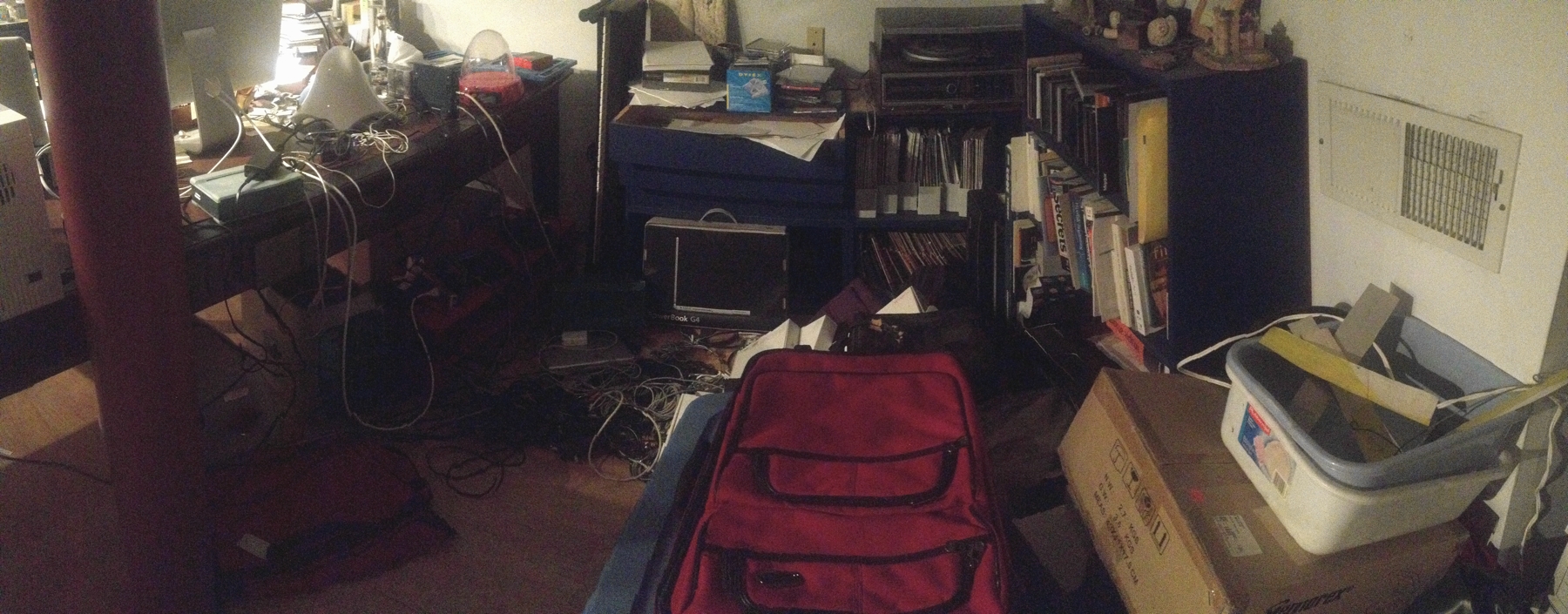
The backside of the technology, including a little shelf unit for the multiplugs and chargers; my old G4 and Grayson’s old iMac; a mess of mostly audio cables which used to live comfortably in a purple computer bag; another keyboard and stand; printing paper supplies; every box of every Apple product I’ve bought in the last ten years; paper for the printer and drawers that haven’t been opened in fifteen years; old issues of Mac magazines; my Lovely First Wife’s old quadraphonic stereo (and 8-track player!); shelves of old software and books that are largely useless; my old SE-30 and two old synthesizers; a Memorex turntable that could potentially digitize any album we want to if we’d take it out of the box and set it up.

I will spare you the photos of the other bookshelves, the CD shelves, and (behind me in the two photos above) my college drafting board; various art supplies like chipboard, canvas boards, sketch pads, a paper cutter (one of two now), rulers, Lacuna Group stuff.  Plus a tall cabinet of art supplies and printing supplies, and a filing cabinet.

I should be a busy, productive artist, but it will take me until 2014 to reconfigure all this stuff.  Don’t expect new works from me until then.  At least that will be my excuse.

—to be continued…

An odd precedent

Last night, a very strange thing happened: I got to hear one of my pieces performed.  Live.

The composer and his Muse

Maila Springfield, that goddess of the piano, asked me to write her something that she could play when performing with her estimable husband David and another friend.  She was their accompanist, and she wanted something cool for herself.  That was in 2009/10, and so when I took the summer of 2010 off, that became my project.

The result was Six preludes (no fugues), and I think I did an admirable job, if I do say so myself.

Maila premiered them in the fall of 2011, but I didn’t get to hear them because of something something argle bargle.  Last summer, after the Music Faculty Recital, she confessed to me that she thought about asking to perform them but didn’t think I’d like it.  Conflict of interest, etc.  I set her mind at ease: any time you want to play them out loud with me in the audience is fine with me.

And so this year she did.

Wow.  She launched into #1 with a ferocity that took my breath away (and I think a lot of the audience’s).  #2 was gorgeous.  #3 was once again everyone’s favorite.  #4 was quiet, sustained, simple.  #5 was massive, and the ending rocked me back in my seat.  #6 wended its way through each variation, and the ending was boffo.  The crowd went wild.

She did lose her way in #1, a ferocious little two-part invention that careens down the keyboard like some X-treme snowboarder in an 11-measure passage before sticking the dismount at the bottom, and then jumping back to the top and doing it again.  She said, “I don’t know what happened; I looked up and suddenly didn’t know where I was.  I shouldn’t have looked up!”  She’s wonderful.

It has inspired me to wish I were actually working on Five Easier Pieces for her.

24 hour challenge #13

From Dave, way back in 2009, 3-187-13:

they are given to
hold close, not
air, not each other

From “Knee Lunes,” by Robert Kelly.

No, I don’t know what to do with this, nor have I ever.  See you tomorrow night.

[If you’re just joining us, here are the instructions for the 24 hour challenge, as well as previous efforts.]

4/23/13, 10:36 pm

Okay, it sucks, but really, I don’t even.  I mean to say, wot?

24 hour challenge #13, “Knee Lunes,” for Dave: score [pdf] | bassoon [mp3]

The return of the 24 hour challenge: #12

I know.  It’s rather unbelievable.  What have I gotten myself (back) into?

But in a longstanding Lichtenbergian tradition, I have resurrected 2009’s 24 hour challenge in order to avoid working on Five Easier Pieces, of which I have exactly three abortive attempts.

For those who cannot recall exactly what I am talking about, head over to the 24 hour challenge page and refresh your memory.

And here we go:

From Mike, who will be astonished to learn that his numbers (4-1081-33) finally came up:

Come Sweete & frolick then with vs
Noe Longer doate on Telaphus
A youth aboue thy fate
A wanton Wench & rich beside
Hath him in twofould bondage tie’d
Nor does he proue vngrate.

That’s ll. 31-36 from “Maecenas Birthday,” by the Roman poet Horace, translated by one Thomas Pestell, an early 17th c. poet about whom not even Wikipedia has a thing.

Let’s see if I can get this up by tomorrow midnight.

4/19/13, 8:58 p.m.

Well, what do you know?  I did it.

A little background: entries #12, #13, and #14 have all been on sticky notes on my monitor since 2009.  I had to look at them every morning and every night, right above my Lichtenbergian chalice.  So it’s not as if I haven’t give these scraps some thought.  Even before I had to stop the 24 hour challenge because of decamping to Valdosta in June 2009, I knew that I wanted to set this one as a kind of Cole Porter beguine, a song for a 1930s chanteuse, as it were.

See what you think.  I think the tempo could be a little slower.  It would have to be interpreted, of course, by the artistes.

24 hour challenge #12, “Maecenas Birthday” for Mike: score [pdf], bassoon [mp3]

Fragment #3

A while back, I bought a CD called Nouveaux “Brandebourgeois,” i.e., New Brandenburgs. The conceit is that this musicalologist Bruce Haynes has grave-robbed J.S. Bach’s other works to piece together six more Brandenburg Concerti such as the man himself might have written if he had gotten the job in Brandenburg and become a court composer instead of a church composer.

A brave attempt, but fruitless. The more I listened, the less they worked. As a composer, I have found that themes know themselves what they’re for: a sonata, a choral work, a symphony, a fugue. It doesn’t do to try to force a song theme into a symphony, nor vice versa.

And so even when I didn’t know the original pieces, the fake concerti never took flight. All those cantata themes were just not agile enough to dance through the intricacies of the Brandenburgs.

A lesson to us all, I’m sure.

Libertà!

There is an odd moment in Mozart’s Don Giovanni that perplexes directors and audiences alike, near the end of Act I.  The Don is giving a party, deliberately taunting his enemies, and as he welcomes them he seemingly out of nowhere cries, “Viva la libertà!”— “Hurray for Liberty!”  The others take up the cry, often coming downstage to deliver themselves of this stirring sentiment.  Trumpets and drums, which we have not heard since the Overture, make it a rousing, if confusing, moment, which vanishes as quickly as it appeared.

I was reminded of this as I tootled across the back roads of Georgia on my GHP RESA World Tour recently: my iPhone was set to play my 7500 tracks of music randomly, and that scene popped up somewhere between Statesboro and Waycross.  And that in turn reminded me of my experience at Atlanta Opera last season with their execrable production of Don Giovanni.

Costumes were fine, set was fine, the orchestra was good, and most of the singers were acceptable, although the Don himself was very shaky.  But none of them could act, and it looked as they didn’t have a director at all, because whoever directed it simply didn’t.  I am not exaggerating when I say that I could have blocked that entire three-and-a-half hour show in one rehearsal, one short rehearsal.  Everyone just came on, walked to their spot, faced downstage, and sang. It was excruciating.

Giovanni is a tough nut to crack.  Our main character is an abusive, self-gratifying, self-justifying sleazeball.  His servant Leporello is a codependent toady.  His opponents, the “good guys,” are both hapless and feckless, especially Don Ottavio, the fiancé of Donna Anna, whose father Giovanni kills in the opening scene while trying to escape from Anna’s bedroom.  Ottavio spends the entire opera dithering about who the killer is (Giovanni was masked) and whether or not it might not be maybe Don Giovanni and what he might maybe do about that if he could only be sure.  Maybe.  More about that in a moment.

I’ve never been sure how Mozart means us to take Giovanni.  He’s clearly a not-nice person, but he’s the main character, and the non-evil people are just tools in his hands (besides being simply tools like Ottavio and Masetto, the peasant lout whose fiancée Zerlina Giovanni tries to seduce.)  In the end, he is dragged to hell by the statue of the Commendatore, Donna Anna’s dead father, and it’s extremely unclear whether we’re supposed to be smug in our righteous condemnation of the brute, or overcome with admiration at our boy’s proud refusal to repent and to become “other than he is.”

So anyway, Atlanta Opera’s director failed to crack the nut, and the audience’s tolerance of the stage action got increasingly thinner until the final scene, when Don Ottavio rushes onstage, finally ready to punish the vile seducer, only to find that his dead father-in-law has beat him to it.  The audience howled with derisive laughter.

It got worse.  That climactic scene is followed by the lamest ending ever: Donna Anna & Ottavio, Leporello, Zerlina & Masetto, and Donna Elvira (Giovanni’s deluded stalker) all stand and sing what they’ll do next:

  • Let’s get married. (Ottavio)
  • Sure, but we have to wait a year. (Anna)
  • I’ll enter a convent. (Elvira, who has spent the entire opera essentially begging Giovanni to do her one more time.)
  • I guess I’ll find a new master. (Leporello)
  • We’ll go get breakfast. (Zerlina & Masetto)

Mercy.  Then there’s the rousing final sextet, where they all sing how good is rewarded and evil punished.

Sure.  Whatever.  Curtain.

As fate would have it, the next day after this performance I received an email from Atlanta Opera asking me to rate my experience.  With raised eyebrows and pursed lips, I set to it.

After a series of questions asking whether I thought it was appropriate for the Bank of America to be a corporate sponsor—sure, I said, just like a Mexican drug cartel: money is money—they asked what the most enjoyable part of the evening was for me.

I was able to reply truthfully that it was during the curtain call, when I had a vision: wouldn’t it be a blast if while our idiot good guys are singing their platitudes about good always winning out, we see behind them the devils from the finale climbing out of the floor and dusting themselves off; followed by the Commendatore, whose statue costume we noted looked a little ratty when we first saw it; followed by Don Giovanni himself, who pulls out a roll of bills and pays them all off.  He makes his escape while his enemies congratulate themselves on their virtue.

He is the 1%: throughout, he uses his position and his wealth to abuse everyone around him for his own pleasure, and even when they think they’ve got him cornered, he buys his way out of it.  We’ve seen it happen the entire opera, and so when he fakes his own death, we are not surprised.

Why Atlanta Opera doesn’t hire me, I’ll never know.

Anyway, back to libertà.  I hadn’t really given my epiphany a second thought since typing it into the email survey form with such grim pleasure, but when that scene played out on GA-121, it all made sense.  Giovanni, after inviting his worst enemies to a party where he intends to seduce Zerlina right in front of them, distracts them with cries of Liberty! Freedom!  And like the pitiful sheep they are, they sing right along while he moves in on the peasant girl (who never gives in, by the way).

What else are they going to do? He’s the 1%.  Suckers.

Earth Dance, part 2

This is going to surprise you, but I am not whining about my composition and how it’s going.

No, really.

I’ve observed something very interesting about my work on Earth Dance this time around.  I’m not struggling with it, which is not to say I’m just breezing along like some Mozart or Puccini, just pouring the music out onto the page (or in my case, the screen).  It’s still a very hard slog, but I’m not struggling.

Instead, I just excrete some work out there and play with it for a while, and then without any hesitation whatsoever skip a few measures, put in a double barline to remind myself of the new place, and start over with new excretions.  No pain, no gain, and no sweat.

I’m also sanguine about where the whole thing is going.  If I don’t like the sound of it, if it’s not chthonic enough, I’m OK with that.  Just start a new excretion.

If I like what I hear, also no problem.  I’m not at all concerned about taking it in a wrong direction, or even in any direction.

All I’m doing is excreting.  Sooner or later, I will hear what I want to hear.

I have come to understand my working habits and my approach to success.  Why should I worry about what I’m pretty sure is going to be a purely entertaining piece?

No, I’m not ready to share any of it yet.

Earth Dance: the beginning

As promised, here is the framework for all the complaining you will enjoy between now and June.

Last summer, on the last night of GHP I think, Dr. Ryan Smith—our percussion teacher—asked all the composers on the music staff to write a piece for percussion ensemble to be played in 2012.  He was generous enough to include me in that request; I was actually surprised and gratified.  To my protestations that I don’t know how to write for percussion, he merely pooh-poohed me.  (Perhaps he was thinking of my “Dance for Double Bass Duo and Marimba”?)

I didn’t bother thinking about it until after the new year—I had other things to deal with, after all.  Still, if I’m going to do this I need to start now, so while driving up and down I-85 I began thinking about what I might do.  I’m a lot more comfortable with the tuned percussion—I really don’t  know how to write for all the really interesting things you can bang on—so I began planning on marimbas.

And because I’m radical like that, I thought I might include some low strings, some cellos, double basses.

So at the moment, the ensemble is for two marimbas, a vibraphone, a djembe, and bongos, plus two cellos and two double basses.

The working title is “Earth Dance.”  I’m pretending it’s the third movement in a suite called Elemental Dances: Fire/Water/Earth/Air.  We’ll see  how that goes, of course.

Last night’s work was just trying to create crap, and I largely succeeded.  There was one theme that was attractive, but I’m going for ponderous/savage/dark, so it may not work.

More as it fails to develop.